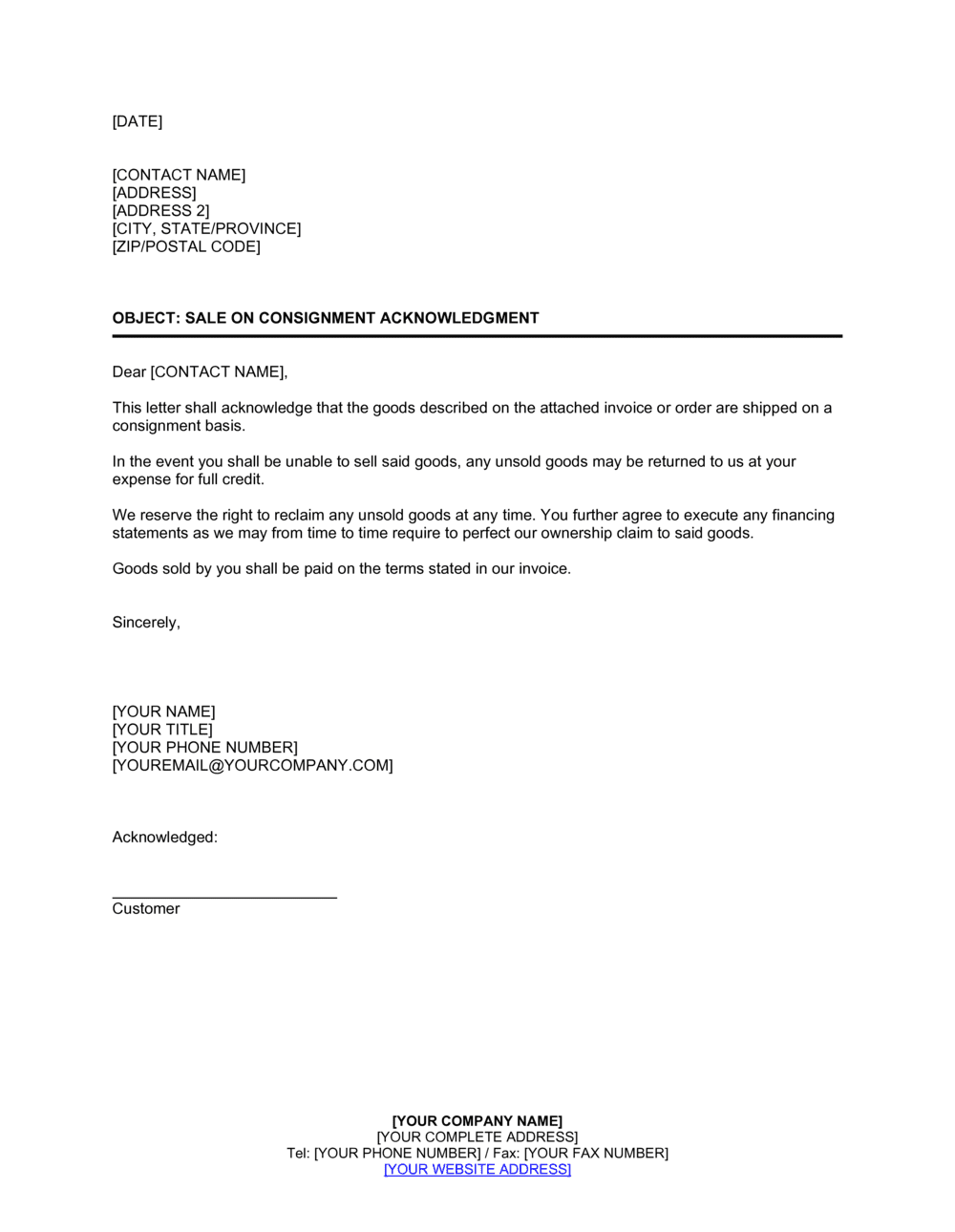
Sale on Consignment Acknowledgment Template

Free Word download β€’ Edit online β€’ Save & share with Drive β€’ Export to PDF

1 pageβ€’20–30 min to fillβ€’Difficulty: Standardβ€’Signature requiredβ€’Legal review recommended
Learn more ↓
FreeSale on Consignment Acknowledgment Template

At a glance

What it is
A Sale On Consignment Acknowledgment is a legally binding document signed by both a consignor (the party supplying goods) and a consignee (the party selling those goods on the consignor's behalf) that records the terms under which inventory is transferred, sold, and accounted for. This free Word download lets you customize it online and export as PDF β€” covering ownership retention, sale price, commission, remittance timing, and liability in a single clear document.
When you need it
Use it whenever you place goods with a retailer, gallery, distributor, or agent for sale without transferring ownership upfront. It protects both parties as soon as inventory leaves the consignor's possession.
What's inside
Descriptions of consigned goods and quantities, pricing and commission structure, remittance schedule, title and risk-of-loss provisions, unsold goods return terms, record-keeping obligations, and termination conditions.

What is a Sale On Consignment Acknowledgment?

A Sale On Consignment Acknowledgment is a legally binding document signed by both a consignor and a consignee that formally records the terms under which goods are transferred for sale without the transfer of ownership. The consignor retains legal title to every item until it is sold to an end buyer; the consignee takes physical possession as a bailee and acts on the consignor's behalf, earning a commission on each completed sale. The acknowledgment captures the specific goods delivered, their agreed value, the pricing and commission structure, the remittance timeline, and each party's responsibilities for risk, insurance, reporting, and return of unsold inventory β€” creating a single enforceable record that governs the entire arrangement from handoff to final settlement.

Why You Need This Document

Without a signed consignment acknowledgment, the consignor's ownership rights are exposed on multiple fronts simultaneously. If the consignee's business fails, unsecured consigned goods can be swept into a bankruptcy estate alongside the consignee's own inventory β€” leaving the consignor waiting months or years to recover property they never sold. If goods are lost, damaged, or stolen, the absence of a clear risk-of-loss clause leaves both parties arguing over who bears the cost. Without a defined remittance deadline, the consignee has no contractual obligation to pay promptly, and without a minimum price clause, they can discount goods to levels that return almost nothing to the consignor. A complete, signed acknowledgment closes all of these gaps before a single item changes hands, providing the consignor with enforceable title retention, clear payment triggers, and an immediate right to demand return β€” and giving the consignee documented authority to sell, a defined commission entitlement, and protection against ownership disputes with third parties.

Which variant fits your situation?

If your situation is…Use this template
Placing artwork with a gallery for an indefinite exhibition periodArt Consignment Agreement
Distributing goods through a retail chain with standardized commission tiersConsignment Distribution Agreement
Selling used or estate goods through a resale shopConsignment Sale Agreement (Personal Property)
Acknowledging a single, one-time batch of consigned goodsSale On Consignment Acknowledgment
Establishing an ongoing consignment relationship with regular restockingConsignment Agreement (Ongoing)
Consigning perishable or time-sensitive goods with strict return deadlinesConsignment Agreement with Expiry Clause
Transferring consigned goods across international bordersInternational Consignment Agreement

Common mistakes to avoid

❌ No title-retention clause

Why it matters: Without explicit language reserving title to the consignor, a consignee's creditors or bankruptcy trustee can claim the goods as the consignee's property β€” leaving the consignor as an unsecured creditor.

Fix: Include a clear clause stating that title remains with the consignor until an end buyer completes a purchase, and in the US, consider filing a UCC-1 financing statement to perfect your interest.
❌ Vague or incomplete goods description

Why it matters: Descriptions like 'assorted artwork' or 'various clothing items' make it impossible to verify what was consigned, what sold, and what must be returned β€” turning every discrepancy into a credibility dispute.

Fix: Attach a Schedule A listing each item with description, quantity, reference ID, and agreed unit value, initialed by both parties at the time of delivery.

❌ No defined remittance deadline

Why it matters: Without a specific payment deadline, the consignee can hold sale proceeds indefinitely. The consignor has no legal trigger to demand payment or charge interest on overdue amounts.

Fix: State a specific number of days after each sale β€” typically 15 to 30 β€” and include a late-payment interest rate of at least 1.5% per month on overdue balances.

❌ Omitting the consignee insolvency clause

Why it matters: If the consignee files for bankruptcy without a termination-on-insolvency clause, the consignor may be stuck waiting for a bankruptcy court to release their own goods β€” a process that can take months or years.

Fix: Add an immediate termination right triggered by the consignee's insolvency, cessation of business, or appointment of a receiver, with an obligation to return goods and remit proceeds within 10 days.

❌ Leaving risk of loss with the consignor

Why it matters: The consignor is the party with no physical control over the goods once delivered. Bearing the risk of goods they cannot monitor or protect creates unfair exposure to theft, damage, or negligence.

Fix: Assign risk of loss to the consignee from the date of receipt and require them to maintain property insurance covering the full consignment value with the consignor named as a loss payee.

❌ No return obligation or end date

Why it matters: An open-ended consignment with no return clause allows a consignee to hold unsold goods indefinitely, making it nearly impossible for the consignor to reclaim their inventory or place it elsewhere.

Fix: Set a specific end date and a firm return deadline, with a clear statement that unsold goods must be returned in original condition at the consignee's cost.

The 10 key clauses, explained

Parties and recitals

In plain language: Identifies the consignor and consignee by their full legal names and addresses, and states the purpose of the acknowledgment.

Sample language
This Sale On Consignment Acknowledgment ('Agreement') is entered into on [DATE] between [CONSIGNOR LEGAL NAME], located at [ADDRESS] ('Consignor'), and [CONSIGNEE LEGAL NAME], located at [ADDRESS] ('Consignee').

Common mistake: Using a trade name or personal name instead of the registered legal entity name. A mismatch between the contract party and the actual business entity can make enforcement difficult.

Description and quantity of consigned goods

In plain language: Lists every item being consigned with a detailed description, quantity, unique identifiers (SKU, serial number, or artwork title), and agreed value per unit.

Sample language
Consignor hereby delivers to Consignee the following goods on consignment: [ITEM DESCRIPTION], Qty: [NUMBER], Unit Value: $[AMOUNT], Reference ID: [SKU / SERIAL / CATALOG NUMBER]. A complete inventory list is attached as Schedule A.

Common mistake: Using a vague description like 'assorted merchandise.' Without specific identifiers, disputes over which items were consigned, damaged, or sold become impossible to resolve cleanly.

Title and ownership

In plain language: Confirms that title to the goods remains with the consignor at all times until an end buyer completes a purchase, and that the consignee holds the goods in a fiduciary capacity.

Sample language
Title to and ownership of all consigned goods shall remain with Consignor until sold to an end purchaser. Consignee holds the goods as bailee and shall not pledge, encumber, or grant any security interest in the goods.

Common mistake: Omitting the title-retention clause entirely. Without it, a consignee's creditors β€” or a bankruptcy trustee β€” may treat consigned goods as the consignee's own assets.

Pricing and minimum sale price

In plain language: Sets the retail price or price range at which the consignee may sell the goods and the floor price below which no sale can proceed without written consent.

Sample language
Consignee shall offer the goods for sale at a retail price of $[AMOUNT] per unit, or within a range of $[MIN] to $[MAX]. Consignee shall not sell below $[MINIMUM SALE PRICE] without prior written authorization from Consignor.

Common mistake: Leaving pricing entirely to the consignee's discretion. Without a minimum price, the consignee can discount goods to the point where the consignor receives inadequate net proceeds.

Commission and remittance

In plain language: States the consignee's commission rate or fixed fee, how net proceeds are calculated, and the deadline by which payment must be remitted to the consignor after each sale.

Sample language
Consignee shall be entitled to a commission of [X]% of the actual sale price per unit sold. Net proceeds (sale price less commission) shall be remitted to Consignor within [30] days of each sale. Payments shall be made by [PAYMENT METHOD] to [ACCOUNT DETAILS].

Common mistake: Defining commission as a percentage of the retail price without specifying whether it applies to discounted or promotional prices β€” creating disputes whenever a sale or promotion occurs.

Record-keeping and reporting

In plain language: Requires the consignee to maintain accurate sales records and provide the consignor with periodic statements showing units sold, sale prices, commissions deducted, and remaining inventory.

Sample language
Consignee shall maintain accurate records of all consignment sales and shall provide Consignor with a written sales report on or before the [15th] day of each month, showing units sold, sale price per unit, commission deducted, net proceeds remitted, and remaining inventory count.

Common mistake: No reporting obligation at all. Without required statements, the consignor has no way to verify inventory levels, identify losses, or reconcile payments.

Risk of loss and insurance

In plain language: Allocates responsibility for loss or damage while the goods are in the consignee's possession and specifies whether the consignee must carry insurance covering the consignor's interest.

Sample language
Consignee assumes all risk of loss, theft, or damage to consigned goods from the date of receipt until return or sale. Consignee shall maintain property insurance covering the consigned goods at their full consignment value of $[AMOUNT], naming Consignor as a loss payee.

Common mistake: Leaving risk of loss silent, which defaults to the consignor bearing the risk in many jurisdictions. If the consignee is in physical possession, they should carry the risk and the insurance.

Term and return of unsold goods

In plain language: Sets the duration of the consignment arrangement and the consignee's obligation to return unsold goods in their original condition by a specific date at the consignee's cost.

Sample language
This consignment arrangement shall commence on [START DATE] and terminate on [END DATE] unless extended in writing. Consignee shall return all unsold goods to Consignor in their original condition by [RETURN DATE] at Consignee's expense.

Common mistake: No defined end date and no return obligation. An open-ended consignment with no return clause allows a consignee to hold goods indefinitely without accounting for them.

Termination and default

In plain language: States the conditions under which either party may terminate the arrangement early β€” including consignee insolvency, breach of payment terms, or consignor request β€” and what happens to goods and proceeds on termination.

Sample language
Either party may terminate this Agreement with [15] days' written notice. Consignor may terminate immediately if Consignee becomes insolvent, ceases business, or fails to remit payment within [X] days of the due date. On termination, all unsold goods shall be returned and all outstanding proceeds remitted within [10] days.

Common mistake: Failing to address consignee insolvency specifically. Without this clause, a consignor competing for their own goods in a bankruptcy proceeding faces costly delays and potential losses.

Governing law and dispute resolution

In plain language: Specifies the jurisdiction whose law governs the agreement and how disputes will be resolved β€” mediation, arbitration, or litigation.

Sample language
This Agreement shall be governed by the laws of [STATE / PROVINCE / COUNTRY]. Any dispute arising under this Agreement shall be resolved by binding arbitration administered by [BODY] in [CITY], except that either party may seek injunctive relief in a court of competent jurisdiction.

Common mistake: Choosing a governing law state with no meaningful connection to either party's location or the goods' location. Courts in the goods' jurisdiction may apply local law regardless, particularly regarding creditor rights and UCC filings.

How to fill it out

  1. 1

    Enter the legal names and addresses of both parties

    Use each party's full registered legal entity name β€” not a trade name or DBA. Include street address, city, state or province, and postal code for both consignor and consignee.

    πŸ’‘ Verify the consignee's legal entity name against a state or provincial business registry before signing. Enforcing a contract against the wrong entity is expensive and uncertain.

  2. 2

    Attach a complete Schedule A inventory list

    List every item being consigned with its description, quantity, unit reference ID (SKU, serial number, or catalog number), and agreed consignment value per unit. Attach this as Schedule A and have both parties initial it.

    πŸ’‘ Photograph each item at handoff and attach the images to your file copy. Visual records resolve condition disputes far faster than written descriptions alone.

  3. 3

    Set the pricing, commission rate, and minimum sale price

    Specify the standard retail price, the acceptable discount range, the minimum sale price requiring consignor approval, and the exact commission percentage or fixed fee the consignee earns per unit sold.

    πŸ’‘ State clearly whether commission is calculated on the full retail price or the actual sale price. The difference matters the moment the consignee runs a promotion.

  4. 4

    Define the remittance schedule and payment method

    Enter the number of days after each sale within which the consignee must remit net proceeds, the payment method (ACH, check, wire), and the consignor's account or mailing details.

    πŸ’‘ Net 30 from each sale is standard for retail consignment. If you expect high sales volume, consider a weekly or bi-weekly cycle to improve your cash flow.

  5. 5

    Allocate risk of loss and specify insurance requirements

    Confirm that the consignee bears risk of loss from the date of receipt and requires them to carry property insurance covering the full consignment value, naming the consignor as a loss payee.

    πŸ’‘ Request a certificate of insurance from the consignee before delivering goods. A verbal assurance of coverage is not enforceable against the insurer.

  6. 6

    Set the consignment term and return deadline

    Enter the start date, end date, and the specific date by which unsold goods must be returned. State that returns are at the consignee's cost and must be in original condition.

    πŸ’‘ A 90-day initial term with an option to renew is typical for retail. Shorter terms work better for seasonal or perishable goods.

  7. 7

    Execute before delivering the goods

    Both parties must sign β€” and date β€” the agreement before the consignor hands over any inventory. Use Business in a Box eSign to timestamp execution and store the fully executed document.

    πŸ’‘ Never deliver consigned goods based on a handshake or email exchange. An unsigned agreement at handoff creates a title and risk-of-loss dispute from day one.

Frequently asked questions

What is a sale on consignment acknowledgment?

A sale on consignment acknowledgment is a signed legal document that records the terms under which a consignor delivers goods to a consignee for sale without transferring ownership. It confirms the goods delivered, the pricing and commission structure, the remittance schedule, and each party's obligations regarding title, risk, and return of unsold items. It is the primary record protecting both parties if a dispute arises.

Who needs a consignment acknowledgment?

Any party placing goods with another for sale on their behalf should use one β€” including artists delivering work to galleries, manufacturers supplying retailers, crafters placing products in boutiques, and wholesalers testing new distribution channels. Retailers and gallery operators accepting consigned inventory also need the document to formalize their obligations and protect themselves against ownership disputes.

What is the difference between consignment and a regular sale?

In a regular sale, ownership and risk transfer to the buyer immediately upon delivery and payment. In a consignment arrangement, the consignor retains ownership until the consignee sells the goods to an end buyer. The consignee never owns the goods β€” they act as an agent or bailee. This means the consignor must explicitly protect their title rights through contract language and, in the US, potentially a UCC filing.

Does a consignment acknowledgment need to be signed to be enforceable?

In most jurisdictions, a written and signed consignment acknowledgment is generally enforceable as a binding contract when it identifies the parties, describes the goods, and states the material terms. An unsigned document may still be admissible as evidence of the parties' intent but creates significant enforceability uncertainty. Both parties should sign before any goods change hands.

What happens to consigned goods if the consignee goes bankrupt?

Without a properly filed UCC-1 financing statement in the US (or equivalent perfection in other jurisdictions), a consignor's goods can be treated as the consignee's property by a bankruptcy trustee, leaving the consignor as an unsecured creditor. Including an insolvency termination clause in the acknowledgment gives the consignor an immediate right to demand return, but perfecting the security interest through a public filing is the more reliable protection.

Who bears the risk of loss for consigned goods?

The acknowledgment should explicitly allocate risk of loss. In practice, the consignee β€” who has physical possession and control β€” typically bears the risk from the date of receipt. Without a clear clause, many jurisdictions default to placing risk with the consignor as the owner, which is unfair when the consignor has no ability to monitor or protect the goods. Requiring the consignee to carry insurance covering the consignor's interest is standard best practice.

How is the commission in a consignment arrangement typically structured?

Commission is most commonly expressed as a percentage of the actual sale price per unit β€” typically 20–50% depending on the industry, goods type, and sales effort required. Galleries commonly take 40–50%; retail consignment shops typically take 30–40%. The acknowledgment should specify whether commission applies to the full retail price or the discounted price when items are marked down, and when it is deducted before or after remittance.

Can I use a consignment acknowledgment for international shipments?

A standard domestic consignment acknowledgment is generally not sufficient for cross-border shipments, which also require customs documentation, export/import declarations, and potentially a pro forma invoice. An international consignment should reference the governing jurisdiction explicitly, address currency and exchange rate risk, and comply with the import requirements of the destination country. Consider using a dedicated international consignment agreement for these arrangements.

Do I need to file a UCC statement for a consignment in the US?

In most US states, a consignor must file a UCC-1 financing statement to protect their ownership interest against the consignee's other creditors. Without filing, consigned goods can be treated as the consignee's inventory under UCC Article 9, particularly if the consignee is in the business of selling goods of that kind. Filing requirements and procedures vary by state, so consider consulting a lawyer before delivering high-value consigned goods.

How this compares to alternatives

vs Purchase Order

A purchase order transfers ownership and payment obligation from the buyer at a fixed price on delivery. A consignment acknowledgment does not transfer ownership β€” the consignor retains title until the goods are sold to an end buyer. Use a purchase order when the buyer assumes full ownership risk; use a consignment acknowledgment when the consignor wants to retain title and share in the sale proceeds.

vs Distribution Agreement

A distribution agreement governs an ongoing commercial relationship where the distributor buys and resells goods in their own name, taking full ownership risk. A consignment acknowledgment covers a specific delivery of goods held in trust for the consignor's account. Distributors own their inventory; consignees never do.

vs Consignment Agreement (Ongoing)

An ongoing consignment agreement establishes the entire framework for a continuing relationship β€” restocking terms, volume targets, and long-term commission structures. A sale on consignment acknowledgment documents a single, specific delivery of goods under already-agreed or standalone terms. Use the acknowledgment for discrete transactions; use the full agreement for a recurring commercial relationship.

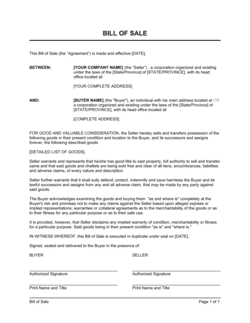
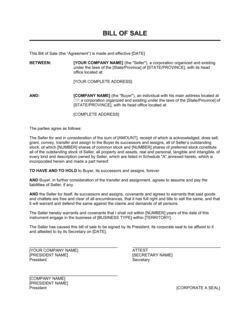
vs Bill of Sale

A bill of sale documents the permanent transfer of ownership from seller to buyer for a fixed price, with no ongoing relationship. A consignment acknowledgment explicitly preserves the consignor's title and creates an ongoing obligation on the consignee to sell, account, and remit. They address opposite ownership structures and cannot substitute for one another.

Industry-specific considerations

Art and galleries

Gallery consignment terms typically run 3–12 months with 40–50% commission; provenance documentation and insurance requirements are standard inclusions.

Retail and fashion

Boutiques and resale shops use consignment acknowledgments for each supplier batch, with 30–40% commission, seasonal return deadlines, and markdown authorization thresholds.

Manufacturing and wholesale

Manufacturers placing product with regional distributors on consignment use acknowledgments to retain title, require periodic inventory reports, and trigger automatic return if sell-through thresholds are not met.

Food and beverage

Perishable consignment requires short remittance cycles (7–14 days), strict minimum price floors, and explicit spoilage risk allocation β€” typically assigned to the consignee after acceptance.

Jurisdictional notes

United States

UCC Article 9 governs consignment arrangements in all US states. A consignor must generally file a UCC-1 financing statement to protect their title interest against the consignee's other creditors. Without filing, consigned goods may be treated as the consignee's inventory in a bankruptcy proceeding. State-level variations in filing requirements and priority rules mean a lawyer review is advisable for high-value consignments.

Canada

Each Canadian province has its own Personal Property Security Act (PPSA) governing consignment and secured transactions. Consignors must register a PPSA financing statement in the province where the goods are located to protect their priority interest against third-party creditors. Quebec operates under the Civil Code's hypothec framework rather than the PPSA, and French-language contract requirements apply to provincially regulated entities.

United Kingdom

English law recognizes consignment as a form of bailment, and the consignor retains title without the need for a public registration in most cases. However, if the consignee grants a charge over their assets to a lender, the lender may claim priority over consigned goods not clearly identified in the consignee's records. The Consumer Rights Act 2015 may apply where the consignee sells to consumers, imposing implied terms that cannot be excluded.

European Union

EU member states treat consignment under national contract and property law frameworks, which vary significantly β€” German and French law, for example, have distinct approaches to retention of title and third-party creditor priority. Cross-border consignment within the EU may also carry VAT implications: the transfer of goods between member states for sale can trigger a deemed supply requiring VAT registration in the destination country. GDPR may apply to customer data collected in connection with consignment sales.

Template vs lawyer β€” what fits your deal?

PathBest forCostTime
Use the templateStandard domestic consignment arrangements with goods valued under $10,000 and straightforward commission termsFree15–30 minutes
Template + legal reviewHigh-value goods, art collections, or consignees in jurisdictions requiring UCC filing or equivalent perfection$200–$5001–3 days
Custom draftedInternational consignment, regulated goods (firearms, pharmaceuticals, alcohol), or complex multi-party distribution arrangements$1,000–$3,500+1–2 weeks

Glossary

Consignor
The party who owns the goods and delivers them to the consignee for sale on their behalf, retaining title until the goods are sold.
Consignee
The party who receives and sells goods on behalf of the consignor, typically in exchange for a commission, without taking ownership of the goods.
Consignment
An arrangement where the owner of goods (consignor) transfers physical possession β€” but not legal title β€” to another party (consignee) for the purpose of sale.
Title Retention
A legal position in which the consignor maintains ownership of the goods until the consignee completes a sale to an end buyer.
Commission
The percentage of the sale price or a fixed fee paid to the consignee as compensation for selling the consigned goods.
Remittance Period
The agreed timeframe within which the consignee must pay the consignor the net proceeds after deducting commission β€” commonly 15, 30, or 45 days after a sale.
Risk of Loss
The allocation of financial responsibility if consigned goods are damaged, stolen, or destroyed while in the consignee's possession.
Minimum Sale Price
The lowest price at which the consignee is authorized to sell the goods without obtaining additional written approval from the consignor.
Unsold Goods Return
The obligation of the consignee to return any goods not sold by a specified date, at the consignee's expense or as otherwise agreed.
UCC Article 9
The section of the US Uniform Commercial Code governing secured transactions, which can affect a consignor's priority rights over consigned goods if a financing statement is not properly filed.

Part of your Business Operating System

This document is one of 3,000+ business & legal templates included in Business in a Box.

  • Fill-in-the-blanks β€” ready in minutes
  • 100% customizable Word document
  • Compatible with all office suites
  • Export to PDF and share electronically

Create your document in 3 simple steps.

From template to signed document β€” all inside one Business Operating System.
1
Download or open template

Access over 3,000+ business and legal templates for any business task, project or initiative.

2
Edit and fill in the blanks with AI

Customize your ready-made business document template and save it in the cloud.

3
Save, Share, Send, Sign

Share your files and folders with your team. Create a space of seamless collaboration.

Save time, save money, and create top-quality documents.

β˜…β˜…β˜…β˜…β˜…

"Fantastic value! I'm not sure how I'd do without it. It's worth its weight in gold and paid back for itself many times."

Managing Director Β· Mall Farm
Robert Whalley
Managing Director, Mall Farm Proprietary Limited
β˜…β˜…β˜…β˜…β˜…

"I have been using Business in a Box for years. It has been the most useful source of templates I have encountered. I recommend it to anyone."

Business Owner Β· 4+ years
Dr Michael John Freestone
Business Owner
β˜…β˜…β˜…β˜…β˜…

"It has been a life saver so many times I have lost count. Business in a Box has saved me so much time and as you know, time is money."

Owner Β· Upstate Web
David G. Moore Jr.
Owner, Upstate Web

Run your business with a system β€” not scattered tools

Stop downloading documents. Start operating with clarity. Business in a Box gives you the Business Operating System used by over 250,000 companies worldwide to structure, run, and grow their business.

Free Forever PlanΒ Β·Β No credit card required