Employee Handbook Acknowledgment Form Template

Free Word download β€’ Edit online β€’ Save & share with Drive β€’ Export to PDF

1 pageβ€’15–20 min to fillβ€’Difficulty: Standard
Learn more ↓
FreeEmployee Handbook Acknowledgment Form Template

At a glance

What it is
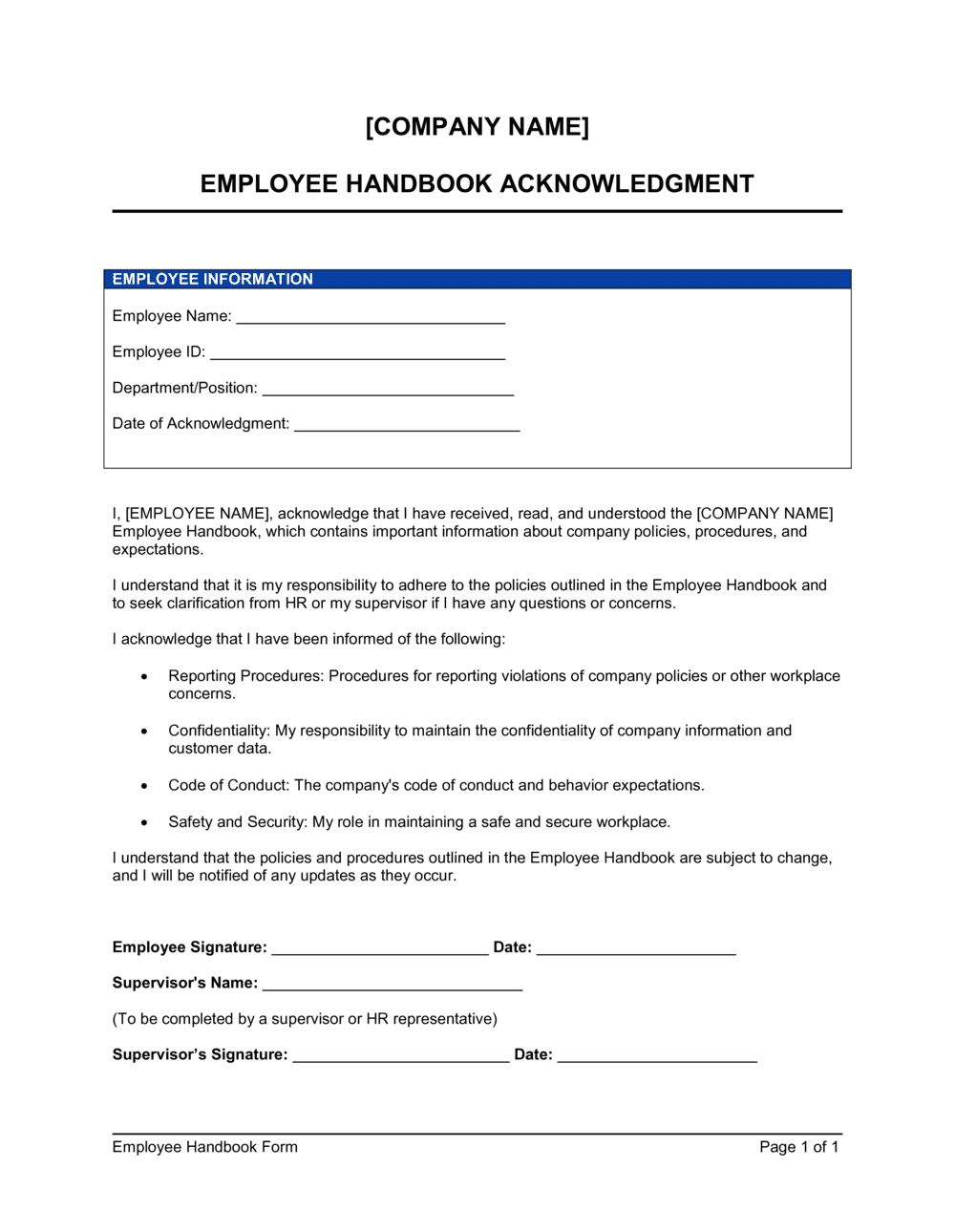
An Employee Handbook Acknowledgment Form is a one-page signed document confirming that an employee has received, read, and understood the company's employee handbook. This free Word download is ready to fill in with your company name, handbook version, and employee details β€” then print, sign, and file in the employee's personnel record.
When you need it
Issue it on or before an employee's first day of work, whenever the handbook is materially updated, and any time you need documented proof that a specific policy version was in force and communicated to a specific employee.
What's inside
The form captures the employee's full name and job title, the handbook version or effective date, a plain-language acknowledgment statement, a declaration that the employee can ask questions, the employee's signature and date, and a space for a manager or HR witness signature.

What is an Employee Handbook Acknowledgment Form?

An Employee Handbook Acknowledgment Form is a short signed document in which an employee confirms they have received, read, and understood the company's employee handbook. It captures the handbook version or effective date, the employee's identifying details, a plain-language declaration of compliance, and signatures from both the employee and an HR witness. The form serves as the formal paper trail linking a specific employee to a specific version of company policy β€” creating the evidentiary record that matters when disputes over conduct, discipline, or termination arise.

Why You Need This Document

Without a signed acknowledgment on file, proving that an employee knew about a policy they violated becomes an exercise in credibility β€” their word against yours. Employment tribunals, arbitrators, and courts routinely ask employers to produce evidence that a policy was communicated before holding an employee to it. A signed, dated form tied to a specific handbook version answers that question immediately and removes the most common defense in workplace disputes: "I never knew that was the rule." Collecting acknowledgments at onboarding and again after every material handbook update takes five minutes per employee and can be the difference between a defensible termination and a costly settlement.

Which variant fits your situation?

If your situation is…Use this template
New hire completing onboarding paperwork on day oneEmployee Handbook Acknowledgment Form
Existing employee re-acknowledging after a handbook updatePolicy Update Acknowledgment Form
Remote employee signing electronically via emailEmployee Handbook Acknowledgment Form
Employee acknowledging a standalone code of conductCode of Conduct Acknowledgment Form
Employee confirming receipt of a specific HR policy (e.g., harassment policy)HR Policy Acknowledgment Form
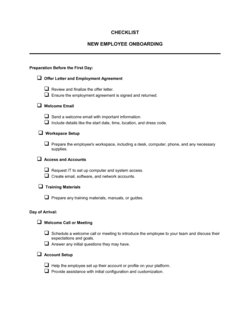
Full onboarding packet including all new-hire paperworkNew Employee Onboarding Checklist

Common mistakes to avoid

❌ Acknowledgment form signed after the start date

Why it matters: If an incident occurs in the employee's first week before they have signed, the employer cannot prove the policy was communicated β€” weakening any disciplinary action.

Fix: Make the signed acknowledgment form a condition of completing day-one onboarding, before the employee begins work on any substantive tasks.

❌ Blank handbook version or effective date field

Why it matters: Without a version or date, it is impossible to confirm which set of policies the employee agreed to β€” a critical gap when defending against claims that a policy was never communicated.

Fix: Update the template header each time the handbook is revised with the new version number and effective date, and collect fresh signatures from all employees.

❌ Using 'received' without 'read and understood'

Why it matters: An acknowledgment of receipt alone allows an employee to argue they never read the handbook, making policy violations harder to enforce.

Fix: Ensure the acknowledgment statement explicitly includes all three elements: received, read, and understood β€” and that the employee initials or checks each.

❌ No at-will or non-contract disclaimer

Why it matters: Without a clear disclaimer, handbook language describing progressive discipline or job security has been interpreted by courts as an implied employment contract in some jurisdictions.

Fix: Include a one-sentence disclaimer stating the handbook is a policy guide only, does not create a contract, and does not alter employment terms.

The 8 key fields, explained

Company name and handbook title

Handbook version or effective date

Employee full name and job title

Acknowledgment statement

At-will or non-contract disclaimer

Right to ask questions statement

Employee signature and date

HR or manager witness signature

How to fill it out

  1. 1

    Enter the company name and handbook details

    Fill in your company's legal name and the full title of the handbook. Add the handbook version number or effective date so the form ties to a specific edition.

    πŸ’‘ Keep a master log of handbook versions with effective dates β€” it makes locating the correct signed form during a dispute much faster.

  2. 2

    Complete the employee identification fields

    Enter the employee's full legal name, job title, and department. Cross-reference the spelling with the employee's government ID or onboarding paperwork.

    πŸ’‘ Pre-populate these fields before the onboarding meeting so the employee only needs to review, sign, and date β€” reducing errors.

  3. 3

    Review the acknowledgment statement with the employee

    Read the core acknowledgment statement aloud or give the employee time to read it. Confirm they understand that signing means they have read and agree to comply with all handbook policies.

    πŸ’‘ For employees whose primary language is not English, provide a translated summary of key policies before asking for a signature.

  4. 4

    Confirm the at-will disclaimer applies to your jurisdiction

    Review the at-will or non-contract disclaimer and adjust it if the employee works in a jurisdiction where at-will employment does not apply β€” such as Canada, the UK, or the EU.

    πŸ’‘ In Canada and the UK, replace at-will language with a statement that the handbook does not alter the notice obligations set out in the employment contract.

  5. 5

    Invite the employee to ask questions

    Give the employee a genuine opportunity to ask about any policy before they sign. Note any questions asked and how they were answered, even informally.

    πŸ’‘ If an employee raises a concern about a specific policy at this stage, document it in writing before having them sign β€” do not pressure them to sign unresolved concerns.

  6. 6

    Collect the employee's signature and date

    Have the employee sign and date the form. If using an electronic signature tool, ensure the timestamp is captured automatically.

    πŸ’‘ Never backdate a signature or accept an undated form β€” both create legal exposure that outweighs the administrative convenience.

  7. 7

    Add the HR or manager witness signature

    An HR representative or the employee's direct manager should sign and date the witness line immediately after the employee signs.

    πŸ’‘ The witness should be someone other than the employee's direct supervisor when possible, to avoid any appearance of coercion.

  8. 8

    File the original and provide a copy to the employee

    File the signed original in the employee's personnel file. Provide the employee with a copy for their own records, either printed or as a PDF.

    πŸ’‘ Scan and store a digital copy in your HRIS or a secure cloud folder in addition to the physical file β€” paper-only storage creates recovery risk.

Frequently asked questions

What is an employee handbook acknowledgment form?

An employee handbook acknowledgment form is a short signed document confirming that an employee has received, read, and understood the company's employee handbook. It creates a written record that specific policies were communicated to the employee, which is critical evidence in disputes over conduct, termination, or policy compliance.

Is an employee handbook acknowledgment form legally required?

No federal or state law in the US specifically mandates a signed acknowledgment form, but employment law practitioners widely recommend one as a best practice. Without it, employers cannot easily prove in arbitration or litigation that an employee was informed of the policies they allegedly violated. Many employment disputes turn entirely on whether the employee had notice of the relevant policy.

When should employees sign the acknowledgment form?

On or before their first day of work, ideally as part of the formal onboarding packet. Employees should also sign a new form whenever the handbook is materially revised β€” particularly when changes affect discipline, termination, harassment, or at-will status. Keeping dated signed copies for each version ensures the employer can always identify which policies applied at any point in time.

Does the handbook acknowledgment form create a contract?

No β€” and the form should say so explicitly. A properly drafted acknowledgment includes a disclaimer stating that the handbook is a policy guide only and does not constitute an employment contract or guarantee of continued employment. Without this disclaimer, certain handbook language β€” particularly around progressive discipline β€” has been found to create implied contractual obligations in some jurisdictions.

What if an employee refuses to sign the acknowledgment form?

An employee's refusal to sign does not mean they are exempt from the handbook's policies. Document the refusal in writing, note the date and the witness present, and file this documentation in the employee's personnel file. You can note on the form itself: 'Employee refused to sign on [DATE] β€” witnessed by [NAME].' The handbook still applies; the record protects the employer if a later dispute arises.

Can the acknowledgment form be signed electronically?

Yes. Electronic signatures are legally valid in the US under the E-SIGN Act and UETA, and in most other jurisdictions under equivalent legislation. Ensure your e-signature tool timestamps the signing event and stores a tamper-evident copy. The timestamp serves the same function as a handwritten date and is often more reliable.

How long should employers retain signed acknowledgment forms?

Retain signed acknowledgment forms for the duration of employment plus at least 3–7 years after separation, depending on the applicable statute of limitations for employment claims in your jurisdiction. In the US, EEOC guidance recommends retaining personnel records for at least one year after termination; many employment attorneys recommend 4–7 years to cover most discrimination and wrongful termination claim windows.

Should a new acknowledgment form be collected every time the handbook changes?

Yes, whenever the handbook is materially revised β€” particularly when changes affect policies employees are expected to follow, such as attendance, discipline, harassment, and termination procedures. Minor formatting or typographical corrections may not warrant new signatures, but any change that could affect an employee's rights or obligations should be accompanied by a fresh signed acknowledgment tied to the updated version number and effective date.

How this compares to alternatives

vs Employee Handbook

The employee handbook is the full policy document β€” covering conduct, benefits, leave, discipline, and more β€” that can run 30–80 pages. The acknowledgment form is the single-page receipt confirming the employee received and reviewed it. You need both: the handbook sets the policies; the acknowledgment proves they were communicated.

vs Offer Letter

An offer letter confirms compensation, title, and start date before employment begins. An acknowledgment form is signed after the employee has reviewed the handbook during onboarding. The offer letter establishes the employment terms; the acknowledgment form documents policy compliance obligations.

vs Employment Contract

An employment contract is a binding bilateral agreement setting compensation, IP, non-compete, and termination terms. An acknowledgment form is a unilateral receipt confirming the employee reviewed a policy document. The acknowledgment explicitly states the handbook is not a contract β€” both documents serve different legal functions.

vs New Employee Onboarding Checklist

An onboarding checklist tracks every task, form, and training item required during the onboarding process. The handbook acknowledgment form is one specific item on that checklist. Use the checklist to manage the full onboarding workflow and the acknowledgment form to create the signed evidentiary record for the handbook specifically.

Industry-specific considerations

Retail and Hospitality

High turnover means acknowledgment forms must be collected quickly during brief onboarding windows, and re-signed frequently as handbooks are updated for seasonal policy changes.

Healthcare

Strict HIPAA confidentiality and conduct policies make documented acknowledgment essential β€” regulators may request proof that employees were informed of compliance obligations.

Technology / SaaS

Remote and distributed teams require electronic acknowledgment workflows with timestamped records, and handbooks are updated frequently as remote work and IP policies evolve.

Professional Services

Client confidentiality, billing compliance, and conflict-of-interest policies require clear documented employee acknowledgment to support professional liability coverage.

Template vs pro β€” what fits your needs?

PathBest forCostTime
Use the templateAny employer collecting signed handbook acknowledgments from new or existing employeesFree5 minutes per employee
Template + professional reviewEmployers updating handbook language and acknowledgment text simultaneously, or operating in multiple jurisdictions$100–$300 (HR consultant or employment attorney review)1–2 hours
Custom draftedLarge employers with complex multi-jurisdiction operations, union environments, or industry-specific compliance requirements$500–$1,5001–3 days

Glossary

Acknowledgment Form
A signed document confirming that a person has received, read, and understood a specific document or policy.
Handbook Version
A date or version number identifying which edition of the employee handbook the employee is acknowledging, important when the handbook is periodically revised.
At-Will Statement
A clause, often included in the acknowledgment, clarifying that the handbook is not an employment contract and does not alter the at-will nature of the employment relationship.
Personnel File
The official confidential record maintained by the employer for each employee, containing employment documents including signed acknowledgment forms.
Effective Date
The date on which a handbook version or policy officially takes effect and becomes binding on employees.
Witness Signature
An HR representative's or manager's signature confirming that the employee signed the form in their presence.
Policy Acknowledgment
Formal confirmation by an employee that they have been informed of and understand a specific workplace policy or rule.
Onboarding
The structured process of integrating a new employee into the organization, including completing required forms, training, and orientation activities.

Part of your Business Operating System

This document is one of 3,000+ business & legal templates included in Business in a Box.

  • Fill-in-the-blanks β€” ready in minutes
  • 100% customizable Word document
  • Compatible with all office suites
  • Export to PDF and share electronically

Create your document in 3 simple steps.

From template to signed document β€” all inside one Business Operating System.
1
Download or open template

Access over 3,000+ business and legal templates for any business task, project or initiative.

2
Edit and fill in the blanks with AI

Customize your ready-made business document template and save it in the cloud.

3
Save, Share, Send, Sign

Share your files and folders with your team. Create a space of seamless collaboration.

Save time, save money, and create top-quality documents.

β˜…β˜…β˜…β˜…β˜…

"Fantastic value! I'm not sure how I'd do without it. It's worth its weight in gold and paid back for itself many times."

Managing Director Β· Mall Farm
Robert Whalley
Managing Director, Mall Farm Proprietary Limited
β˜…β˜…β˜…β˜…β˜…

"I have been using Business in a Box for years. It has been the most useful source of templates I have encountered. I recommend it to anyone."

Business Owner Β· 4+ years
Dr Michael John Freestone
Business Owner
β˜…β˜…β˜…β˜…β˜…

"It has been a life saver so many times I have lost count. Business in a Box has saved me so much time and as you know, time is money."

Owner Β· Upstate Web
David G. Moore Jr.
Owner, Upstate Web

Run your business with a system β€” not scattered tools

Stop downloading documents. Start operating with clarity. Business in a Box gives you the Business Operating System used by over 250,000 companies worldwide to structure, run, and grow their business.

Free Forever PlanΒ Β·Β No credit card required