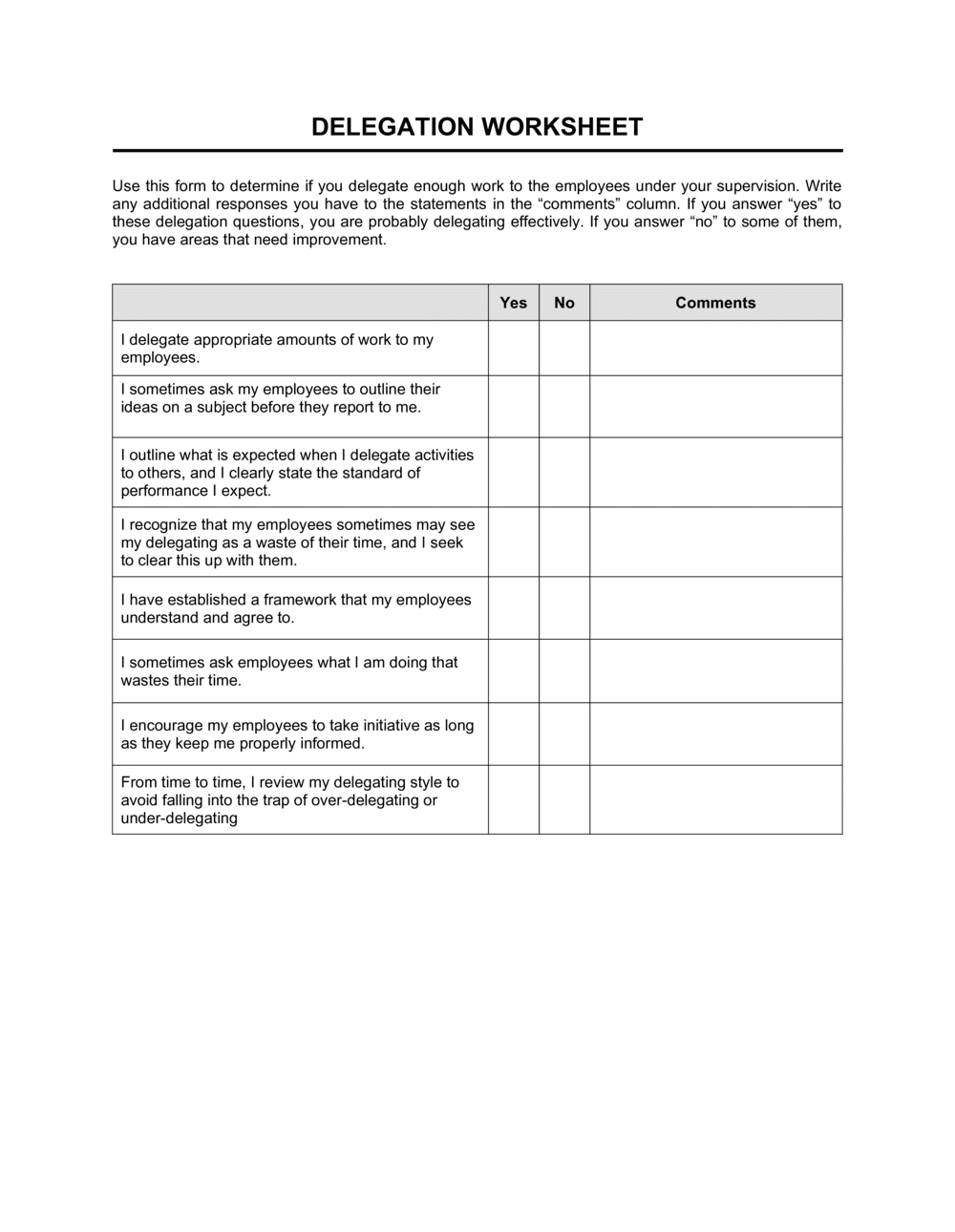
Worksheet_Delegation

Free download β€’ Use as a template β€’ Print or share

1 pageβ€’20–30 min to useβ€’Difficulty: Standardβ€’Signature requiredβ€’Legal review recommended
Learn more ↓
FreeWorksheet_Delegation Template

At a glance

What it is
A Worksheet Delegation is a structured legal document used to formally assign specific authority, tasks, or responsibilities from one party β€” typically a manager, executive, or organizational unit β€” to another. This free Word download gives you an editable, signable framework that clarifies the scope of delegated power, sets limits on that authority, and documents accountability obligations, all in a format you can export as PDF and execute immediately.
When you need it
Use it when a principal needs to transfer decision-making authority or task ownership to a delegate β€” whether for a defined project, an absence period, or an ongoing operational role. It is particularly important when the delegation carries financial, legal, or regulatory consequences that require a documented paper trail.
What's inside
The document covers the identity of the delegating party and delegate, the specific scope and limits of delegated authority, duration, reporting and accountability requirements, conditions for revocation, and the signatures of both parties confirming mutual understanding and acceptance.

What is a Worksheet Delegation?

A Worksheet Delegation is a binding written document that formally transfers specific authority, decision-making power, or task ownership from a principal β€” typically a manager, executive, or organizational unit β€” to a designated delegate for a defined period or purpose. Unlike informal verbal instructions or a general job description, a delegation worksheet sets out the precise scope of what the delegate may decide, the explicit limits they must not exceed, the duration of the authority, and the accountability mechanisms that govern how they report back. It functions both as an internal governance document and as evidence for third parties β€” vendors, auditors, regulators, and financial institutions β€” that the delegate has legitimate authority to act.

Why You Need This Document

Without a written delegation, authority transfers rely on memory, verbal understanding, and organizational assumption β€” all of which fail when disputes arise, personnel change, or auditors ask who approved a specific decision. The cost of an undocumented delegation surfaces in predictable ways: a vendor signs a contract believing the delegate had authority, the principal disputes the commitment, and the organization faces litigation over apparent authority. In regulated industries, an unrecorded authority transfer can trigger compliance failures and personal liability for both the principal and the delegate. A properly executed Worksheet Delegation closes these gaps by creating a clear, signed record of exactly what was authorized, what was not, who bears responsibility for decisions made, and how the authority ends. This template gives you a structured, legally grounded starting point that you can tailor to any operational context and execute in under 30 minutes.

Which variant fits your situation?

If your situation is…Use this template
Delegating authority during a planned executive absenceWorksheet Delegation (Temporary Authority)
Assigning financial signing authority to a CFO or finance directorDelegation of Financial Authority
Transferring full legal authority to act on behalf of a principalPower of Attorney
Assigning a specific project scope to a team leadProject Assignment Agreement
Delegating HR decisions such as hiring or termination approvalHR Delegation of Authority Form
Establishing recurring delegated authority across an entire organizational hierarchyDelegation of Authority Policy
Assigning duties to an agent to act on behalf of a company in a legal matterAgency Agreement

Common mistakes to avoid

❌ Delegating authority without any financial ceiling

Why it matters: A delegate who can commit the organization to unlimited financial obligations creates liability exposure that may exceed the principal's own authority. Boards, lenders, and auditors flag uncapped delegations immediately.

Fix: Include a specific dollar threshold for every category of financial authority. Align those thresholds with your company's existing delegation-of-authority policy or board-approved limits.
❌ Using the document only as an internal memo rather than a signed agreement

Why it matters: An unsigned delegation is not enforceable against the delegate, and third parties β€” vendors, regulators, financial institutions β€” may refuse to recognize authority that has not been formally documented and executed.

Fix: Ensure both parties sign and date the document before the effective date. Store the executed copy where it can be produced quickly for third parties.

❌ Leaving the duration open-ended with no revocation mechanism

Why it matters: A delegation with no end date and no revocation procedure can outlast the principal's intent β€” a former employee or departed manager may continue to be perceived as holding authority.

Fix: Always specify either a fixed end date or a clear revocation procedure with a written-notice requirement and a stated effectiveness date.

❌ Failing to address sub-delegation

Why it matters: When the document is silent on sub-delegation, agency law in several jurisdictions permits the delegate to pass authority to a third party, creating unauthorized chains of authority the principal never approved.

Fix: Include an explicit prohibition on sub-delegation unless the principal provides prior written consent. This single clause prevents a common source of unauthorized commitments.

❌ Drafting scope in vague, catch-all language

Why it matters: Phrases like 'all duties and responsibilities of the Principal' grant the delegate unlimited authority, overriding internal policies, regulatory constraints, and governance documents simultaneously.

Fix: Replace catch-all language with an itemized list of specific, numbered authorizations. If you cannot itemize them, the delegation scope is too broad to be safe.

❌ No indemnification or liability allocation clause

Why it matters: Without it, disputes over who bears the cost of a delegate's error default to general agency law β€” which may hold the principal fully liable for acts they did not intend to authorize.

Fix: Include a clause specifying that the delegate is liable for losses arising from actions outside the granted scope or resulting from negligence or wilful misconduct.

The 10 key clauses, explained

Parties and Roles

In plain language: Identifies the delegating party and the delegate by full legal name, title, and organizational role, establishing who is granting and who is receiving authority.

Sample language
This Worksheet Delegation is entered into on [DATE] between [DELEGATING PARTY FULL NAME], [TITLE], ('Principal') and [DELEGATE FULL NAME], [TITLE], ('Delegate'), both employed by / affiliated with [ORGANIZATION NAME].

Common mistake: Using job titles alone without full legal names. If the titleholder changes, the document becomes ambiguous about who holds authority and creates liability gaps.

Purpose and Background

In plain language: States the reason for the delegation β€” a leave period, a project, a vacancy, or an ongoing operational need β€” so that the document's intent is clear to any third party reviewing it.

Sample language
The Principal is delegating authority to the Delegate for the following purpose: [DESCRIPTION OF PURPOSE, e.g., 'to manage vendor contracts during the Principal's parental leave from [DATE] to [DATE]'].

Common mistake: Omitting the purpose clause entirely. Without it, third parties cannot determine whether the delegate is acting within the intended scope, creating confusion in disputes.

Scope of Delegated Authority

In plain language: Defines exactly which decisions, actions, or task categories the delegate is authorized to carry out on behalf of the principal.

Sample language
The Delegate is hereby authorized to: (a) approve purchase orders up to $[AMOUNT]; (b) execute vendor agreements valued under $[AMOUNT]; (c) represent the Principal in meetings with [STAKEHOLDER GROUP]; and (d) [ADDITIONAL AUTHORIZED ACTIONS].

Common mistake: Drafting scope too broadly β€” phrases like 'all duties of the Principal' give the delegate unlimited authority that may conflict with company policy, board resolutions, or regulatory requirements.

Limits and Exclusions

In plain language: Sets the explicit ceiling on delegated authority β€” financial thresholds, excluded decisions, or matters that remain with the principal β€” so the delegate cannot exceed their mandate.

Sample language
Notwithstanding the above, the Delegate is expressly NOT authorized to: (a) approve expenditures exceeding $[AMOUNT]; (b) enter into any agreement with a term exceeding [X] months; (c) terminate employees; or (d) make representations on behalf of the organization in legal or regulatory proceedings.

Common mistake: Failing to include any limits clause. A delegation with no ceiling is indistinguishable from a full transfer of authority and can expose the principal to liability for acts they never intended to authorize.

Duration and Effective Dates

In plain language: States when the delegation begins and ends β€” whether a fixed period, an event trigger, or an open-ended arrangement subject to revocation.

Sample language
This delegation is effective from [START DATE] and shall remain in force until [END DATE / OCCURRENCE OF EVENT], unless earlier revoked in writing by the Principal pursuant to the Revocation clause below.

Common mistake: Omitting an end date on a temporary delegation. If the principal returns but forgets to issue a written revocation, the delegate may continue to exercise authority unintentionally.

Reporting and Accountability

In plain language: Establishes how and how often the delegate must report back to the principal, what records must be kept, and the consequences of failing to account for decisions made.

Sample language
The Delegate shall provide the Principal with a written summary of all decisions made under this delegation on a [weekly / monthly] basis, retain copies of all documents executed, and make those records available to the Principal upon request within [X] business days.

Common mistake: No reporting requirement at all. Without a structured accountability mechanism, delegations become informal arrangements that are difficult to audit, dispute, or terminate.

Sub-Delegation

In plain language: States whether the delegate may pass the authority on to a third party, and if so, under what conditions and with what approval requirements.

Sample language
The Delegate may not sub-delegate any authority granted under this document without the prior written consent of the Principal. Any purported sub-delegation without such consent is void and of no legal effect.

Common mistake: Leaving sub-delegation unaddressed. When the clause is silent, courts in some jurisdictions apply the general agency rule permitting sub-delegation β€” creating authority chains the principal never intended.

Revocation

In plain language: Describes how and when the principal may cancel the delegation before its scheduled end date, and what happens to actions taken between the decision to revoke and the delegate's receipt of notice.

Sample language
The Principal may revoke this delegation at any time by providing written notice to the Delegate. Revocation takes effect upon the Delegate's receipt of notice. Actions taken by the Delegate in good faith before receiving revocation notice remain binding on the Principal.

Common mistake: No notice requirement for revocation. Without specifying the mechanism, a verbal revocation may be disputed, leaving third parties uncertain whether the delegate still holds authority.

Indemnification and Liability

In plain language: Allocates responsibility for losses or liabilities arising from the delegate's exercise of authority β€” whether the organization, the principal, or the delegate bears the risk.

Sample language
The Delegate shall indemnify and hold harmless the Principal and [ORGANIZATION NAME] from any claims, losses, or liabilities arising from the Delegate's actions that exceed the scope of authority granted herein or that result from the Delegate's negligence or wilful misconduct.

Common mistake: No indemnification clause or one that indemnifies the delegate for all acts, including those outside the granted scope. This removes any financial incentive for the delegate to stay within limits.

Governing Law and Signatures

In plain language: Identifies the jurisdiction whose law governs interpretation of the document and provides the signature block confirming both parties have read, understood, and accepted the delegation terms.

Sample language
This Worksheet Delegation is governed by the laws of [STATE / PROVINCE / COUNTRY]. Signed by: [PRINCIPAL NAME], [TITLE], Date: [DATE]; and [DELEGATE NAME], [TITLE], Date: [DATE].

Common mistake: Both parties not signing the document. A delegation signed only by the principal is arguably unilateral β€” the delegate's signature confirms acceptance of the accountability obligations, not just the authority.

How to fill it out

  1. 1

    Identify the parties with full legal names and titles

    Enter the full legal name and job title of both the delegating party and the delegate. Include the organization's legal name to anchor the document in the correct entity.

    πŸ’‘ Cross-check names against HR records or company registrations β€” title-only references create ambiguity if personnel change.

  2. 2

    State the purpose and background of the delegation

    Write one to three sentences explaining why the delegation is being created β€” a leave of absence, a project, a vacancy, or an operational need. This context helps third parties and auditors interpret the document correctly.

    πŸ’‘ Be specific about the triggering event rather than using generic language like 'operational requirements.' Specificity limits scope disputes later.

  3. 3

    Define the scope of authority in itemized detail

    List every category of decision or action the delegate is authorized to take. Use sub-clauses (a), (b), (c) format and include dollar thresholds, counterparty types, and any relevant conditions.

    πŸ’‘ If you cannot list the authorized actions specifically, the delegation is probably too broad β€” narrow it before execution.

  4. 4

    Set explicit limits and exclusions

    List all actions that are expressly excluded from the delegation β€” financial ceilings, HR decisions, board-reserved matters, and regulatory filings are common exclusions.

    πŸ’‘ Mirror the exclusions directly against your company's delegation-of-authority policy or board resolutions to avoid internal contradictions.

  5. 5

    Enter the effective dates

    State both the start date and the end date (or the event that terminates the delegation). If the delegation is ongoing, note that it is subject to written revocation.

    πŸ’‘ For temporary delegations during absences, tie the end date to the principal's confirmed return date rather than a fixed calendar date to avoid gaps.

  6. 6

    Specify reporting frequency and record-keeping obligations

    State how often the delegate must report to the principal, in what format (written memo, email summary, log), and how long records must be retained.

    πŸ’‘ Weekly written summaries are standard for financial delegations; monthly is acceptable for operational task delegations with lower risk.

  7. 7

    Confirm governing law and obtain both signatures

    Select the governing jurisdiction and have both parties sign and date the document before the effective date. Keep one executed copy with each party and one in the organization's records.

    πŸ’‘ Use Business in a Box eSign to timestamp execution and ensure both parties receive a copy of the fully executed document automatically.

Frequently asked questions

What is a Worksheet Delegation?

A Worksheet Delegation is a formal written document that transfers specific authority, tasks, or decision-making power from a principal β€” typically a manager, executive, or organizational unit β€” to a designated delegate. It defines the scope and limits of that authority, sets a duration, establishes accountability obligations, and is signed by both parties to create a binding and auditable record of the transfer.

When should I use a Worksheet Delegation instead of a Power of Attorney?

A Worksheet Delegation is appropriate for internal organizational authority transfers β€” operational decisions, project approvals, procurement authority, or task ownership within a company. A Power of Attorney is a broader legal instrument that authorizes someone to act on your behalf in external legal, financial, or real-estate matters, typically recognized by third parties such as courts, banks, and government agencies. Use a delegation for business management situations; use a Power of Attorney when legal capacity to bind a principal to external obligations is required.

Does a delegation of authority need to be signed to be valid?

In most jurisdictions, a delegation is more easily enforceable and auditable when signed by both the principal and the delegate. The principal's signature authorizes the transfer; the delegate's signature confirms acceptance of the associated accountability obligations. Unsigned delegations may be treated as informal instructions rather than binding documents, particularly by third parties such as vendors or financial institutions.

Can a delegate pass their authority on to someone else?

Only if the delegation document expressly permits sub-delegation and the principal has provided written consent. In the absence of an explicit permission clause, most well-drafted delegation documents prohibit sub-delegation entirely. Without a prohibition, general agency law in several jurisdictions may permit it by default β€” which is why addressing sub-delegation in the document is critical.

How specific does the scope of authority need to be?

As specific as possible. A well-drafted scope clause lists every category of authorized action with concrete parameters β€” dollar thresholds, counterparty types, decision categories, and any applicable conditions. Vague or catch-all language creates ambiguity about what the delegate may do, which courts and auditors resolve against the party that drafted the ambiguity. If you cannot list the authorized actions specifically, narrow the delegation before executing it.

How do I revoke a delegation of authority?

Provide the delegate with written notice of revocation β€” email with read receipt, hand-delivered letter, or courier delivery β€” and state the date on which the revocation takes effect. Typically, revocation is effective upon the delegate's receipt of notice. If the delegate has shared their authority with third parties (e.g., vendors or counterparties), notify those parties of the revocation separately to prevent them from relying on the delegate's now-cancelled authority.

Is a Worksheet Delegation legally binding?

A properly executed Worksheet Delegation is generally enforceable as a binding agreement between the principal and the delegate when it meets the basic requirements of a contract: identification of parties, clear scope and terms, mutual assent evidenced by signatures, and, in some jurisdictions, consideration. Consider consulting a lawyer to confirm enforceability under the governing jurisdiction's specific contract and agency laws, particularly for high-stakes or regulated delegations.

What happens if a delegate acts outside the scope of the delegation?

Actions taken outside the granted scope are generally not binding on the principal unless the principal ratifies them after the fact. The delegate may be personally liable for losses caused by unauthorized acts, particularly where the document includes an indemnification clause. In agency law, a third party who reasonably and in good faith relied on apparent authority may still be able to hold the principal liable β€” which is why precise scope and limits language, combined with notice to relevant third parties, is essential.

How long should a delegation of authority last?

Duration depends on the purpose. Temporary delegations during a leave of absence or project should have a fixed end date tied to a specific event or calendar date. Ongoing operational delegations β€” such as standing procurement authority for a department head β€” can run indefinitely but should specify that they are subject to written revocation and should be reviewed at least annually. Open-ended delegations with no review mechanism become governance risks over time.

How this compares to alternatives

vs Power of Attorney

A Power of Attorney grants broad legal capacity to act on behalf of a principal in dealings with external parties β€” courts, banks, government agencies, and real estate transactions. A Worksheet Delegation is an internal organizational document that transfers operational or administrative authority within an enterprise. Use a Power of Attorney when third-party legal recognition is required; use a delegation for internal management authority.

vs Agency Agreement

An Agency Agreement creates a commercial relationship where one party acts on behalf of another in dealings with third parties, typically for sales, procurement, or representation. A Worksheet Delegation is narrower β€” it documents an internal transfer of authority between employees or organizational units within the same entity, rather than creating a separate commercial agency relationship.

vs Job Description

A job description defines the ongoing responsibilities and expectations of a role. A delegation document transfers specific authority from one role or individual to another for a defined period or purpose. A job description does not create binding legal authority for financial or legal decisions; a delegation document does, and is enforceable against both parties.

vs Letter of Authorization

A Letter of Authorization is a brief, often one-page document confirming that a named individual has permission to act in a specific narrow situation β€” collecting a document, attending a meeting, or signing a single instrument. A Worksheet Delegation is a comprehensive agreement covering scope, limits, duration, reporting, indemnification, and revocation across a range of decisions. Use a letter of authorization for one-off, low-stakes situations; use a delegation worksheet for recurring or high-stakes authority transfers.

Industry-specific considerations

Financial Services

Delegation documents cover trading authority, payment approval thresholds, and client account decisions, and must align with regulatory frameworks such as FINRA rules and FCA senior manager accountability regimes.

Healthcare

Clinical and administrative authority delegations must comply with licensing board requirements, and scope must be precisely limited to avoid unauthorized practice of medicine or patient care decisions.

Construction and Real Estate

Project managers and site supervisors receive delegated authority for subcontractor approvals, safety sign-offs, and change orders, with financial ceilings tied to contract values.

Professional Services

Engagement partners delegate client billing approval, staffing decisions, and proposal sign-off to senior managers, with accountability trails critical for quality-control audits.

Jurisdictional notes

United States

Delegation of authority documents in the US are governed by state agency and contract law, which varies significantly. In corporate settings, certain authority β€” such as signing contracts above board-approved thresholds or encumbering company assets β€” may require a board resolution rather than (or in addition to) a delegation worksheet. California, Delaware, and New York all have specific statutes addressing apparent authority and ratification that affect enforceability against third parties.

Canada

Canadian agency law governs the scope of delegated authority, and provinces including Ontario, British Columbia, and Alberta each apply common-law agency principles with some statutory overlays. Corporate authority delegations must be consistent with the company's constating documents (articles of incorporation and bylaws). Quebec applies a civil law framework under the Civil Code of Quebec, which has distinct rules for mandates and representation β€” delegation documents used in Quebec should be reviewed for civil law compliance.

United Kingdom

In the UK, delegation of authority is governed by common law agency principles and, for companies, by the Companies Act 2006. Directors may delegate board functions to committees or officers but cannot delegate duties that are expressly reserved under the Companies Act or the company's articles of association. Senior manager accountability under the FCA's Senior Managers and Certification Regime (SM&CR) requires that financial services firms maintain clear, documented responsibility maps β€” a Worksheet Delegation is a key supporting document for SM&CR compliance.

European Union

EU member states apply their own national contract and agency laws, which differ substantially between civil law countries (France, Germany, Spain, Italy) and any common-law influenced systems. In civil law jurisdictions, the concept of a mandate (mandat in French, Vollmacht in German) governs authority delegation and typically requires more formal documentation than a simple worksheet. GDPR implications may arise if the delegation involves processing personal data on behalf of the principal β€” in such cases, a Data Processing Agreement or addendum may be required alongside the delegation document.

Template vs lawyer β€” what fits your deal?

PathBest forCostTime
Use the templateInternal operational delegations for managers and department heads in standard business settingsFree15–30 minutes
Template + legal reviewDelegations involving financial authority above $50,000, regulated industries, or cross-border authority transfers$300–$8001–3 days
Custom draftedExecutive-level authority transfers, regulated sectors (financial services, healthcare), or delegations that interact with board resolutions or shareholder agreements$1,000–$3,500+1–2 weeks

Glossary

Delegating Party (Principal)
The individual or entity that holds original authority and chooses to transfer some or all of it to another party.
Delegate
The individual or entity receiving the transferred authority and accepting responsibility for exercising it within the defined limits.
Scope of Authority
The specific decisions, actions, or tasks the delegate is authorized to perform β€” nothing outside this scope is covered by the delegation.
Limits of Authority
The explicit boundaries that cap what the delegate may do, such as a maximum spend threshold or a prohibition on entering new contracts above a stated value.
Sub-Delegation
The act of a delegate passing their delegated authority on to a third party β€” most delegation documents prohibit this unless expressly permitted.
Revocation
The formal withdrawal of delegated authority by the principal before the delegation's scheduled expiry, ending the delegate's right to act.
Accountability
The obligation of the delegate to report on, justify, and accept consequences for decisions made under the delegated authority.
Ratification
The principal's after-the-fact approval of an action taken by the delegate that exceeded or pre-dated the formal delegation, converting it into an authorized act.
Fiduciary Duty
An obligation to act in the best interests of the principal when exercising delegated authority, placing the principal's interests above one's own.
Effective Date
The specific calendar date on which the delegation becomes operative and the delegate may begin exercising the transferred authority.

Part of your Business Operating System

This document is one of 3,000+ business & legal templates included in Business in a Box.

  • Fill-in-the-blanks β€” ready in minutes
  • 100% customizable Word document
  • Compatible with all office suites
  • Export to PDF and share electronically

Create your document in 3 simple steps.

From template to signed document β€” all inside one Business Operating System.
1
Download or open template

Access over 3,000+ business and legal templates for any business task, project or initiative.

2
Edit and fill in the blanks with AI

Customize your ready-made business document template and save it in the cloud.

3
Save, Share, Send, Sign

Share your files and folders with your team. Create a space of seamless collaboration.

Save time, save money, and create top-quality documents.

β˜…β˜…β˜…β˜…β˜…

"Fantastic value! I'm not sure how I'd do without it. It's worth its weight in gold and paid back for itself many times."

Managing Director Β· Mall Farm
Robert Whalley
Managing Director, Mall Farm Proprietary Limited
β˜…β˜…β˜…β˜…β˜…

"I have been using Business in a Box for years. It has been the most useful source of templates I have encountered. I recommend it to anyone."

Business Owner Β· 4+ years
Dr Michael John Freestone
Business Owner
β˜…β˜…β˜…β˜…β˜…

"It has been a life saver so many times I have lost count. Business in a Box has saved me so much time and as you know, time is money."

Owner Β· Upstate Web
David G. Moore Jr.
Owner, Upstate Web

Run your business with a system β€” not scattered tools

Stop downloading documents. Start operating with clarity. Business in a Box gives you the Business Operating System used by over 250,000 companies worldwide to structure, run, and grow their business.

Free Forever PlanΒ Β·Β No credit card required