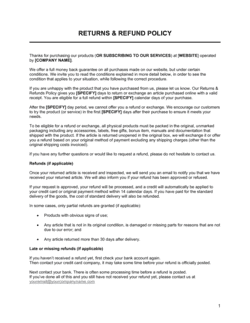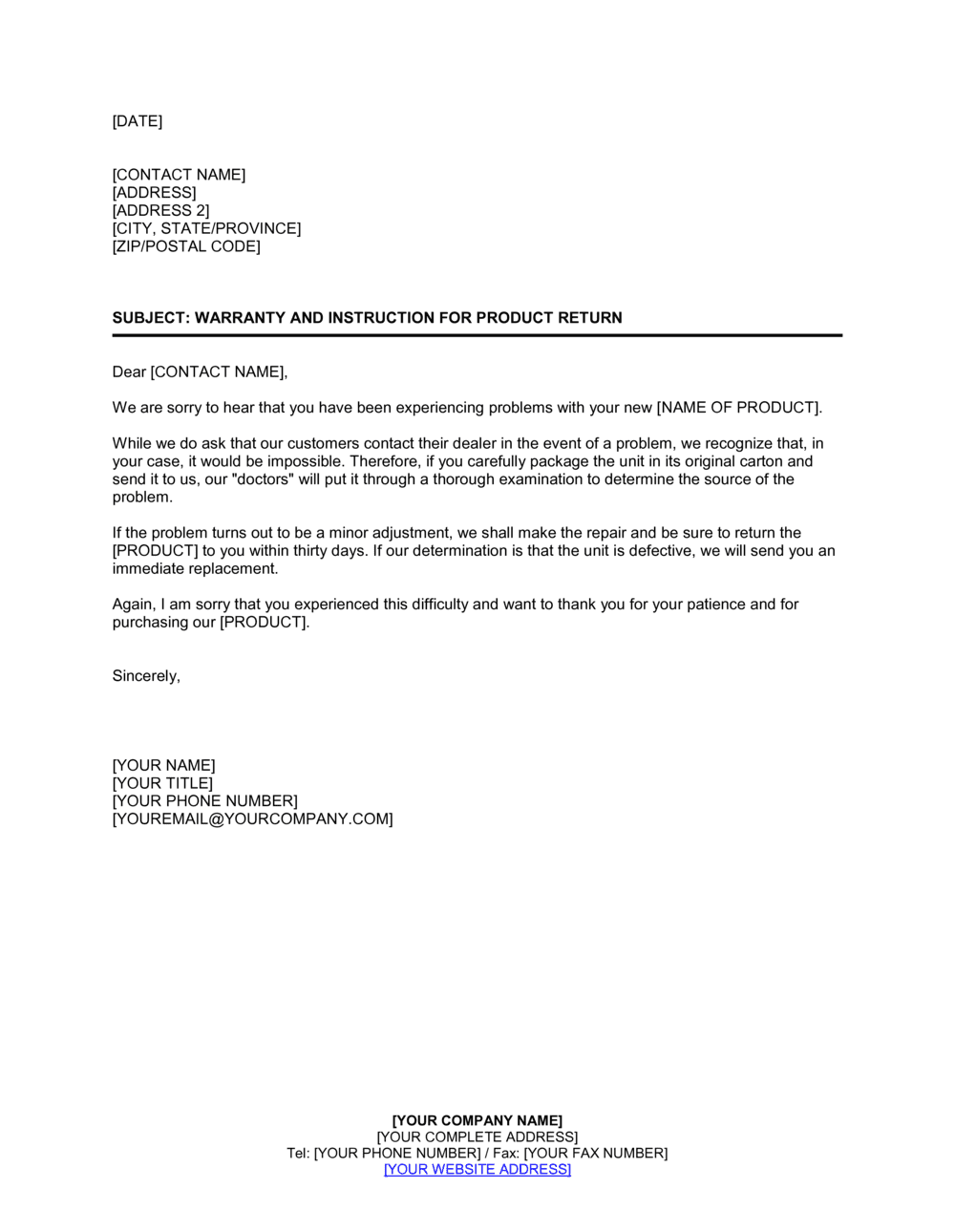
Acknowledgment of Warranty and Instruction for Product Return Template

Free Word download • Edit online • Save & share with Drive • Export to PDF

1 page15–20 min to fillDifficulty: Standard
Learn more ↓
FreeAcknowledgment of Warranty and Instruction for Product Return Template

At a glance

What it is
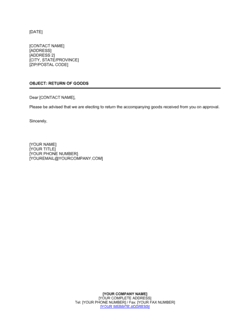
An Acknowledgment of Warranty and Instruction for Product Return is a formal business letter a seller or manufacturer sends to a customer to confirm that their product defect or complaint falls within the applicable warranty and to provide step-by-step instructions for returning the item. This free Word download is fully editable online and can be exported as PDF and sent to customers in minutes.
When you need it
Use it when a customer contacts you with a defective product, a warranty claim, or a request for a replacement or refund that falls within your stated warranty terms. It formally closes the loop on the complaint and sets clear expectations for what happens next.
What's inside
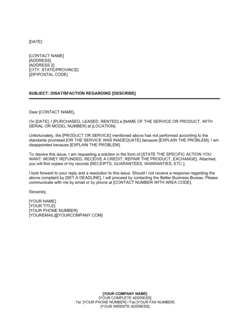
A greeting and reference to the original complaint or claim, a confirmation that the warranty applies, step-by-step return instructions including packaging and shipping requirements, information on the resolution offered (repair, replacement, or refund), and a professional closing with contact details for follow-up questions.

What is an Acknowledgment of Warranty and Instruction for Product Return?

An Acknowledgment of Warranty and Instruction for Product Return is a formal business letter a seller or manufacturer sends to a customer to confirm that their reported product defect is covered under the applicable warranty and to provide clear, step-by-step directions for returning the item. The letter documents two decisions at once — that the warranty claim is valid and that a specific remedy (repair, replacement, or refund) will be provided — while removing ambiguity about how the customer should physically return the product. It functions as both a customer service communication and an internal record of warranty fulfillment activity.

Why You Need This Document

Without a written warranty acknowledgment, customers are left to interpret verbal commitments, follow-up emails, and chat transcripts — any of which can be misread or disputed. The absence of a clear return instruction letter is the most common cause of incorrectly packaged returns, missing proof of purchase, and customer dissatisfaction during the claims process. Businesses that handle warranty returns without a standardized letter typically see higher rates of follow-up contacts, chargebacks, and negative reviews. A properly completed acknowledgment letter sets precise expectations — the remedy, the return deadline, who pays for shipping, and how long resolution takes — so the transaction closes cleanly on the first attempt. This template gives you a professional, editable starting point that takes under ten minutes to complete per claim.

Which variant fits your situation?

If your situation is…Use this template
Customer's product defect is outside the warranty periodWarranty Claim Denial Letter
Product defect is covered and a direct replacement is being sent without returnProduct Replacement Confirmation Letter
Customer requests a refund rather than a repair or replacementRefund Approval Letter
Return requires a formal pre-authorization number before shippingReturn Merchandise Authorization (RMA) Form
Defect poses a safety risk and a broader recall is neededProduct Recall Notice
Complaint is under review and a final decision has not been madeAcknowledgment of Customer Complaint Letter

Common mistakes to avoid

❌ No explicit warranty coverage confirmation

Why it matters: Jumping to return instructions without confirming coverage leaves the customer uncertain whether their claim was accepted, leading to follow-up calls and potential escalations.

Fix: Add a single sentence that unambiguously states the defect is covered before describing the remedy or return process.
❌ Open-ended return deadline

Why it matters: Without a specific return-by date, customers delay, and your inventory, accounting, and replacement stock planning all become harder to manage.

Fix: State a firm return-by date — typically 14–21 days from the letter date — and note that claims received after this date may require re-evaluation.

❌ Vague remedy description

Why it matters: Phrases like 'we will resolve your issue' without specifying repair, replacement, or refund create mismatched expectations and generate a second round of customer contacts.

Fix: Name the remedy explicitly, include the dollar amount or replacement model, and state when the customer can expect it.

❌ No claim or order reference number

Why it matters: A letter without a reference number cannot be matched to a customer account or prior correspondence, making every follow-up call start from scratch.

Fix: Include the original order number and a claim ID in the subject line and body of the letter, and ask the customer to quote it in any future contacts.

The 8 key clauses, explained

Header and reference line

In plain language: Identifies the letter date, the customer's name and address, and a subject line referencing the specific product, order number, or claim ID.

Sample language
Date: [DATE] | To: [CUSTOMER FULL NAME], [ADDRESS] | Re: Warranty Claim — [PRODUCT NAME], Order #[ORDER NUMBER]

Common mistake: Omitting the order or claim reference number. Without it, the customer cannot match the letter to their original complaint, causing confusion and duplicate contacts.

Opening acknowledgment

In plain language: Confirms receipt of the customer's complaint or return request and thanks them for bringing the issue forward.

Sample language
Thank you for contacting us regarding the [PRODUCT NAME] purchased on [PURCHASE DATE]. We have reviewed your report of [BRIEF DEFECT DESCRIPTION] and appreciate you bringing this to our attention.

Common mistake: Using a generic opener like 'We are in receipt of your letter' without referencing the specific product or issue. This makes the letter feel automated and can frustrate customers who have already described their problem.

Warranty coverage confirmation

In plain language: Explicitly states that the reported defect falls within the terms of the applicable warranty and that the customer is entitled to a remedy.

Sample language
After reviewing your claim, we can confirm that the reported [DEFECT] is covered under the [PRODUCT NAME] [DURATION] limited warranty applicable to purchases made within [DATE RANGE].

Common mistake: Failing to state explicitly that coverage is confirmed. Leaving it implicit — jumping straight to return instructions — can leave the customer uncertain about whether their claim was accepted.

Description of the remedy offered

In plain language: States clearly whether the customer will receive a repair, a replacement unit, or a refund, and any conditions attached to the remedy.

Sample language
As a resolution, we will [repair your unit and return it within [X] business days / ship a replacement [PRODUCT NAME] at no charge / issue a full refund of $[AMOUNT] to your original payment method] upon receipt of the returned item.

Common mistake: Offering the remedy conditionally without specifying the condition clearly. Phrases like 'subject to inspection' without defining what the inspection covers create disputes after the item is received.

Step-by-step return instructions

In plain language: Provides numbered steps for how to package, label, and ship the defective item back, including any materials the customer should include.

Sample language
To complete your return: (1) Place the item in its original packaging or a comparable box. (2) Include a copy of this letter and your proof of purchase. (3) Affix the enclosed prepaid shipping label to the outside of the package. (4) Drop the package at any [CARRIER] location by [DATE].

Common mistake: Giving return instructions without specifying a deadline. Customers who receive open-ended instructions often delay, creating inventory and accounting reconciliation problems for the seller.

Shipping and cost responsibility

In plain language: Clarifies who bears the cost of return shipping — the seller or the customer — and whether a prepaid label is included.

Sample language
A prepaid [CARRIER] return label is enclosed with this letter. There is no cost to you for return shipping. Please do not ship using any other carrier, as we are unable to reimburse unauthorized shipping charges.

Common mistake: Not clarifying who pays for return shipping. If the customer assumes the seller pays and ships at their own expense using an express courier, the resulting dispute can outweigh the cost of the original claim.

Processing timeline

In plain language: Sets the customer's expectation for how long the repair, replacement dispatch, or refund processing will take after the returned item is received.

Sample language
Once we receive your return, please allow [X] business days for [inspection and repair / replacement dispatch / refund processing]. You will receive a confirmation email when your [remedy] has been [completed / shipped / processed].

Common mistake: Giving a timeline that starts from when the letter is sent rather than when the return is received. The customer controls the return shipment date, so timelines must begin at receipt.

Contact information and closing

In plain language: Provides a specific contact — name, direct phone, or dedicated email — for follow-up questions, and closes with a professional sign-off.

Sample language
If you have questions at any point during this process, please contact our customer support team at [EMAIL] or [PHONE], Monday–Friday, [HOURS], referencing claim number [CLAIM ID]. We value your business and are committed to resolving this matter promptly.

Common mistake: Listing only a general support line or web form. Customers with an active warranty claim expect a direct escalation path, and routing them back through a general queue erodes trust in the resolution process.

How to fill it out

  1. 1

    Enter the date, customer details, and reference line

    Add today's date, the customer's full name and mailing address, and a subject line that includes the product name and the order or claim number from your system.

    💡 Use the same claim reference number throughout all correspondence so the customer can connect this letter to any previous email or phone communication.

  2. 2

    Write a specific opening acknowledgment

    Name the exact product, the purchase date, and the specific defect or issue the customer reported. Avoid generic language that could apply to any complaint.

    💡 Pull the defect description verbatim from the customer's original message — it signals you read their complaint carefully.

  3. 3

    Confirm warranty coverage explicitly

    State that the defect falls within the warranty period and terms. If the customer is near the edge of their warranty window, include the original purchase date and warranty expiration date to pre-empt questions.

    💡 If coverage is partial — for example, repair is covered but not shipping — state this clearly here rather than letting the customer discover it after the fact.

  4. 4

    State the remedy clearly

    Choose repair, replacement, or refund, and enter the specific details — turnaround time for repairs, model number for replacements, or refund amount and method.

    💡 If the exact replacement model is discontinued, name the substitute model and briefly explain why it is an equivalent or better option.

  5. 5

    List numbered return instructions

    Format the return steps as a numbered list — packaging requirements, documents to include, how to attach the label, where to drop off the parcel, and the return-by date.

    💡 Set the return-by deadline at 14–21 days from the letter date. This is long enough to be reasonable and short enough to keep your inventory cycle predictable.

  6. 6

    Clarify shipping responsibility and include the label

    State whether a prepaid label is enclosed or whether the customer is responsible for shipping costs. If the customer pays, specify the maximum reimbursable amount and the accepted carrier.

    💡 Attach or embed the prepaid label as a PDF if sending this letter by email — printing a label after a phone call or email exchange is faster than mailing a physical copy.

  7. 7

    Add the processing timeline and contact details

    Enter the number of business days from receipt to resolution, and provide a named contact or dedicated email address for this claim. Sign off with your name and title.

    💡 Underpromise on timelines and overpromise on follow-through. A 7-day estimate you meet beats a 3-day promise you miss.

Frequently asked questions

What is an acknowledgment of warranty and instruction for product return?

It is a formal letter a seller or manufacturer sends to a customer to confirm that their reported product defect is covered under the applicable warranty and to provide clear instructions for returning the defective item. It serves two purposes simultaneously: it documents the warranty acceptance decision and gives the customer a step-by-step process to complete the return without additional phone calls or emails.

When should I send this letter?

Send it as soon as you have reviewed the customer's complaint and confirmed that the defect falls within your warranty terms — ideally within 1–3 business days of receiving the claim. A prompt response reduces customer frustration, limits the risk of a chargeback or negative review, and starts the return clock early enough to keep your inventory cycle on track.

Does this letter need to be signed?

A signature is not required for this type of letter to be effective in most business contexts. Including a printed name and title adds professionalism and gives the customer a specific contact. If your business requires an internal authorization trail, have the responsible customer service manager or operations lead sign before sending.

What if the customer's product is outside the warranty period?

Do not use this template. Instead, use a warranty claim denial letter that explains the warranty period has expired and outlines any out-of-warranty repair or goodwill options you are willing to offer. Sending a warranty acknowledgment for an out-of-warranty claim creates a written admission of coverage that is difficult to walk back.

Should I include a prepaid return shipping label?

Best practice for confirmed warranty claims is to provide a prepaid label, as requiring the customer to pay return shipping on a defective product is a leading cause of negative reviews and chargebacks. If your warranty terms require the customer to cover return shipping, state this explicitly in the letter and specify the maximum reimbursable amount and accepted carrier to avoid disputes.

What documents should the customer include with the return?

At minimum, ask the customer to include a copy of this letter and their original proof of purchase (receipt or order confirmation). For higher-value products, you may also request a completed defect description form or photos of the damage. Keep the list short — too many requirements create friction and delays.

Can I send this letter by email instead of post?

Yes, email is acceptable and faster for most customers. Attach the letter as a PDF and embed a prepaid return label as a separate attachment if applicable. Keep the email subject line consistent with the claim reference number so the customer can find it easily. For regulated industries or high-value warranty claims, also send a physical copy by tracked mail as a backup record.

How do I handle a warranty claim where the customer no longer has the packaging?

State in the return instructions that the customer should use a comparable box with sufficient padding to protect the item in transit. Requiring original packaging when the product has been in use for months is unreasonable and creates unnecessary barriers to return. Note that damage caused by inadequate packing is the customer's responsibility and may affect the resolution if it prevents inspection of the original defect.

How this compares to alternatives

vs Warranty Claim Denial Letter

A warranty claim denial letter is used when the defect falls outside coverage — due to an expired warranty period, customer misuse, or exclusions in the warranty terms. This acknowledgment letter is used when the claim is accepted. Sending the wrong template is a material error that creates binding commitments or wrongful denials.

vs Acknowledgment of Customer Complaint Letter

A general complaint acknowledgment confirms receipt of an issue and promises a follow-up investigation — it does not confirm warranty coverage or provide return instructions. Use the complaint acknowledgment when the claim is still under review; use this warranty acknowledgment once the decision to honor the claim has been made.

vs Return Merchandise Authorization (RMA) Form

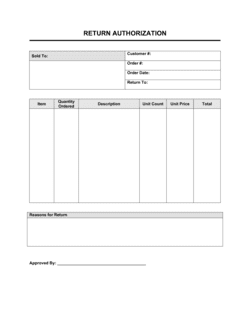
An RMA form is a structured intake document that captures product details, defect codes, and authorizes the return with a tracking number. This warranty letter is the customer-facing communication that accompanies or references the RMA. They are typically used together — the letter explains the decision and process; the RMA form manages the operational logistics.

vs Product Recall Notice

A product recall notice is issued when a defect poses a safety risk across a batch or product line and all affected customers must be contacted proactively. This warranty acknowledgment is a one-to-one response to an individual customer claim. If individual claims reveal a systemic defect, escalate from this template to a recall notice immediately.

Industry-specific considerations

Consumer Electronics

High return volumes and short model cycles make a standardized warranty letter essential for managing RMA queues and replacement stock planning.

Manufacturing

B2B warranty claims often involve large quantities or component-level defects requiring detailed return instructions and inspection protocols tied to quality control records.

Retail and E-commerce

Online sellers face strict platform policies on return response times; a templated letter ensures consistent, compliant communication across high volumes of warranty claims.

Medical Devices and Health Products

Defective medical or health products may trigger regulatory reporting obligations alongside the standard warranty return process, making documentation accuracy especially important.

Template vs pro — what fits your needs?

PathBest forCostTime
Use the templateRetailers, small manufacturers, and e-commerce sellers handling standard warranty returnsFree5–10 minutes per letter
Template + professional reviewBusinesses with complex warranty terms, high claim volumes, or industry-specific compliance requirements$100–$300 for a one-time legal or operations review of your standard template1–2 days
Custom draftedMedical device manufacturers, regulated industries, or businesses facing litigation risk from warranty disputes$500–$2,000 for a lawyer-drafted warranty response protocol1–2 weeks

Glossary

Warranty
A seller's or manufacturer's written promise to repair, replace, or refund a product that fails to meet specified standards within a defined period.
Return Merchandise Authorization (RMA)
A unique reference number issued to a customer that authorizes return of a product and allows the seller to track the incoming shipment.
Warranty Period
The defined timeframe — often 90 days, 1 year, or 2 years from purchase — during which a warranty claim is valid.
Defective Product
A product that fails to function as described due to a manufacturing flaw, materials failure, or workmanship error rather than customer misuse.
Resolution Type
The remedy offered under a warranty claim — typically repair, replacement with an equivalent unit, or a full or partial refund.
Proof of Purchase
Documentation — such as a receipt, invoice, or order confirmation — required to verify that the product was bought from an authorized seller within the warranty period.
Prepaid Shipping Label
A return postage label provided by the seller at no cost to the customer, used when the defect is confirmed and the seller absorbs return shipping costs.
Express Warranty
A warranty explicitly stated in writing or verbally — as opposed to an implied warranty, which arises automatically under consumer protection law.
Implied Warranty of Merchantability
A legally implied guarantee — in most jurisdictions — that a product is fit for its ordinary intended purpose, even if no written warranty is provided.

Part of your Business Operating System

This document is one of 3,000+ business & legal templates included in Business in a Box.

  • Fill-in-the-blanks — ready in minutes
  • 100% customizable Word document
  • Compatible with all office suites
  • Export to PDF and share electronically

Create your document in 3 simple steps.

From template to signed document — all inside one Business Operating System.
1
Download or open template

Access over 3,000+ business and legal templates for any business task, project or initiative.

2
Edit and fill in the blanks with AI

Customize your ready-made business document template and save it in the cloud.

3
Save, Share, Send, Sign

Share your files and folders with your team. Create a space of seamless collaboration.

Save time, save money, and create top-quality documents.

★★★★★

"Fantastic value! I'm not sure how I'd do without it. It's worth its weight in gold and paid back for itself many times."

Managing Director · Mall Farm
Robert Whalley
Managing Director, Mall Farm Proprietary Limited
★★★★★

"I have been using Business in a Box for years. It has been the most useful source of templates I have encountered. I recommend it to anyone."

Business Owner · 4+ years
Dr Michael John Freestone
Business Owner
★★★★★

"It has been a life saver so many times I have lost count. Business in a Box has saved me so much time and as you know, time is money."

Owner · Upstate Web
David G. Moore Jr.
Owner, Upstate Web

Run your business with a system — not scattered tools

Stop downloading documents. Start operating with clarity. Business in a Box gives you the Business Operating System used by over 250,000 companies worldwide to structure, run, and grow their business.

Free Forever Plan · No credit card required