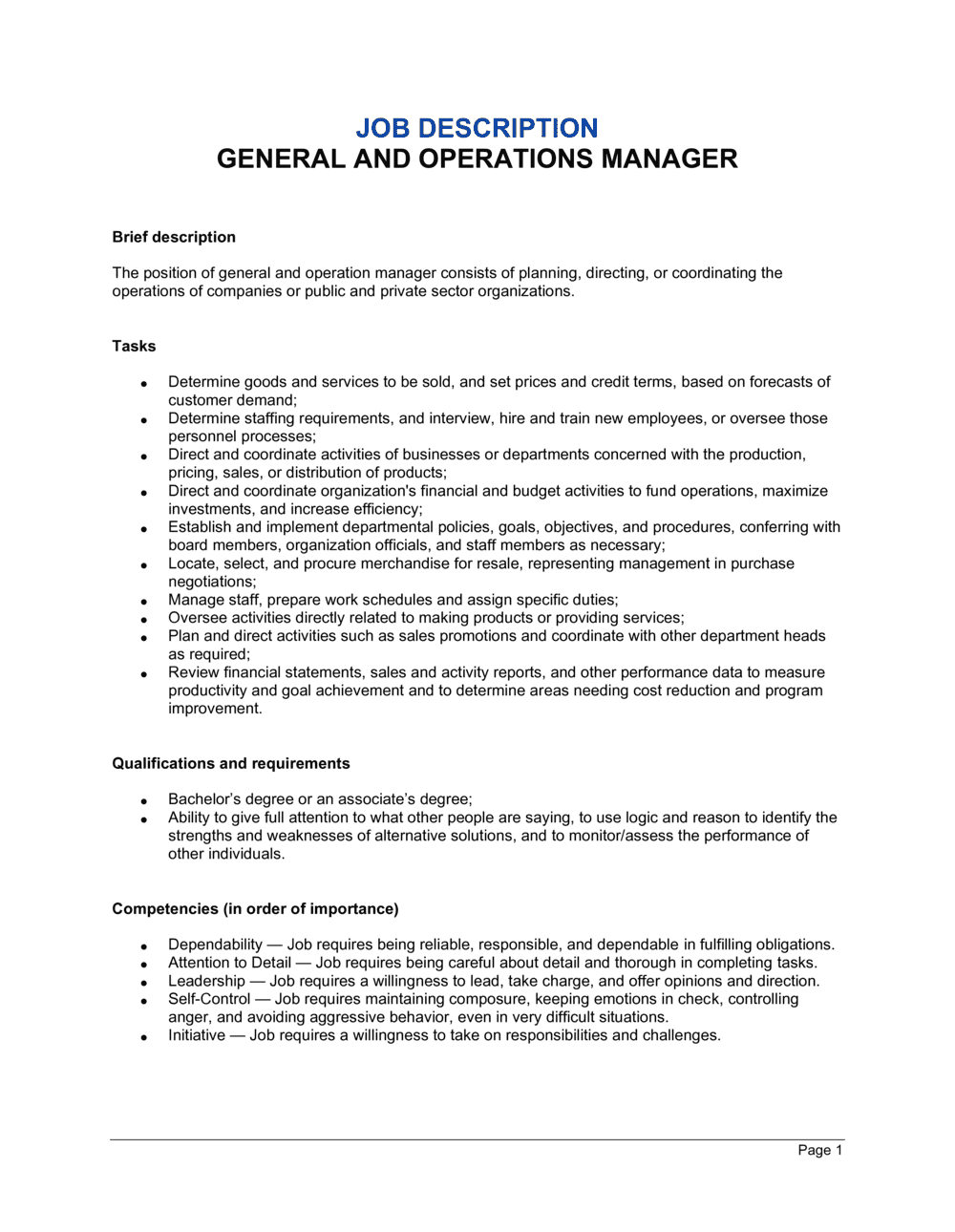
General and Operations Manager Job Description Template

Free Word download • Edit online • Save & share with Drive • Export to PDF

2 pages20–30 min to fillDifficulty: StandardSignature requiredLegal review recommended
Learn more ↓
FreeGeneral and Operations Manager Job Description Template

At a glance

What it is
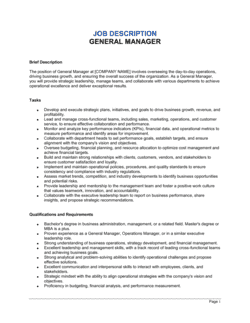
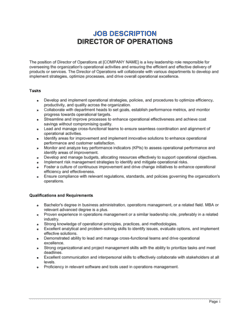
A General and Operations Manager Job Description is a formal document that defines the scope, duties, reporting structure, qualifications, and compensation expectations for a senior management role responsible for overseeing day-to-day business operations. This free Word download gives you a structured, legally grounded starting point you can edit online and export as PDF to attach to an employment offer or post on job boards.
When you need it
Use it when hiring or promoting into a General or Operations Manager role, when restructuring reporting lines, or when formalizing an existing manager's responsibilities to reduce ambiguity about authority and accountability.
What's inside
Role summary, core duties and responsibilities, authority and reporting structure, performance standards, required and preferred qualifications, compensation and benefits overview, work schedule and travel requirements, and acknowledgment signature block.

What is a General and Operations Manager Job Description?

A General and Operations Manager Job Description is a formal document that defines the scope, duties, reporting structure, qualifications, and performance expectations for a senior management role responsible for overseeing the day-to-day operational functions of a business or division. It identifies the role's place in the organizational hierarchy, establishes the limits of independent authority — including budget approval thresholds — and sets the measurable KPIs against which the role holder will be evaluated. Unlike a casual summary, a properly drafted job description creates a documented baseline for performance management, supports lawful termination for cause, and satisfies the written disclosure obligations that apply in an increasing number of jurisdictions.

Why You Need This Document

Without a written, signed job description, an operations or general manager hire operates in a documented vacuum that creates risk on three fronts simultaneously. First, undefined authority thresholds expose the company to unauthorized expenditures — a manager who has never been told their approval limit may commit to vendor contracts or capital purchases the company cannot absorb. Second, the absence of documented KPIs and duties makes performance management and termination for cause difficult to defend against wrongful-dismissal claims, particularly in Canada and the UK where common-law notice entitlements are substantial. Third, in Colorado, California, New York, and Washington, job postings without a salary range violate pay-transparency laws that carry fines per non-compliant listing. This template gives you a legally grounded, editable starting point that closes all three gaps — so the first conversation about performance, authority, or compensation has a written document to anchor it.

Which variant fits your situation?

If your situation is…Use this template
Hiring a general manager for a single retail or service locationStore General Manager Job Description
Defining an operations role limited to supply chain and logisticsSupply Chain Manager Job Description
Onboarding a C-suite Chief Operating Officer with board accountabilityChief Operating Officer Job Description
Hiring a plant or facility manager in a manufacturing settingPlant Manager Job Description
Defining an entry-level operations coordinator roleOperations Coordinator Job Description
Creating a job description for a project-based operations contractorIndependent Contractor Agreement
Formalizing the full employment relationship after the description is acceptedEmployment Contract

Common mistakes to avoid

❌ Omitting the 'not a contract' disclaimer

Why it matters: A detailed job description with specific duties and compensation can be interpreted as an implied employment contract in some jurisdictions, limiting the employer's ability to modify duties or terminate at will.

Fix: Add a clear disclaimer above the signature block: 'This job description is not a contract of employment and may be modified by [COMPANY NAME] at any time with reasonable notice.'

❌ Using vague, aspirational duties with no measurable outputs

Why it matters: Performance management and termination for cause both depend on documented, specific expectations — aspirational language ('drive operational excellence') provides no legal or managerial footing.

Fix: Replace aspirational phrases with action verbs tied to specific systems or metrics: 'Manages a $[X] operational budget and reports monthly variance to the CFO.'

❌ Publishing without a pay range in a pay-transparency jurisdiction

Why it matters: Colorado, California, New York, and Washington require salary ranges in job postings. Non-compliant postings generate regulatory complaints and can result in fines starting at $500 per violation.

Fix: Check the work location against current pay-transparency laws and include a salary range before posting. When hiring remotely, apply the most restrictive jurisdiction's rules.

❌ Setting degree requirements without operational justification

Why it matters: A blanket four-year degree requirement that disproportionately screens out a protected class without a bona fide operational basis constitutes potential disparate impact discrimination under Title VII.

Fix: State the specific knowledge or skill the degree requirement is a proxy for, and consider whether equivalent experience satisfies the same need — e.g., 'Bachelor's degree or 7+ years of equivalent management experience.'

❌ Not documenting budget authority thresholds

Why it matters: Without a stated approval limit, a general or operations manager may commit to vendor contracts, capital expenditures, or hiring decisions the employer did not intend to authorize.

Fix: Add a single sentence in the reporting structure section: 'The role holder may approve expenditures up to $[AMOUNT] independently; amounts above this threshold require written approval from [TITLE].'

❌ Skipping the acknowledgment signature block

Why it matters: Without a signed acknowledgment, the employer cannot demonstrate the employee received and understood the job description — weakening performance management and potential for-cause termination cases.

Fix: Add signature lines for the employee and an HR or management representative, collect them before the start date, and file the signed copy in the employee's personnel file.

The 10 key clauses, explained

Role Summary and Purpose

In plain language: A 3–5 sentence overview of why the role exists, what business problem it solves, and how it fits within the organization's leadership structure.

Sample language
The General and Operations Manager is responsible for overseeing the daily operations of [COMPANY NAME], ensuring that business functions across [DEPARTMENTS] are executed efficiently, on budget, and in alignment with company objectives as directed by [REPORTING TITLE].

Common mistake: Writing a role summary that duplicates the job title without explaining context — hiring managers and candidates cannot assess fit, and courts cannot assess whether duties match compensation classification.

Core Duties and Responsibilities

In plain language: A numbered or bulleted list of the primary tasks the role holder is accountable for — typically 8–15 specific actions, not vague aspirations.

Sample language
Responsibilities include: (1) overseeing daily operations across [DEPARTMENTS]; (2) managing a team of [NUMBER] direct reports; (3) monitoring and reporting on KPIs including [METRIC 1] and [METRIC 2]; (4) managing an operational budget of up to $[AMOUNT]; (5) identifying and implementing process improvements.

Common mistake: Using purely aspirational language ('champion a culture of excellence') with no measurable responsibilities. Vague duties make performance management and lawful termination for cause significantly harder to defend.

Reporting Structure and Authority

In plain language: States who the role reports to, who reports to the role holder, and the limits of independent decision-making authority — especially budget approval thresholds.

Sample language
This role reports directly to [TITLE / CEO / COO]. The General and Operations Manager has direct authority over the following teams: [LIST]. Expenditures up to $[AMOUNT] may be approved independently; expenditures above this threshold require approval from [TITLE].

Common mistake: Omitting budget authority thresholds. Without a stated approval limit, the manager may commit the company to significant expenditures the employer did not intend to authorize.

Performance Standards and KPIs

In plain language: Defines the measurable outcomes by which the role holder's success will be evaluated — typically tied to cost reduction targets, throughput, customer satisfaction scores, or headcount metrics.

Sample language
Performance will be evaluated quarterly against: (a) operational cost variance within [X]% of budget; (b) on-time delivery rate of [X]%; (c) employee retention rate of [X]% within direct reports; (d) customer satisfaction score above [X].

Common mistake: Listing no performance standards at all. Without documented metrics, annual reviews become subjective, and termination for poor performance is difficult to defend against wrongful-dismissal claims.

Required Qualifications

In plain language: The minimum education, experience, certifications, and skills an applicant must possess — these must be directly tied to the job's legitimate requirements to comply with anti-discrimination law.

Sample language
Required: Bachelor's degree in Business Administration, Operations Management, or a related field; minimum [X] years of progressive management experience in [INDUSTRY]; demonstrated experience managing teams of [X]+ employees; proficiency in [TOOLS / SYSTEMS].

Common mistake: Requiring a four-year degree for a role that does not genuinely require it. Courts and the EEOC have found blanket degree requirements that screen out protected classes — without operational justification — can constitute disparate impact discrimination.

Preferred Qualifications

In plain language: Secondary attributes that differentiate stronger candidates but are not grounds for disqualification — MBA, specific industry certifications, bilingual ability, or experience with particular software.

Sample language
Preferred: MBA or graduate degree in a related field; [CERTIFICATION] certification; experience in [SPECIFIC INDUSTRY]; proficiency in [SOFTWARE PLATFORM]; bilingual fluency in [LANGUAGE].

Common mistake: Listing preferred qualifications that are indistinguishable from required qualifications. When every preferred item appears in the required list, the distinction loses legal meaning and confuses applicants.

Compensation, Benefits, and Classification

In plain language: States the salary range or pay grade, bonus eligibility, benefit enrollment, FLSA classification, and whether the role is full-time, part-time, or contract.

Sample language
Compensation: $[MIN] – $[MAX] annually, commensurate with experience. Bonus: eligible for up to [X]% of base salary annually. Classification: Exempt, Full-Time. Benefits: health, dental, and vision insurance; [X] days PTO; 401(k) with [X]% employer match.

Common mistake: Omitting the salary range entirely in jurisdictions that legally require disclosure. Colorado, New York, California, and Washington mandate pay-range disclosure in job postings — non-compliance results in regulatory penalties.

Work Schedule, Location, and Travel

In plain language: Specifies whether the role is on-site, remote, or hybrid; standard working hours; and any travel requirement expressed as a percentage or frequency.

Sample language
This is a full-time, on-site role based at [LOCATION]. Standard hours are Monday–Friday, [START TIME]–[END TIME]. Up to [X]% travel may be required to visit [CLIENT SITES / BRANCH LOCATIONS / VENDORS].

Common mistake: Not stating travel requirements upfront. An employee who later refuses a required travel obligation — undisclosed in the job description — may have grounds to treat the demand as a unilateral change to their employment terms.

Equal Employment Opportunity Statement

In plain language: A legally required declaration that the employer does not discriminate on the basis of protected characteristics in hiring, compensation, promotion, or any other term of employment.

Sample language
[COMPANY NAME] is an equal opportunity employer. We do not discriminate on the basis of race, color, religion, sex, national origin, age, disability, veteran status, sexual orientation, gender identity, or any other characteristic protected by applicable federal, state, or local law.

Common mistake: Using a generic EEO statement that does not include all protected characteristics required by the jurisdiction's applicable laws — state and local laws frequently extend beyond federal EEOC protections.

Acknowledgment and Signature Block

In plain language: A section where the employee or candidate acknowledges they have read, understood, and received a copy of the job description — with date and signature lines for both parties.

Sample language
I, [EMPLOYEE NAME], acknowledge that I have received, read, and understood this job description. I understand that this document is not a contract of employment and that my duties may be modified by [COMPANY NAME] with reasonable notice. Signature: __________ Date: __________

Common mistake: Omitting the disclaimer that the job description is not an employment contract. Without it, a detailed job description can be construed as an implied contract of employment in some jurisdictions.

How to fill it out

  1. 1

    Define the role's purpose in the organizational context

    Write a 3–5 sentence role summary that explains why this position exists, which business function it oversees, and to whom it is accountable. Avoid restating the job title.

    💡 Align the role summary with the language in your existing org chart — inconsistencies between documents can create authority disputes later.

  2. 2

    List specific, measurable responsibilities

    Write 8–12 concrete duties using action verbs — 'manages,' 'approves,' 'monitors,' 'reports.' Tie each duty to a business outcome or system where possible.

    💡 Group duties by function (e.g., financial oversight, team management, vendor relations) to make the description easier for candidates to scan and for courts to evaluate.

  3. 3

    Set the reporting structure and authority limits

    Name the direct supervisor title, list the teams or positions that report to this role, and state the independent budget approval threshold in dollar terms.

    💡 A budget authority clause protects the company from unauthorized expenditures — use a specific dollar figure, not a vague phrase like 'reasonable expenses.'

  4. 4

    Define performance standards and KPIs

    Add at least three to five quantifiable performance indicators with baseline targets. Tie them to the core responsibilities listed in step 2.

    💡 Use KPIs that are already tracked in your existing reporting systems — a KPI you cannot measure is unenforceable in a performance-improvement context.

  5. 5

    Draft required and preferred qualifications separately

    List only qualifications with a direct, demonstrable connection to the job's duties under 'Required.' Everything else goes under 'Preferred.' Review each requirement against EEOC guidance on disparate impact.

    💡 Have HR or legal review the qualifications list before publishing — blanket degree or experience requirements with no operational justification are the most common source of EEOC complaints on job postings.

  6. 6

    Enter compensation, classification, and benefits

    State the salary range, FLSA classification (exempt or non-exempt), bonus structure, and benefits summary. Check your jurisdiction's pay-transparency disclosure requirements before publishing.

    💡 Exempt classification for an operations manager is standard under the FLSA executive exemption, but confirm the salary meets the current federal threshold ($684/week as of 2025) and any higher state minimum.

  7. 7

    Add the EEO statement and signature block

    Insert your organization's standard EEO statement and add signature lines for both the employer representative and the employee or candidate. Include the 'not a contract' disclaimer above the signature.

    💡 Collect the signed acknowledgment before the employee's first day — it closes the loop on notice that they received and understood the role expectations.

  8. 8

    Review with legal or HR before posting or issuing

    Have a legal or HR professional review the final document against federal, state or provincial, and local employment laws applicable to your jurisdiction before posting the role or attaching it to an offer.

    💡 In jurisdictions requiring pay-range disclosure (CO, NY, CA, WA), publishing without a range exposes the company to regulatory complaints — even for internal postings.

Frequently asked questions

What does a General and Operations Manager do?

A General and Operations Manager oversees the daily operational functions of a business — coordinating across departments such as finance, HR, production, and logistics to ensure the organization runs efficiently and meets its performance targets. They typically manage direct reports, control an operational budget, report to senior leadership, and are accountable for measurable outcomes like cost variance, throughput, and staff retention. The scope varies by company size, but the role is consistently one of the most cross-functional in any organization.

Is a job description a legally binding document?

A job description is not typically a binding contract of employment on its own — but it can create implied obligations if drafted carelessly. In some jurisdictions, courts have found that detailed descriptions with specific compensation and duties amount to an implied contract, limiting the employer's flexibility to modify the role or terminate the employee. Including a clear 'not a contract' disclaimer and pairing the job description with a formal employment agreement closes this gap.

What qualifications should I require for a General and Operations Manager?

Most employers require a bachelor's degree in business, operations, or a related field and a minimum of 5–10 years of progressive management experience. Required qualifications should have a direct, demonstrable connection to the role's duties to avoid disparate impact discrimination claims. Preferred qualifications might include an MBA, relevant industry certifications, or specific software proficiency. Always review requirements against EEOC guidance before posting.

Do I need to disclose salary in a job description?

In an increasing number of US states — including Colorado, California, New York, and Washington — pay transparency laws require employers to include a salary range in any public job posting. Even for internal postings, some states require disclosure. In Canada, Ontario and British Columbia have introduced pay transparency requirements. Check the applicable laws for every jurisdiction in which the role may be filled before publishing.

Can I modify a job description after the employee is hired?

In most at-will jurisdictions, an employer can modify duties and responsibilities with reasonable notice, provided the changes are not so dramatic as to constitute constructive dismissal. Including a clause in the job description and employment contract that explicitly reserves the employer's right to modify duties with notice — and having the employee sign the acknowledgment — protects the employer's flexibility. In Canada and the UK, material changes without consent may constitute a breach of contract.

What is the difference between a General Manager and a Chief Operating Officer?

A General and Operations Manager typically oversees day-to-day operational execution within a defined scope — a division, location, or function. A Chief Operating Officer (COO) is a C-suite executive with company-wide operational authority, typically reporting to the CEO and accountable to the board. The COO role involves strategic leadership, executive team management, and often investor or board accountability that falls outside the general manager's remit.

What FLSA classification applies to a General and Operations Manager?

A General and Operations Manager typically qualifies for the FLSA executive exemption — meaning the role is classified as exempt from overtime requirements — provided the employee is paid on a salary basis of at least $684 per week (the 2025 federal threshold), their primary duty is managing the enterprise or a recognized department, they customarily direct two or more employees, and they have authority to hire, fire, or provide meaningful input into such decisions. Always verify classification with HR or legal counsel, as some states impose higher salary thresholds.

Should the job description be attached to the employment contract?

Yes, attaching the signed job description to the employment contract — or referencing it as a schedule — creates a complete record of the agreed role expectations. This is especially important for a senior management role where duties, authority, and KPIs are material to compensation and performance evaluations. Have both documents signed before the employee's start date to ensure the acknowledgment constitutes valid consideration in common-law jurisdictions.

How often should a General and Operations Manager job description be updated?

Review and update the job description at least annually or whenever there is a material change to the role's duties, reporting structure, compensation, or required qualifications. Stale job descriptions that no longer reflect actual duties create risk in performance reviews, termination proceedings, and EEOC audits. Collect a new signed acknowledgment from the employee each time a material update is made.

How this compares to alternatives

vs Employment Contract

An employment contract is a legally binding agreement governing the entire employment relationship — compensation, IP assignment, non-compete, confidentiality, and termination. A job description defines the scope of the role and performance expectations. The job description is typically attached to the employment contract as a schedule, not used in its place. Relying on a job description alone leaves critical legal protections unaddressed.

vs Executive Employment Agreement

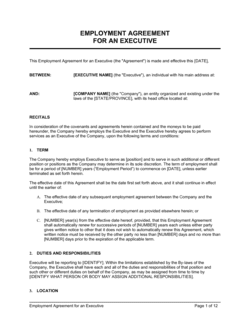
An executive employment agreement governs C-suite hires with equity, enhanced severance, change-of-control provisions, and board accountability. A General and Operations Manager job description is appropriate for senior operational roles that fall below C-suite level. For COO or VP-Operations hires with equity and material severance exposure, an executive agreement should be used alongside the job description.

vs Independent Contractor Agreement

An independent contractor agreement engages a self-employed individual for project-based operational work without creating an employment relationship. A job description is used for employees — it establishes duties, reporting lines, and performance standards that imply the behavioral control characteristic of employment. Using a job description with a contractor can be evidence of misclassification.

vs Offer Letter

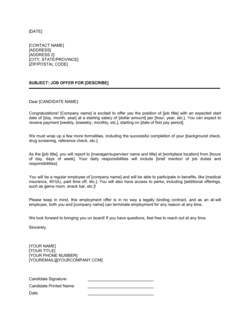
An offer letter confirms compensation and role title to secure a candidate's acceptance. A job description provides the full scope of duties, authority, qualifications, and performance expectations. Both documents should be issued together — the offer letter references the job description, and the signed acknowledgment confirms the candidate received and understood the full role expectations before starting.

Industry-specific considerations

Manufacturing

Emphasis on production throughput, shift scheduling, safety compliance, and supplier management within a defined plant or facility scope.

Retail and E-commerce

Multi-location oversight, inventory management, loss prevention, and customer experience KPIs tied to same-store sales performance.

Healthcare

Regulatory compliance with HIPAA and Joint Commission standards, credentialing oversight, and coordination across clinical and administrative departments.

Professional Services

Billable utilization targets, practice group coordination, client delivery oversight, and staff development requirements specific to licensed professionals.

Hospitality and Food Service

Revenue-per-available-room or covers-per-service metrics, health code compliance, and high-turnover workforce management across front- and back-of-house teams.

Technology and SaaS

Cross-functional coordination between engineering, product, and customer success; vendor and infrastructure cost management; and remote or distributed team oversight.

Jurisdictional notes

United States

The FLSA executive exemption covers most General and Operations Managers if the salary threshold ($684/week federally as of 2025) is met and management is the primary duty. Several states — California, New York, Colorado, and Washington — impose higher salary thresholds and mandatory pay-range disclosure in job postings. EEOC guidance requires that all stated qualifications be job-related and consistent with business necessity to avoid disparate impact liability.

Canada

Canadian provinces set their own employment standards governing overtime exemptions for managers — in Ontario, a manager exempt from overtime must have genuine supervisory authority, not merely a managerial title. British Columbia and Ontario have enacted pay-transparency legislation requiring salary ranges in publicly posted positions. Quebec requires all employment documents issued to provincially regulated employees to be available in French.

United Kingdom

UK employers must provide a written statement of particulars — which may reference a job description — on or before the employee's first day under the Employment Rights Act 1996. Job descriptions should avoid language that could constitute indirect discrimination under the Equality Act 2010. The Working Time Regulations 1998 limit average weekly hours to 48 unless the employee opts out, which is relevant for senior operational roles with variable schedules.

European Union

The EU Transparent and Predictable Working Conditions Directive requires employers to provide written information about the job — including duties and remuneration — within seven calendar days of the start date. Many member states, including Germany and France, have works council consultation obligations before a new management role is created or materially changed. Pay transparency obligations under EU Directive 2023/970 require employers to disclose salary ranges in job postings starting in 2026.

Template vs lawyer — what fits your deal?

PathBest forCostTime
Use the templateSmall businesses and HR teams hiring standard operational management roles in a single US state or Canadian provinceFree30–60 minutes
Template + legal reviewMulti-state or cross-border roles, companies in pay-transparency jurisdictions, or roles with significant budget authority$200–$500 for an HR or employment counsel review1–3 days
Custom draftedRegulated industries (healthcare, financial services), senior roles with equity or complex authority structures, or companies with documented EEOC exposure$500–$2,000+1–2 weeks

Glossary

Job Description
A formal document listing the duties, qualifications, reporting relationships, and performance expectations for a specific role within an organization.
Scope of Authority
The boundaries of a manager's decision-making power — which actions they may take unilaterally, which require approval, and what budget they control.
KPIs (Key Performance Indicators)
Quantifiable metrics used to evaluate whether a role holder is achieving the objectives set out in the job description.
Exempt vs. Non-Exempt
US FLSA classification determining overtime eligibility — exempt employees (typically salaried managers) are not entitled to overtime pay; non-exempt employees must receive 1.5× their rate for hours over 40 per week.
At-Will Employment
A US employment doctrine allowing either the employer or employee to end the working relationship at any time for any lawful reason without cause.
BFOQ (Bona Fide Occupational Qualification)
A legally recognized requirement that an employee must meet to perform a job — the only basis on which an otherwise protected characteristic may be used in a hiring decision.
Reporting Structure
The defined chain of command showing who a role reports to directly and who reports to the role holder.
Direct Reports
Employees who report directly to the manager named in the job description, whose performance the manager is accountable for overseeing.
Total Compensation
All forms of pay and benefits received by an employee — base salary, bonus, equity, health benefits, retirement contributions, and perquisites combined.
FLSA (Fair Labor Standards Act)
The US federal law establishing minimum wage, overtime pay, recordkeeping, and child-labor standards applicable to most private and public employers.

Part of your Business Operating System

This document is one of 3,000+ business & legal templates included in Business in a Box.

  • Fill-in-the-blanks — ready in minutes
  • 100% customizable Word document
  • Compatible with all office suites
  • Export to PDF and share electronically

Create your document in 3 simple steps.

From template to signed document — all inside one Business Operating System.
1
Download or open template

Access over 3,000+ business and legal templates for any business task, project or initiative.

2
Edit and fill in the blanks with AI

Customize your ready-made business document template and save it in the cloud.

3
Save, Share, Send, Sign

Share your files and folders with your team. Create a space of seamless collaboration.

Save time, save money, and create top-quality documents.

★★★★★

"Fantastic value! I'm not sure how I'd do without it. It's worth its weight in gold and paid back for itself many times."

Managing Director · Mall Farm
Robert Whalley
Managing Director, Mall Farm Proprietary Limited
★★★★★

"I have been using Business in a Box for years. It has been the most useful source of templates I have encountered. I recommend it to anyone."

Business Owner · 4+ years
Dr Michael John Freestone
Business Owner
★★★★★

"It has been a life saver so many times I have lost count. Business in a Box has saved me so much time and as you know, time is money."

Owner · Upstate Web
David G. Moore Jr.
Owner, Upstate Web

Run your business with a system — not scattered tools

Stop downloading documents. Start operating with clarity. Business in a Box gives you the Business Operating System used by over 250,000 companies worldwide to structure, run, and grow their business.

Free Forever Plan · No credit card required