Understanding Small Business Loans Template

Free Word download • Edit online • Save & share with Drive • Export to PDF

5 pages25–35 min to fillDifficulty: ComplexSignature requiredLegal review recommended
Learn more ↓
FreeUnderstanding Small Business Loans Template

At a glance

What it is
A Small Business Loan Agreement is a legally binding contract between a lender and a borrowing business that governs the terms of a loan — including the principal amount, interest rate, repayment schedule, collateral, covenants, and default remedies. This free Word download gives you a professionally structured starting point you can edit online and export as PDF to formalize any business lending arrangement.
When you need it
Use it whenever a business borrows money from a bank, credit union, private lender, or even a family member or business partner — any situation where the loan terms need to be documented in a binding, enforceable form.
What's inside
Loan amount and disbursement terms, interest rate and calculation method, repayment schedule and amortization, collateral and security interests, financial covenants and reporting obligations, events of default and lender remedies, prepayment terms, and governing law.

What is a Small Business Loan Agreement?

A Small Business Loan Agreement is a legally binding contract between a lender and a borrowing business that formally documents every material term of a loan: the principal amount, interest rate and calculation method, repayment schedule, collateral and security interests, financial covenants, events of default, and the lender's remedies if the borrower fails to perform. Unlike an informal promissory note, a full loan agreement covers the entire lifecycle of the lending relationship — from disbursement conditions through to payoff or enforcement — and creates enforceable obligations on both parties that courts can interpret and uphold.

Why You Need This Document

Advancing or receiving business funds without a written loan agreement exposes both sides to serious risk. A lender without a signed agreement has no documented right to collateral, no defined default triggers, and no clear repayment terms to enforce in court — a dispute becomes a credibility contest rather than a contract interpretation. A borrower without a written agreement has no protection against a lender changing terms, demanding early repayment, or claiming additional fees not originally discussed. Beyond the relationship risk, unperfected security interests — those not documented and filed correctly — are voided in bankruptcy, leaving an unsecured lender at the back of the queue. For SBA and institutional loans, missing or incomplete documentation can trigger technical default under the lender's own credit policy. This template gives both lenders and borrowers a professionally structured, jurisdiction-aware starting point that covers every essential clause, so the agreement reflects what was actually negotiated — not what each party remembers.

Which variant fits your situation?

If your situation is…Use this template
Term loan for equipment purchase or capital expenditureEquipment Financing Agreement
Revolving credit facility with a draw-down mechanismBusiness Line of Credit Agreement
Short-term bridge loan to cover a cash flow gapShort-Term Business Loan Agreement
Loan from a shareholder or director to the companyShareholder Loan Agreement
SBA-backed loan with government guarantee provisionsSBA Loan Agreement Addendum
Loan convertible to equity at a future funding roundConvertible Note Agreement
Real estate secured commercial mortgage loanCommercial Mortgage Agreement

Common mistakes to avoid

❌ No collateral description or vague 'all assets' language

Why it matters: A security interest in 'all assets' without a specific collateral schedule may not be perfectable under the UCC or equivalent legislation, leaving the lender unsecured in the event of the borrower's insolvency.

Fix: Attach a collateral schedule that identifies assets by category and, where applicable, by serial number, account number, or address — specific enough to satisfy UCC Article 9 or the applicable provincial PPSA requirements.

❌ Omitting a cross-default clause

Why it matters: If the borrower defaults on a separate line of credit or trade debt, the lender has no early warning right and may rank behind other creditors who accelerate first.

Fix: Include a cross-default provision triggered by any default on indebtedness exceeding a defined threshold — typically $[25,000]–$[50,000] for small business loans — giving the lender the right to accelerate in concert.

❌ Signing after disbursement has already occurred

Why it matters: A loan agreement signed after funds are transferred creates a fresh-consideration problem in common-law jurisdictions — restrictive covenants, guarantee obligations, and security interest grants may be voidable.

Fix: Execute the agreement on or before the disbursement date. If funds were advanced informally, document the advance separately and have the borrower acknowledge it as the consideration for the agreement.

❌ No cure period for covenant defaults

Why it matters: Without a cure period, a technical covenant breach — such as a delayed financial report — automatically triggers acceleration, potentially destroying an otherwise healthy borrower relationship and exposing the lender to wrongful acceleration claims.

Fix: Add a 30-day cure period for non-payment defaults and a 10-business-day cure period for reporting failures, with notice requirements before the lender may accelerate.

The 10 key clauses, explained

Loan Amount and Disbursement

In plain language: States the exact principal amount being lent, how and when funds will be disbursed to the borrower, and any conditions that must be met before disbursement.

Sample language
Lender agrees to loan Borrower the principal sum of $[LOAN AMOUNT] ('Loan'), to be disbursed in [one lump sum / installments of $[AMOUNT]] on or before [DISBURSEMENT DATE], subject to satisfaction of the conditions set out in Schedule A.

Common mistake: Leaving disbursement conditions vague or unstated — if conditions precedent are not defined, the lender may be contractually obligated to fund even when the borrower's circumstances have materially changed.

Interest Rate and Calculation

In plain language: Specifies whether the rate is fixed or variable, the exact percentage, the calculation basis (daily, monthly, or annual), and any rate change triggers for variable loans.

Sample language
The Loan shall bear interest at a [fixed / variable] rate of [X]% per annum, calculated on the basis of a 365-day year on the outstanding principal balance. [For variable: the rate shall adjust quarterly based on the [PRIME RATE / SOFR] plus [X] basis points.]

Common mistake: Stating an interest rate without specifying the calculation basis — a rate 'of 12% per annum' applied on a 360-day bank year versus a 365-day year produces a different effective cost and can generate disputes at payoff.

Repayment Schedule

In plain language: Sets the payment amount, frequency, due dates, and whether payments are interest-only for a period before full amortization begins.

Sample language
Borrower shall repay the Loan in [X] equal monthly installments of $[PAYMENT AMOUNT], beginning on [FIRST PAYMENT DATE] and continuing on the same day of each month thereafter, with a final balloon payment of $[AMOUNT] due on [MATURITY DATE].

Common mistake: Omitting a payment allocation clause specifying how payments are applied — payments should apply first to fees, then to accrued interest, then to principal; without this, disputes arise about the remaining balance.

Collateral and Security Interest

In plain language: Identifies any assets pledged as security for the loan and authorizes the lender to perfect its security interest through appropriate filings.

Sample language
To secure repayment of the Loan, Borrower hereby grants Lender a first-priority security interest in [COLLATERAL DESCRIPTION — e.g., all accounts receivable, inventory, and equipment of Borrower]. Borrower authorizes Lender to file UCC-1 financing statements to perfect such interest.

Common mistake: Describing collateral in vague terms like 'business assets' without a specific schedule — courts require reasonable identification of collateral for a security interest to be enforceable against third parties.

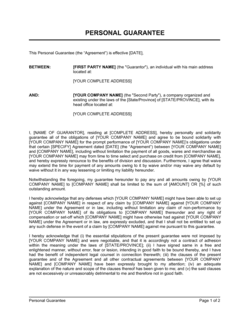
Personal Guarantee

In plain language: Requires one or more business owners or principals to personally guarantee repayment if the business defaults, making them individually liable for the outstanding balance.

Sample language
As a condition of the Loan, [GUARANTOR NAME], in his/her individual capacity, unconditionally and irrevocably guarantees the full and prompt payment and performance of all obligations of Borrower under this Agreement ('Personal Guarantee').

Common mistake: Including personal guarantee language in the loan body without a separate, signed guarantee instrument — for larger loans, lenders should execute a standalone guarantee agreement to ensure the guarantor's intent is clearly documented.

Financial Covenants and Reporting

In plain language: Defines the financial ratios the borrower must maintain (e.g., minimum DSCR) and the reports the borrower must deliver to the lender on an ongoing basis.

Sample language
Borrower shall (a) maintain a Debt Service Coverage Ratio of not less than [1.25]:1.0, tested [quarterly / annually]; (b) deliver audited financial statements within [90] days of each fiscal year end; and (c) provide monthly management accounts within [30] days of each month end.

Common mistake: Setting covenant thresholds without a cure period — a single quarter below the minimum DSCR can trigger technical default; include a 30-day cure window for first breaches to avoid inadvertent acceleration.

Events of Default and Remedies

In plain language: Lists the specific events that constitute a default and the lender's rights on default — including acceleration, enforcement against collateral, and recovery of legal costs.

Sample language
Each of the following constitutes an Event of Default: (a) failure to pay any amount due within [10] days of its due date; (b) material breach of any covenant not cured within [30] days of notice; (c) insolvency, assignment for the benefit of creditors, or commencement of bankruptcy proceedings by Borrower.

Common mistake: Using only a missed payment as an event of default and omitting material adverse change, cross-default, or insolvency triggers — leaving the lender exposed if the borrower's financial condition deteriorates before any payment is missed.

Prepayment

In plain language: States whether the borrower may repay the loan before maturity, and if so, whether a prepayment penalty applies and how it is calculated.

Sample language
Borrower may prepay the Loan in whole or in part at any time upon [X] days' written notice, subject to a prepayment fee of [X]% of the prepaid principal if prepayment occurs within [Y] months of the Disbursement Date.

Common mistake: Omitting prepayment terms entirely — without this clause, the borrower's right to prepay (and any associated fee) is ambiguous, which can create conflict if the borrower refinances or sells the business.

Representations and Warranties

In plain language: The borrower's formal statements of fact at the time of signing — covering legal existence, authority to borrow, no undisclosed liabilities, and accuracy of financial statements provided.

Sample language
Borrower represents and warrants that: (a) it is duly organized and in good standing in [STATE / PROVINCE]; (b) it has full authority to execute this Agreement; (c) the financial statements provided to Lender are true and accurate in all material respects; and (d) no litigation is pending that would materially affect Borrower's ability to repay.

Common mistake: Limiting representations to the signing date without a 'bring-down' provision — without it, the lender has no contractual recourse if a representation was already false when the loan was made.

Governing Law and Dispute Resolution

In plain language: Specifies which jurisdiction's law governs the agreement and the forum — arbitration or court — for resolving any disputes that arise.

Sample language
This Agreement shall be governed by and construed in accordance with the laws of the State of [STATE], without regard to conflict of laws principles. Any dispute shall be resolved by binding arbitration administered by [AAA / JAMS] in [CITY], except that Lender may seek injunctive or other equitable relief in any court of competent jurisdiction.

Common mistake: Choosing a governing law state with no meaningful connection to either party's operations — some state courts apply local consumer protection statutes to business loans made to residents, overriding a choice-of-law clause.

How to fill it out

  1. 1

    Identify both parties with full legal names

    Enter the lender's full legal name and address and the borrower's registered legal entity name, state of incorporation, and principal place of business. Do not use trade names or DBA names in the operative clauses.

    💡 Cross-check the borrower's name against the secretary of state filing to confirm the entity is in good standing before executing.

  2. 2

    Define the loan amount and disbursement conditions

    Enter the exact principal amount and the disbursement mechanics — single draw or multiple tranches. List any conditions the borrower must satisfy before each disbursement in Schedule A.

    💡 For multi-tranche loans, tie each disbursement to a specific, measurable milestone rather than a calendar date to protect the lender's position.

  3. 3

    Set the interest rate, calculation basis, and APR

    Choose fixed or variable rate, enter the exact percentage, and specify the day-count convention (365 or 360). Calculate the APR — including origination fees — and disclose it in the agreement to comply with truth-in-lending requirements.

    💡 For variable-rate loans, name the specific index (SOFR, prime rate) and the spread in basis points rather than a vague 'market rate' reference.

  4. 4

    Build the repayment schedule

    Set the payment amount, frequency, and first payment date. Attach a full amortization schedule as an exhibit showing each payment's split between principal and interest. If there is a balloon payment, state the maturity date and amount explicitly.

    💡 Use an amortization calculator to verify the schedule — rounding errors across 60 monthly payments can create a material discrepancy at the balloon.

  5. 5

    Describe collateral and authorize security filings

    Identify collateral by category and specific item where possible. Include authorization for the lender to file a UCC-1 financing statement. If real property is involved, describe the lien structure separately and reference a deed of trust or mortgage instrument.

    💡 File the UCC-1 within 3 business days of signing — priority is determined by filing date, not contract date.

  6. 6

    Calibrate financial covenants to the borrower's actual financials

    Review the borrower's last two years of financials before setting covenant thresholds. A DSCR minimum of 1.25x is standard for SBA loans; adjust for the borrower's industry and cash flow volatility.

    💡 Include a 30-day cure period for first-time covenant breaches — it reduces lender liability for wrongful acceleration and gives performing borrowers a safety valve.

  7. 7

    Attach personal guarantee instruments separately

    If a personal guarantee is required, execute it as a standalone signed exhibit — do not rely solely on the guarantee language embedded in the loan body. The guarantor should sign both the loan agreement and the separate guarantee.

    💡 Have the guarantor sign in front of a notary if the loan exceeds $250,000 — some jurisdictions require notarization for guarantees to be enforceable.

  8. 8

    Execute before any funds are disbursed

    Both parties must sign the agreement, and all exhibits (amortization schedule, collateral description, personal guarantee) must be attached before any money changes hands. Date the agreement to match the actual signing date.

    💡 Use a dated execution block for each signatory — loan agreements signed 'as of' a retroactive date can create enforceability problems and regulatory issues.

Frequently asked questions

What is a small business loan agreement?

A small business loan agreement is a legally binding contract between a lender — a bank, credit union, private lender, or individual — and a borrowing business entity that sets out all material terms of the loan: principal, interest rate, repayment schedule, collateral, covenants, events of default, and remedies. It creates enforceable obligations on both parties and is the primary document governing the lending relationship for the life of the loan.

What are the key terms in a small business loan agreement?

The essential terms are: loan amount and disbursement mechanics, interest rate and calculation basis, repayment schedule with amortization table, collateral and security interest, personal guarantee (if required), financial covenants and reporting obligations, events of default, lender remedies including acceleration, prepayment terms, and governing law. Missing any of these creates gaps courts will fill with jurisdiction-specific defaults — often unfavorable to the lender.

Do I need a lawyer to prepare a small business loan agreement?

For straightforward loans under $50,000 between known parties, a high-quality template is typically sufficient if both parties review it carefully. For loans above $100,000, secured loans involving real property, SBA-backed facilities, or cross-border arrangements, engaging a commercial lawyer for a 1–3 hour review is strongly recommended. Errors in security interest perfection or personal guarantee language can cost far more than the legal review fee.

What is a personal guarantee in a small business loan?

A personal guarantee is a commitment by a business owner or principal to repay the loan from personal assets if the business entity cannot. Most institutional lenders require personal guarantees from owners holding more than 20% equity in the borrowing entity. The SBA mandates personal guarantees from all owners with 20% or more ownership for SBA 7(a) and 504 loans. Signing a personal guarantee removes the protection of the corporate veil for that specific obligation.

What happens if a small business defaults on a loan?

Upon an event of default, the lender typically has the right to accelerate — declare the entire outstanding balance immediately due and payable — and to enforce its security interest against collateral. The lender may also call on personal guarantees, initiate collection proceedings, or file for the borrower's insolvency in extreme cases. The specific remedies and their sequencing depend on what is written in the loan agreement and the laws of the governing jurisdiction.

What is a UCC financing statement and when is it required?

A UCC financing statement (UCC-1) is a public notice filed with a state secretary of state to perfect a lender's security interest in a borrower's personal property collateral under the Uniform Commercial Code. It must be filed to protect the lender's priority claim against other creditors and in the event of the borrower's bankruptcy. Priority is determined by filing date — the first lender to file generally ranks ahead of later creditors in the same collateral. The equivalent in Canada is a PPSA registration.

What is the difference between a secured and unsecured business loan?

A secured loan is backed by collateral — specific business assets, real property, or a personal guarantee — giving the lender a legal claim against those assets if the borrower defaults. An unsecured loan relies solely on the borrower's creditworthiness with no specific collateral pledge. Secured loans typically carry lower interest rates because the lender's risk is reduced; unsecured loans are faster to close but usually limited in size and carry higher rates.

Can a small business loan agreement include a prepayment penalty?

Yes, prepayment penalties are legally permitted in most jurisdictions for commercial business loans and are common in fixed-rate term loans, SBA 504 loans, and commercial real estate financing. They compensate the lender for lost interest income when a borrower repays early. SBA 7(a) loans over 15 years carry a prepayment penalty of 5%, 3%, and 1% in the first three years. Borrowers negotiating a loan should review the prepayment provision carefully before signing, especially if a sale or refinance is anticipated within the loan term.

What financial covenants are typically included in a small business loan?

Common covenants include a minimum debt service coverage ratio (DSCR) — typically 1.25x for SBA loans — a maximum leverage ratio (total debt to EBITDA), a minimum liquidity or current ratio, and restrictions on additional indebtedness without lender consent. Reporting covenants require delivery of annual audited or reviewed financial statements, quarterly management accounts, and notice of material adverse events. Covenant packages are negotiated and should reflect the borrower's actual financial profile, not generic thresholds.

How is a business loan agreement different from a promissory note?

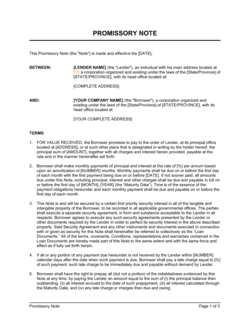
A promissory note is a shorter instrument — typically 1–3 pages — in which the borrower unconditionally promises to repay a specific sum with interest on a defined schedule. It is the borrower's payment obligation in written form. A full loan agreement is broader: it adds collateral provisions, covenants, representations and warranties, events of default, lender remedies, and governing law. For small informal loans, a promissory note may suffice; for any secured or institutional loan, a full loan agreement is required.

How this compares to alternatives

vs Promissory Note

A promissory note is a short, unconditional payment promise covering principal, interest, and repayment dates — typically 1–3 pages. A loan agreement is the comprehensive governing document that adds collateral, covenants, representations, default triggers, and lender remedies. For informal or small unsecured loans between known parties, a promissory note may be sufficient; for any secured loan or institutional facility, a full loan agreement is required.

vs Business Line of Credit Agreement

A term loan agreement disburses a fixed lump sum repaid on a set amortization schedule over a defined term. A line of credit agreement provides a revolving credit facility the borrower can draw and repay repeatedly up to a maximum limit. Term loans suit capital expenditures with predictable repayment; lines of credit suit working capital needs with variable timing.

vs Convertible Note Agreement

A convertible note is a short-term debt instrument designed to convert into equity at a future funding round — it is a financing hybrid used primarily by startups that are not yet ready to price an equity round. A standard business loan agreement is straight debt with fixed repayment and no equity component. Convertible notes carry maturity dates and conversion mechanics; loan agreements carry amortization schedules and collateral.

vs Shareholder Loan Agreement

A shareholder loan agreement documents a loan made by an owner or director to their own company — typically subordinated to senior lenders and subject to tax rules on interest imputation. A third-party business loan agreement is an arm's-length commercial transaction with market-rate terms, security interests, and financial covenants. The two documents serve different purposes and carry different tax and insolvency implications.

Industry-specific considerations

Retail and E-commerce

Inventory financing terms, seasonal payment adjustments, and borrowing base certificates tied to eligible inventory and receivables.

Food and Beverage

Equipment collateral schedules for kitchen and cold-storage assets, SBA 504 real estate components for owner-occupied restaurant premises, and health-permit compliance covenants.

Construction and Trades

Draw-based disbursement tied to project milestones, lien subordination provisions for real property collateral, and cash flow covenants calibrated to project-based revenue cycles.

Professional Services

Accounts-receivable-based collateral with eligibility criteria, billing-concentration limits, and covenant thresholds tied to billable utilization rather than inventory metrics.

Manufacturing

Equipment and machinery as primary collateral with UCC fixture filings, inventory borrowing bases, and capex covenant restrictions to protect asset quality.

Healthcare

Insurance receivables as collateral with Medicare/Medicaid assignment restrictions, licensing compliance covenants, and change-of-control provisions triggered by practice acquisition.

Jurisdictional notes

United States

Commercial loans to businesses are generally exempt from consumer truth-in-lending requirements under Regulation Z, but SBA loans carry specific documentation and guarantee requirements set by SBA Standard Operating Procedures. Security interests in personal property must be perfected by filing a UCC-1 financing statement with the secretary of state in the borrower's state of organization. Usury limits for commercial loans vary significantly by state — some states have no cap; others impose maximums that apply even to business borrowers.

Canada

Security interests in personal property are governed by provincial Personal Property Security Acts (PPSA) rather than the UCC — lenders must register a financing statement in the province where the borrower is located or the collateral is situated. The federal Canada Small Business Financing Act governs government-backed small business loans, with specific registration and asset-use requirements. Quebec-based borrowers are subject to the Civil Code of Quebec, which uses a hypothec rather than a security agreement to create security interests.

United Kingdom

Business loan agreements in the UK are generally subject to the Companies Act 2006 for corporate borrowers and regulated by the FCA where the lender is an authorized institution. Security over company assets is typically taken as a fixed or floating charge and must be registered at Companies House within 21 days of creation under section 859A of the Companies Act, or it becomes void against a liquidator. Personal guarantees from directors should include independent legal advice confirmation to reduce the risk of a guarantor challenging enforceability on grounds of undue influence.

European Union

Loan documentation requirements and security registration procedures vary significantly by member state — French loans use a nantissement for personal property security; German loans use a Sicherungsübereignung or Pfandrecht. The EU Late Payment Directive sets default interest rates for commercial transactions, and several member states apply that framework to loan agreements by analogy. Cross-border EU lending may also trigger GDPR considerations for personal data shared in credit assessments and guarantee instruments.

Template vs lawyer — what fits your deal?

PathBest forCostTime
Use the templateInformal loans under $50,000 between known parties, unsecured shareholder loans, or straightforward term loans with simple repayment schedulesFree30–60 minutes
Template + legal reviewSecured loans from $50,000–$250,000, loans with personal guarantees, or multi-covenant facilities$500–$1,5002–5 days
Custom draftedSBA or institutional loans above $250,000, real-property-secured facilities, cross-border arrangements, or complex multi-lender syndications$2,000–$8,000+1–4 weeks

Glossary

Principal
The original loan amount borrowed, before interest or fees — the amount the borrower is obligated to repay in full.
Amortization
The process of paying down a loan through scheduled installments that cover both principal and interest over the loan term.
Collateral
An asset pledged by the borrower to secure the loan — if the borrower defaults, the lender may seize the collateral to recover the outstanding balance.
Security Interest
A legal claim a lender holds over collateral, typically perfected by filing a UCC financing statement or registering under applicable law.
Personal Guarantee
A promise by a business owner or principal to be personally liable for the loan if the business entity cannot repay — removing the shield of limited liability.
Covenant
A contractual promise in a loan agreement — affirmative covenants require the borrower to do something (e.g., maintain insurance); negative covenants prohibit actions (e.g., taking on additional debt).
Event of Default
A defined trigger — such as a missed payment, breach of covenant, or insolvency — that entitles the lender to accelerate the loan and demand immediate full repayment.
Acceleration
A lender's right, upon an event of default, to declare the entire remaining loan balance immediately due and payable rather than waiting for scheduled installments.
APR (Annual Percentage Rate)
The true annual cost of a loan expressed as a percentage, including interest and fees — used for comparison across different loan products.
Prepayment Penalty
A fee charged to the borrower for repaying the loan ahead of schedule, compensating the lender for lost future interest income.
UCC Financing Statement
A public notice filed under the Uniform Commercial Code to perfect a lender's security interest in the borrower's personal property collateral.
Cross-Default
A clause stating that a default on any other debt obligation by the borrower also constitutes a default under this loan agreement.

Part of your Business Operating System

This document is one of 3,000+ business & legal templates included in Business in a Box.

  • Fill-in-the-blanks — ready in minutes
  • 100% customizable Word document
  • Compatible with all office suites
  • Export to PDF and share electronically

Create your document in 3 simple steps.

From template to signed document — all inside one Business Operating System.
1
Download or open template

Access over 3,000+ business and legal templates for any business task, project or initiative.

2
Edit and fill in the blanks with AI

Customize your ready-made business document template and save it in the cloud.

3
Save, Share, Send, Sign

Share your files and folders with your team. Create a space of seamless collaboration.

Save time, save money, and create top-quality documents.

★★★★★

"Fantastic value! I'm not sure how I'd do without it. It's worth its weight in gold and paid back for itself many times."

Managing Director · Mall Farm
Robert Whalley
Managing Director, Mall Farm Proprietary Limited
★★★★★

"I have been using Business in a Box for years. It has been the most useful source of templates I have encountered. I recommend it to anyone."

Business Owner · 4+ years
Dr Michael John Freestone
Business Owner
★★★★★

"It has been a life saver so many times I have lost count. Business in a Box has saved me so much time and as you know, time is money."

Owner · Upstate Web
David G. Moore Jr.
Owner, Upstate Web

Run your business with a system — not scattered tools

Stop downloading documents. Start operating with clarity. Business in a Box gives you the Business Operating System used by over 250,000 companies worldwide to structure, run, and grow their business.

Free Forever Plan · No credit card required