Absolute Assignment and Transfer of Loans Template

Free Word download • Edit online • Save & share with Drive • Export to PDF

6 pages30–40 min to fillDifficulty: ComplexSignature requiredLegal review recommended
Learn more ↓
FreeAbsolute Assignment and Transfer of Loans Template

At a glance

What it is
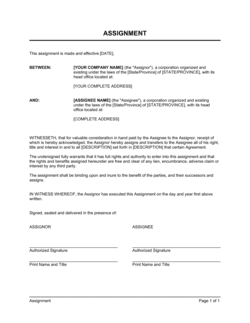
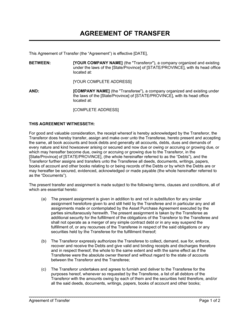
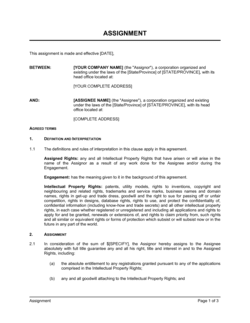
An Absolute Assignment and Transfer of Loans is a legally binding agreement by which a lender (the assignor) unconditionally transfers all rights, title, and interest in one or more loans to a new party (the assignee), permanently and without reservation. This free Word download gives you a structured, attorney-vetted starting point you can edit online and export as PDF to execute with counterparties, notaries, or financial institutions.
When you need it
Use it when a lender sells or transfers a loan portfolio, when a business is acquired and its receivables must move to the buyer, or when a financial institution restructures its balance sheet by offloading loan assets to a third party. It is also required when collateral tied to a loan must follow the loan to its new owner.
What's inside
Identification of the assignor, assignee, and the specific loans being transferred; representations and warranties about the validity of the loans; the consideration paid for the assignment; indemnification obligations; notice requirements to the borrower; and governing law and dispute resolution clauses.

What is an Absolute Assignment and Transfer of Loans?

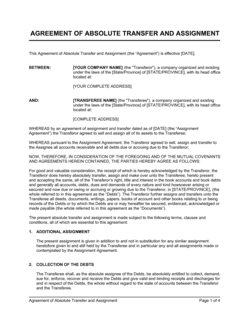
An Absolute Assignment and Transfer of Loans is a legally binding agreement by which a lender — the assignor — permanently and unconditionally transfers all of its rights, title, and interest in one or more loans to a new creditor, the assignee. Unlike a participation arrangement or a collateral pledge, an absolute assignment is final: the original lender exits the loan relationship entirely, the assignee steps into the lender's position, and the borrower's repayment obligations flow to the new creditor from the effective date forward. The agreement identifies the specific loans being transferred through a detailed schedule, states the consideration paid, sets out the assignor's representations about the validity of the loans, addresses the transfer of collateral and security interests, and governs how and when borrowers are notified of the change.

Why You Need This Document

Without a properly drafted absolute assignment agreement, a loan transfer is legally vulnerable on multiple fronts simultaneously. An undocumented or informally documented transfer can be challenged by a bankruptcy trustee, subordinated to a later-perfected lien, or defeated by a borrower who continued paying the original lender in the absence of proper notice. Representations and warranties from the assignor about loan quality are worthless unless captured in a signed, enforceable agreement — and without them, the assignee has no contractual remedy when a purchased loan turns out to carry an undisclosed default or prior encumbrance. Collateral that is not separately assigned and recorded — mortgages, UCC filings, guarantees — does not automatically follow the loan in most jurisdictions, leaving the assignee with an unsecured claim. This template gives you a structured, comprehensive starting point that addresses all of these risks in a single document, reducing execution time while ensuring the transfer is defensible in court, in bankruptcy, and under regulatory scrutiny.

Which variant fits your situation?

If your situation is…Use this template
Transferring a single commercial mortgage note to a new lenderAssignment of Mortgage
Selling a portfolio of consumer loans to a debt buyerLoan Sale and Purchase Agreement
Transferring intercompany receivables between subsidiariesIntercompany Loan Assignment Agreement
Partial transfer where assignor retains a participation interestLoan Participation Agreement
Pledging a loan as collateral rather than transferring ownershipCollateral Assignment of Loan
Assigning rights under a promissory note only, not the full loan fileAssignment of Promissory Note
Transferring all business contracts and debts as part of a company saleAssignment and Assumption Agreement

Common mistakes to avoid

❌ Incomplete or ambiguous loan schedule

Why it matters: If Schedule A does not identify each loan with sufficient specificity — including outstanding balance, collateral, and borrower identity — courts may refuse to enforce the transfer as to the disputed loans.

Fix: Attach a full data tape with loan-level detail and confirm each entry against the original loan documents before execution.

❌ Failing to record the mortgage assignment separately

Why it matters: In most US states, a mortgage does not automatically transfer with the promissory note unless separately assigned and recorded in the county land records. An unrecorded mortgage assignment leaves the assignee holding an unsecured obligation.

Fix: Prepare and record a standalone Assignment of Mortgage for each real-property-secured loan concurrent with or immediately after the loan assignment closes.

❌ No notice sent to borrowers

Why it matters: Without a formal Notice of Assignment, borrowers may continue paying the original lender — creating a commingling dispute and potentially requiring the assignee to pursue double-payment recovery.

Fix: Send certified written notices to each borrower within the deadline specified in the agreement, and retain proof of delivery for every notice.

❌ Using nominal consideration in a commercial portfolio sale

Why it matters: Stating 'one dollar and other good and valuable consideration' on a multi-million-dollar loan sale invites IRS scrutiny, undermines true-sale accounting, and weakens regulatory capital treatment.

Fix: State the actual purchase price in the consideration clause and, if price is calculated by formula, include the formula and resulting amount in the executed agreement.

❌ Omitting representations about undisclosed defaults or prior assignments

Why it matters: If the assignor has already pledged, participated, or partially transferred a loan and does not disclose it, the assignee acquires a defective or encumbered asset with no contractual recourse against the assignor.

Fix: Require the assignor to represent explicitly that no prior assignments, participations, or encumbrances exist, and back the representation with a UCC and title search prior to closing.

❌ No corporate authorization attached at signing

Why it matters: An officer who lacks board authority to approve the transaction can render the assignment voidable — a risk that materializes most often in M&A disputes or insolvency proceedings.

Fix: Attach a board resolution or officer's certificate from each party confirming that the signatory is authorized to execute and deliver the agreement on behalf of the entity.

The 10 key clauses, explained

Parties and Recitals

In plain language: Identifies the assignor and assignee by their full legal names and entity types, and sets out the background — the existing loan relationship and the parties' intention to transfer it absolutely.

Sample language
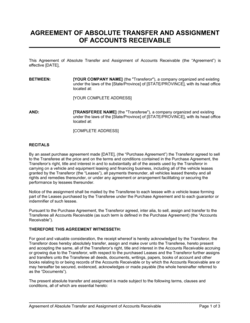
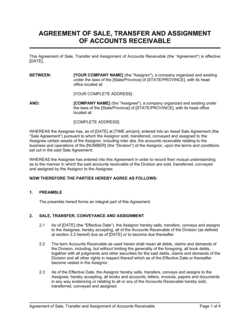
This Absolute Assignment and Transfer of Loans (the 'Agreement') is entered into as of [DATE] by and between [ASSIGNOR LEGAL NAME], a [STATE/PROVINCE] [ENTITY TYPE] ('Assignor'), and [ASSIGNEE LEGAL NAME], a [STATE/PROVINCE] [ENTITY TYPE] ('Assignee'). WHEREAS, Assignor is the holder of those certain loans described in Schedule A attached hereto, and desires to assign and transfer all of its right, title, and interest therein to Assignee on the terms set forth below.

Common mistake: Using a trade name instead of the registered legal entity for either party. A mismatch between the named party and the actual loan-file holder can void the assignment or create a gap in chain-of-title that surfaces during later litigation or sale.

Description and Schedule of Loans

In plain language: Identifies each loan being transferred with enough specificity — loan number, borrower name, outstanding principal, interest rate, maturity date, and collateral — to eliminate ambiguity about what is and is not included.

Sample language
Assignor hereby assigns to Assignee all loans set forth in Schedule A, including without limitation Loan No. [LOAN NUMBER] in the original principal amount of $[AMOUNT] dated [DATE], made to [BORROWER NAME], bearing interest at [RATE]% per annum, maturing on [MATURITY DATE], and secured by [COLLATERAL DESCRIPTION].

Common mistake: Attaching an incomplete or informal Schedule A — for example, a spreadsheet export that omits collateral descriptions or uses internal codes instead of legal property descriptions. Ambiguous schedules are the single most litigated element of loan transfer disputes.

Absolute Transfer and Conveyance

In plain language: States unequivocally that the transfer is absolute and irrevocable — the assignor conveys all rights, title, and interest in the loans with no retained economic interest or right of reversion.

Sample language
For good and valuable consideration, the receipt and sufficiency of which is hereby acknowledged, Assignor does hereby absolutely, unconditionally, and irrevocably assign, transfer, convey, and set over to Assignee all of Assignor's right, title, and interest in and to the Loans, including all principal, accrued interest, fees, and collateral securing the same, to have and to hold the same unto Assignee, its successors and assigns, forever.

Common mistake: Including language that could be read as a pledge or collateral assignment rather than an absolute transfer. Courts distinguish between absolute assignments and security interests — ambiguous language can cause the transaction to be recharacterized as a secured loan rather than a true sale, with significant tax and regulatory consequences.

Consideration

In plain language: States the purchase price paid by the assignee for the loan assets and confirms receipt of that consideration by the assignor.

Sample language
In consideration of the sum of $[PURCHASE PRICE] (the 'Purchase Price'), paid by Assignee to Assignor concurrently with the execution of this Agreement, the receipt and sufficiency of which is hereby acknowledged by Assignor, Assignor agrees to the assignment set forth herein.

Common mistake: Leaving consideration as 'one dollar and other good and valuable consideration' in commercial transactions where a real price is being paid. While nominal consideration can satisfy the legal minimum, it creates tax valuation issues and weakens the 'true sale' analysis for accounting and regulatory purposes.

Representations and Warranties of Assignor

In plain language: Warranties by the assignor that the loans are valid and enforceable, that the assignor has legal authority to transfer them, that no defaults are undisclosed, and that no prior assignments or encumbrances exist.

Sample language
Assignor represents and warrants to Assignee as of the date hereof that: (a) Assignor is the sole legal and beneficial owner of each Loan, free and clear of all liens and encumbrances; (b) each Loan is a valid and binding obligation of the applicable Obligor, enforceable in accordance with its terms; (c) no event of default has occurred or is continuing under any Loan except as disclosed in Schedule B; and (d) Assignor has full legal authority to execute this Agreement and consummate the transactions contemplated herein.

Common mistake: Omitting a representation that no prior assignments, participations, or security interests encumber the loans being transferred. If an undisclosed prior pledge exists, the assignee may acquire a defective title — with no contractual remedy against the assignor.

Notice to Obligors

In plain language: Obligates the assignor (or the assignee) to send written notice to each borrower informing them of the transfer and directing future payments to the assignee.

Sample language
Promptly following the execution of this Agreement, Assignor shall deliver to each Obligor a written Notice of Assignment in the form attached hereto as Exhibit 1, directing such Obligor to remit all future payments of principal, interest, and fees to Assignee at [PAYMENT ADDRESS / ACCOUNT DETAILS], effective as of [EFFECTIVE DATE].

Common mistake: Failing to specify who is responsible for sending notice and by what deadline. If neither party sends timely notice, the borrower may continue paying the assignor — creating a commingling-of-funds dispute and potential double-payment liability.

Transfer of Collateral and Security Interests

In plain language: Confirms that all collateral securing the loans — mortgages, pledges, guarantees, UCC filings — is transferred to the assignee as part of the assignment, and sets out the steps to perfect that transfer.

Sample language
The assignment effected hereby includes, without limitation, all mortgages, deeds of trust, pledges, guarantees, security agreements, UCC financing statements, and other collateral documents securing the Loans. Assignor shall, at Assignee's request and expense, execute and deliver all such further instruments as may be necessary to perfect Assignee's interest in the Collateral, including but not limited to UCC-3 amendment statements and assignments of mortgage to be recorded in [COUNTY / JURISDICTION].

Common mistake: Transferring the loan note but not separately assigning the mortgage or deed of trust. In many jurisdictions, a mortgage does not automatically follow the note unless formally assigned and recorded — leaving the assignee with an unsecured obligation.

Indemnification

In plain language: Sets out each party's obligation to compensate the other for losses arising from their respective breaches of representations, undisclosed liabilities, or third-party claims related to the loans.

Sample language
Assignor shall indemnify, defend, and hold harmless Assignee and its affiliates, officers, directors, and agents from and against any and all losses, claims, damages, liabilities, and expenses arising out of or relating to (a) any breach of Assignor's representations and warranties herein, (b) any claim by an Obligor or third party arising from acts or omissions of Assignor prior to the Effective Date, or (c) any undisclosed lien or encumbrance on any Loan.

Common mistake: Limiting indemnification to direct damages only and excluding consequential losses. If a borrower successfully defends a collection action based on a pre-assignment defect, the assignee's consequential losses — lost interest, legal fees, collection costs — can far exceed the direct loss.

Governing Law and Dispute Resolution

In plain language: Specifies the jurisdiction whose law governs the agreement and the mechanism — arbitration, mediation, or litigation — for resolving disputes.

Sample language
This Agreement shall be governed by and construed in accordance with the laws of the State of [STATE], without regard to its conflict-of-laws principles. Any dispute arising out of or relating to this Agreement shall be resolved by binding arbitration administered by [AAA / JAMS] in [CITY, STATE], except that either party may seek injunctive or equitable relief in any court of competent jurisdiction.

Common mistake: Choosing a governing law that conflicts with mandatory consumer-protection or lending regulations in the state where the loans were originated. Several states require that consumer loan assignments comply with local law regardless of the contractual choice-of-law.

Entire Agreement and Amendment

In plain language: Confirms that the written agreement, including all schedules and exhibits, is the complete and exclusive statement of the parties' agreement, superseding all prior negotiations and representations.

Sample language
This Agreement, together with all Schedules and Exhibits hereto, constitutes the entire agreement of the parties with respect to the subject matter hereof and supersedes all prior and contemporaneous agreements, representations, and understandings. This Agreement may not be amended except by a written instrument signed by both parties.

Common mistake: Omitting an integration clause entirely when the transaction was negotiated over email or term sheet. Prior email exchanges containing different representations about loan quality or price can be introduced as contract terms if the written agreement does not explicitly supersede them.

How to fill it out

  1. 1

    Identify and verify the legal entities

    Enter the full registered legal names of both the assignor and assignee — confirm against corporate registry filings or articles of incorporation. Include entity type (LLC, corporation, LP) and state or province of formation.

    💡 Pull a current certificate of good standing for both parties before execution — a lapsed entity cannot validly assign or accept loan assets in most jurisdictions.

  2. 2

    Build the loan schedule (Schedule A)

    List every loan being transferred with its loan number, original and outstanding principal balance, interest rate, maturity date, borrower legal name, and a full legal description of any collateral. Attach loan agreements and promissory notes as sub-exhibits.

    💡 Have a title search or UCC search run on each loan before completing Schedule A — undisclosed prior liens should be disclosed in Schedule B, not buried in the main schedule.

  3. 3

    State the purchase price and payment mechanism

    Enter the agreed purchase price in the consideration clause, specify the payment method (wire transfer, escrow, installment), and confirm the account details. If the price is a percentage of outstanding principal, show the calculation.

    💡 For tax and accounting purposes, state the actual economic consideration — not a nominal amount. True-sale accounting treatment under ASC 860 requires that the transfer price reflect fair value.

  4. 4

    Complete the representations and warranties

    Review each rep and warranty against the actual condition of the loans. Disclose all known defaults, partial payments, bankruptcy filings by borrowers, or prior participations in Schedule B. Do not make a representation you cannot verify.

    💡 Request an updated loan-level data tape from the assignor's servicing system the day before closing to catch any changes in loan status between signing the term sheet and execution.

  5. 5

    Prepare and schedule borrower notices

    Draft a Notice of Assignment for each borrower — specifying the effective date, the new payment recipient, and updated remittance instructions. Decide whether the assignor or assignee will send notices and set a deadline (typically within 5 business days of closing).

    💡 Send borrower notices by certified mail with return receipt, and retain proof of delivery. In regulated lending contexts, a missed or late notice can expose the assignee to a consumer complaint or regulatory action.

  6. 6

    Arrange collateral transfer filings

    Identify all UCC financing statements, mortgage assignments, pledge agreements, and guarantee assignments that must be filed or recorded to perfect the assignee's interest. Prepare UCC-3 amendments and mortgage assignment instruments for filing in every relevant jurisdiction.

    💡 Record mortgage assignments before the closing wire if possible — recording gaps as short as one day have been used by bankruptcy trustees to challenge the perfection of transfers.

  7. 7

    Execute and date the agreement

    Both parties sign on or before the effective date. Ensure authorized signatories have the corporate authority to bind their respective entities — attach board resolutions or officer certificates if the transaction is material.

    💡 For large portfolio transfers, use a closing checklist to confirm every Schedule, Exhibit, and ancillary document is executed before funds are released.

  8. 8

    File, record, and deliver executed copies

    File UCC-3 amendments in the applicable Secretary of State office, record mortgage assignments with the county recorder, and deliver fully executed originals to both parties. Retain the loan file and original promissory notes with the assignee.

    💡 Original wet-ink promissory notes must physically accompany the loan file to the assignee — a copy is not sufficient to enforce negotiable instruments in most jurisdictions.

Frequently asked questions

What is an absolute assignment and transfer of loans?

An absolute assignment and transfer of loans is a legal agreement by which a lender permanently transfers all of its rights, title, and interest in one or more loans to a new creditor. Unlike a collateral assignment or participation, an absolute assignment is unconditional — the original lender retains no economic interest, right of reversion, or ongoing claim to the loan once the transfer is complete. The assignee steps entirely into the shoes of the original lender from the effective date.

What is the difference between an absolute assignment and a collateral assignment of loans?

An absolute assignment transfers full ownership of the loan to the assignee permanently. A collateral assignment pledges the loan as security for a separate obligation — the lender retains beneficial ownership and the pledge is released if the underlying debt is repaid. The distinction matters significantly for accounting treatment, regulatory capital, and bankruptcy analysis. Courts look at the substance of the transaction, not just its label, to determine which characterization applies.

What collateral filings are needed after a loan assignment?

For loans secured by personal property under a UCC-governed security agreement, the assignee must file a UCC-3 amendment statement naming itself as the new secured party of record. For real-property-secured loans, an Assignment of Mortgage or Assignment of Deed of Trust must be recorded in the county land records where the property is located. Failure to make these filings can leave the assignee's interest unperfected and vulnerable to a subsequent lien or bankruptcy trustee challenge.

What representations should an assignor make about the loans?

At minimum: that the assignor holds legal and beneficial title to each loan free of undisclosed encumbrances; that each loan is valid and enforceable against the borrower; that no undisclosed defaults are occurring; that the assignor has authority to enter the transaction; and that no prior assignments, participations, or pledges encumber the loans. These representations give the assignee a contractual remedy if a loan turns out to be defective post-transfer.

Is an absolute assignment of loans a 'true sale' for accounting purposes?

Whether the transfer qualifies as a true sale under ASC 860 (US GAAP) or IFRS 9 depends on several factors: whether the assignor has surrendered control of the loans, whether recourse to the assignor is limited, and whether the consideration reflects fair value. A transaction structured as an absolute assignment but with full recourse, a retained economic interest, or a repurchase obligation may be recharacterized as a secured borrowing on the assignor's balance sheet. Consult your auditor before relying on sale accounting treatment.

Do I need a lawyer to complete a loan assignment agreement?

For any commercial loan portfolio transfer, legal review is strongly recommended. The interplay between UCC Article 9 perfection requirements, real-property recording rules, regulatory capital treatment, and borrower-notice obligations creates significant legal complexity. A one-size-fits-all template is a useful starting point, but a lawyer familiar with the governing jurisdiction and loan type should review the final document — particularly the representations and collateral transfer provisions — before execution.

What happens if the assignment is not properly perfected?

An unperfected assignment may be voidable by a bankruptcy trustee under the strong-arm clause (11 U.S.C. §544), subordinated to a subsequent perfected lien, or unenforceable against third parties. In practical terms, this means the assignee could lose priority in the collateral to a later creditor or trustee who files first — even if the economic transfer occurred earlier. Timely UCC filing and mortgage recording are the primary defenses against this risk.

Can an assignment of loans be reversed or cancelled?

An absolute assignment is irrevocable once executed — the assignor cannot unilaterally reclaim the loans. Reversal requires a new assignment back to the original lender, supported by fresh consideration, and all collateral filings must be updated accordingly. If the original assignment contained conditions or was procured by fraud or misrepresentation, a court could void it — but this is a litigation remedy, not a contractual one.

How this compares to alternatives

vs Loan Participation Agreement

A loan participation agreement allows a lender to share the economic risk of a loan with another party while retaining legal ownership and the borrower relationship. An absolute assignment transfers full legal and beneficial ownership — the assignor exits the loan entirely. Participations are used when the originating lender wants to reduce exposure without triggering borrower notification or collateral re-filing obligations.

vs Collateral Assignment of Loan

A collateral assignment pledges the loan as security for a separate debt obligation. Ownership remains with the assignor unless the assignor defaults on the secured obligation. An absolute assignment transfers ownership unconditionally and permanently. Courts and regulators look at the economic substance — not the label — to determine which type of transfer actually occurred.

vs Assignment and Assumption Agreement

An assignment and assumption agreement transfers both rights and obligations — the assignee assumes the assignor's contractual duties, including future funding commitments, as well as acquiring the benefits. An absolute loan assignment typically transfers rights only (the right to receive repayment) without assuming ongoing lender obligations unless explicitly stated. Use an assumption agreement when the loan is a revolving facility with future advance obligations.

vs Promissory Note Endorsement

Endorsing a promissory note transfers the negotiable instrument itself under UCC Article 3, without a formal assignment agreement. An absolute assignment agreement is a broader document covering the entire loan relationship — including collateral, guarantees, accrued interest, and representations — not just the note. For secured or complex commercial loans, an assignment agreement is more appropriate than a simple endorsement.

Industry-specific considerations

Banking and Financial Services

Banks use absolute loan assignments to sell non-performing or performing loan portfolios to debt buyers, freeing regulatory capital and cleaning balance sheets under Basel III requirements.

Commercial Real Estate

Mortgage notes are assigned absolutely when properties are sold, refinanced, or when a lender exits a market — triggering mandatory county recording of the Assignment of Mortgage.

Private Equity and Debt Funds

Distressed debt funds acquire non-performing loan portfolios via absolute assignment, often in bulk, and require robust Schedule A loan tapes and seller reps to price credit risk accurately.

Manufacturing and Corporate Finance

Intercompany loans between parent companies and subsidiaries are absolutely assigned during divestitures, restructurings, or spin-offs to clean up the balance sheet of the entity being separated.

Jurisdictional notes

United States

Loan assignments involving personal-property collateral must be perfected by filing a UCC-3 amendment with the applicable Secretary of State under UCC Article 9. Real-property-secured loans require a separately recorded Assignment of Mortgage or Assignment of Deed of Trust in the county where the property is located. Consumer loan assignments may trigger CFPB notice requirements and state-specific licensing obligations for the assignee — particularly in California, New York, and Illinois. Bankruptcy remoteness analysis under 11 U.S.C. §544 makes proper perfection critical.

Canada

Personal property security interests must be assigned and re-registered under the applicable provincial Personal Property Security Act (PPSA) — each province maintains its own registry. Real-property mortgage assignments must be registered in the provincial land title or registry office. In Quebec, the Civil Code governs; a hypothec assignment (rather than a mortgage assignment) must be published in the Register of Personal and Movable Real Rights (RDPRM) or land register as applicable. Borrower notice requirements vary by province and by whether the loan is consumer or commercial.

United Kingdom

Under the Law of Property Act 1925, a legal assignment of a debt requires written notice to the debtor (borrower) to be effective at law. An equitable assignment is valid without notice but gives the assignee fewer enforcement rights. FCA-regulated mortgage portfolios require the assignee to hold the appropriate FCA permission before taking on the lender role. Secondary loan trading in the UK is also governed by LMA standard documentation and market practice for syndicated facilities.

European Union

The EU Securitisation Regulation (2017/2402) imposes due diligence, transparency, and risk-retention requirements on certain bulk loan transfers. Member state law governs the formal validity and perfection requirements for individual loan assignments — France requires signification by bailiff or notarial deed for a legal-quality assignment; Germany requires Abtretungsanzeige (notice of assignment) to perfect against the debtor. GDPR applies to the transfer of borrower personal data embedded in loan files — a data processing agreement or legitimate-interest assessment is typically required alongside the loan assignment.

Template vs lawyer — what fits your deal?

PathBest forCostTime
Use the templateSimple single-loan transfers between sophisticated commercial parties with no real-property collateral and no regulatory filing complexityFree1–2 hours
Template + legal reviewSmall portfolio transfers, intercompany restructurings, or single mortgage note assignments requiring county recording and UCC filing$500–$1,5002–5 business days
Custom draftedLarge or regulated portfolio sales, cross-border loan transfers, transactions requiring true-sale accounting opinions, or consumer loan portfolios subject to CFPB or state licensing rules$3,000–$15,000+2–6 weeks

Glossary

Assignor
The original lender or creditor who transfers their rights and interests in a loan to a new party.
Assignee
The party receiving the transferred loan rights, who steps into the shoes of the original lender after the assignment.
Absolute Assignment
An unconditional and permanent transfer of all rights, title, and interest in a loan — the assignor retains no reversionary right or ongoing economic interest.
Loan Portfolio
A collection of loan agreements held by a single lender, often transferred together under one assignment agreement to a single buyer.
Representations and Warranties
Statements of fact made by the assignor about the validity, enforceability, and current status of the loans being transferred, on which the assignee relies.
Notice of Assignment
A formal written notification sent to the borrower informing them that their loan has been transferred to a new creditor and directing future payments accordingly.
Consideration
The purchase price or other value exchanged by the assignee in return for receiving the loan assets — required for the assignment to be a binding contract.
Indemnification
A contractual obligation by which one party agrees to compensate the other for losses arising from breaches of representations, undisclosed defects, or third-party claims.
Perfection of Assignment
The legal steps required to make the assignment enforceable against third parties — typically filing a UCC-1 financing statement in the US or registering the transfer in applicable land or charge registries.
Non-Recourse Assignment
An assignment in which the assignor makes no guarantee about the borrower's ability to repay — the assignee accepts the credit risk as-is.
Obligor
The borrower or debtor whose repayment obligations under the original loan are being transferred to the new creditor via the assignment.

Part of your Business Operating System

This document is one of 3,000+ business & legal templates included in Business in a Box.

  • Fill-in-the-blanks — ready in minutes
  • 100% customizable Word document
  • Compatible with all office suites
  • Export to PDF and share electronically

Create your document in 3 simple steps.

From template to signed document — all inside one Business Operating System.
1
Download or open template

Access over 3,000+ business and legal templates for any business task, project or initiative.

2
Edit and fill in the blanks with AI

Customize your ready-made business document template and save it in the cloud.

3
Save, Share, Send, Sign

Share your files and folders with your team. Create a space of seamless collaboration.

Save time, save money, and create top-quality documents.

★★★★★

"Fantastic value! I'm not sure how I'd do without it. It's worth its weight in gold and paid back for itself many times."

Managing Director · Mall Farm
Robert Whalley
Managing Director, Mall Farm Proprietary Limited
★★★★★

"I have been using Business in a Box for years. It has been the most useful source of templates I have encountered. I recommend it to anyone."

Business Owner · 4+ years
Dr Michael John Freestone
Business Owner
★★★★★

"It has been a life saver so many times I have lost count. Business in a Box has saved me so much time and as you know, time is money."

Owner · Upstate Web
David G. Moore Jr.
Owner, Upstate Web

Run your business with a system — not scattered tools

Stop downloading documents. Start operating with clarity. Business in a Box gives you the Business Operating System used by over 250,000 companies worldwide to structure, run, and grow their business.

Free Forever Plan · No credit card required