Checklist Small Business Legal Compliance Inventory

Free download β€’ Use as a template β€’ Print or share

2 pagesβ€’20–25 min to useβ€’Difficulty: Standard
Learn more ↓
FreeChecklist Small Business Legal Compliance Inventory Template

At a glance

What it is
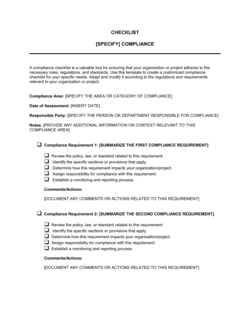
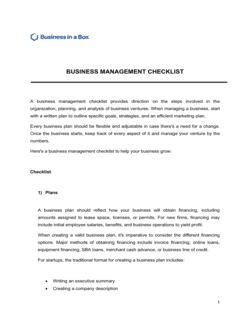
A Small Business Legal Compliance Inventory is a structured checklist that catalogs every license, permit, registration, filing, and regulatory obligation a business must maintain to operate lawfully. This free Word download lets you document each requirement, its governing authority, its renewal date, and its current status β€” all in one place you can review quarterly or share with an advisor.
When you need it
Use it when launching a new business to map your compliance obligations from day one, or when auditing an existing operation to confirm nothing has lapsed. It is also useful when adding a new location, product line, or employee class that triggers additional regulatory requirements.
What's inside
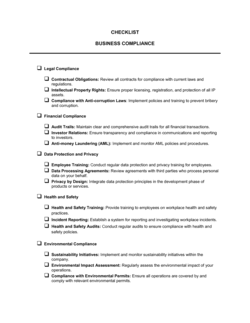
Sections covering business formation and registration, federal and state tax IDs, industry-specific licenses, zoning and local permits, employment law obligations, data privacy requirements, insurance coverage, and renewal tracking with status indicators for each item.

What is a Small Business Legal Compliance Inventory?

A Small Business Legal Compliance Inventory is a structured checklist that catalogs every license, permit, registration, filing, and regulatory obligation a business must maintain to operate lawfully. It organizes compliance requirements across categories β€” entity formation, tax IDs, local permits, industry-specific licenses, employment law, data privacy, and insurance β€” into a single trackable document with status indicators and renewal dates for each item. Rather than relying on scattered reminders and individual knowledge, the checklist gives business owners and their advisors one place to confirm that nothing has lapsed and nothing is approaching expiration unnoticed.

Why You Need This Document

Operating without a centralized compliance inventory means you are depending on memory and email reminders to manage obligations that carry real financial and legal consequences when missed. A lapsed business license can trigger fines and a mandatory stop-operations order. A missed annual entity report can result in administrative dissolution β€” stripping the personal liability protection the LLC or corporation was formed to provide. Outdated workplace posters or an expired seller's permit create the same exposure on a smaller scale but with the same certainty: regulators do not grant grace periods for items that were simply forgotten. This template gives you a 90-minute starting point to audit your current status, close any gaps you find, and build a renewal calendar that runs on its own β€” so compliance becomes a scheduled task rather than a recurring emergency.

Which variant fits your situation?

If your situation is…Use this template
General compliance audit covering all regulatory categoriesSmall Business Legal Compliance Inventory
Tracking only HR and employment law obligationsHR Compliance Checklist
Preparing for a specific government inspection or auditRegulatory Audit Preparation Checklist
Onboarding a new employee and verifying authorization to workEmployee Onboarding Checklist
Monitoring annual tax filing deadlines and estimated paymentsTax Calendar and Deadline Tracker
Tracking data privacy compliance under CCPA or GDPRData Privacy Compliance Checklist
Reviewing insurance coverage adequacy across policy typesBusiness Insurance Review Checklist

Common mistakes to avoid

❌ Conflating state entity registration with local business licensing

Why it matters: These are separate filings with different authorities, different fees, and different renewal cycles. Operating without the local license can result in fines or a stop-work order.

Fix: Check with your city or county clerk's office specifically β€” state registration confirmation is not a substitute for local licensing.
❌ Missing the annual entity report filing

Why it matters: Most states administratively dissolve LLCs and corporations that miss annual report filings, stripping personal liability protection retroactively.

Fix: Add the annual report due date to the renewal tracker with a 60-day lead time and assign one person as the accountable owner.

❌ Letting required workplace posters go out of date

Why it matters: Federal and state agencies update mandatory postings periodically. Displaying an outdated poster counts as a violation during an OSHA or DOL audit, even if the content change was minor.

Fix: Subscribe to your state labor department's update list and review posted notices each January and July.

❌ No centralized owner for compliance renewals

Why it matters: When renewal reminders exist only in one employee's inbox or calendar, staff turnover creates an invisible compliance gap that may not surface until a fine arrives.

Fix: Assign every line item in the renewal tracker to a named role β€” not just a person β€” and confirm the assignment transfers during any staff transition.

The 9 key fields, explained

Business formation and entity registration

Federal and state tax ID registrations

Local business license and DBA filings

Industry-specific licenses and permits

Zoning, land use, and certificate of occupancy

Employment law obligations

Data privacy and cybersecurity compliance

Business insurance coverage

Renewal calendar and status tracker

How to fill it out

  1. 1

    Gather your existing registrations and licenses

    Pull together every government-issued document the business currently holds β€” state registration, EIN confirmation, business license, seller's permit, and any industry permits. These become the starting data for each row.

    πŸ’‘ Your state's Secretary of State business search portal will show the current status of your entity registration and flag any missed annual reports.

  2. 2

    Identify which industry-specific licenses apply

    Look up your primary NAICS code and check with the relevant state licensing board or agency to confirm every permit your business activity requires. Add each one as a separate line item.

    πŸ’‘ Many states publish an online business license lookup tool by business type and city β€” use it before assuming your general business license covers all activity.

  3. 3

    Confirm local zoning and occupancy status

    Contact your city or county planning department to verify the zoning classification of each business location and confirm a certificate of occupancy is on file for the premises.

    πŸ’‘ If you operate from a home office, check whether a home occupation permit is required β€” many municipalities impose restrictions on signage, customer visits, and employee count.

  4. 4

    Complete the employment law section

    Record your state employer account number, workers' compensation policy details, and confirm I-9 records are complete for every current employee. Note which mandatory workplace posters are displayed.

    πŸ’‘ Download the current required posters directly from the DOL and your state labor department websites β€” do not rely on third-party poster services without checking that the versions are current.

  5. 5

    Map applicable data privacy obligations

    Identify which privacy laws apply based on where you operate, where your customers are located, and what data you collect. Record the date your privacy policy was last updated.

    πŸ’‘ If you collect email addresses for marketing, confirm your practices comply with CAN-SPAM and, if any customers are in California, with CCPA β€” even for small subscriber lists.

  6. 6

    Log all insurance policies with renewal dates

    Enter each active policy with carrier, policy number, coverage limit, and renewal date. Flag any coverage gaps β€” e.g., a business with delivery vehicles but no commercial auto policy.

    πŸ’‘ Ask your broker for a certificate of insurance summary listing all active policies in one place β€” this makes the insurance section of the checklist a 5-minute task.

  7. 7

    Build the renewal calendar and assign owners

    Transfer every renewal date into the consolidated tracker at the bottom of the checklist. Assign a named owner and a lead time for each item β€” typically 30–60 days before the renewal date.

    πŸ’‘ Set a recurring quarterly calendar block to review the tracker. More items lapse in Q4 than any other quarter because owners are distracted by year-end operations.

Frequently asked questions

What licenses and permits do most small businesses need?

Most small businesses need at minimum: a state entity registration (LLC or corporation), a federal EIN, a state tax account or seller's permit if selling taxable goods, a local business license, and any industry-specific permits required by their activity. Businesses with employees also need a state employer account number, workers' compensation insurance, and compliance with mandatory workplace posting requirements.

How often should a compliance checklist be reviewed?

A quarterly review is the practical minimum for most small businesses. Annual reviews miss mid-year permit expirations and regulatory changes. A full audit is also warranted whenever the business adds a new location, hires its first employee, begins selling in a new state, or launches a new product or service category that may trigger additional obligations.

What happens if a small business lets a license or permit lapse?

Consequences vary by jurisdiction and permit type, but typically include fines, back fees, and a required stop-work or stop-operations period until the lapse is corrected. In regulated industries β€” food service, healthcare, construction β€” operating on a lapsed license can also trigger personal liability for the business owner and may void insurance coverage for incidents occurring during the lapse period.

Does a small business need a compliance checklist if it has no employees?

Yes. A sole proprietor or single-member LLC still has entity registration, tax, local licensing, zoning, and data privacy obligations. The checklist is shorter without the employment law section, but the remaining categories are equally important. Many of the most common small business compliance fines β€” missed annual reports, lapsed business licenses β€” affect businesses with no employees at all.

Is this checklist the same as an HR compliance checklist?

No. An HR compliance checklist focuses exclusively on employment law obligations β€” I-9s, payroll taxes, workplace postings, leave laws, and anti-discrimination requirements. A small business legal compliance inventory is broader, covering entity formation, tax registrations, industry permits, zoning, data privacy, and insurance in addition to employment obligations. Many businesses use both documents in parallel.

Can I use this checklist to prepare for a government audit or inspection?

It is a strong starting point. The checklist helps you confirm that key documents exist, are current, and are accessible. For a specific regulatory inspection β€” OSHA safety audit, state tax audit, or health department review β€” you may need a more targeted preparation checklist focused on the inspecting agency's criteria. Consider having an advisor familiar with that agency's inspection protocol review your readiness before the scheduled date.

What is the difference between a compliance checklist and a compliance policy?

A compliance checklist is an operational tracking tool β€” it lists specific obligations, their status, and their renewal dates. A compliance policy is a governance document that defines the company's standards, responsibilities, and procedures for maintaining compliance on an ongoing basis. The checklist is what you work from day to day; the policy is the framework that explains why and how compliance is managed across the organization.

How this compares to alternatives

vs HR Compliance Checklist

An HR compliance checklist covers employment law obligations exclusively β€” I-9 records, payroll tax accounts, leave law compliance, and required workplace postings. The small business legal compliance inventory covers all of those areas plus entity formation, tax registrations, industry permits, zoning, data privacy, and insurance. Use both for a complete picture; use the HR checklist alone only if you are auditing employment practices specifically.

vs Business Startup Checklist

A business startup checklist is a one-time launch tool covering entity formation, account setup, and initial operational steps. A legal compliance inventory is an ongoing maintenance document β€” it tracks renewal dates, current status, and emerging obligations year over year. After launch, the startup checklist becomes historical; the compliance inventory stays active.

vs Regulatory Audit Preparation Checklist

A regulatory audit preparation checklist is targeted to a specific agency's inspection criteria β€” OSHA, state health department, or IRS. A small business legal compliance inventory is broader and not inspection-specific. The inventory helps you stay continuously compliant; the audit prep checklist focuses your attention on what a particular inspector will look for on a specific date.

vs Risk Management Plan

A risk management plan identifies, assesses, and prioritizes business risks β€” including but not limited to compliance risks β€” and defines mitigation strategies. A compliance inventory is narrower: it tracks specific legal obligations and their status without broader risk scoring or mitigation planning. The compliance inventory is an input into a risk management plan, not a substitute for one.

Industry-specific considerations

Food and beverage

Food handler permits, health department inspections, liquor licenses, and FDA food facility registration each carry separate renewal cycles that must be tracked independently.

Construction and trades

Contractor's license, bonding requirements, specialty trade permits (electrical, plumbing, HVAC), and OSHA 300 log maintenance are all category-specific obligations with separate issuing authorities.

Healthcare and wellness

Professional licenses for each practitioner, DEA registration if applicable, HIPAA compliance documentation, and state health department facility licensure are all required and independently tracked.

Retail and e-commerce

Multi-state sales tax nexus registration, seller's permits in every state where the business has economic nexus, and CCPA or state data privacy obligations for customer data collection.

Template vs pro β€” what fits your needs?

PathBest forCostTime
Use the templateSmall business owners and operators conducting an initial or annual compliance self-auditFree2–4 hours
Template + professional reviewBusinesses in regulated industries, multi-state operators, or owners who have never done a formal compliance audit$300–$800 (attorney or compliance consultant review)1–3 days
Custom draftedFranchise systems, healthcare entities, or businesses subject to multiple overlapping federal and state regulatory frameworks$1,000–$3,000+1–2 weeks

Glossary

Business License
A government-issued authorization allowing a company to operate within a specific municipality, county, or state.
EIN (Employer Identification Number)
A nine-digit tax ID issued by the IRS to identify a business entity for federal tax purposes β€” required for payroll, banking, and most registrations.
DBA (Doing Business As)
A fictitious or trade name registration filed when a business operates under a name different from its legal entity name.
Zoning Permit
Local government approval confirming that the business activity is permitted at a specific physical address under applicable land-use rules.
Certificate of Occupancy
A document issued by a local authority confirming a building meets code requirements and is approved for a specific use or occupancy type.
Workers' Compensation Insurance
State-mandated insurance coverage that pays benefits to employees injured on the job, required in virtually every US state once a business has one or more employees.
Seller's Permit
A state-issued registration allowing a business to collect and remit sales tax on taxable goods and services sold within that state.
I-9 Verification
A federally required employment eligibility verification process confirming that every new hire is authorized to work in the United States.
OSHA Posting Requirements
Federal and state mandates requiring employers to display specific workplace safety and employee-rights notices in a visible location at the worksite.
Registered Agent
An individual or entity designated to receive official legal and government correspondence on behalf of a business entity in its state of formation.

Part of your Business Operating System

This document is one of 3,000+ business & legal templates included in Business in a Box.

  • Fill-in-the-blanks β€” ready in minutes
  • 100% customizable Word document
  • Compatible with all office suites
  • Export to PDF and share electronically

Create your document in 3 simple steps.

From template to signed document β€” all inside one Business Operating System.
1
Download or open template

Access over 3,000+ business and legal templates for any business task, project or initiative.

2
Edit and fill in the blanks with AI

Customize your ready-made business document template and save it in the cloud.

3
Save, Share, Send, Sign

Share your files and folders with your team. Create a space of seamless collaboration.

Save time, save money, and create top-quality documents.

β˜…β˜…β˜…β˜…β˜…

"Fantastic value! I'm not sure how I'd do without it. It's worth its weight in gold and paid back for itself many times."

Managing Director Β· Mall Farm
Robert Whalley
Managing Director, Mall Farm Proprietary Limited
β˜…β˜…β˜…β˜…β˜…

"I have been using Business in a Box for years. It has been the most useful source of templates I have encountered. I recommend it to anyone."

Business Owner Β· 4+ years
Dr Michael John Freestone
Business Owner
β˜…β˜…β˜…β˜…β˜…

"It has been a life saver so many times I have lost count. Business in a Box has saved me so much time and as you know, time is money."

Owner Β· Upstate Web
David G. Moore Jr.
Owner, Upstate Web

Run your business with a system β€” not scattered tools

Stop downloading documents. Start operating with clarity. Business in a Box gives you the Business Operating System used by over 250,000 companies worldwide to structure, run, and grow their business.

Start freeΒ Β·Β No credit card required