Line Of Credit Agreement Template

Free Word download β€’ Edit online β€’ Save & share with Drive β€’ Export to PDF

3 pagesβ€’25–30 min to fillβ€’Difficulty: Standardβ€’Signature requiredβ€’Legal review recommended
Learn more ↓
FreeLine Of Credit Agreement Template

At a glance

What it is
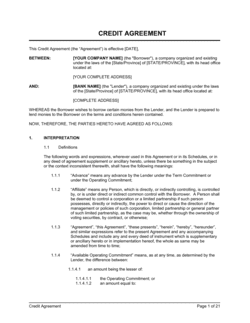
A Line of Credit Agreement is a legally binding contract between a lender and a borrower that establishes a revolving or non-revolving credit facility up to a defined maximum amount. This free Word download gives you a structured, attorney-reviewed starting point β€” covering credit limit, draw conditions, interest rate, repayment schedule, covenants, events of default, and collateral β€” that you can edit online and export as PDF for execution.
When you need it
Use it whenever a lender extends a standing credit facility to a business or individual borrower β€” including when a company needs flexible working capital, when a private lender advances funds in tranches, or when two parties formalize an informal credit arrangement that has been operating without documentation.
What's inside
Parties and credit limit, draw and availability conditions, interest rate and calculation method, repayment and minimum payment terms, fees, covenants (affirmative and negative), events of default, remedies, collateral and security interest, and governing law with dispute resolution.

What is a Line of Credit Agreement?

A Line of Credit Agreement is a legally binding contract between a lender and a borrower that establishes a credit facility β€” typically revolving β€” up to a defined maximum amount called the credit limit. Unlike a term loan that disburses a fixed lump sum, a line of credit allows the borrower to draw funds as needed, repay them, and draw again throughout the facility term, with interest accruing only on the outstanding balance at any given time. The agreement governs every dimension of this relationship: how draws are requested and funded, what interest rate applies and how it is calculated, when and how repayments are made, what financial covenants the borrower must maintain, what events trigger a default, and what collateral secures the lender's position. This free Word download gives businesses and private lenders a professionally structured starting point that covers all of these elements and can be edited online and exported as a signed PDF in under an hour.

Why You Need This Document

Operating a credit facility without a signed agreement exposes both parties to serious, concrete risks. A lender advancing funds without documented draw conditions, repayment terms, and default rights has no legal basis to demand repayment ahead of maturity or to enforce collateral claims β€” leaving recovery entirely dependent on the borrower's goodwill. A borrower drawing on an undocumented line has no protection against arbitrary rate changes, unexpected fee charges, or unilateral facility cancellation. When the relationship sours β€” and with credit facilities, disputes over interest calculations, re-draw rights, and covenant compliance are common β€” neither party has a signed document to rely on. Courts treat undocumented credit arrangements as either unenforceable or subject to jurisdiction-specific default rules that rarely reflect what either party intended. A signed Line of Credit Agreement eliminates all of that ambiguity, creates enforceable obligations on both sides, and gives the lender the perfected security interest needed to recover ahead of other creditors if the borrower becomes insolvent.

Which variant fits your situation?

If your situation is…Use this template
Revolving credit that resets as the borrower repaysRevolving Line of Credit Agreement
Fixed-draw credit facility with no ability to re-borrow repaid amountsNon-Revolving Line of Credit Agreement
Credit line secured by specific collateral such as inventory or receivablesSecured Line of Credit Agreement
Unsecured credit line based solely on borrower creditworthinessUnsecured Line of Credit Agreement
Credit extended by one individual to another for personal purposesPersonal Line of Credit Agreement
One-time fixed-amount loan with a set repayment schedule instead of a revolving facilityLoan Agreement
Intercompany advance between affiliated entities within a corporate groupIntercompany Loan Agreement

Common mistakes to avoid

❌ Referencing LIBOR as the floating rate benchmark

Why it matters: LIBOR was permanently discontinued in June 2023. Any agreement that references LIBOR with no fallback provision has no functioning interest rate calculation after that date, creating a material ambiguity that may require court intervention to resolve.

Fix: Replace all LIBOR references with SOFR (US), SONIA (UK), or €STR (EU) and include a benchmark replacement fallback clause in case the chosen rate is also discontinued.

❌ Omitting the revolving vs. non-revolving distinction

Why it matters: If the agreement doesn't specify, borrowers commonly assume they can re-borrow repaid amounts while lenders assume the opposite β€” a dispute that is expensive to resolve after funds have already been advanced.

Fix: State explicitly in the credit limit clause whether repaid principal restores availability and include a sentence confirming the mechanism by which availability is recalculated.

❌ No cure period for covenant breaches

Why it matters: An agreement that treats any covenant breach as an immediate event of default gives lenders a hair-trigger acceleration right that courts in several jurisdictions have found unconscionable, potentially voiding the default clause.

Fix: Include a tiered cure period β€” typically 5 business days for payment defaults and 30 calendar days for covenant breaches β€” before an event of default is formally declared.

❌ Collateral description too narrow to cover after-acquired property

Why it matters: A security interest in 'current inventory as of the date hereof' does not attach to inventory purchased the following week. The lender ends up unsecured on a growing portion of the collateral base.

Fix: Use the phrase 'now owned or hereafter acquired' in the collateral description and confirm the UCC-1 filing covers after-acquired property under Article 9 of the Uniform Commercial Code.

❌ No integration clause

Why it matters: Without an entire-agreement clause, prior term sheets, emails, or oral promises can be admitted as evidence of additional credit terms β€” exposing the lender to obligations never formally agreed.

Fix: Include a standard integration clause: 'This Agreement constitutes the entire agreement between the parties with respect to the credit facility and supersedes all prior negotiations, representations, and agreements.'

❌ Failing to require guarantees for thinly capitalized borrowers

Why it matters: A credit line extended to an LLC or shell company with minimal assets gives the lender no practical recourse if the entity defaults and has insufficient collateral. Recovery may be zero.

Fix: For borrowers without sufficient standalone assets, attach a personal or corporate guarantee as an exhibit and require its execution as a condition precedent to the first draw.

The 10 key clauses, explained

Parties, recitals, and definitions

In plain language: Identifies the lender and borrower by full legal name, establishes the purpose of the credit facility, and defines every capitalized term used throughout the agreement.

Sample language
This Line of Credit Agreement ('Agreement') is entered into as of [DATE] between [LENDER LEGAL NAME], a [STATE/COUNTRY] [ENTITY TYPE] ('Lender'), and [BORROWER LEGAL NAME], a [STATE/COUNTRY] [ENTITY TYPE] ('Borrower'). Lender agrees to extend to Borrower a line of credit on the terms set forth herein.

Common mistake: Using trade names instead of full registered legal entity names. If the named party doesn't match the executing entity, the agreement may be unenforceable against the intended party.

Credit limit and availability

In plain language: Sets the maximum amount the borrower may have outstanding at any time and explains how availability is calculated as repayments are made.

Sample language
Lender shall make available to Borrower a revolving line of credit in a maximum aggregate principal amount not to exceed [CREDIT LIMIT] (the 'Credit Limit'). Availability at any time equals the Credit Limit minus the sum of all outstanding Draws.

Common mistake: Failing to specify whether the facility is revolving or non-revolving. The distinction determines whether repaid amounts can be re-borrowed β€” an omission that triggers disputes when the borrower tries to draw again.

Draw conditions and request procedure

In plain language: States how and when the borrower may request funds β€” including notice period, minimum draw amount, and any conditions precedent (such as no existing event of default).

Sample language
Borrower may request a Draw by delivering written notice to Lender no less than [X] business days prior to the requested funding date. Each Draw shall be in a minimum amount of $[MINIMUM DRAW AMOUNT]. No Draw shall be made if an Event of Default has occurred and is continuing.

Common mistake: Setting no minimum draw amount or notice period. Without these, the lender faces operational friction from micro-draws and same-day funding demands that create processing and liquidity problems.

Interest rate and calculation

In plain language: Specifies the interest rate applicable to drawn balances β€” fixed or floating β€” the calculation basis (360 or 365 days), and when interest accrues.

Sample language
Outstanding principal shall accrue interest at a per annum rate equal to [FIXED RATE]% / the [PRIME RATE / SOFR] plus [SPREAD]%, calculated on the basis of actual days elapsed over a [360/365]-day year. Interest shall accrue daily on the outstanding principal balance.

Common mistake: Referencing LIBOR in new agreements. LIBOR was discontinued at end of June 2023. All floating-rate credit agreements must reference SOFR (US), SONIA (UK), or €STR (EU) β€” or another agreed replacement benchmark.

Repayment schedule and minimum payments

In plain language: Defines when and how the borrower must repay drawn amounts β€” monthly interest-only, minimum principal payments, or full repayment at maturity β€” and whether early repayment is permitted.

Sample language
Borrower shall pay accrued interest monthly on the [DAY] of each calendar month. Principal is due in full on the Maturity Date of [DATE]. Borrower may prepay outstanding principal at any time without penalty / subject to a prepayment fee of [X]%.

Common mistake: No prepayment provision at all. If the agreement is silent on prepayment, whether the borrower can repay early without penalty is unclear β€” creating disputes when the borrower tries to reduce their balance.

Fees

In plain language: Lists all fees payable under the facility β€” commitment fee, facility fee, draw fee, late payment fee β€” with amounts, calculation basis, and due dates.

Sample language
Borrower shall pay Lender: (a) a facility fee of [X]% per annum on the Credit Limit, payable quarterly; (b) a draw fee of $[AMOUNT] per Draw request; and (c) a late fee of [X]% on any payment not received within [X] days of its due date.

Common mistake: Omitting a late payment fee or setting it too low. Without a meaningful late fee, there is no financial incentive for the borrower to pay on time β€” and no contractual remedy short of declaring a full event of default.

Covenants

In plain language: Sets affirmative obligations (e.g., deliver financial statements, maintain insurance, pay taxes) and negative restrictions (e.g., no additional debt above a threshold, no asset sales without consent) on the borrower while the facility is outstanding.

Sample language
Borrower shall: (a) deliver unaudited financial statements within [X] days of each quarter end; (b) maintain a debt-service coverage ratio of not less than [X]:1; and (c) not incur additional indebtedness in excess of $[AMOUNT] without Lender's prior written consent.

Common mistake: Using financial covenants without defining the calculation method precisely. A covenant requiring a 1.25x DSCR is meaningless without specifying whether EBITDA, operating income, or cash flow from operations forms the numerator.

Events of default and remedies

In plain language: Enumerates specific triggering conditions β€” missed payment, covenant breach, insolvency, material adverse change β€” that entitle the lender to accelerate the balance and pursue remedies.

Sample language
Each of the following constitutes an Event of Default: (a) Borrower's failure to pay any amount due within [X] days of its due date; (b) breach of any covenant not cured within [X] days of notice; (c) Borrower's insolvency, bankruptcy filing, or assignment for the benefit of creditors; (d) a Material Adverse Change in Borrower's financial condition.

Common mistake: No cure period for covenant breaches. An instant default on any covenant breach β€” without a notice-and-cure window β€” gives lenders disproportionate power and may be challenged as unconscionable in some jurisdictions.

Collateral and security interest

In plain language: Describes the collateral pledged to secure the line (if any), grants the lender a security interest, and specifies perfection steps such as UCC filing.

Sample language
To secure all obligations hereunder, Borrower hereby grants Lender a first-priority security interest in all of Borrower's accounts receivable, inventory, and equipment, now owned or hereafter acquired. Lender is authorized to file UCC-1 financing statements to perfect such interest.

Common mistake: No collateral clause on a secured facility, or a collateral description too narrow to cover after-acquired property. An unperfected or under-described security interest leaves the lender as an unsecured creditor in a bankruptcy proceeding.

Governing law, dispute resolution, and miscellaneous

In plain language: Specifies which jurisdiction's law governs, how disputes are resolved (arbitration or litigation), and includes standard boilerplate β€” integration, amendment, waiver, severability, and notice provisions.

Sample language
This Agreement is governed by the laws of [STATE / PROVINCE / COUNTRY], without regard to conflicts-of-law principles. Any dispute shall be resolved by [binding arbitration / litigation in the courts of [JURISDICTION]]. This Agreement constitutes the entire agreement between the parties and supersedes all prior negotiations.

Common mistake: Choosing a governing law with no connection to where either party operates or where collateral is located. Enforcing a security interest or judgment under a foreign governing law adds cost and delay that most lenders and borrowers underestimate.

How to fill it out

  1. 1

    Enter the parties' full legal names and entity details

    Use each party's complete registered legal name β€” not a trade name or DBA β€” along with their state or province of formation, entity type, and principal address.

    πŸ’‘ Pull the exact legal name from your state's business registry to avoid mismatches with signatures on file at the bank or UCC office.

  2. 2

    Set the credit limit and facility type

    Enter the maximum aggregate credit amount and explicitly state whether the facility is revolving (repaid amounts can be re-borrowed) or non-revolving (each draw permanently reduces availability).

    πŸ’‘ If the facility is revolving, include a clause confirming that each repayment automatically restores availability β€” this prevents future disputes about re-draw rights.

  3. 3

    Define the interest rate and calculation basis

    State the rate as fixed or floating. For floating rates, reference a current benchmark (SOFR + spread in the US; SONIA + spread in the UK) and specify the day-count convention β€” 360 or 365 days.

    πŸ’‘ Include a floor rate (e.g., 'not less than 3.00% per annum') on floating-rate facilities to protect the lender if benchmark rates drop sharply.

  4. 4

    Specify draw conditions and minimum draw amounts

    Set the notice period for draw requests (typically 2–5 business days), the minimum draw amount, and the conditions that must be satisfied β€” no existing event of default, representations still true β€” before a draw is funded.

    πŸ’‘ Require draw requests in writing via a signed draw notice form, attached as Exhibit A, to create a clear paper trail for every advance.

  5. 5

    Complete the repayment and fee schedule

    Enter payment due dates, whether payments are interest-only during the draw period, the maturity date for principal, and all applicable fees β€” facility fee, draw fee, and late payment fee.

    πŸ’‘ Set the late fee at 1.5–5% of the overdue amount per month. Below 1.5% rarely changes borrower behavior; above 5% may be deemed a penalty and unenforceable in some jurisdictions.

  6. 6

    Draft covenants proportionate to the borrower's risk profile

    Choose affirmative covenants (financial reporting, insurance maintenance, tax compliance) and negative covenants (additional debt cap, asset disposal restrictions) calibrated to the credit limit and borrower's financial condition.

    πŸ’‘ Include a financial covenant with a specific ratio β€” such as a minimum current ratio of 1.2:1 or a maximum debt-to-equity of 3:1 β€” and define exactly how each metric is calculated.

  7. 7

    Describe the collateral and authorize UCC filing

    For a secured facility, describe the collateral with sufficient specificity β€” accounts receivable, inventory, equipment, or 'all assets' β€” and include authorization for the lender to file a UCC-1 financing statement to perfect the security interest.

    πŸ’‘ File the UCC-1 within 5 business days of signing. Priority over other creditors is determined by the date of filing, not the date of the agreement.

  8. 8

    Sign before any funds are advanced

    Both parties must execute the agreement β€” and any required security agreement or guarantee β€” before the first draw is funded. Post-draw signatures raise consideration issues and may leave the lender's security interest unperfected.

    πŸ’‘ Use a countersignature block that records the date of each party's signature separately. A signature date after the first draw date creates immediate enforceability risk.

Frequently asked questions

What is a line of credit agreement?

A line of credit agreement is a legally binding contract between a lender and a borrower that establishes a credit facility β€” typically revolving β€” up to a defined maximum amount. Unlike a term loan, the borrower draws only what is needed, repays it, and can borrow again up to the credit limit throughout the facility term. The agreement governs every aspect of the arrangement: draw conditions, interest rate, repayment, fees, covenants, default events, and collateral.

What is the difference between a line of credit and a loan agreement?

A loan agreement provides a fixed, lump-sum disbursement that the borrower repays on a set schedule. A line of credit agreement establishes a revolving facility the borrower can draw and repay repeatedly up to the credit limit. Interest on a line of credit accrues only on the outstanding drawn balance, not the full facility amount β€” making it more flexible and typically cheaper for working-capital needs where the borrower does not need the full amount at once.

Does a line of credit agreement need to be in writing?

Any credit facility above the threshold covered by the Statute of Frauds in the applicable jurisdiction β€” generally agreements not performable within one year, or involving amounts above a statutory minimum β€” must be in writing to be enforceable. In practice, all commercial lines of credit should be documented in a signed written agreement regardless of amount. An oral credit arrangement creates significant evidentiary and enforceability problems for both parties.

What interest rate should a line of credit agreement use?

The rate depends on the parties' agreement and market conditions. Commercial bank lines of credit typically price at a floating rate β€” prime rate plus a spread of 1–4%, or SOFR plus a spread β€” with a rate floor. Private and intercompany lines often use a fixed rate. The agreement should state the rate explicitly, define the day-count convention (360 or 365 days), and include a fallback mechanism if the reference rate is discontinued. LIBOR must not be used in any new agreements as of 2023.

What collateral is typically required for a business line of credit?

Collateral requirements vary by lender and borrower creditworthiness. Asset-based lines of credit are typically secured by accounts receivable, inventory, or equipment β€” with availability tied to a borrowing base formula (e.g., 80% of eligible receivables). Unsecured lines rely solely on the borrower's creditworthiness and often require a personal or corporate guarantee. Commercial real estate lines are secured by a deed of trust or mortgage on the property. Whatever collateral is pledged, a UCC-1 financing statement should be filed to perfect the lender's security interest.

What are covenants in a line of credit agreement and why do they matter?

Covenants are contractual promises the borrower makes to the lender while the facility is outstanding. Affirmative covenants require specific actions β€” delivering quarterly financial statements, maintaining adequate insurance, staying current on taxes. Negative covenants restrict certain actions β€” taking on additional debt above a threshold, selling material assets, or changing ownership structure without lender consent. Breach of a covenant triggers a default process, typically with a cure period, that can result in acceleration of the full outstanding balance if not remedied.

What happens when a borrower defaults on a line of credit?

When an event of default occurs and is not cured within any applicable cure period, the lender typically has the right to stop funding further draws, accelerate the outstanding balance (making it immediately due in full), and enforce its security interest against pledged collateral. The agreement should specify the notice-and-cure process before acceleration is triggered. In insolvency proceedings, a secured lender with a perfected security interest has priority over unsecured creditors for recovery from the collateral.

Is a personal guarantee required on a business line of credit?

A personal guarantee is not legally required by default but is commonly demanded by lenders when extending credit to newly formed LLCs, thinly capitalized entities, or borrowers without a strong standalone credit history. The guarantee makes one or more individual owners personally liable for the outstanding balance if the business entity defaults. Whether to require one depends on the lender's risk assessment and the borrower's negotiating position.

Do I need a lawyer to prepare a line of credit agreement?

For straightforward facilities between a well-established business borrower and a private lender, a professionally drafted template reviewed by a lawyer is often sufficient. Engage a lawyer directly when the facility exceeds $250,000, when collateral includes real property or complex asset categories, when the borrower operates in a regulated industry, or when the agreement involves cross-border parties subject to different jurisdictions. A 2–4 hour attorney review typically costs $600–$1,500 and is worthwhile for any material facility.

How this compares to alternatives

vs Loan Agreement

A loan agreement provides a single lump-sum disbursement repaid on a fixed amortization schedule. A line of credit agreement establishes a revolving facility the borrower accesses as needed, paying interest only on the drawn balance. Use a loan agreement for a defined capital expenditure with a predictable repayment timeline; use a line of credit for ongoing working capital needs where funding requirements fluctuate.

vs Promissory Note

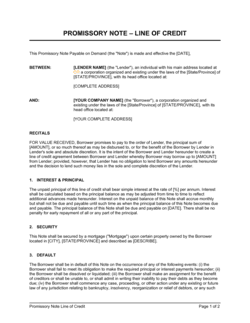
A promissory note is a short, unconditional promise to repay a specific sum by a specific date β€” it documents an existing obligation but does not govern how funds are advanced. A line of credit agreement governs the entire draw-and-repayment lifecycle, covenants, collateral, and default mechanics. A promissory note is sometimes used alongside a line of credit agreement to evidence each individual draw.

vs Business Credit Application

A credit application is a form the prospective borrower completes so the lender can assess creditworthiness β€” it is a pre-approval step, not a binding agreement. A line of credit agreement is the binding contract executed after the lender approves the facility. The application precedes the agreement; the agreement governs the funded relationship.

vs Security Agreement

A security agreement is a standalone document granting the lender a security interest in specific collateral β€” it is often executed alongside a line of credit agreement for secured facilities. The line of credit agreement governs the credit terms; the security agreement governs the collateral pledge and enforcement rights. For simple facilities, the security interest can be embedded directly in the line of credit agreement rather than documented separately.

Industry-specific considerations

Retail and e-commerce

Inventory-secured revolving lines tied to a borrowing base formula β€” typically 70–80% of eligible finished-goods inventory β€” used to fund seasonal stock buildup before peak sales periods.

Construction and real estate

Draw-down facilities secured by property equity or project receivables, with availability conditions tied to construction milestones and inspector sign-offs.

Professional services

Unsecured or receivables-backed lines used to bridge payroll and operating expenses between client billing cycles, with covenants tied to accounts receivable aging.

Manufacturing

Asset-based lines secured by raw materials, work-in-progress, and finished goods, with borrowing base certificates submitted monthly to confirm available collateral.

SaaS and technology

Revenue-based or unsecured credit facilities for growth-stage companies, with covenants focused on MRR growth rate, churn, and cash runway rather than traditional asset coverage.

Healthcare

Receivables-backed lines secured by Medicare and insurance claim receivables, with special eligibility rules excluding government-program receivables that are subject to assignment restrictions.

Jurisdictional notes

United States

Article 9 of the Uniform Commercial Code governs security interests in personal property in all 50 states β€” a UCC-1 financing statement must be filed in the borrower's state of organization to perfect a security interest in accounts receivable, inventory, or equipment. State usury laws cap interest rates on commercial loans; most states exempt business-to-business credit from consumer-rate caps. SOFR has replaced LIBOR as the primary floating-rate benchmark since June 2023. California, New York, and Texas each have specific commercial lending disclosure requirements for facilities under certain thresholds.

Canada

Security interests in personal property in Canada are governed by each province's Personal Property Security Act (PPSA) β€” similar in structure to UCC Article 9 but requiring registration in the province where the borrower's collateral is located. The criminal interest rate under the Criminal Code caps effective annual rates at 60% (being revised as of 2024 β€” verify current statutory limit). Quebec's Civil Code governs security interests in that province through a hypothec rather than a PPSA registration. Interest on business loans must be expressed as an effective annual rate under the Interest Act.

United Kingdom

Security over company assets in England and Wales must be registered at Companies House within 21 days of creation under the Companies Act 2006 or it is void against a liquidator and creditors. SONIA (Sterling Overnight Index Average) has replaced LIBOR as the benchmark for sterling-denominated floating-rate facilities. Consumer credit lines are regulated by the Financial Conduct Authority under the Consumer Credit Act 1974; business-to-business credit facilities are largely unregulated but must not include unlawful penalty clauses under common law.

European Union

Security interest registration requirements vary significantly by member state β€” Germany, France, and the Netherlands each have distinct perfection regimes with different registration bodies and timelines. €STR (Euro Short-Term Rate) has replaced EURIBOR-based LIBOR equivalents for floating-rate euro-denominated facilities. The EU Late Payment Directive sets maximum payment terms and interest rates for commercial transactions; facilities between businesses must comply with national implementing legislation. Cross-border facilities within the EU may trigger tax withholding obligations on interest payments depending on the lender's and borrower's respective jurisdictions.

Template vs lawyer β€” what fits your deal?

PathBest forCostTime
Use the templatePrivate intercompany lines, small unsecured facilities under $100,000 between known partiesFree30–60 minutes
Template + legal reviewSecured facilities, lines between $100,000 and $500,000, or facilities with financial covenants$600–$1,5002–5 days
Custom draftedInstitutional lending, facilities above $500,000, regulated industries, or cross-border parties$2,500–$10,000+1–4 weeks

Glossary

Credit Limit
The maximum outstanding balance the borrower may carry at any one time under the line of credit.
Draw
A specific advance of funds the borrower requests against the available balance of the credit line.
Revolving Credit
A credit structure where repaid principal becomes available to borrow again, up to the credit limit, throughout the facility term.
Availability
The portion of the credit limit not currently drawn β€” the amount the borrower may still access at a given point in time.
Interest Rate
The annualized percentage charged on the outstanding drawn balance, which may be fixed or variable (e.g., tied to the prime rate or SOFR plus a spread).
Facility Fee
A periodic charge β€” typically expressed as a percentage of the total credit limit β€” paid regardless of how much of the line is drawn.
Covenant
A contractual promise by the borrower to do (affirmative covenant) or refrain from doing (negative covenant) certain things while the facility is outstanding.
Event of Default
A defined triggering condition β€” such as missed payment, breach of covenant, or insolvency β€” that entitles the lender to demand immediate repayment of all outstanding amounts.
Acceleration
The lender's right, upon an event of default, to declare the entire outstanding balance immediately due and payable before its scheduled maturity.
Security Interest
A lender's legal claim over specified collateral β€” such as accounts receivable, inventory, or real property β€” that the lender may seize and liquidate if the borrower defaults.
SOFR
Secured Overnight Financing Rate β€” the benchmark interest rate that replaced LIBOR in the United States for pricing floating-rate credit facilities.
Maturity Date
The date on which the credit facility expires and any outstanding balance must be repaid in full unless the facility is renewed or extended.

Part of your Business Operating System

This document is one of 3,000+ business & legal templates included in Business in a Box.

  • Fill-in-the-blanks β€” ready in minutes
  • 100% customizable Word document
  • Compatible with all office suites
  • Export to PDF and share electronically

Create your document in 3 simple steps.

From template to signed document β€” all inside one Business Operating System.
1
Download or open template

Access over 3,000+ business and legal templates for any business task, project or initiative.

2
Edit and fill in the blanks with AI

Customize your ready-made business document template and save it in the cloud.

3
Save, Share, Send, Sign

Share your files and folders with your team. Create a space of seamless collaboration.

Save time, save money, and create top-quality documents.

β˜…β˜…β˜…β˜…β˜…

"Fantastic value! I'm not sure how I'd do without it. It's worth its weight in gold and paid back for itself many times."

Managing Director Β· Mall Farm
Robert Whalley
Managing Director, Mall Farm Proprietary Limited
β˜…β˜…β˜…β˜…β˜…

"I have been using Business in a Box for years. It has been the most useful source of templates I have encountered. I recommend it to anyone."

Business Owner Β· 4+ years
Dr Michael John Freestone
Business Owner
β˜…β˜…β˜…β˜…β˜…

"It has been a life saver so many times I have lost count. Business in a Box has saved me so much time and as you know, time is money."

Owner Β· Upstate Web
David G. Moore Jr.
Owner, Upstate Web

Run your business with a system β€” not scattered tools

Stop downloading documents. Start operating with clarity. Business in a Box gives you the Business Operating System used by over 250,000 companies worldwide to structure, run, and grow their business.

Start freeΒ Β·Β No credit card required