New Employee Welcome Letter Template

Free Word download β€’ Edit online β€’ Save & share with Drive β€’ Export to PDF

1 pageβ€’15–25 min to fillβ€’Difficulty: Standard
Learn more ↓
FreeNew Employee Welcome Letter Template

At a glance

What it is
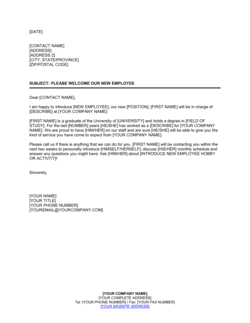
A New Employee Welcome Letter is a formal written communication sent to a new hire before or on their first day to confirm key onboarding details and set a positive tone for the working relationship. This free Word download gives you a structured, professional starting point you can edit online and send by email or print for in-person delivery.
When you need it
Send it after a signed offer letter or employment contract is in place, typically 3–7 days before the employee's start date. It bridges the gap between acceptance and arrival, reducing first-day anxiety and no-shows.
What's inside
A warm opening greeting, confirmation of start date and reporting location, first-day logistics, a brief introduction to the team and company culture, and a direct point of contact for pre-start questions.

What is a New Employee Welcome Letter?

A New Employee Welcome Letter is a formal written communication sent by an employer to a new hire before their first day of work. It confirms the start date, arrival time, work location, and direct manager, while introducing the new employee to the company's team and culture in a warm, human tone. Unlike an offer letter or employment contract, it carries no legal obligations β€” its function is to close the gap between offer acceptance and day one, giving the employee the practical information and personal reassurance they need to arrive prepared and confident.

Why You Need This Document

New hires who receive no communication between signing and their start date are significantly more likely to experience first-day anxiety, arrive unprepared, or β€” in the worst case β€” not show up at all. A missing welcome letter also signals a disorganized onboarding process, which sets a poor cultural tone before the employee has met a single colleague. Beyond the human dimension, an effective welcome letter triggers pre-start paperwork collection β€” tax forms, direct deposit, and I-9 verification β€” so that payroll is set up before the first paycheck is due. This template gives you a structured, professional starting point that takes 15 minutes to personalize and delivers a first impression your new hire will remember.

Which variant fits your situation?

If your situation is…Use this template
Welcoming a remote employee who will never visit the officeRemote Employee Welcome Letter
Onboarding a temporary or contract workerNew Contractor Welcome Letter
Welcoming an executive or senior leader joining the leadership teamExecutive Welcome Letter
Introducing a new team member to existing colleagues via emailNew Employee Announcement Email
Formally offering the role before the welcome letter is sentJob Offer Letter
Providing a full overview of policies, benefits, and proceduresEmployee Handbook

Common mistakes to avoid

❌ Sending the letter after the start date

Why it matters: A welcome letter that arrives on or after day one serves no logistical purpose and signals a disorganized onboarding process, which directly affects early employee confidence.

Fix: Build a pre-start checklist with a trigger to send the welcome letter 5–7 calendar days after the signed offer is returned.
❌ Using a generic, role-agnostic template without personalizing

Why it matters: New hires who receive a letter that could have been sent to anyone are less likely to feel valued, which research consistently links to lower early engagement and higher 90-day turnover.

Fix: At minimum, include the specific job title, team name, and the manager's name β€” three fields that make the letter feel written for that individual.

❌ Omitting first-day logistics entirely

Why it matters: Without a specific arrival time, location, and contact name, new hires make incorrect assumptions about where to go and who to ask for, creating avoidable confusion on both sides.

Fix: Include a dedicated logistics paragraph covering arrival time, address, dress code, what to bring, and who will meet them β€” even if it is only four sentences.

❌ No mention of pre-start paperwork or deadlines

Why it matters: When tax forms, direct deposit authorizations, and I-9 documents are collected on day one instead of before, payroll setup is delayed and the employee's first paycheck can be late.

Fix: List every required pre-start form, attach them to the welcome letter email, and state a specific return deadline at least two business days before the start date.

The 9 key clauses, explained

Header and date line

In plain language: Company letterhead, the date the letter is issued, and the employee's full name and address or email.

Sample language
[COMPANY NAME] | [COMPANY ADDRESS] | [DATE] [EMPLOYEE FULL NAME] [EMPLOYEE ADDRESS OR EMAIL]

Common mistake: Omitting the date or using the start date instead of the letter's issue date β€” these are separate dates and conflating them creates confusion in the employee's records.

Salutation

In plain language: A direct, warm greeting using the employee's preferred first name.

Sample language
Dear [EMPLOYEE FIRST NAME],

Common mistake: Using a generic 'Dear New Employee' or 'To Whom It May Concern' β€” impersonal openers undermine the welcoming intent of the letter before the first sentence.

Opening welcome statement

In plain language: Expresses genuine enthusiasm about the hire joining the team and briefly states the role they are filling.

Sample language
On behalf of the entire team at [COMPANY NAME], I am delighted to welcome you as our new [JOB TITLE]. We are very pleased you have chosen to join us and look forward to everything you will bring to the role.

Common mistake: Writing a generic welcome that could apply to any hire. Referencing the specific role title signals the letter was written for this person, not copied from a form.

Start date and reporting details

In plain language: Confirms the employee's official start date, reporting time, work location or remote setup instructions, and the name of their direct manager.

Sample language
Your first day is [DATE]. Please arrive at [LOCATION / ADDRESS] by [TIME] and ask for [MANAGER NAME], [MANAGER TITLE], who will be your direct manager and will meet you at reception.

Common mistake: Leaving the start time vague with 'normal business hours.' New hires without a specific arrival time often show up too early or too late, creating a poor first impression on both sides.

First-day logistics

In plain language: Covers practical details: dress code, parking or transit, entry instructions, what to bring, and any access credentials or IT setup steps to complete in advance.

Sample language
Please bring a government-issued photo ID and your [REQUIRED DOCUMENT] for I-9 / right-to-work verification. Our dress code is [DESCRIPTION]. Parking is available at [LOCATION]; visitor badges are issued at the front desk.

Common mistake: Omitting ID or documentation requirements until the morning of day one β€” employees who arrive without required forms create compliance delays and payroll holdups.

Introduction to team and culture

In plain language: Gives the new hire a brief, human sense of who they will be working with and what the company culture feels like day to day.

Sample language
You will be joining the [TEAM NAME] team, a group of [X] people who [BRIEF DESCRIPTION OF TEAM FOCUS]. At [COMPANY NAME], we value [VALUE 1], [VALUE 2], and [VALUE 3] β€” and we think you will feel that from your first day.

Common mistake: Pasting the company mission statement verbatim from the website. It reads as boilerplate and does not give the employee any genuine insight into the day-to-day culture.

Onboarding schedule or next steps

In plain language: Outlines what the first day or first week will look like β€” orientation sessions, IT setup, team introductions, and any pre-reading or forms to complete before arrival.

Sample language
Your first week will include an orientation session on [DATE], IT setup on [DATE], and introductory meetings with your team. Please complete the attached new-hire paperwork and return it to [CONTACT] by [DATE] so payroll is set up before your start date.

Common mistake: Sending the welcome letter with no mention of pre-start paperwork, then scrambling to collect tax forms and direct deposit details on day one, which delays first-paycheck processing.

Point of contact for pre-start questions

In plain language: Names a specific person the new hire can contact before their start date if they have questions about logistics, paperwork, or their role.

Sample language
If you have any questions before you start, please do not hesitate to contact [CONTACT NAME] at [EMAIL] or [PHONE NUMBER]. We are happy to help.

Common mistake: Listing only a general HR inbox with no named contact. New hires who cannot reach a real person before day one are more likely to have unresolved concerns and a higher risk of no-show.

Closing and signature

In plain language: A warm, forward-looking sign-off followed by the sender's name, title, and company.

Sample language
We look forward to welcoming you on [DATE] and are excited about what we will accomplish together. Warm regards, [SENDER FULL NAME] [SENDER TITLE] [COMPANY NAME]

Common mistake: Signing with only a first name or leaving the title blank. The new hire needs to know exactly who sent the letter to know who to contact or how to address them when they arrive.

How to fill it out

  1. 1

    Add your company letterhead and the issue date

    Replace the header placeholder with your company name, address, phone, and logo if applicable. Enter the date the letter is being sent β€” not the employee's start date.

    πŸ’‘ Sending the letter 5–7 days before the start date gives the employee enough time to arrange logistics without the letter feeling last-minute.

  2. 2

    Enter the employee's name and role

    Use the employee's full legal name in the address block and their preferred first name in the salutation. Confirm the exact job title matches the signed offer letter.

    πŸ’‘ Ask during the hiring process whether the employee goes by a preferred name β€” using it from the very first letter builds immediate rapport.

  3. 3

    Confirm start date, time, and location

    Enter the exact start date, a specific arrival time (not a range), the physical address or remote login instructions, and the name and title of the direct manager who will greet them.

    πŸ’‘ Include a Google Maps link or parking instructions in the email version β€” a new hire navigating an unfamiliar location on their first morning is already under stress.

  4. 4

    List first-day logistics and what to bring

    Note the dress code, any documents required for onboarding compliance (ID, work authorization), and practical details like parking, entry codes, or visitor badge procedures.

    πŸ’‘ Group logistics into a short bulleted list inside this paragraph β€” it is faster to scan than prose and reduces the chance of an employee missing a required item.

  5. 5

    Write a genuine team and culture introduction

    Name the team the employee is joining, briefly describe its focus, and identify one or two cultural values with a concrete example rather than a slogan.

    πŸ’‘ One specific detail β€” 'we have lunch together every Friday' or 'we do a 15-minute stand-up each morning' β€” tells the employee more about culture than three paragraphs of mission language.

  6. 6

    Outline the first-week schedule and any pre-start tasks

    Summarize orientation, IT setup, and key introductory meetings. List any forms or paperwork the employee should complete and return before their start date, with a specific deadline.

    πŸ’‘ Attach the new-hire paperwork packet to the same email as the welcome letter so the employee has everything in one place.

  7. 7

    Add a named point of contact and sign the letter

    Provide a specific person's name, direct email, and phone number for pre-start questions. Sign off with the sender's full name and title.

    πŸ’‘ If the letter is from the CEO or a senior leader rather than HR, have HR also listed as a secondary contact for practical paperwork questions.

Frequently asked questions

What is a new employee welcome letter?

A new employee welcome letter is a formal written communication sent by an employer to a new hire before their first day of work. It confirms start details, introduces the team and company culture, outlines first-day logistics, and provides a contact for pre-start questions. It is not a legally binding document β€” its purpose is to set a positive tone and reduce first-day uncertainty.

When should I send a welcome letter to a new employee?

Send it 5–7 calendar days before the employee's start date β€” early enough to give them time to arrange logistics, but close enough to feel timely and relevant. Sending it the same day as the signed offer letter is also common for fast-turnaround hires. Avoid sending it less than 48 hours before the start date, as the employee may not see it in time.

Is a welcome letter the same as an offer letter?

No. An offer letter is a formal document that proposes employment terms β€” salary, title, start date, and conditions β€” and requires the candidate's signature to create a binding agreement. A welcome letter is sent after the offer is accepted and signed; it is a friendly, practical communication focused on onboarding logistics and cultural introduction, not contractual terms.

Does a welcome letter need to be signed?

No signature is required. A welcome letter is a professional courtesy communication, not a contract. It is typically sent by email or printed on company letterhead and signed by the sender (HR manager, CEO, or direct manager) but does not require the employee's signature or acknowledgment.

What should a new employee welcome letter include?

At minimum: a warm greeting by name, confirmation of the start date and arrival time, the work location or remote setup instructions, the name of the direct manager, first-day logistics (dress code, what to bring, parking), a brief introduction to the team and culture, any pre-start paperwork instructions, and a named contact for questions. Letters that omit logistics information leave new hires without the practical details they need most.

Can a welcome letter be sent by email?

Yes, and email is now the most common delivery method. Sending the letter as a professionally formatted PDF attachment or in the body of a well-structured email is equally acceptable. If the role involves physical office attendance, some employers also print and hand it to the employee on arrival as a tangible keepsake β€” but the email version must be sent in advance regardless.

Who should sign a new employee welcome letter?

For small businesses and startups, the CEO or founder often signs the letter, which carries significant cultural weight. In larger organizations, the direct hiring manager or HR manager typically signs. Some companies send two versions β€” one from HR covering logistics and one from the manager covering team context. Whichever approach you use, include a named sender with a title so the employee knows who to address.

How is a welcome letter different from an employee handbook?

A welcome letter is a brief, personal communication β€” typically one page β€” focused on making the new hire feel welcome and confirmed for day one. An employee handbook is a comprehensive reference document covering policies, benefits, conduct standards, and procedures in detail. The welcome letter often references the handbook and may include it as an attachment, but the two serve entirely different purposes.

How this compares to alternatives

vs Job Offer Letter

A job offer letter proposes employment terms β€” compensation, title, and conditions β€” and requires the candidate's signature to become binding. A welcome letter is sent after the offer is accepted and signed; it covers onboarding logistics and culture introduction, not contractual terms. Both are needed for a complete hiring process, in sequence.

vs New Employee Announcement

A new employee announcement is sent internally to existing staff to introduce the incoming hire β€” name, role, and start date. A welcome letter is sent directly to the new hire before their first day. They serve opposite audiences: one prepares the team, the other prepares the employee.

vs Employment Contract

An employment contract is a legally binding document setting out the full terms of the working relationship β€” IP, confidentiality, non-compete, and termination. A welcome letter is non-binding and purely communicative. The contract must be signed before the welcome letter is sent, not after.

vs Employee Handbook

An employee handbook is a comprehensive reference covering all company policies, benefits, and conduct standards β€” typically 30–80 pages. A welcome letter is a single-page communication that introduces the employee to the company and confirms day-one logistics. The welcome letter often references the handbook as an attached document.

Industry-specific considerations

Technology / SaaS

Remote or hybrid logistics dominate β€” welcome letters typically include Slack workspace invitations, laptop shipping confirmation, and links to pre-start IT setup guides.

Healthcare

Credentialing, licensing verification, and HIPAA acknowledgment forms are referenced in the welcome letter, with specific deadlines before clinical duties begin.

Retail / Hospitality

High turnover makes a warm, fast welcome letter critical for early engagement; shift schedule, uniform policy, and training roster details are typically included.

Professional Services

Client confidentiality expectations, timesheet systems, and billable-hour orientation are commonly referenced to set professional standards from the first communication.

Template vs pro β€” what fits your needs?

PathBest forCostTime
Use the templateAny employer onboarding a new hire who wants a professional, consistent welcome communicationFree10–15 minutes per letter
Template + professional reviewCompanies standardizing onboarding across multiple departments or locations$0–$200 (HR consultant review)1–2 hours
Custom draftedEnterprise onboarding programs integrated with HRIS workflows and automated trigger systems$500–$2,000 (HR consultant or onboarding platform setup)1–2 weeks

Glossary

Onboarding
The structured process of integrating a new employee into the company β€” covering paperwork, training, introductions, and culture orientation.
Start Date
The officially agreed first day of employment, which should match the date stated in the signed employment contract or offer letter.
Reporting Manager
The person the new employee reports to directly, responsible for their day-to-day supervision and performance management.
Point of Contact
A named individual the new hire can reach before their start date for questions about logistics, paperwork, or first-day expectations.
First-Day Logistics
Practical details about the first day β€” arrival time, entry instructions, dress code, parking, and who to ask for upon arrival.
Probationary Period
A defined initial period β€” typically 30 to 90 days β€” during which both employer and employee evaluate fit before the role is confirmed as permanent.
Employee Handbook
A written reference document covering company policies, procedures, benefits, and conduct expectations provided to new hires during onboarding.
New Hire Paperwork
The set of forms a new employee must complete before or on their first day β€” tax forms, direct deposit authorization, benefits enrollment, and identity verification.

Part of your Business Operating System

This document is one of 3,000+ business & legal templates included in Business in a Box.

  • Fill-in-the-blanks β€” ready in minutes
  • 100% customizable Word document
  • Compatible with all office suites
  • Export to PDF and share electronically

Create your document in 3 simple steps.

From template to signed document β€” all inside one Business Operating System.
1
Download or open template

Access over 3,000+ business and legal templates for any business task, project or initiative.

2
Edit and fill in the blanks with AI

Customize your ready-made business document template and save it in the cloud.

3
Save, Share, Send, Sign

Share your files and folders with your team. Create a space of seamless collaboration.

Save time, save money, and create top-quality documents.

β˜…β˜…β˜…β˜…β˜…

"Fantastic value! I'm not sure how I'd do without it. It's worth its weight in gold and paid back for itself many times."

Managing Director Β· Mall Farm
Robert Whalley
Managing Director, Mall Farm Proprietary Limited
β˜…β˜…β˜…β˜…β˜…

"I have been using Business in a Box for years. It has been the most useful source of templates I have encountered. I recommend it to anyone."

Business Owner Β· 4+ years
Dr Michael John Freestone
Business Owner
β˜…β˜…β˜…β˜…β˜…

"It has been a life saver so many times I have lost count. Business in a Box has saved me so much time and as you know, time is money."

Owner Β· Upstate Web
David G. Moore Jr.
Owner, Upstate Web

Run your business with a system β€” not scattered tools

Stop downloading documents. Start operating with clarity. Business in a Box gives you the Business Operating System used by over 250,000 companies worldwide to structure, run, and grow their business.

Free Forever PlanΒ Β·Β No credit card required