Supermarket Business Plan Template

Free Word download β€’ Edit online β€’ Save & share with Drive β€’ Export to PDF

39 pagesβ€’3h 5m – 4h 15m to fillβ€’Difficulty: Expert
Learn more ↓
FreeSupermarket Business Plan Template

At a glance

What it is
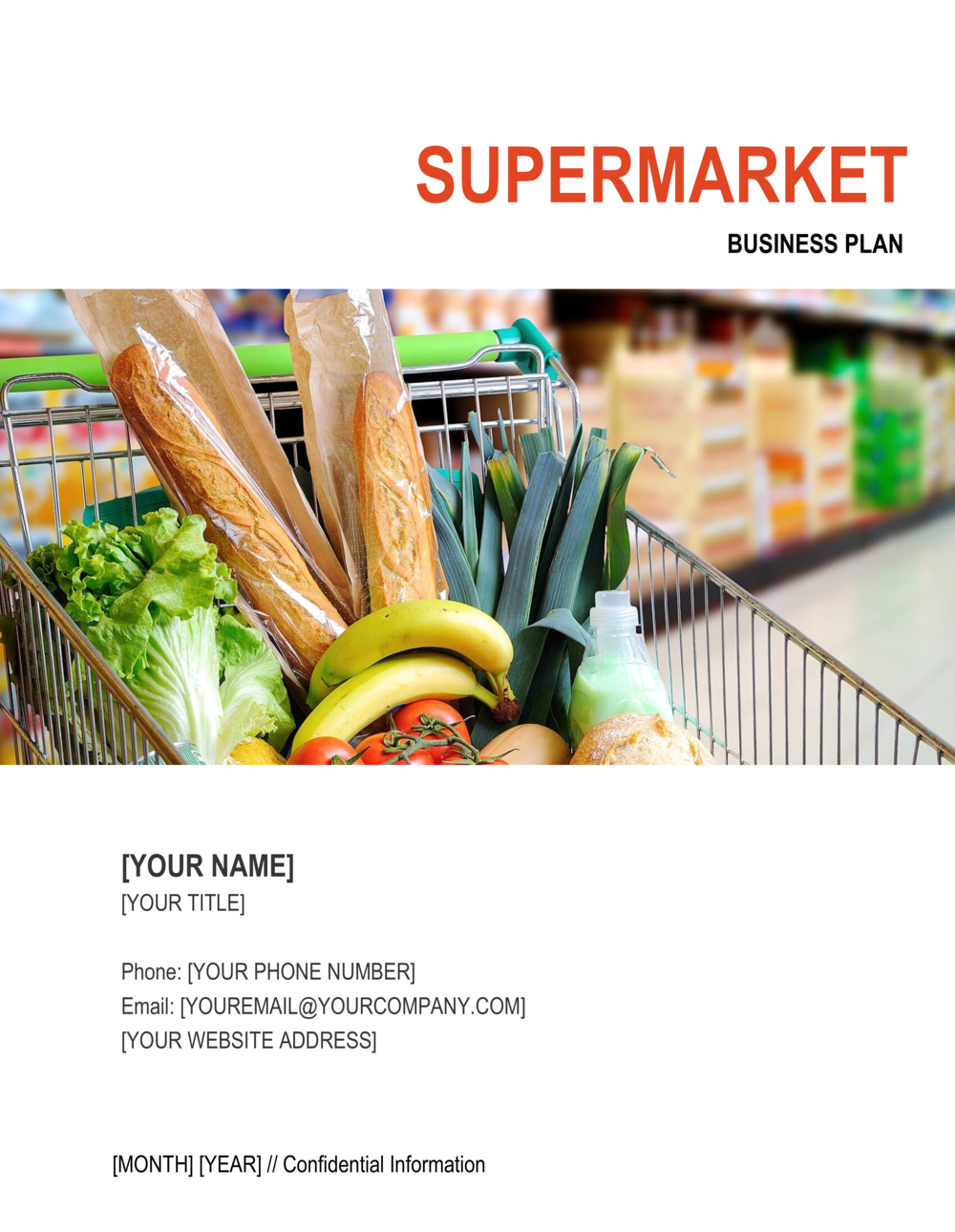
A Supermarket Business Plan is a structured document that maps the commercial, operational, and financial strategy for launching or expanding a grocery retail business. This free Word download gives you a professionally formatted starting point covering everything from store layout and merchandise mix to supplier contracts and projected cash flow, ready to edit online and export as PDF for lenders, investors, or franchise partners.
When you need it
Use it when applying for a bank loan or SBA financing to open a new grocery location, seeking investors for a regional chain expansion, or building an internal operating roadmap for a store reformat or new category rollout.
What's inside
Executive summary, company overview, market and competitive analysis, store concept and merchandise strategy, marketing and customer acquisition plan, operations and staffing model, supply chain and vendor management, and a full three-statement financial model with monthly Year 1 detail.

What is a Supermarket Business Plan?

A Supermarket Business Plan is a structured document that defines the commercial strategy, store operations model, merchandise mix, supply chain, staffing plan, and 3–5 year financial projections for a grocery retail business. It functions as the primary submission document for SBA loan applications, investor presentations, and franchise or anchor-tenant approvals β€” and as an internal operating roadmap that holds the store's management team accountable to measurable targets from opening day forward. Unlike a general retail business plan, a supermarket plan requires department-level margin modeling, perishable inventory management detail, and trade area demand analysis tied to a specific site.

Why You Need This Document

Without a complete business plan, grocery store financing stalls before the first lender meeting. SBA 7(a) lenders require an itemized use-of-funds schedule, department-level financial projections, and a trade area analysis before issuing a term sheet β€” a pitch deck or summary memo will not pass underwriting. Beyond financing, the planning process forces you to stress-test assumptions that are easy to underestimate in grocery retail: opening inventory cash requirements, perishable labor costs, shrink exposure, and the sales ramp during the critical first three months. A well-built supermarket business plan turns those blind spots into funded, staffed, and scheduled decisions before you sign a lease or place an opening inventory order.

Which variant fits your situation?

If your situation is…Use this template
Opening a neighborhood convenience or corner storeConvenience Store Business Plan
Launching a natural or organic specialty groceryOrganic Grocery Store Business Plan
Applying for an SBA 7(a) loan for a first storeSupermarket Business Plan (SBA Format)
Planning a full-service restaurant inside a grocery footprintRestaurant Business Plan
Quick internal alignment on a store reformat or new categoryOne-Page Business Plan
Expanding an existing chain into a new metro marketBusiness Expansion Plan
Launching an online grocery or delivery-first modelE-Commerce Business Plan

Common mistakes to avoid

❌ Using national industry averages instead of trade area data

Why it matters: A lender approving a single-store loan cares about the 2-mile ring around your site, not the $900B US grocery industry. Generic statistics signal that no real site analysis was done.

Fix: Pull census data, competitor locations, and a household spending estimate for your specific trade area radii and present them as the foundation of your market section.

❌ Single blended gross margin across all departments

Why it matters: Produce, meat, deli, and dry grocery have materially different margin profiles β€” blending them hides whether the merchandise mix is financially viable and makes the model impossible to stress-test.

Fix: Build department-level margin assumptions based on FMI benchmark data and show how they blend to your projected store-level gross margin.

❌ Omitting the opening inventory investment from the funding schedule

Why it matters: Opening inventory for a mid-size supermarket runs $300,000–$800,000 at cost and must be funded before the first sale. Missing it creates a cash shortfall on Day 1 that no operating cash flow can cover.

Fix: Calculate opening inventory by department at cost and include it as a funded line item in both the use-of-funds schedule and the opening-month cash flow statement.

❌ No customer retention strategy beyond grand opening

Why it matters: Grand-opening traffic spikes typically fade by Week 6–8. Without a loyalty program, weekly circular, or community engagement plan, the store has no mechanism to convert trial shoppers into regular customers.

Fix: Plan the loyalty program launch for Day 1, set a 6-month household enrollment target, and budget a weekly marketing spend for at least the first 12 months.

❌ Flat Year 1 sales from Month 1

Why it matters: New supermarkets typically ramp to steady-state weekly sales over 8–16 weeks. Modeling full volume from Month 1 overstates revenue and understates the cash required to survive the opening period.

Fix: Apply a ramp factor of 60–75% of steady-state weekly sales for the first 3 months and show the cumulative cash impact in the monthly cash flow statement.

❌ Underestimating part-time labor needs in perishable departments

Why it matters: Meat, produce, and deli require skilled, often full-time labor for trimming, rotation, and food-safety compliance β€” understaffing these departments directly increases shrink and drives customer complaints.

Fix: Model perishable department staffing separately from dry grocery and build a shift schedule that covers all required food-safety tasks at the department level.

The 10 key sections, explained

Executive Summary

Company Overview

Market and Trade Area Analysis

Store Concept and Merchandise Strategy

Marketing and Customer Acquisition

Operations and Staffing Plan

Supply Chain and Vendor Management

Technology and Store Systems

Financial Projections

Funding Requirements and Use of Funds

How to fill it out

  1. 1

    Define the store concept and format

    Choose the store format β€” conventional, discount, natural/organic, ethnic, or warehouse β€” and write the company overview section first. Lock in the trade area address, square footage, and ownership structure before filling any other section.

    πŸ’‘ Your format choice drives every downstream assumption: margin benchmarks, staffing ratios, and supplier relationships all vary significantly between a discount grocer and a full-service conventional supermarket.

  2. 2

    Conduct a trade area analysis with primary data

    Pull census demographic data for the 1-, 2-, and 3-mile rings around your site. Identify all grocery competitors by format and distance, and estimate the annual grocery spending in the trade area using household count Γ— average annual grocery spend ($5,500–$7,500 per US household).

    πŸ’‘ A site visit at peak hours (Saturday 10am–2pm) to count competitor parking lot utilization gives you demand evidence no database can replicate.

  3. 3

    Build the department sales mix and merchandise plan

    Allocate your projected annual sales across departments using FMI or USDA benchmarks as a starting point, then adjust for your specific format. Calculate SKU count by department and set a private-label penetration target.

    πŸ’‘ Prepared foods and deli are the fastest-growing margin contributors in conventional supermarkets β€” if your format supports it, plan at least 12% of sales from this department from Year 2 onward.

  4. 4

    Model staffing and labor cost by department

    Build a staffing plan listing every role, full-time vs. part-time hours, and hourly wage or salary. Calculate total labor cost and express it as a percentage of projected sales β€” target 14–18% for a conventional format.

    πŸ’‘ Model Sunday and holiday premium pay separately β€” these costs are easy to underestimate and materially affect weekly labor percentages in a seven-day retail operation.

  5. 5

    Identify suppliers and model the opening inventory buy

    Name your primary wholesale distributor and at least three DSD vendor categories. Calculate the opening inventory investment by department at cost, and include it as a funded line item in the use-of-funds schedule.

    πŸ’‘ Negotiate extended payment terms (Net 45–60) on the opening inventory buy before you sign a distributor agreement β€” this preserves working capital in your critical first quarter.

  6. 6

    Build the three-statement financial model

    Model monthly P&L, cash flow, and balance sheet for Year 1 using department-level gross margins, your staffing cost schedule, and itemized operating expenses. Carry the annual summary forward for Years 2–5.

    πŸ’‘ Include a Month 1–3 ramp-up factor of 60–75% of steady-state weekly sales β€” new supermarkets rarely open at full volume, and ignoring the ramp creates an optimistic cash flow that surprises lenders.

  7. 7

    Complete the use-of-funds schedule with vendor quotes

    Itemize every opening cost β€” leasehold improvements, refrigeration cases, shelving, POS hardware, initial inventory, and working capital reserve β€” supported by at least one contractor bid or equipment quote per major category.

    πŸ’‘ Add a 10–15% contingency line to your build-out costs; grocery refrigeration and electrical work routinely run over initial estimates.

  8. 8

    Write the executive summary last

    Pull the single strongest data point from each section β€” trade area spending gap, projected Year 1 revenue, gross margin, and funding ask β€” and compress them into a 1–2 page summary. The summary is the first thing a lender reads and often the only thing read before a meeting.

    πŸ’‘ State your funding ask and the specific milestone it funds in the first paragraph of the executive summary β€” lenders should not have to search for the number.

Frequently asked questions

What is a supermarket business plan?

A supermarket business plan is a structured document covering the store concept, trade area analysis, merchandise strategy, operations model, staffing plan, supply chain, and 3–5 year financial projections for a grocery retail business. It serves as the primary document for securing SBA loans, attracting investors, or getting franchise approval, and as an internal operating roadmap for the store's management team.

What financial projections should a supermarket business plan include?

A complete financial section includes a monthly P&L for Year 1 and annual statements for Years 2–5, a cash flow statement on the same cadence, a projected balance sheet, and an itemized opening investment schedule with use-of-funds detail. Key metrics to include are sales per square foot, gross margin by department, labor as a percentage of sales, shrink rate, and EBITDA breakeven month.

How much does it cost to open a supermarket?

Opening costs vary significantly by store size and format. A small independent grocery (5,000–10,000 sq ft) typically requires $500,000– $1.5M in total investment. A conventional full-service supermarket (30,000–50,000 sq ft) commonly runs $3M–$10M, with refrigeration and leasehold improvements as the largest cost categories. Working capital and opening inventory together typically account for 20–30% of total investment and are frequently underestimated.

What gross margin should I project for a supermarket?

Store-level gross margins for conventional US supermarkets average 25–30% of net sales. Department margins vary considerably: produce runs 35–45%, dry grocery 22–28%, meat and seafood 28–35%, and deli and prepared foods 40–55%. Your blended margin depends on your department sales mix and how aggressively you price relative to competitors. Model each department separately rather than using a single blended rate.

Can I get an SBA loan for a supermarket?

Yes. SBA 7(a) loans are one of the most common financing tools for independent supermarket owners, with loan amounts up to $5M and terms up to 10 years for working capital or 25 years for real estate. Lenders require a complete business plan with a detailed use-of-funds schedule, 3–5 year financial projections, a trade area analysis, and evidence of industry experience. A well-structured business plan is not optional β€” it is the primary approval document.

How long should a supermarket business plan be?

A plan submitted to an SBA lender or investor typically runs 25–40 pages plus financial model appendices. Internal operating plans can be shorter. The financial model β€” including monthly P&L, cash flow, balance sheet, and department-level assumptions β€” is the most scrutinized section and should be thorough even if the narrative sections are concise.

What is a realistic sales per square foot target for a supermarket?

US conventional supermarkets average $500–$650 in annual sales per square foot. High-performing stores in dense urban markets or strong value-oriented formats can reach $800–$1,200 per square foot. Natural and organic formats typically run $700–$900 per square foot. Use trade-area household density and income data to calibrate your projection rather than defaulting to a national average.

Do I need a consultant to write a supermarket business plan?

For an SBA loan under $1M at a straightforward single-store location, a well-completed template is typically sufficient. Engage a retail industry consultant or business plan writer ($2,000–$8,000) when the loan or raise exceeds $2M, when the site involves significant construction or refrigeration complexity, or when the lender requires a formal market feasibility study with primary research.

How do I analyze competition in my trade area?

Map all grocery competitors within a 3-mile radius by format (conventional, discount, natural, club, convenience). For each, note approximate store size, price positioning relative to yours, and any visible gaps in assortment or service that your concept addresses. Conduct a physical store visit and a price check on 30–50 key items. Lenders expect named competitors with a specific analysis β€” "limited competition" without evidence is a common red flag.

How this compares to alternatives

vs Restaurant Business Plan

A restaurant business plan focuses on menu development, kitchen operations, covers per day, and food cost as a percentage of revenue. A supermarket business plan covers a much broader merchandise mix across dozens of categories, with department-level margin modeling, inventory management systems, and a wholesale supply chain. Both are food-focused, but the operational and financial drivers are fundamentally different.

vs One-Page Business Plan

A one-page plan is a rapid-alignment tool for internal teams or early concept testing. It lacks the financial depth, trade area analysis, and use-of-funds detail that SBA lenders and investors require for a capital-intensive grocery store opening. Use the one-page plan to pressure-test your concept, then build this full plan before approaching any lender.

vs Financial Projections Template

A standalone financial projections template covers the numbers only β€” P&L, cash flow, and balance sheet. A supermarket business plan contextualizes those numbers with market evidence, merchandise strategy, operational detail, and team background. Lenders never evaluate grocery store financials in isolation; the full plan is the required submission.

vs Marketing Plan

A marketing plan covers customer acquisition channels, promotional calendars, loyalty strategy, and brand positioning in depth. A supermarket business plan includes a marketing section but also covers site analysis, operations, supply chain, staffing, and financials. Use both together β€” the marketing plan provides the tactical detail the business plan summarizes.

Industry-specific considerations

Grocery and Food Retail

Department-level margin modeling, shrink management targets, DSD vendor relationships, and private-label penetration strategy are the core operational differentiators in this sector.

Franchise and Licensed Retail

Franchise partners require a site-specific business plan demonstrating trade area demand, operator experience, and financial capacity before granting territory or store approval.

Real Estate and Site Development

Landlords and developers use the business plan to evaluate a grocery tenant's financial strength and operational credibility before committing to a long-term anchor lease.

Financial Services and Lending

SBA lenders and community development financial institutions (CDFIs) use the business plan as the primary underwriting document for grocery store loans, with particular focus on the opening investment schedule and cash flow breakeven timeline.

Template vs pro β€” what fits your needs?

PathBest forCostTime
Use the templateIndependent grocery owners applying for SBA loans under $1M or preparing for a franchisor reviewFree3–5 weeks (50–80 hours including financial modeling)
Template + professional reviewFirst-time owners, loans of $1M–$3M, or markets with complex competitive dynamics requiring a formal feasibility study$1,500–$5,000 for a retail consultant or accountant review4–6 weeks
Custom draftedMulti-store chain expansions, raises above $3M, anchor tenant lease negotiations, or CDFI and institutional lender submissions$5,000–$15,000 for a specialist grocery retail business plan writer6–10 weeks

Glossary

Gross Margin (Retail)
Net sales minus the cost of goods sold, expressed as a percentage β€” typically 25–35% for full-service supermarkets.
SKU (Stock Keeping Unit)
A unique identifier assigned to each distinct product variant carried in the store, used for inventory tracking and reordering.
Shrink
Inventory loss from theft, spoilage, damage, or administrative error β€” a key profitability metric targeted below 2% of sales in well-run supermarkets.
Category Management
The process of managing product categories as strategic business units, optimizing assortment, shelf placement, pricing, and promotion by category.
Planogram
A visual diagram specifying exactly how and where products should be placed on shelves to maximize sales and space efficiency.
Private Label
Store-branded products manufactured by a third party but sold under the retailer's own brand, typically at lower price points and higher margins than national brands.
Slotting Fee
A payment a supplier makes to a retailer for shelf space β€” common in larger chains, less so in independent grocers.
Average Transaction Value (ATV)
Total sales divided by the number of customer transactions in a given period, used to track basket size trends.
Loyalty Program
A structured reward scheme that incentivizes repeat purchases by crediting customers with points, discounts, or exclusive pricing tied to a membership card or app.
COGS (Cost of Goods Sold)
The direct cost of the merchandise sold during a period, including purchase price, freight, and vendor allowances.
Trade Area
The geographic zone from which a store draws the majority of its customers β€” typically a 1- to 5-mile radius for a full-service supermarket.

Part of your Business Operating System

This document is one of 3,000+ business & legal templates included in Business in a Box.

  • Fill-in-the-blanks β€” ready in minutes
  • 100% customizable Word document
  • Compatible with all office suites
  • Export to PDF and share electronically

Create your document in 3 simple steps.

From template to signed document β€” all inside one Business Operating System.
1
Download or open template

Access over 3,000+ business and legal templates for any business task, project or initiative.

2
Edit and fill in the blanks with AI

Customize your ready-made business document template and save it in the cloud.

3
Save, Share, Send, Sign

Share your files and folders with your team. Create a space of seamless collaboration.

Save time, save money, and create top-quality documents.

β˜…β˜…β˜…β˜…β˜…

"Fantastic value! I'm not sure how I'd do without it. It's worth its weight in gold and paid back for itself many times."

Managing Director Β· Mall Farm
Robert Whalley
Managing Director, Mall Farm Proprietary Limited
β˜…β˜…β˜…β˜…β˜…

"I have been using Business in a Box for years. It has been the most useful source of templates I have encountered. I recommend it to anyone."

Business Owner Β· 4+ years
Dr Michael John Freestone
Business Owner
β˜…β˜…β˜…β˜…β˜…

"It has been a life saver so many times I have lost count. Business in a Box has saved me so much time and as you know, time is money."

Owner Β· Upstate Web
David G. Moore Jr.
Owner, Upstate Web

Run your business with a system β€” not scattered tools

Stop downloading documents. Start operating with clarity. Business in a Box gives you the Business Operating System used by over 250,000 companies worldwide to structure, run, and grow their business.

Start freeΒ Β·Β No credit card required