Internship Form Template

Free Word download β€’ Edit online β€’ Save & share with Drive β€’ Export to PDF

2 pagesβ€’15–25 min to fillβ€’Difficulty: Standard
Learn more ↓
FreeInternship Form Template

At a glance

What it is
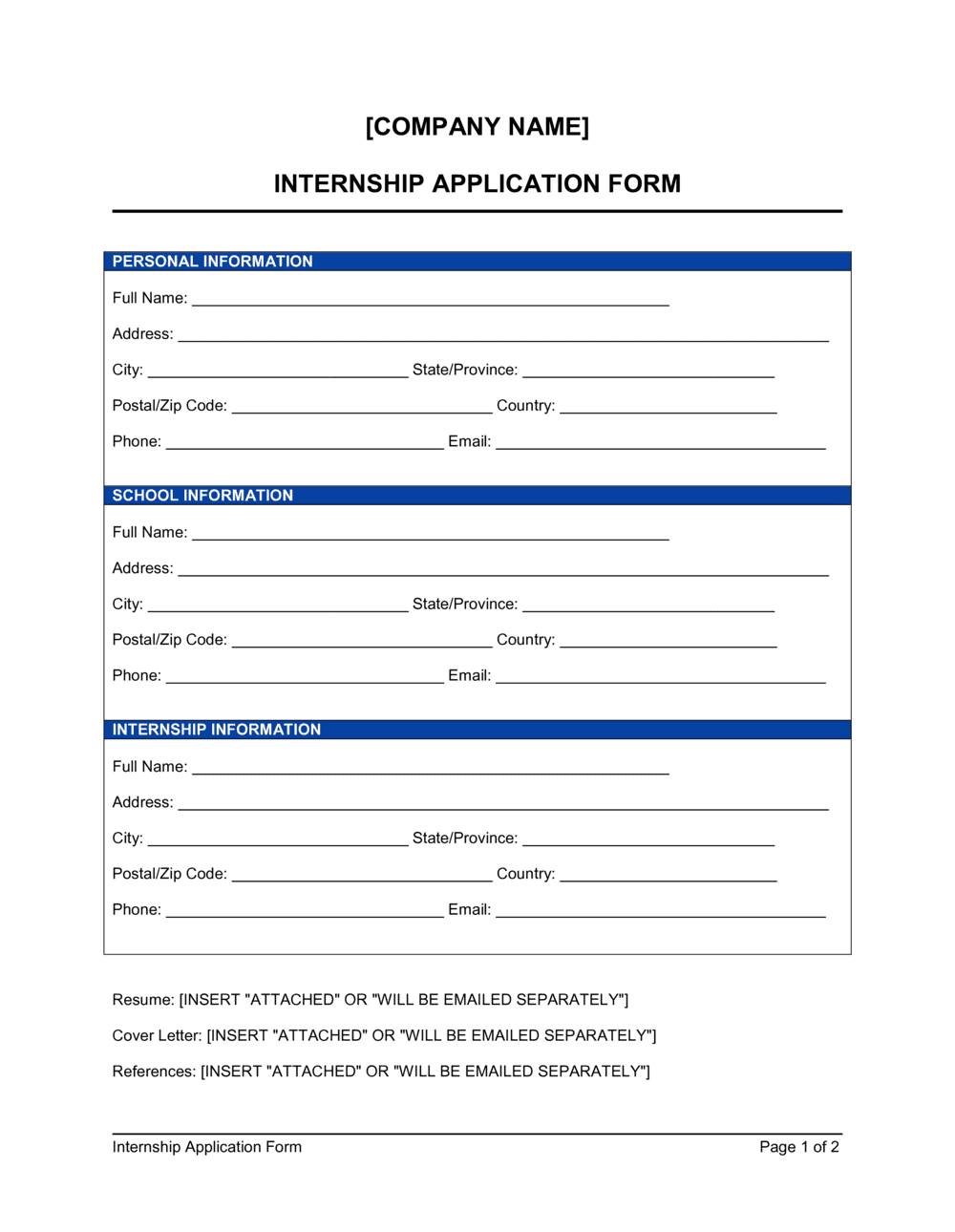
An Internship Form is a standardized document that captures all the essential details of an internship arrangement in one place β€” intern contact information, academic program, supervisor, placement dates, compensation or stipend, learning objectives, and emergency contacts. This free Word download is editable online and exports to PDF in minutes.
When you need it
Use it whenever you bring on an intern, whether paid or unpaid, full-time or part-time β€” before their first day on site or remotely.
What's inside
Intern personal and academic details, host organization and supervisor information, internship dates and schedule, pay or stipend terms, defined learning objectives, and emergency contact fields.

What is an Internship Form?

An Internship Form is a standardized administrative document used to record all the essential details of an internship placement before it begins. It captures the intern's personal and academic information, the host organization and supervising manager, the placement dates and weekly schedule, compensation or stipend terms, agreed learning objectives, and emergency contact details β€” creating a single reference document for HR, the supervisor, and the academic institution. Unlike an internship agreement, the form is not a binding contract; it is an intake and record-keeping tool that ensures every placement starts with the same documented foundation.

Why You Need This Document

Without a completed internship form, placements begin with critical gaps: no documented supervisor, no agreed learning objectives, and no emergency contact on file. These gaps create real problems β€” academic institutions may reject the placement for credit approval without documented objectives, wage disputes become harder to resolve when compensation terms were never written down, and a workplace incident during an undocumented placement leaves you without basic records. For unpaid internships in particular, written documentation of the educational purpose and learning outcomes is one of the primary factors regulators examine when determining whether the arrangement meets the legal conditions for unpaid status. This template gives you a consistent, professional form you can complete in under ten minutes per intern and file immediately β€” so every placement starts the right way.

Which variant fits your situation?

If your situation is…Use this template
Formalizing a paid internship with defined employment-like termsInternship Agreement
Engaging an unpaid intern for academic creditUnpaid Internship Agreement
Hiring a student for a short project or summer placementPart-Time Employment Contract
Onboarding any new hire beyond the internship programNew Employee Information Form
Evaluating intern performance at end of placementInternship Evaluation Form
Engaging a student for project-based freelance workIndependent Contractor Agreement

Common mistakes to avoid

❌ Vague or missing learning objectives

Why it matters: Without specific objectives, end-of-term evaluations have no benchmark, academic institutions may reject the placement for credit, and interns have no clear sense of what they are working toward.

Fix: Write two to five objectives before the start date using action verbs and measurable outcomes β€” e.g., 'draft and present one market analysis report' rather than 'learn about marketing.'

❌ Leaving compensation fields blank

Why it matters: An ambiguous or empty pay field creates disputes after the placement ends and can expose the organization to wage claims if local law treats the intern as an employee.

Fix: Explicitly record the pay rate, stipend amount, or 'Unpaid β€” academic credit only' β€” no field should be left blank or marked 'TBD.'

❌ No named supervisor on the form

Why it matters: A generic department contact means the intern has no clear person to escalate issues to, and academic institutions have no one to contact for evaluations or incident reports.

Fix: Assign a named individual with direct contact details and note a backup supervisor for absences.

❌ Collecting the form after the start date

Why it matters: Emergency contact information, compensation terms, and learning objectives have no value if they are recorded days or weeks into a placement β€” and any incident in the gap is undocumented.

Fix: Complete and file the internship form before or on the intern's first day, treating it the same way you would a new-hire onboarding document.

The 9 key fields, explained

Intern personal information

Academic institution and program

Host organization and department

Supervising manager

Internship dates and schedule

Compensation and stipend

Learning objectives

Emergency contact

Intern and supervisor acknowledgment

How to fill it out

  1. 1

    Enter the intern's personal and contact details

    Fill in the intern's full legal name, personal email, phone number, and mailing address. Confirm the personal email is not a school-issued address that may expire.

    πŸ’‘ Ask interns to provide a personal email at the same time as their school email so you have a permanent contact on file.

  2. 2

    Record the academic institution and program

    Note the school name, the degree or diploma program, and the expected graduation date. If the internship is not for academic credit, record the enrollment status anyway for eligibility verification.

    πŸ’‘ Cross-reference the program name with the institution's catalog spelling β€” inconsistencies cause delays when sharing records with career offices.

  3. 3

    Complete the host organization and department section

    Enter the company's full registered legal name, the specific department, and whether the intern will work on-site, remotely, or in a hybrid arrangement.

    πŸ’‘ If the intern rotates across departments, note the primary department and list rotation dates in the schedule field.

  4. 4

    Name the supervising manager and their contact details

    Enter the supervisor's full name, job title, direct phone number, and work email. This is the person interns and academic institutions will contact for day-to-day questions and evaluations.

    πŸ’‘ Assign a backup supervisor in case the primary is unavailable β€” note their contact in the comments or notes field.

  5. 5

    Set the exact placement dates and weekly schedule

    Enter the start and end dates and the number of hours per week. Specify the standard working days and hours, and note any planned breaks such as exam periods.

    πŸ’‘ Align the end date with the academic institution's submission deadline for credit forms β€” a one-week buffer prevents last-minute rushes.

  6. 6

    Specify compensation or stipend terms

    Select paid, unpaid, or stipend; enter the rate or amount; and record the payment frequency. For unpaid placements, explicitly write 'Unpaid β€” academic credit only.'

    πŸ’‘ Check your jurisdiction's wage laws before marking an internship as unpaid β€” several US states and Canadian provinces impose conditions on unpaid placements for private-sector employers.

  7. 7

    Define two to five learning objectives

    Write specific, measurable objectives the intern will work toward during the placement. Involve the intern and their academic coordinator in drafting these before the start date.

    πŸ’‘ Tie at least one objective directly to a project the intern will complete β€” deliverable-linked objectives make evaluation straightforward.

  8. 8

    Collect emergency contact and obtain signatures

    Have the intern provide an emergency contact name, relationship, and phone number. Then collect printed name, signature, and date from both the intern and the supervising manager.

    πŸ’‘ Store the completed form in a shared folder accessible to both HR and the supervisor β€” emergency contact details are useless if only HR can access them during a workplace incident.

Frequently asked questions

What is an internship form?

An internship form is a standardized document that captures all the key details of an internship arrangement before it begins β€” intern contact information, academic program, host organization, supervisor, placement dates, schedule, compensation or stipend, learning objectives, and emergency contacts. It serves as the official record of the placement for HR, the supervising manager, and the academic institution.

Is an internship form the same as an internship agreement?

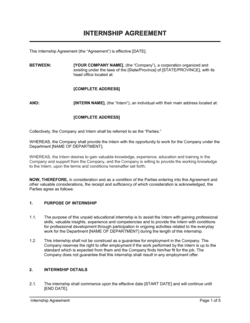
No. An internship form collects and records the factual details of the placement. An internship agreement is a binding contract that establishes obligations, confidentiality terms, IP ownership, and termination conditions. For straightforward academic placements, the form alone is typically sufficient. For paid internships or placements involving sensitive work, both documents should be used together.

Does an internship form need to be signed?

A signature is not legally required for the form to function as an administrative record, but collecting acknowledgment signatures from both the intern and the supervising manager is strongly recommended. Signatures confirm that both parties reviewed and agreed to the placement details β€” particularly the schedule, compensation terms, and learning objectives.

Do unpaid internships need a form?

Yes. An internship form is especially important for unpaid placements because it documents that the arrangement meets the conditions for lawful unpaid internship status β€” including the educational purpose, learning objectives, and the absence of displacement of regular employees. This documentation protects the organization if a wage dispute arises later.

How far in advance should the internship form be completed?

Complete the form before the intern's first day β€” ideally one to two weeks in advance. This gives time to confirm supervisor availability, finalize the schedule, and share a copy with the academic institution if required for credit registration. Emergency contact information has no value if it is collected after an incident has occurred.

What are learning objectives and why do they matter?

Learning objectives are specific, agreed-upon skills or outcomes the intern is expected to develop during the placement. They matter because many academic programs require them for credit approval, they give the supervisor a framework for assignments and feedback, and they give the intern a clear sense of what the placement is meant to accomplish. Two to five concrete objectives are sufficient for most placements.

Can I use this form for remote internships?

Yes. The form works for on-site, remote, and hybrid placements. For remote interns, note the remote work status in the location field and confirm that the supervisor's contact details are sufficient for daily communication. Emergency contact information is just as important for remote interns β€” workplace incidents can happen anywhere.

Should I give the intern a copy of the completed form?

Yes. Provide the intern with a copy on or before their start date. Many academic institutions also require a copy for their placement records. Keeping the intern's copy in a shared folder or emailing it as a PDF ensures both parties have the same reference document throughout the placement.

How this compares to alternatives

vs Internship Agreement

An internship agreement is a binding contract covering obligations, confidentiality, IP rights, and termination conditions. The internship form is an administrative intake document that records placement details. For paid internships or roles involving sensitive information, use both β€” the form captures the facts; the agreement creates enforceable terms.

vs New Employee Information Form

A new employee information form is designed for permanent or long-term hires and includes payroll setup, tax withholding elections, and benefits enrollment fields. The internship form is scoped to the fixed-term, educational nature of an internship β€” including learning objectives, academic institution details, and stipend terms not relevant to regular employees.

vs Independent Contractor Agreement

An independent contractor agreement is a legal document for self-employed individuals engaged for project-based work. An internship form is an administrative record for a structured, supervisory placement β€” typically involving a student. Using a contractor agreement for an intern can create misclassification risk if the arrangement looks more like employment.

vs Internship Evaluation Form

The internship form is completed at the start of a placement to record details and objectives. An internship evaluation form is completed at the end to assess performance against those objectives. The two documents work in sequence β€” the learning objectives defined on the intake form become the scoring criteria on the evaluation form.

Industry-specific considerations

Professional Services

Law firms, accounting firms, and consulting agencies use the form to document client-facing intern roles and ensure confidentiality obligations are acknowledged before work begins.

Healthcare

Hospitals and clinics require completed intern forms to verify academic enrollment, confirm supervisory coverage ratios, and satisfy accreditation body documentation standards.

Technology / SaaS

Tech companies use the form to assign remote interns to specific teams, document IP-adjacent learning objectives, and collect contact details for distributed onboarding.

Nonprofit Organizations

Nonprofits rely on the form to satisfy grant-reporting requirements that mandate documentation of volunteer and intern hours, roles, and educational outcomes.

Template vs pro β€” what fits your needs?

PathBest forCostTime
Use the templateAny organization onboarding paid or unpaid interns for a structured placementFree5–10 minutes per intern
Template + professional reviewOrganizations placing interns in regulated industries or requiring academic credit approval$0–$100 (HR advisor or career office review)1–2 hours
Custom draftedLarge internship programs with custom workflows, ERP integration, or multi-site placements$200–$800 (HR consultant or developer)1–5 days

Glossary

Internship
A fixed-term, structured work experience β€” paid or unpaid β€” offered to students or recent graduates to develop practical skills in a professional setting.
Stipend
A fixed regular payment to an intern that is not tied to an hourly wage, often used for unpaid academic internships to cover living or travel expenses.
Learning Objectives
Specific skills, knowledge areas, or competencies the intern is expected to develop during the placement, agreed upon by the intern, supervisor, and academic institution.
Supervising Manager
The designated employee responsible for overseeing the intern's daily work, providing feedback, and completing any required evaluations.
Academic Program
The degree, diploma, or certificate program the intern is enrolled in β€” used to confirm eligibility and align placement activities with course requirements.
Placement Period
The defined start and end dates of the internship, including the scheduled hours per week and any agreed exceptions such as exam breaks.
Emergency Contact
A person designated by the intern to be notified in the event of a workplace incident, medical emergency, or other urgent situation.
Host Organization
The company, nonprofit, or agency providing the internship placement and supervising the intern's day-to-day activities.

Part of your Business Operating System

This document is one of 3,000+ business & legal templates included in Business in a Box.

  • Fill-in-the-blanks β€” ready in minutes
  • 100% customizable Word document
  • Compatible with all office suites
  • Export to PDF and share electronically

Create your document in 3 simple steps.

From template to signed document β€” all inside one Business Operating System.
1
Download or open template

Access over 3,000+ business and legal templates for any business task, project or initiative.

2
Edit and fill in the blanks with AI

Customize your ready-made business document template and save it in the cloud.

3
Save, Share, Send, Sign

Share your files and folders with your team. Create a space of seamless collaboration.

Save time, save money, and create top-quality documents.

β˜…β˜…β˜…β˜…β˜…

"Fantastic value! I'm not sure how I'd do without it. It's worth its weight in gold and paid back for itself many times."

Managing Director Β· Mall Farm
Robert Whalley
Managing Director, Mall Farm Proprietary Limited
β˜…β˜…β˜…β˜…β˜…

"I have been using Business in a Box for years. It has been the most useful source of templates I have encountered. I recommend it to anyone."

Business Owner Β· 4+ years
Dr Michael John Freestone
Business Owner
β˜…β˜…β˜…β˜…β˜…

"It has been a life saver so many times I have lost count. Business in a Box has saved me so much time and as you know, time is money."

Owner Β· Upstate Web
David G. Moore Jr.
Owner, Upstate Web

Run your business with a system β€” not scattered tools

Stop downloading documents. Start operating with clarity. Business in a Box gives you the Business Operating System used by over 250,000 companies worldwide to structure, run, and grow their business.

Start freeΒ Β·Β No credit card required