1
Identify the legal entities on both sides
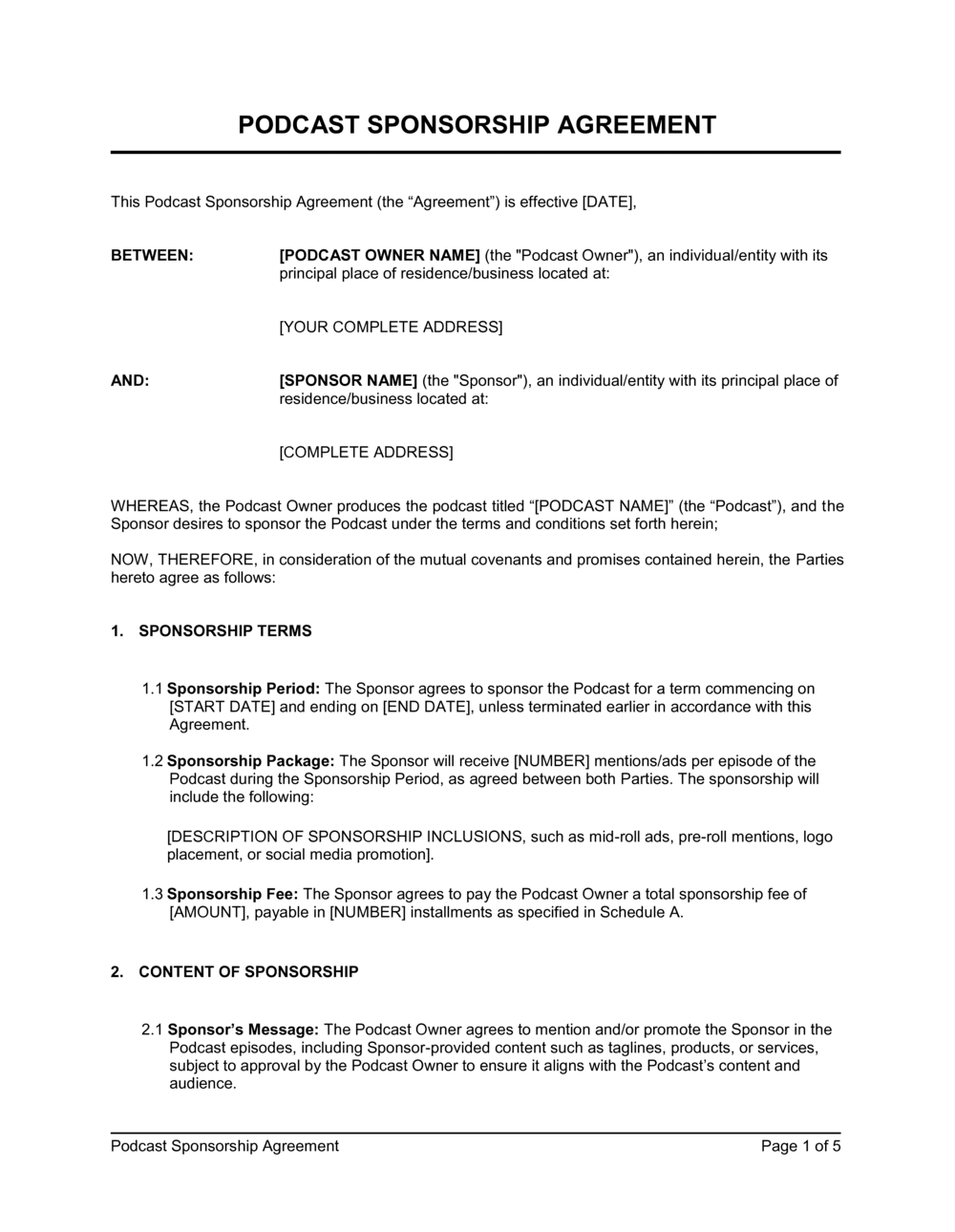
Enter the host's full registered legal name — LLC, corporation, or sole proprietorship — and the sponsor's full corporate name. Include both parties' addresses and primary contact information.
💡 If you operate the podcast under a trade name, confirm your LLC or corporation's registered name with your state filing and use that name in the contract — not the show title.
2
Define the campaign scope and flight dates
Specify the total number of episodes, the show name, and the exact start and end dates of the campaign flight. Include the publication platform (Apple Podcasts, Spotify, etc.) if relevant to the deliverables.
💡 Build at least two weeks of buffer into the end date to account for recording delays or publishing holidays — tight campaign windows are the most common cause of missed deliverables.
3
Specify ad format, placement, and duration
State whether the placement is pre-roll, mid-roll, or post-roll; whether it is host-read or produced; the target duration in seconds; and the approximate episode timestamp range for insertion.
💡 Mid-roll placements between minutes 15–25 of a 45-minute episode consistently outperform pre-roll on listener completion metrics — specify the timestamp range, not just 'mid-roll.'
4
Set the fee structure and payment terms
Choose flat fee per episode or CPM pricing. For CPM, define the rate, the download-counting window (typically 30 days post-publication), and the measurement source (Spotify for Podcasters, Chartable, etc.). Set the invoice trigger, payment due date, and late fee.
💡 For CPM deals, name the specific analytics platform used to count downloads — discrepancies between host and sponsor measurement tools are the single most frequent billing dispute in podcast advertising.
5
Draft the download guarantee and make-good terms
Enter the minimum download commitment per episode and the make-good mechanism — a free replacement episode, a pro-rata credit, or a partial refund. Set the measurement window (30 days is standard).
💡 Set the guarantee at 80–90% of your trailing 90-day episode average, not your all-time peak. An unattainable guarantee exposes you to make-good obligations on every episode.
6
Complete the exclusivity category in Schedule A
Write a narrow, specific definition of the sponsor's category — brand names, product types, or service verticals they compete in — rather than a broad industry label. Both parties should agree on the definition before signing.
💡 A one-line category definition like 'budgeting apps priced under $20/month' is more enforceable and fairer to both parties than 'personal finance' or 'fintech.'
7
Set the approval timeline and FTC disclosure language
Enter the number of business days the sponsor has to submit talking points before recording and the number of days to request revisions after a draft is delivered. Include the exact FTC disclosure language the host will use verbally.
💡 Draft the disclosure sentence in the contract itself — 'This episode is sponsored by [SPONSOR NAME]' — so there is no ambiguity about what constitutes a compliant disclosure at the time of recording.
8
Review, execute, and retain before recording
Both parties must sign the agreement before any sponsored content is recorded or published. Use a timestamped e-signature platform and store the fully executed copy in a shared or cloud location accessible to both parties.
💡 Send the executed agreement along with the first invoice. Sponsors who have not yet received a signed contract are more likely to delay payment or dispute deliverables after publication.