Sponsorship Agreement Template

Free Word download β€’ Edit online β€’ Save & share with Drive β€’ Export to PDF

9 pagesβ€’30–40 min to fillβ€’Difficulty: Complexβ€’Signature requiredβ€’Legal review recommended
Learn more ↓
FreeSponsorship Agreement Template

At a glance

What it is
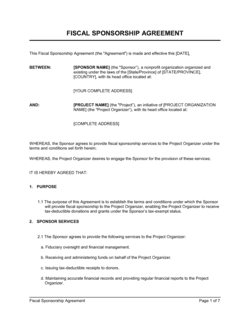
A Sponsorship Agreement is a legally binding contract between a sponsor β€” the entity providing money, goods, or services β€” and a sponsored party such as an event organizer, sports team, individual athlete, or charity. This free Word download covers fees, deliverables, branding rights, exclusivity, IP usage, morality clauses, and termination in a single document you can edit online and export as PDF for execution.
When you need it
Use it whenever a company or individual commits financial or in-kind support in exchange for defined promotional benefits β€” before any funds change hands or branding materials are produced. It applies equally to one-off event sponsorships, multi-year athlete endorsements, and ongoing charity partnerships.
What's inside
Parties and recitals, sponsorship fee and payment schedule, sponsor deliverables and recognition rights, exclusivity scope, intellectual property licensing, morality and reputational clauses, term and renewal, termination triggers, and governing law.

What is a Sponsorship Agreement?

A Sponsorship Agreement is a legally binding contract between a sponsor β€” the company or individual providing financial or in-kind support β€” and a sponsored party such as an event organizer, sports team, individual athlete, or charitable organization. It defines every dimension of their commercial relationship: the sponsorship fee and payment schedule, the exact promotional deliverables the sponsored party must provide, the scope of the sponsor's branding and IP rights, any exclusivity restrictions on competing brands, morality conduct standards, and the conditions under which either party may exit. Unlike a letter of intent or proposal, a signed sponsorship agreement creates enforceable obligations on both sides and eliminates the ambiguity that arises when only verbal commitments or email exchanges document the deal.

Why You Need This Document

Without a written sponsorship agreement, both parties carry significant unprotected risk from the moment money changes hands or production begins. A sponsor who pays a fee based on an email exchange has no contractual basis to demand a refund if deliverables are missed, no exclusivity protection against a competing brand appearing at the same event, and no morality clause remedy if the sponsored party's conduct damages the sponsor's reputation. The sponsored party faces the opposite risk: no documented proof of what the sponsor actually promised, no right to retain the deposit if the sponsor cancels after production costs are incurred, and no IP approval process to prevent unauthorized or brand-damaging use of their trademarks. A properly drafted sponsorship agreement closes all of these gaps before any funds transfer or event production begins β€” and this template gives you the structure to do that in under an hour.

Which variant fits your situation?

If your situation is…Use this template
Sponsoring a single event such as a concert, gala, or trade showEvent Sponsorship Agreement
Endorsing an individual athlete or content creatorAthlete Endorsement Agreement
Supporting a nonprofit or charitable organizationCharity Sponsorship Agreement
Providing in-kind goods or services instead of cashIn-Kind Sponsorship Agreement
Naming rights deal for a venue, arena, or facilityNaming Rights Agreement
Multi-year title sponsorship of a sports league or broadcast propertyTitle Sponsorship Agreement
Short-term influencer partnership with social media deliverablesInfluencer Marketing Agreement

Common mistakes to avoid

❌ Vague deliverable descriptions

Why it matters: Phrases like 'prominent logo placement' or 'social media exposure' are interpreted differently by every party β€” leading to post-event disputes over whether the sponsor received what it paid for.

Fix: Specify every deliverable with measurable attributes: logo size in centimetres or pixels, minimum display duration, exact social media platform, post timing, and required hashtags or handles.

❌ No exclusivity category definition

Why it matters: A sponsor paying for exclusivity in 'beverages' can find a competing energy drink brand on-site if the contract does not define the category boundaries, undermining the core value of the deal.

Fix: Define the exclusivity category by reference to specific product types, SIC codes, or IAB taxonomy, and state explicitly which competing brands are excluded.

❌ Morality clause with unchecked sponsor discretion

Why it matters: Courts in multiple jurisdictions have voided morality clauses that give one party unlimited, subjective authority to terminate β€” treating them as illusory contracts or penalties in disguise.

Fix: Anchor the clause to objective triggering events β€” criminal conviction, regulatory finding, or a documented and public reputational incident β€” and include a cure or response window.

❌ No payment remedy for late or missed instalments

Why it matters: Without a late-payment clause, the sponsored party has no contractual right to charge interest, suspend deliverables, or terminate β€” leaving them performing obligations for a sponsor who isn't paying.

Fix: Include an interest rate on overdue amounts, a right to suspend deliverables after a defined grace period, and a right to terminate if the overdue amount is not cured within a stated number of days.

❌ Signing after event production has started

Why it matters: Work performed before the agreement is signed is not governed by the contract β€” IP created during that period, deliverables already produced, and payments already made all fall outside the contract's protections.

Fix: Execute the agreement β€” including sponsor payment of the deposit β€” before any event production, branding, or promotional content referencing the sponsor is created.

❌ No renewal notice deadline

Why it matters: Without a defined window for renewal decisions, parties miss the practical deadline, sponsors lose leverage to negotiate, and sponsored parties are left uncertain whether to seek alternative sponsors.

Fix: Set a specific renewal notice deadline β€” typically 60 to 90 days before expiry β€” and state the consequence of silence: the agreement expires or continues on the same terms at the sponsored party's option.

The 10 key clauses, explained

Parties, recitals, and sponsorship scope

In plain language: Identifies the sponsor and sponsored party by their legal names, describes the event or property being sponsored, and states the purpose of the agreement.

Sample language
This Sponsorship Agreement is entered into as of [DATE] between [SPONSOR LEGAL NAME], a [STATE/COUNTRY] [ENTITY TYPE] ('Sponsor'), and [SPONSORED PARTY LEGAL NAME] ('Sponsored Party'), in connection with [EVENT/PROPERTY NAME] scheduled for [DATE(S)] at [LOCATION].

Common mistake: Using a trade name or brand name instead of the registered legal entity β€” if a dispute arises, enforcing against the right entity becomes difficult without the correct legal name on the contract.

Sponsorship fee, payment schedule, and in-kind terms

In plain language: States the total financial or in-kind consideration, when each payment instalment is due, the accepted payment method, and what happens if a payment is missed.

Sample language
Sponsor shall pay a total Sponsorship Fee of $[AMOUNT] payable as follows: [X]% upon execution ($[AMOUNT]) and [X]% no later than [DATE] ($[AMOUNT]). Payment shall be made by [METHOD] to [ACCOUNT DETAILS]. Overdue amounts accrue interest at [X]% per month.

Common mistake: No instalment schedule and no late-payment remedy β€” leaving the sponsored party with no contractual basis to pursue overdue funds or suspend deliverables.

Sponsor deliverables and recognition rights

In plain language: Lists every specific promotional benefit the sponsored party must provide β€” logo placement dimensions and locations, verbal mentions, digital impressions, tickets, hospitality β€” and when each must be delivered.

Sample language
Sponsored Party shall provide Sponsor with: (a) [LOGO SIZE] logo placement on [LOCATIONS]; (b) [X] verbal mentions per [EVENT/BROADCAST]; (c) [X] tickets to [EVENT]; (d) one [X]-word feature in the official program; and (e) [X] social media posts tagged @[HANDLE] within [X] days of the event.

Common mistake: Describing deliverables in vague terms like 'prominent logo placement' without specifying size, position, and minimum display duration β€” creating disputes over what was actually owed.

Exclusivity and category restrictions

In plain language: Defines whether the sponsor has exclusive rights within a product or industry category, the geographic scope of that exclusivity, and the period during which it applies.

Sample language
Sponsored Party grants Sponsor exclusive sponsorship rights in the [CATEGORY β€” e.g., financial services] category for the [EVENT/SEASON], meaning Sponsored Party shall not accept sponsorship from any direct competitor of Sponsor within that category during the Term.

Common mistake: Leaving the category undefined β€” a sponsor who pays for exclusivity in 'beverages' may find a competing brand participating under 'energy drinks' if the contract does not define the category precisely.

Intellectual property license

In plain language: Grants each party a limited, non-exclusive license to use the other's logos and trademarks strictly for agreed promotional purposes, and requires prior written approval of all materials bearing the licensed marks.

Sample language
Each party grants the other a limited, non-exclusive, non-transferable, royalty-free license to use its trademarks and logos solely in connection with the sponsorship described herein. All uses of the licensed marks require prior written approval, not to be unreasonably withheld within [X] business days of submission.

Common mistake: No approval process for how the sponsor's logo is used in event materials β€” resulting in unauthorized color, sizing, or context usage that violates the sponsor's brand guidelines.

Morality and reputational conduct clause

In plain language: Allows the sponsor to terminate the agreement without penalty if the sponsored party engages in conduct β€” criminal charges, public scandal, discriminatory statements β€” that the sponsor reasonably determines damages its brand.

Sample language
Sponsor may terminate this Agreement with immediate effect if Sponsored Party engages in conduct that, in Sponsor's reasonable judgment, brings Sponsor into public disrepute, offends prevailing community standards, or violates Sponsor's published code of conduct, including but not limited to [EXAMPLES].

Common mistake: Drafting the morality clause with no objective threshold β€” courts have voided clauses that give a sponsor unlimited discretion to terminate based on undisclosed internal standards.

Term, renewal, and right of first refusal

In plain language: States when the agreement starts and ends, whether it auto-renews, and whether the sponsor has the right to match a competing offer before the sponsored party accepts it.

Sample language
This Agreement commences on [START DATE] and expires on [END DATE] unless earlier terminated. Either party may renew by written notice no later than [X] days before expiry. Sponsor has a right of first refusal to match any bona fide third-party offer received by Sponsored Party within [X] days of notice.

Common mistake: No renewal notice deadline β€” parties miss the window and then dispute whether the relationship continues on the same or new terms.

Termination for cause and for convenience

In plain language: Sets out the specific breaches that allow immediate termination (non-payment, morality clause violation, fraud) and whether either party may exit without cause on advance notice.

Sample language
Either party may terminate for material breach upon [X] days' written notice if the breach is not cured within that period. Sponsor may terminate for convenience on [X] days' written notice, in which case Sponsor forfeits the deposit but owes no further fees. Sponsored Party shall not be required to refund fees for deliverables already performed.

Common mistake: No cure period before termination for breach β€” triggering an immediate exit over a minor or inadvertent failure that both parties would have preferred to fix.

Liability limitation and indemnification

In plain language: Caps each party's financial exposure for contract-related claims and requires each party to indemnify the other against third-party claims arising from their own actions or content.

Sample language
Neither party's aggregate liability shall exceed the total Sponsorship Fee paid in the twelve months preceding the claim. Each party ('Indemnitor') shall indemnify and hold harmless the other from any third-party claims arising from the Indemnitor's content, conduct, or breach of this Agreement.

Common mistake: No liability cap at all β€” leaving both parties exposed to claims far exceeding the economic value of the sponsorship deal itself.

Governing law, dispute resolution, and notices

In plain language: Specifies which jurisdiction's law governs the agreement, how disputes are resolved (arbitration or litigation), and the formal address for legal notices.

Sample language
This Agreement is governed by the laws of [STATE/PROVINCE/COUNTRY]. Disputes shall be resolved by binding arbitration under [AAA/JAMS/ICC] rules in [CITY], except that either party may seek injunctive relief in any court of competent jurisdiction. Notices shall be sent to the addresses set out in Schedule A.

Common mistake: Omitting a dispute resolution mechanism and defaulting to court β€” leaving a straightforward commercial dispute subject to multi-year litigation costs that dwarf the sponsorship fee.

How to fill it out

  1. 1

    Insert legal entity names and describe the property

    Enter the full registered legal name of both the sponsor and the sponsored party. Describe the event or property being sponsored β€” full name, dates, and location β€” in the recitals so the scope is unambiguous.

    πŸ’‘ Verify the sponsored party's legal name against their corporate registry or nonprofit registration before signing β€” trade names create enforceability gaps.

  2. 2

    Set the sponsorship fee, payment schedule, and currency

    Enter the total fee, break it into instalments tied to specific dates or milestones, and state the currency explicitly. Add a late-payment interest rate and the right to suspend deliverables if a payment is overdue by more than a set number of days.

    πŸ’‘ Requiring a non-refundable deposit of 30–50% at signing protects the sponsored party against late cancellation after production costs are incurred.

  3. 3

    List every deliverable with measurable specifics

    Replace generic descriptions with exact specifications: logo dimensions in pixels or centimetres, number and timing of social media posts, specific ticket quantities and seat categories, and which pages or surfaces carry the sponsor's mark.

    πŸ’‘ Attach a Schedule B with logo usage guidelines and approved color values so the sponsor's brand is never reproduced incorrectly in event materials.

  4. 4

    Define the exclusivity category precisely

    State the product or industry category in which the sponsor holds exclusivity, the geography it covers, and whether it extends to digital and broadcast as well as physical event assets.

    πŸ’‘ Reference a standard industry classification β€” such as an SIC code or IAB category β€” to eliminate ambiguity about what counts as a competing brand.

  5. 5

    Complete the morality clause with objective thresholds

    Rather than leaving termination to the sponsor's sole discretion, specify triggering conduct: criminal conviction, regulatory sanction, or a defined reputational event. Include a notice and response period so the sponsored party can address the issue before termination takes effect.

    πŸ’‘ Consider making the morality clause mutual β€” sponsors themselves can engage in conduct that damages the sponsored party's reputation, and a mutual clause addresses that risk.

  6. 6

    Set the term, renewal deadline, and right of first refusal

    Enter start and end dates, a renewal notice window of at least 60–90 days before expiry, and whether the sponsor has a right to match competing offers in the next cycle.

    πŸ’‘ For multi-year agreements, add an annual fee escalator β€” typically 3–5% β€” so the value of the deal keeps pace with inflation and audience growth.

  7. 7

    Confirm governing law matches the sponsored party's operating location

    Select the jurisdiction where the event takes place or where the sponsored party is incorporated. For international arrangements, name the arbitration body and seat city explicitly.

    πŸ’‘ Specifying arbitration rather than court litigation typically resolves sponsorship disputes in 6–9 months versus 2–4 years in court β€” a significant advantage when the deal's value is time-sensitive.

  8. 8

    Have both parties sign before any money or assets are transferred

    Ensure both authorized signatories execute the agreement β€” including their titles and the date β€” before any payment is made or any event production begins in reliance on the sponsorship.

    πŸ’‘ Use a timestamped eSign platform to create an audit trail confirming who signed, on what device, and at what time β€” critical if execution is disputed later.

Frequently asked questions

What is a sponsorship agreement?

A sponsorship agreement is a legally binding contract between a sponsor and a sponsored party β€” such as an event, sports team, athlete, or charity β€” that defines the financial consideration, promotional deliverables, branding rights, exclusivity terms, and termination conditions of their commercial relationship. It protects both parties by documenting exactly what was promised and what happens if either side fails to deliver.

What should a sponsorship agreement include?

At minimum: the legal names of both parties, a description of the event or property, the sponsorship fee and payment schedule, a specific list of deliverables and recognition rights, the exclusivity category and scope, an IP license for logo usage, a morality clause, the term and renewal process, termination triggers with cure periods, a liability cap, and governing law. Missing any of these creates gaps courts fill with defaults that rarely suit either party.

Is a sponsorship agreement legally required?

No jurisdiction requires a written sponsorship agreement by law, but proceeding without one exposes both parties to significant risk. Verbal sponsorship commitments are difficult to enforce when deliverables are disputed, payments are missed, or a sponsor wants to exit after a reputational incident. A written agreement is the only reliable way to establish what was promised and what remedies apply if it isn't delivered.

What is a morality clause in a sponsorship agreement?

A morality clause allows the sponsor to terminate the agreement without penalty if the sponsored party β€” typically an athlete, influencer, or public figure β€” engages in conduct that the sponsor reasonably determines damages its brand or public image. To be enforceable in most jurisdictions, the clause must be anchored to objective triggering events rather than giving the sponsor unlimited discretion to exit for any reason.

What does exclusivity mean in a sponsorship contract?

Exclusivity means the sponsored party agrees not to accept sponsorship from the sponsor's direct competitors within a defined product or industry category during the term of the agreement. Category exclusivity β€” covering only a specific sector such as financial services or athletic footwear β€” is more common than blanket exclusivity covering all commercial categories. The category must be precisely defined to be enforceable.

Can a sponsor terminate a sponsorship agreement early?

Yes, if the agreement includes a termination for convenience clause. This typically requires advance written notice β€” commonly 30 to 60 days β€” and may require the sponsor to forfeit the deposit or pay a kill fee for production costs already incurred. Termination for cause β€” such as non-payment or a morality clause violation β€” is usually immediate and without financial penalty to the terminating party, provided a cure period has passed.

Who owns the intellectual property created during a sponsorship?

Ownership of content and creative assets produced during a sponsorship depends on the agreement. Typically, each party retains ownership of its own pre-existing trademarks and logos, and grants the other a limited license for defined uses. Content created jointly β€” such as co-branded event videos β€” requires an explicit ownership or joint-license clause. Without one, both parties may have conflicting claims over the same asset.

Do I need a lawyer to draft a sponsorship agreement?

For straightforward event or charity sponsorships below $25,000, a high-quality template is typically sufficient if the parties complete it carefully. A lawyer review is advisable for deals involving significant fees, multi-year terms, athlete or celebrity endorsements, complex IP arrangements, or cross-border parties. Hourly legal review of a completed template typically costs $300–$800 and is worthwhile for any deal where reputational risk or fee exposure is material.

What is the difference between a sponsorship agreement and an endorsement agreement?

A sponsorship agreement covers a defined event, team, or property β€” the sponsor's brand appears in connection with that property in exchange for a fee. An endorsement agreement engages an individual β€” typically a celebrity or athlete β€” to personally recommend or represent the sponsor's products or services, often including exclusivity across all competing brands. Endorsement contracts carry higher reputational risk and typically include more detailed morality, exclusivity, and content approval provisions.

How this compares to alternatives

vs Event Sponsorship Proposal

A sponsorship proposal is a marketing document sent to prospective sponsors outlining the opportunity, audience demographics, and available packages. It generates interest and initiates negotiation. A sponsorship agreement is the binding contract executed after both parties agree on terms. The proposal creates no obligations; the agreement creates enforceable ones.

vs Influencer Marketing Agreement

An influencer marketing agreement is focused on a specific individual's content creation and social media obligations β€” post cadence, platform, hashtags, FTC disclosure, and content approval. A sponsorship agreement covers broader property rights including events, venues, and teams, with physical branding, activation rights, and exclusivity clauses that influencer deals typically do not require.

vs Non-Disclosure Agreement

An NDA protects confidential information shared during sponsorship negotiations β€” audience data, pricing, and strategic plans β€” but creates no commercial obligations. Once terms are agreed, the sponsorship agreement governs the relationship. Both documents are often used together: the NDA during due diligence, the sponsorship agreement at execution.

vs Partnership Agreement

A partnership agreement creates an ongoing business relationship with shared profits, joint decision-making, and mutual liability. A sponsorship agreement is a one-directional commercial arrangement β€” the sponsor pays a fee for defined promotional benefits without acquiring any ownership stake, profit share, or governance rights in the sponsored property.

Industry-specific considerations

Sports and athletics

Jersey and kit naming rights, venue board placement, broadcast logo integration, and player appearance obligations are standard deliverables requiring precise specifications in the contract.

Events and entertainment

Tiered sponsor packages β€” title, gold, silver β€” each with differentiated deliverables, logo sizes, and activation rights must be documented to prevent disputes over what each tier actually includes.

Nonprofit and charitable organizations

Charity sponsorships must address cause-marketing compliance, gift acknowledgment language for tax purposes, and the sponsor's right to use charitable association in its own marketing without implying endorsement.

Media and broadcasting

Broadcast and podcast sponsorships require impression guarantees, make-good provisions when audience targets are missed, and pre-approval rights over the host's ad-read scripts.

Jurisdictional notes

United States

Sponsorship agreements in the US are governed by general contract law, with no federal statute specifically regulating them. FTC endorsement guidelines require sponsored parties who are individuals to disclose the commercial relationship in media content. Cause-marketing arrangements involving charities must comply with state charitable solicitation registration laws, which vary significantly across jurisdictions. California courts have scrutinized morality clauses heavily β€” objective triggering language is essential for enforceability.

Canada

Canadian sponsorship agreements are subject to provincial contract law, and Quebec arrangements must be drafted in French for consumer-facing contexts under the Charter of the French Language. Charity sponsorships engaging in co-venture fundraising in Ontario require compliance with the Charitable Fundraising Act. The Competition Act governs misleading representations in sponsored content, and the ASC's influencer guidelines apply to digital activations. Non-compete and exclusivity clauses must be reasonable in scope to be enforceable.

United Kingdom

UK sponsorship agreements are governed by the Contracts Act and general common law principles. The ASA's CAP and BCAP codes require clear disclosure of sponsored content in advertising and broadcast contexts. Gambling and alcohol sponsorships face additional regulatory restrictions under sector-specific codes. Post-Brexit, EU state aid rules no longer apply, but GDPR obligations remain relevant where the sponsorship involves processing audience personal data shared between the parties.

European Union

EU sponsorship deals must comply with GDPR where audience data β€” event registration, social media metrics, or CRM records β€” is shared between sponsor and sponsored party; a data processing addendum is typically required. The AVMS Directive governs sponsorship of broadcast and on-demand audiovisual content, requiring specific disclosure credits. Member state advertising codes impose additional restrictions on alcohol, gambling, and pharmaceutical sponsorships. Cross-border EU arrangements should specify the governing member state's law explicitly to avoid conflict-of-laws disputes.

Template vs lawyer β€” what fits your deal?

PathBest forCostTime
Use the templateEvent organizers, nonprofits, and small sports teams handling sponsorships below $25,000 with straightforward deliverablesFree30–60 minutes
Template + legal reviewDeals above $25,000, athlete or celebrity endorsements, multi-year arrangements, or cross-border parties$300–$8002–5 days
Custom draftedMajor naming rights deals, broadcast sponsorships, or arrangements involving complex IP licensing and regulatory considerations$2,000–$8,000+2–4 weeks

Glossary

Sponsor
The company or individual providing money, goods, or services in exchange for promotional or reputational benefits.
Sponsored Party
The event, team, athlete, charity, or organization receiving the sponsorship and delivering the agreed promotional benefits.
Sponsorship Fee
The total cash consideration paid by the sponsor, stated in the agreement with a payment schedule and currency.
In-Kind Sponsorship
Sponsorship provided through goods or services β€” such as equipment, catering, or software β€” rather than direct cash payment.
Exclusivity
A contractual restriction preventing the sponsored party from accepting sponsorship from the sponsor's direct competitors within a defined category.
Category Exclusivity
Exclusivity limited to a specific product or industry category β€” for example, a single soft-drink brand or one airline β€” rather than all commercial sectors.
Morality Clause
A provision allowing the sponsor to terminate the agreement if the sponsored party engages in conduct that damages the sponsor's brand or public reputation.
Deliverables
The specific promotional actions the sponsored party must perform β€” logo placement, social media posts, speaking mentions, VIP tickets β€” in exchange for the sponsorship fee.
IP License
A limited permission granted by one party to the other to use their trademarks, logos, or other intellectual property for defined purposes and a defined period.
Activation Rights
The sponsor's right to engage directly with the event's audience β€” through booths, sampling, contests, or digital integrations β€” beyond passive logo placement.
Termination for Cause
The right to end the agreement immediately, without severance or penalty, when the other party commits a specified material breach such as non-payment or morality clause violation.
Right of First Refusal
A clause granting the sponsor priority to match any competing offer and renew the sponsorship before the sponsored party accepts a third-party deal.

Part of your Business Operating System

This document is one of 3,000+ business & legal templates included in Business in a Box.

  • Fill-in-the-blanks β€” ready in minutes
  • 100% customizable Word document
  • Compatible with all office suites
  • Export to PDF and share electronically

Create your document in 3 simple steps.

From template to signed document β€” all inside one Business Operating System.
1
Download or open template

Access over 3,000+ business and legal templates for any business task, project or initiative.

2
Edit and fill in the blanks with AI

Customize your ready-made business document template and save it in the cloud.

3
Save, Share, Send, Sign

Share your files and folders with your team. Create a space of seamless collaboration.

Save time, save money, and create top-quality documents.

β˜…β˜…β˜…β˜…β˜…

"Fantastic value! I'm not sure how I'd do without it. It's worth its weight in gold and paid back for itself many times."

Managing Director Β· Mall Farm
Robert Whalley
Managing Director, Mall Farm Proprietary Limited
β˜…β˜…β˜…β˜…β˜…

"I have been using Business in a Box for years. It has been the most useful source of templates I have encountered. I recommend it to anyone."

Business Owner Β· 4+ years
Dr Michael John Freestone
Business Owner
β˜…β˜…β˜…β˜…β˜…

"It has been a life saver so many times I have lost count. Business in a Box has saved me so much time and as you know, time is money."

Owner Β· Upstate Web
David G. Moore Jr.
Owner, Upstate Web

Run your business with a system β€” not scattered tools

Stop downloading documents. Start operating with clarity. Business in a Box gives you the Business Operating System used by over 250,000 companies worldwide to structure, run, and grow their business.

Free Forever PlanΒ Β·Β No credit card required