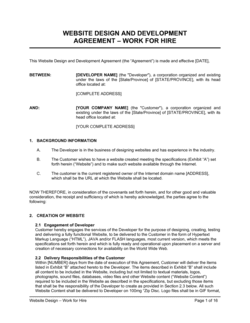
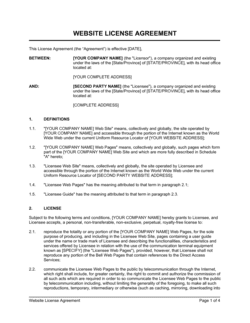
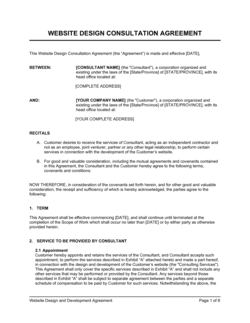
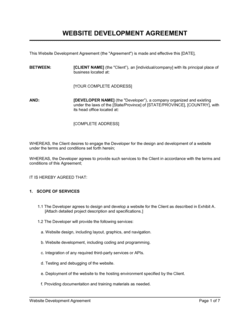
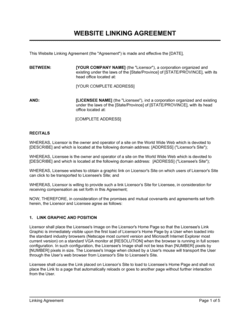
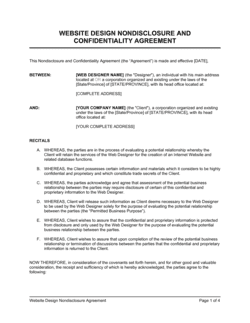
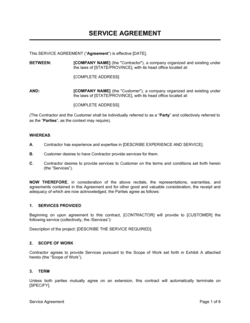
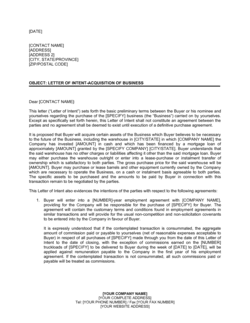
Website Cross Sponsorship Agreement Template

Free Word download • Edit online • Save & share with Drive • Export to PDF

8 pages30–40 min to fillDifficulty: ComplexSignature requiredLegal review recommended
Learn more ↓
FreeWebsite Cross Sponsorship Agreement Template

At a glance

What it is
A Website Cross Sponsorship Agreement is a legally binding contract between two website owners or online businesses who agree to mutually promote each other's brands, content, or products on their respective digital properties. This free Word download covers banner placement, link obligations, content approval, exclusivity, compensation, and termination in a single ready-to-edit document you can export as PDF and execute in minutes.
When you need it
Use it whenever two websites or digital publishers agree to display each other's branding, links, or sponsored content — whether for a fixed campaign period or an ongoing co-marketing relationship. It is equally relevant for media properties trading ad inventory, bloggers swapping sponsored posts, or SaaS companies running co-branded landing pages.
What's inside
Mutual sponsorship obligations, placement and format specifications, content approval rights, performance metrics, exclusivity restrictions, compensation or value-exchange terms, intellectual property licensing, indemnification, confidentiality, and termination provisions.

What is a Website Cross Sponsorship Agreement?

A Website Cross Sponsorship Agreement is a legally binding contract between two website owners or online businesses who agree to mutually promote each other's brand, content, or products on their respective digital properties. Unlike a standard sponsorship arrangement where one party pays and the other delivers exposure, a cross sponsorship is reciprocal — both parties simultaneously act as sponsor and host, exchanging promotional placements of equivalent value with no net cash transfer required. The agreement governs what each party must publish, where and for how long, how content is approved, what performance is expected, and what happens when either party wants to exit.

Why You Need This Document

Operating a cross-promotional relationship on a handshake leaves both parties exposed to disputes that are entirely avoidable in writing. Without a signed agreement, there is no enforceable basis to demand the other party honor their placement commitments, remove your branding after the relationship ends, or compensate you if their content damages your reputation with your audience. Branded logos and links published under an undocumented arrangement also lack the IP license that legally authorizes their display — meaning either party could technically be held liable for trademark infringement. An executed Website Cross Sponsorship Agreement resolves all of this before the first banner goes live: it documents what each party owes, establishes performance floors, limits brand risk through content approval rights, and creates a clear exit path that protects both sides. This template gives you a professionally structured starting point you can adapt and execute in under an hour.

Which variant fits your situation?

If your situation is…Use this template
One party pays cash while the other provides promotional placementWebsite Sponsorship Agreement
Two parties exchange newsletter ad slots with no cash changing handsWebsite Cross Sponsorship Agreement
Affiliate relationship where one party earns a commission on referred salesAffiliate Marketing Agreement
Licensing a logo or trademark for use on a partner's websiteTrademark License Agreement
Comprehensive co-marketing arrangement covering offline and online channelsCo-Marketing Agreement
Influencer posting sponsored content on a social media profileInfluencer Marketing Agreement
Embedding a partner's widget or tool on your site for revenue shareRevenue Share Agreement

Common mistakes to avoid

❌ Vague placement specifications

Why it matters: Without defined page locations, dimensions, and minimum display durations, either party can technically comply by placing a tiny, buried link that delivers no meaningful exposure — and there is no contractual basis to demand more.

Fix: Describe every placement element in a Schedule A: exact page URL, position on page, pixel dimensions, and minimum number of months the placement must remain active.

❌ No content removal timeline after termination

Why it matters: Logos and sponsored links that persist after the agreement ends imply a continuing endorsement relationship. This can expose the innocent party to misrepresentation or unauthorized trademark use claims.

Fix: Specify in the termination clause that each party must remove the other's branded content within a set number of business days — 10 business days is a common standard.

❌ Omitting the IP license clause

Why it matters: Displaying another company's trademark without a license is technically trademark infringement regardless of the parties' intent. Without the license, the entire legal basis for the promotion is missing.

Fix: Include a mutual, limited, non-exclusive trademark license specifically scoped to fulfillment of the agreement's obligations — nothing broader.

❌ One-sided or missing indemnification

Why it matters: Both parties are publishing each other's content — if one party's content infringes a third-party copyright or violates advertising law, the hosting party can be drawn into the resulting claim. One-sided protection leaves a real gap.

Fix: Make indemnification reciprocal: each party indemnifies the other for losses arising from its own content, IP ownership failures, or legal compliance breaches.

❌ No performance floor for impressions or clicks

Why it matters: Without minimum delivery metrics, a party can satisfy the agreement by placing a banner in a low-traffic corner of a page that receives virtually no views — technically compliant, commercially worthless.

Fix: Negotiate and document minimum monthly impressions for each party's placement in a Schedule B, and define the remedy — additional placements, extended term, or termination right — if minimums are not met.

❌ Auto-renewal with no notice of non-renewal deadline

Why it matters: Parties routinely miss auto-renewal cut-off dates and find themselves locked into another full term of an arrangement they intended to exit. The notice window is often shorter than it appears.

Fix: Set a calendar reminder 45 days before the notice deadline and confirm the non-renewal notice requirement is stated plainly — in days, not months — in the termination clause.

The 10 key clauses, explained

Parties and recitals

In plain language: Identifies both website owners by legal entity name, states each party's website URL, and summarizes the mutual intent of the agreement.

Sample language
This Website Cross Sponsorship Agreement ('Agreement') is entered into as of [DATE] by and between [PARTY A LEGAL NAME], operating the website at [PARTY A URL] ('Party A'), and [PARTY B LEGAL NAME], operating the website at [PARTY B URL] ('Party B'). The parties desire to promote each other's brands on a mutual basis as set out herein.

Common mistake: Using a brand name or domain instead of the registered legal entity name. If the entity name doesn't match the one that owns the website's IP or domain registration, enforcement becomes ambiguous.

Sponsorship obligations and placement specifications

In plain language: Defines exactly what each party must publish on their site — banner dimensions, link destination, page location, minimum display period, and any rotation or prominence requirements.

Sample language
Party A shall display Party B's [BANNER / LOGO / LINK] on [PAGE URL OR SECTION] at [POSITION — e.g., above the fold, sidebar] in a format no smaller than [DIMENSIONS] for a minimum of [X] months. Party B shall display Party A's [BANNER / LOGO / LINK] on equivalent terms as set out in Schedule A.

Common mistake: Describing placement in vague terms like 'prominent position.' Without specific page URLs, dimensions, and position coordinates, either party can comply technically while delivering near-zero visibility.

Content approval and brand guidelines

In plain language: Requires each party to submit its sponsored content for the other's approval before publication and to comply with the other's brand guidelines, which are attached as an exhibit.

Sample language
Each party shall submit proposed sponsored content to the other party at least [X] business days prior to the scheduled publication date. The reviewing party may approve, request revisions, or reject content within [X] business days. Each party's brand guidelines are attached as Exhibit [A/B] and are incorporated herein.

Common mistake: No approval right at all, or an approval right with no deadline. Without a decision deadline, one party can stall publication indefinitely by simply not responding.

Performance metrics and reporting

In plain language: Sets measurable targets — impressions, clicks, or engagement rates — and requires each party to report actual delivery against those targets at defined intervals.

Sample language
Each party shall provide the other with a monthly performance report by the [X]th day of the following month, including total impressions, click-through rate, and any other metrics set out in Schedule B. Minimum guaranteed impressions for each party shall be [X] per month.

Common mistake: Omitting performance metrics entirely and treating the agreement as a best-efforts arrangement. Without minimums, there is no basis to claim a shortfall or trigger a remedy.

Exclusivity restrictions

In plain language: Defines whether either party is restricted from entering similar cross-sponsorship deals with the other party's direct competitors, and for how long the restriction lasts.

Sample language
During the term of this Agreement, [PARTY A / BOTH PARTIES] shall not enter into a cross-sponsorship or co-marketing arrangement with any entity listed in Schedule C ('Restricted Competitors') without the prior written consent of the other party.

Common mistake: Using an overly broad exclusivity definition that covers the entire industry rather than direct competitors. Broad exclusivity restricts legitimate business relationships and creates disproportionate risk for one or both parties.

Compensation and value-in-kind exchange

In plain language: States whether any cash consideration is exchanged or whether each party's promotional placement constitutes the full consideration, and addresses any true-up mechanism if placements are unequal in value.

Sample language
The parties agree that this Agreement is a value-in-kind exchange. Each party's performance of its sponsorship obligations under Schedule A constitutes full and adequate consideration. [Alternatively: Party A shall pay Party B $[X] per month as a balancing payment to reflect the difference in audience reach set out in Schedule B.]

Common mistake: Leaving compensation silent when the parties' audiences are materially different in size. A site with 500,000 monthly visitors providing equal placement to a site with 5,000 visitors is not a balanced exchange — the agreement should address the gap.

Intellectual property licensing

In plain language: Grants each party a limited, non-exclusive license to use the other's logos, trademarks, and branded assets solely for fulfilling obligations under this agreement, and prohibits any other use.

Sample language
Each party grants the other a limited, non-exclusive, non-transferable, royalty-free license to display its logos, trademarks, and other branded materials solely for the purpose of fulfilling its sponsorship obligations under this Agreement. No other use is permitted without prior written consent.

Common mistake: No IP license clause at all. Without one, displaying the other party's logo technically infringes their trademark — the license is the legal basis for the entire arrangement.

Representations, warranties, and indemnification

In plain language: Each party warrants that its content does not infringe third-party rights, violate applicable law, or contain false or misleading claims — and agrees to indemnify the other for losses arising from a breach of those warranties.

Sample language
Each party represents and warrants that (a) it has the right to enter into this Agreement; (b) its sponsored content does not infringe any third-party intellectual property rights; and (c) its website complies with applicable advertising and data protection laws. Each party shall indemnify and hold harmless the other from claims arising from a breach of these representations.

Common mistake: One-sided indemnification that only protects one party. Cross-sponsorship involves mutual risk — both parties are publishing content from the other, and both need protection from the other's defective content.

Term, termination, and wind-down

In plain language: States the agreement's start and end dates, any auto-renewal provisions, the notice period required to terminate for convenience, and what happens to live placements after termination.

Sample language
This Agreement commences on [START DATE] and continues for [X] months ('Initial Term'), renewing automatically for successive [X]-month periods unless either party provides [30] days' written notice of non-renewal. Either party may terminate for cause upon [15] days' written notice if the other party materially breaches this Agreement and fails to cure within [15] days. Upon termination, each party shall remove the other's branded content within [10] business days.

Common mistake: No wind-down timeline for removing content after termination. Branded logos and links that linger post-termination can imply a continued endorsement relationship that neither party intends — and may expose both to misrepresentation claims.

Governing law and dispute resolution

In plain language: Specifies which jurisdiction's law governs the agreement and the process for resolving disputes — mediation, arbitration, or litigation — and where proceedings take place.

Sample language
This Agreement is governed by the laws of [STATE / PROVINCE / COUNTRY], without regard to its conflict-of-law provisions. Any dispute arising under this Agreement shall first be submitted to non-binding mediation. If mediation fails within [30] days, disputes shall be resolved by binding arbitration in [CITY] under the rules of [AAA / JAMS / applicable institution], except claims for injunctive relief.

Common mistake: Selecting governing law based on where one party is incorporated without considering where the other party operates. Courts in some jurisdictions will not enforce a foreign governing-law choice where the agreement has no substantial connection to that jurisdiction.

How to fill it out

  1. 1

    Identify both parties by legal entity name and website URL

    Enter the full registered legal name of each website owner — not a brand name or domain — alongside the exact URL of each website covered by the agreement. Confirm domain ownership matches the legal entity signing.

    💡 Run a WHOIS lookup to confirm the domain is registered to the correct legal entity before execution — mismatches between registrant and signatory are a common source of disputes.

  2. 2

    Define placement specifications in Schedule A

    For each party, specify the exact page URL or section, placement position (e.g., homepage sidebar, header, dedicated sponsor page), banner dimensions in pixels, link destination URL, and minimum display duration in months.

    💡 Include a screenshot or wireframe of each party's site showing the exact placement location — this eliminates ambiguity and makes compliance straightforward to verify.

  3. 3

    Set content approval timelines and attach brand guidelines

    Agree on a submission deadline (e.g., 5 business days before go-live) and a review period (e.g., 3 business days to approve or request revisions). Attach each party's current brand guidelines as Exhibit A and Exhibit B.

    💡 Specify what counts as deemed approval — if the reviewing party does not respond within the review period, state whether silence equals approval or rejection.

  4. 4

    Establish performance metrics and reporting obligations

    Agree on minimum impressions or click targets per month for each party and state who is responsible for providing analytics data. Specify the reporting tool (e.g., Google Analytics, a shared dashboard) and the delivery deadline each month.

    💡 Use the same analytics platform for both parties where possible — comparing Google Analytics to a proprietary counter creates disputes about which numbers are authoritative.

  5. 5

    Negotiate exclusivity scope and list restricted competitors

    Decide whether exclusivity is mutual or one-sided, then compile a Schedule C listing the specific competitor domains or brand names covered. Keep the list narrow and specific — overly broad lists restrict legitimate commercial relationships.

    💡 Review the list annually if the agreement auto-renews — the competitive landscape changes, and a list that made sense at signing may be outdated 12 months later.

  6. 6

    Address compensation or confirm value-in-kind exchange

    If the parties' audience sizes or traffic levels are materially different, negotiate a balancing payment or an asymmetric placement obligation to equalize value. If the exchange is genuinely equal, confirm that each party's performance constitutes full consideration.

    💡 Attach a Schedule B comparing each party's relevant metrics — monthly unique visitors, email list size, social following — to document the basis for any value-equivalence determination.

  7. 7

    Insert the IP license, warranties, and indemnification language

    Confirm the IP license is mutual, limited in scope to performance under this agreement, and non-transferable. Ensure warranties are mutual and cover IP ownership, content accuracy, and legal compliance. Make indemnification reciprocal.

    💡 For higher-value arrangements, ask each party to confirm they carry commercial general liability or media liability insurance and insert a minimum coverage requirement.

  8. 8

    Sign before any content goes live

    Both parties must execute the agreement before either party publishes the other's branded content. Obtain wet signatures or use a timestamped e-signature tool so you have a clear record of when each party accepted the terms.

    💡 Use Business in a Box eSign to generate an audit-trail-protected execution record — a time-stamped signed copy protects both parties if a placement dispute arises later.

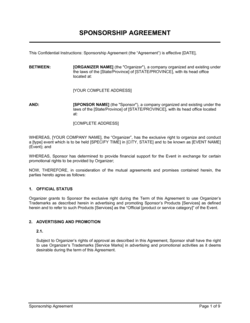
Frequently asked questions

What is a website cross sponsorship agreement?

A website cross sponsorship agreement is a contract between two website owners who agree to promote each other's brand, content, or products on their respective digital properties. Each party acts as both a sponsor and a host, typically exchanging promotional placements of equivalent value rather than exchanging cash. The agreement defines placement specifications, content approval rights, performance metrics, exclusivity, IP licensing, and termination terms.

Is a website cross sponsorship agreement legally binding?

Yes — when properly executed by both parties, a website cross sponsorship agreement is generally enforceable as a binding contract in most jurisdictions, provided it satisfies the standard requirements of offer, acceptance, and consideration. The mutual exchange of promotional placements typically constitutes sufficient consideration even when no cash changes hands. Review by a lawyer is advisable for high-value arrangements or when the parties operate in different jurisdictions.

What is the difference between a cross sponsorship agreement and a standard sponsorship agreement?

A standard sponsorship agreement is typically one-directional — one party pays cash or provides a benefit and the other party provides promotional placement in return. A cross sponsorship agreement is mutual: both parties simultaneously act as sponsor and host, trading promotional exposure of equivalent value. Cross sponsorship arrangements are common between complementary websites with similar audience sizes that want to reach each other's readers without paying cash.

Do I need a lawyer to draft a website cross sponsorship agreement?

For straightforward arrangements between two sites of similar size and audience, a well-drafted template is typically sufficient. Engage a lawyer when the deal involves material exclusivity restrictions that affect your core business, when one or both parties operate in a regulated industry (finance, healthcare, legal), when cross-border enforcement may be needed, or when the promotional arrangement is significant enough to affect existing advertiser or sponsorship relationships.

What should I do if the other party's site has significantly more traffic than mine?

Unequal audience sizes mean the promotional value each party delivers is not equivalent. The agreement should address this gap — either by requiring the smaller-audience party to provide more prominent or longer-duration placement, or by including a cash balancing payment from the party receiving more value. Documenting each party's current traffic and audience metrics in a schedule at signing prevents disputes about what was agreed.

Can I include an exclusivity clause that prevents the other party from working with competitors?

Yes, exclusivity clauses are common in cross sponsorship agreements. However, courts in many jurisdictions will only enforce restrictions that are reasonable in scope and duration. List specific competitor domains or brand names rather than an entire industry category, keep the restriction period proportionate to the agreement term, and consider whether mutual exclusivity is justified given each party's commercial interests. Overbroad exclusivity clauses are frequently challenged and may void the restriction entirely if found unreasonable.

What happens to the other party's content on my site when the agreement ends?

The agreement should specify a removal deadline — typically 5 to 10 business days after termination — by which each party must remove the other's logos, banners, links, and sponsored content from their site. Without a defined deadline, branded assets can linger and create the misleading impression of a continuing endorsement relationship, which may expose both parties to misrepresentation or unauthorized trademark use claims. Keep confirmation of removal in writing.

Does a website cross sponsorship agreement need to address GDPR or data privacy?

If either party's sponsored content involves tracking pixels, cookies, or user data collection — for example, retargeting tags embedded in a banner — then data privacy obligations are triggered and should be addressed in the agreement. EU-based parties must comply with GDPR, which requires user consent before placing non-essential cookies. The agreement should confirm which party is the data controller for any tracking, how consent is obtained, and how user data is handled.

How long should a website cross sponsorship agreement last?

Initial terms of 6 to 12 months are typical for content-focused cross sponsorship arrangements, giving both parties enough time to measure meaningful performance data while limiting long-term exposure if the partnership underdelivers. Auto-renewal provisions with 30-day non-renewal notices are standard. For campaign-specific arrangements tied to a product launch or seasonal event, a fixed term with no renewal is more appropriate.

How this compares to alternatives

vs Website Sponsorship Agreement

A standard website sponsorship agreement is one-directional — one party pays cash and the other provides promotional placement. A cross sponsorship agreement is mutual, with both parties acting as sponsor and host simultaneously, typically exchanging placements of equivalent value with no net cash transfer. Use the standard sponsorship agreement when a clear payor-payee relationship exists; use the cross sponsorship form when the exchange is reciprocal.

vs Affiliate Marketing Agreement

An affiliate agreement compensates one party with a commission on referred sales or leads — the relationship is ongoing, performance-based, and financially contingent on conversion. A cross sponsorship agreement delivers fixed placement exposure regardless of sales outcomes. Cross sponsorship suits brand-awareness goals; affiliate agreements suit direct-response or revenue-share objectives.

vs Co-Marketing Agreement

A co-marketing agreement typically covers a broader range of joint activities — joint webinars, shared whitepapers, co-authored email campaigns, and offline events — across multiple channels. A cross sponsorship agreement is specifically scoped to website-based promotional placements. If your collaboration extends beyond your respective websites, a co-marketing agreement is more appropriate.

vs Influencer Marketing Agreement

An influencer agreement engages an individual content creator to produce and publish sponsored content on their personal social or web channels in exchange for payment or product. A cross sponsorship agreement is between two business entities with established websites, is mutual in obligation, and typically involves no cash payment. The parties in a cross sponsorship are commercial equals; in an influencer deal, one party is the brand and the other is the creator.

Industry-specific considerations

Media and Publishing

Editorial content swaps, co-branded newsletters, and banner inventory exchanges between publications targeting overlapping reader demographics.

SaaS and Technology

Co-branded landing pages, integration partner spotlights, and mutual app marketplace feature placements with defined click and conversion reporting.

E-commerce and Retail

Sponsored product placements, curated gift guide cross-features, and homepage banner swaps between non-competing stores sharing a target customer segment.

Events and Entertainment

Co-presenting sponsor logos on event websites, reciprocal speaker promotion, and post-event content cross-linking with defined minimum display periods.

Professional Services

Referral partnership spotlights, co-authored thought leadership features, and mutual firm profile placements on resource directories or industry portals.

Nonprofit and Associations

Corporate sponsor badge displays exchanged for nonprofit mission content placements, with brand guideline compliance obligations and removal protocols for lapsed sponsorships.

Jurisdictional notes

United States

US law treats mutual promotional arrangements as binding contracts when both parties exchange valuable obligations. The FTC's Endorsement and Testimonial Guidelines require clear disclosure of material connections between websites, including cross-sponsorship arrangements. State-level advertising and consumer protection statutes — particularly in California under the CCPA — may impose additional data privacy obligations if tracking pixels or cookies are involved in the sponsored placements.

Canada

Canadian courts generally enforce mutual promotional contracts under common-law contract principles in nine provinces and under civil law in Quebec. Canada's Anti-Spam Legislation (CASL) applies if cross-sponsorship obligations include any promotional email component — commercial electronic messages require express or implied consent from recipients. Quebec's Law 25 imposes stricter data privacy obligations than PIPEDA for digital properties with Quebec users and should be considered if tracking or analytics are involved.

United Kingdom

Website cross sponsorship agreements are enforceable in England and Wales as binding contracts where both parties have exchanged clear obligations. The UK Advertising Standards Authority (ASA) and the Committee of Advertising Practice (CAP) require that paid-for or sponsored digital content be clearly identified as such. Post-Brexit, the UK GDPR applies independently of the EU GDPR and requires that any tracking embedded in sponsorship placements comply with UK data protection standards and cookie consent requirements.

European Union

EU-based parties must comply with GDPR if sponsored content placements involve any form of user tracking or personal data processing. The EU Digital Services Act (DSA) imposes transparency obligations on online platforms regarding sponsored or promotional content. The EU Unfair Commercial Practices Directive requires that commercial relationships underlying editorial or promotional content be clearly disclosed to consumers. Member state advertising law varies — Germany's UWG and France's Loi Sapin II impose additional disclosure and anti-corruption standards worth reviewing for cross-border arrangements.

Template vs lawyer — what fits your deal?

PathBest forCostTime
Use the templateTwo complementary websites of similar size arranging a straightforward banner or link exchangeFree30 minutes
Template + legal reviewArrangements involving material exclusivity, significant audience-size imbalance, regulated industries, or cross-border parties$300–$7002–4 days
Custom draftedHigh-value co-branding deals with major publishers, arrangements involving complex IP licensing, or multi-party cross-sponsorship networks$1,500–$4,000+1–3 weeks

Glossary

Cross Sponsorship
A mutual arrangement where two parties each agree to promote the other's brand or content on their own digital property, typically without a net cash payment between them.
Placement Specification
Contractual details defining exactly where on a webpage a sponsor's banner, logo, or link must appear — including page, position, size, and minimum display duration.
Share of Voice
The proportion of a site's total ad or promotional inventory allocated to a specific sponsor's content during a defined period.
Content Approval Right
A contractual provision giving one or both parties the right to review and reject the other's sponsored content before it is published.
Exclusivity Clause
A restriction preventing one or both parties from entering into similar cross-sponsorship arrangements with direct competitors during the agreement term.
Impressions
The number of times a sponsored placement is displayed to website visitors, used as a metric for measuring the value delivered under the agreement.
Click-Through Rate (CTR)
The percentage of visitors who see a sponsored placement and click on it, used as a performance benchmark in some cross-sponsorship arrangements.
Indemnification
A contractual obligation requiring one party to compensate the other for losses, claims, or damages arising from a specific cause — such as infringing content placed under the agreement.
Brand Guidelines
A sponsor's written standards governing the use of its logos, colors, fonts, and messaging — typically attached as an exhibit to the agreement.
Term and Renewal
The defined start and end dates of the agreement and any automatic or optional renewal provisions that extend it beyond the initial period.
Value-in-Kind Exchange
A non-cash sponsorship arrangement where each party's promotional placement is treated as the equivalent consideration, with no invoice or payment required.

Part of your Business Operating System

This document is one of 3,000+ business & legal templates included in Business in a Box.

  • Fill-in-the-blanks — ready in minutes
  • 100% customizable Word document
  • Compatible with all office suites
  • Export to PDF and share electronically

Create your document in 3 simple steps.

From template to signed document — all inside one Business Operating System.
1
Download or open template

Access over 3,000+ business and legal templates for any business task, project or initiative.

2
Edit and fill in the blanks with AI

Customize your ready-made business document template and save it in the cloud.

3
Save, Share, Send, Sign

Share your files and folders with your team. Create a space of seamless collaboration.

Save time, save money, and create top-quality documents.

★★★★★

"Fantastic value! I'm not sure how I'd do without it. It's worth its weight in gold and paid back for itself many times."

Managing Director · Mall Farm
Robert Whalley
Managing Director, Mall Farm Proprietary Limited
★★★★★

"I have been using Business in a Box for years. It has been the most useful source of templates I have encountered. I recommend it to anyone."

Business Owner · 4+ years
Dr Michael John Freestone
Business Owner
★★★★★

"It has been a life saver so many times I have lost count. Business in a Box has saved me so much time and as you know, time is money."

Owner · Upstate Web
David G. Moore Jr.
Owner, Upstate Web

Run your business with a system — not scattered tools

Stop downloading documents. Start operating with clarity. Business in a Box gives you the Business Operating System used by over 250,000 companies worldwide to structure, run, and grow their business.

Start free · No credit card required