Shipping Policy Template

Free Word download β€’ Edit online β€’ Save & share with Drive β€’ Export to PDF

2 pagesβ€’20–25 min to fillβ€’Difficulty: Standard
Learn more ↓
FreeShipping Policy Template

At a glance

What it is
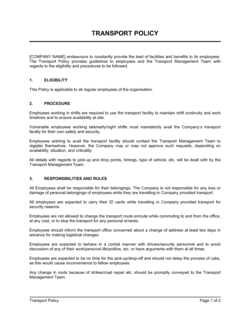
A Shipping Policy is a customer-facing document that defines exactly how an online store or retailer handles order fulfillment β€” delivery timeframes, shipping rates by method and destination, carrier partners, order tracking, and what happens when shipments are delayed, lost, or damaged. This free Word download gives you a structured, ready-to-publish starting point you can edit online and paste directly into your website footer, checkout page, or help center.
When you need it
Use it before launching any e-commerce store, adding a new shipping region, or whenever customer complaints about delivery expectations are rising. Payment processors and marketplace platforms such as Shopify, Etsy, and Amazon also require a published shipping policy as a condition of use.
What's inside
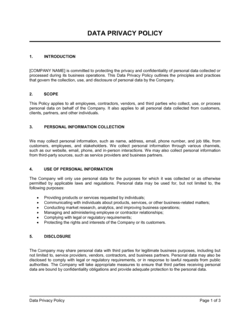
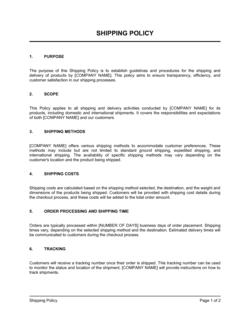
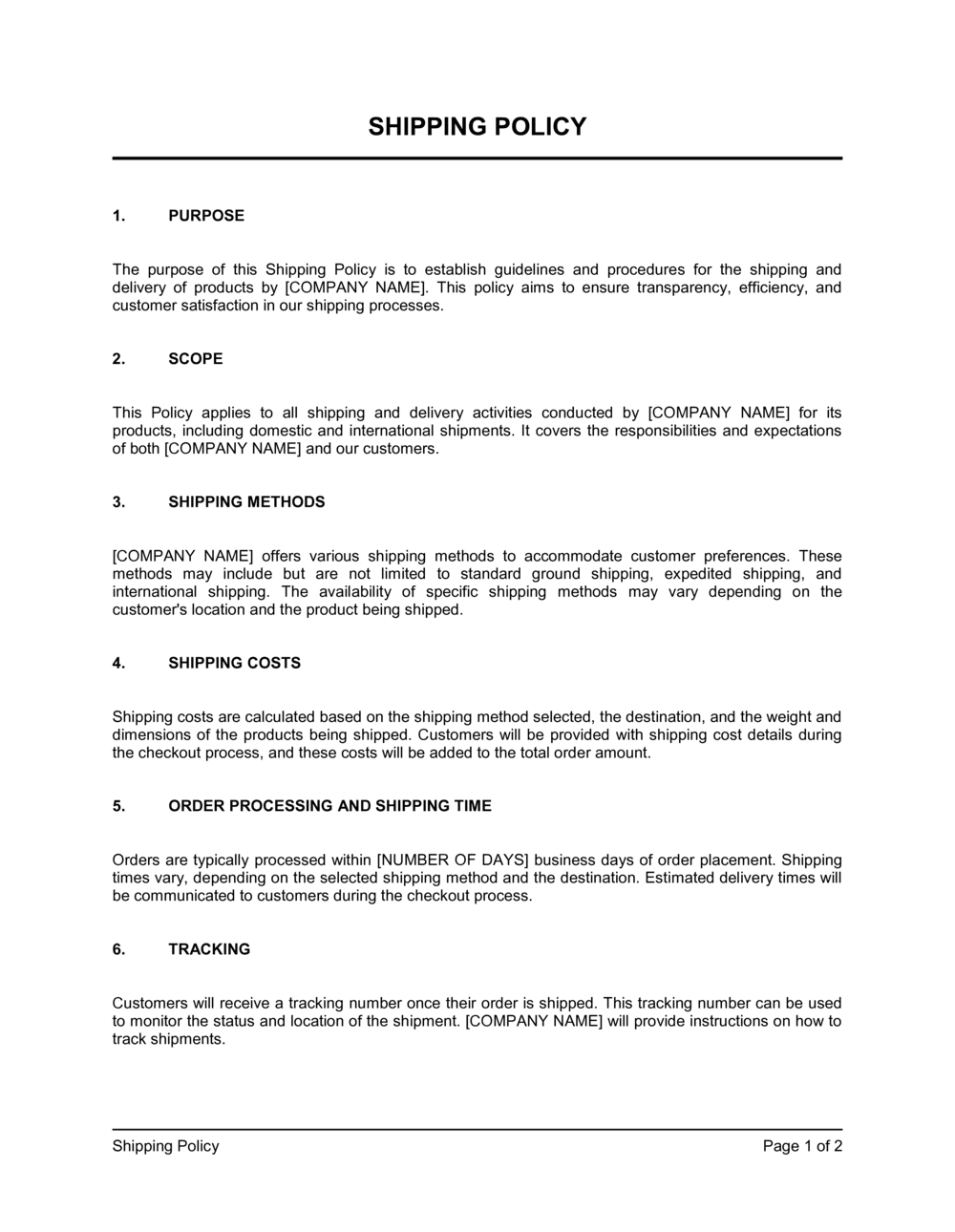
Order processing times, domestic and international shipping rates and methods, estimated delivery windows by carrier and service level, order tracking instructions, policies for lost or damaged shipments, restricted and unshippable items, and a contact section for shipping inquiries.

What is a Shipping Policy?

A Shipping Policy is a customer-facing operational document that defines exactly how a business processes and delivers orders β€” covering processing times, available shipping methods and rates, carrier partners, order tracking, estimated delivery windows, and resolution procedures for lost or damaged shipments. It draws a clear line between what the store controls (order processing) and what the carrier controls (transit), giving customers accurate expectations before they buy. Unlike a return policy, which handles post-delivery issues, a shipping policy governs every step from the moment a customer clicks "place order" to the moment the package arrives at their door.

Why You Need This Document

Without a published shipping policy, customers guess at delivery timelines, contact support when estimates don't match reality, and dispute charges when unexpected customs fees appear on international orders. Each of those scenarios costs money β€” in support labor, chargeback fees, and lost repeat customers. E-commerce platforms including Shopify, Etsy, and Amazon require a published shipping policy as a condition of selling on their platforms, and payment processors use it as evidence in merchant-favor dispute resolutions. A clear policy also reduces cart abandonment: studies consistently show that unexpected shipping costs and unclear delivery windows are two of the top three reasons shoppers leave before completing checkout. This template gives you a structured, ready-to-publish document you can complete in under an hour and update as your carrier rates and fulfillment operations evolve.

Which variant fits your situation?

If your situation is…Use this template
Selling physical goods through a Shopify or WooCommerce storeE-commerce Shipping Policy
Selling on Etsy or Amazon with marketplace-specific requirementsMarketplace Shipping Policy
Offering both domestic and international shipping with different rulesInternational Shipping Policy
Running a subscription box with fixed monthly shipment datesSubscription Fulfillment Policy
Handling customer returns and refunds alongside shipping termsReturn and Refund Policy
Shipping hazardous, perishable, or oversized goods with special handlingFreight and Special Handling Policy
Defining internal warehouse and fulfillment procedures for staffFulfillment Standard Operating Procedure

Common mistakes to avoid

❌ Merging processing time and transit time into one estimate

Why it matters: When delays occur, customers cannot determine whether the store or the carrier is responsible, leading to disputes and chargebacks that are difficult to contest.

Fix: State processing time and carrier transit time separately in your policy and on order confirmation emails, so customers understand the two-stage timeline.

❌ Not disclosing customs duty responsibility for international orders

Why it matters: Customers who receive unexpected import tax invoices dispute the charge with their credit card company, citing undisclosed costs β€” a dispute category merchants typically lose.

Fix: Add an explicit statement identifying who pays customs duties and taxes, and repeat it on the international checkout page.

❌ Using the word 'guaranteed' for standard shipping estimates

Why it matters: Standard carrier services do not carry delivery guarantees, and using that language in your policy creates a contractual expectation you cannot fulfill during peak seasons or weather events.

Fix: Replace 'guaranteed' with 'estimated' and add a sentence noting that carrier delays outside your control may affect delivery dates.

❌ Publishing a policy that never gets updated after carrier rate changes

Why it matters: A rate shown in the policy that differs from the rate at checkout triggers cart abandonment and customer complaints about bait-and-switch pricing.

Fix: Schedule a policy review each January after carrier rate increases and any time you change fulfillment providers or add a new shipping region.

The 9 key sections, explained

Order processing time

Domestic shipping methods and rates

International shipping methods and rates

Order tracking

Delivery estimates and delays

Lost, damaged, or stolen shipments

Restricted and unshippable items

Address accuracy and re-delivery

Contact information and policy updates

How to fill it out

  1. 1

    Enter your company name and effective date

    Replace [COMPANY NAME] throughout the template with your registered business or brand name. Set the effective date to today or your store launch date.

    πŸ’‘ Use the same brand name your customers see at checkout β€” legal entity names create confusion if they differ from your storefront.

  2. 2

    Set your order processing time and cutoff

    Enter the number of business days your warehouse or fulfillment provider takes from order receipt to carrier handoff. Add the specific cutoff time (e.g., 2:00 PM EST) for same-day processing.

    πŸ’‘ If you use a third-party fulfillment center (3PL), confirm their processing SLA in writing before publishing your policy β€” their cutoff becomes your published commitment.

  3. 3

    List your domestic shipping methods with current rates

    Enter each shipping tier β€” standard, expedited, and overnight if offered β€” with the carrier, current rate, and transit time. Include your free shipping threshold if you offer one.

    πŸ’‘ Check carrier rate tables each January when annual increases take effect and update the policy before they go live β€” a rate mismatch between your policy and checkout erodes trust.

  4. 4

    Define your international shipping coverage and customs policy

    List the countries or regions you ship to, the available services and rates, and explicitly state whether customs duties are the customer's responsibility or covered by DDP pricing.

    πŸ’‘ If you cannot absorb customs duties, use plain language like 'import taxes are the buyer's responsibility' rather than burying this in fine print β€” surprise duty charges are one of the top causes of international chargebacks.

  5. 5

    Describe your lost and damaged shipment process

    Write out the steps a customer must follow β€” timeframe to report, what evidence to provide, and what resolution they can expect (refund, reship, or carrier claim).

    πŸ’‘ Set a 48-hour photo documentation window for damaged items β€” carrier claims require this evidence, and waiting longer makes claims harder to file.

  6. 6

    Add any restricted items or destination exclusions

    List any products that cannot be shipped internationally, require special handling fees, or are excluded from certain service levels (e.g., no air shipping for lithium batteries).

    πŸ’‘ Cross-reference your carrier agreements for prohibited items β€” shipping a restricted item without disclosing it can result in carrier penalties and package seizure.

  7. 7

    Publish and link from all required locations

    Add the completed policy to your website footer, the checkout confirmation page, and any marketplace profile that requires it. Timestamp the published version.

    πŸ’‘ Shopify and WooCommerce allow you to add a policy link directly to the cart and checkout pages β€” placing it there reduces customer service volume by 15–25% for shipping-related questions.

Frequently asked questions

What is a shipping policy?

A shipping policy is a customer-facing document that defines how a business handles order fulfillment β€” including processing times, available shipping methods, rates, delivery estimates, tracking, and what happens when orders are lost or damaged. It sets clear expectations before purchase, reduces customer service volume, and is required by most e-commerce platforms and marketplace sellers.

What should a shipping policy include?

A complete shipping policy covers order processing time and cutoff, domestic and international shipping methods and rates, estimated delivery windows, order tracking instructions, procedures for lost or damaged shipments, restricted items or destinations, address accuracy responsibilities, and a last-updated date. Omitting any of these sections leaves gaps that generate support tickets and disputes.

Is a shipping policy legally required?

No law universally mandates a shipping policy, but most e-commerce platform terms of service β€” including Shopify, Etsy, and Amazon β€” require sellers to publish one. Consumer protection regulations in several jurisdictions require clear pre-purchase disclosure of delivery timeframes, and credit card dispute rules favor merchants who can point to a published, clearly communicated policy.

Where should I display my shipping policy?

Publish it in your website footer, on a dedicated /shipping-policy page, on your checkout and cart pages, and on any marketplace profile where you sell. Linking to it from your order confirmation email is also strongly recommended. The more visible the policy, the fewer shipping-related support tickets you will receive.

How do I handle international shipping in my shipping policy?

List the countries you ship to, the available service levels and rates for each region, estimated transit times, and β€” critically β€” who is responsible for customs duties and import taxes. If you ship DDU (Delivered Duty Unpaid), state clearly that the buyer is responsible for any import fees. If you offer DDP (Delivered Duty Paid), explain that all fees are included in the price. Ambiguity on this point is one of the leading causes of international chargebacks.

What is the difference between a shipping policy and a return policy?

A shipping policy covers what happens between order placement and delivery β€” processing times, carrier methods, rates, tracking, and lost-in-transit claims. A return policy covers what happens after delivery β€” how customers initiate a return, the eligibility window, who pays return shipping, and how refunds or exchanges are processed. They are distinct documents, though many businesses link them together in a combined help-center page.

How often should I update my shipping policy?

Review your shipping policy at least once a year, typically in January when major carriers (UPS, FedEx, USPS) publish their annual rate increases. Also update it whenever you add or remove a shipping destination, switch fulfillment providers, change your cutoff time, or add a new service level. Always update the last-revised date when you publish changes.

Can I use a single shipping policy for multiple stores?

You can use one template as a foundation, but each storefront should have its own published version tailored to that store's carriers, rates, and destinations. A policy that names USPS and UPS will confuse customers on a Canadian storefront where Canada Post and Purolator are the relevant carriers. Customize rate tables and carrier names for each channel.

Do I need a lawyer to write a shipping policy?

For most e-commerce stores, a well-structured template is sufficient. A lawyer or compliance consultant adds value if you are shipping regulated goods (pharmaceuticals, alcohol, firearms, hazardous materials), operating in heavily regulated markets, or if your return and shipping terms need to comply with specific consumer protection laws in the EU, UK, or Australia. For standard retail and DTC operations, a template reviewed by your operations team covers the essentials.

How this compares to alternatives

vs Return and Refund Policy

A shipping policy covers the outbound journey from order placement to delivery. A return and refund policy covers what happens after delivery β€” eligibility, timeframes, and refund methods. Both are required for any e-commerce store, and customers expect them to be clearly linked. Combining them into one document often creates a document that is too long and hard to scan.

vs Terms and Conditions

Terms and conditions govern the entire customer relationship β€” account use, intellectual property, dispute resolution, and liability. A shipping policy is a focused operational document covering fulfillment only. Terms and conditions typically reference the shipping policy rather than duplicate it. Both documents are required for a compliant e-commerce store.

vs Fulfillment SOP

A fulfillment standard operating procedure is an internal document for warehouse and operations staff describing how to pick, pack, label, and hand off orders. A shipping policy is external-facing and written for customers. They should align β€” processing times in the policy must match the SOP's actual timelines β€” but they serve entirely different audiences.

vs Privacy Policy

A privacy policy covers how customer data β€” including shipping addresses and purchase history β€” is collected, stored, and used. A shipping policy covers how physical orders are delivered. E-commerce stores need both, and shipping address data handling should be consistent between the two documents.

Industry-specific considerations

E-commerce and DTC

Multiple carrier options, free shipping thresholds, real-time rate calculation at checkout, and high international order volume require a detailed, regularly updated policy.

Food and Beverage

Perishable goods require expedited-only shipping, temperature-controlled packaging disclosures, and restricted delivery windows that must be explicitly stated in the policy.

Manufacturing and Wholesale

Freight and LTL shipments, lead times measured in weeks rather than days, oversized item surcharges, and FOB shipping terms distinguish wholesale shipping policies from retail ones.

Retail

In-store pickup options, ship-from-store programs, and buy-online-return-in-store terms require the shipping policy to coordinate with the return policy and store operations procedures.

Template vs pro β€” what fits your needs?

PathBest forCostTime
Use the templateE-commerce stores, DTC brands, and marketplace sellers shipping standard consumer goods domestically and internationallyFree30–60 minutes
Template + professional reviewStores adding international shipping, regulated product categories, or marketplace compliance requirements$100–$300 (operations consultant or compliance review)1–2 days
Custom draftedHigh-volume merchants shipping hazardous, perishable, or heavily regulated goods across multiple jurisdictions$500–$2,000 (legal or compliance specialist)1–2 weeks

Glossary

Order Processing Time
The number of business days between when an order is placed and when it is handed to a carrier for delivery β€” distinct from transit time.
Transit Time
The number of business days a carrier takes to deliver a package after it has been picked up from the seller.
Fulfillment Cutoff
The time of day by which an order must be placed to be processed and shipped the same business day.
Carrier
A shipping company β€” such as UPS, FedEx, USPS, Canada Post, or DHL β€” responsible for physically transporting the package to the customer.
Tracking Number
A unique alphanumeric code assigned by a carrier that allows the sender and recipient to monitor a shipment's location and status in real time.
Flat-Rate Shipping
A fixed shipping charge applied regardless of the package weight, dimensions, or distance β€” simplifies checkout but may not reflect actual carrier cost.
Free Shipping Threshold
A minimum order value above which the seller absorbs the shipping cost β€” commonly used as a conversion incentive.
Customs Duties and Import Taxes
Fees levied by a destination country's government on imported goods, typically paid by the recipient unless the seller ships on a DDP (Delivered Duty Paid) basis.
DDP (Delivered Duty Paid)
A shipping arrangement in which the seller pays all customs duties, import taxes, and clearance fees so the customer receives the package with no additional charges.
Lost Shipment Claim
A formal request submitted to a carrier to investigate and compensate for a package that has not been delivered within an acceptable timeframe after the expected delivery date.
Dimensional Weight (DIM Weight)
A pricing method carriers use to charge based on a package's size rather than its actual weight when the package is large but light.

Part of your Business Operating System

This document is one of 3,000+ business & legal templates included in Business in a Box.

  • Fill-in-the-blanks β€” ready in minutes
  • 100% customizable Word document
  • Compatible with all office suites
  • Export to PDF and share electronically

Create your document in 3 simple steps.

From template to signed document β€” all inside one Business Operating System.
1
Download or open template

Access over 3,000+ business and legal templates for any business task, project or initiative.

2
Edit and fill in the blanks with AI

Customize your ready-made business document template and save it in the cloud.

3
Save, Share, Send, Sign

Share your files and folders with your team. Create a space of seamless collaboration.

Save time, save money, and create top-quality documents.

β˜…β˜…β˜…β˜…β˜…

"Fantastic value! I'm not sure how I'd do without it. It's worth its weight in gold and paid back for itself many times."

Managing Director Β· Mall Farm
Robert Whalley
Managing Director, Mall Farm Proprietary Limited
β˜…β˜…β˜…β˜…β˜…

"I have been using Business in a Box for years. It has been the most useful source of templates I have encountered. I recommend it to anyone."

Business Owner Β· 4+ years
Dr Michael John Freestone
Business Owner
β˜…β˜…β˜…β˜…β˜…

"It has been a life saver so many times I have lost count. Business in a Box has saved me so much time and as you know, time is money."

Owner Β· Upstate Web
David G. Moore Jr.
Owner, Upstate Web

Run your business with a system β€” not scattered tools

Stop downloading documents. Start operating with clarity. Business in a Box gives you the Business Operating System used by over 250,000 companies worldwide to structure, run, and grow their business.

Start freeΒ Β·Β No credit card required