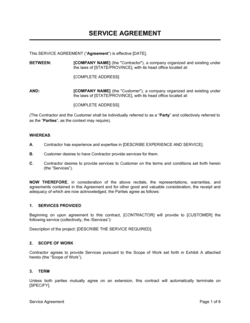
Fulfillment Services Agreement Template

Free Word download • Edit online • Save & share with Drive • Export to PDF

17 pages35–45 min to fillDifficulty: ComplexSignature requiredLegal review recommended
Learn more ↓
FreeFulfillment Services Agreement Template

At a glance

What it is
A Fulfillment Services Agreement is a legally binding contract between a merchant or brand (the client) and a third-party fulfillment provider (the 3PL) that governs how the provider receives, stores, picks, packs, and ships the client's inventory to end customers. This free Word download covers all material terms — service levels, fees, liability, insurance, and termination — in a single enforceable document you can edit online and export as PDF.
When you need it
Use it before handing inventory to any third-party warehouse or fulfillment center, whether you are an e-commerce brand outsourcing logistics for the first time or an established retailer switching 3PL providers. It is equally relevant for subscription box operators, direct-to-consumer brands, and B2B distributors that rely on a provider to ship on their behalf.
What's inside
Scope of services and service-level commitments, fee schedules for receiving, storage, pick-and-pack, and shipping, inventory ownership and loss liability, insurance requirements, data and system integration obligations, IP and branding guidelines, term and termination conditions, and governing law.

What is a Fulfillment Services Agreement?

A Fulfillment Services Agreement is a legally binding contract between a merchant or brand (the client) and a third-party logistics provider (the 3PL or fulfillment center) that governs every aspect of how the provider receives, stores, picks, packs, and ships the client's inventory to end customers. It defines the scope of services, performance standards, fee structure, inventory liability, insurance obligations, data rights, and termination conditions in a single enforceable document. Unlike an informal arrangement or a provider's one-page terms of service, a properly drafted fulfillment agreement creates specific, measurable obligations on the provider and proportionate protections for the client's inventory, revenue operations, and customer relationships.

Why You Need This Document

Handing inventory to a third-party provider without a written agreement transfers operational control while retaining all of the financial risk. If the provider ships the wrong items, damages goods during storage, loses a pallet in a facility fire, or goes out of business mid-quarter, the client has no contractual basis to recover losses, demand an orderly transition, or enforce service standards. The consequences are immediate and measurable: missed orders, unhappy customers, potential marketplace seller-account penalties, and inventory losses with no clear liability path. A signed fulfillment services agreement — executed before the first pallet arrives — establishes the service levels your operations depend on, caps the provider's liability at a meaningful amount, requires adequate insurance coverage, and guarantees transition assistance if the relationship ends. This template gives you a professionally structured starting point that covers all material terms, so you can onboard a new logistics partner in hours rather than weeks.

Which variant fits your situation?

If your situation is…Use this template
Standard e-commerce brand outsourcing pick, pack, and ship to a single 3PLFulfillment Services Agreement
Merchant storing goods in a warehouse without active fulfillment servicesWarehousing Agreement
Brand engaging a carrier or freight broker for transport onlyFreight Broker Agreement
Dropshipping arrangement where the supplier ships directly to the customerDropshipping Agreement
Manufacturer handling distribution under a licensed brand's directionDistribution Agreement
Retailer or brand engaging a logistics provider for last-mile deliveryLogistics Services Agreement
Multi-channel seller requiring cross-border fulfillment with customs handlingInternational Fulfillment Services Agreement

Common mistakes to avoid

❌ Vague scope language referencing 'standard fulfillment services'

Why it matters: When a dispute arises over kitting, custom inserts, or returns processing, providers interpret 'standard' in their favor — and the client pays extra or receives substandard service with no contractual recourse.

Fix: Enumerate every service in a numbered list in the scope clause and attach a Schedule B with detailed operational specifications for each service type.

❌ SLAs with no stated remedy for breach

Why it matters: A provider that misses a 99.5% accuracy target suffers no financial consequence unless the contract specifies one — meaning the SLA is unenforceable in practice.

Fix: Attach a service credit table or termination trigger to each SLA so the remedy is automatic and calculable without negotiation.

❌ Accepting a liability cap equal to one month of fees

Why it matters: For a brand storing $200,000 of inventory in Q4, a cap of $15,000 in monthly fees leaves $185,000 of exposure uncovered in the event of a warehouse fire or major picking error.

Fix: Negotiate a liability cap tied to the declared replacement value of inventory on hand, supplemented by mandatory warehouse legal liability insurance coverage.

❌ No transition-assistance clause

Why it matters: Without a contractual obligation to cooperate, a provider at the end of a contentious relationship can delay inventory transfer for weeks and charge fees not previously disclosed, halting the client's order operations entirely.

Fix: Include a transition clause requiring the provider to complete inventory transfer within a fixed business-day window and to waive exit fees not explicitly listed in the agreement.

❌ Failing to obtain certificates of insurance before inventory transfer

Why it matters: Clients who move inventory into a facility without verifying active warehouse legal liability coverage discover the gap only after a loss event — when the provider's policy has lapsed or excludes the relevant cause of loss.

Fix: Make delivery of current COIs, with the client named as an additional insured, a condition precedent to the first inventory transfer under the agreement.

❌ No integration or data-access clause

Why it matters: Without a contractual right to real-time inventory and order data, a client whose provider's system goes down has no basis to demand access or compensation for the downstream impact on customers.

Fix: Specify the data fields, access method (API or portal), and uptime SLA for the provider's system integration, with a defined remedy for outages exceeding a stated threshold.

The 10 key clauses, explained

Parties, recitals, and definitions

In plain language: Identifies the client (merchant) and the fulfillment provider by legal entity name, states the purpose of the agreement, and defines key terms used throughout the contract.

Sample language
This Fulfillment Services Agreement ('Agreement') is entered into as of [DATE] by and between [CLIENT LEGAL NAME], a [STATE/PROVINCE] [ENTITY TYPE] ('Client'), and [PROVIDER LEGAL NAME], a [STATE/PROVINCE] [ENTITY TYPE] ('Provider').

Common mistake: Using a trade name instead of the registered legal entity name for either party — if the provider operates under a DBA, the underlying legal entity must appear in the parties clause or enforcement becomes complicated.

Scope of services

In plain language: Lists exactly which services the provider will perform — receiving, storage, pick and pack, shipping, returns processing — and explicitly excludes anything not listed.

Sample language
Provider shall perform the following services: (a) receiving and logging inbound inventory shipments; (b) storing Client inventory at the Facility; (c) picking and packing orders per Client specifications; (d) tendering completed orders to Carrier; and (e) processing customer returns as set out in Schedule B.

Common mistake: Leaving the scope vague by using language like 'standard fulfillment services' — when a dispute arises over whether kitting, custom packaging, or returns handling is included, vague scope always costs more to resolve than writing it out.

Service levels and performance standards

In plain language: Sets measurable commitments for order processing speed, shipment accuracy, inventory accuracy, and uptime of the provider's systems — with remedies if the provider misses the targets.

Sample language
Provider shall process and tender to Carrier all orders received by [X:00 PM] local time on a business day within [1] business day. Order accuracy shall be no less than [99.5]% on a monthly basis. Inventory accuracy shall be maintained at no less than [99]%, verified by quarterly cycle counts.

Common mistake: Setting SLAs without defining the remedy for breach — an SLA with no consequence is a wish list, not an enforceable obligation.

Fees, invoicing, and payment terms

In plain language: Specifies the fee structure for each service category — receiving, storage per pallet or cubic foot, pick-and-pack per order, outbound handling — plus invoicing frequency and payment due date.

Sample language
Client shall pay Provider the fees set out in Schedule A, including: receiving at $[X] per pallet; storage at $[X] per pallet per month; pick-and-pack at $[X] per order plus $[X] per additional item; and outbound handling at $[X] per shipment. Invoices are issued monthly and due Net [30] days from the invoice date.

Common mistake: Agreeing on per-order fees verbally without locking the full rate card in a schedule — providers commonly apply standard rate increases at renewal unless fees are fixed in the contract.

Inventory ownership and risk of loss

In plain language: Confirms that the client retains title to all inventory at all times and specifies which party bears the financial risk if inventory is lost, damaged, or destroyed while in the provider's facility.

Sample language
Title to and ownership of all Client inventory shall remain with Client at all times. Provider shall be liable for inventory loss or damage caused by Provider's negligence or willful misconduct, up to the replacement cost per unit set out in Schedule C. Provider is not liable for loss caused by carrier, Acts of God, or Client error.

Common mistake: Failing to attach a Schedule C with per-unit replacement values for each SKU — without declared values, the provider's liability defaults to wholesale cost or a fixed cap that may be far below actual inventory value.

Insurance obligations

In plain language: Requires each party to maintain specific types and minimum coverage amounts of insurance — commercial general liability, warehouse legal liability, and cargo insurance — and to provide certificates of insurance upon request.

Sample language
Provider shall maintain, at minimum: (a) Commercial General Liability insurance with limits of no less than $[1,000,000] per occurrence; (b) Warehouse Legal Liability insurance covering Client inventory at replacement value; and (c) Workers' Compensation as required by applicable law. Client shall maintain product liability insurance with limits of no less than $[1,000,000] per occurrence.

Common mistake: Not requiring the provider to name the client as an additional insured on the warehouse legal liability policy — a standard omission that leaves the client without a direct claim path if inventory is damaged.

Intellectual property and branding

In plain language: Grants the provider a limited license to use the client's trademarks, logos, and packaging specs solely to perform the services — and prohibits the provider from using them for any other purpose.

Sample language
Client grants Provider a limited, non-exclusive, royalty-free license to use Client's trademarks, logos, and branding materials solely as necessary to perform the Services during the Term. Provider shall not sublicense, modify, or use Client's IP for any other purpose without prior written consent.

Common mistake: Not addressing IP at all in the agreement, leaving the provider technically without authorization to print the client's logo on shipping labels — and the client without a clear basis to object if the provider uses the logo in its own marketing materials.

Data, systems integration, and confidentiality

In plain language: Requires each party to protect the other's confidential information, governs access to order and inventory data, and sets out obligations for the technical integration between platforms.

Sample language
Each party shall keep the other's Confidential Information strictly confidential and shall not disclose it to any third party without prior written consent. Provider shall maintain Client's order and inventory data in a secure system and shall provide Client with real-time access to inventory and order status through the Provider's portal or API.

Common mistake: Allowing the provider broad rights to use aggregated order data for benchmarking or marketing without the client's consent — this is frequently buried in a data-use rider and is worth negotiating out.

Term, termination, and transition

In plain language: States the initial contract length, renewal mechanics, the notice period required to terminate, grounds for immediate termination for cause, and the provider's obligations to assist with an orderly inventory transition.

Sample language
This Agreement commences on [START DATE] and continues for an initial term of [12] months, renewing automatically for successive [12]-month periods unless either party provides [60] days' written notice of non-renewal. Either party may terminate for cause upon [30] days' written notice if the other materially breaches and fails to cure within that period. Upon termination, Provider shall cooperate in good faith to transfer Client inventory within [15] business days at Client's cost.

Common mistake: No transition-assistance obligation — if the relationship ends acrimoniously, a provider with no contractual obligation to cooperate can hold inventory for weeks or charge unreasonable transfer fees while orders stack up.

Limitation of liability and indemnification

In plain language: Caps the total financial exposure of each party and sets out the circumstances in which each party will defend and hold harmless the other from third-party claims.

Sample language
Provider's aggregate liability under this Agreement shall not exceed [3] months of fees paid by Client in the [12] months preceding the claim. Each party shall indemnify, defend, and hold harmless the other from third-party claims arising from the indemnifying party's negligence, willful misconduct, or material breach of this Agreement.

Common mistake: Accepting a liability cap expressed as 'fees paid in the prior month' — for clients with seasonal inventory spikes, a one-month fee cap may cover only a fraction of the actual inventory value at risk during peak season.

How to fill it out

  1. 1

    Enter the legal entity names and effective date

    Replace both party placeholders with the full registered legal names of the client and the provider. Set the effective date to the date both parties will sign, not the date operations begin.

    💡 Request a copy of the provider's corporate registry certificate before execution to confirm the exact legal name — trade names and registered names frequently differ.

  2. 2

    Define the scope of services in full

    List every service the provider will perform — receiving, storage, pick and pack, shipping, kitting, returns — in the scope clause and in Schedule B. If a service is not listed, assume it is excluded and will be billed as an additional service at the provider's discretion.

    💡 Walk through a typical order cycle end-to-end before drafting the scope to catch services you rely on but haven't formally specified.

  3. 3

    Set measurable SLAs with explicit remedies

    Define order-processing cutoff times, accuracy percentages, and inventory reconciliation frequency. For each SLA, state the remedy — a service credit, fee reduction, or termination right — that applies if the target is missed.

    💡 Tie the remedy directly to the SLA it covers — a single generic 'service credit' clause is harder to invoke and easier for a provider to dispute than an SLA-specific formula.

  4. 4

    Attach a complete fee schedule as Schedule A

    Document every fee category — receiving, storage, pick-and-pack, outbound handling, special projects, minimum monthly fees — with the exact rate for each. State whether rates are fixed for the initial term or subject to annual adjustment and, if adjustable, cap the permitted increase.

    💡 Request the provider's standard rate card and negotiate caps on annual rate increases — 3–5% per year is reasonable; uncapped increases have caught many brands off guard at renewal.

  5. 5

    Declare per-SKU inventory replacement values in Schedule C

    List each product SKU with its replacement cost — typically the landed cost of goods — so the liability clause has a concrete basis for calculating loss claims.

    💡 Update Schedule C at least annually and whenever you launch a new product line. Outdated replacement values undermine any loss claim.

  6. 6

    Confirm insurance requirements and request certificates

    Fill in the coverage minimums for both parties, require the provider to name the client as an additional insured, and request certificates of insurance before any inventory is transferred to the facility.

    💡 Set a recurring calendar reminder to request updated COIs annually — policies expire and providers sometimes let coverage lapse without notifying clients.

  7. 7

    Set the term, notice period, and transition obligations

    Choose the initial term length (12 months is standard), the auto-renewal mechanism, the written notice period required to terminate (60–90 days is typical), and the number of business days the provider has to prepare inventory for transfer upon termination.

    💡 Negotiate the transition period before signing — providers are far more cooperative about transition terms when they are contractually obligated from the start.

  8. 8

    Review the liability cap against peak inventory value

    Calculate your peak inventory value (typically Q4 for consumer goods) and compare it to the liability cap. If the cap is expressed as a multiple of monthly fees, verify that it is adequate during high-inventory periods and negotiate an inventory-value-based alternative if not.

    💡 Consider requiring the provider to carry warehouse legal liability insurance equal to the full declared replacement value of your inventory rather than relying solely on the contractual liability cap.

Frequently asked questions

What is a fulfillment services agreement?

A fulfillment services agreement is a binding contract between a merchant and a third-party logistics provider (3PL) that governs how the provider receives, stores, picks, packs, and ships the merchant's inventory to end customers. It defines service levels, fees, liability for inventory loss, insurance requirements, and termination conditions. Without one, the parties' obligations are undefined and disputes over lost inventory or missed shipment deadlines become expensive to resolve.

What is the difference between a fulfillment services agreement and a warehousing agreement?

A warehousing agreement covers passive storage of goods — the provider receives inventory and holds it but does not actively process or ship orders. A fulfillment services agreement covers active logistics operations: receiving, storage, picking, packing, shipping, and often returns processing. If your provider is doing anything beyond storing pallets, you need a fulfillment agreement, not a warehousing agreement.

Who should sign a fulfillment services agreement?

Both the client (the brand or merchant whose inventory is being handled) and the fulfillment provider (the 3PL or warehouse operator) must sign. Each party's authorized signatory — typically a CEO, COO, or VP of Operations — should execute the agreement before any inventory is transferred or any orders are processed. Signing after operations begin weakens enforceability of restrictive clauses like non-solicitation and liability caps.

What service levels should a fulfillment services agreement include?

At minimum, include order-processing turnaround time (e.g., orders placed by 12:00 PM ship same day), order accuracy rate (typically 99–99.9%), inventory accuracy rate (typically 99%+), and system uptime if the provider's platform is integrated with your store. Each SLA should be paired with a specific remedy — a service credit, fee reduction, or termination trigger — otherwise the commitment is unenforceable in practice.

How is liability for lost or damaged inventory handled in a fulfillment agreement?

Typically, the fulfillment provider is liable for inventory lost or damaged due to their negligence or willful misconduct, up to a contractual cap. The cap is commonly expressed as a multiple of monthly fees or as the declared replacement cost per SKU listed in a schedule. Clients should negotiate a cap tied to actual inventory replacement value rather than a fee multiple, and require the provider to carry warehouse legal liability insurance sufficient to cover peak inventory levels.

Is a fulfillment services agreement required by law?

No law mandates a written fulfillment agreement, but operating without one leaves both parties exposed. Without a written contract, the parties' obligations default to general commercial law principles, which rarely provide the specific protections — defined SLAs, liability caps, transition assistance — that a well-drafted agreement delivers. Most established 3PLs will not onboard a client without a signed agreement as a matter of their own risk management.

What happens when a fulfillment services agreement is terminated?

Upon termination, the provider should be contractually obligated to complete all pending orders, provide a final inventory reconciliation, and transfer remaining inventory to the client's designated address or new provider within a fixed period — typically 10–15 business days. Without a transition-assistance clause, a provider has no obligation to cooperate quickly or at previously agreed rates, and exit fees not disclosed in the contract may surface.

Should I use the fulfillment provider's standard contract or my own template?

Provider-issued contracts are drafted to protect the provider — they typically include broad liability exclusions, minimal SLA remedies, and fee escalation rights. Using your own template as a starting point gives you control over the initial draft and shifts the negotiation dynamic. For any arrangement involving more than $50,000 in annual fees or significant inventory value, have a lawyer review the final agreement regardless of which party's template is used.

Do I need a lawyer to draft a fulfillment services agreement?

For straightforward domestic arrangements with a small 3PL, a high-quality template reviewed by a business lawyer for 1–2 hours is typically sufficient. Engage a lawyer directly for arrangements involving significant inventory value (over $500,000), cross-border logistics with customs complexity, custom technology integration requirements, or a provider whose standard contract includes unusually restrictive indemnification or liability language.

How this compares to alternatives

vs Warehousing Agreement

A warehousing agreement governs passive storage only — the provider receives and holds inventory but does not process orders or ship to end customers. A fulfillment services agreement covers the full logistics operation: receiving, storage, order processing, shipping, and returns. If your provider touches orders, you need a fulfillment agreement, not a warehousing agreement.

vs Distribution Agreement

A distribution agreement governs a distributor who takes title to goods and resells them through their own sales channels. A fulfillment services agreement governs a provider who handles and ships the client's goods as an agent, without taking title. The client retains ownership of inventory under a fulfillment agreement; the distributor owns the goods under a distribution agreement.

vs Dropshipping Agreement

A dropshipping agreement governs a supplier who ships directly to the end customer from their own inventory, typically under the merchant's branding. A fulfillment agreement governs a third party that stores the merchant's own inventory and ships on their behalf. The key distinction is inventory ownership: the merchant owns the stock under a fulfillment arrangement; the supplier owns it under a dropshipping arrangement.

vs Logistics Services Agreement

A logistics services agreement typically governs transportation and freight management — carrier selection, rate negotiation, and shipment tracking — without covering warehousing or order processing. A fulfillment services agreement is broader, covering the full order cycle from receiving and storage through pick-and-pack and dispatch. Businesses that outsource both warehousing and transport in a single relationship need a fulfillment agreement.

Industry-specific considerations

E-commerce and direct-to-consumer

High SKU counts, peak-season volume spikes, carrier rate negotiation on behalf of the client, and same-day or next-day SLA commitments driven by marketplace standards.

Consumer packaged goods

Temperature and humidity storage requirements, lot and expiry tracking for food and personal care products, and compliance with retailer compliance programs (GTIN, EDI labeling).

Healthcare and medical devices

FDA-regulated storage and handling, serialization and lot-level traceability requirements, and chain-of-custody documentation for recall readiness.

Manufacturing and wholesale

Pallet-level receiving and dispatch, freight and LTL coordination, vendor-managed inventory arrangements, and EDI integration with retail buyers.

Jurisdictional notes

United States

US fulfillment agreements are governed by UCC Article 7 (Documents of Title) when a warehouse receipt is issued. State law governs most commercial disputes, so the choice-of-law clause matters — Delaware and New York are common choices for their developed commercial case law. Cross-state operations may trigger nexus for sales tax purposes; the agreement should address which party is responsible for managing tax compliance obligations in each state.

Canada

Canadian fulfillment agreements should specify the province of governing law given significant variation between common-law provinces and Quebec's civil-law regime. Ontario and British Columbia have established commercial courts and are typical choices. PIPEDA (and Quebec's Law 25) imposes obligations on the handling of personal data contained in order records; data processing obligations should be addressed explicitly, particularly for consumer order information.

United Kingdom

UK fulfillment agreements are subject to the Supply of Goods and Services Act 1982 and, for consumer orders, the Consumer Rights Act 2015. The UK GDPR requires that any order data containing personal information be processed under a Data Processing Agreement, which should be executed alongside the fulfillment agreement. Post-Brexit customs obligations apply to UK-EU cross-channel fulfillment arrangements and should be addressed in a separate customs addendum.

European Union

EU GDPR Article 28 requires a Data Processing Agreement between the merchant (controller) and the fulfillment provider (processor) whenever order data containing personal information is handled — this is mandatory and cannot be waived by contract. VAT registration obligations in the member state where the fulfillment center is located must be assessed; the EU One-Stop Shop (OSS) scheme may simplify multi-country VAT compliance. Member state labor laws may affect which party bears employer obligations for warehouse workers.

Template vs lawyer — what fits your deal?

PathBest forCostTime
Use the templateSmall e-commerce brands outsourcing fulfillment to a single domestic 3PL with annual fees under $50,000Free1–2 hours
Template + legal reviewBrands with significant inventory value, seasonal volume spikes, or a provider whose standard contract includes aggressive liability exclusions$400–$8002–4 days
Custom draftedEnterprise brands with cross-border logistics, regulated product categories (healthcare, food), custom technology integrations, or contracts above $250,000 annually$2,000–$6,000+2–4 weeks

Glossary

3PL (Third-Party Logistics)
A company that provides outsourced logistics services — storage, order fulfillment, and shipping — on behalf of a merchant or brand.
Service Level Agreement (SLA)
A contractual commitment to specific performance metrics, such as order processing within 1 business day or a 99.5% order accuracy rate.
Pick and Pack
The warehouse process of selecting individual items from inventory (picking) and packaging them for shipment to the end customer (packing).
Receiving
The process by which the fulfillment provider accepts, counts, and logs inbound inventory shipments from the client or their suppliers.
Inventory Shrinkage
Inventory loss attributable to damage, theft, or administrative error while in the provider's custody — a key liability term in any fulfillment contract.
SKU (Stock Keeping Unit)
A unique alphanumeric identifier assigned to each distinct product variant, used to track inventory levels and order accuracy.
Chargeback
In a fulfillment context, a fee or deduction the fulfillment provider invoices for a specific error or non-standard service, such as handling a non-conforming inbound shipment.
Force Majeure
A clause excusing a party from performance obligations when extraordinary events beyond their control — natural disasters, pandemics, port strikes — prevent fulfillment.
Carrier
The shipping company (e.g., UPS, FedEx, USPS, DHL) engaged by the fulfillment provider to transport packages from the warehouse to the end customer.
Liability Cap
The maximum dollar amount the fulfillment provider is obligated to pay for losses, errors, or damage — typically expressed as a multiple of monthly fees or a fixed dollar ceiling.
Integration
The technical connection between the client's order management system or e-commerce platform and the provider's warehouse management system, enabling automated order routing.
Term and Renewal
The initial contract duration and the conditions under which it automatically renews or expires — commonly 12 months with 30–90 days' written notice to cancel.

Part of your Business Operating System

This document is one of 3,000+ business & legal templates included in Business in a Box.

  • Fill-in-the-blanks — ready in minutes
  • 100% customizable Word document
  • Compatible with all office suites
  • Export to PDF and share electronically

Create your document in 3 simple steps.

From template to signed document — all inside one Business Operating System.
1
Download or open template

Access over 3,000+ business and legal templates for any business task, project or initiative.

2
Edit and fill in the blanks with AI

Customize your ready-made business document template and save it in the cloud.

3
Save, Share, Send, Sign

Share your files and folders with your team. Create a space of seamless collaboration.

Save time, save money, and create top-quality documents.

★★★★★

"Fantastic value! I'm not sure how I'd do without it. It's worth its weight in gold and paid back for itself many times."

Managing Director · Mall Farm
Robert Whalley
Managing Director, Mall Farm Proprietary Limited
★★★★★

"I have been using Business in a Box for years. It has been the most useful source of templates I have encountered. I recommend it to anyone."

Business Owner · 4+ years
Dr Michael John Freestone
Business Owner
★★★★★

"It has been a life saver so many times I have lost count. Business in a Box has saved me so much time and as you know, time is money."

Owner · Upstate Web
David G. Moore Jr.
Owner, Upstate Web

Run your business with a system — not scattered tools

Stop downloading documents. Start operating with clarity. Business in a Box gives you the Business Operating System used by over 250,000 companies worldwide to structure, run, and grow their business.

Free Forever Plan · No credit card required