Assignment of Real Estate Contract Template

Free Word download • Edit online • Save & share with Drive • Export to PDF

1 page20–30 min to fillDifficulty: StandardSignature requiredLegal review recommended
Learn more ↓
FreeAssignment of Real Estate Contract Template

At a glance

What it is
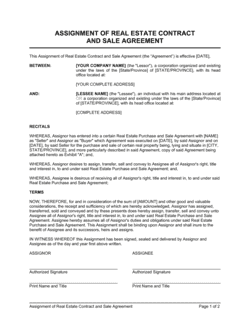
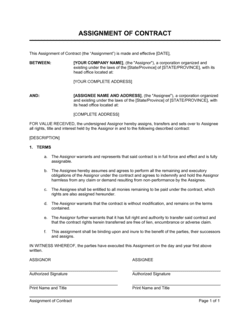
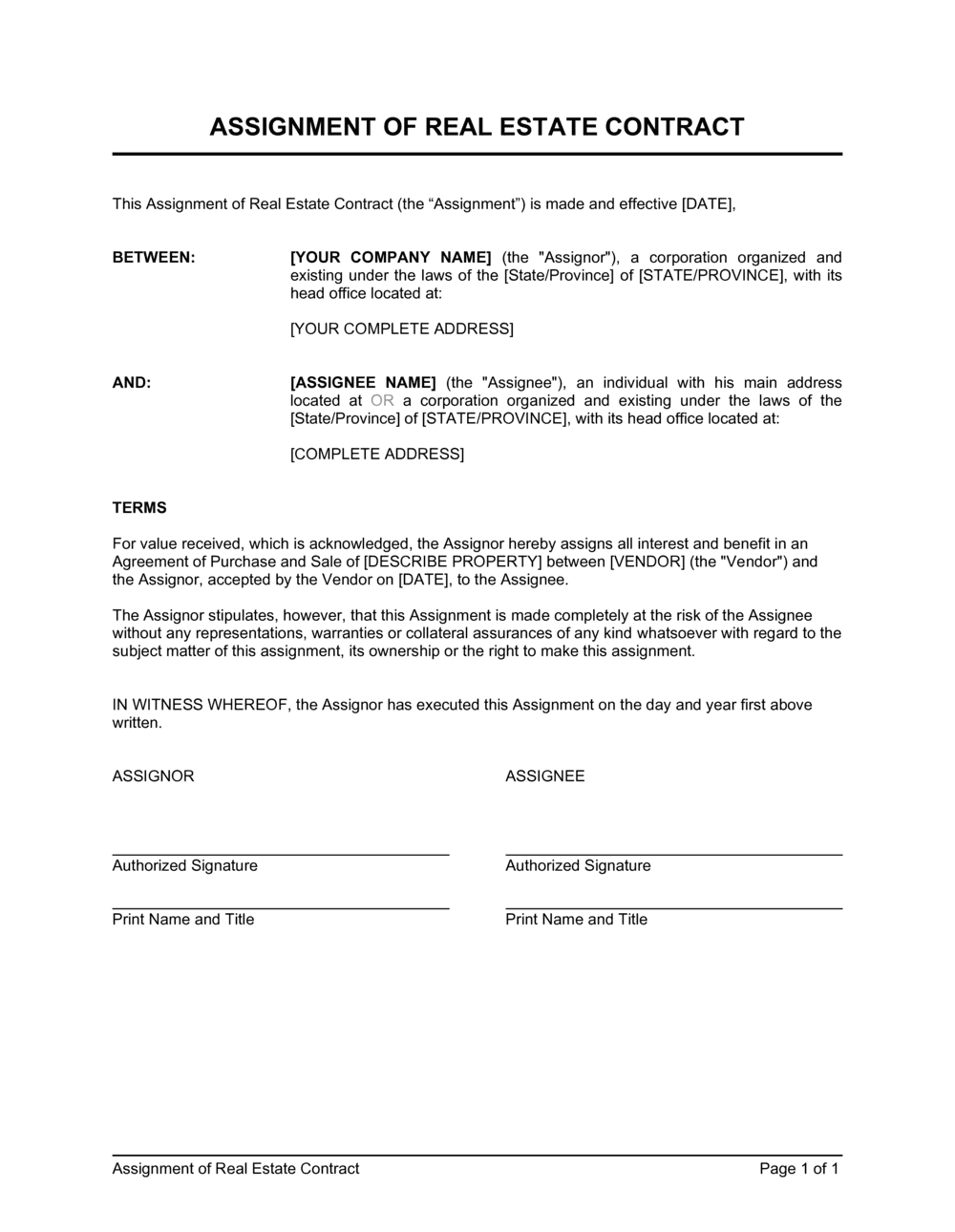
An Assignment of Real Estate Contract is a legally binding document that transfers a buyer's rights and obligations under an existing purchase agreement to a new third-party buyer — the assignee. This free Word download gives you a ready-to-edit template you can customize with property details, assignment fee, and consent terms, then export as PDF for execution at or before closing.
When you need it
Use it when you have a property under contract and wish to transfer your equitable interest to another buyer before closing — common in wholesale real estate investing, fix-and-flip acquisition pipelines, and situations where the original buyer can no longer complete the purchase. The original purchase agreement must typically permit assignment, or the seller must provide written consent.
What's inside
Identification of the assignor, assignee, and original seller; a full description of the underlying purchase agreement and property; the assignment fee and payment terms; representations and warranties from both parties; seller consent (if required); and closing and indemnification provisions that govern liability after the transfer.

What is an Assignment of Real Estate Contract?

An Assignment of Real Estate Contract is a legally binding document that transfers a buyer's rights and obligations under an existing property purchase agreement to a new third-party buyer. The original buyer — the assignor — exits the transaction by selling their equitable interest for an assignment fee, and the incoming buyer — the assignee — steps in to complete the purchase directly with the seller on the terms already negotiated. The document does not create a new sale between the seller and the assignee; it redirects the contractual position established in the original purchase agreement. In wholesale real estate investing, this mechanism allows investors to earn a profit from a contracted property without ever taking title to it.

Why You Need This Document

Without a written assignment agreement, the transfer of a purchase contract is legally ambiguous — both the assignor and assignee face unclear liability if the deal falls apart, and the title company has no instructions for how to handle the earnest money deposit or disburse the assignment fee at closing. An undocumented or informally arranged assignment can expose the original buyer to ongoing obligations under the purchase agreement even after they believe they have exited the deal. Sellers who were never formally notified of the change can challenge the closing, creating title issues that delay or void the transaction entirely. A properly executed assignment agreement allocates liability between the parties from the moment of transfer, documents the seller's consent where required, and gives the title company clear written instructions to execute a clean closing — protecting the assignor's fee, the assignee's investment, and the integrity of the transaction from contract to close.

Which variant fits your situation?

If your situation is…Use this template
Wholesale investor transferring a residential contract to an end buyer for a feeAssignment of Real Estate Contract
Transferring an option to purchase real property rather than a purchase contractReal Estate Option Agreement
Seller financing arrangement where the buyer takes over existing mortgage paymentsAssumption Agreement
Transferring ownership of the property itself rather than contract rightsReal Estate Purchase Agreement
Pre-construction condo assignment to a new buyer before closingPre-Sale Assignment Agreement
Assigning a commercial lease rather than a purchase contractAssignment of Lease Agreement
Joint venture with another investor on the same contracted propertyReal Estate Joint Venture Agreement

Common mistakes to avoid

❌ Assigning without checking for an anti-assignment clause

Why it matters: Assigning a contract that prohibits assignment without seller consent is a breach of the original purchase agreement and can result in the seller voiding the deal, forfeiting the earnest money deposit, and pursuing damages.

Fix: Read the original purchase agreement before marketing the contract to potential assignees. If consent is required, obtain it in writing before signing the assignment.

❌ Not attaching the original purchase agreement as an exhibit

Why it matters: Without the underlying contract attached, disputes arise about which terms the assignee actually assumed — creating ambiguity on purchase price, contingencies, closing date, and inspection credits.

Fix: Always attach a complete, signed copy of the original purchase agreement as Exhibit A to the assignment document.

❌ Leaving the earnest money treatment unaddressed

Why it matters: When the assignment is silent on the earnest money, the title company receives conflicting instructions and may hold funds pending resolution — delaying or derailing the closing.

Fix: Include an explicit earnest money clause stating whether the deposit is credited to the assignee, retained by the assignor, or transferred to a new escrow account.

❌ Executing the assignment after the purchase agreement's contingency periods have expired

Why it matters: If inspection, financing, or due diligence contingencies in the original purchase agreement have already lapsed, the assignee inherits a contract with no exit rights and full exposure to the purchase obligation.

Fix: Complete the assignment while contingency periods are still open, or negotiate a contract amendment with the seller to extend them before execution.

❌ Choosing a governing law different from the property's state

Why it matters: Courts almost universally apply the law of the state where the property is located to real estate transactions — a conflicting choice-of-law clause will likely be disregarded, creating uncertainty about which rules apply.

Fix: Set the governing law to the state where the property is physically located, regardless of where the assignor or assignee are based.

❌ No indemnification clause allocating pre- and post-assignment liability

Why it matters: Without an indemnification provision, if the assignee defaults or the seller raises a pre-closing claim, both parties may face joint exposure with no contractual framework to determine who bears the cost.

Fix: Include a mutual indemnification clause that clearly separates the assignor's liability for pre-assignment obligations from the assignee's liability for post-assignment obligations.

The 9 key clauses, explained

Identification of parties and underlying agreement

In plain language: Names the assignor, assignee, and original seller, and identifies the purchase agreement being assigned by reference to its execution date and property address.

Sample language
This Assignment of Real Estate Contract ('Assignment') is entered into as of [DATE] by and between [ASSIGNOR FULL NAME] ('Assignor') and [ASSIGNEE FULL NAME OR ENTITY] ('Assignee'). This Assignment relates to that certain Purchase and Sale Agreement dated [ORIGINAL CONTRACT DATE] between Assignor and [SELLER NAME] ('Seller') for the property located at [PROPERTY ADDRESS] ('Property').

Common mistake: Failing to attach the original purchase agreement as an exhibit. Without it, the assignment floats free of its source document and disputes arise about which terms were actually transferred.

Assignment of rights and assumption of obligations

In plain language: States that the assignor transfers all rights under the purchase agreement to the assignee, and that the assignee agrees to assume and perform all remaining obligations — including completing the purchase at the contracted price.

Sample language
Assignor hereby assigns, transfers, and conveys to Assignee all of Assignor's right, title, and interest in and to the Purchase Agreement. Assignee hereby accepts the foregoing assignment and assumes all obligations of Assignor under the Purchase Agreement arising on or after the effective date of this Assignment.

Common mistake: Using vague 'some rights' language instead of a full assignment. Partial assignments create ambiguity about who is responsible for completing the purchase and who bears liability if the deal falls through.

Assignment fee and payment terms

In plain language: Sets the dollar amount the assignee pays the assignor for the contract rights, when payment is due, and how it is made — at signing, through escrow, or at closing.

Sample language
In consideration of the assignment set forth herein, Assignee shall pay Assignor an assignment fee of $[AMOUNT] ('Assignment Fee'). The Assignment Fee shall be paid [at the time of execution of this Assignment / through escrow / at closing], by [wire transfer / certified check / escrow disbursement].

Common mistake: Leaving the assignment fee to be paid at closing without an escrow arrangement. If the deal falls through, recovering an unsecured fee from the assignee can be difficult or impossible.

Seller consent and acknowledgment

In plain language: Obtains the seller's written acknowledgment that they consent to the assignment and will honor the purchase agreement with the assignee as the new buyer.

Sample language
Seller hereby consents to the assignment of the Purchase Agreement from Assignor to Assignee and agrees to proceed with the sale of the Property on the terms set forth in the Purchase Agreement with Assignee as the buyer. Seller acknowledges receipt of a copy of this Assignment.

Common mistake: Proceeding without seller consent when the original purchase agreement contains an anti-assignment clause. An assignment made without required consent is voidable, exposing the assignor to breach of contract liability.

Representations and warranties of the assignor

In plain language: The assignor confirms that the purchase agreement is valid, in full force, and not in default; that no prior assignments have been made; and that they have the right to assign.

Sample language
Assignor represents and warrants that: (a) the Purchase Agreement is in full force and effect; (b) Assignor is not in default under the Purchase Agreement; (c) Assignor has not previously assigned or encumbered the Purchase Agreement; and (d) Assignor has full authority to execute this Assignment.

Common mistake: Omitting a representation that no prior assignments exist. Dual assignments — selling the same contract to two different assignees — are not unheard of in wholesale markets and create title and fraud exposure for everyone involved.

Representations and warranties of the assignee

In plain language: The assignee confirms they have reviewed the purchase agreement, have the financial ability to close, and accept the property and contract terms as-is from the assignor.

Sample language
Assignee represents and warrants that: (a) Assignee has reviewed and accepts the terms of the Purchase Agreement; (b) Assignee has the financial capacity to close the purchase on the terms stated therein; and (c) Assignee accepts the Property in its current condition as described in the Purchase Agreement.

Common mistake: No representation of financial capacity. If the assignee cannot close, the assignor may still face seller claims depending on how liability is allocated — vetting assignee capacity upfront is essential.

Release and indemnification

In plain language: Allocates which party is responsible for obligations before the assignment date versus after, and requires each party to indemnify the other for liabilities arising from their respective period of responsibility.

Sample language
Assignor shall indemnify, defend, and hold harmless Assignee from any claims, losses, or liabilities arising from Assignor's obligations under the Purchase Agreement prior to the effective date of this Assignment. Assignee shall indemnify Assignor for all obligations arising on or after such date.

Common mistake: No indemnification provision at all. Without one, a closing dispute over inspection credits, title defects, or seller demands leaves both parties exposed with no contractual framework for who bears the loss.

Earnest money deposit treatment

In plain language: Specifies what happens to the original earnest money deposit — whether it is credited to the assignee's purchase price, retained by the assignor, or transferred to escrow on the assignee's behalf.

Sample language
The earnest money deposit of $[DEPOSIT AMOUNT] previously paid by Assignor under the Purchase Agreement shall be [credited to Assignee at closing and deducted from the purchase price / retained by Assignor as part of the Assignment Fee / transferred by Assignor to the escrow account on Assignee's behalf].

Common mistake: Not addressing the earnest money at all, assuming the title company will sort it out. Conflicting instructions between the assignment document and the original purchase agreement cause closing delays and escrow disputes.

Governing law and entire agreement

In plain language: Specifies which state's or jurisdiction's law governs the assignment and confirms the document is the complete agreement between assignor and assignee on the subject.

Sample language
This Assignment shall be governed by and construed in accordance with the laws of the State of [STATE]. This Assignment constitutes the entire agreement between Assignor and Assignee with respect to the subject matter hereof and supersedes all prior negotiations, representations, and understandings.

Common mistake: Choosing a governing law that differs from the state where the property is located. Real property transactions are almost always governed by the law of the situs — the state where the property sits — regardless of the parties' locations.

How to fill it out

  1. 1

    Review the original purchase agreement for assignment restrictions

    Before filling out anything, locate and read the assignment clause (or anti-assignment clause) in the original purchase agreement. Confirm whether seller consent is required, prohibited, or freely permitted.

    💡 If the contract says 'buyer may not assign without seller's prior written consent,' get that consent in writing before executing the assignment — verbal agreement is not sufficient.

  2. 2

    Identify all parties with full legal names

    Enter the assignor's full legal name (or entity name if an LLC or corporation), the assignee's full legal name or entity, and the seller's name exactly as it appears in the original purchase agreement.

    💡 If the assignee is an LLC, use the registered entity name and confirm the signatory has authority to bind the entity — an operating agreement or corporate resolution may be needed.

  3. 3

    Describe the underlying purchase agreement and property

    Reference the original purchase agreement by its execution date, parties, and property address. Include the legal description if the purchase agreement includes one.

    💡 Attach the original purchase agreement as Exhibit A. Every term in the assignment flows from that document — having it attached eliminates disputes about what was agreed.

  4. 4

    Set the assignment fee and payment mechanics

    Enter the dollar amount of the assignment fee, specify when it is due (at signing, in escrow, or at closing), and identify the payment method. If using escrow, coordinate with the title company before the assignment is signed.

    💡 Structure the fee through the title company's escrow whenever possible — it ensures the assignor is paid at closing without chasing the assignee for a separate check.

  5. 5

    Address the earnest money deposit

    Decide whether the original earnest money will be credited to the assignee's purchase price, retained by the assignor, or transferred. Document this decision explicitly in the earnest money clause.

    💡 Confirm with the title company how they will treat the deposit before the assignment is signed. Conflicting instructions between the assignment and the purchase agreement are one of the most common causes of closing delays.

  6. 6

    Obtain seller consent if required

    If the original purchase agreement requires seller consent for assignment, complete the seller consent section and obtain the seller's signature before the assignment takes effect. Do not close on an assignment without this if the contract requires it.

    💡 Present the seller with both the assignment document and a brief explanation of why the transaction is changing hands. Sellers who are caught off guard at closing are far more likely to object or delay.

  7. 7

    Execute all signatures before the closing date

    Both assignor and assignee must sign the assignment, and the seller must sign the consent section if applicable. All signatures should be obtained well before the purchase agreement's closing date.

    💡 Send the executed assignment to the title company immediately after signing so they can update the closing file and prepare the correct disbursement instructions.

  8. 8

    Deliver copies to the title company and all parties

    Provide a fully executed copy to the title company, the seller, and both assignor and assignee. Confirm the title company has updated the closing disclosure to reflect the assignee as the new buyer.

    💡 Follow up with the title company 3–5 business days before closing to confirm all assignment documents have been received and the file is in order — last-minute surprises are common when assignment paperwork is submitted late.

Frequently asked questions

What is an assignment of real estate contract?

An assignment of real estate contract is a legal document that transfers a buyer's rights and obligations under an existing property purchase agreement to a new third-party buyer. The original buyer — the assignor — exits the transaction, and the new buyer — the assignee — steps in to complete the purchase on the original terms. The property itself does not change hands through the assignment; only the buyer's position in the contract does.

What is an assignment fee in real estate?

An assignment fee is the amount the assignee pays the assignor in exchange for the right to step into the purchase agreement. In wholesale real estate, this fee represents the assignor's profit — the spread between the contracted purchase price and the price the assignee is willing to pay. Assignment fees typically range from $2,000 to $20,000 or more depending on the property's equity and the local market.

What is the difference between an assignment and a double close?

In an assignment, the assignor never takes title — they transfer their purchase contract rights to the assignee for a fee, and the assignee closes directly with the seller. In a double close, the investor purchases the property in one transaction and immediately resells it in a second back-to-back transaction. A double close is used when the original contract prohibits assignment, when the investor wants to keep the profit margin private from the seller, or when lender seasoning requirements must be met.

Does an assignment of real estate contract need to be notarized?

Notarization is generally not required for an assignment of real estate contract to be enforceable between the parties. However, if the assignment needs to be recorded in the public land records — which is uncommon but may be required in some states or specific transactions — notarization may be necessary. The underlying deed at closing will be notarized regardless; the assignment document itself typically does not need to be.

What happens to the earnest money when a real estate contract is assigned?

The treatment of earnest money must be spelled out in the assignment agreement. Common approaches are: crediting the full deposit to the assignee at closing and reducing the purchase price accordingly; allowing the assignor to retain the deposit as part of or in addition to the assignment fee; or requiring the assignee to deposit new earnest money and having the original deposit returned to the assignor. The title company must receive clear written instructions consistent with both the purchase agreement and the assignment.

Can an LLC or corporation be an assignee in a real estate assignment?

Yes. An LLC, corporation, or other legal entity can be named as the assignee. In fact, assigning to an entity the investor controls is a common strategy for taking title in an LLC for liability protection. When an entity is the assignee, confirm the entity is validly formed, in good standing, and that the signatory has documented authority to bind the entity — the title company will typically require an operating agreement or corporate resolution before closing.

What should I do if the original purchase agreement prohibits assignment?

If the contract contains a clear anti-assignment provision, you have three options: request the seller's written consent and amend the contract to permit the assignment; negotiate a contract amendment that explicitly adds assignment rights; or pursue a double close instead of an assignment. Proceeding with an unauthorized assignment exposes the assignor to breach of contract liability, potential forfeiture of the earnest money deposit, and possible legal action from the seller.

How this compares to alternatives

vs Real Estate Purchase Agreement

A purchase agreement is the original contract between a seller and buyer that governs the property sale. An assignment of real estate contract transfers the buyer's position in that existing agreement to a new buyer — it does not create a new transaction with the seller. You need a purchase agreement first; the assignment document comes after.

vs Real Estate Option Agreement

An option agreement gives the buyer the right — but not the obligation — to purchase a property within a set period for a set price. An assignment of contract transfers an existing purchase obligation that the buyer is already bound to complete. Options are useful when the investor is not yet committed; assignments are used once a purchase contract is already signed.

vs Assignment of Lease Agreement

An assignment of lease transfers a tenant's rights and obligations under an existing lease to a new tenant. An assignment of real estate contract transfers a buyer's rights under a purchase agreement. Both involve transferring a position in a contract rather than creating a new agreement, but the underlying document — and the legal requirements — differ significantly between purchase and lease contexts.

vs Quitclaim Deed

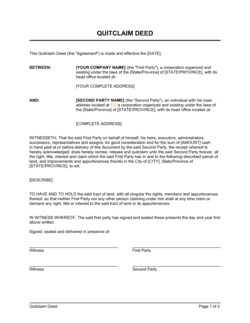
A quitclaim deed transfers whatever ownership interest a grantor holds in real property directly to the grantee — it moves title, not contractual position. An assignment of real estate contract transfers the buyer's equitable interest in a purchase agreement before closing; no title has yet been conveyed. A deed is used at or after closing; an assignment is used before.

Industry-specific considerations

Residential Real Estate

Wholesale investors contract residential properties below market value and assign the purchase agreement to fix-and-flip buyers or landlords before closing, earning a fee without taking title.

Commercial Real Estate

Developers assign pre-negotiated commercial purchase contracts to institutional buyers or joint venture partners when equity is sourced after the property is locked up.

Real Estate Development

Pre-construction condo and townhome assignments allow original purchasers to transfer their contracts to new buyers before the project completes, with the developer's consent typically required under the purchase agreement.

Property Investment and Private Equity

Portfolio investors use assignment agreements to transfer contracted single-family or multi-family assets between affiliated entities or to outside buyers as part of fund deployment or exit strategies.

Jurisdictional notes

United States

Assignment rights in real estate contracts are governed primarily by state law and the terms of the original purchase agreement. Several states — including California and Florida — have developed specific market practices around wholesale assignments. Some MLS associations in various states have adopted purchase agreement forms containing anti-assignment provisions. Always confirm assignment is permitted under the specific contract form used in the transaction's state. Certain states also require disclosure of the assignment and fee to all parties, and some municipalities have enacted wholesale disclosure or anti-assignment ordinances.

Canada

Assignment of pre-construction condominiums is a significant and regulated market in Ontario and British Columbia. Ontario introduced assignment disclosure requirements under the Condominium Act, and developers often include assignment restrictions or fees in purchase agreements. Quebec's civil law framework treats contract assignment differently from common law provinces — assignment generally requires the obligor's (seller's) consent to be effective against them. Assignors in Canada may be subject to HST/GST on the assignment fee, and CRA has audited wholesale assignment transactions for unreported income.

United Kingdom

In England and Wales, contracts for the sale of land are generally assignable unless the contract expressly prohibits it, but formal requirements under the Law of Property (Miscellaneous Provisions) Act 1989 require contracts for the disposition of land to be in writing and signed. Stamp Duty Land Tax (SDLT) implications arise on assignment — the assignee typically pays SDLT on the full purchase price, and the assignment fee itself may also attract SDLT in some circumstances. Scottish property law operates under a separate system where missives (the exchange of formal offer letters) form the binding contract and assignment practice differs from English law.

European Union

Real estate contract assignment rules vary significantly across EU member states, as real property law is not harmonized at the EU level. In many civil law jurisdictions — including France, Germany, Spain, and Italy — a seller's consent is typically required to assign a purchase obligation to a third party. Transfer taxes, notarial requirements, and registration obligations differ by country and can apply to the assignment transaction itself in addition to the underlying property transfer. GDPR considerations may arise when sharing party data with third-party assignees, particularly in commercial transactions involving personal data of natural persons.

Template vs lawyer — what fits your deal?

PathBest forCostTime
Use the templateExperienced wholesale investors assigning residential contracts in states where assignment is permitted and the original purchase agreement allows itFree20–30 minutes
Template + legal reviewInvestors new to assignment deals, higher-value properties, or transactions where the purchase agreement contains complex contingencies or anti-assignment language requiring a negotiated amendment$300–$8001–3 days
Custom draftedCommercial property assignments, multi-million dollar deals, cross-state transactions, pre-construction assignments with developer consent requirements, or deals involving entity-to-entity transfers with tax structuring implications$1,500–$5,000+1–2 weeks

Glossary

Assignor
The original buyer under the purchase agreement who transfers their contractual rights and obligations to the assignee.
Assignee
The new third-party buyer who steps into the assignor's position and assumes responsibility for completing the purchase.
Underlying Purchase Agreement
The original real estate purchase contract between the assignor and the seller that governs the terms of the property sale.
Assignment Fee
The compensation paid by the assignee to the assignor in exchange for the transfer of the purchase agreement rights — the assignor's profit in a wholesale transaction.
Equitable Interest
The beneficial ownership interest a buyer holds in a property from the moment a purchase agreement is signed, before legal title transfers at closing.
Anti-Assignment Clause
A provision in the original purchase agreement that restricts or prohibits the buyer from assigning the contract without the seller's prior written consent.
Novation
A legal substitution that replaces the original buyer with the assignee and releases the assignor from all further obligations — distinct from a standard assignment, which may retain assignor liability.
Double Close
An alternative to assignment where the investor purchases the property and immediately resells it in two back-to-back closings — used when assignment is restricted or when the investor wants to keep the profit margin private.
Earnest Money Deposit
A good-faith deposit paid by the original buyer under the purchase agreement, the fate of which must be addressed in the assignment — either retained by the assignor, credited to the assignee, or transferred.
Closing Date
The scheduled date on which the assignee must complete the purchase from the seller, as set in the original purchase agreement or as modified by written amendment.
Title Company
The neutral third party that coordinates the closing, searches the property title for defects or encumbrances, and disburses funds including the assignment fee.
Seller Consent
Written permission from the property seller acknowledging and approving the transfer of the purchase agreement to the assignee — required when the original contract contains an anti-assignment clause.

Part of your Business Operating System

This document is one of 3,000+ business & legal templates included in Business in a Box.

  • Fill-in-the-blanks — ready in minutes
  • 100% customizable Word document
  • Compatible with all office suites
  • Export to PDF and share electronically

Create your document in 3 simple steps.

From template to signed document — all inside one Business Operating System.
1
Download or open template

Access over 3,000+ business and legal templates for any business task, project or initiative.

2
Edit and fill in the blanks with AI

Customize your ready-made business document template and save it in the cloud.

3
Save, Share, Send, Sign

Share your files and folders with your team. Create a space of seamless collaboration.

Save time, save money, and create top-quality documents.

★★★★★

"Fantastic value! I'm not sure how I'd do without it. It's worth its weight in gold and paid back for itself many times."

Managing Director · Mall Farm
Robert Whalley
Managing Director, Mall Farm Proprietary Limited
★★★★★

"I have been using Business in a Box for years. It has been the most useful source of templates I have encountered. I recommend it to anyone."

Business Owner · 4+ years
Dr Michael John Freestone
Business Owner
★★★★★

"It has been a life saver so many times I have lost count. Business in a Box has saved me so much time and as you know, time is money."

Owner · Upstate Web
David G. Moore Jr.
Owner, Upstate Web

Run your business with a system — not scattered tools

Stop downloading documents. Start operating with clarity. Business in a Box gives you the Business Operating System used by over 250,000 companies worldwide to structure, run, and grow their business.

Start free · No credit card required