❌ Vague scope of work
Why it matters: Triggers scope creep, unpaid work, and disputes over what was promised.
Fix: Define deliverables, quantities, formats, revision rounds, and explicit exclusions in a dedicated exhibit.
Free Word download • Edit online • Save & share with Drive • Export to PDF
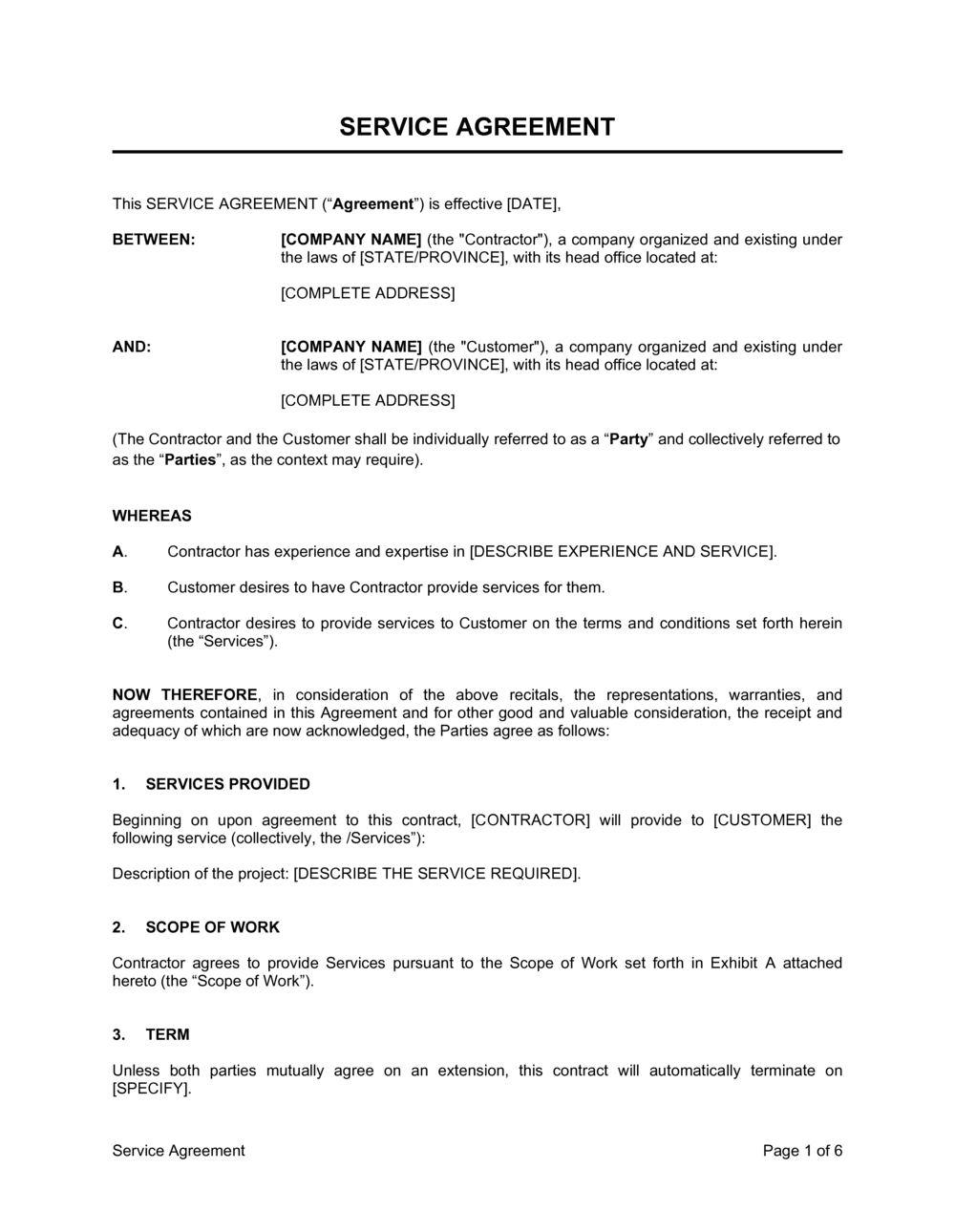
A Service Agreement is a legally binding contract between a Service Provider and a Client that governs a paid engagement. It defines what work will be performed, the fees and payment schedule, who owns the resulting work product, what each party must keep confidential, and the conditions under which either party can exit. Service agreements are the standard legal instrument for consulting, agency, IT implementation, coaching, and any other professional services engagement where a defined scope of work is exchanged for compensation.
Without a written Service Agreement, the commercial terms of an engagement exist only in emails, verbal conversations, and assumptions — none of which are reliably enforceable. The consequences are specific and costly: clients dispute scope and withhold payment; providers deliver work they never get paid for; IP ownership defaults to the creator rather than the buyer; and a single missed deliverable can trigger a claim with no liability cap to limit exposure. A properly structured Service Agreement converts every material assumption into an enforceable term, giving both the Provider and the Client a clear, shared record of what was agreed — before work begins.
| If your situation is… | Use this template |
|---|---|
| Short-term project with a fixed price and defined deliverables | Fixed-Price Service Agreement |
| Ongoing engagement billed by the hour or day | Time-and-Materials Service Agreement |
| Monthly retainer with a recurring scope of work | Retainer Agreement |
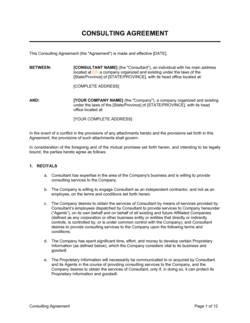
| One-time consulting project with a defined statement of work | Consulting Agreement |
| Software implementation or IT professional services | IT Services Agreement |
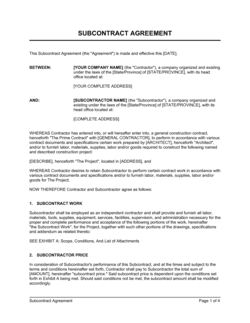
| Subcontracting services to another provider | Subcontractor Agreement |
| Master framework governing multiple future statements of work | Master Service Agreement (MSA) |
Why it matters: Triggers scope creep, unpaid work, and disputes over what was promised.
Fix: Define deliverables, quantities, formats, revision rounds, and explicit exclusions in a dedicated exhibit.
Why it matters: Without an explicit assignment clause, copyright law defaults ownership to the creator — usually the provider — not the client.
Fix: Include an assignment clause that transfers ownership on full payment, with a carve-out for pre-existing provider IP.
Why it matters: Leaves the provider exposed to claims that can dwarf the value of the engagement — a $5,000 project can generate a $500,000 claim.
Fix: Cap aggregate liability at fees paid in the prior 12 months and exclude consequential damages explicitly.
Why it matters: Out-of-scope requests absorb unbillable hours and erode margin without a formal mechanism to price and approve them.
Fix: Require a signed Change Order for any work not described in the original scope, executed before new work begins.
Why it matters: Removes financial incentive for the client to pay on time; overdue invoices average 22 days late without one.
Fix: Charge 1.5% per month on overdue balances and reserve the right to suspend services after 15 days past due.
Why it matters: Confidentiality obligations evaporate at contract end without explicit language, exposing sensitive information.
Fix: State that confidentiality, IP, and indemnification clauses survive termination for a defined period — typically 2–3 years.
In plain language: Identifies the service provider and client as legal entities and states when the agreement starts.
This Service Agreement ('Agreement') is entered into as of [DATE] by and between [PROVIDER LEGAL NAME], a [STATE/COUNTRY] [ENTITY TYPE] ('Provider'), and [CLIENT LEGAL NAME], a [STATE/COUNTRY] [ENTITY TYPE] ('Client').
Common mistake: Using a trade name or personal name instead of the registered legal entity. Courts may struggle to enforce the agreement against an unregistered name.
In plain language: Defines exactly what the provider will do — and, just as importantly, what is excluded.
Provider shall perform the services described in Exhibit A ('Services'). Any work not expressly included in Exhibit A is out of scope and requires a signed Change Order before Provider is obligated to perform it.
Common mistake: Writing a vague scope like 'marketing support' without specifying channels, output volume, or revision rounds — guaranteeing scope creep and disputes.
In plain language: States the total fee or rate, when invoices are due, accepted payment methods, and whether expenses are reimbursable.
Client shall pay Provider [AMOUNT] in accordance with the schedule in Exhibit B. Invoices are due Net [15/30] days from receipt. Late payments accrue interest at [1.5]% per month. Pre-approved out-of-pocket expenses are reimbursable within [30] days of submission.
Common mistake: Omitting a late-payment interest clause, which removes all financial incentive for the client to pay on time.
In plain language: Determines who owns the work product created during the engagement — client, provider, or a combination.
Upon receipt of full payment, Provider assigns to Client all right, title, and interest in deliverables created specifically for Client under this Agreement. Provider retains ownership of pre-existing tools, frameworks, and methodologies used to produce the deliverables.
Common mistake: Leaving IP ownership silent. Without an explicit assignment, the provider — not the client — owns the work product under copyright law in most jurisdictions.
In plain language: Restricts both parties from disclosing the other's proprietary information to third parties.
Each party agrees to hold the other's Confidential Information in strict confidence, use it only to perform obligations under this Agreement, and not disclose it to any third party without prior written consent. This obligation survives termination for three (3) years.
Common mistake: No survival clause. Once the agreement terminates, confidentiality obligations disappear without one.
In plain language: States what the provider guarantees about the quality of services and what it does not guarantee.
Provider warrants that it will perform services in a professional manner consistent with industry standards. EXCEPT AS EXPRESSLY STATED, PROVIDER DISCLAIMS ALL OTHER WARRANTIES, EXPRESS OR IMPLIED, INCLUDING WARRANTIES OF FITNESS FOR A PARTICULAR PURPOSE.
Common mistake: Omitting a disclaimer of implied warranties, exposing the provider to liability for outcomes entirely outside their control.
In plain language: Caps the maximum financial exposure for each party, typically at the fees paid under the agreement.
In no event shall either party's aggregate liability exceed the total fees paid or payable by Client to Provider in the [twelve (12)] months preceding the claim. Neither party shall be liable for indirect, incidental, consequential, or punitive damages.
Common mistake: Capping liability at a single month's fees on a multi-year engagement, leaving the provider exposed to claims that far exceed any reasonable expectation.
In plain language: Sets the agreement's duration, how it renews, and the grounds and notice required to end it early.
This Agreement commences on the Effective Date and continues until completion of the Services, unless earlier terminated. Either party may terminate for material breach uncured within [30] days of written notice. Client may terminate for convenience on [30] days' written notice, subject to payment for all work completed through the termination date.
Common mistake: No termination-for-convenience right for the client — creating friction when business needs change and the client needs to exit cleanly.
In plain language: Specifies which jurisdiction's law applies and how disputes are handled — litigation, mediation, or arbitration.
This Agreement is governed by the laws of [STATE / COUNTRY]. Any dispute not resolved by good-faith negotiation within [30] days shall be submitted to binding arbitration administered by [AAA / JAMS] in [CITY].
Common mistake: Defaulting to litigation with no attempt at a negotiation or mediation step first, which turns minor billing disputes into expensive court proceedings.
Pull the full registered names and entity types for both Provider and Client from corporate registry records — not websites or business cards.
💡 A contract signed in the wrong name is the most common reason enforcement becomes complicated.
List every task, deliverable, format, quantity, and revision round included. Then add an explicit exclusions paragraph.
💡 Spend 80% of your drafting time here. Vague scope is the root cause of nearly every service dispute.
Enter the total fee or hourly/daily rate, invoice milestones, due dates, and the late-payment interest rate.
💡 Net 15 is increasingly standard for independent providers; Net 30 is typical for larger B2B engagements.
Decide whether the client gets full assignment, a license only, or whether background IP stays with the provider. Fill in the IP clause accordingly.
💡 Providers should always carve out pre-existing tools, templates, and methods — these are your reusable assets.
Set the initial term, renewal mechanism, and notice periods for both for-cause and for-convenience termination.
💡 Always include a payment-through-termination-date clause so you are compensated for work already performed.
Enter the cap amount — typically 12 months of fees paid — and confirm the consequential-damages exclusion.
💡 Check any client-issued terms; procurement teams often try to remove or raise this cap.
Have authorized representatives of both parties sign. Store the executed agreement where both parties can retrieve it quickly.
💡 Use Business in a Box eSign for electronic signing and BIB Drive for secure storage.
A Service Agreement is a legally binding contract between a service provider and a client that defines the services to be performed, fees, deliverables, IP ownership, confidentiality obligations, and termination rights. It establishes the commercial and legal framework for a paid engagement, replacing informal understandings with enforceable terms that protect both parties.
At minimum: parties and effective date, scope of services with explicit exclusions, fees and payment schedule, IP ownership, confidentiality, warranties, limitation of liability, term, termination rights, and governing law. Complex engagements add change-order procedures, acceptance criteria, expense reimbursement rules, and subcontracting restrictions.
Any individual or business that provides or purchases services for compensation. Consultants, agencies, developers, designers, coaches, accountants, and IT firms all need one. If money changes hands for a service and nothing is in writing, both parties face avoidable financial and legal risk.
Yes, provided it meets the four elements of a valid contract: offer, acceptance, consideration (payment in exchange for services), and mutual intent to be bound. Both parties must sign. Courts in the US, Canada, UK, EU, and Australia routinely enforce well-drafted service agreements, including electronic signatures under applicable e-signature laws.
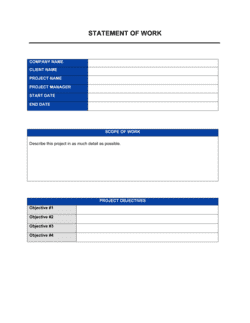
A Service Agreement sets the overarching legal and commercial terms — liability, IP, confidentiality, governing law. A Statement of Work (SOW) is a project-specific exhibit attached to that agreement describing scope, deliverables, timeline, and price for a particular engagement. For ongoing relationships, a Master Service Agreement plus per-project SOWs is more efficient than re-signing full contracts each time.
The terms are functionally interchangeable in most jurisdictions. "Contract for Services" is the traditional legal term distinguishing an independent contractor relationship from an employment contract ("Contract of Service"). Structurally, they cover the same ground. The label matters less than the substance — ensure the agreement reflects an independent contractor relationship if that is the intent.
For standard domestic engagements under $50,000, a well-structured template is sufficient for most providers. Engage a lawyer when the deal involves proprietary technology, cross-border regulatory obligations, custom IP arrangements, or fees above $100,000. A 1–2 hour attorney review typically costs $300–$800 and is worthwhile for high-value or high-risk engagements.
Project-based agreements run for the duration of the project — commonly 30 days to 12 months. Retainer-based agreements typically run 6–12 months with monthly auto-renewal. Include a 30-day termination-for-convenience right so either party can exit cleanly when circumstances change without waiting for a breach to occur.
Without a change-order clause, the provider faces an uncomfortable choice: do the work unpaid or risk the relationship by refusing. A properly drafted Change Order clause requires any out-of-scope request to be priced, agreed in writing, and signed before new work begins — protecting margin and preventing disputes over what was promised.
Copyright law defaults ownership to the creator — the provider — unless the agreement contains an explicit written assignment to the client. A Work for Hire designation or an assignment clause triggered on full payment transfers ownership to the client. Providers should always carve out pre-existing IP, tools, and frameworks they bring to the engagement.
An MSA sets the permanent legal framework — liability, IP, confidentiality, governing law — once, then project-specific Statements of Work attach for each engagement. A standalone Service Agreement combines both layers into one document. MSAs are more efficient for ongoing multi-project relationships; standalone agreements suit one-off engagements.
A Consulting Agreement is a narrower variant of a Service Agreement tailored to advisory and strategic engagements — it often emphasizes deliverable-free advice, knowledge transfer, and access to the consultant's expertise rather than discrete outputs. The core legal architecture is identical.
An Independent Contractor Agreement focuses on classification — affirming non-employee status, tax responsibility, and control over work methods. A Service Agreement focuses on the commercial terms of a specific engagement. In practice, complex arrangements use both: the contractor agreement governs the relationship, the service agreement governs each project.
An employment contract governs a continuing subordinate relationship — the employer controls when, where, and how work is done. A Service Agreement governs an independent commercial relationship. Misclassifying an employment relationship as a service agreement exposes the hiring party to back taxes, penalties, and benefits claims.
Engagement scope, billing rates, expense policies, non-solicitation of client employees.
Revision rounds, deliverable formats, usage rights for creative assets, campaign performance disclaimers.
Acceptance criteria, source code ownership, bug-fix warranties, third-party library licenses.
Regulatory compliance obligations, liability caps aligned with professional indemnity coverage, client data security requirements.
HIPAA / GDPR data handling, scope-of-practice disclaimers, insurance verification requirements.
Curriculum ownership, session cancellation and rescheduling policy, participant minimum requirements.
Governed by state contract law; no single federal statute. IP assignment must be in writing under the Copyright Act to transfer ownership. Worker misclassification tests vary by state — California's ABC test is the strictest. Limitation-of-liability and consequential-damage exclusions are broadly enforceable in commercial B2B contexts.
Common law applies in nine provinces; Quebec follows civil law under the Civil Code of Quebec. IP assignments require written confirmation under the Copyright Act. PIPEDA and provincial privacy laws govern client data handling. Quebec contracts must address French language requirements under the Charter of the French Language.
Governed by the Supply of Goods and Services Act 1982, which implies a reasonable-skill-and-care standard even without an express warranty clause. Unfair Contract Terms Act 1977 restricts liability exclusions in consumer and some B2B contexts. IR35 rules may reclassify contractor engagements as employment for tax purposes.
GDPR imposes strict obligations when personal data is processed during service delivery — a Data Processing Agreement is typically required alongside the Service Agreement. IP assignment formalities vary by member state. Posted Worker Directive may apply when staff are deployed cross-border within the EU.
| Path | Best for | Cost | Time |
|---|---|---|---|
| Use the template | Domestic engagements under $50,000 with standard scope and no regulated IP | Free | 20 minutes |
| Template + legal review | Engagements above $50,000, custom IP arrangements, or light cross-border work | $300–$800 | 1–3 days |
| Custom drafted | High-value contracts, regulated industries, proprietary technology, or international clients | $1,500–$8,000+ | 1–3 weeks |
This document is one of 3,000+ business & legal templates included in Business in a Box.

Access over 3,000+ business and legal templates for any business task, project or initiative.

Customize your ready-made business document template and save it in the cloud.

Share your files and folders with your team. Create a space of seamless collaboration.
"Fantastic value! I'm not sure how I'd do without it. It's worth its weight in gold and paid back for itself many times."
"I have been using Business in a Box for years. It has been the most useful source of templates I have encountered. I recommend it to anyone."
"It has been a life saver so many times I have lost count. Business in a Box has saved me so much time and as you know, time is money."
Stop downloading documents. Start operating with clarity. Business in a Box gives you the Business Operating System used by over 250,000 companies worldwide to structure, run, and grow their business.
Start free · No credit card required