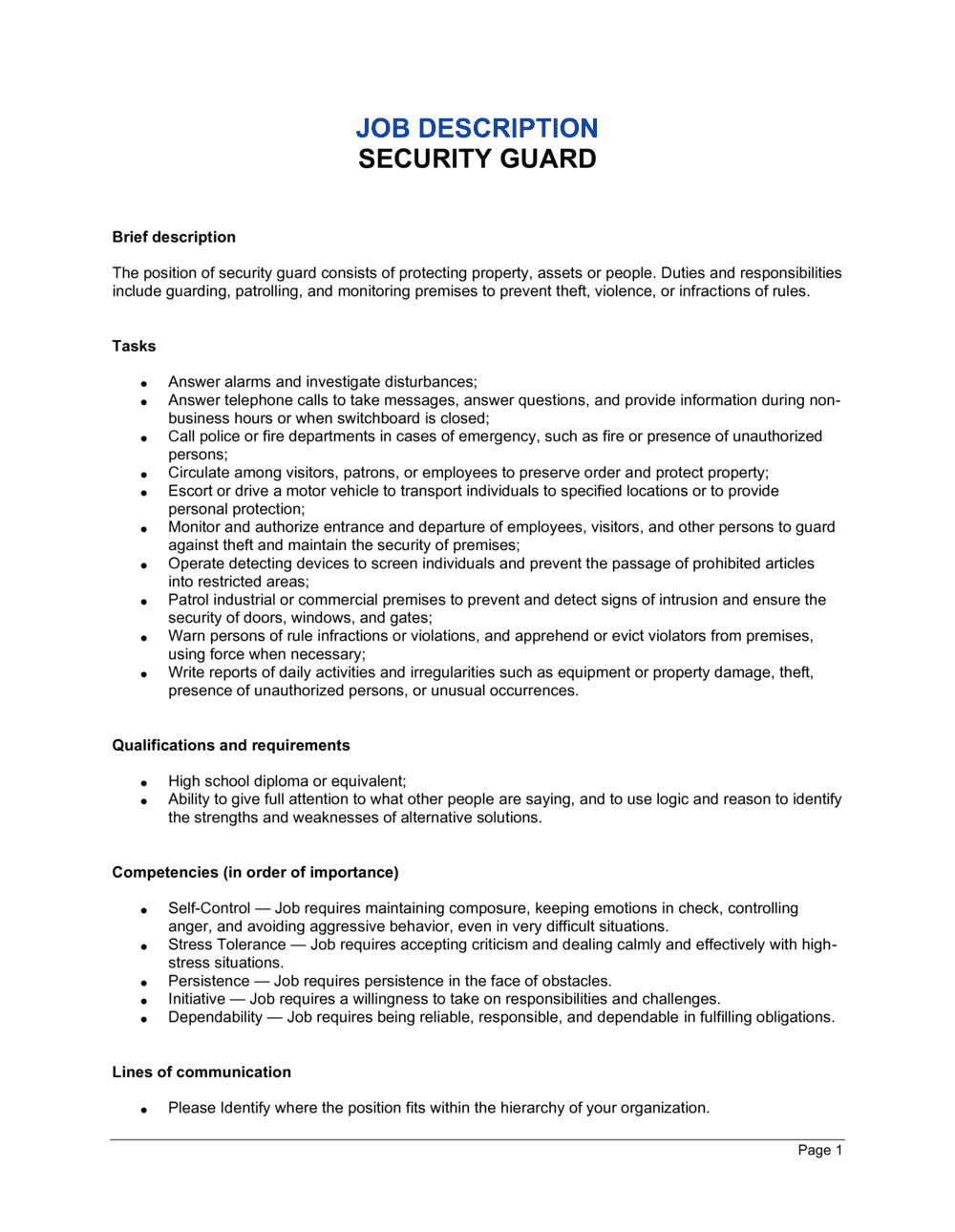
Security Guard Job Description Template

Free Word download • Edit online • Save & share with Drive • Export to PDF

2 pages20–30 min to fillDifficulty: StandardSignature requiredLegal review recommended
Learn more ↓
FreeSecurity Guard Job Description Template

At a glance

What it is
A Security Guard Job Description is a formal binding document that defines the scope of duties, licensing requirements, physical standards, reporting structure, and performance expectations for a security guard role. This free Word download gives employers, security firms, and HR teams a structured, legally defensible starting point they can edit online and export as PDF for use in hiring, onboarding, and performance management.
When you need it
Use it when posting a security guard vacancy, onboarding a new officer, or standardizing role expectations across a security team. It is also required documentation when defending a termination decision or responding to a workplace incident claim tied to scope-of-duty questions.
What's inside
Position summary, core duties and patrol responsibilities, licensing and certification requirements, physical and fitness standards, reporting structure, equipment and uniform requirements, performance expectations, and acknowledgment signature block for the hired officer.

What is a Security Guard Job Description?

A Security Guard Job Description is a formal document that defines the specific duties, licensing requirements, physical standards, conduct expectations, and reporting obligations of a security officer position. It establishes the scope of the role — determining what the officer is authorized and expected to do — and serves as the governing reference for hiring, onboarding, performance management, and, when needed, disciplinary action. Beyond HR functions, a well-drafted job description is a legal instrument: under the doctrine of respondeat superior, an employer is liable for the acts of an employee performed within the scope of their employment, making a precisely defined scope both a management tool and a liability boundary.

Why You Need This Document

Without a written security guard job description, you have no documented standard against which to measure performance, no defined scope to limit employer liability during an incident, and no licensing checklist to confirm a guard is legally authorized to work their post. Deploying a security guard without confirmed credentials is a regulatory violation in most US states and Canadian provinces — resulting in fines, license suspension, and civil exposure if an incident occurs. Vague or absent duty descriptions make disciplinary decisions legally indefensible and give opposing counsel an open field in negligent-hiring and inadequate-supervision claims. This template closes those gaps in under an hour, giving you a signed, site-specific document that protects your organization, sets clear expectations for your security staff, and satisfies the documentation requirements that regulators and insurers increasingly demand before coverage applies.

Which variant fits your situation?

If your situation is…Use this template
Hiring an armed security officer with firearm authorizationArmed Security Guard Job Description
Staffing a front-desk or lobby security postReceptionist Security Officer Job Description
Deploying a mobile patrol officer across multiple sitesMobile Patrol Security Guard Job Description
Contracting an external security firm rather than hiring directlySecurity Services Agreement
Hiring a loss prevention specialist for a retail environmentLoss Prevention Officer Job Description
Setting expectations for a supervisory or senior guard roleSecurity Supervisor Job Description
Onboarding a security guard with a full employment contractEmployment Contract

Common mistakes to avoid

❌ Vague duty descriptions that cannot support performance management

Why it matters: A description that says 'monitor premises' provides no measurable standard — making it legally difficult to discipline or terminate an officer who fails to perform, and creating scope ambiguity in negligent-supervision claims.

Fix: Replace every abstract duty with a specific, observable task: 'Conduct a perimeter foot patrol every 2 hours, recording the check-in time at each checkpoint in the shift log.'

❌ Omitting required licensing details

Why it matters: Deploying a guard without confirming the required state license is a regulatory violation in most US states and Canadian provinces — exposing the employer to fines, license suspension, and civil liability if an incident occurs.

Fix: List every required credential by official name and verify it against the current licensing authority requirements before each hire.

❌ No reference to the Use-of-Force Policy

Why it matters: A job description that authorizes a guard to 'respond to threats' without defining force limits creates an open-ended duty to act with no upper boundary — the employer bears full liability for any excessive-force incident.

Fix: Cross-reference your Use-of-Force Policy by name and attach it as a supplement, requiring the guard to sign acknowledgment of both documents simultaneously.

❌ Missing the ADA accommodation statement in physical requirements

Why it matters: Physical requirements without a reasonable-accommodation clause signal non-compliance with the ADA (US) and equivalent legislation in Canada, the UK, and the EU — attracting regulatory complaints from rejected applicants.

Fix: Add the standard reasonable-accommodation statement immediately after the physical requirements list: 'Reasonable accommodations will be considered in accordance with applicable law.'

❌ Using a personal name instead of a title in the reporting structure

Why it matters: When the named supervisor leaves or is promoted, the job description becomes inaccurate — requiring amendment or creating confusion about who the guard actually reports to during incidents.

Fix: Always use job titles (e.g., 'Security Shift Supervisor') rather than personal names in the reporting and escalation sections.

❌ Treating the signed job description as the employment contract

Why it matters: A job description that includes salary, start date, and a signature block can be construed as a binding employment contract — limiting the employer's ability to modify terms or terminate at will.

Fix: Include an explicit disclaimer: 'This job description does not constitute a contract of employment and is subject to change.' Issue a separate offer letter or employment agreement for contractual terms.

The 9 key clauses, explained

Position summary and classification

In plain language: States the job title, employment classification (full-time, part-time, contract), pay grade, and the primary purpose of the role in one to three sentences.

Sample language
The Security Guard is a [FULL-TIME / PART-TIME] non-exempt position reporting to the [SECURITY SUPERVISOR / FACILITIES MANAGER] at [LOCATION NAME]. The primary purpose of this role is to protect [EMPLOYER NAME]'s personnel, property, and assets by maintaining a safe and secure environment.

Common mistake: Omitting the FLSA classification (exempt vs. non-exempt). Misclassifying a security guard as exempt from overtime — when the role is hourly with no supervisory authority — creates wage-and-hour liability.

Core duties and patrol responsibilities

In plain language: Lists the specific recurring tasks the officer is expected to perform — patrols, access checks, alarm response, incident reporting, and visitor management.

Sample language
Conduct foot and vehicle patrols of [PROPERTY DESCRIPTION] on a schedule determined by [SUPERVISOR TITLE]; monitor all entry and exit points; verify credentials of all visitors against the approved access list; respond to alarms within [X] minutes; prepare written incident reports for all security events within [X] hours of occurrence.

Common mistake: Using vague language like 'maintain security.' Specific, enumerated duties define the scope of employment and are cited in negligent-hiring and respondeat superior claims — vague descriptions undermine both your defense and your ability to manage performance.

Licensing, certification, and training requirements

In plain language: States the mandatory pre-employment licenses (guard card, firearms permit, first-aid certification) and any employer-provided training requirements.

Sample language
Candidate must hold a valid [STATE] Security Guard License / Guard Card at the time of hire. [ARMED POSITIONS: Candidate must also hold a valid [STATE] Exposed Firearms Permit.] CPR and First Aid certification required within [30] days of hire. [EMPLOYER NAME] will provide [X] hours of site-specific post-order training prior to solo deployment.

Common mistake: Failing to specify which licenses are required before hire versus which the employer will sponsor post-hire. This ambiguity delays onboarding and creates compliance gaps when a guard is deployed without the required credentials.

Physical requirements and fitness standards

In plain language: Defines the physical demands of the role — standing hours, lifting capacity, vision and hearing standards — which are legally relevant for ADA accommodation analysis.

Sample language
This role requires the ability to stand and walk for up to [8] consecutive hours; lift and carry objects weighing up to [50] lbs; have correctable vision to at least 20/40 in each eye; and hear verbal instructions clearly in a noisy environment. Reasonable accommodations will be considered in accordance with applicable law.

Common mistake: Listing physical requirements that exceed what the role genuinely demands, or omitting the ADA reasonable accommodation statement. Overstated requirements expose the employer to disability discrimination claims; omitting the accommodation language signals non-compliance.

Reporting structure and communication protocols

In plain language: Identifies who the officer reports to, how shift handovers are conducted, and how and when incidents must be escalated to supervisors or law enforcement.

Sample language
The Security Guard reports directly to [SECURITY SUPERVISOR / SHIFT LEAD]. All incidents classified as [LEVEL 2 OR ABOVE per the Post Orders] must be verbally reported to the on-duty supervisor within [15] minutes and documented in writing within [2] hours. Emergencies requiring police, fire, or medical response must be escalated to 911 before notifying internal supervision.

Common mistake: No defined escalation threshold. Without a clear classification of what triggers supervisor notification versus direct emergency response, officers hesitate during incidents — increasing liability and response time.

Equipment, uniform, and appearance standards

In plain language: Specifies what equipment the officer is issued or required to maintain, and the uniform and personal appearance standards for the post.

Sample language
[EMPLOYER NAME] will issue: [UNIFORM ITEMS], [RADIO / COMMUNICATIONS DEVICE], [FLASHLIGHT], and [BATON / EQUIPMENT LIST IF APPLICABLE]. The officer is responsible for maintaining issued equipment in serviceable condition. The uniform must be worn at all times during the shift; [EMPLOYER NAME]'s personal appearance policy applies.

Common mistake: Not specifying who bears the cost of uniform replacement. If the contract is silent and uniforms are required, courts in several jurisdictions have found that employer-mandated uniform costs reducing pay below minimum wage constitute a wage violation.

Behavioral and conduct standards

In plain language: Sets expectations for professionalism, prohibited conduct (sleeping on post, use of personal devices, unauthorized disclosure), and zero-tolerance offenses.

Sample language
Officers must remain alert and professional throughout the shift. Prohibited conduct includes: sleeping on post; use of personal mobile devices except during authorized breaks; disclosure of post orders, client information, or security protocols to unauthorized persons; and use of force beyond that authorized by [EMPLOYER NAME]'s Use-of-Force Policy.

Common mistake: Omitting a reference to the employer's Use-of-Force Policy. Without this link, the job description creates a duty to act but provides no standard — leaving the employer exposed if an officer uses excessive or insufficient force.

Performance evaluation and documentation standards

In plain language: Describes how performance will be measured, the frequency of formal reviews, and the documentation the officer is expected to maintain.

Sample language
Performance will be evaluated [QUARTERLY / SEMI-ANNUALLY] against the criteria set out in [EMPLOYER NAME]'s Security Officer Performance Standards. Officers are expected to maintain complete, accurate, and contemporaneous log entries and incident reports throughout each shift. Incomplete or falsified documentation is grounds for immediate termination.

Common mistake: No mention of documentation standards. Incident reports written hours or days after the fact are routinely challenged in litigation — specifying contemporaneous documentation requirements establishes both a performance standard and an evidentiary foundation.

At-will statement and acknowledgment

In plain language: Confirms the nature of the employment relationship (at-will or otherwise), states that the job description does not constitute a contract, and provides a signature block for the officer to acknowledge receipt.

Sample language
This job description is provided for informational purposes and does not constitute a contract of employment. Employment with [EMPLOYER NAME] is [at-will and] subject to the terms of the applicable offer letter and employment agreement. By signing below, the employee confirms they have received, read, and understood this job description. Employee Signature: _______________ Date: _______________

Common mistake: Using the job description as a standalone employment contract without a separate offer letter or employment agreement. A signed job description that includes salary and start date can inadvertently create contractual obligations the employer did not intend.

How to fill it out

  1. 1

    Complete the position summary block

    Enter the official job title, employment type (full-time, part-time, contract), FLSA classification, pay grade or range, work location, and the primary reporting relationship.

    💡 Confirm the FLSA overtime classification with your HR advisor before publishing — security guards are almost always non-exempt hourly workers, not salaried-exempt.

  2. 2

    List core duties with specific, measurable language

    Replace every generic phrase like 'maintain security' with a concrete task: patrol frequency, documentation turnaround time, and response thresholds. Each duty should be specific enough to support a performance improvement plan if needed.

    💡 Aim for 8–12 enumerated duties. Fewer than 6 is too vague for legal defensibility; more than 15 makes the document unwieldy and reduces enforceability of each individual standard.

  3. 3

    Specify all required licenses and certifications

    Enter the exact license name, issuing authority, and whether it is required before hire or within a defined period post-hire. Include both unarmed guard credentials and any armed or specialized certifications relevant to the post.

    💡 Cross-reference your state's security guard licensing authority website to confirm current minimum training-hour requirements before finalizing this section — requirements change with legislation.

  4. 4

    Define physical requirements accurately

    List only the physical demands the role genuinely imposes — sustained standing and walking, lifting, vision, and hearing. Include the ADA reasonable accommodation statement verbatim from the template.

    💡 Have your facilities or operations team walk the post and time the patrol route before writing this section — guessing at physical demands creates both legal risk and unrealistic hiring expectations.

  5. 5

    Set the reporting structure and escalation thresholds

    Name the direct supervisor title (not a personal name), define the incident classification tiers that trigger escalation, and specify the time limits for verbal and written reporting.

    💡 Use the same incident classification terminology here as in your Post Orders and Use-of-Force Policy — inconsistent language between documents creates gaps that opposing counsel will exploit.

  6. 6

    Add uniform, equipment, and conduct standards

    List every item the employer issues and every item the guard must supply. State clearly who is responsible for replacement costs and what uniform deductions — if any — will be made from pay.

    💡 If your jurisdiction requires employee authorization for payroll deductions, include a separate written authorization form — a reference in the job description alone is insufficient in several states and provinces.

  7. 7

    Insert the at-will statement and signature block

    Confirm whether employment is at-will or notice-based (based on jurisdiction), state that the document does not constitute a contract, and include printed name, signature, and date lines for both the employee and a company representative.

    💡 Collect the signed acknowledgment before the guard's first day on post — a signature obtained after deployment lacks the consideration required to make it enforceable in common-law jurisdictions.

Frequently asked questions

What is a security guard job description?

A security guard job description is a formal document that defines the duties, qualifications, physical standards, licensing requirements, and behavioral expectations for a security officer role. It serves as the authoritative reference for hiring decisions, performance management, and — critically — establishing the scope of the officer's employment for legal and liability purposes. A well-drafted description protects the employer in negligent-hiring and respondeat superior claims.

What duties should be listed in a security guard job description?

Core duties typically include: conducting scheduled foot or vehicle patrols, monitoring CCTV and access-control systems, verifying visitor credentials, responding to alarms, preparing contemporaneous incident reports, enforcing trespassing and access policies, and escalating emergencies to law enforcement. Specific duties vary by site type — a healthcare facility emphasizes de-escalation and patient safety, while a retail post focuses on loss prevention and floor surveillance.

Does a security guard job description need to be signed?

A signed acknowledgment is strongly recommended and, in many contexts, functionally required. A signature confirms the guard has received, read, and understood the duties, conduct standards, and policies referenced in the document. In disciplinary or termination proceedings, a signed job description is evidence that the officer was on notice of the standard they failed to meet. Collect the signature before the first day on post — post-start signatures raise enforceability questions in common-law jurisdictions.

What licenses does a security guard need?

Licensing requirements vary by jurisdiction. In most US states, security guards must hold a state-issued guard card, requiring a background check and a minimum number of training hours — typically 8 to 40 hours depending on the state. Armed guards require an additional firearms permit. California mandates BSIS registration; Texas requires a commissioned or non-commissioned officer license. In Canada, provinces such as Ontario require a Security Guard License under the Private Security and Investigative Services Act. The UK requires an SIA Door Supervisor or Security Guard licence. Confirm current requirements with the applicable regulatory authority before hiring.

What is the difference between a security guard job description and a security services agreement?

A job description defines the duties, qualifications, and expectations for an employee or contracted individual filling a security guard role. A security services agreement is a commercial contract between a business and an external security firm that governs scope of services, liability, insurance, payment, and termination at the organizational level. The job description operates at the individual level; the services agreement operates at the vendor relationship level. Both documents are needed when engaging a security firm — the agreement governs the contract, and the job description governs the individual post.

Can I use one job description for armed and unarmed security guards?

No. Armed and unarmed guard roles carry fundamentally different legal obligations, training requirements, licensing, and use-of-force standards. Using a single description for both roles creates ambiguity about the officer's authority and the employer's liability exposure. Maintain separate job descriptions for each classification, with the armed version explicitly referencing the applicable firearms permit requirements and a jurisdiction-specific use-of-force policy.

How often should a security guard job description be updated?

Review and update the job description whenever the role's duties change materially — such as when a new CCTV system is installed, a site expands, or post-order protocols are revised. A full review should also occur annually and after any significant security incident to confirm that the documented duties reflect actual practice. Outdated job descriptions can be used against employers in litigation to argue that formal duties and actual conduct diverged.

What physical requirements can legally be included?

Physical requirements must reflect the genuine demands of the specific post — sustained walking and standing, lifting capacity for specific tasks, and any sensory requirements tied to surveillance duties. Requirements that exceed the actual demands of the role, or that disproportionately screen out candidates with disabilities without justification, can constitute unlawful discrimination under the ADA (US), the Canadian Human Rights Act, the UK Equality Act 2010, and equivalent EU legislation. Always pair physical requirements with a reasonable-accommodation statement.

Does a security guard job description protect the employer from liability?

A well-drafted job description is a meaningful — but not absolute — liability tool. It establishes the scope of the officer's authorized duties (relevant to respondeat superior claims), provides notice of conduct and use-of-force standards (relevant to negligent-supervision claims), and creates a documented basis for termination decisions. However, a job description alone does not replace a Use-of-Force Policy, Post Orders, or a signed Employment Contract. All four documents work together to build a defensible employer record.

How this compares to alternatives

vs Security Services Agreement

A security services agreement is a commercial contract between a client organization and a security firm governing scope, pricing, insurance, and liability at the vendor level. A security guard job description defines the individual officer's duties, qualifications, and conduct standards. Both documents are needed when engaging a third-party security firm — the services agreement governs the commercial relationship; the job description governs each deployed officer.

vs Employment Contract

An employment contract governs the legal terms of the working relationship — compensation, benefits, IP, non-compete, and termination. A job description defines role-specific duties and expectations. Job descriptions are incorporated by reference into employment contracts but do not replace them. Relying solely on a job description leaves the employer without enforceable restrictive covenants or termination provisions.

vs Non-Disclosure Agreement

An NDA specifically protects confidential information — client identities, security protocols, site layouts, and access codes — from unauthorized disclosure by the officer during and after employment. A job description references confidentiality obligations but cannot enforce them on its own. Security roles with access to sensitive site information should pair the job description with a standalone NDA for enforceable post-employment protection.

vs Independent Contractor Agreement

An independent contractor agreement engages a self-employed security professional for a defined scope of work without employment entitlements. A job description is an employment document — using a job-description format with a contractor creates misclassification risk, as courts look at behavioral control and integration to determine worker status. Security firms that direct daily conduct, set schedules, and provide equipment face significant contractor-reclassification exposure.

Industry-specific considerations

Retail and loss prevention

Emphasis on floor surveillance, shoplifting deterrence protocols, POS area monitoring, and coordination with law enforcement on apprehension procedures.

Healthcare and hospitals

De-escalation of agitated patients or visitors, HIPAA-compliant incident documentation, code-of-conduct enforcement in clinical areas, and coordination with nursing staff.

Construction and industrial sites

Perimeter access control, vehicle and materials logging, after-hours patrol of high-value equipment, and enforcement of site-specific health and safety protocols.

Events and venues

Crowd management, prohibited-items screening, alcohol incident response, emergency evacuation procedures, and coordination with local law enforcement at large gatherings.

Jurisdictional notes

United States

Licensing requirements vary significantly by state — California (BSIS), Texas (DPS), and New York (DCJS) each operate distinct licensing regimes with different training-hour minimums. Armed guard permits require separate state firearms authorizations. The FLSA classifies most security guards as non-exempt hourly workers entitled to overtime. Physical requirements must comply with the ADA, and pre-employment background check procedures are subject to FCRA and applicable state ban-the-box laws.

Canada

Security guards must hold a provincial license — Ontario requires registration under the Private Security and Investigative Services Act (PSISA), with mandatory training and background checks. Quebec employers must comply with the Act respecting private security and provide French-language documentation for provincially regulated roles. Physical demands must accommodate workers under the Canadian Human Rights Act. Armed guard provisions are governed by federal firearms legislation with strict PAL requirements.

United Kingdom

Security guards providing manned guarding services must hold a valid Security Industry Authority (SIA) licence — either a Door Supervisor or Security Guard licence depending on the role. Employers must verify SIA licence status before deployment under the Private Security Industry Act 2001. Physical requirements must comply with the Equality Act 2010. Employers must provide a written statement of employment particulars on or before the first day, incorporating key job description terms.

European Union

Security regulation varies by member state — Germany, France, and Spain each have national licensing regimes with different training and registration requirements. The EU Transparent and Predictable Working Conditions Directive requires written terms within 7 days of hire. GDPR applies to incident reports and CCTV monitoring logs, requiring appropriate data retention and access policies. Physical requirements must comply with the Employment Equality Directive's disability protections.

Template vs lawyer — what fits your deal?

PathBest forCostTime
Use the templateSmall businesses, property managers, and security firms hiring unarmed guards for standard commercial postsFree30–60 minutes
Template + legal reviewArmed security roles, healthcare or government facilities, multi-site deployments, or jurisdictions with complex licensing requirements$300–$600 (employment lawyer review)2–5 business days
Custom draftedLarge security firms managing dozens of posts, highly regulated environments (airports, nuclear facilities, financial institutions), or cross-border deployments$1,000–$3,500+1–3 weeks

Glossary

Post Orders
Written site-specific instructions that tell a security officer exactly what to do, when, and how at a particular assignment location.
Use-of-Force Policy
A documented framework defining the circumstances under which a security officer may apply physical force and the escalation steps required before doing so.
Scope of Duty
The defined boundaries of a security officer's authority and responsibilities — determining what actions they are authorized and expected to take.
BSIS (Bureau of Security and Investigative Services)
The California state agency that licenses and regulates security guards and private patrol operators in California.
Unarmed vs. Armed Guard
An unarmed guard monitors and reports without a weapon; an armed guard carries a licensed firearm and requires additional state-specific permits and training.
Incident Report
A contemporaneous written record documenting a security event — including time, location, parties involved, actions taken, and outcome.
Access Control
Procedures and systems used to manage who is permitted to enter or exit a specific area, including badge checks, visitor logs, and surveillance monitoring.
De-escalation
Techniques used by a security officer to reduce tension or conflict verbally and non-physically before the situation requires force or police intervention.
Respondeat Superior
A legal doctrine holding an employer liable for the negligent acts of an employee performed within the scope of their employment — making accurate job descriptions critical to defining that scope.
Guard Card
A state-issued license — required in most US states — that certifies a security guard has completed minimum training hours and passed a background check.
CCTV Monitoring
The ongoing review of closed-circuit television feeds to detect, record, and respond to suspicious activity or security breaches.

Part of your Business Operating System

This document is one of 3,000+ business & legal templates included in Business in a Box.

  • Fill-in-the-blanks — ready in minutes
  • 100% customizable Word document
  • Compatible with all office suites
  • Export to PDF and share electronically

Create your document in 3 simple steps.

From template to signed document — all inside one Business Operating System.
1
Download or open template

Access over 3,000+ business and legal templates for any business task, project or initiative.

2
Edit and fill in the blanks with AI

Customize your ready-made business document template and save it in the cloud.

3
Save, Share, Send, Sign

Share your files and folders with your team. Create a space of seamless collaboration.

Save time, save money, and create top-quality documents.

★★★★★

"Fantastic value! I'm not sure how I'd do without it. It's worth its weight in gold and paid back for itself many times."

Managing Director · Mall Farm
Robert Whalley
Managing Director, Mall Farm Proprietary Limited
★★★★★

"I have been using Business in a Box for years. It has been the most useful source of templates I have encountered. I recommend it to anyone."

Business Owner · 4+ years
Dr Michael John Freestone
Business Owner
★★★★★

"It has been a life saver so many times I have lost count. Business in a Box has saved me so much time and as you know, time is money."

Owner · Upstate Web
David G. Moore Jr.
Owner, Upstate Web

Run your business with a system — not scattered tools

Stop downloading documents. Start operating with clarity. Business in a Box gives you the Business Operating System used by over 250,000 companies worldwide to structure, run, and grow their business.

Free Forever Plan · No credit card required