Demand to Pay Promissory Note Template

Free Word download β€’ Edit online β€’ Save & share with Drive β€’ Export to PDF

1 pageβ€’20–30 min to fillβ€’Difficulty: Standardβ€’Signature requiredβ€’Legal review recommended
Learn more ↓
FreeDemand to Pay Promissory Note Template

At a glance

What it is
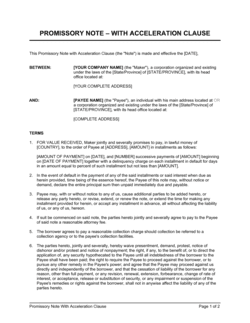
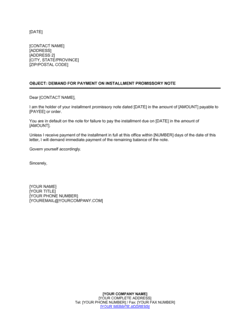
A Demand To Pay Promissory Note is a legally binding written promise by a borrower to repay a specified principal amount β€” plus any agreed interest β€” to a lender immediately upon the lender's written demand, with no fixed repayment schedule. This free Word download gives you a professionally drafted note you can edit online, sign, and export as PDF in under 30 minutes.
When you need it
Use it whenever you are lending money to a person or business and want full flexibility to call the loan at any time β€” such as short-term business loans between related entities, shareholder loans, or informal personal loans that need legal documentation.
What's inside
Borrower and lender identification, principal amount, interest rate and accrual method, demand and repayment mechanics, default provisions, acceleration, governing law, and signature block.

What is a Demand To Pay Promissory Note?

A Demand To Pay Promissory Note is a legally binding written instrument in which a borrower (the maker) unconditionally promises to repay a stated principal amount β€” plus any accrued interest β€” to the lender (the payee) immediately upon written demand, without any fixed repayment schedule or maturity date. Because repayment is triggered by the lender's demand rather than a calendar date, the note gives the lender maximum flexibility: the loan can remain outstanding indefinitely or be called back within days, depending on the lender's needs. It functions as both a binding payment obligation and a negotiable instrument under applicable commercial law, meaning it can in principle be transferred to a third-party holder.

Why You Need This Document

Without a written demand promissory note, a loan between parties β€” even a substantial one β€” may be treated by tax authorities as a gift, reclassified as equity, or disputed outright if the relationship deteriorates. Undocumented shareholder loans are among the most common triggers for CRA and IRS reassessments of owner-managed businesses. Beyond tax risk, an oral or informal loan leaves the lender with no clear enforcement mechanism: no defined grace period, no agreed interest rate, and no basis for recovering legal fees if collection becomes necessary. A properly executed demand note eliminates all four gaps, creates a clear evidentiary record of the debt, and gives the lender a straightforward path to enforcement through the courts if the borrower refuses to repay. This template provides a professionally drafted starting point that covers every essential clause, ready to customize and sign in under 30 minutes.

Which variant fits your situation?

If your situation is…Use this template
Loan with a fixed repayment schedule and set maturity dateTerm Promissory Note
Installment loan repaid in equal monthly paymentsInstallment Promissory Note
Interest-free loan between related partiesNon-Interest Bearing Promissory Note
Loan secured by specific collateral such as equipment or real estateSecured Promissory Note
Comprehensive loan agreement with covenants and representationsLoan Agreement
Bridge financing convertible into equity at a future roundConvertible Promissory Note
IOU for a small informal personal loan between individualsPersonal Loan Agreement

Common mistakes to avoid

❌ Using informal or trade names instead of registered legal names

Why it matters: A note signed by 'ABC Consulting' instead of 'ABC Consulting LLC' can be unenforceable against the entity, leaving the lender with no recourse beyond the individual who signed.

Fix: Confirm the borrower's exact registered entity name from the applicable corporate registry before completing the parties clause.

❌ Setting an interest rate above the jurisdictional usury cap

Why it matters: Interest charged above the legal maximum is unenforceable; in some jurisdictions, a usurious rate voids the entire interest obligation and may subject the lender to civil or criminal penalties.

Fix: Check the usury limits for both commercial and consumer loans in the governing jurisdiction before inserting an interest rate, and document the source you relied on.

❌ Accepting oral demand as sufficient to trigger repayment

Why it matters: Without a written demand requirement, disputes over whether and when a demand was made are decided by credibility alone β€” and courts often find in the borrower's favor when no written record exists.

Fix: Specify in the note that demand must be in writing and identify the acceptable delivery methods and notice addresses for both parties.

❌ Omitting default events beyond non-payment

Why it matters: If the borrower files for bankruptcy before a demand is made, a lender with no insolvency-based default trigger may be treated as an unsecured creditor with no acceleration rights, losing priority to other creditors.

Fix: Include insolvency, assignment for creditors, and commencement of bankruptcy proceedings as independent Events of Default that trigger acceleration without a prior demand.

❌ Failing to retain the original executed note

Why it matters: A promissory note is typically a negotiable instrument, and courts in many jurisdictions require production of the original to enforce it. A copy alone may be insufficient, especially if the borrower disputes the debt.

Fix: Designate the lender as the holder of the original signed note at execution, store it securely, and provide the borrower with a certified copy for their records.

❌ Not dating the note or recording the actual advance date

Why it matters: Without a clear advance date, calculation of accrued interest becomes a disputed question of fact, and the statute of limitations on enforcement may run from an ambiguous starting point.

Fix: Record both the note execution date and the actual loan advance date explicitly. If the advance occurs on a different date than signing, note both and specify when interest begins to accrue.

The 10 key clauses, explained

Parties β€” lender and borrower identification

In plain language: Identifies the lender (payee) and borrower (maker) by their full legal names and addresses, establishing who is bound by the note.

Sample language
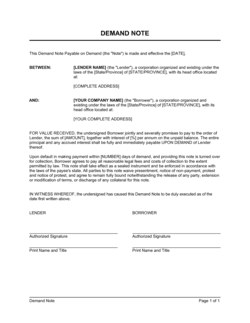
FOR VALUE RECEIVED, [BORROWER FULL LEGAL NAME], of [BORROWER ADDRESS] ('Maker'), promises to pay to the order of [LENDER FULL LEGAL NAME], of [LENDER ADDRESS] ('Payee'), the principal sum of [AMOUNT IN WORDS] ($[AMOUNT IN FIGURES]).

Common mistake: Using informal names or trade names instead of the borrower's full legal name. If the borrower is a corporation or LLC, the entity name must match its registered name exactly or enforcement against the entity β€” not the individual β€” becomes complicated.

Principal amount

In plain language: States the exact dollar amount lent, written in both numerals and words to eliminate ambiguity.

Sample language
The principal sum of [AMOUNT IN WORDS] dollars ($[AMOUNT IN FIGURES] [CURRENCY]) advanced by Payee to Maker on [ADVANCE DATE].

Common mistake: Omitting the advance date or stating an amount that differs between the words and figures fields. Courts typically default to the written-words amount when the two conflict, which may not match the actual loan.

Interest rate and accrual

In plain language: Sets the annual interest rate, how interest accrues (simple or compound), and the calculation basis (e.g., 365-day year).

Sample language
This Note shall bear interest on the unpaid principal balance at the rate of [X]% per annum, calculated on the basis of a 365-day year, accruing daily from the date of advance until repaid in full.

Common mistake: Setting an interest rate without checking the usury ceiling for the governing jurisdiction. Rates above the statutory maximum are unenforceable and, in some jurisdictions, void the entire interest obligation.

Payment on demand

In plain language: States that the full outstanding principal and accrued interest are due and payable immediately upon the lender's written demand, with no fixed maturity date.

Sample language
The entire outstanding principal balance of this Note, together with all accrued and unpaid interest, shall be due and payable in full ON DEMAND by Payee, upon written notice delivered to Maker at the address set out above.

Common mistake: Failing to specify the form of demand β€” oral vs. written, and the delivery method. Oral demands are difficult to prove. Requiring written notice sent by email or certified mail creates a clear evidentiary record.

Repayment grace period

In plain language: Specifies the number of days the borrower has to repay after receiving a demand notice before the lender can declare a default and pursue remedies.

Sample language
Upon receipt of written demand, Maker shall repay the full outstanding principal and accrued interest within [NUMBER] business days. Failure to repay within this period shall constitute an Event of Default under this Note.

Common mistake: Omitting a grace period entirely. Without one, the borrower has no practical time to arrange funds, and the note may be challenged as commercially unreasonable β€” particularly in consumer loan contexts.

Default and remedies

In plain language: Defines events of default beyond non-payment β€” such as insolvency or assignment for creditors β€” and sets out the lender's remedies, including acceleration of the full balance.

Sample language
An 'Event of Default' shall include: (a) failure to repay within the grace period after demand; (b) Maker becoming insolvent or making an assignment for the benefit of creditors; or (c) commencement of bankruptcy, receivership, or similar proceedings against Maker. Upon any Event of Default, all outstanding amounts shall become immediately due and payable at Payee's election.

Common mistake: Limiting default events to non-payment only. If the borrower becomes insolvent but hasn't missed a payment yet, a lender with no insolvency-triggered default clause may lose priority to other creditors.

Costs of collection and legal fees

In plain language: Requires the borrower to pay the lender's reasonable legal fees and collection costs if the lender must take legal action to recover amounts owed.

Sample language
In the event of default, Maker shall pay all costs of collection incurred by Payee, including reasonable attorneys' fees and court costs, whether or not litigation is commenced.

Common mistake: Omitting this clause and then being unable to recover legal costs after winning a collection judgment. Without an express contractual fee-shifting provision, each party typically bears its own legal costs under the American Rule.

Waiver of presentment and notice of dishonor

In plain language: The borrower waives technical notice requirements under negotiable instruments law, simplifying enforcement for the lender.

Sample language
Maker hereby waives presentment for payment, notice of non-payment, protest, and notice of protest and dishonor of this Note.

Common mistake: Deleting this clause to 'simplify' the document. Without the waiver, the lender may need to follow strict presentment formalities under the applicable Uniform Commercial Code or Bills of Exchange Act before pursuing default remedies.

Governing law and jurisdiction

In plain language: Specifies which jurisdiction's law governs interpretation and enforcement of the note and where disputes must be resolved.

Sample language
This Note shall be governed by and construed in accordance with the laws of the [STATE / PROVINCE / COUNTRY], without regard to its conflict of laws principles. Maker consents to the exclusive jurisdiction of the courts of [JURISDICTION] for any action to enforce this Note.

Common mistake: Choosing a governing law with no connection to either party or the loan transaction. Some jurisdictions β€” particularly US states β€” require a meaningful nexus between the parties and the chosen law for the selection to be honored.

Entire agreement and amendments

In plain language: Confirms the note is the complete agreement between the parties on this loan and that amendments require written consent from both parties.

Sample language
This Note constitutes the entire agreement between the parties with respect to the loan described herein and supersedes all prior oral or written understandings. This Note may not be amended, modified, or waived except by a written instrument signed by both parties.

Common mistake: Allowing oral modifications by not including this clause. A lender who verbally agrees to extend a repayment deadline may inadvertently waive their right to enforce the original demand terms.

How to fill it out

  1. 1

    Enter the legal names and addresses of both parties

    Use the borrower's and lender's full legal names β€” for companies, the registered entity name β€” and their current mailing addresses. If the borrower is signing in a personal capacity as guarantor of a business debt, note that distinction explicitly.

    πŸ’‘ Run a quick corporate registry search to confirm the borrower entity's exact registered name before filling in the parties clause.

  2. 2

    State the principal amount in both words and figures

    Write the loan amount in full words followed by the numeral in parentheses and specify the currency. Record the actual date the money was or will be advanced, not the date the note is signed if they differ.

    πŸ’‘ If the loan is being advanced in tranches, consider attaching a draw schedule rather than trying to capture multiple advance dates in the body of the note.

  3. 3

    Set the interest rate and confirm it is within usury limits

    Enter the annual interest rate and specify whether it compounds or accrues as simple interest. Before finalizing, verify the applicable usury ceiling for the governing jurisdiction β€” federal and state or provincial limits differ for commercial vs. consumer loans.

    πŸ’‘ For zero-interest loans between related parties, consult a tax advisor first. Tax authorities in the US, Canada, and the UK may impute a market interest rate on below-market loans between related entities.

  4. 4

    Define the demand and grace period mechanics

    Specify that demand must be in writing and state the delivery method β€” email with read receipt, certified mail, or courier. Then set the grace period in business days (typically 5–10 days for commercial loans, up to 30 days for personal ones).

    πŸ’‘ Include both parties' email addresses in a notices clause so there is no dispute about where written demand must be sent.

  5. 5

    List all events of default

    Beyond non-repayment after demand, include insolvency events, assignment for the benefit of creditors, and commencement of bankruptcy or receivership proceedings. For corporate borrowers, add change of control as a default trigger if the lender's decision to lend was based on specific ownership.

    πŸ’‘ Review the borrower's existing debt obligations before finalizing default triggers β€” conflicting default clauses across multiple notes can create unintended cross-default situations.

  6. 6

    Include the fee-shifting and waiver clauses

    Confirm the costs-of-collection clause specifying attorneys' fees is in the note, and retain the presentment waiver. These two clauses materially improve the lender's enforcement position if the borrower defaults.

    πŸ’‘ Some US states limit or disallow contractual attorney-fee provisions in consumer loan agreements β€” verify applicability before including the clause.

  7. 7

    Choose and confirm the governing law

    Select the jurisdiction whose law will govern the note β€” typically where the lender is located or where the borrower operates. Ensure the chosen state or province has a usury ceiling that accommodates your interest rate.

    πŸ’‘ If the borrower is in one US state and the lender in another, the governing-law clause is especially important β€” courts will usually honor a commercially reasonable choice of law between sophisticated parties.

  8. 8

    Execute before the loan is advanced

    Both parties should sign the note before or at the time funds are transferred. The lender should retain the original signed note; the borrower should receive a copy. For higher-value loans, witness signatures or notarization adds evidentiary weight.

    πŸ’‘ Store the executed original in a secure location β€” a promissory note may be a negotiable instrument, and the original document is required for enforcement in many jurisdictions.

Frequently asked questions

What is a demand to pay promissory note?

A demand to pay promissory note is a written, legally binding promise by a borrower to repay a specific principal amount β€” plus any accrued interest β€” to the lender immediately upon written demand. Unlike a term note with a fixed maturity date, a demand note has no scheduled repayment date. The lender may call the loan at any time by delivering written notice to the borrower, who then has a specified grace period to repay in full.

What is the difference between a demand note and a term promissory note?

A term promissory note has a fixed maturity date on which the full balance becomes due, and often includes a scheduled repayment plan in the interim. A demand note has no maturity date β€” it is due whenever the lender demands repayment. Demand notes give lenders maximum flexibility but may be less suitable when the borrower needs certainty about the repayment timeline, such as for long-term capital investment.

Is a demand promissory note legally enforceable?

A demand promissory note is generally enforceable when properly executed β€” signed by the borrower, supported by actual consideration (the loan amount), and compliant with the usury laws of the governing jurisdiction. Enforceability depends on the note being complete, unambiguous, and executed before or at the time of the loan advance. Consulting a lawyer is advisable for higher-value loans or cross-border arrangements.

Does a demand promissory note need to be notarized?

Notarization is not required for a demand promissory note to be enforceable in most US states, Canadian provinces, or UK jurisdictions. However, notarization adds evidentiary weight, makes it harder for the borrower to deny the signature, and is advisable for loans above $10,000 or between parties with a complex relationship. Some states require notarization for real-estate-secured notes regardless of amount.

What interest rate should I use on a demand promissory note?

The appropriate rate depends on the nature of the loan and the governing jurisdiction. Commercial demand notes often use the prime rate plus a spread β€” for example, prime plus 2%. Consumer loans are subject to stricter usury caps, which vary by US state from roughly 10% to 25% annually. For loans between related parties, tax authorities may impute a minimum rate (the IRS Applicable Federal Rate in the US, or the prescribed rate in Canada) even if the parties agree to zero interest.

Can I charge interest on a demand promissory note between family members?

Yes, interest can be charged on loans between family members, and in many cases it should be. In the US, Canada, and the UK, tax authorities scrutinize below-market or interest-free loans between related parties and may impute interest income to the lender regardless of what the note says. Charging at least the applicable statutory minimum rate β€” the IRS AFR in the US or the CRA prescribed rate in Canada β€” avoids deemed- interest treatment and reduces the risk of the loan being reclassified as a gift.

What happens if the borrower does not repay after demand is made?

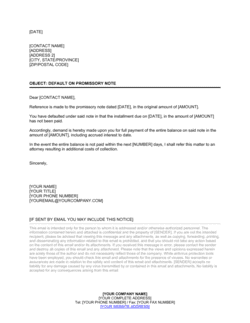
If the borrower fails to repay within the grace period specified in the note after receiving written demand, an Event of Default occurs. The lender may then pursue the full outstanding balance plus accrued interest through civil litigation, obtain a judgment, and enforce it against the borrower's assets. A well-drafted note accelerates the entire balance on default and entitles the lender to recover reasonable attorneys' fees and collection costs.

What is the statute of limitations for enforcing a demand promissory note?

The statute of limitations typically runs from the date the lender's demand is made β€” not from the date the note was signed. In most US states, the limitation period for written contracts is 4 to 6 years. In Canada, provincial limitation periods are generally 2 years from the date a claim is discovered. In the UK, the Limitation Act 1980 provides a 6-year period. Because the clock starts on demand, a lender who never formally demands repayment may preserve the right to do so indefinitely β€” though courts can find implied waiver after very long periods.

Should a demand promissory note be witnessed or have a guarantor?

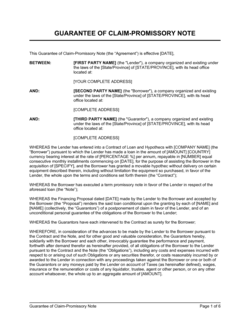
Witness signatures are not legally required in most jurisdictions but are advisable for loans above $5,000 or where a dispute is foreseeable. A guarantor β€” a third party who agrees to repay if the borrower defaults β€” should be documented in a separate guarantee agreement rather than on the face of the note itself, to avoid ambiguity about the guarantor's obligations and the effect of any amendments to the note.

Can a demand promissory note be transferred to a third party?

A promissory note is generally a negotiable instrument under Article 3 of the US Uniform Commercial Code, the Canadian Bills of Exchange Act, and the UK Bills of Exchange Act 1882. This means the lender (payee) can endorse and transfer the note to a third party, who then becomes the new holder with the right to demand repayment. To prevent transfer without the borrower's consent, include a non-negotiability clause stating the note is not transferable or assignable without written consent.

How this compares to alternatives

vs Term Promissory Note

A term promissory note sets a fixed maturity date and often a scheduled repayment plan, giving the borrower certainty about when and how much is owed. A demand note gives the lender the right to call the full balance at any time. Use a term note when the borrower needs a defined repayment horizon for planning; use a demand note when the lender needs maximum flexibility to retrieve funds quickly.

vs Loan Agreement

A loan agreement is a comprehensive contract covering representations, covenants, conditions precedent, reporting obligations, and detailed remedies β€” suited to larger, more complex financing arrangements. A demand promissory note is a shorter, simpler instrument that captures the core payment obligation. For loans between sophisticated commercial parties above $50,000, a loan agreement typically provides better protection than a standalone note.

vs Secured Promissory Note

A secured promissory note ties the repayment obligation to a specific piece of collateral β€” equipment, inventory, or real property β€” giving the lender priority over that asset in a default. A demand note is unsecured, meaning the lender is a general creditor. If the loan is material and the borrower has identifiable assets, a secured note or a note paired with a security agreement provides meaningfully stronger protection.

vs Convertible Promissory Note

A convertible promissory note includes a mechanism to convert the outstanding debt into equity at a future financing event, typically at a discount to the round price. A demand note is a pure debt instrument with no equity conversion feature. Use a convertible note for startup bridge financing where equity upside is part of the deal; use a demand note for straightforward loans where cash repayment is the only intended outcome.

Industry-specific considerations

Financial services and private lending

Private lenders use demand notes for short-term bridge financing where the ability to call the loan on short notice is essential to portfolio liquidity management.

Real estate

Real estate investors use demand notes for short-term acquisition financing between related entities, often pending a refinance or property sale that will trigger full repayment.

Professional services

Accounting and law firms advise owner-managed businesses to formalize shareholder loans with demand notes to satisfy tax authority documentation requirements and preserve the loan characterization.

Technology and startups

Angel investors and founders use demand notes to document bridge loans advanced ahead of a formal convertible note or equity round, preserving the lender's right to call the loan if the round does not close within an expected timeframe.

Jurisdictional notes

United States

Demand promissory notes are governed by Article 3 of the Uniform Commercial Code in all US states. Usury limits vary significantly by state β€” New York caps consumer rates at 16% while some states impose no cap on commercial loans. The IRS requires loans between related parties to charge at least the Applicable Federal Rate (AFR) to avoid imputed interest and potential gift tax treatment. California imposes additional consumer-protection disclosures for loans under $40,000.

Canada

Canadian demand notes are governed by the federal Bills of Exchange Act and applicable provincial law. The Criminal Code caps effective interest at 60% per annum for all loans. The CRA prescribed rate applies to below-market loans between related parties for income-attribution purposes. Quebec's Consumer Protection Act imposes strict disclosure requirements on consumer loans, and notes must be in French for provincially-regulated consumer transactions in Quebec.

United Kingdom

UK demand notes are governed by the Bills of Exchange Act 1882. The Financial Conduct Authority regulates consumer credit agreements, and consumer demand notes may require FCA authorization and specified disclosures under the Consumer Credit Act 1974. The Limitation Act 1980 provides a 6-year enforcement window running from the date of demand. Stamp Duty is not typically payable on a simple promissory note in the UK.

European Union

EU member states each maintain their own laws on promissory notes and consumer credit. The EU Consumer Credit Directive imposes mandatory disclosure requirements and cooling-off periods for consumer loans up to €75,000. Interest rate caps vary widely β€” France enforces a usury rate published quarterly by the Banque de France, while Germany applies civil-code good-faith limits. Cross-border enforcement within the EU is facilitated by the Brussels I Regulation, but the governing law clause remains essential.

Template vs lawyer β€” what fits your deal?

PathBest forCostTime
Use the templateStraightforward domestic loans between individuals or small businesses under $25,000Free20–30 minutes
Template + legal reviewLoans above $25,000, related-party loans with tax implications, or cross-provincial or cross-state arrangements$200–$500 for a one-hour lawyer review1–2 business days
Custom draftedCommercial loans above $100,000, loans with complex default structures, or multi-jurisdiction enforcement requirements$800–$3,000+3–7 business days

Glossary

Promissory Note
A written, unconditional promise by one party (the maker or borrower) to pay a specific sum of money to another party (the payee or lender) under stated terms.
Demand Note
A promissory note with no fixed maturity date that becomes due and payable in full immediately upon the lender's written demand.
Principal
The original amount of money lent, excluding any interest or fees that accrue over time.
Accrued Interest
Interest that has accumulated on the outstanding principal balance from the advance date to the date of repayment or demand.
Default
A borrower's failure to comply with any material term of the note β€” most commonly, failure to repay within the time specified in a demand.
Acceleration
A clause that makes the entire outstanding balance immediately due and payable upon a specified triggering event, such as default or insolvency.
Maker
The party who signs and is legally obligated under a promissory note β€” commonly called the borrower.
Payee
The party to whom payment under a promissory note is owed β€” commonly called the lender or holder.
Usury
The practice of charging interest above the maximum rate permitted by law in the applicable jurisdiction.
Consideration
Something of value exchanged between parties to make a contract legally enforceable β€” in a promissory note, the loan amount disbursed to the borrower.
Holder in Due Course
A third party who acquires a negotiable promissory note in good faith, for value, and without notice of any defect β€” and who takes the note free of most defenses the maker could raise against the original payee.

Part of your Business Operating System

This document is one of 3,000+ business & legal templates included in Business in a Box.

  • Fill-in-the-blanks β€” ready in minutes
  • 100% customizable Word document
  • Compatible with all office suites
  • Export to PDF and share electronically

Create your document in 3 simple steps.

From template to signed document β€” all inside one Business Operating System.
1
Download or open template

Access over 3,000+ business and legal templates for any business task, project or initiative.

2
Edit and fill in the blanks with AI

Customize your ready-made business document template and save it in the cloud.

3
Save, Share, Send, Sign

Share your files and folders with your team. Create a space of seamless collaboration.

Save time, save money, and create top-quality documents.

β˜…β˜…β˜…β˜…β˜…

"Fantastic value! I'm not sure how I'd do without it. It's worth its weight in gold and paid back for itself many times."

Managing Director Β· Mall Farm
Robert Whalley
Managing Director, Mall Farm Proprietary Limited
β˜…β˜…β˜…β˜…β˜…

"I have been using Business in a Box for years. It has been the most useful source of templates I have encountered. I recommend it to anyone."

Business Owner Β· 4+ years
Dr Michael John Freestone
Business Owner
β˜…β˜…β˜…β˜…β˜…

"It has been a life saver so many times I have lost count. Business in a Box has saved me so much time and as you know, time is money."

Owner Β· Upstate Web
David G. Moore Jr.
Owner, Upstate Web

Run your business with a system β€” not scattered tools

Stop downloading documents. Start operating with clarity. Business in a Box gives you the Business Operating System used by over 250,000 companies worldwide to structure, run, and grow their business.

Start freeΒ Β·Β No credit card required