Installment Note Bank Deposit as Collateral Template

Free Word download • Edit online • Save & share with Drive • Export to PDF

3 pages25–30 min to fillDifficulty: ComplexSignature requiredLegal review recommended
Learn more ↓
FreeInstallment Note Bank Deposit as Collateral Template

At a glance

What it is
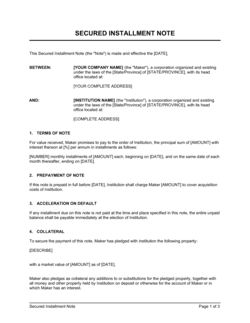
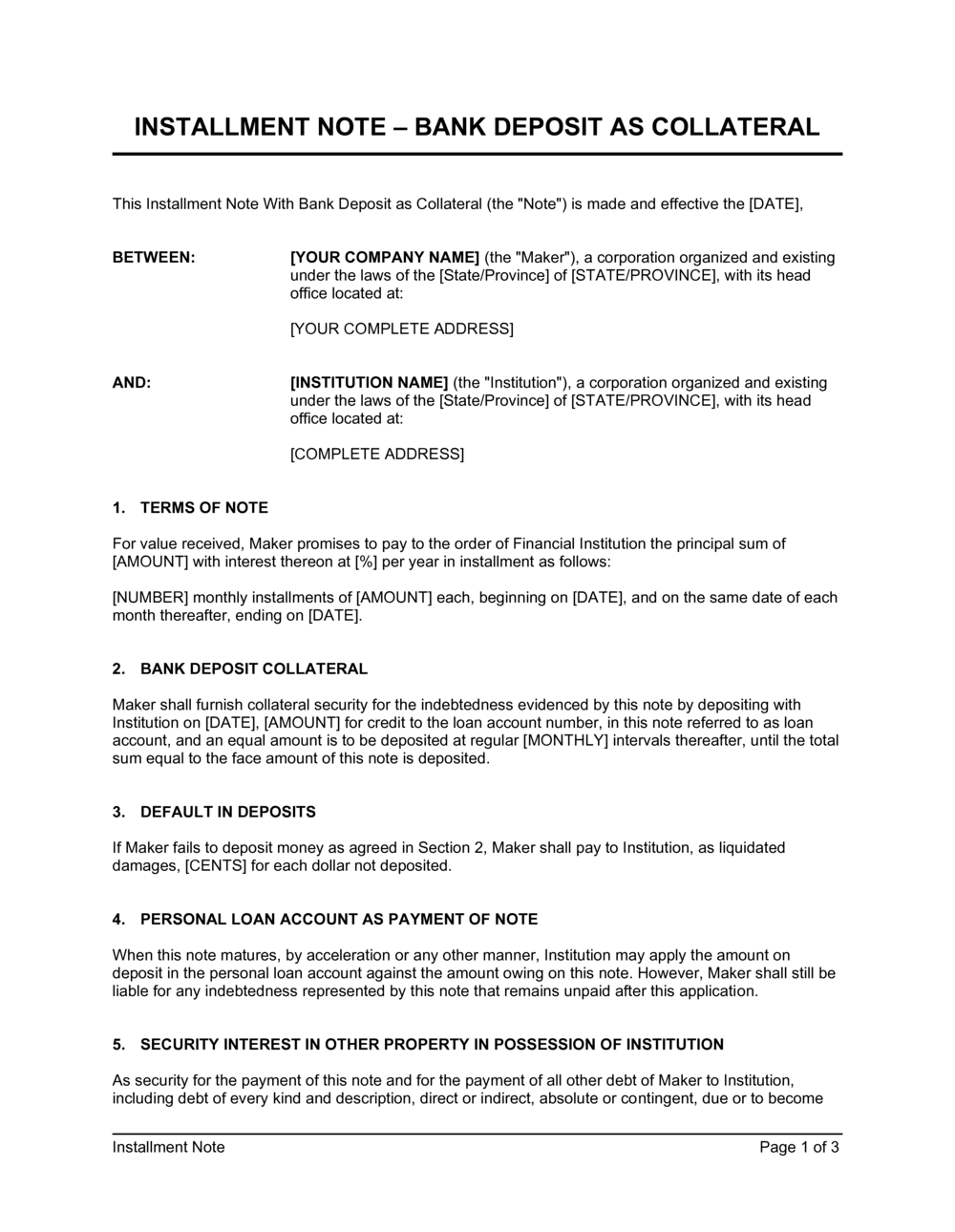
An Installment Note Bank Deposit As Collateral is a legally binding promissory note in which a borrower promises to repay a loan in regular scheduled installments and pledges a bank deposit account as security for that obligation. This free Word download gives you a professionally structured template covering principal, interest, repayment schedule, collateral pledge, default triggers, and lender remedies — ready to edit online and export as PDF for execution.
When you need it
Use it when a lender requires a borrower to back a loan with a pledged bank deposit — such as a certificate of deposit or savings account — and both parties need a single enforceable document that governs both the repayment obligation and the collateral arrangement. It is commonly used in private business loans, intra-company financing, and shareholder lending scenarios where liquid deposit assets serve as the security instrument.
What's inside
Parties and loan amount, installment repayment schedule with interest rate, identification and pledge of the bank deposit as collateral, lender's right to apply the deposit on default, prepayment terms, representations and warranties, events of default, acceleration clause, and governing law.

What is an Installment Note Bank Deposit As Collateral?

An Installment Note Bank Deposit As Collateral is a legally binding promissory note in which a borrower commits to repaying a loan through a defined series of periodic installments — monthly being most common — while simultaneously pledging a specific bank deposit account as security for that repayment obligation. The deposit may be a savings account, money market account, or certificate of deposit held at a named financial institution. Unlike an unsecured installment note, this instrument gives the lender a perfected security interest in a liquid, value-certain asset: if the borrower misses payments or otherwise defaults, the lender can apply the pledged deposit directly against the outstanding balance, typically without the delay and cost of court proceedings. The note governs both the payment obligation and the collateral arrangement in a single enforceable document, supplemented by a deposit account control agreement executed with the depository bank.

Why You Need This Document

Without a properly documented installment note and a perfected security interest in the pledged deposit, a lender advancing funds faces the same recovery risk as an unsecured creditor — meaning a default triggers expensive litigation rather than a straightforward application of the collateral. The absence of a written amortization schedule invites disputes over exactly how much is owed at each point in the loan. Failing to execute a deposit account control agreement leaves the security interest unperfected under UCC Article 9, which means a bankruptcy trustee or a later-arriving creditor can claim priority over the deposit the lender believed was locked down. Related-party loans documented only by email or informal agreement are routinely recharacterized as gifts or equity contributions by tax authorities and bankruptcy courts. This template provides the complete documented structure — parties, rate, schedule, pledge mechanics, control agreement requirement, default triggers, and remedies — that transforms an informal lending arrangement into an enforceable secured obligation with predictable outcomes for both sides.

Which variant fits your situation?

If your situation is…Use this template
Lump-sum repayment at maturity instead of installmentsBalloon Payment Promissory Note
Loan secured by real property rather than a bank depositMortgage Promissory Note
Unsecured installment loan with no collateral pledgeInstallment Promissory Note
Loan secured by personal property or equipment rather than a depositSecured Promissory Note
Short-term loan repaid in a single payment with no installmentsDemand Promissory Note
Loan between related parties requiring IRS-compliant interest termsIntra-Family Loan Agreement
Line of credit secured by a deposit account rather than a fixed loan amountBusiness Line of Credit Agreement

Common mistakes to avoid

❌ Failing to execute a deposit account control agreement

Why it matters: Under UCC Article 9, a security interest in a deposit account is only perfected by control — not by filing a financing statement alone. Without a DACA, the lender's interest is unperfected and subordinate to a subsequent lien holder or a bankruptcy trustee.

Fix: Require the DACA to be executed concurrently with the note and condition loan disbursement on the bank's countersignature of the control agreement.

❌ No minimum balance requirement on the pledged account

Why it matters: If the borrower can freely withdraw funds from the pledged account, the collateral may be depleted to zero before any default is triggered, leaving the lender with no security.

Fix: Specify a minimum balance covenant in the pledge clause — typically at least 100% of the current outstanding principal — and treat any breach as an immediate event of default.

❌ Omitting an amortization schedule exhibit

Why it matters: Describing the payment amount in the body of the note without an attached schedule creates disputes over exactly how much is owed at any given point, particularly after partial prepayments.

Fix: Attach a complete amortization table as a numbered exhibit, have both parties initial it at signing, and include a provision stating that the schedule governs in the event of any discrepancy.

❌ Setting an interest rate below the IRS Applicable Federal Rate for related-party loans

Why it matters: For US loans between related parties — family members, shareholders, or affiliated entities — a rate below the IRS AFR triggers imputed interest rules, meaning the IRS treats phantom interest as taxable income to the lender regardless of what was actually paid.

Fix: Check the current AFR for the applicable term (short, mid, or long) on the IRS website before finalizing the rate, and document the rate selection in a contemporaneous memo.

❌ No cure period for payment defaults

Why it matters: A note that allows immediate acceleration on the first missed payment, without any notice or cure period, may be found unconscionable or unenforceable in some jurisdictions, particularly for consumer borrowers.

Fix: Include a written notice requirement and a 5–10 day cure period for payment defaults while preserving the right to accelerate immediately on non-curable defaults such as insolvency or fraud.

❌ Using a trade name instead of a registered legal entity name

Why it matters: If the name on the note does not match the legal owner of the pledged account, the bank may refuse to execute the DACA or the security interest may be challengeable in a bankruptcy proceeding as granted by the wrong party.

Fix: Verify the exact registered legal name of the borrower against the account title at the depository bank before drafting and confirm any discrepancy with a legal name change or doing-business-as documentation.

The 10 key clauses, explained

Parties, Loan Amount, and Recitals

In plain language: Identifies the lender and borrower as legal entities, states the principal loan amount, and records the date and purpose of the loan.

Sample language
This Installment Note is entered into as of [DATE] by and between [LENDER LEGAL NAME] ('Lender') and [BORROWER LEGAL NAME] ('Borrower'). For value received, Borrower promises to pay to the order of Lender the principal sum of $[AMOUNT] (the 'Loan'), together with interest as set forth herein.

Common mistake: Using trade names instead of registered legal entity names. If the lender's name on the note does not match the account holder on record at the pledged bank, perfecting the security interest becomes procedurally complicated.

Interest Rate

In plain language: States the annual interest rate applied to the outstanding principal, whether it is fixed or variable, and how interest accrues — typically on a 365-day or 360-day basis.

Sample language
The outstanding principal balance shall accrue interest at a rate of [X]% per annum, calculated on the basis of a 365-day year, from the date hereof until paid in full.

Common mistake: Failing to specify the day-count convention. '6% per annum' is ambiguous — courts and parties calculate different amounts depending on whether they use a 360- or 365-day year, which compounds materially over multi-year loans.

Repayment Schedule and Installments

In plain language: Sets the payment amount, frequency (monthly, quarterly, etc.), first payment date, and final maturity date, and specifies how each payment is applied to interest first and then principal.

Sample language
Borrower shall repay the Loan in [NUMBER] consecutive monthly installments of $[AMOUNT] each, commencing on [FIRST PAYMENT DATE] and continuing on the [DAY] of each month thereafter until [MATURITY DATE], on which date all remaining principal and accrued interest shall be due and payable in full.

Common mistake: Omitting an amortization schedule as an exhibit. A verbal description of the payment amount is insufficient when interest compounds and balances change — attach a full schedule to eliminate disputes over what is owed at any point.

Pledge of Bank Deposit as Collateral

In plain language: Identifies the specific bank deposit account or certificate of deposit being pledged, grants the lender a security interest in it, and requires the borrower to maintain the deposit in good standing throughout the loan term.

Sample language
To secure the full and punctual payment of all amounts due hereunder, Borrower hereby pledges, assigns, and grants to Lender a first-priority security interest in the deposit account held at [BANK NAME], Account No. [ACCOUNT NUMBER] (the 'Pledged Deposit'), and agrees to maintain such account in a balance of not less than $[MINIMUM BALANCE] at all times during the term of this Note.

Common mistake: Pledging the deposit account without specifying a minimum balance requirement. If the borrower is free to draw down the account, the collateral may be worth less than the outstanding loan balance by the time a default occurs.

Control Agreement and Perfection

In plain language: Requires the lender to enter into a deposit account control agreement (DACA) with the depository bank to perfect its security interest and establish priority over competing creditors.

Sample language
Borrower shall, concurrently with execution of this Note, cause [BANK NAME] to execute a Deposit Account Control Agreement in form acceptable to Lender, granting Lender control over the Pledged Deposit for purposes of perfecting Lender's security interest under Article 9 of the Uniform Commercial Code.

Common mistake: Skipping the control agreement and relying only on a UCC-1 filing for a deposit account. Under UCC Article 9, a lender's security interest in a deposit account can only be perfected by control — a financing statement alone is insufficient and leaves the lender unsecured against third-party creditors.

Events of Default

In plain language: Lists the specific actions or omissions that constitute a default, including missed payments, breach of covenants, insolvency, and unauthorized withdrawal from the pledged account.

Sample language
Each of the following constitutes an Event of Default: (a) Borrower fails to make any installment payment within [X] days of its due date; (b) Borrower withdraws funds from the Pledged Deposit without Lender's prior written consent; (c) Borrower becomes insolvent, makes an assignment for the benefit of creditors, or files for bankruptcy protection; (d) any representation or warranty herein proves materially false when made.

Common mistake: Defining default as any missed payment with zero cure period. In most jurisdictions, courts expect lenders to provide at least a 5–10 day written notice and cure period before accelerating, and notes without a cure period are sometimes found unconscionable.

Acceleration and Remedies

In plain language: Gives the lender the right to declare the entire unpaid balance immediately due upon a default and to apply the pledged deposit proceeds directly against the outstanding obligation.

Sample language
Upon the occurrence of an Event of Default, Lender may, at its option and without further notice, (a) declare the entire unpaid principal balance and all accrued interest immediately due and payable, and (b) exercise all rights of a secured party under applicable law, including applying the proceeds of the Pledged Deposit to satisfy all amounts outstanding under this Note.

Common mistake: Omitting the right to apply the deposit without a court order. If the note does not expressly grant the lender a contractual setoff or self-help remedy over the pledged account, the lender may need to initiate legal proceedings before touching the deposit — defeating the purpose of liquid collateral.

Prepayment

In plain language: States whether the borrower may repay the loan early and whether a prepayment penalty applies, including the formula for calculating it.

Sample language
Borrower may prepay the outstanding principal balance, in whole or in part, at any time without premium or penalty, provided that all accrued and unpaid interest through the prepayment date is paid simultaneously.

Common mistake: Omitting a prepayment clause entirely. Without it, the parties may dispute whether early repayment is permitted, and in some jurisdictions the note may be interpreted as prohibiting prepayment — trapping the borrower in the repayment schedule even if funds are available.

Representations and Warranties

In plain language: The borrower confirms that it has authority to enter the agreement, that the pledged deposit is free of other liens, and that execution does not violate any other obligation.

Sample language
Borrower represents and warrants that: (a) Borrower has full authority to execute this Note and pledge the Pledged Deposit; (b) the Pledged Deposit is owned solely by Borrower and is free and clear of all liens, claims, and encumbrances other than the security interest granted herein; (c) execution of this Note does not violate any agreement to which Borrower is a party.

Common mistake: Omitting the 'no prior liens' representation. If the deposit is already pledged to another creditor, the new lender's security interest is subordinate — and the note's collateral protection is illusory without an express warranty to the contrary.

Governing Law, Waiver, and Entire Agreement

In plain language: Specifies the jurisdiction whose law governs the note, the borrower's waiver of presentment and notice of dishonor, and confirms the note constitutes the entire agreement between the parties on the subject matter.

Sample language
This Note shall be governed by the laws of [STATE/PROVINCE]. Borrower waives presentment, demand for payment, protest, and notice of dishonor. This Note constitutes the entire agreement of the parties with respect to the subject matter hereof and supersedes all prior negotiations and understandings.

Common mistake: Omitting the borrower's waiver of presentment and notice of dishonor. Without this waiver, state law may require the lender to formally present the note for payment and give specific notices before the note is enforceable — adding procedural delays that eliminate the benefit of liquid collateral.

How to fill it out

  1. 1

    Enter the parties' full legal names and the loan date

    Use the borrower's and lender's registered legal entity names — not trade names or abbreviations. Include the state or province of formation for each entity and the date of execution.

    💡 Cross-reference the name on the pledged bank account against the borrower's legal name before signing — a mismatch can delay or block the control agreement with the depository bank.

  2. 2

    State the principal amount and interest rate

    Enter the exact loan amount in numerals and words (e.g., '$50,000 (Fifty Thousand Dollars)'). State the annual interest rate and specify the day-count convention (365 or 360 days).

    💡 For loans between related parties in the US, verify that the interest rate meets or exceeds the current IRS Applicable Federal Rate (AFR) to avoid imputed-income issues.

  3. 3

    Complete the repayment schedule

    Enter the installment amount, payment frequency, first payment date, and final maturity date. Attach a complete amortization schedule as Exhibit A showing each payment's interest and principal components.

    💡 Use an online amortization calculator to generate the schedule, then paste it into the exhibit — errors in manual calculations compound over the loan term.

  4. 4

    Identify the pledged deposit account

    Enter the full name of the depository bank, the account number, and the account type (savings, money market, or CD). Specify the minimum balance the borrower must maintain throughout the loan term.

    💡 Set the minimum balance at 110–125% of the outstanding principal balance at each point in the amortization schedule to preserve adequate collateral coverage as the loan pays down.

  5. 5

    Arrange the deposit account control agreement

    Contact the depository bank before or concurrently with signing the note to initiate a DACA. Confirm the bank's form and execution timeline — some banks require 10–15 business days to process the agreement.

    💡 Do not disburse loan proceeds until the DACA is fully executed and in place. Funding before perfection leaves the lender unsecured.

  6. 6

    Define the events of default and cure period

    Specify each default trigger clearly — missed payment, unauthorized account withdrawal, insolvency, or breach of warranty. Include a written notice and cure period of at least 5–10 days for payment defaults.

    💡 Distinguish curable defaults (missed payment) from non-curable defaults (fraud, insolvency) — give a cure period only for the former to preserve lender remedies on serious breaches.

  7. 7

    Confirm governing law and execute before funding

    Select the governing jurisdiction — typically the state or province where the lender or borrower is located or where the pledged account is held. Both parties must sign before any funds are disbursed.

    💡 File a UCC-1 financing statement in addition to the DACA as a belt-and-suspenders measure — while control is the primary perfection method for deposit accounts, a UCC-1 provides additional public notice of the security interest.

Frequently asked questions

What is an installment note with bank deposit as collateral?

An installment note with bank deposit as collateral is a promissory note in which the borrower agrees to repay a loan in regular scheduled installments and simultaneously pledges a specific bank deposit account — such as a savings account, money market account, or certificate of deposit — as security. If the borrower defaults, the lender has a contractual and legal right to apply the pledged deposit directly against the outstanding balance without initiating a separate lawsuit to recover the asset.

How is this different from a standard unsecured installment note?

An unsecured installment note relies solely on the borrower's promise to pay; the lender's only recourse on default is to sue for the unpaid balance. A note secured by a bank deposit gives the lender a direct claim against a specific liquid asset — the deposit account — that can typically be applied against the debt far faster and at lower cost than litigation. The collateral pledge also reduces the lender's credit risk, which often supports a lower interest rate for the borrower.

Does the lender need to file a UCC-1 to secure a bank deposit?

Under UCC Article 9, the primary and only effective method of perfecting a security interest in a deposit account is by establishing control — most commonly through a deposit account control agreement with the depository bank. A UCC-1 financing statement alone does not perfect a security interest in a deposit account. However, filing a UCC-1 in addition to obtaining a DACA is still advisable as it provides public notice and supports priority arguments in complex creditor disputes.

What is a deposit account control agreement and why does it matter?

A deposit account control agreement is a three-party agreement among the lender, the borrower, and the depository bank. Under it, the bank acknowledges the lender's security interest and agrees to follow the lender's instructions regarding the account — including blocking withdrawals or remitting funds to the lender on an event of default — without the borrower's further consent. Without a DACA, the lender's security interest in the deposit account is unperfected under UCC Article 9, meaning it is subordinate to a bankruptcy trustee and most competing creditors.

Can the borrower still use the pledged deposit account while the loan is outstanding?

That depends entirely on what the note and DACA permit. In many arrangements, the borrower retains access to funds above the required minimum balance, and the lender only takes control on a default event. In higher-risk or lower-credit scenarios, the lender may require a restricted or blocked account from which the borrower cannot withdraw without written lender consent. The note should state the access terms explicitly to prevent disputes.

What happens to the pledged deposit when the loan is fully repaid?

Once the borrower has made all scheduled installment payments and the note is paid in full, the lender should execute a written release of its security interest, terminate the DACA, and instruct the depository bank to release any holds or restrictions on the pledged account. The lender should also file a UCC-3 termination statement if a UCC-1 was filed. The note template should include a release obligation clause to give the borrower a contractual right to demand this upon payoff.

What interest rate should I use on an installment note?

For purely private commercial loans, the parties may agree to any rate that complies with applicable usury laws — typically well above the market floor. For related-party loans in the US, the rate must equal or exceed the IRS Applicable Federal Rate for the applicable term to avoid imputed-interest tax consequences. In Canada, the Criminal Code prohibits effective annual rates above 60%. In the UK and EU, consumer credit legislation caps rates for consumer borrowers, though commercial notes are generally less restricted. Always verify current rate limits with a qualified adviser before finalizing the note.

Do I need a lawyer to prepare this document?

For straightforward commercial loans between creditworthy parties in a single domestic jurisdiction, a high-quality template is usually an adequate starting point. Legal review is strongly recommended when the loan amount is significant (above $50,000), when the borrower is a related party raising tax or estate-planning issues, when the transaction is cross-border, or when the parties need to negotiate DACA terms with a major financial institution. A 1–2 hour attorney review typically costs $300–$600 and is worthwhile for any secured lending transaction.

How this compares to alternatives

vs Unsecured Installment Note

An unsecured installment note carries no collateral pledge — the lender's only recourse on default is a lawsuit for the unpaid balance. An installment note secured by a bank deposit gives the lender a direct claim against a liquid asset, dramatically reducing recovery risk and cost. Use the secured version whenever the borrower has a suitable deposit account and the lender requires meaningful credit protection.

vs Secured Promissory Note (Equipment or Receivables)

A secured promissory note can pledge any type of personal property — equipment, inventory, or receivables — as collateral. A deposit-backed note specifically targets a bank account, which is uniquely liquid and value-certain. The perfection mechanics differ significantly: equipment collateral is perfected by UCC-1 filing, while deposit collateral requires a deposit account control agreement with the bank.

vs Demand Promissory Note

A demand note is repayable in full whenever the lender demands, with no fixed schedule. An installment note establishes a predictable repayment cadence that both parties can plan around. Use a demand note for short-term bridge arrangements where timing is uncertain; use an installment note when both parties want a defined amortization schedule and a fixed maturity date.

vs Business Loan Agreement

A business loan agreement is a comprehensive multi-party credit facility document covering covenants, representations, conditions precedent, and detailed default mechanics — appropriate for bank-originated commercial loans. An installment note is a shorter, more direct instrument suited to private or bilateral lending. For transactions with institutional lenders, the full loan agreement is typically required; for private or intra-company loans, the note is sufficient.

Industry-specific considerations

Financial Services and Private Lending

Private lenders and non-bank finance companies use deposit-backed installment notes to originate secured loans at lower risk without requiring real property collateral.

Real Estate

Real estate investors pledge earnest money deposits or escrow accounts as collateral on bridge loans, using the note to formalize repayment terms while a property acquisition or development closes.

Professional Services

Law firms, accounting practices, and consulting businesses use deposit-backed notes to structure partner buy-ins or succession financing secured against the incoming partner's capital account.

Technology and SaaS

Early-stage technology companies use installment notes secured by founder deposit accounts to formalize angel or family-office bridge loans without triggering equity dilution at an early valuation.

Jurisdictional notes

United States

UCC Article 9 governs security interests in deposit accounts. Perfection by control via a DACA is mandatory — a UCC-1 filing alone does not perfect a deposit account security interest. Usury laws vary by state; some states cap interest rates for commercial notes. For related-party loans, the IRS Applicable Federal Rate sets the minimum interest rate to avoid imputed income. California, New York, and Texas each have specific lender-licensing and usury provisions that may apply depending on the parties involved.

Canada

Personal Property Security Acts (PPSAs) in each province govern security interests in deposit accounts, broadly analogous to UCC Article 9. Perfection by control or registration under the applicable PPSA is required. The federal Criminal Code prohibits effective annual interest rates above 60%, which applies to all loans including commercial notes. Quebec transactions are governed by the Civil Code of Quebec, which has different pledge and security documentation requirements from common-law provinces.

United Kingdom

Security over bank deposits in England and Wales is typically created by way of fixed charge or mortgage rather than a UCC-style pledge. A control arrangement equivalent to a DACA — often called a blocked account or account charge agreement — is standard practice. Lenders must comply with FCA consumer credit regulations if the borrower is an individual. Stamp duty does not apply to promissory notes in most circumstances, but legal advice is recommended for any transaction above £50,000.

European Union

Security over deposit accounts varies significantly across EU member states. Germany uses account pledge agreements under §1274 BGB; France uses a nantissement de compte bancaire under the Code monétaire et financier. The EU Financial Collateral Arrangements Directive provides a harmonized framework for financial collateral — including cash and deposit accounts — that simplifies enforcement across member states for eligible counterparties. Consumer credit directives cap rates and impose disclosure requirements for any note where the borrower is a natural person.

Template vs lawyer — what fits your deal?

PathBest forCostTime
Use the templatePrivate bilateral loans under $50,000 between creditworthy commercial parties in a single domestic jurisdictionFree30–60 minutes
Template + legal reviewLoans above $50,000, related-party transactions with tax implications, or any arrangement requiring DACA negotiation with a major bank$300–$7002–5 business days
Custom draftedCross-border secured lending, institutional lenders, complex multi-tranche structures, or transactions where non-compete enforceability of collateral terms is critical$1,500–$5,000+1–3 weeks

Glossary

Installment Note
A promissory note requiring the borrower to repay the loan in a series of scheduled periodic payments rather than a single lump sum at maturity.
Collateral
An asset pledged by the borrower to the lender as security for repayment; the lender may seize and apply the asset if the borrower defaults.
Pledge
The act of delivering or assigning an asset — such as a bank deposit account — to a lender as security without transferring title until default occurs.
Certificate of Deposit (CD)
A time-deposit instrument issued by a bank paying a fixed interest rate for a defined term; commonly used as collateral because its value is certain and liquid.
Security Interest
A lender's legal right in the borrower's collateral that allows the lender to take possession or apply proceeds of the asset upon default, governed in the US by Article 9 of the UCC.
Acceleration Clause
A provision that makes the entire unpaid loan balance immediately due and payable upon the occurrence of a defined default event.
Default
A borrower's failure to perform a material obligation under the note — such as missing a payment, breaching a representation, or becoming insolvent — that triggers the lender's remedies.
Amortization Schedule
A table showing the breakdown of each installment payment into principal reduction and interest, and the remaining balance after each payment.
Setoff Right
A lender's contractual or statutory right to apply funds held in a deposit account directly against an outstanding debt owed by the account holder.
Prepayment
The borrower's optional or mandatory early repayment of principal before the scheduled due date, which may or may not trigger a prepayment penalty depending on the note terms.
Perfection
The legal process — typically by filing a UCC-1 financing statement or taking control of the deposit account — by which a lender makes its security interest enforceable against third parties.
UCC-1 Financing Statement
A public filing with the relevant state authority that gives notice of a lender's security interest in collateral, establishing priority over later creditors.

Part of your Business Operating System

This document is one of 3,000+ business & legal templates included in Business in a Box.

  • Fill-in-the-blanks — ready in minutes
  • 100% customizable Word document
  • Compatible with all office suites
  • Export to PDF and share electronically

Create your document in 3 simple steps.

From template to signed document — all inside one Business Operating System.
1
Download or open template

Access over 3,000+ business and legal templates for any business task, project or initiative.

2
Edit and fill in the blanks with AI

Customize your ready-made business document template and save it in the cloud.

3
Save, Share, Send, Sign

Share your files and folders with your team. Create a space of seamless collaboration.

Save time, save money, and create top-quality documents.

★★★★★

"Fantastic value! I'm not sure how I'd do without it. It's worth its weight in gold and paid back for itself many times."

Managing Director · Mall Farm
Robert Whalley
Managing Director, Mall Farm Proprietary Limited
★★★★★

"I have been using Business in a Box for years. It has been the most useful source of templates I have encountered. I recommend it to anyone."

Business Owner · 4+ years
Dr Michael John Freestone
Business Owner
★★★★★

"It has been a life saver so many times I have lost count. Business in a Box has saved me so much time and as you know, time is money."

Owner · Upstate Web
David G. Moore Jr.
Owner, Upstate Web

Run your business with a system — not scattered tools

Stop downloading documents. Start operating with clarity. Business in a Box gives you the Business Operating System used by over 250,000 companies worldwide to structure, run, and grow their business.

Free Forever Plan · No credit card required