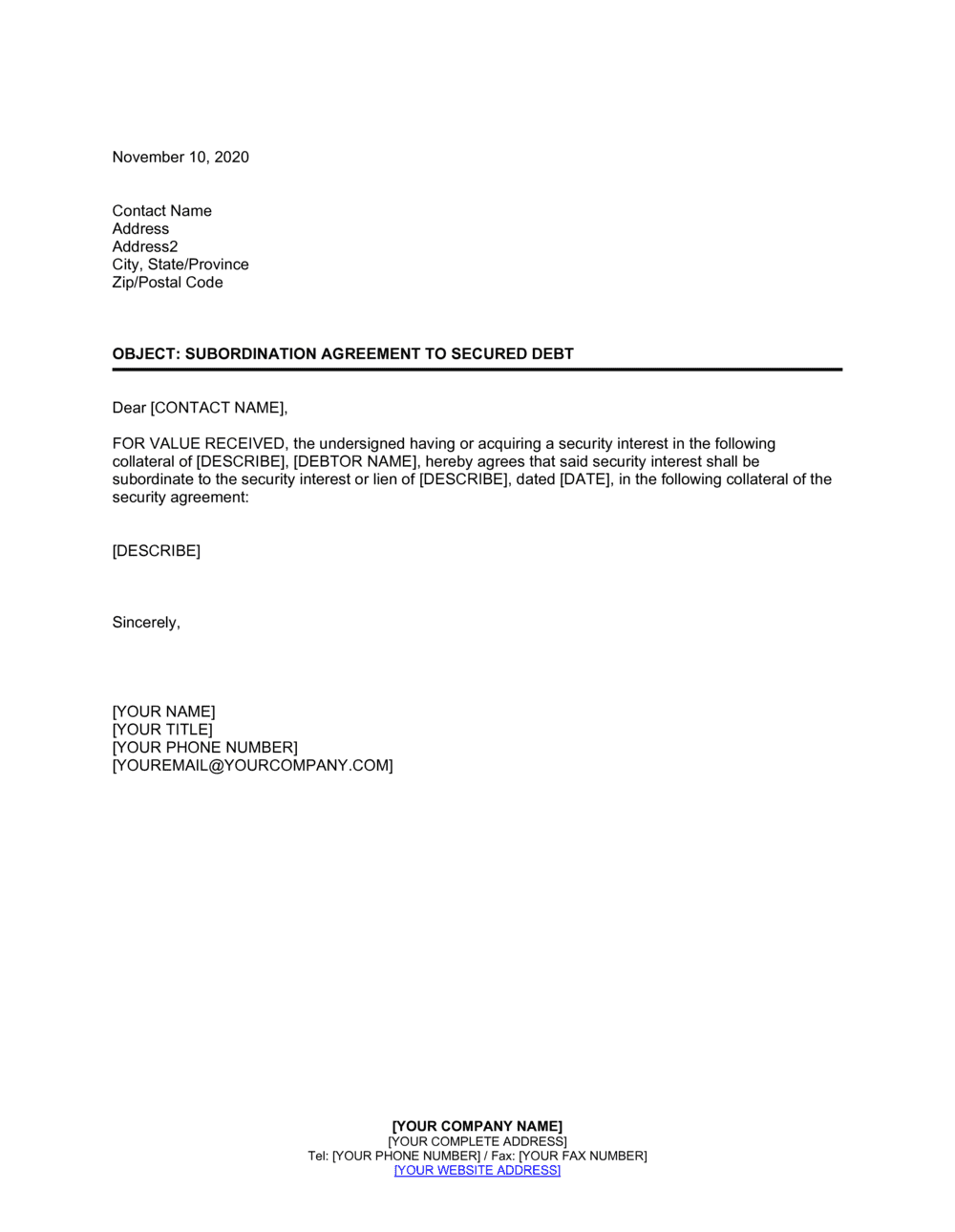
Subordination Agreement to Secured Debt Template

Free Word download • Edit online • Save & share with Drive • Export to PDF

1 page20–30 min to fillDifficulty: StandardSignature requiredLegal review recommended
Learn more ↓
FreeSubordination Agreement to Secured Debt Template

At a glance

What it is
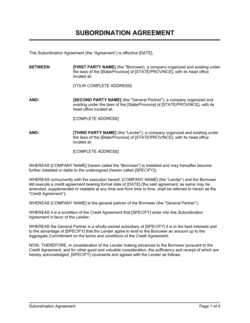
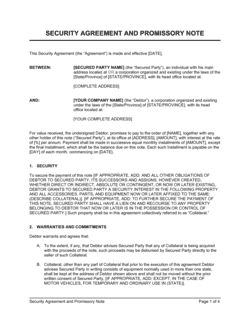
A Subordination Agreement to Secured Debt is a legally binding contract in which a junior creditor formally agrees that its claim against a borrower's assets ranks below that of a senior secured lender. This free Word download gives you a structured, attorney-ready starting point you can edit online and export as PDF for execution by all parties to the transaction.
When you need it
Use it whenever a borrower has two or more creditors with competing claims on the same collateral and the senior lender requires written confirmation that the junior creditor's lien or repayment rights will not interfere with the senior lender's priority position.
What's inside
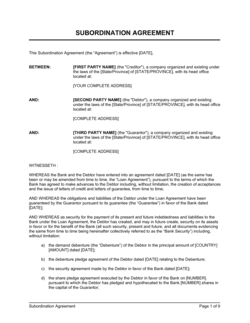
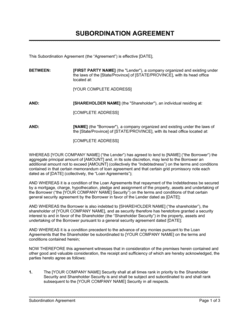
Identification of all parties and the senior and junior debt instruments, the subordination and standstill obligations, consent to senior lender enforcement actions, permitted payments to the junior creditor, events of default, and governing law. The document also includes representations, termination conditions, and signature blocks for all required parties.

What is a Subordination Agreement to Secured Debt?

A Subordination Agreement to Secured Debt is a legally binding tri-party contract in which a junior creditor formally agrees that its lien against a borrower's assets — and its right to receive payment on the underlying debt — ranks below the claim of a designated senior secured lender. The agreement does not extinguish or modify the junior debt itself; it contractually reorders the priority in which competing creditors are paid from the same pool of collateral or from the borrower's assets in a default or insolvency scenario. Without a written subordination agreement, lien priority is generally determined by the order in which security interests were recorded or perfected under applicable law — an outcome that may not reflect what the parties actually intended.

Why You Need This Document

Senior lenders require a subordination agreement as a condition of funding whenever a borrower carries other debt secured by the same collateral, because unresolved lien priority exposes the senior lender to the risk that a junior creditor could demand repayment, initiate enforcement, or block a foreclosure sale at exactly the wrong moment. Without a signed and recorded subordination agreement, a senior lender funding a commercial real estate loan cannot obtain first-lien title insurance, an SBA loan cannot close under SBA Standard Operating Procedures, and a mezzanine lender has no contractual standstill protection during a restructuring. For junior creditors, a properly drafted agreement protects them too — defining exactly what payments they may continue to receive, setting an outer limit on standstill obligations, and establishing clear termination conditions so their full rights are restored the moment the senior debt is repaid. This template gives all three parties a structured, attorney-reviewable starting point that covers every material provision — from standstill periods and permitted payments to turnover obligations and bankruptcy-proof termination language.

Which variant fits your situation?

If your situation is…Use this template
Real estate transaction with a first mortgage and a seller carry-back noteReal Estate Subordination Agreement
Corporate debt stack with senior bank facility and mezzanine trancheIntercreditor and Subordination Agreement
SBA loan requiring subordination of existing shareholder loansSubordination Agreement to Secured Debt
Lease subordination required by a commercial mortgage lenderSNDA Agreement (Subordination, Non-Disturbance, and Attornment)
Startup subordinating a convertible note to a new venture debt facilityDebt Subordination Side Letter
Second-lien lender acknowledging senior lender's enforcement prioritySecond Lien Intercreditor Agreement
Shareholder loan subordinated to institutional bank financingShareholder Loan Subordination Agreement

Common mistakes to avoid

❌ Subordinating the lien but not the payment obligation

Why it matters: A lien-only subordination allows the junior creditor to demand repayment in full even during a senior default — which can force the borrower into a cross-default under the senior facility.

Fix: Draft the subordination clause to cover both the payment obligation and the lien securing it, explicitly stating that all rights to receive payment on the junior debt are subordinated to the senior debt.

❌ Omitting the indefeasible payment standard in the termination clause

Why it matters: If a payment to the senior lender is clawed back in bankruptcy as a preference, the termination never legally occurred — but the junior creditor may have already resumed enforcement activity in reliance on it.

Fix: Include express language that the subordination terminates only upon 'indefeasible payment in full in cash' and add a 91-day post-payment grace period to account for the preference look-back window.

❌ Granting the senior lender unlimited modification rights

Why it matters: Without a cap, the senior lender can increase the facility amount to an amount that completely eliminates any realistic recovery for the junior creditor — courts in some jurisdictions have voided the subordination entirely as a result.

Fix: Negotiate and document a specific dollar cap on principal increases and require written junior creditor consent for any material modification beyond that cap.

❌ Failing to record the agreement in real property transactions

Why it matters: An unrecorded subordination agreement is generally not binding on subsequent purchasers or lienholders without notice — and a title insurer may refuse to insure the senior lender's priority position.

Fix: Record the fully executed subordination agreement in the county land records immediately after closing and obtain a title endorsement confirming the senior lender's first-lien priority.

The 10 key clauses, explained

Parties and Recitals

In plain language: Identifies the senior lender, junior creditor, and borrower by legal name, and sets out the background facts — the senior loan amount, the junior debt instrument, and the purpose of the subordination.

Sample language
This Subordination Agreement is entered into as of [DATE] by and among [SENIOR LENDER LEGAL NAME] ('Senior Lender'), [JUNIOR CREDITOR LEGAL NAME] ('Junior Creditor'), and [BORROWER LEGAL NAME] ('Borrower'). Senior Lender has made or agreed to make a loan to Borrower in the principal amount of $[AMOUNT] ('Senior Debt'). Junior Creditor holds a [NOTE / MORTGAGE / OTHER INSTRUMENT] dated [DATE] in the principal amount of $[AMOUNT] ('Junior Debt').

Common mistake: Using trade names instead of registered legal entity names. If the entity names don't match the underlying loan documents exactly, the subordination may not bind the correct legal party.

Subordination of Junior Debt

In plain language: The core operative clause in which the junior creditor unequivocally agrees that its debt and any lien securing it rank below the senior debt and senior lender's security interest in all respects.

Sample language
Junior Creditor hereby subordinates, in all respects, the Junior Debt and all liens, claims, and security interests securing the Junior Debt to the Senior Debt and all liens, claims, and security interests securing the Senior Debt, whether now existing or hereafter arising.

Common mistake: Subordinating only the lien and not the underlying payment obligation. Courts have found that a lien-only subordination does not prevent the junior creditor from demanding repayment, which can trigger a default under the senior facility.

Standstill and Restrictions on Junior Creditor

In plain language: Prohibits the junior creditor from taking any enforcement action — including demanding payment, accelerating the junior debt, or exercising remedies against the collateral — without the senior lender's written consent, typically for a defined standstill period after a default.

Sample language
During any Senior Default Period, Junior Creditor shall not, without the prior written consent of Senior Lender, (a) accelerate or demand payment of the Junior Debt; (b) commence or join in any enforcement action; (c) exercise any right of set-off; or (d) initiate insolvency proceedings against Borrower. The standstill period shall be no less than [180] days from written notice of default.

Common mistake: Setting an indefinite standstill with no outer time limit. Junior creditors who agree to unlimited standstills may be completely blocked from recovery — courts in some jurisdictions will void provisions they deem unconscionable.

Permitted Payments to Junior Creditor

In plain language: Specifies the payments the borrower is allowed to make to the junior creditor during the term — typically scheduled interest only, subject to no ongoing default under the senior facility.

Sample language
Borrower may pay, and Junior Creditor may receive and retain, regularly scheduled interest payments on the Junior Debt in accordance with the Junior Debt documents, provided that (i) no Event of Default has occurred and is continuing under the Senior Debt, and (ii) no payment is in the nature of a principal repayment, prepayment, or acceleration payment.

Common mistake: Omitting a 'no ongoing default' condition on permitted payments. Without this carve-out, the borrower could make large payments to the junior creditor during a default period, depleting assets the senior lender relies on for repayment.

Turnover and Payment-in-Kind Obligations

In plain language: Requires the junior creditor to promptly turn over to the senior lender any payment it receives that is not a permitted payment — including proceeds from collateral sales, insurance settlements, or bankruptcy distributions.

Sample language
If Junior Creditor receives any payment or distribution on account of the Junior Debt other than a Permitted Payment, Junior Creditor shall hold such payment in trust for Senior Lender and promptly deliver the same to Senior Lender in the form received, duly endorsed as required.

Common mistake: No express trust or constructive trust language. Without it, a junior creditor who spends a received payment before the senior lender demands turnover may face only a money judgment — not recovery of the specific funds.

Consent to Senior Lender Enforcement

In plain language: The junior creditor consents in advance to the senior lender's right to enforce its security interest, foreclose on collateral, and apply proceeds to the senior debt without obtaining the junior creditor's separate approval each time.

Sample language
Junior Creditor hereby irrevocably consents to Senior Lender's exercise of any and all remedies available under the Senior Debt documents or applicable law, including foreclosure or sale of the collateral, without the requirement to obtain Junior Creditor's further consent, and waives any right to notice of such enforcement except as required by applicable law.

Common mistake: Not including an express waiver of marshaling rights. Without this waiver, the junior creditor may compel the senior lender to liquidate assets in a specific order — complicating and delaying enforcement.

Representations and Warranties

In plain language: Each party represents that it has authority to enter the agreement, the junior debt instrument is accurately described, no prior subordination exists that would conflict, and the agreement does not violate any other contract.

Sample language
Junior Creditor represents and warrants that: (a) it is the sole holder of the Junior Debt and has not transferred or pledged any interest therein; (b) the Junior Debt documents described herein are true and complete copies; (c) no default exists under the Junior Debt as of the date hereof; and (d) execution of this Agreement does not conflict with any other agreement to which Junior Creditor is a party.

Common mistake: Omitting a representation that the junior creditor has not already assigned or pledged its interest in the junior debt to a fourth party. If the junior debt has been securitized or assigned, the agreement may not bind the actual holder.

Amendment and Modification of Senior Debt

In plain language: Permits the senior lender to modify the terms of the senior facility — including increasing the loan amount, extending the maturity, or changing the interest rate — without the junior creditor's consent, up to defined limits.

Sample language
Senior Lender may, without Junior Creditor's consent, amend, modify, extend, or increase the Senior Debt, provided that the principal amount of the Senior Debt shall not be increased by more than $[AMOUNT] above the original principal amount without Junior Creditor's prior written consent.

Common mistake: Granting unlimited modification rights to the senior lender. If the senior lender can increase the senior debt without limit, the junior creditor's recovery position can be diluted to zero — courts have voided unlimited modification clauses in some jurisdictions.

Termination

In plain language: States that the subordination obligations automatically terminate and the junior creditor's full rights are restored when the senior debt has been indefeasibly paid in full and all senior lender commitments have been terminated.

Sample language
This Agreement and the subordination obligations hereunder shall terminate automatically and without further action upon the indefeasible payment in full in cash of all Senior Debt and the termination of all commitments of Senior Lender to make further advances to Borrower.

Common mistake: No 'indefeasible payment' language. Without it, a payment to the senior lender that is later clawed back in a bankruptcy preference action means the subordination never actually terminated — leaving the junior creditor in a worse position than expected.

Governing Law and Dispute Resolution

In plain language: Specifies the jurisdiction whose law governs the agreement and how disputes between creditors will be resolved — typically litigation in a specified court or binding arbitration.

Sample language
This Agreement shall be governed by and construed in accordance with the laws of the State of [STATE], without regard to its conflict-of-laws principles. Any dispute arising hereunder shall be resolved exclusively in the state or federal courts located in [COUNTY], [STATE], and each party irrevocably submits to personal jurisdiction therein.

Common mistake: Selecting a governing law state that has no connection to where the collateral is located or where the borrower operates. Real property subordinations in particular must account for the lex situs rule — courts apply the law of the state where the property sits for lien-priority questions regardless of what the contract says.

How to fill it out

  1. 1

    Identify all parties by registered legal name

    Enter the senior lender, junior creditor, and borrower using their full legal registered names — not trade names or DBA names. Cross-reference each party's corporate registry filing or loan documents.

    💡 For institutional lenders, include the entity type and state of formation (e.g., 'XYZ Bank, N.A., a national banking association') to eliminate any ambiguity about which entity is bound.

  2. 2

    Describe both debt instruments accurately

    Enter the senior debt instrument details — date, original principal amount, and any security documents — and the junior debt instrument details — promissory note date, principal amount, interest rate, and maturity. These descriptions must match the underlying documents exactly.

    💡 Attach copies of both the senior and junior debt instruments as exhibits so the agreement is self-contained for future reference in enforcement proceedings.

  3. 3

    Define the collateral and lien positions

    Specify what assets secure the senior debt, the recording or filing references for the senior lien (e.g., deed of trust book and page, UCC filing number), and the equivalent details for the junior lien.

    💡 Run a UCC and title search before finalizing this section to confirm there are no unexpected senior interests that rank ahead of the parties' intended positions.

  4. 4

    Set the standstill period and permitted payments

    Negotiate and enter the standstill period duration — typically 90 to 180 days — and specify which payments the borrower may continue making to the junior creditor during a default, usually scheduled interest only.

    💡 A 180-day standstill is standard for commercial real estate transactions; 90 days is more common for corporate debt. Shorter periods benefit junior creditors; longer periods benefit senior lenders.

  5. 5

    Define any modification limits on the senior debt

    If the senior facility is a revolving credit line or may increase, set a dollar cap on how much the senior principal can increase without junior creditor consent.

    💡 Junior creditors should resist open-ended modification rights. A cap of 10–15% above the original principal is a common negotiated position.

  6. 6

    Include turnover and trust language

    Confirm the turnover clause explicitly states that any non-permitted payment received by the junior creditor is held in trust and must be delivered to the senior lender in the form received.

    💡 Add a short-form endorsement block below the turnover clause so the junior creditor can endorse checks or instruments directly to the senior lender without further documentation.

  7. 7

    Have all three parties sign before the senior loan closes

    All three parties — senior lender, junior creditor, and borrower — must execute the agreement. In most transactions, the subordination agreement is a condition precedent to the senior loan funding.

    💡 Obtain notarized signatures wherever the underlying security instrument (mortgage, deed of trust) also requires notarization — some title insurers and recording offices require conforming execution.

  8. 8

    Record or file the agreement where required

    For real property transactions, record the subordination agreement in the county land records where the property is located. For UCC-governed collateral, confirm whether an amendment to existing UCC financing statements is needed.

    💡 Failure to record a real property subordination agreement may allow the original lien-priority recording dates to govern — negating the entire purpose of the document.

Frequently asked questions

What is a subordination agreement to secured debt?

A subordination agreement to secured debt is a legally binding contract in which a junior creditor agrees that its lien and repayment rights rank below those of a senior secured lender. The agreement governs the order in which creditors are paid if the borrower defaults, refinances, or has its assets liquidated. Without it, lien priority is typically determined by the order in which security interests were recorded or perfected — which may not reflect the parties' intended arrangement.

When is a subordination agreement required?

Senior lenders typically require a subordination agreement as a condition of funding whenever the borrower already has other debt secured by the same collateral. Common triggers include SBA loans where shareholder loans exist, commercial real estate transactions with a seller carry-back note, and corporate credit facilities layered on top of existing mezzanine or convertible debt. Title insurers for real estate transactions also routinely require recorded subordination agreements before insuring first-lien priority.

What is the difference between a subordination agreement and an intercreditor agreement?

A subordination agreement is a focused document in which a junior creditor consents to rank below a senior lender. An intercreditor agreement is a broader contract between two or more creditors — often of roughly equivalent sophistication — that governs a wider set of issues including enforcement coordination, voting rights in bankruptcy, purchase options on the senior debt, and cure rights. A subordination agreement is often a component of or simplified version of a full intercreditor arrangement.

Does a subordination agreement need to be recorded?

For real property transactions, yes — the subordination agreement should be recorded in the county land records where the collateral is located. An unrecorded agreement is generally not binding on subsequent purchasers or lienholders without actual notice, and most title insurers require recording as a condition of insuring the senior lender's first-lien priority. For personal property governed by UCC Article 9, recording in the land records is not applicable, but confirm whether amendments to existing UCC financing statements are needed to reflect the new priority.

What is a standstill provision in a subordination agreement?

A standstill provision prohibits the junior creditor from taking any enforcement action — demanding payment, suing, foreclosing, or initiating bankruptcy — for a defined period after a default event, typically 90 to 180 days. It gives the senior lender time to enforce its own remedies without interference from the junior creditor. Standard commercial standstill periods run 180 days for real estate and 90 days for corporate debt transactions. Standstills without an outer time limit may be challenged as unconscionable in some jurisdictions.

Can a junior creditor still receive payments under a subordination agreement?

Yes, but only as specifically permitted by the agreement. Most subordination agreements allow the borrower to continue making scheduled interest payments to the junior creditor as long as no event of default exists under the senior facility. Principal repayments, prepayments, and acceleration payments to the junior creditor are typically blocked. If the junior creditor receives a non-permitted payment, it is usually required to hold it in trust and turn it over to the senior lender.

What happens to a subordination agreement in a borrower's bankruptcy?

Subordination agreements are generally enforceable in bankruptcy proceedings under Section 510(a) of the US Bankruptcy Code, which provides that a subordination agreement is enforceable in a bankruptcy case to the same extent it would be enforceable outside of bankruptcy. This means the junior creditor's claim is paid only after the senior debt is satisfied in full from the estate. In Canada and the UK, contractual subordination provisions are similarly respected, though the specific mechanics differ under each insolvency regime.

Does a subordination agreement require all three parties to sign?

Yes. A valid subordination agreement typically requires execution by the senior lender, the junior creditor, and the borrower. The junior creditor's signature establishes the subordination obligation. The borrower's signature confirms the accuracy of both debt descriptions and authorizes the restructured priority arrangement. The senior lender's signature acknowledges the agreement and the specific permitted payments it consents to. Two-party subordination agreements — signed only by the senior lender and junior creditor — exist but are generally less enforceable against the borrower.

Do I need a lawyer to prepare a subordination agreement?

For straightforward transactions — such as an SBA loan requiring subordination of a single shareholder note — a well-drafted template is a practical starting point. However, given that subordination agreements directly affect creditors' recovery rights in a default or insolvency, legal review is strongly recommended for any transaction above $100,000, any real estate transaction where recording is required, and any multi-tranche or multi-creditor debt structure. Mistakes in subordination drafting can result in millions of dollars of unintended exposure.

How this compares to alternatives

vs Intercreditor Agreement

An intercreditor agreement is a comprehensive contract governing the relationship between two or more creditors across a full set of issues — voting, enforcement coordination, bankruptcy rights, and cure periods. A subordination agreement is narrower, focusing specifically on payment and lien priority. For simple two-creditor transactions, a subordination agreement is usually sufficient; for complex multi-tranche facilities, a full intercreditor agreement is standard.

vs Deed of Trust

A deed of trust creates and perfects a lender's security interest in real property; it does not by itself address how that interest ranks against other liens. A subordination agreement is the separate document that contractually re-orders lien priorities that have already been established. Both documents are typically required together in real estate transactions with multiple creditors.

vs Creditor Agreement

A creditor agreement broadly governs the relationship between a creditor and debtor — covering repayment terms, covenants, and default consequences. A subordination agreement is a tri-party document specifically addressing how two or more creditors rank relative to each other on the same collateral or debt obligation. The two documents serve different functions and are often used together.

vs Promissory Note

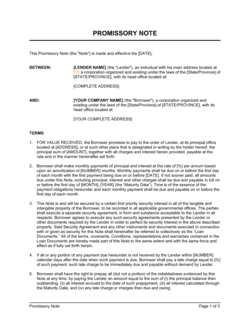
A promissory note creates the debt obligation itself — the borrower's written promise to repay a specific amount under defined terms. A subordination agreement does not create new debt; it modifies the priority of existing debt obligations relative to one another. A subordination agreement references and is subordinate to the promissory notes it governs.

Industry-specific considerations

Commercial Real Estate

Seller carry-back notes and second mortgages must be formally subordinated to the first-lien lender's deed of trust before title insurance can be issued on the senior position.

Banking and Financial Services

Senior bank lenders require subordination agreements as a standard closing condition whenever a borrower has existing shareholder loans, mezzanine debt, or other liens on the pledged collateral.

Private Equity and Venture Capital

Mezzanine and second-lien lenders negotiate detailed standstill periods, permitted payment buckets, and cure rights before subordinating to a senior credit facility in leveraged buyout transactions.

Small Business and SBA Lending

SBA Standard Operating Procedures require that all existing creditors with liens on business assets execute subordination agreements in favor of the SBA lender before an SBA 7(a) or 504 loan can close.

Jurisdictional notes

United States

Subordination agreements are enforceable in US bankruptcy proceedings under Section 510(a) of the Bankruptcy Code. For real property, the agreement must be recorded in the county land records to bind subsequent purchasers and lienholders. UCC Article 9 governs priority for personal property security interests; a subordination agreement between creditors is effective as a contractual reordering of UCC-perfected priorities. California, New York, and Texas each have specific recording and notarization requirements.

Canada

In Canada, contractual subordination is recognized under both federal insolvency legislation (the BIA and CCAA) and provincial property law. Real property subordination agreements must be registered in the applicable provincial land registry — requirements vary between common-law provinces and Quebec, where the Civil Code governs hypothec priority. Ontario's Personal Property Security Act and equivalent provincial statutes govern priority for personal property collateral, and a subordination agreement between creditors is effective as a contractual modification of PPSA-perfected priorities.

United Kingdom

UK courts enforce contractual subordination agreements as a matter of contract law. In insolvency, the Insolvency Act 1986 and the administration regime recognize creditor subordination arrangements, though the specific mechanics of enforcement differ from US bankruptcy. For real property, priority is governed by the Land Registration Act 2002 and the date of registration at HM Land Registry — a subordination agreement should be noted on the register where practicable. Security over company assets must also be registered at Companies House within 21 days of creation.

European Union

Contractual subordination is recognized across EU member states, but the enforceability mechanics in insolvency vary significantly by country. Germany, France, and the Netherlands each have distinct insolvency regimes that treat subordinated creditors differently. The EU Restructuring Directive (2019/1023) provides a framework for cross-class cram-down that can affect subordination arrangements in restructuring proceedings. GDPR considerations arise when personal data of natural-person creditors is included in the agreement documentation.

Template vs lawyer — what fits your deal?

PathBest forCostTime
Use the templateSBA loan closings requiring subordination of a single shareholder note under $250,000Free30–60 minutes
Template + legal reviewCommercial real estate transactions, multi-creditor structures, or any subordination involving collateral above $250,000$500–$1,500 for a transactional attorney review2–5 business days
Custom draftedLeveraged buyouts, complex intercreditor arrangements, mezzanine debt structures, or cross-border transactions$3,000–$15,000+1–4 weeks

Glossary

Subordination
The contractual act of agreeing that one creditor's claim or lien ranks behind another creditor's claim or lien in terms of repayment priority.
Senior Lender
The creditor whose debt and security interest take first priority — meaning they are repaid first and have first claim on collateral in a default or liquidation.
Junior Creditor
The creditor whose debt and security interest rank below the senior lender's, meaning they are repaid only after the senior obligation is satisfied.
Lien Priority
The order in which creditors have legal rights to a debtor's assets, typically established by recording date unless altered by a subordination agreement.
Standstill Obligation
A contractual restriction preventing the junior creditor from taking enforcement action — such as demanding payment, suing, or seizing collateral — for a defined period after a default.
Collateral
Assets pledged by the borrower to secure repayment of a debt, which the secured lender may seize and liquidate if the borrower defaults.
Intercreditor Agreement
A broader agreement between two or more creditors that governs their respective rights, payment priorities, and enforcement actions — a subordination agreement is often a component of an intercreditor arrangement.
Permitted Payments
Payments the senior lender expressly allows the borrower to make to the junior creditor — typically scheduled interest payments — without triggering a subordination breach.
Event of Default
A defined triggering event — such as missed payment, covenant breach, or insolvency filing — that activates the senior lender's enforcement rights and the junior creditor's standstill obligations.
Enforcement Action
Any step a creditor takes to collect on a debt or realize on collateral, including demand letters, litigation, foreclosure, or appointment of a receiver.
Subordinated Debt
Debt that contractually ranks below senior secured debt in priority of repayment, often carrying a higher interest rate to compensate for the elevated credit risk.

Part of your Business Operating System

This document is one of 3,000+ business & legal templates included in Business in a Box.

  • Fill-in-the-blanks — ready in minutes
  • 100% customizable Word document
  • Compatible with all office suites
  • Export to PDF and share electronically

Create your document in 3 simple steps.

From template to signed document — all inside one Business Operating System.
1
Download or open template

Access over 3,000+ business and legal templates for any business task, project or initiative.

2
Edit and fill in the blanks with AI

Customize your ready-made business document template and save it in the cloud.

3
Save, Share, Send, Sign

Share your files and folders with your team. Create a space of seamless collaboration.

Save time, save money, and create top-quality documents.

★★★★★

"Fantastic value! I'm not sure how I'd do without it. It's worth its weight in gold and paid back for itself many times."

Managing Director · Mall Farm
Robert Whalley
Managing Director, Mall Farm Proprietary Limited
★★★★★

"I have been using Business in a Box for years. It has been the most useful source of templates I have encountered. I recommend it to anyone."

Business Owner · 4+ years
Dr Michael John Freestone
Business Owner
★★★★★

"It has been a life saver so many times I have lost count. Business in a Box has saved me so much time and as you know, time is money."

Owner · Upstate Web
David G. Moore Jr.
Owner, Upstate Web

Run your business with a system — not scattered tools

Stop downloading documents. Start operating with clarity. Business in a Box gives you the Business Operating System used by over 250,000 companies worldwide to structure, run, and grow their business.

Start free · No credit card required