Mortgage Note Template

Free Word download β€’ Edit online β€’ Save & share with Drive β€’ Export to PDF

2 pagesβ€’20–30 min to fillβ€’Difficulty: Standardβ€’Signature requiredβ€’Legal review recommended
Learn more ↓
FreeMortgage Note Template

At a glance

What it is
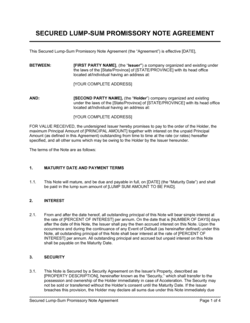
A Mortgage Note is a legally binding promissory note in which a borrower personally promises to repay a real estate loan β€” stating the principal amount, interest rate, payment schedule, and consequences of default. This free Word download gives you an attorney-reviewed starting point you can edit online and export as PDF, ready to record alongside your mortgage or deed of trust.
When you need it
Use it whenever a lender advances funds secured by real property β€” including private mortgage lending, seller-financed sales, hard-money loans, and refinances where a new note is required. The mortgage or deed of trust secures the property; this note creates the personal repayment obligation.
What's inside
Principal amount and disbursement date, interest rate and calculation method, payment schedule with amortization terms, prepayment rights, late-charge provisions, default and acceleration, due-on-sale clause, borrower representations, and governing law.

What is a Mortgage Note?

A Mortgage Note is a legally binding promissory note in which a borrower personally promises to repay a real estate loan β€” stating the exact principal amount, annual interest rate, payment schedule, maturity date, and the consequences of default. Unlike the accompanying mortgage or deed of trust, which pledges the property as collateral and is recorded in public land records, the mortgage note creates the borrower's personal repayment obligation. If the borrower defaults, the lender has two parallel remedies: foreclose on the secured property under the mortgage, and sue on the note for any remaining deficiency in states that permit recourse lending.

Why You Need This Document

Without a properly drafted mortgage note, a private lender or seller-financing transaction has no enforceable written record of the borrower's repayment obligation β€” leaving the lender dependent on oral testimony or informal correspondence to establish the debt's terms in court. Missing or ambiguous provisions on interest calculation, balloon payments, or default cure periods routinely produce litigation that costs more to resolve than the note would have cost to draft correctly. A clearly written mortgage note, signed before funds are disbursed and retained as an original instrument, defines exactly what the borrower owes, when they owe it, and what the lender can do if payments stop β€” giving both parties a single authoritative document that protects the transaction across its full term.

Which variant fits your situation?

If your situation is…Use this template
Unsecured personal or business loan with no real property collateralPromissory Note
Seller financing the sale of residential property to the buyerSeller Financing Agreement
Lender requires a deed of trust instead of a traditional mortgageDeed of Trust
Short-term bridge or hard-money loan with balloon paymentBalloon Payment Promissory Note
Commercial property acquisition with an institutional lenderCommercial Mortgage Agreement
Intra-family loan requiring IRS Applicable Federal Rate documentationFamily Loan Agreement
Refinance transaction replacing an existing noteLoan Modification Agreement

Common mistakes to avoid

❌ Mismatching the borrower name with title records

Why it matters: If the name on the note differs from the name on the deed, the lender's ability to foreclose is compromised β€” courts may require additional proceedings to establish standing.

Fix: Pull the current title commitment or deed before drafting and copy the vesting language exactly as it appears in the property records.

❌ Omitting a balloon payment disclosure

Why it matters: Borrowers who reach maturity expecting a $0 balance and instead face a six-figure balloon routinely dispute the note, claim fraud, and refuse to pay β€” triggering costly litigation.

Fix: State the balloon amount explicitly in the payment and maturity clauses and ensure the borrower initials that provision separately at signing.

❌ Setting an interest rate below the IRS Applicable Federal Rate on a private loan

Why it matters: The IRS imputes interest at the AFR regardless of the contracted rate, creating phantom income for the lender and a potential gift-tax issue for amounts below market rate.

Fix: Check the current AFR on the IRS website (published monthly) and set the note rate at or above the applicable tier β€” short-term, mid-term, or long-term β€” based on the loan's maturity.

❌ Using governing law from a state other than where the property is located

Why it matters: Courts routinely apply the law of the property's location regardless of the governing-law clause, particularly for residential mortgages β€” meaning your chosen state's more favorable foreclosure or prepayment rules may not apply.

Fix: Always set governing law to the state where the secured property is physically located, and confirm the note's terms comply with that state's mortgage lending statutes.

❌ Failing to retain the original signed note

Why it matters: Courts in most jurisdictions require production of the original promissory note β€” not a copy β€” to initiate foreclosure. A lost original triggers a separate legal proceeding to establish the debt and can delay enforcement by months.

Fix: Store the wet-ink original in a fireproof safe or with a title company. If the note is transferred or sold, execute a proper endorsement and track the chain of custody.

❌ Inconsistent default and cure terms between the note and the mortgage

Why it matters: If the note gives 15 days to cure a default and the mortgage gives 30, a lender who follows the note's shorter timeline may have a procedurally defective foreclosure dismissed.

Fix: Draft both documents together and cross-reference default, notice, and cure provisions explicitly β€” or use matching boilerplate from the same template set.

The 10 key clauses, explained

Parties, Loan Amount, and Disbursement Date

In plain language: Identifies the lender and borrower by legal name, states the exact principal advanced, and records the date funds were or will be disbursed.

Sample language
For value received, [BORROWER FULL NAME] ('Borrower') promises to pay to the order of [LENDER FULL NAME] ('Lender') the principal sum of [DOLLAR AMOUNT] ($[AMOUNT]), disbursed on [DATE], together with interest as set forth herein.

Common mistake: Using a nickname or business trade name instead of the registered legal entity. If the borrower name on the note doesn't match title records, foreclosure proceedings become significantly more complicated.

Interest Rate and Calculation Method

In plain language: States whether the rate is fixed or adjustable, the annual percentage rate, and how daily interest is calculated β€” typically on a 365-day or 30/360 basis.

Sample language
Interest shall accrue on the unpaid principal balance at [X.XX]% per annum, fixed, calculated on the basis of a 365-day year and the actual number of days elapsed.

Common mistake: Omitting the interest calculation basis. A 30/360 convention versus an actual/365 method produces materially different amounts on large balances, and ambiguity leads to payment disputes.

Payment Schedule and Amortization

In plain language: Defines the payment amount, due date, payment frequency, and how each payment is applied β€” first to interest accrued, then to principal.

Sample language
Borrower shall pay [MONTHLY / QUARTERLY] installments of $[PAYMENT AMOUNT], beginning on [FIRST PAYMENT DATE] and continuing on the same day of each [month / quarter] thereafter, until the Maturity Date. Each payment shall be applied first to accrued interest, then to principal.

Common mistake: Specifying a payment amount that doesn't fully amortize the loan by the stated maturity date, unintentionally creating an undisclosed balloon. Run amortization math before inserting numbers.

Maturity Date and Balloon Payment

In plain language: States when the entire outstanding balance β€” principal plus accrued interest β€” becomes due, whether the loan fully amortizes or carries a balloon.

Sample language
The entire outstanding principal balance, together with all accrued and unpaid interest and charges, shall be due and payable in full on [MATURITY DATE] ('Maturity Date'). If not sooner paid, Borrower shall pay a final balloon payment of approximately $[BALLOON AMOUNT] on the Maturity Date.

Common mistake: Failing to state explicitly whether a balloon exists. Borrowers who discover an unexpected balloon payment at maturity routinely claim they were never told β€” creating litigation regardless of who is right.

Prepayment Rights and Penalty

In plain language: States whether the borrower may pay ahead of schedule, whether a penalty applies, and how prepayments are applied to the outstanding balance.

Sample language
Borrower may prepay the principal in whole or in part at any time [without penalty / subject to a prepayment fee of [X]% of the amount prepaid if prepayment occurs within [X] years of the disbursement date]. Prepayments shall be applied to principal in the inverse order of maturity.

Common mistake: Drafting a prepayment clause that conflicts with applicable state law. Several states cap or prohibit prepayment penalties on residential loans β€” including California and Texas β€” regardless of what the note says.

Late Charge Provision

In plain language: Defines the grace period after the due date and the fee charged if payment is not received within that window.

Sample language
If any installment is not received by Lender within [15] calendar days after its due date, Borrower shall pay a late charge of [5]% of the overdue installment. This late charge is intended to compensate Lender for the cost of collection and is not a penalty.

Common mistake: Setting a grace period shorter than what state law requires. Many states mandate at minimum a 10-day grace period on residential mortgage loans β€” a shorter contractual period is unenforceable and can expose the lender to regulatory liability.

Default and Acceleration

In plain language: Lists the events that constitute default, states the notice and cure period the borrower receives, and confirms the lender's right to accelerate the full balance if the default is not cured.

Sample language
Borrower shall be in default if: (a) any payment is not received within [15] days of its due date; (b) Borrower fails to maintain required insurance or taxes on the property; or (c) Borrower files for bankruptcy. Upon default, Lender may, after providing [30] days' written notice and opportunity to cure, declare the entire outstanding balance immediately due and payable.

Common mistake: No cure period before acceleration. Courts in most jurisdictions require that lenders provide a reasonable opportunity to cure a payment default before accelerating β€” omitting the cure provision creates a procedurally defective note.

Due-on-Sale Clause

In plain language: Requires the borrower to repay the note in full if the secured property is sold, transferred, or encumbered without the lender's written consent.

Sample language
If all or any part of the Property, or any interest therein, is sold, transferred, or encumbered by Borrower without Lender's prior written consent, Lender may, at its option, require immediate payment in full of all sums secured by this Note.

Common mistake: Omitting the due-on-sale clause entirely in a private mortgage. Without it, the borrower can transfer the property β€” and the lender has no contractual right to demand repayment or review the new owner's creditworthiness.

Borrower Representations and Waivers

In plain language: Records the borrower's acknowledgment that they received the note, understood its terms, and waives certain defenses β€” presentment, notice of dishonor, and demand β€” that would otherwise require the lender to follow additional procedural steps before collecting.

Sample language
Borrower represents that Borrower has read and understands this Note and has had the opportunity to consult with counsel. Borrower waives presentment, demand for payment, notice of dishonor, and protest.

Common mistake: Relying on boilerplate waivers without ensuring the borrower actually signed and dated the note at closing. An unsigned waiver block is no waiver at all.

Governing Law and Severability

In plain language: Specifies which jurisdiction's law governs the note and states that if any provision is found unenforceable, the remainder of the note survives.

Sample language
This Note shall be governed by the laws of the State of [STATE], without regard to its conflict of law principles. If any provision of this Note is held invalid or unenforceable, the remaining provisions shall continue in full force and effect.

Common mistake: Choosing a governing state with no connection to the property location. Courts routinely override governing-law clauses in favor of the state where the real property is located, particularly for residential mortgage notes.

How to fill it out

  1. 1

    Enter the legal names of borrower and lender

    Use the full registered legal name for any entity β€” LLC, corporation, trust β€” and the legal name matching government-issued ID for individuals. Confirm that the borrower's name matches exactly how they hold title to the secured property.

    πŸ’‘ If the property is held in a trust, the trustee signs in their capacity as trustee β€” 'Jane Doe, as Trustee of the Jane Doe Living Trust' β€” not in their personal capacity.

  2. 2

    State the principal amount and disbursement date

    Enter the exact dollar amount being lent and the date funds are transferred. If the loan is funded in stages, note each tranche date and amount separately or in a schedule.

    πŸ’‘ For seller-financed transactions, the principal is typically the purchase price minus the buyer's down payment β€” confirm this figure matches the purchase agreement exactly.

  3. 3

    Set the interest rate and calculation basis

    Choose fixed or adjustable rate and enter the annual percentage. Specify whether interest accrues on a 365-day or 30/360 basis, and confirm the rate meets the IRS Applicable Federal Rate for intra-family loans.

    πŸ’‘ For private loans between family members or related parties, the IRS requires a minimum interest rate (the AFR) β€” lending below this rate creates imputed interest income for the lender and a gift tax issue.

  4. 4

    Define the payment schedule precisely

    Enter the installment amount, payment frequency (monthly is standard), first payment date, and final maturity date. Run the full amortization schedule to confirm that scheduled payments retire the loan exactly at maturity, or explicitly state a balloon amount.

    πŸ’‘ Use an amortization calculator to verify the payment amount before inserting it β€” even small rounding errors compound over a 15- or 30-year term.

  5. 5

    Set prepayment, late-charge, and grace-period terms

    Decide whether prepayment is permitted freely or with a penalty, and enter any penalty formula. Set the grace period (10–15 days is typical) and the late-charge percentage (3–5% of the overdue installment is standard).

    πŸ’‘ Check your state's residential mortgage statutes before finalizing these figures β€” California, Texas, and several other states cap late fees and prohibit certain prepayment penalties by statute.

  6. 6

    Draft the default, cure, and acceleration terms

    List the events of default, the written notice period the borrower receives before acceleration (30 days is standard for residential loans), and the cure window. Confirm these align with the parallel default provisions in the accompanying mortgage or deed of trust.

    πŸ’‘ The default language in the note and the mortgage must be consistent β€” conflicting cure periods between the two documents create procedural defects that delay foreclosure.

  7. 7

    Include the due-on-sale clause and confirm governing law

    Activate the due-on-sale provision unless you intend to allow the note to be assumed by a future buyer. Confirm the governing law matches the state where the secured property is located.

    πŸ’‘ Federal law under the Garn-St. Germain Act preempts most state restrictions on due-on-sale enforcement for residential loans β€” but certain transfers (death of borrower, divorce, transfer to a child) are exempt from triggering the clause.

  8. 8

    Execute, notarize if required, and record

    Have the borrower sign and date the note at closing, before any funds are disbursed. While the note itself is typically not recorded, the accompanying mortgage or deed of trust must be recorded in the county property records to perfect the lien.

    πŸ’‘ Retain the original signed note in a secure location β€” the original instrument is required to enforce the note or initiate foreclosure in most jurisdictions, and a lost original requires a court proceeding to replace.

Frequently asked questions

What is a mortgage note?

A mortgage note is a promissory note β€” a written, legally binding promise by a borrower to repay a specific loan amount with interest on a defined schedule β€” that is secured by real property. The note creates the personal debt obligation; the accompanying mortgage or deed of trust pledges the property as collateral. If the borrower defaults, the lender can foreclose on the property and also pursue the borrower personally on the note, depending on whether the loan is recourse or non-recourse.

What is the difference between a mortgage and a mortgage note?

A mortgage (or deed of trust) is the security instrument β€” it pledges the real property as collateral and is recorded in county property records to create a lien. A mortgage note is the debt instrument β€” it is the borrower's personal promise to repay the loan. Both documents are executed at closing, but they serve distinct legal functions: you can have a note without a recorded mortgage (an unsecured loan), but a mortgage without a note creates a lien with no corresponding repayment obligation to enforce.

Does a mortgage note need to be notarized?

In most US states, the promissory note itself does not require notarization to be enforceable between the parties. However, the accompanying mortgage or deed of trust generally must be notarized before it can be recorded in county land records. Requirements vary by state β€” some states require notarization of both documents for recording. Always confirm local county recorder requirements before closing.

Can a mortgage note be transferred or sold?

Yes. A mortgage note is a negotiable instrument and can be transferred by endorsement and delivery to another party β€” a common practice in secondary mortgage markets. The transfer must be documented through an endorsement on the note itself or an allonge (an attachment). The corresponding mortgage or deed of trust is transferred via a separate recorded assignment. Borrowers must be notified of the transfer and should direct future payments to the new note holder.

What happens if a borrower defaults on a mortgage note?

Upon default β€” typically a missed payment β€” the lender issues a written notice giving the borrower a cure period (commonly 30 days for residential loans). If the default is not cured, the lender may accelerate the entire outstanding balance, then initiate foreclosure proceedings under the mortgage or deed of trust. In recourse states, the lender may also pursue a deficiency judgment against the borrower personally for any shortfall after the foreclosure sale.

What is a due-on-sale clause in a mortgage note?

A due-on-sale clause gives the lender the right to demand full repayment of the note if the borrower sells or transfers the secured property without prior written lender consent. It prevents a buyer from assuming the existing loan without the lender's approval. Under the federal Garn-St. Germain Depository Institutions Act, lenders on most residential loans can enforce due-on-sale clauses, though certain transfers β€” such as transfers to a surviving spouse or child upon the borrower's death β€” are exempt.

What interest rate should I use on a private mortgage note?

The rate must at minimum equal the IRS Applicable Federal Rate (AFR) for the applicable loan term β€” short-term (up to 3 years), mid-term (3–9 years), or long-term (over 9 years). The IRS publishes the AFR monthly. Loans between related parties β€” family members, controlled entities β€” that carry a rate below the AFR are subject to imputed interest rules, which recharacterize part of the principal payments as interest income for the lender regardless of what the note says.

Do I need a lawyer to prepare a mortgage note?

For standard private mortgage lending or straightforward seller-financing transactions in a single state, a high-quality template combined with a brief attorney review is typically sufficient. Engage a real estate attorney when the transaction involves a trust, LLC, or corporate entity; when the loan crosses state lines; when the amount exceeds $500,000; or when complex terms such as adjustable rates, participation interests, or cross-collateralization are involved. Attorney review of a mortgage note typically costs $300–$800 and is worthwhile given that the document governs a secured debt that may span decades.

What is the difference between a recourse and non-recourse mortgage note?

On a recourse mortgage note, if foreclosure proceeds are insufficient to cover the outstanding debt, the lender can pursue the borrower's other personal assets β€” bank accounts, wages, other property β€” through a deficiency judgment. On a non-recourse note, the lender's recovery is limited to the secured property only. Many states β€” including California for purchase-money residential loans β€” prohibit or restrict deficiency judgments by statute, effectively making certain loans non-recourse by operation of law regardless of what the note says.

How this compares to alternatives

vs Promissory Note

A promissory note is an unsecured debt instrument β€” the borrower promises to repay but pledges no specific collateral. A mortgage note is a promissory note specifically tied to real property, with an accompanying mortgage or deed of trust that creates an enforceable lien. Use a standard promissory note for personal or business loans; use a mortgage note when real property secures the debt.

vs Mortgage Agreement

A mortgage agreement (or deed of trust) is the security instrument that pledges the property as collateral and is recorded in public land records. The mortgage note is the debt instrument β€” the personal repayment promise. Both documents are executed together at closing and cross-reference each other; neither alone fully documents a real estate loan.

vs Loan Agreement

A loan agreement is a detailed bilateral contract covering disbursement conditions, representations, covenants, and events of default β€” typically used for business or commercial lending. A mortgage note is a simpler, borrower-executed instrument focused solely on the repayment obligation. Complex commercial real estate transactions often use both: a loan agreement governing the lending relationship and a mortgage note as the negotiable instrument.

vs Deed of Trust

A deed of trust transfers legal title to a neutral third-party trustee as security rather than directly to the lender, allowing non-judicial foreclosure in states that recognize it β€” typically faster and cheaper than judicial foreclosure under a traditional mortgage. The mortgage note is used alongside either a mortgage or a deed of trust depending on the state; the choice of security instrument does not affect the note's structure.

Industry-specific considerations

Real Estate Investment

Short-term bridge and hard-money notes with balloon maturities, interest-only periods, and higher rates reflecting the elevated risk profile of fix-and-flip or distressed-asset financing.

Financial Services

Mortgage note origination, secondary-market sales via endorsement and assignment, and servicing transfers requiring accurate note documentation and chain-of-title tracking.

Agriculture and Rural Property

Seller-financed farm and ranch transactions where institutional financing is unavailable, often structured with seasonal payment schedules aligned to harvest or livestock sale cycles.

Professional Services

Attorneys, title agents, and escrow officers who prepare closing packages for private lending transactions and seller-carry deals outside standard bank channels.

Jurisdictional notes

United States

Mortgage note law is primarily state-governed, with significant variation in foreclosure process (judicial vs. non-judicial), deficiency judgment rights, prepayment penalty limits, and mandatory grace periods. California prohibits deficiency judgments on purchase-money residential loans and bans most prepayment penalties after five years. The Garn-St. Germain Act provides federal due-on-sale enforcement rights for most residential lenders. Fannie Mae and Freddie Mac publish standardized note forms (Form 3200 series) that are required for any loan intended for secondary-market sale.

Canada

Private mortgage lending in Canada is governed by provincial law β€” Ontario's Mortgages Act and British Columbia's Land Title Act are the primary frameworks. Most private notes follow a standard interest-act calculation requiring an annual or semi-annual compounding disclosure; failure to comply with the Interest Act can limit the lender to 5% interest regardless of the contracted rate. Quebec treats mortgages as hypothecs under the Civil Code, requiring notarial form. Foreclosure (judicial sale or power of sale depending on province) timelines range from 3 months in BC to 12+ months in Ontario.

United Kingdom

In England and Wales, the equivalent of a mortgage note is the mortgage deed, which must be executed as a deed (signed, witnessed, and delivered) and registered with HM Land Registry within two months of completion to be binding on third parties. The Financial Conduct Authority regulates most residential mortgage lending under the Mortgage Credit Directive, requiring lender authorization for regulated activity. Private lending between individuals on residential property is subject to FCA consumer credit rules if the borrower is not a business.

European Union

The EU Mortgage Credit Directive (2014/17/EU) harmonizes consumer mortgage standards across member states, requiring standardized pre-contractual information (ESIS), a 7-day reflection period before signing, and an early repayment right with capped compensation. Individual member states implement significant variations: France requires notarial form for mortgage instruments; Germany uses a Grundschuld (land charge) structure rather than a traditional mortgage note; the Netherlands requires notarial deed registration. Cross-border private loans must comply with the law of the member state where the property is located.

Template vs lawyer β€” what fits your deal?

PathBest forCostTime
Use the templatePrivate lenders and seller-financing transactions under $500,000 in a single state with straightforward fixed-rate, fully-amortizing termsFree30–60 minutes
Template + legal reviewLoans involving entities (LLC, trust, corporation), balloon payments, adjustable rates, or borrowers in states with complex mortgage lending regulations$300–$8002–5 days
Custom draftedCommercial real estate loans above $500,000, multi-state collateral, participation interests, cross-collateralization, or secondary-market sale requirements$1,500–$5,000+1–3 weeks

Glossary

Promissory Note
A written promise to repay a specified sum under defined terms β€” the personal debt obligation that the mortgage or deed of trust secures against real property.
Principal
The original loan amount advanced by the lender, before interest or fees accrue.
Amortization
The gradual repayment of principal through scheduled installments, so that each payment reduces the outstanding balance until the loan is fully paid.
Acceleration Clause
A provision allowing the lender to demand the entire outstanding balance immediately upon a defined event, typically default or sale of the property.
Due-on-Sale Clause
A lender's right to require full repayment of the note if the borrower transfers ownership of the secured property without prior lender consent.
Balloon Payment
A lump-sum payment of remaining principal due at the end of a loan term that is shorter than the full amortization period.
Applicable Federal Rate (AFR)
The minimum interest rate published monthly by the IRS that must be charged on private loans β€” including family loans β€” to avoid imputed interest tax consequences.
Deed of Trust
An alternative to a traditional mortgage in which title is conveyed to a neutral third-party trustee as security, rather than directly to the lender.
Default
A borrower's failure to perform any obligation in the note β€” most commonly missing a payment β€” that triggers the lender's remedies including acceleration and foreclosure.
Prepayment Penalty
A charge the lender may impose if the borrower repays all or part of the principal before the scheduled payoff date.
Late Charge
A fee assessed when a scheduled payment is received after the contractual grace period, typically expressed as a percentage of the overdue installment.
Recourse vs. Non-Recourse
A recourse note allows the lender to pursue the borrower's personal assets after foreclosure if the property sale doesn't cover the debt; a non-recourse note limits recovery to the property only.

Part of your Business Operating System

This document is one of 3,000+ business & legal templates included in Business in a Box.

  • Fill-in-the-blanks β€” ready in minutes
  • 100% customizable Word document
  • Compatible with all office suites
  • Export to PDF and share electronically

Create your document in 3 simple steps.

From template to signed document β€” all inside one Business Operating System.
1
Download or open template

Access over 3,000+ business and legal templates for any business task, project or initiative.

2
Edit and fill in the blanks with AI

Customize your ready-made business document template and save it in the cloud.

3
Save, Share, Send, Sign

Share your files and folders with your team. Create a space of seamless collaboration.

Save time, save money, and create top-quality documents.

β˜…β˜…β˜…β˜…β˜…

"Fantastic value! I'm not sure how I'd do without it. It's worth its weight in gold and paid back for itself many times."

Managing Director Β· Mall Farm
Robert Whalley
Managing Director, Mall Farm Proprietary Limited
β˜…β˜…β˜…β˜…β˜…

"I have been using Business in a Box for years. It has been the most useful source of templates I have encountered. I recommend it to anyone."

Business Owner Β· 4+ years
Dr Michael John Freestone
Business Owner
β˜…β˜…β˜…β˜…β˜…

"It has been a life saver so many times I have lost count. Business in a Box has saved me so much time and as you know, time is money."

Owner Β· Upstate Web
David G. Moore Jr.
Owner, Upstate Web

Run your business with a system β€” not scattered tools

Stop downloading documents. Start operating with clarity. Business in a Box gives you the Business Operating System used by over 250,000 companies worldwide to structure, run, and grow their business.

Free Forever PlanΒ Β·Β No credit card required