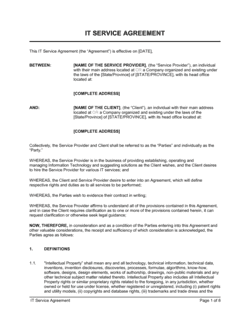
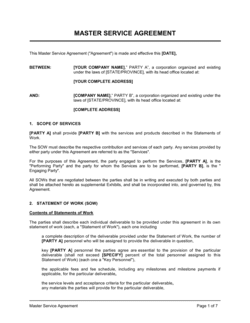
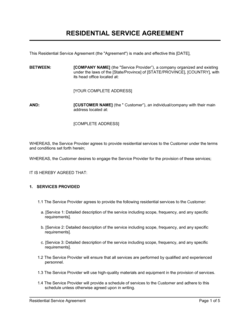
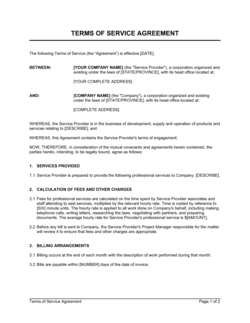
SaaS Agreement Template

Free Word download • Edit online • Save & share with Drive • Export to PDF

7 pages25–35 min to fillDifficulty: ComplexSignature requiredLegal review recommended
Learn more ↓
FreeSaaS Agreement Template

At a glance

What it is
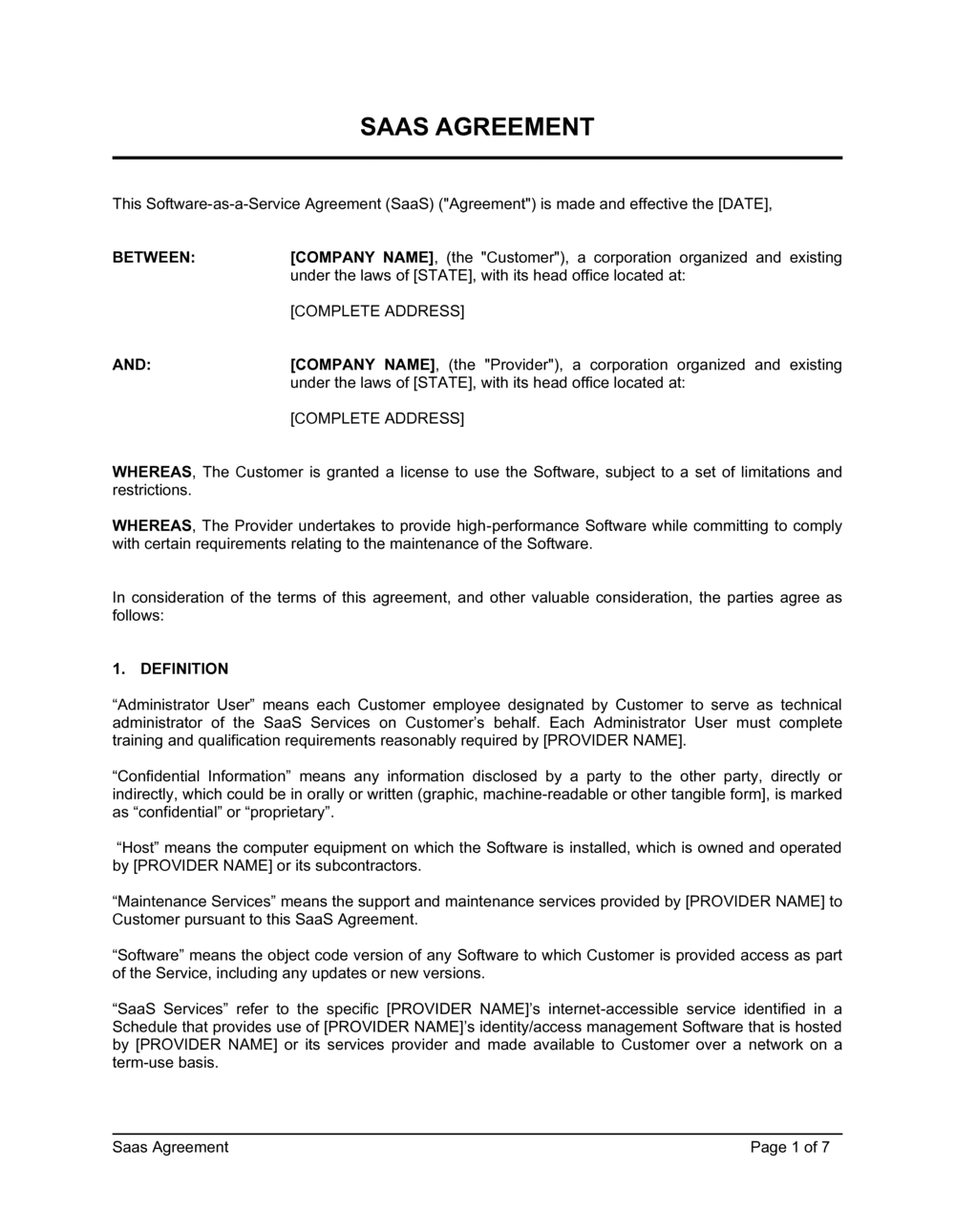
A SaaS Agreement is a legally binding contract between a software-as-a-service provider and a customer that governs access to a cloud-hosted software platform on a subscription basis. This free Word download covers subscription fees, usage rights, data ownership, service-level commitments, confidentiality, IP assignment, and termination in a single document you can edit online and export as PDF.
When you need it
Use it whenever you license a cloud software product to paying customers — whether at initial product launch, when onboarding enterprise clients who require a signed agreement, or when replacing informal terms-of-service click- wraps with a negotiated contract for high-value accounts.
What's inside
Subscription scope and fees, acceptable use policy, data processing and privacy obligations, service-level agreement and uptime commitments, intellectual property ownership, confidentiality, indemnification, limitation of liability, and termination and off-boarding provisions.

What is a SaaS Agreement?

A SaaS Agreement is a legally binding contract between a cloud software provider and a customer that governs subscription-based access to a hosted software platform. Unlike a traditional software license — where the customer receives a copy of the program to install on their own servers — a SaaS agreement covers a continuous service relationship: the provider hosts the software, maintains the infrastructure, and commits to performance standards, while the customer pays a recurring fee for access. The agreement defines authorized users, subscription fees, uptime obligations, data ownership, IP rights, confidentiality, liability limits, and the terms on which either party may exit the relationship.

Why You Need This Document

Without a signed SaaS agreement, you are exposed on four critical fronts simultaneously. First, your intellectual property — the platform you built — is accessible to customers under no documented restrictions on reverse engineering, resale, or misuse. Second, your customer's data sits in your systems with no explicit ownership clause, creating regulatory exposure under GDPR, CCPA, and sector-specific laws the moment a regulator or auditor asks who is responsible for that data. Third, enterprise procurement teams will not close a deal — regardless of how strong your product is — without a countersigned contract covering SLA commitments and data-security obligations. Fourth, a customer who churns with no data-return clause in place can hold your support team hostage until you manually export their records under threat of legal action. This template gives you a market-standard starting point that closes all four gaps, signals professionalism to buyers, and reduces the negotiation cycle on every enterprise deal you pursue.

Which variant fits your situation?

If your situation is…Use this template
Licensing software to individual consumers or SMBs via self-serve checkoutSaaS Terms of Service
Onboarding an enterprise customer requiring negotiated contract termsSaaS Agreement (Enterprise)
Processing personal data on behalf of EU or UK customersData Processing Agreement (DPA)
Reselling or white-labeling a SaaS platform to third partiesSoftware Reseller Agreement
Providing a free trial or pilot with an option to convertSoftware Pilot Agreement
Licensing on-premise software instead of a hosted cloud productSoftware License Agreement
Engaging a developer to build or customize the SaaS platformSoftware Development Agreement

Common mistakes to avoid

❌ Provisioning access before the agreement is signed

Why it matters: Access given before execution creates an implied license on whatever terms were communicated informally — typically the customer's most favorable interpretation of pricing and SLA.

Fix: Make signature a technical prerequisite for account provisioning. eSign tools with automated access triggers enforce this without manual follow-up.

❌ Using a click-wrap terms-of-service for enterprise deals

Why it matters: Enterprise procurement teams routinely reject click-wrap terms as unenforceable or legally insufficient, stalling deals for weeks while a negotiated contract is drafted from scratch.

Fix: Maintain a pre-negotiated SaaS Agreement template for enterprise accounts and a separate online terms for self-serve customers — never apply the same document to both.

❌ Granting an overly broad data-use license

Why it matters: Language permitting the provider to use customer data 'to improve the service' has been interpreted by regulators and courts to include AI model training, data monetization, and sharing with third-party analytics providers.

Fix: Limit permitted data uses to 'providing and supporting the contracted Services' and require explicit written consent for any other use.

❌ No SLA remedy or service credit formula

Why it matters: An SLA that commits to 99.9% uptime but provides no remedy for missing it is unenforceable as a commercial matter and signals to enterprise buyers that the provider has no confidence in its own infrastructure.

Fix: Tie every uptime commitment to a specific, calculable service credit — for example, 5% of monthly fees for each full hour of downtime beyond the permitted threshold.

❌ Omitting a data return and deletion clause

Why it matters: Customers who cannot export their data on termination face immediate operational crises and regulatory exposure under GDPR, CCPA, and sector-specific data retention rules.

Fix: Commit to a specific export window (minimum 30 days) and a deletion timeline (90 days post-termination) with written confirmation of deletion on request.

❌ No limitation of liability carve-outs for gross negligence or data breaches

Why it matters: A liability cap that applies even to the provider's deliberate misconduct or negligent data breach is often unenforceable and will be struck down by courts in the UK, EU, and several US states.

Fix: Exclude from the cap: losses arising from gross negligence or willful misconduct, IP indemnification obligations, breaches of the confidentiality clause, and death or personal injury caused by either party.

The 10 key clauses, explained

Subscription Grant and Scope of Use

In plain language: Defines what the customer is actually licensed to do — access the platform, number of seats or users, permitted use cases — and what is expressly excluded.

Sample language
[PROVIDER NAME] grants [CUSTOMER NAME] a non-exclusive, non-transferable, limited license to access and use [PLATFORM NAME] during the Subscription Term solely for [CUSTOMER]'s internal business purposes, for up to [NUMBER] authorized users.

Common mistake: Failing to define 'authorized users' or 'internal business purposes.' Customers have shared credentials across organizations or resold access to third parties, voiding the license and creating revenue leakage.

Fees, Payment, and Auto-Renewal

In plain language: States the subscription price, billing frequency, accepted payment methods, late-payment penalties, and the auto-renewal mechanism with required notice period to cancel.

Sample language
Customer shall pay [PROVIDER] a subscription fee of $[AMOUNT] per [month/year], due in advance on the [DATE] of each billing period. Invoices not paid within [30] days accrue interest at [1.5]% per month. The Subscription Term renews automatically unless either party provides [30] days' written notice prior to the renewal date.

Common mistake: Omitting the cancellation notice period for auto-renewal. Without a stated deadline, customers claim they cancelled in time and dispute charges — resulting in chargebacks and relationship damage.

Service-Level Agreement and Uptime Commitment

In plain language: Commits the provider to a specific monthly uptime percentage, defines scheduled maintenance windows, and specifies the service credits owed to the customer if the SLA is missed.

Sample language
[PROVIDER] shall use commercially reasonable efforts to ensure [PLATFORM NAME] is available [99.9]% of the time in each calendar month, excluding Scheduled Maintenance. If uptime falls below [99.9]%, Customer shall receive a service credit equal to [X]% of monthly fees for each [Y] hours of excess downtime.

Common mistake: Defining uptime without excluding scheduled maintenance windows. Any planned downtime counts against the SLA percentage, making even legitimate maintenance a technical breach.

Data Ownership and Customer Data

In plain language: Confirms that the customer retains ownership of all data they input or generate on the platform, and commits the provider to use that data only to deliver the contracted service.

Sample language
Customer retains all right, title, and interest in and to Customer Data. [PROVIDER] shall not access, use, or disclose Customer Data except as necessary to provide the Services or as required by applicable law. [PROVIDER] shall not sell, rent, or use Customer Data for advertising or product development without Customer's prior written consent.

Common mistake: Granting the provider a broad license to use customer data 'to improve products and services.' This language can permit training AI models or sharing aggregated data in ways customers never intended or consented to.

Data Processing and Privacy Compliance

In plain language: Governs the provider's processing of personal data on behalf of the customer, incorporating GDPR, CCPA, or other applicable privacy law obligations — including sub-processor disclosure and breach notification timelines.

Sample language
To the extent [PROVIDER] processes Personal Data on behalf of Customer, [PROVIDER] shall do so only on Customer's documented instructions, implement appropriate technical and organizational security measures, notify Customer of a confirmed data breach within [72] hours of discovery, and maintain a record of sub-processors available to Customer on request.

Common mistake: Treating data processing as a standard confidentiality clause rather than a standalone DPA obligation. Under GDPR Article 28, a processor without a compliant DPA exposes both parties to regulatory fines.

Intellectual Property Ownership and Restrictions

In plain language: Establishes that the provider owns the platform, all underlying code, and any improvements, while the customer owns their data and any separately-developed integrations.

Sample language
[PROVIDER] retains all intellectual property rights in [PLATFORM NAME], including all modifications, enhancements, and derivative works. Customer shall not reverse engineer, decompile, copy, or create derivative works of the platform. Customer retains ownership of Customer Data and Customer-developed integrations built using [PROVIDER]'s published API.

Common mistake: Not addressing ownership of custom features or configurations built at the customer's request. Without explicit language, both parties may claim ownership of bespoke functionality, leading to disputes on termination.

Confidentiality

In plain language: Requires both parties to protect each other's non-public business information — pricing, roadmaps, customer lists, technical architecture — and defines the limited exceptions when disclosure is permitted.

Sample language
Each party agrees to hold the other's Confidential Information in strict confidence using at least the same degree of care it applies to its own confidential information (but no less than reasonable care), and not to disclose it to any third party without prior written consent, except to employees or advisors who need it to perform obligations under this Agreement.

Common mistake: No time limit on confidentiality obligations post-termination. Perpetual confidentiality is difficult to enforce and creates compliance headaches; a 3–5 year post-termination period is the standard commercial approach.

Limitation of Liability and Disclaimer of Warranties

In plain language: Caps total financial liability for both parties (typically 12 months of fees paid) and disclaims implied warranties of fitness for purpose — protecting the provider from open-ended damage claims.

Sample language
In no event shall either party's total liability under this Agreement exceed the fees paid by Customer in the [12] months preceding the claim. Neither party shall be liable for indirect, incidental, consequential, or punitive damages, even if advised of the possibility of such damages. The Services are provided 'as is' without warranties beyond those expressly stated herein.

Common mistake: A limitation of liability clause that does not carve out exceptions for data breaches caused by the provider's gross negligence, IP indemnification obligations, or death and personal injury claims. Courts and regulators may refuse to enforce a cap that shields bad-faith conduct.

Term, Termination, and Off-Boarding

In plain language: Sets the initial subscription term, the conditions under which either party may terminate early (for cause or convenience), notice requirements, and the provider's obligation to return or delete customer data on exit.

Sample language
Either party may terminate this Agreement for material breach if the breach remains uncured [30] days after written notice. [PROVIDER] may terminate immediately if Customer fails to pay fees overdue by more than [60] days. On termination, [PROVIDER] shall make Customer Data available for export for [30] days, after which it shall be deleted within [90] days.

Common mistake: No data return or deletion timeline on termination. Customers who lose access to their data immediately upon cancellation face operational emergencies, regulatory exposure, and reputational damage — and will demand contractual remedies.

Governing Law and Dispute Resolution

In plain language: Specifies the jurisdiction whose laws govern the agreement and whether disputes go to arbitration, mediation, or court — including the forum and process for seeking injunctive relief.

Sample language
This Agreement shall be governed by the laws of [STATE/PROVINCE/COUNTRY] without regard to conflict-of-law principles. Any dispute not resolved by good-faith negotiation within [30] days shall be submitted to binding arbitration administered by [AAA/JAMS/ICC] in [CITY], except that either party may seek injunctive relief in any court of competent jurisdiction.

Common mistake: Choosing a governing law with no nexus to where either party operates. Some jurisdictions — including California — apply local law regardless of what the contract specifies, making a mismatched choice both unenforceable and misleading.

How to fill it out

  1. 1

    Identify the parties and platform

    Enter the provider's full legal entity name and registered address, the customer's legal entity name and billing address, and the precise commercial name of the software platform being licensed.

    💡 Use the provider's registered corporate name — not a product brand name — to ensure IP ownership and liability clauses bind the correct legal entity.

  2. 2

    Define the subscription scope and authorized users

    Specify the edition or tier of the platform being licensed, the number of authorized seats or users, and any permitted sub-entities or affiliates. State whether the license is per-user, per-instance, or usage-based.

    💡 Define 'authorized user' narrowly enough to prevent credential sharing but broadly enough to include employees who rotate into and out of the account.

  3. 3

    Set subscription fees, billing cycle, and renewal terms

    Enter the subscription price, billing frequency (monthly or annual), invoice due date, late-payment interest rate, and the advance notice period required to prevent auto-renewal.

    💡 Annual upfront billing with a 60-day cancellation notice window is standard for enterprise SaaS; monthly billing typically warrants a shorter 30-day notice period.

  4. 4

    Complete the SLA and uptime commitments

    Enter the monthly uptime target (e.g., 99.9%), define the scheduled maintenance window, and specify the service credit formula for SLA breaches — typically a percentage of monthly fees per hour of excess downtime.

    💡 Confirm your actual infrastructure uptime data before committing to an SLA percentage. Promising 99.9% when your cloud provider only guarantees 99.5% leaves a contractual gap.

  5. 5

    Address data ownership, processing, and privacy

    Confirm that the customer owns their data, limit the provider's permitted uses of that data to service delivery, and insert or reference a standalone Data Processing Agreement if the platform handles personal data governed by GDPR or CCPA.

    💡 For EU and UK customers, a compliant DPA is not optional — it is a regulatory requirement under GDPR Article 28 regardless of what the main agreement says.

  6. 6

    Set the limitation of liability cap and exclusions

    Enter the liability cap amount (typically total fees paid in the prior 12 months), list the categories of excluded consequential damages, and carve out exceptions for data breaches caused by the provider's gross negligence, IP indemnification, and death or personal injury.

    💡 Some enterprise customers will negotiate a higher cap for data-related breaches — a dual cap (e.g., 1× fees generally, 2× fees for data events) is an accepted market compromise.

  7. 7

    Define termination conditions and data off-boarding

    Set the cure period for breach-based termination (30 days is standard), the notice period for termination for convenience if permitted, and the data export window and deletion timeline the provider commits to after termination.

    💡 A 30-day data export window followed by a 90-day deletion window is the minimum enterprise customers expect — shorter windows routinely trigger negotiation delays.

  8. 8

    Select governing law and sign before go-live

    Choose a governing law jurisdiction with a real connection to the provider's operations, complete the signature blocks with authorized signatories for both parties, and execute before the customer is given access to the platform.

    💡 Use Business in a Box eSign to timestamp execution and store the countersigned copy — access provisioning before signature creates an implied-contract risk that dilutes your terms.

Frequently asked questions

What is a SaaS agreement?

A SaaS agreement is a legally binding contract between a cloud software provider and a customer that governs subscription access to a hosted platform. It defines the scope of the license, subscription fees and billing terms, uptime commitments, data ownership and privacy obligations, intellectual property rights, liability limits, and termination conditions. Unlike a software license agreement for on-premise software, a SaaS agreement is built around continuous service delivery and data custody.

What should a SaaS agreement include?

A complete SaaS agreement covers ten core areas: subscription grant and authorized user definition, fees and auto-renewal terms, service-level agreement with uptime commitments and service credits, data ownership and permitted data uses, data processing and privacy compliance obligations, IP ownership and use restrictions, confidentiality, limitation of liability and warranty disclaimers, termination conditions and data off-boarding, and governing law and dispute resolution. Missing any of these creates gaps that enterprise buyers will flag during procurement review.

Is a SaaS agreement the same as terms of service?

No. Terms of service are a click-wrap, unilateral document designed for self-serve or consumer customers — they are not individually negotiated and are accepted by clicking a checkbox. A SaaS agreement is a bilaterally signed contract, typically used for mid-market and enterprise accounts where the customer requires negotiated terms, a signed commitment from the provider, and specific data-security and SLA provisions. Many SaaS companies maintain both: terms of service for self-serve and a negotiated SaaS agreement for larger accounts.

Who owns customer data under a SaaS agreement?

The customer retains ownership of all data they upload, input, or generate within the platform. The SaaS agreement should confirm this explicitly and limit the provider's permitted uses of that data to delivering the contracted service. The provider should not sell, rent, use for advertising, or train AI models on customer data without separate, explicit written consent. On termination, the provider is generally obligated to return the data in a portable format and delete it within a defined period.

What is a reasonable SLA uptime commitment for a SaaS product?

99.9% monthly uptime (approximately 43 minutes of permitted downtime per month) is the standard commercial baseline for most SaaS products. Mission-critical platforms — financial infrastructure, healthcare systems, or real-time communications tools — typically commit to 99.95% or 99.99%. The SLA must exclude scheduled maintenance windows, upstream provider outages if they are disclosed in advance, and downtime caused by the customer's own actions. Always tie the uptime commitment to a calculable service credit remedy.

Do I need a Data Processing Agreement as part of my SaaS agreement?

Yes, if your platform processes personal data on behalf of customers who are subject to GDPR, UK GDPR, CCPA, or similar privacy regulations. Under GDPR Article 28, a processor — which is what the SaaS provider is — must have a compliant Data Processing Agreement in place before handling any EU personal data. A DPA can be embedded in the SaaS agreement or executed as a separate addendum. Failing to have one exposes both the provider and the customer to regulatory fines.

What liability cap is standard in a SaaS agreement?

The most widely accepted liability cap is total fees paid by the customer in the 12 months preceding the claim. Some enterprise customers negotiate a dual cap — a general cap of 12 months' fees and an elevated cap of 24 months' fees for data-related events. The cap should exclude liability for gross negligence or willful misconduct, IP indemnification obligations, breaches of the confidentiality clause, and — in the UK and EU — death or personal injury. A cap that does not carve out these categories is often unenforceable.

Can a SaaS provider terminate the agreement if a customer doesn't pay?

Yes, but the agreement should specify the process clearly. A standard approach is to allow termination for non-payment after the invoice has been overdue for 30–60 days and the customer has received written notice with a cure period of at least 10 business days. Immediate termination without notice exposes the provider to breach claims if the customer disputes the invoice. Suspending access pending payment — rather than terminating outright — is a common and commercially reasonable intermediate step.

Do I need a lawyer to draft a SaaS agreement?

For self-serve or low-value accounts, a well-constructed template is generally sufficient. Engage a lawyer when closing enterprise deals above $25,000 annually, when processing sensitive personal data governed by GDPR or HIPAA, when operating in regulated industries such as financial services or healthcare, or when the customer insists on significant redlines to the standard form. A 2–3 hour template review typically costs $500–$900 and is worthwhile for any deal where data liability or IP ownership is material.

How this compares to alternatives

vs Software License Agreement

A software license agreement governs on-premise software installed on the customer's own servers — the customer receives a perpetual or term license to a specific version. A SaaS agreement governs cloud-hosted software delivered as a continuous service, where the provider retains the software, hosts the data, and commits to uptime. SaaS customers never receive a copy of the software; they buy access.

vs Software Development Agreement

A software development agreement governs the creation of custom software — the scope of work, milestones, IP ownership of the deliverable, and acceptance criteria. A SaaS agreement governs access to an already-built platform on a subscription basis. If a developer builds a custom platform and then hosts it for the client, both agreements may be needed: one for the build, one for ongoing access.

vs Master Service Agreement

A master service agreement sets broad commercial terms for an ongoing relationship — payment, confidentiality, liability, and dispute resolution — and governs multiple statements of work beneath it. A SaaS agreement is a self-contained document specific to cloud software access. Some enterprise providers use an MSA plus a SaaS-specific order form; for most SaaS businesses, a standalone SaaS agreement covering all terms is simpler and preferred.

vs Terms of Service

Terms of service are a unilateral, click-wrap document published on a website and accepted by user action — they are not individually negotiated or countersigned. A SaaS agreement is a bilaterally executed contract providing stronger enforceability, individually negotiated terms, and the data-processing and SLA provisions that enterprise customers require. Use terms of service for self-serve accounts and a signed SaaS agreement for enterprise relationships.

Industry-specific considerations

Financial Services and Fintech

Enhanced data-security standards, SOC 2 Type II and PCI-DSS compliance references, financial data confidentiality provisions, and regulatory audit-access rights for supervisory authorities.

Healthcare and MedTech

HIPAA Business Associate Agreement incorporated by reference or attached as an addendum, PHI handling restrictions, breach notification within 60 days under HIPAA's Breach Notification Rule, and data residency requirements.

SaaS and Technology

API rate limits and fair-use policies, multi-tenant data isolation commitments, version deprecation and backward-compatibility notice periods, and open-source component disclosures.

Professional Services and Consulting

Client-confidentiality pass-through obligations, data segmentation between multiple client workspaces, and billing tied to active project seats rather than named users.

Retail and E-commerce

Integration with payment processors and PCI-DSS scope clarification, seasonal traffic and auto-scaling SLA provisions, and consumer data handling under CCPA and similar state privacy laws.

Education and EdTech

FERPA and COPPA compliance obligations for student data, parental consent requirements for users under 13, and data deletion rights triggered by student or institutional off-boarding.

Jurisdictional notes

United States

No single federal SaaS-specific statute governs these agreements, but the CCPA and CPRA apply to California-based customers or data subjects, requiring specific data-use restrictions and deletion rights. HIPAA applies to any platform handling protected health information — a Business Associate Agreement is required in addition to the SaaS agreement. Limitation of liability and disclaimer clauses are generally enforceable under the UCC and state contract law, but gross-negligence carve-outs are required for the cap to survive scrutiny in several states.

Canada

Canada's Personal Information Protection and Electronic Documents Act (PIPEDA) and provincial privacy laws (notably Quebec Law 25) impose consent, data-residency, and breach-notification obligations on SaaS providers handling personal data of Canadian residents. Quebec Law 25 requires a Privacy Impact Assessment for transfers of personal information outside Canada and mandates French-language contracts for provincially regulated entities in Quebec. SaaS agreements must address cross-border data transfer restrictions if customer data is hosted in US data centers.

United Kingdom

UK GDPR (retained post-Brexit) requires a compliant Data Processing Agreement wherever the SaaS provider processes personal data as a processor. Data transfers from the UK to non-adequate countries require standard contractual clauses or another approved transfer mechanism. The UK's Consumer Rights Act 2015 and Unfair Contract Terms Act 1977 can strike down limitation of liability clauses that are unreasonable when contracting with certain customer types. SaaS providers targeting UK enterprise clients should ensure their liability cap and warranty disclaimer survive the reasonableness test under UCTA.

European Union

GDPR Article 28 mandates a written Data Processing Agreement before any EU personal data is processed on behalf of a controller — this is not optional and cannot be waived by contract. The DPA must specify processing purposes, data categories, sub-processor disclosure obligations, and security measures. Transfers of personal data outside the EU to non-adequate countries require Standard Contractual Clauses (SCCs) updated per the 2021 European Commission decision. The EU AI Act, phasing in from 2025–2027, introduces additional transparency and risk-assessment obligations for SaaS providers whose platforms incorporate AI or machine-learning components.

Template vs lawyer — what fits your deal?

PathBest forCostTime
Use the templateSaaS founders onboarding SMB customers with standard subscription terms and deals under $25,000 annuallyFree30–60 minutes
Template + legal reviewEnterprise deals above $25,000, platforms processing personal data under GDPR or HIPAA, or customers with significant redline requests$500–$1,2002–5 days
Custom draftedRegulated industries (fintech, healthcare), multi-jurisdiction deployments, or deals where IP ownership and data liability are material negotiating points$2,000–$8,000+2–4 weeks

Glossary

Subscription Term
The defined period — monthly, annual, or multi-year — during which the customer is licensed to access the SaaS platform under the agreement.
Service-Level Agreement (SLA)
A contractual commitment specifying minimum uptime (e.g., 99.9%), response times for support issues, and the remedies owed if those thresholds are missed.
Uptime Percentage
The proportion of time in a given period during which the platform is available and operational, typically measured monthly and excluding scheduled maintenance.
Acceptable Use Policy (AUP)
A clause or attached schedule defining what the customer may and may not do with the software — prohibiting reverse engineering, resale, or illegal use.
Data Processing Agreement (DPA)
A separate or embedded agreement governing how the provider handles personal data on behalf of the customer, required under GDPR, UK GDPR, and similar laws.
Intellectual Property (IP) Ownership
The clause that clarifies who owns the software, its underlying code, and any improvements or configurations created during the subscription.
Customer Data
All data uploaded, entered, or generated by the customer within the platform — typically owned by the customer and subject to return or deletion obligations on termination.
Limitation of Liability
A clause capping the total financial exposure of either party — typically expressed as the fees paid in the prior 12 months — and excluding consequential or indirect damages.
Auto-Renewal
A mechanism by which the subscription automatically renews at the end of each term unless one party provides advance written notice of cancellation.
Data Portability
The customer's contractual right to export their data in a usable format before or upon termination, preventing vendor lock-in.
Indemnification
A contractual obligation by which one party agrees to compensate the other for losses arising from specified events — typically IP infringement claims or data breaches caused by the indemnifying party.
Force Majeure
A clause excusing non-performance when a party is prevented from meeting obligations by events outside their reasonable control, such as natural disasters or internet infrastructure outages.

Part of your Business Operating System

This document is one of 3,000+ business & legal templates included in Business in a Box.

  • Fill-in-the-blanks — ready in minutes
  • 100% customizable Word document
  • Compatible with all office suites
  • Export to PDF and share electronically

Create your document in 3 simple steps.

From template to signed document — all inside one Business Operating System.
1
Download or open template

Access over 3,000+ business and legal templates for any business task, project or initiative.

2
Edit and fill in the blanks with AI

Customize your ready-made business document template and save it in the cloud.

3
Save, Share, Send, Sign

Share your files and folders with your team. Create a space of seamless collaboration.

Save time, save money, and create top-quality documents.

★★★★★

"Fantastic value! I'm not sure how I'd do without it. It's worth its weight in gold and paid back for itself many times."

Managing Director · Mall Farm
Robert Whalley
Managing Director, Mall Farm Proprietary Limited
★★★★★

"I have been using Business in a Box for years. It has been the most useful source of templates I have encountered. I recommend it to anyone."

Business Owner · 4+ years
Dr Michael John Freestone
Business Owner
★★★★★

"It has been a life saver so many times I have lost count. Business in a Box has saved me so much time and as you know, time is money."

Owner · Upstate Web
David G. Moore Jr.
Owner, Upstate Web

Run your business with a system — not scattered tools

Stop downloading documents. Start operating with clarity. Business in a Box gives you the Business Operating System used by over 250,000 companies worldwide to structure, run, and grow their business.

Start free · No credit card required