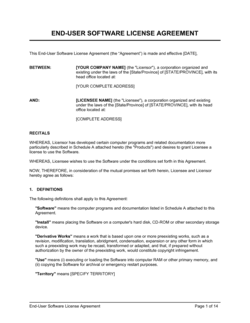
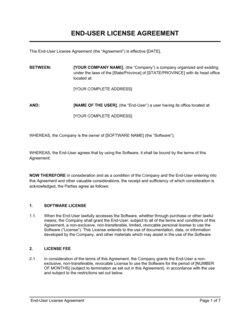
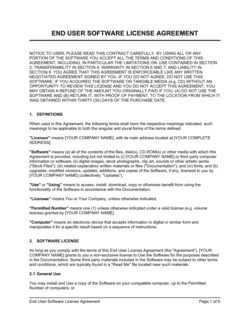
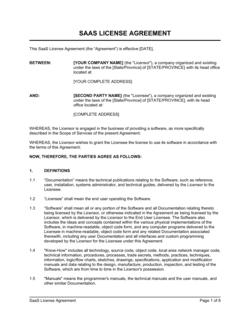
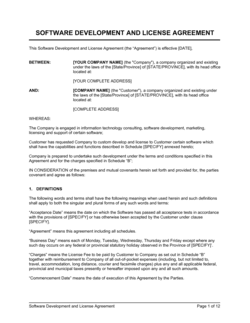
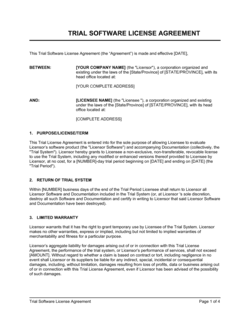
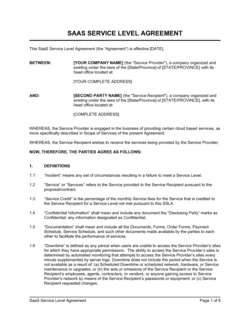
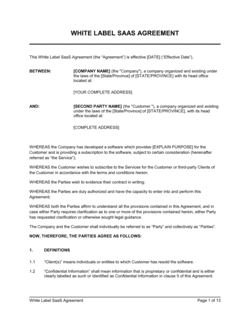
SaaS End User License Agreement Template

Free Word download • Edit online • Save & share with Drive • Export to PDF

10 pages30–40 min to fillDifficulty: ComplexSignature requiredLegal review recommended
Learn more ↓
FreeSaaS End User License Agreement Template

At a glance

What it is
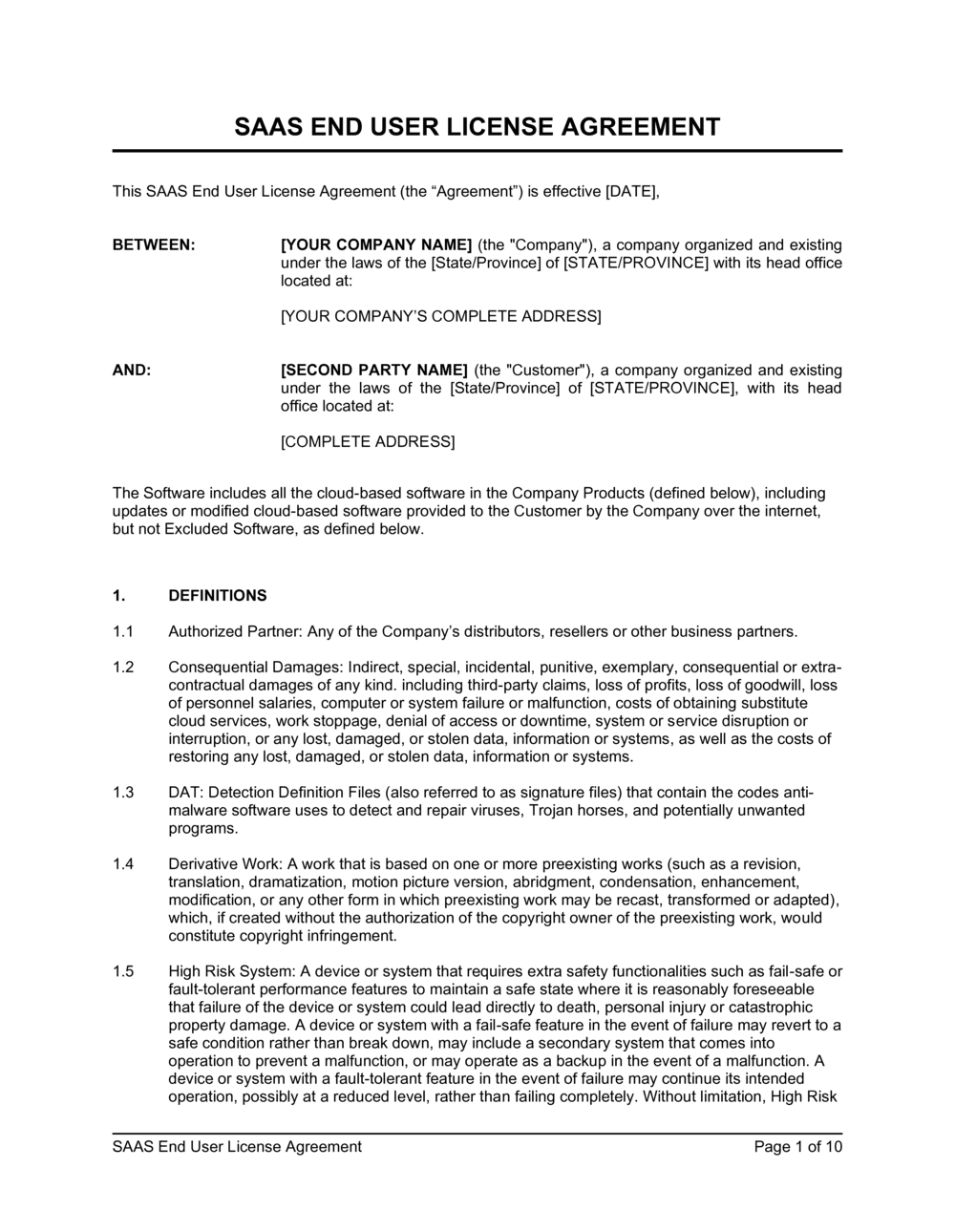
A SaaS End User License Agreement (EULA) is a legally binding contract between a software vendor and the end user that governs how the user may access and use a cloud-based software product. This free Word download gives you a structured, attorney-style starting point you can edit online and export as PDF — covering license scope, restrictions, data handling, IP ownership, disclaimers, and termination in a single document.
When you need it
Use it before making any SaaS product available to users — whether at account signup, app launch, or checkout — to establish the enforceable terms under which your software is licensed rather than sold.
What's inside
License grant and scope, permitted and prohibited uses, intellectual property ownership, data collection and privacy obligations, warranty disclaimers, limitation of liability, indemnification, term and termination, and governing law.

What is a SaaS End User License Agreement?

A SaaS End User License Agreement (EULA) is a legally binding contract between a software vendor and an end user that defines the precise terms under which the user may access and use a cloud-based software product. Unlike a traditional software purchase, a SaaS EULA does not transfer ownership of the software — it grants only a limited, non-exclusive, non-transferable license to use the product during a subscription period, subject to the vendor's conditions. The agreement covers the scope of the license, permitted and prohibited uses, intellectual property ownership, data handling obligations, warranty disclaimers, liability caps, and the conditions under which either party may terminate access.

Why You Need This Document

Deploying a SaaS product without a EULA leaves your business exposed on every front that matters commercially. Without an explicit IP ownership clause, a user could argue that configurations, integrations, or customizations built inside your platform create some form of joint ownership. Without use restrictions, a competitor can sign up, analyze your product's architecture and output through legitimate use, and build a rival tool with no legal recourse available to you. Without a liability cap, a single enterprise customer's claim for data loss or service interruption could expose you to damages far exceeding the value of their contract. Courts do not fill these gaps in your favor — they apply jurisdiction-specific defaults that routinely favor the user. A properly structured SaaS EULA, accepted via a clickwrap mechanism before first login, closes all of these gaps and gives your product a legally defensible foundation from the moment the first user signs up.

Which variant fits your situation?

If your situation is…Use this template
Licensing software to individual consumers via a website or app storeConsumer Software EULA
Licensing software to a business under a negotiated enterprise dealEnterprise Software License Agreement
Governing ongoing SaaS access including uptime, support, and billingSaaS Subscription Agreement
Setting API access rules and rate limits for developer usersAPI License Agreement
Distributing open-source software with attribution and share-alike termsOpen Source Software License
Providing a no-cost trial version with conversion to paid termsSoftware Trial Agreement
Protecting confidential pre-release software shared with beta testersBeta Software Testing Agreement

Common mistakes to avoid

❌ Using perpetual license language in a subscription product

Why it matters: Perpetual grants survive termination, meaning a user who stops paying may argue they retain a valid license indefinitely. This undermines your ability to suspend or terminate access for non-payment.

Fix: Replace 'perpetual' with 'during the subscription term' throughout the license grant clause, and tie access explicitly to continued payment and compliance.

❌ No prohibition on using the software to build a competing product

Why it matters: Without this restriction, a competitor can sign up, reverse-engineer your UX and architecture through legitimate use, and build a rival tool — all within the literal terms of your EULA.

Fix: Add an explicit restriction prohibiting use of the software, its output, or any information derived from it to develop or improve a competing product or service.

❌ Omitting a Data Processing Agreement for B2B customers

Why it matters: If your business customers upload personal data of their own users or employees, you are acting as a data processor under GDPR. Operating without a DPA exposes both you and your customer to regulatory fines of up to 4% of global annual turnover.

Fix: Maintain a standard DPA as a separate exhibit to the EULA and require B2B customers to execute it before uploading any personal data to your platform.

❌ Warranty disclaimers written in lowercase

Why it matters: US courts applying the UCC and equivalent statutes in Canada and the UK require warranty disclaimers to be conspicuous — typically all-caps or bold — to be enforceable. A lowercase disclaimer may be treated as ineffective.

Fix: Format all warranty and liability disclaimers in ALL CAPS or bold text, as shown in the template, to meet the conspicuousness standard across major jurisdictions.

❌ No post-termination data return or deletion clause

Why it matters: Enterprise customers require contractual assurance that their data will be returned in a usable format and then securely deleted. The absence of this clause is a sales blocker and a GDPR compliance gap.

Fix: Add a clause specifying a 30-day data-export window after termination, the export format, and the method and timeline for secure deletion, with written confirmation provided to the customer.

❌ Auto-renewal notice period shorter than the billing cycle

Why it matters: A 7-day cancellation window on an annual contract gives users virtually no opportunity to avoid a full year's renewal charge. Courts and consumer protection authorities in California, the EU, and the UK have voided such clauses.

Fix: Set auto-renewal notice periods of at least 30 days for monthly plans and 60–90 days for annual plans, and send automated reminder emails before each renewal date.

The 10 key clauses, explained

License grant and scope

In plain language: Defines the specific, limited, non-exclusive right the vendor grants the user to access and use the software — including seat count, geography, and permitted purposes.

Sample language
[COMPANY NAME] grants [USER / LICENSEE] a limited, non-exclusive, non-transferable, revocable license to access and use [SOFTWARE NAME] solely for [USER'S] internal business purposes, for up to [NUMBER] authorized users, during the subscription term.

Common mistake: Using 'perpetual' license language in a SaaS agreement. SaaS access is subscription-based and terminates on non-payment or cancellation — perpetual grant language contradicts this and creates disputes over continued access after termination.

Permitted and prohibited uses

In plain language: Lists what the user is allowed to do with the software and explicitly prohibits actions like reverse engineering, sublicensing, or competitive benchmarking.

Sample language
User shall not: (a) reverse engineer, decompile, or disassemble the Software; (b) sublicense, resell, or transfer access to any third party; (c) use the Software to build a competing product; or (d) remove or alter any proprietary notices or labels on the Software.

Common mistake: Omitting a prohibition on using the software to build a competing product. Without this clause, a competitor can sign up, analyze your product's architecture and UX, and use those insights to build a rival tool — all within the literal terms of your license.

Intellectual property ownership

In plain language: Confirms that the vendor owns all rights to the software, source code, documentation, and improvements — and that the user acquires no ownership interest whatsoever.

Sample language
All right, title, and interest in and to the Software, including all intellectual property rights, are and shall remain the exclusive property of [COMPANY NAME]. This Agreement does not convey to User any ownership interest in the Software.

Common mistake: Failing to address user-generated content or configurations created within the platform. If a user builds workflows, datasets, or templates inside your software, ownership of that content must be explicitly allocated to avoid disputes.

User data and privacy

In plain language: Describes what data the vendor collects from the user, how it is used, and whether a separate Data Processing Agreement is incorporated for GDPR or CCPA compliance.

Sample language
By using the Software, User consents to [COMPANY NAME]'s collection and use of usage data as described in the Privacy Policy at [URL]. Where User provides personal data of its own customers or employees, the parties shall execute a Data Processing Agreement prior to such processing.

Common mistake: Incorporating the full privacy policy by reference without a DPA for B2B SaaS. If your business customers upload personal data of their own end users, you are acting as a data processor and a separate DPA is legally required under GDPR — reference alone is insufficient.

Subscription term and automatic renewal

In plain language: Sets the initial license period, renewal mechanics, and the notice period required to cancel before the renewal date.

Sample language
The initial term of this Agreement commences on [START DATE] and continues for [12] months. Unless either party provides written notice of non-renewal at least [30] days prior to the end of the then-current term, this Agreement shall automatically renew for successive [12]-month periods.

Common mistake: Setting an auto-renewal notice period shorter than the billing cycle. A 7-day cancellation window on an annual plan gives users almost no opportunity to avoid a full year's renewal charge — courts and regulators in multiple jurisdictions have voided auto-renewal clauses on this basis.

Fees, payment, and suspension

In plain language: States the subscription fee, payment schedule, consequences of non-payment including suspension or termination, and any late-payment interest.

Sample language
User shall pay the Subscription Fee of $[AMOUNT] per [month/year], due on the [1st] of each period. Fees not paid within [15] days of the due date accrue interest at [1.5]% per month. [COMPANY NAME] may suspend access to the Software upon [5] business days' written notice of non-payment.

Common mistake: Omitting a suspension clause and jumping straight to termination for non-payment. Suspension preserves the relationship and gives the user a cure period, while termination is irreversible and harder to enforce in jurisdictions that require notice before contract cancellation.

Warranty disclaimer

In plain language: States that the software is provided 'as is' and disclaims all implied warranties, including fitness for a particular purpose, merchantability, and uninterrupted or error-free operation.

Sample language
THE SOFTWARE IS PROVIDED 'AS IS' WITHOUT WARRANTY OF ANY KIND. [COMPANY NAME] EXPRESSLY DISCLAIMS ALL IMPLIED WARRANTIES, INCLUDING WARRANTIES OF MERCHANTABILITY, FITNESS FOR A PARTICULAR PURPOSE, AND NON-INFRINGEMENT. [COMPANY NAME] DOES NOT WARRANT THAT THE SOFTWARE WILL BE UNINTERRUPTED, ERROR-FREE, OR FREE OF HARMFUL COMPONENTS.

Common mistake: Using lowercase text for warranty disclaimers. Under the Uniform Commercial Code in the US and equivalent statutes in other jurisdictions, disclaimers of implied warranties must be conspicuous — typically defined as capitalized or bold text — to be effective.

Limitation of liability

In plain language: Caps the total financial exposure of the vendor to the fees the user paid in the preceding 12 months and excludes indirect, consequential, or punitive damages.

Sample language
IN NO EVENT SHALL [COMPANY NAME]'S TOTAL LIABILITY EXCEED THE AMOUNTS PAID BY USER IN THE [12] MONTHS PRECEDING THE CLAIM. IN NO EVENT SHALL EITHER PARTY BE LIABLE FOR INDIRECT, INCIDENTAL, SPECIAL, CONSEQUENTIAL, OR PUNITIVE DAMAGES, EVEN IF ADVISED OF THE POSSIBILITY OF SUCH DAMAGES.

Common mistake: Excluding consequential damages without carving out indemnification obligations or data breach liability. Courts in several jurisdictions will not allow a vendor to disclaim all liability for a data breach caused by the vendor's own negligence — an unconditional exclusion clause is likely to be struck down.

Term and termination

In plain language: Defines when the agreement ends, grounds for immediate termination for cause, the process for termination for convenience, and what happens to user data after termination.

Sample language
Either party may terminate this Agreement for cause upon [30] days' written notice if the other party materially breaches this Agreement and fails to cure within that period. Upon termination, User's access to the Software ceases immediately. [COMPANY NAME] shall make User's data available for export for [30] days following termination, after which it may be deleted.

Common mistake: No post-termination data return or deletion obligation. Users — especially business customers — require assurance that their data will be returned in a portable format and then securely deleted. Omitting this provision is a sales blocker for enterprise prospects and a GDPR compliance failure.

Governing law and dispute resolution

In plain language: Specifies the jurisdiction whose law applies, the venue for disputes, and whether disputes go to arbitration or court — including any class-action waiver.

Sample language
This Agreement is governed by the laws of [STATE], without regard to conflict of law principles. Any dispute shall be resolved by binding arbitration administered by [AAA/JAMS] in [CITY], except that either party may seek injunctive relief in any court of competent jurisdiction. User waives any right to participate in a class-action proceeding.

Common mistake: Choosing a governing law with no connection to the vendor's place of business or the user's location. Courts in the EU, UK, and several US states apply local consumer or data-protection law regardless of what the contract specifies — selecting a neutral state like Delaware does not override mandatory local statutes.

How to fill it out

  1. 1

    Identify the parties and define the software

    Enter the vendor's full legal entity name, jurisdiction of incorporation, and registered address. Define the software by name and version or service tier. Identify whether the counterparty is an individual consumer or a business entity, as this affects which clauses apply.

    💡 If your SaaS product has multiple tiers (free, pro, enterprise), consider whether a single EULA covers all tiers or whether enterprise users require a separate agreement with negotiated terms.

  2. 2

    Scope the license grant precisely

    Specify whether the license is per-seat, per-organization, per-device, or usage-based. State the geographic scope (worldwide or limited) and whether use is restricted to internal business purposes or extends to use on behalf of third-party clients.

    💡 Per-seat licenses are easiest to audit and enforce. Usage-based or 'unlimited user' grants require clear definitions of what constitutes overuse and how it is measured.

  3. 3

    List specific prohibited uses

    Draft an explicit list of restrictions: reverse engineering, sublicensing, competitive benchmarking, data scraping, and use to build a competing product. Make the list specific to your product's real risk surface rather than copying boilerplate.

    💡 Add a prohibition on using your software's output to train AI or machine-learning models if that is a commercial risk for your product — this clause is increasingly standard in SaaS agreements as of 2025.

  4. 4

    Address data collection, privacy, and any DPA requirement

    Reference your Privacy Policy URL, specify what usage data you collect and why, and determine whether you need to incorporate a Data Processing Agreement for B2B customers who upload personal data. If GDPR applies, a DPA is not optional.

    💡 Maintain a separate, standalone DPA rather than embedding data processing terms inside the EULA — enterprise procurement teams expect to negotiate the DPA independently.

  5. 5

    Set subscription, billing, and suspension terms

    Enter the subscription fee, billing cycle, auto-renewal mechanics, and the notice period required to cancel. Specify the cure period before suspension for non-payment and the further period before outright termination.

    💡 Auto-renewal notice periods of 30 days or more reduce churn-related disputes and satisfy consumer protection requirements in California (ARL), the EU, and the UK.

  6. 6

    Calibrate liability caps to your revenue exposure

    Set the liability cap as a multiple of fees paid — typically the preceding 12 months — and carve out fraud, willful misconduct, and data breach liability from the general consequential-damages exclusion.

    💡 Enterprise customers routinely negotiate liability caps upward to 2–12 months of fees. Leave room in the template to insert negotiated figures without restructuring the clause.

  7. 7

    Define termination and post-termination data obligations

    Set notice periods for termination with and without cause, specify the data-export window (typically 30 days), and state whether data is permanently deleted or anonymized after that window closes.

    💡 State the file format in which user data will be exported (e.g., CSV, JSON) — a vague 'data will be made available' promise is unenforceable and unsatisfying to enterprise procurement teams.

  8. 8

    Select governing law and acceptance mechanism

    Choose the governing jurisdiction based on where the vendor is incorporated and where the majority of users are located. Specify clickwrap acceptance — a checkbox or 'I Agree' button — rather than browsewrap, and record the acceptance timestamp in your user database.

    💡 For US consumer-facing SaaS, Delaware or your home state is standard. For EU users, consider a separate EU-law governed version or addendum to avoid mandatory local-law override conflicts.

Frequently asked questions

What is a SaaS End User License Agreement?

A SaaS End User License Agreement (EULA) is a legally binding contract between a software vendor and the user that governs how the user may access and use a cloud-based software product. Unlike a traditional software sale, a SaaS EULA grants only a limited, non-transferable license to use the software — the vendor retains full ownership of the underlying code, platform, and IP. It covers permitted use, restrictions, data handling, liability limits, and termination conditions.

What is the difference between a SaaS EULA and a Terms of Service?

A EULA focuses specifically on the scope and conditions of the software license — what you can do with the product, what you cannot do, and who owns the IP. Terms of Service (ToS) or Terms of Use are broader governing documents that cover the entire relationship with the platform, including content policies, account management, payment terms, and dispute resolution. Many SaaS companies combine both into a single document; others maintain them separately, with the EULA as an exhibit to the ToS.

Does a SaaS EULA need to be signed?

A traditional wet or electronic signature is not required for a SaaS EULA to be enforceable in most jurisdictions, provided the user actively accepts it through a clickwrap mechanism — clicking an 'I Agree' button or checking an acceptance box at signup. Courts have consistently upheld clickwrap acceptance as equivalent to a signature. Browsewrap agreements — where continued use constitutes acceptance — are significantly less reliable, particularly for B2B customers or material financial obligations.

What is the difference between a SaaS EULA and a SaaS Subscription Agreement?

A EULA defines the legal conditions of the software license itself — IP ownership, permitted use, restrictions, and disclaimers. A SaaS Subscription Agreement governs the commercial relationship — pricing, billing cycles, SLA commitments, support levels, and renewal terms. Many enterprise SaaS vendors use a Master Subscription Agreement (MSA) that incorporates the EULA by reference, keeping license and commercial terms in separate, negotiable documents.

Is a SaaS EULA enforceable internationally?

Enforceability depends on the jurisdiction and how the agreement is presented. Clickwrap EULAs are generally enforceable in the US, Canada, the UK, and the EU when properly presented before first use. However, governing-law and jurisdiction clauses may be overridden by mandatory local statutes — particularly EU consumer protection law, GDPR, and UK Consumer Rights Act protections. Vendors selling to consumers in multiple countries should consider jurisdiction-specific addenda or separate agreements.

What data protection obligations should a SaaS EULA address?

At minimum, the EULA should reference the Privacy Policy, disclose what usage data is collected and why, and state whether the vendor shares data with third parties. For B2B SaaS where customers upload personal data of their own users, a separate Data Processing Agreement (DPA) is legally required under GDPR and is standard practice under CCPA for California businesses. The DPA should specify the categories of personal data processed, processing purposes, retention periods, sub-processor lists, and data subject rights procedures.

Can a SaaS vendor disclaim all liability in a EULA?

Vendors can significantly limit liability — typically to fees paid in the prior 12 months — and exclude consequential and indirect damages. However, a complete disclaimer of all liability is not enforceable in most jurisdictions. Courts in the EU, UK, and several US states will not uphold clauses that attempt to exclude liability for death, personal injury, fraud, or gross negligence caused by the vendor's own acts. Data breach liability caused by the vendor's negligence is also difficult to disclaim entirely, particularly under GDPR.

How should a SaaS EULA handle automatic renewal?

The EULA should clearly state the initial subscription term, the automatic renewal trigger, the notice period required to cancel before renewal, and how notice must be delivered (email, in-app, or written). California's Automatic Renewal Law requires affirmative consent and clear disclosure before charging for auto-renewing subscriptions. EU and UK consumer protection law imposes similar requirements. Best practice is a minimum 30-day cancellation window for monthly plans and 60–90 days for annual plans, with automated reminder emails.

Do I need a lawyer to draft a SaaS EULA?

For straightforward consumer-facing SaaS with standard use cases and no data-processing complexity, a high-quality template is a solid starting point. Engage a lawyer when your product processes personal data of business customers' end users (requiring a DPA), when you sell into regulated industries such as healthcare or financial services, when enterprise customers negotiate non-standard liability or IP terms, or when you operate in multiple jurisdictions with conflicting mandatory requirements. A focused template review typically costs $500–$1,500 and is advisable before any significant commercial launch.

How this compares to alternatives

vs SaaS Subscription Agreement

A SaaS Subscription Agreement governs the commercial relationship — pricing, billing, SLA, support, and renewal — while a EULA governs the legal conditions of the software license itself, including IP ownership, use restrictions, and disclaimers. Enterprise vendors typically use both: the Subscription Agreement as the master commercial contract with the EULA incorporated as a license exhibit. For simpler products, the two are often merged into a single document.

vs Software Development Agreement

A Software Development Agreement governs the creation of custom software — deliverables, milestones, IP assignment, and acceptance testing between a developer and a client. A SaaS EULA governs the end user's right to use an already-built software product. The development agreement applies during the build phase; the EULA applies once the product is deployed and accessed by users.

vs Non-Disclosure Agreement

An NDA protects confidential information exchanged during pre-contract discussions or partnerships, while a EULA contains its own confidentiality clause governing the user's obligation not to disclose the vendor's proprietary software and data. An NDA is typically signed before a demo or evaluation; the EULA is signed or accepted at product activation. Both may coexist — the NDA covers the evaluation period, the EULA governs ongoing use.

vs Terms of Service

Terms of Service (or Terms and Conditions) are a broader governance document covering the entire user relationship with a platform — account registration, acceptable use, content policies, payment terms, and dispute resolution. A EULA is a narrower, license-specific document focused on IP rights and software use restrictions. Consumer-facing SaaS platforms often merge both into a single ToS; B2B vendors typically keep them separate to allow enterprise negotiation of the EULA without touching the broader platform terms.

Industry-specific considerations

SaaS / Technology

Multi-tier licensing (free, pro, enterprise), API access restrictions, and prohibition on using outputs to train competing AI models are standard additions for technology-sector EULAs.

Healthcare / MedTech

HIPAA Business Associate Agreement requirements, restrictions on processing protected health information, and mandatory audit-log retention terms must be incorporated by reference or as an exhibit.

Financial Services

Regulatory compliance obligations (SEC, FINRA, FCA), data residency requirements for financial records, and enhanced liability caps reflecting the high value of transactions processed through the software.

Education / EdTech

FERPA compliance for student data in the US, COPPA age-gating for platforms accessible to users under 13, and institutional license structures covering multiple campuses or districts.

Marketing / Agencies

Sub-user and client-account provisioning terms, data ownership of campaign assets created within the platform, and restrictions on competitive benchmarking using the tool's analytics output.

Manufacturing / Industrial

IoT and operational technology integrations require device-level license scoping, on-premise deployment addenda, and export-control compliance clauses for software shipped internationally.

Jurisdictional notes

United States

EULAs are generally enforceable under state contract law when presented via clickwrap before first use. Warranty disclaimers must meet the UCC conspicuousness standard — all-caps formatting is the standard approach. California's Automatic Renewal Law imposes strict disclosure and consent requirements for auto-renewing subscriptions. Non-compete and benchmarking restrictions vary in enforceability by state; California courts often decline to enforce them.

Canada

Canadian courts have upheld clickwrap EULAs as binding contracts where acceptance is clearly recorded. PIPEDA (federal) and provincial privacy laws such as Quebec's Law 25 impose data collection, consent, and breach-notification obligations that must be reflected in the EULA or an incorporated privacy policy. Quebec's Law 25 also requires contracts with Quebec consumers to be presented in French. Auto-renewal clauses must comply with provincial consumer protection legislation, which varies by province.

United Kingdom

The Consumer Rights Act 2015 renders unfair contract terms — including broad liability exclusions and one-sided termination rights — unenforceable against consumers. The UK GDPR (post-Brexit equivalent of EU GDPR) requires a DPA for B2B data processing arrangements. Automatic renewal clauses must be clearly disclosed and must not constitute an unfair commercial practice under the Consumer Protection from Unfair Trading Regulations. Post-Brexit, UK and EU data transfer mechanisms are separate and must be addressed independently.

European Union

GDPR requires a Data Processing Agreement for any B2B SaaS arrangement where personal data of data subjects is processed — this is non-negotiable and must be a formal exhibit to or incorporated into the EULA. The EU Unfair Contract Terms Directive restricts one-sided liability caps and termination clauses in consumer contracts. The Digital Services Act and the proposed EU AI Act impose additional obligations on platforms operating at scale or using AI-driven features. Cross-border data transfers outside the EEA require Standard Contractual Clauses or an adequacy decision.

Template vs lawyer — what fits your deal?

PathBest forCostTime
Use the templateConsumer or SMB SaaS products with standard use cases, no regulated data, and uniform pricing tiersFree30–60 minutes
Template + legal reviewB2B SaaS with data-processing obligations, enterprise customers, or multi-jurisdiction distribution$500–$1,5003–5 business days
Custom draftedHealthcare, fintech, or regulated-industry SaaS; enterprise deals with negotiated liability and IP terms; multi-country commercial rollouts$2,500–$8,000+2–4 weeks

Glossary

License Grant
The specific permission a vendor gives an end user to access and use the software — defining scope, seat count, and permitted purposes.
Permitted Use
The exact activities an end user is authorized to perform with the software under the terms of the license.
Restricted Use
Activities the end user is expressly prohibited from performing — such as reverse engineering, sublicensing, or using the software to build a competing product.
Intellectual Property Ownership
A clause confirming that the software vendor retains all rights, title, and interest in the software, regardless of any customization the user makes.
Warranty Disclaimer
A provision stating that the software is provided 'as is' without guarantees of fitness for a particular purpose, merchantability, or error-free operation.
Limitation of Liability
A cap on the total financial damages the vendor can owe a user — typically limited to fees paid in the preceding 12 months or a fixed dollar amount.
Indemnification
A contractual obligation requiring one party to cover the other's legal costs and damages if a third-party claim arises from a specified breach or misuse.
Clickwrap Agreement
A method of acceptance where the user actively clicks 'I Agree' or 'Accept' to bind themselves to the EULA terms — generally more enforceable than browsewrap.
Browsewrap Agreement
A method of acceptance where terms are posted on a website and continued use is treated as acceptance — less enforceable than clickwrap for material obligations.
Data Processing Agreement (DPA)
A separate or incorporated contract governing how the vendor processes personal data on behalf of the user, required under GDPR and similar privacy laws.
Force Majeure
A clause excusing a party from performance obligations caused by events outside their reasonable control — such as natural disasters, cyberattacks, or government orders.
Governing Law
The jurisdiction whose laws interpret and apply to the contract, and where disputes must be resolved.

Part of your Business Operating System

This document is one of 3,000+ business & legal templates included in Business in a Box.

  • Fill-in-the-blanks — ready in minutes
  • 100% customizable Word document
  • Compatible with all office suites
  • Export to PDF and share electronically

Create your document in 3 simple steps.

From template to signed document — all inside one Business Operating System.
1
Download or open template

Access over 3,000+ business and legal templates for any business task, project or initiative.

2
Edit and fill in the blanks with AI

Customize your ready-made business document template and save it in the cloud.

3
Save, Share, Send, Sign

Share your files and folders with your team. Create a space of seamless collaboration.

Save time, save money, and create top-quality documents.

★★★★★

"Fantastic value! I'm not sure how I'd do without it. It's worth its weight in gold and paid back for itself many times."

Managing Director · Mall Farm
Robert Whalley
Managing Director, Mall Farm Proprietary Limited
★★★★★

"I have been using Business in a Box for years. It has been the most useful source of templates I have encountered. I recommend it to anyone."

Business Owner · 4+ years
Dr Michael John Freestone
Business Owner
★★★★★

"It has been a life saver so many times I have lost count. Business in a Box has saved me so much time and as you know, time is money."

Owner · Upstate Web
David G. Moore Jr.
Owner, Upstate Web

Run your business with a system — not scattered tools

Stop downloading documents. Start operating with clarity. Business in a Box gives you the Business Operating System used by over 250,000 companies worldwide to structure, run, and grow their business.

Start free · No credit card required