1
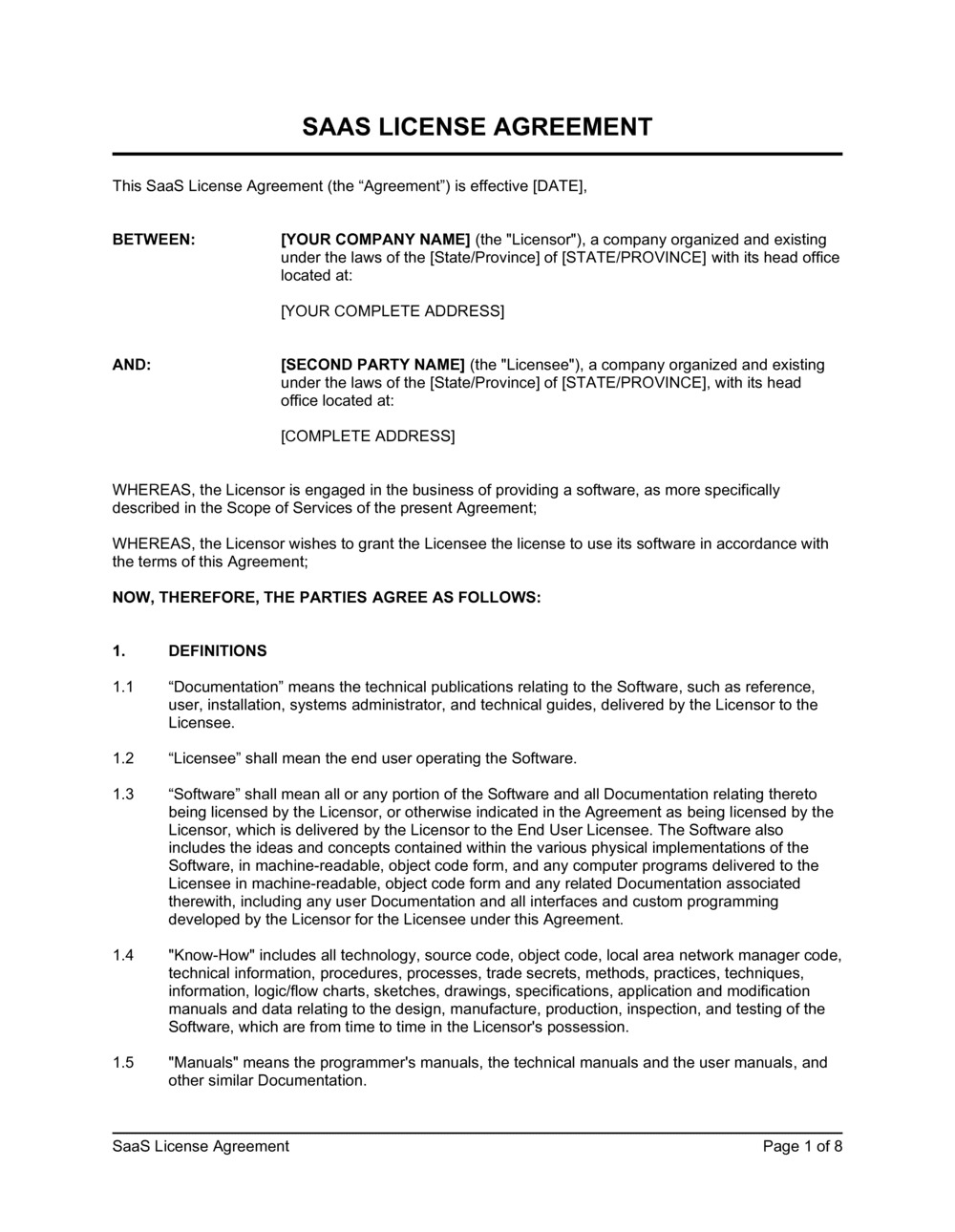
Identify the parties and define the software
Enter the provider's and customer's full legal entity names, registered addresses, and contact persons. Name the software product precisely — the name used here will be referenced throughout the contract.
💡 Use the registered corporate name, not a brand name or domain. If the provider is an LLC and the contract names an Inc., enforcement becomes complicated.
2
Define the subscription scope and user count
Specify the subscription tier, number of permitted users, and any module or feature restrictions. If offering multiple tiers, reference a Schedule A that details each tier rather than embedding specifics in the body.
💡 Defining users by named individuals is more enforceable than defining them by role — 'up to 10 named users on Schedule A' is clearer than 'employees in the finance department.'
3
Set subscription fees, billing cycle, and renewal terms
Enter the fee amount, billing frequency (monthly or annual), due date, accepted payment methods, and late-payment interest rate. Specify the renewal mechanism — auto-renew with notice period, or opt-in renewal — and any price adjustment rights.
💡 Annual subscriptions paid upfront should include a refund policy for terminations mid-term — even if the refund is pro-rated credits rather than cash, document it explicitly.
4
Complete the SLA and uptime commitment
Enter the uptime percentage, the measurement window (monthly or quarterly), how scheduled maintenance windows are defined, and the service credit schedule for missed commitments. Align the credit percentages with the cost of downtime to your customers.
💡 99.9% uptime sounds high but permits approximately 43 minutes of downtime per month. If your customers run critical operations on your platform, consider committing to 99.95% and investing in the infrastructure to support it.
5
Tailor the data security and privacy obligations
Specify the security frameworks you comply with (SOC 2, ISO 27001, etc.), the breach notification window, and whether a Data Processing Addendum is required. If any customer data is personal data under GDPR or CCPA, the DPA is not optional.
💡 Reference your security framework by certification name and effective date — 'SOC 2 Type II certified as of [DATE]' — rather than a vague 'industry-standard' commitment that creates no measurable obligation.
6
Set confidentiality survival period and carve-outs
Define the post-termination confidentiality period (typically 2–5 years) and list the standard carve-outs: information already in the public domain, information independently developed, or information disclosed pursuant to a court order.
💡 Trade secrets should be carved out from the time-limited confidentiality clause and protected indefinitely under a separate trade-secret protection provision.
7
Configure termination triggers and data handling
Set the cure period for material breach (30 days is standard), list termination-for-cause events (insolvency, criminal conduct, AUP violation), and define the data export window and deletion timeline.
💡 Include a 'termination for convenience' right for both parties with at least 30 days' notice — locking either party into a non-performing relationship without an exit creates disputes more costly than lost revenue.
8
Select governing law and dispute resolution
Choose the jurisdiction whose law governs the agreement and specify whether disputes go to binding arbitration, mediation followed by litigation, or direct litigation in a named court.
💡 For US-based SaaS providers with global customers, designate a US governing law but include a clause providing that mandatory consumer or data protection laws of the customer's jurisdiction are not displaced — this reduces the risk of the governing law clause being struck down in EU or UK courts.