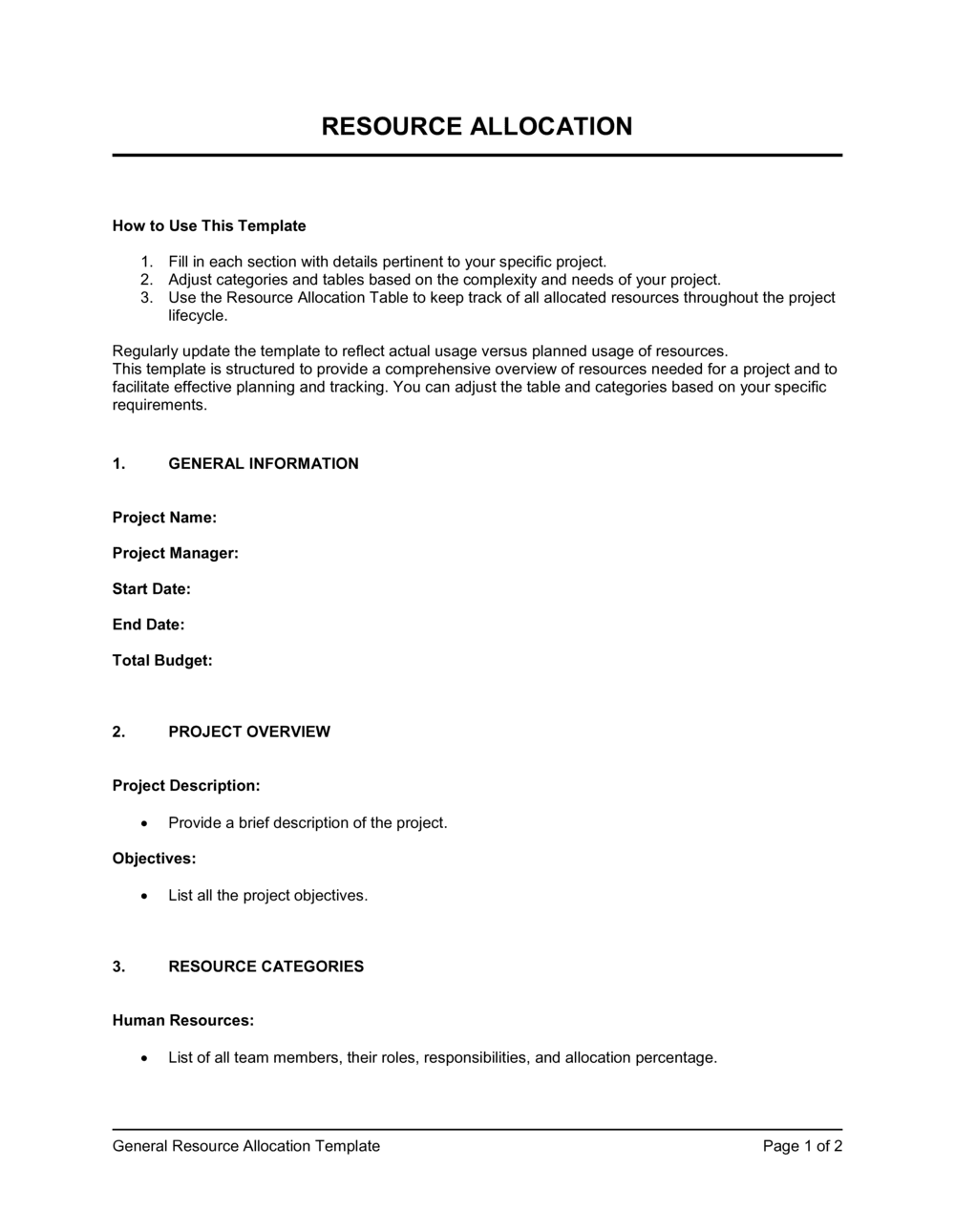
Resource Allocation Template

Free Word download • Edit online • Save & share with Drive • Export to PDF

2 pages20–30 min to fillDifficulty: StandardSignature requiredLegal review recommended
Learn more ↓
FreeResource Allocation Template

At a glance

What it is
A Resource Allocation Template is a binding agreement that formally documents the assignment of personnel, budget, equipment, and time from one party — typically an organization or department — to a defined project, program, or recipient. This free Word download lets you specify who is receiving what resources, under what conditions, and for how long, then export as PDF and execute with the relevant stakeholders in minutes.
When you need it
Use it whenever you need a formal, signed record of resource commitments across projects, departments, or partner organizations — especially when shared resources create accountability or billing disputes. It is particularly critical for cross-functional initiatives, joint ventures, government-funded programs, and any arrangement where resource misuse or reallocation carries financial or operational consequences.
What's inside
The template covers the parties and their roles, a detailed schedule of allocated resources with quantities and durations, permitted use restrictions, reporting and tracking obligations, cost and billing arrangements, substitution and reallocation rights, confidentiality, and termination conditions.

What is a Resource Allocation Template?

A Resource Allocation Template is a binding agreement that formally documents the assignment of specific resources — personnel, budget, equipment, or time — from a resource owner to a recipient project, program, or organizational unit. It defines what is being allocated, in what quantity, for how long, under what permitted-use conditions, and what happens if commitments need to change or be withdrawn. Unlike an informal project plan or spreadsheet, a properly executed resource allocation agreement creates enforceable obligations on both the supplying and receiving parties, providing a clear audit trail for financial reconciliation, performance accountability, and compliance reporting.

Why You Need This Document

Without a signed resource allocation agreement, committed resources are routinely overridden by competing organizational priorities — leaving project managers with no recourse when a key engineer is pulled mid-sprint or a budget line is redirected at quarter-end. The operational cost is real: projects stall, deadlines slip, and accountability disputes consume management time that should go toward delivery. For grant-funded or government-contracted programs, the absence of documented resource allocation is a leading trigger for audit findings and clawback demands. A formal agreement closes these gaps by converting informal verbal commitments into signed, specific, and enforceable obligations — specifying not just what was promised, but what substitution rights exist, how deviations are reported, and how the arrangement unwinds cleanly if circumstances change. This template gives you a professionally structured starting point that covers every material term in 30 to 60 minutes, without requiring a legal team to draft from scratch.

Which variant fits your situation?

If your situation is…Use this template
Assigning staff across multiple internal projectsResource Allocation Template (Internal)
Distributing a budget across departments or cost centersBudget Allocation Agreement
Allocating resources between two separate legal entitiesIntercompany Resource Sharing Agreement
Assigning specific equipment or physical assets to a projectEquipment Allocation and Use Agreement
Tracking personnel time and effort for a billable client projectProject Staffing Plan
Coordinating resource sharing under a joint ventureJoint Venture Agreement
Allocating grant funds and staff for a government-funded programGrant Agreement

Common mistakes to avoid

❌ Vague resource descriptions in the schedule

Why it matters: Terms like 'a senior developer' or 'some budget from IT' leave quantity, qualifications, and duration open to interpretation — the most common trigger of resource allocation disputes.

Fix: Specify each resource by name or job grade, FTE percentage or dollar amount, and exact start and end date in a line-item schedule attached to the agreement.

❌ No milestone reviews for multi-month allocations

Why it matters: Without scheduled checkpoints, underutilization or overrun goes undetected until it is too late to reallocate the resource to a higher-priority initiative.

Fix: Insert at least one formal review date in the agreement for every 90-day allocation period, with defined metrics — utilization rate and project progress — to be assessed at each review.

❌ Omitting a permitted-use restriction

Why it matters: A recipient who redirects allocated personnel or budget to an unauthorized project has not breached the agreement if no scope restriction exists — the owner has no contractual remedy.

Fix: Include an explicit permitted-use clause naming the specific project, and add a prohibition on reassignment or redeployment without prior written consent.

❌ Treating internal allocations as informal arrangements

Why it matters: Unwritten or unsigned internal resource commitments are routinely overridden by competing priorities, leaving project managers with no recourse when critical resources are pulled mid-project.

Fix: Execute a signed resource allocation agreement for every significant internal commitment — even between departments of the same company — so accountability is documented and enforceable.

❌ No resource-return process on termination

Why it matters: When a project ends early or the agreement is terminated, allocated personnel remain in limbo and budget holds are not released, creating operational and financial bottlenecks.

Fix: Include a termination clause with a specific resource-return timeline — typically 5 business days for equipment and immediate cessation for personnel — and a process for settling outstanding charges.

❌ Signing after resources are already deployed

Why it matters: An agreement executed after resources have been committed weakens enforceability of scope restrictions and confidentiality obligations, as work has already begun under no agreed terms.

Fix: Execute the agreement — including all schedules — before any resource is deployed. If an urgent start is needed, use a letter of intent to bridge the gap until the full agreement is signed.

The 10 key clauses, explained

Parties, Roles, and Effective Date

In plain language: Identifies the resource owner and resource recipient as legal entities, clarifies their respective roles, and records the date the agreement takes effect.

Sample language
This Resource Allocation Agreement ('Agreement') is entered into as of [DATE] between [RESOURCE OWNER LEGAL NAME], a [STATE/COUNTRY] [ENTITY TYPE] ('Owner'), and [RECIPIENT LEGAL NAME], a [STATE/COUNTRY] [ENTITY TYPE] ('Recipient').

Common mistake: Using a department name or a project title instead of the legal entity. If a dispute arises, an agreement between 'IT Team' and 'Project Phoenix' is unenforceable because neither is a legal party.

Resource Schedule and Specifications

In plain language: Enumerates each resource being allocated — personnel by name or role, budget by dollar amount and cost center, equipment by asset ID — along with the quantity, allocation percentage, and duration for each.

Sample language
Owner shall allocate to Recipient the resources set out in Schedule A, including: (a) [NAME / ROLE] at [X]% FTE from [START DATE] to [END DATE]; (b) equipment asset [ASSET ID] for the period [START DATE] to [END DATE]; (c) budget of $[AMOUNT] from cost center [CODE].

Common mistake: Describing resources in vague terms like 'a developer' or 'some budget.' Ambiguous specifications create disputes about substitution, quantity, and whether commitments were actually met.

Permitted Use and Scope Restrictions

In plain language: Defines what the recipient is and is not permitted to do with the allocated resources, limiting their use to the named project or program and prohibiting unauthorized redeployment.

Sample language
Recipient shall use the Allocated Resources solely for [PROJECT / PROGRAM NAME] as described in Schedule B. Recipient shall not reassign, subcontract, or otherwise redeploy any Allocated Resource without the Owner's prior written consent.

Common mistake: Omitting a scope restriction entirely. Without it, a recipient who redirects allocated staff or budget to a different project has not technically breached the agreement, even if the original project suffers.

Duration, Milestones, and Renewal

In plain language: Sets the start and end date of the allocation, specifies any interim milestone dates at which resource levels will be reviewed, and states whether the agreement renews automatically or requires written extension.

Sample language
The allocation period shall commence on [START DATE] and expire on [END DATE], unless extended in writing. The parties shall conduct a resource review at the milestones set out in Schedule C. This Agreement shall not renew automatically unless both parties sign a written extension at least [X] days before expiry.

Common mistake: No milestone review dates. Multi-month allocations without checkpoints frequently result in resources being consumed early or underutilized, with no mechanism to rebalance until the project is already off-track.

Cost, Billing, and Chargeback Terms

In plain language: States whether the allocation is at no cost, at cost, or at a marked-up rate; defines the billing frequency and invoice process; and specifies how cost overruns or underutilization adjustments are handled.

Sample language
Recipient shall reimburse Owner for Allocated Resources at the rates set out in Schedule D, payable within [30] days of invoice. Unused allocation at period end shall be [forfeited / credited / rolled forward] as specified in Schedule D.

Common mistake: Leaving billing terms silent on the assumption that internal allocations are free. This creates budget disputes at year-end when cost centers are reconciled and chargeback amounts are contested retroactively.

Reporting and Tracking Obligations

In plain language: Requires the recipient to maintain utilization records, submit periodic reports to the owner, and flag deviations from the planned allocation schedule within a defined timeframe.

Sample language
Recipient shall track utilization of each Allocated Resource and provide Owner with a written utilization report no less than [monthly / quarterly], in the format set out in Schedule E. Recipient shall notify Owner within [5] business days if actual utilization deviates from planned allocation by more than [10]%.

Common mistake: No deviation notification requirement. By the time a 30% underutilization is discovered at a quarterly review, the owner has lost the opportunity to redeploy the resource to a higher-priority initiative.

Substitution and Reallocation Rights

In plain language: Grants or limits each party's right to substitute a named resource with an equivalent, or to unilaterally reallocate a resource to another project, and sets the notice and approval conditions for doing so.

Sample language
Owner may substitute any named personnel with personnel of equivalent seniority and skill set upon [10] business days' written notice to Recipient. Owner may reallocate budget or equipment to another project upon [15] business days' notice if [DEFINED TRIGGER EVENT] occurs.

Common mistake: Granting the owner an unlimited right to substitute personnel without a qualifications threshold. A substitution clause that allows any replacement enables downgrading a senior specialist to a junior analyst without remedy.

Confidentiality and Data Handling

In plain language: Restricts both parties from disclosing proprietary information — project details, financial data, personnel records — encountered during the allocation period, and specifies obligations for data security and return of information on termination.

Sample language
Each party shall maintain the confidentiality of the other's Confidential Information and shall not disclose it to any third party without prior written consent. On termination, Recipient shall promptly return or destroy all Confidential Information in its possession.

Common mistake: No definition of what constitutes Confidential Information. Courts apply a reasonableness test — an overbroad 'everything is confidential' clause is routinely challenged and can undermine the entire confidentiality provision.

Termination and Resource Return

In plain language: States the conditions under which either party may terminate the agreement — for cause, for convenience, or on a trigger event — and sets out the process for returning resources, settling outstanding charges, and transitioning work.

Sample language
Either party may terminate this Agreement for convenience upon [30] days' written notice. Owner may terminate immediately for cause if Recipient uses any Allocated Resource in breach of Section [X]. On termination, Recipient shall cease use of all Allocated Resources and return any equipment within [5] business days.

Common mistake: No resource-return mechanism. When a project is cancelled mid-allocation, allocated personnel remain in ambiguous status and budget holds are not released, blocking both parties from acting on other priorities.

Governing Law and Dispute Resolution

In plain language: Specifies which jurisdiction's law governs the agreement and how disputes are resolved — negotiation, mediation, arbitration, or litigation — including the forum and seat.

Sample language
This Agreement is governed by the laws of [STATE / PROVINCE / COUNTRY]. Any dispute shall be resolved first by good-faith negotiation, then by binding arbitration administered by [AAA / JAMS / ICC] in [CITY], except claims for injunctive or equitable relief.

Common mistake: Choosing a governing law with no connection to where the resources are physically located or the work is performed. Several jurisdictions apply local employment and procurement law regardless of the contractual choice.

How to fill it out

  1. 1

    Identify the parties and confirm legal entity names

    Enter the full registered legal name, entity type, and jurisdiction of incorporation for both the resource owner and the recipient. Do not use brand names, project names, or department names.

    💡 Cross-check both names against your corporate registry or articles of incorporation before execution — a mismatched entity name can void enforcement.

  2. 2

    Complete Schedule A — the resource inventory

    List every resource being allocated: each person by name and role with FTE percentage, each budget line by dollar amount and cost center code, and each piece of equipment by asset ID. Specify the start and end date for each item separately if they differ.

    💡 Use a table format with one row per resource — it makes disputes easier to resolve because each commitment is unambiguous and independently verifiable.

  3. 3

    Define the permitted scope of use in Schedule B

    Describe the specific project or program the resources are assigned to, including its objectives, deliverables, and geographic or organizational boundaries. State explicitly what is out of scope.

    💡 If the project scope is already defined in a separate statement of work or project charter, attach it as an exhibit and cross-reference it here rather than duplicating it.

  4. 4

    Set milestone review dates in Schedule C

    Insert at least one mid-period review date for allocations longer than 90 days. Define what will be assessed at each review: utilization rate, project progress, and whether resource levels need adjustment.

    💡 Monthly reviews are standard for personnel-heavy allocations; quarterly reviews suit budget-only arrangements. Build review dates into both parties' project calendars at signing.

  5. 5

    Populate the cost and billing terms in Schedule D

    Enter the rate or cost basis for each resource (internal transfer price, market rate, or zero cost), billing frequency, invoice format, and payment terms. Specify how unused allocation is treated at period end.

    💡 Even for internal allocations with no actual cash transfer, document a notional rate — it protects both parties during budget reconciliation and audit.

  6. 6

    Configure substitution and reallocation rights

    Decide whether the owner needs the right to substitute personnel or redeploy budget under defined conditions. Set the notice period (typically 10–15 business days), the equivalency threshold for personnel, and any recipient approval rights.

    💡 If key-person dependency is critical to the project, name those individuals explicitly and add a clause requiring recipient consent before any substitution of named personnel.

  7. 7

    Review governing law and dispute resolution

    Select the jurisdiction whose law governs the agreement — typically where the resource owner or the primary work site is located. Choose a dispute resolution mechanism appropriate to the relationship: internal escalation for intra-company agreements, arbitration for inter-company or cross-border arrangements.

    💡 For cross-border allocations, confirm that the chosen governing law does not conflict with mandatory local employment or procurement regulations in the recipient's jurisdiction.

  8. 8

    Execute before the allocation start date

    Both parties must sign the agreement, including all schedules, before resources are committed or work begins. Unsigned or partially-signed agreements create ambiguity about which terms were accepted.

    💡 Use an eSign solution with timestamped execution records. For personnel allocations, ensure the individual's line manager — not just the project sponsor — is also a signatory or acknowledged approver.

Frequently asked questions

What is a resource allocation agreement?

A resource allocation agreement is a binding document that formally assigns specific resources — personnel, budget, equipment, or time — from a resource owner to a recipient project, department, or partner organization. It defines what is being allocated, in what quantity, for how long, at what cost, and under what conditions the allocation may be changed or terminated. It creates enforceable accountability on both sides and serves as the primary record for audits, budget reconciliations, and dispute resolution.

When do I need a signed resource allocation agreement instead of an informal plan?

Any time the resource commitment involves significant financial value, cross-organizational accountability, or regulatory reporting requirements, a signed agreement is preferable to an informal plan. Specifically: when resources are shared between separate legal entities or departments with independent budgets, when the allocation underpins a client contract or grant, when misuse or withdrawal of the resource would trigger a material financial consequence, or when an audit trail is required for compliance. Informal plans work for low-stakes, short-duration, single-team assignments only.

What is the difference between a resource allocation template and a project plan?

A project plan defines the scope, schedule, milestones, and deliverables of a project — it tells you what needs to be done and when. A resource allocation agreement is a binding commitment document that locks in who will provide which resources to support that plan, under what commercial and operational conditions. The project plan drives the work; the resource allocation agreement governs the supply of inputs to it. Both documents should cross-reference each other.

Is a resource allocation agreement legally binding?

Yes, when properly drafted and executed, a resource allocation agreement is generally enforceable as a contract in most jurisdictions — provided it contains the standard elements of a binding agreement: offer, acceptance, consideration, and mutual intent. Internal agreements between departments of the same legal entity are typically enforceable as operational policy documents rather than external contracts, but they still carry significant practical weight in governance and audit contexts. Consider consulting a lawyer for cross-border or high-value arrangements.

What resources can be covered by a resource allocation agreement?

Any quantifiable asset can be covered: salaried or contracted personnel (expressed in FTE or hours), monetary budgets (by dollar amount and cost center), physical equipment (by asset ID), software licenses, facilities and workspace, proprietary data or systems access, and intellectual property. The agreement can cover a single resource type or a bundled allocation of multiple resource categories in a single Schedule A.

How do I handle resource substitution in the agreement?

Include a substitution rights clause that defines whether the owner can replace a named person or asset, what notice is required (typically 10–15 business days), what qualifications the substitute must meet, and whether recipient approval is required. For key personnel whose specific expertise is critical to project success, add a named-individual clause requiring recipient consent before any substitution. Without these terms, an owner can downgrade a resource to a less qualified substitute without triggering a breach.

What happens if the resource owner needs to withdraw a committed resource early?

The termination and reallocation clauses govern this scenario. A well- drafted agreement will require the owner to give advance written notice (typically 15–30 days for non-emergency withdrawals), offer a qualified substitute where possible, and compensate the recipient for direct costs caused by the premature withdrawal if it constitutes a breach. Force majeure clauses typically excuse unforeseeable events — IT outages, natural disasters, regulatory shutdowns — from breach liability.

Do resource allocation agreements need to cover confidentiality?

Yes, in most cases. Personnel allocated to a project will inevitably access the recipient's proprietary information — project strategy, financial data, client details, or technical systems. Without a confidentiality clause, that information has no contractual protection. If a broader NDA already governs the parties' relationship, the resource allocation agreement should cross-reference it rather than duplicate the obligations, to avoid conflicting definitions.

How should I handle resource allocation for government-funded programs?

Government and grant-funded programs typically impose additional requirements on top of a standard resource allocation agreement: specific time-and-effort reporting formats, pre-approval for personnel changes, restrictions on indirect cost rates, and audit rights for the funding agency. The agreement should incorporate the funder's requirements by reference and add a compliance clause confirming the recipient will follow all applicable grant conditions. Failure to document allocated resources adequately is a leading cause of grant clawbacks.

How this compares to alternatives

vs Project Charter

A project charter authorizes a project, names its sponsor, and defines high-level scope and objectives — but it does not create binding commitments on resource supply. A resource allocation agreement is the follow-on document that locks in exactly who provides what resources, under what terms, and with what accountability. You need both: the charter to authorize, the agreement to commit.

vs Staffing Plan

A staffing plan is an operational planning tool that maps headcount needs to project phases — it is typically an internal spreadsheet or report, not a signed agreement. A resource allocation agreement converts that plan into an enforceable commitment, specifying cost terms, substitution rights, and consequences for non-delivery. The staffing plan informs the agreement; the agreement governs the commitment.

vs Joint Venture Agreement

A joint venture agreement governs the entire commercial relationship between two parties pursuing a shared business objective — equity contributions, profit sharing, governance, and IP ownership. A resource allocation agreement is narrower: it governs only the assignment of specific resources to a defined project or program, without creating a new legal entity or ongoing commercial partnership.

vs Service Level Agreement

A service level agreement defines the performance standards and remedies for an ongoing service relationship — uptime percentages, response times, and penalty credits. A resource allocation agreement defines what inputs are being committed, not the performance standards for outputs. The two can work together: a resource allocation agreement supplies the inputs; an SLA governs the quality of what is delivered with them.

Industry-specific considerations

Technology / SaaS

Engineering FTE allocation across concurrent product sprints, shared DevOps infrastructure costs charged back by project, and software license pooling across business units.

Construction and Engineering

Equipment and heavy machinery allocation tied to project phases, subcontractor hour commitments, and materials budget split across multiple concurrent site projects.

Healthcare and Life Sciences

Clinical staff allocation across trials and departments subject to credentialing conditions, medical equipment sharing between facilities, and compliance with workforce planning regulations.

Government and Nonprofit

Grant-funded staff and budget allocation with time-and-effort reporting requirements, audit trail obligations, and funder pre-approval for any reallocation above defined thresholds.

Jurisdictional notes

United States

Resource allocation agreements between separate legal entities are enforceable under standard contract law principles in all US states. For government-funded programs, OMB Uniform Guidance (2 CFR Part 200) mandates time-and-effort reporting for federally funded personnel allocations. In California, any clause that restricts an allocated employee's future employment options may trigger scrutiny under Labor Code §925. State procurement regulations apply to public-sector allocations.

Canada

Resource allocation agreements are governed by provincial contract law. When the allocated resources include employees, provincial Employment Standards Acts set floors on working hours, notice, and conditions that cannot be contracted away. Quebec requires that agreements involving provincially-regulated entities be available in French. Federal programs administered by departments such as PSPC impose additional procurement and resource-tracking requirements.

United Kingdom

Formal resource allocation between organizations is enforceable under English contract law. Where allocated resources include workers, the Working Time Regulations 1998 and any applicable collective agreements constrain how personnel hours may be committed. Public sector bodies are subject to HM Treasury's Managing Public Money guidelines, which require documented resource allocation decisions for audit purposes. IR35 rules should be considered when allocating contractors rather than employees.

European Union

EU-funded program allocations must comply with applicable EU financial regulations and audit requirements, including retention of supporting documentation for at least five years. GDPR applies when allocated personnel handle personal data across organizational boundaries — a data processing addendum is typically required. Works councils in France, Germany, and the Netherlands may have consultation rights before significant cross-organizational personnel reallocation. Member state labor laws set mandatory conditions for any allocated employees.

Template vs lawyer — what fits your deal?

PathBest forCostTime
Use the templateInternal allocations between departments or project teams within a single legal entityFree30–60 minutes
Template + legal reviewCross-organizational or inter-company allocations, grant-funded programs, or allocations involving senior personnel or significant budget$300–$8001–3 days
Custom draftedMulti-jurisdictional arrangements, joint ventures, government contracts, or allocations with complex IP, indemnity, or liability exposure$1,500–$5,000+1–3 weeks

Glossary

Resource Allocation
The process of identifying, assigning, and managing the assets — people, budget, equipment, or time — needed to complete a defined project or program.
Allocated Resource
A specific unit of resource (e.g., one FTE for 20 hours per week, or $50,000 of budget) formally committed to a project under the terms of the agreement.
Resource Owner
The party or department that controls the resource being allocated and retains ultimate authority over its substitution or withdrawal.
Resource Recipient
The party, project, or program receiving the allocated resource and bearing responsibility for its permitted use.
Full-Time Equivalent (FTE)
A standardized unit representing one employee working full-time hours — used to express partial or shared personnel allocations as a decimal fraction.
Reallocation
The act of redirecting a committed resource from one project or recipient to another, typically requiring written notice and approval under the agreement.
Resource Utilization Rate
The percentage of an allocated resource's available capacity actually consumed during the allocation period, used to measure efficiency and inform future planning.
Substitution Right
A clause permitting the resource owner to replace a named person or specific asset with an equivalent, subject to defined approval conditions.
Chargeback
An internal billing mechanism by which the cost of a shared resource is charged back to the department or project consuming it.
Scope of Use
The defined boundary of how an allocated resource may be used — specifying permitted activities, projects, locations, and any prohibited applications.
Earnest Money / Commitment Fee
An upfront payment or reservation charge made by the recipient to secure a resource allocation, forfeited if the recipient cancels without cause.
Force Majeure
A clause excusing a party from resource delivery obligations when performance is prevented by unforeseeable events outside their reasonable control.

Part of your Business Operating System

This document is one of 3,000+ business & legal templates included in Business in a Box.

  • Fill-in-the-blanks — ready in minutes
  • 100% customizable Word document
  • Compatible with all office suites
  • Export to PDF and share electronically

Create your document in 3 simple steps.

From template to signed document — all inside one Business Operating System.
1
Download or open template

Access over 3,000+ business and legal templates for any business task, project or initiative.

2
Edit and fill in the blanks with AI

Customize your ready-made business document template and save it in the cloud.

3
Save, Share, Send, Sign

Share your files and folders with your team. Create a space of seamless collaboration.

Save time, save money, and create top-quality documents.

★★★★★

"Fantastic value! I'm not sure how I'd do without it. It's worth its weight in gold and paid back for itself many times."

Managing Director · Mall Farm
Robert Whalley
Managing Director, Mall Farm Proprietary Limited
★★★★★

"I have been using Business in a Box for years. It has been the most useful source of templates I have encountered. I recommend it to anyone."

Business Owner · 4+ years
Dr Michael John Freestone
Business Owner
★★★★★

"It has been a life saver so many times I have lost count. Business in a Box has saved me so much time and as you know, time is money."

Owner · Upstate Web
David G. Moore Jr.
Owner, Upstate Web

Run your business with a system — not scattered tools

Stop downloading documents. Start operating with clarity. Business in a Box gives you the Business Operating System used by over 250,000 companies worldwide to structure, run, and grow their business.

Start free · No credit card required