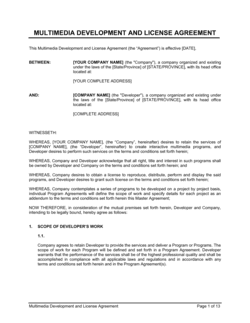
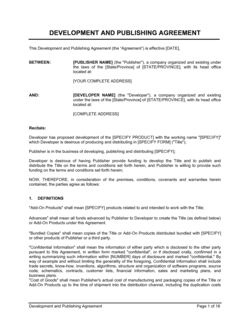
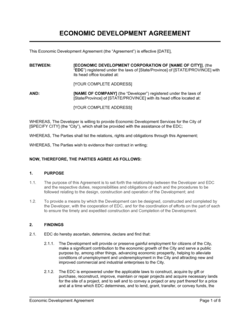
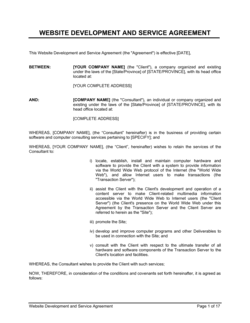
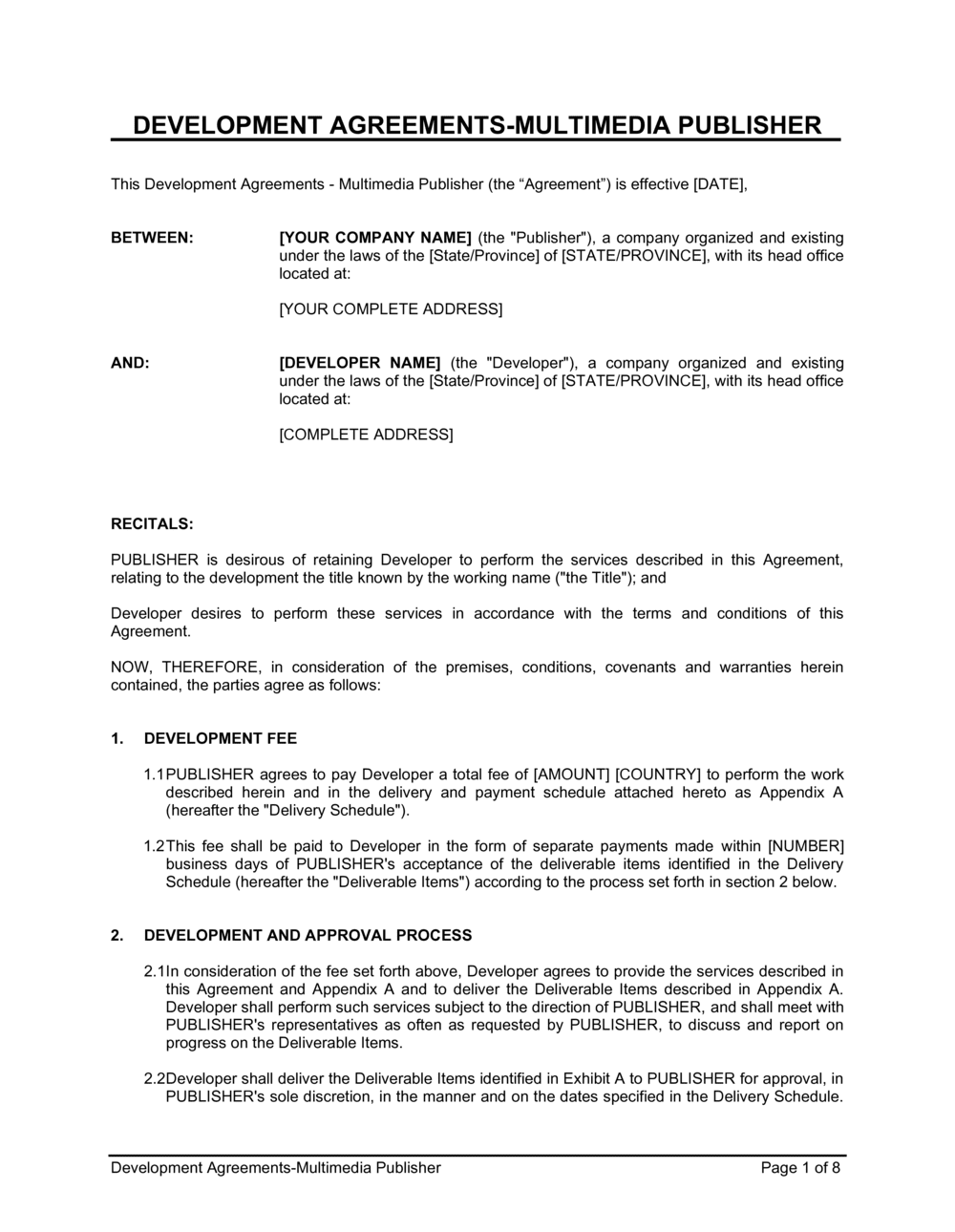
Development Agreements Multimedia Publisher Template

Free Word download • Edit online • Save & share with Drive • Export to PDF

8 pages25–35 min to fillDifficulty: ComplexSignature requiredLegal review recommended
Learn more ↓
FreeDevelopment Agreements Multimedia Publisher Template

At a glance

What it is
A Development Agreement for a Multimedia Publisher is a legally binding contract between a publisher and a developer that governs the creation, delivery, financing, and commercial exploitation of a multimedia product — such as a video game, interactive application, digital film, or educational software. This free Word download covers scope, milestones, funding advances, IP ownership, royalty structure, approval rights, and termination in a single document you can edit online and export as PDF.
When you need it
Use it when a publisher is funding or co-funding a developer to create original multimedia content for commercial release, or when a developer is entering a publishing relationship that involves an advance, milestone payments, or the transfer of distribution rights. It should be executed before any development work begins or any funds change hands.
What's inside
Project scope and deliverables schedule, milestone payments and advance recoupment, intellectual property ownership and licensing terms, approval and quality-control rights, royalty calculation and reporting obligations, marketing commitments, representations and warranties, and termination with reversion rights.

What is a Development Agreement for a Multimedia Publisher?

A Development Agreement for a Multimedia Publisher is a legally binding contract between a publisher and a developer that governs the funded creation, approval, and commercial exploitation of a multimedia product — typically a video game, interactive application, educational software, or digital film. It sets out the full terms under which the publisher finances development through milestone-based advance payments, specifies who owns the resulting intellectual property, defines the royalty structure and recoupment mechanics, and allocates the rights and risks of each party throughout the project lifecycle and beyond release. Unlike a simple services agreement, this document creates an ongoing commercial relationship between two parties with shared financial stakes in the product's commercial performance.

Why You Need This Document

Without a signed development agreement in place before work begins, both publisher and developer are exposed to serious legal and commercial risk. Developers who proceed on a handshake or a term sheet have no enforceable right to milestone payments, no guaranteed reversion if the publisher cancels, and no protection against a catch-all IP assignment that strips them of their pre-existing technology. Publishers who rely on informal arrangements have no approval rights, no recourse for missed milestones, and no clear basis for recouping an advance if the developer fails to deliver. When a product is cancelled, delayed, or commercially disappointing — as many are — the development agreement is the document that determines who walks away with the IP, who absorbs the sunk costs, and whether years of creative work can ever reach an audience. This template provides a balanced, negotiation-ready starting point that reflects how publisher-developer deals are structured in practice, reducing drafting time and ensuring neither party signs away rights they did not intend to give up.

Which variant fits your situation?

If your situation is…Use this template
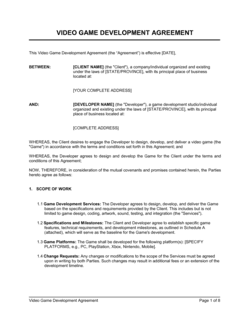
Publisher funding full development of a video gameDevelopment Agreement Multimedia Publisher (Full Funding)
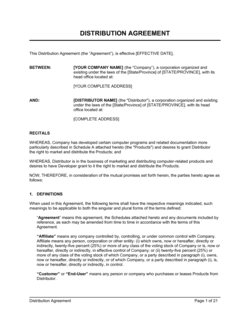
Developer self-funding but granting distribution rights to a publisherDistribution Agreement
Publisher licensing existing IP to a developer for adaptationIP License Agreement
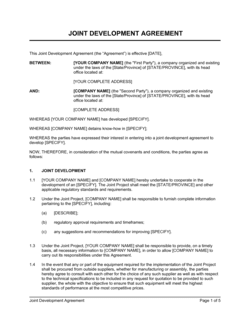
Two studios co-developing a title with shared fundingJoint Development Agreement
Commissioning a freelancer to create multimedia assetsWork for Hire Agreement
Publisher acquiring full ownership of a completed productIP Assignment Agreement
Developer granting limited app-store publishing rightsSoftware Publishing Agreement

Common mistakes to avoid

❌ No deemed-approval provision for milestones

Why it matters: A publisher that never formally approves a milestone submission can withhold payment indefinitely while the developer continues working, draining resources without compensation.

Fix: Insert a deemed-approval clause stating that silence for 21–30 days constitutes acceptance. Pair it with a specific rejection format requiring written notice with itemized deficiencies.

❌ Undefined net revenue deductions

Why it matters: If the contract allows the publisher to deduct 'costs' without a defined list or cap, real-world royalty statements can show zero net revenue even when gross sales are strong — a practice sometimes called 'Hollywood accounting.'

Fix: Define every permitted deduction by category and percentage cap. Platform fees should be capped at actual rates; marketing costs should be excluded from the recoupment base entirely or limited to a specific dollar amount.

❌ Assigning pre-existing developer technology to the publisher

Why it matters: A catch-all IP assignment clause transfers ownership of the developer's engine, tools, and libraries — assets built before the deal and essential to the developer's future projects.

Fix: Attach a Schedule D listing all pre-existing technology and carve it out of the assignment. Grant the publisher a limited license to use it as embedded in the delivered product only.

❌ No reversion right on publisher termination without cause

Why it matters: Without a reversion clause, a publisher that cancels the project for business reasons retains the IP, leaving the developer with only the advance received to date and no rights to commercialize years of work.

Fix: Include an explicit reversion clause: on termination by the publisher without cause, all product IP reverts to the developer, and the developer retains all milestone payments already received.

❌ Vague marketing obligations

Why it matters: A publisher that commits only to 'commercially reasonable efforts' with no minimum spend or release deadline faces no contractual consequence for shelving the product after gold master delivery.

Fix: Require a minimum marketing commitment in dollars, a specific release window, and a reversion trigger if the product is not released within a defined period after gold master approval.

❌ Uncapped IP indemnity from the developer

Why it matters: An uncapped indemnity for IP infringement claims can expose a small developer to liability far exceeding the total contract value, making the deal economically irrational to sign.

Fix: Cap the developer's IP indemnity at the total advance received, and carve out infringement claims arising from publisher-directed changes or third-party assets provided by the publisher.

The 10 key clauses, explained

Project scope and deliverables schedule

In plain language: Defines exactly what will be built — platforms, features, content volume, and technical specifications — and attaches a schedule listing each deliverable with its due date.

Sample language
Developer shall design, develop, and deliver the Product described in Schedule A ('Deliverables') for the [PLATFORM(S)] platform, in accordance with the Technical Specifications attached as Schedule B, by the dates set out in the Milestone Schedule in Schedule C.

Common mistake: Describing the deliverable in vague terms like 'a finished game' without attaching a technical specification. When milestone disputes arise, there is no objective standard against which to measure the submission.

Advance and milestone payment schedule

In plain language: Sets out the total advance, the portion payable at each milestone, and the conditions that must be met before each payment is released.

Sample language
Publisher shall pay Developer a non-refundable recoupable advance of $[TOTAL ADVANCE], payable in installments as follows: $[AMOUNT] on execution; $[AMOUNT] upon Publisher's written approval of the [MILESTONE NAME] deliverable; with the remaining balance payable upon Gold Master approval.

Common mistake: Failing to specify what 'approval' means at each milestone. If the contract does not define approval criteria or a deemed-approval timeline, publishers can withhold payments indefinitely by refusing to formally approve.

Intellectual property ownership

In plain language: Specifies who owns the IP in the finished product, the game engine, tools, and any pre-existing technology the developer brings to the project.

Sample language
Subject to full recoupment of the Advance, all right, title, and interest in the Product — including all copyrights, trademarks, and related IP — shall be owned by [PUBLISHER / DEVELOPER]. Developer retains ownership of its Pre-Existing Technology listed in Schedule D, and hereby grants Publisher a [exclusive / non-exclusive] license to use such technology solely as incorporated in the Product.

Common mistake: Assigning all IP to the publisher without carving out the developer's pre-existing engine or tools. Developers who sign away their core technology lose the ability to use it in future projects.

Royalty rate and recoupment mechanics

In plain language: States the royalty percentage payable to the developer, the recoupment waterfall, and how net revenue is calculated after platform fees and allowable deductions.

Sample language
Publisher shall pay Developer a royalty of [X]% of Net Revenue. 'Net Revenue' means gross receipts from Product sales less: (a) platform or distribution fees not to exceed [X]%; (b) returns and chargebacks; and (c) applicable taxes. Royalties shall not be payable until the Advance has been fully recouped from Developer's royalty share.

Common mistake: Leaving 'net revenue' undefined or allowing the publisher to deduct costs without a defined cap. Uncapped deductions — including marketing costs — can make the royalty base zero regardless of strong sales.

Approval rights and quality assurance

In plain language: Gives the publisher the right to review and approve each milestone, sets a review period, requires written notice of rejection with reasons, and establishes a cure period.

Sample language
Publisher shall have [30] days from receipt of each milestone deliverable to provide written approval or rejection. Rejection notices must specify each deficiency in reasonable detail. Developer shall have [21] days ('Cure Period') to remedy deficiencies and resubmit. If Publisher fails to respond within the review period, the deliverable shall be deemed approved.

Common mistake: No deemed-approval provision. Without one, a publisher that never responds in writing can hold the developer in limbo indefinitely, triggering payment disputes and schedule slippage.

Marketing and release obligations

In plain language: Commits the publisher to a minimum marketing spend or effort and sets a release window, with consequences — including reversion — if the product is not released within the agreed timeframe.

Sample language
Publisher shall use commercially reasonable efforts to market and release the Product by [RELEASE DATE]. Publisher shall commit a minimum marketing budget of $[AMOUNT]. If Publisher does not release the Product within [X] months following Gold Master approval, Developer may terminate this Agreement and all rights shall revert to Developer.

Common mistake: Accepting 'commercially reasonable efforts' without a minimum spend floor or a release deadline tied to reversion rights. Publishers have cancelled completed products with no contractual obligation to release or compensate.

Representations, warranties, and indemnification

In plain language: Each party warrants that it has the authority to enter the agreement, that the product will not infringe third-party IP, and that each party indemnifies the other for breaches of its own warranties.

Sample language
Developer represents and warrants that: (a) it has full authority to enter this Agreement; (b) the Product will be Developer's original work and will not infringe any third-party intellectual property rights; and (c) Developer has obtained all necessary licenses for any third-party content included in the Product. Developer shall indemnify Publisher against any claims arising from Developer's breach of these warranties.

Common mistake: Broad IP warranties without a right to cure or an IP indemnity cap. An uncapped IP indemnity exposes a small developer to liability far exceeding the value of the deal.

Termination and reversion of rights

In plain language: Specifies the events that allow either party to terminate — missed milestones, insolvency, breach — and what happens to the IP and any completed work on termination.

Sample language
Either party may terminate this Agreement on [30] days' written notice if the other party commits a material breach and fails to cure within the notice period. On termination by Publisher without cause, all rights in the Product shall revert to Developer, and Developer shall retain all Advance payments received to date. On termination by Publisher for Developer's uncured breach, Publisher shall retain all deliverables received.

Common mistake: No reversion clause on publisher termination without cause. Without it, a publisher that terminates for convenience retains the IP and the developer walks away with only sunk costs.

Confidentiality

In plain language: Requires both parties to keep project details, financials, and technical information confidential during and for a defined period after the agreement.

Sample language
Each party agrees to keep confidential all non-public information received from the other party ('Confidential Information') and not to disclose it to any third party without prior written consent. This obligation survives termination of this Agreement for a period of [3] years.

Common mistake: Applying confidentiality only to the developer. Publishers possess commercially sensitive information about release strategy, sales data, and royalty calculations that are equally worth protecting.

Governing law and dispute resolution

In plain language: Specifies the jurisdiction whose law governs the contract and the mechanism — arbitration, mediation, or litigation — for resolving disputes.

Sample language
This Agreement shall be governed by the laws of [STATE / PROVINCE / COUNTRY], without regard to conflict-of-law provisions. Any dispute arising out of this Agreement shall be resolved by binding arbitration administered by [AAA / JAMS / ICC] in [CITY], except that either party may seek injunctive relief in any court of competent jurisdiction.

Common mistake: Choosing governing law based on the publisher's home state without considering where the developer operates. Developers in other states or countries may face prohibitive costs enforcing their rights in a distant forum.

How to fill it out

  1. 1

    Identify both parties with full legal entity names

    Enter the registered legal name, jurisdiction of formation, and principal address for both the publisher and the developer. Avoid using trade names or brand names in the contract header.

    💡 Verify the developer's entity type — a sole proprietor has different liability implications than an LLC or corporation, and this affects indemnification exposure.

  2. 2

    Attach a detailed scope and technical specification in Schedule A

    Define the product in measurable terms: platform(s), resolution, content volume, feature list, supported languages, and accessibility requirements. Reference a separate Technical Specification document if one exists.

    💡 The more specific Schedule A is, the easier milestone disputes are to resolve. A vague scope almost always favors whichever party has more leverage at the time of the dispute.

  3. 3

    Build the milestone schedule with approval criteria

    List every milestone — concept approval, vertical slice, alpha, beta, gold master — with its due date, payment amount, and the specific criteria the deliverable must meet to be approved.

    💡 Include an automatic deemed-approval period (typically 21–30 days) so that publisher inaction cannot indefinitely delay payment.

  4. 4

    Negotiate and document the advance and recoupment structure

    Enter the total advance, the installment tied to each milestone, and the exact recoupment formula specifying which costs are recoupable and in what order. Confirm whether the advance is refundable if the developer fails to deliver.

    💡 Developers should resist recoupment of publisher marketing costs from their royalty share — this is standard publisher practice but can eliminate royalties even on commercially successful titles.

  5. 5

    Define net revenue and the royalty rate

    List every permitted deduction from gross revenue to arrive at the net royalty base, including a percentage cap on platform fees. Set the royalty rate and any tiered escalator tied to cumulative units or revenue.

    💡 A tiered royalty that increases above a sales threshold — e.g., 15% to 500K units, 20% thereafter — rewards breakout success and is worth negotiating even if the base rate is lower.

  6. 6

    Specify IP ownership and carve out pre-existing technology

    Decide whether the publisher or developer owns the product IP on completion, and attach a Schedule D listing any pre-existing developer technology excluded from the assignment. Include a license back to the developer if the publisher owns the IP.

    💡 Developers who own proprietary engines or tools should always carve them out explicitly — a catch-all assignment clause will otherwise transfer ownership of technology built years before the deal.

  7. 7

    Set termination triggers and reversion rights

    List the events that allow each party to terminate — missed milestones, payment failures, insolvency, change of control — and specify exactly what happens to the deliverables and IP under each termination scenario.

    💡 A reversion right on publisher termination without cause is the single most valuable clause a developer can negotiate. Without it, a publisher can shelve the product and retain the IP indefinitely.

  8. 8

    Execute before development work begins

    Both parties must sign before any development activity or advance payment occurs. Post-commencement signatures create ambiguity about whether pre-contract work is covered by the IP assignment and milestone schedule.

    💡 Use a countersignature structure — publisher signs first and returns to developer — to preserve a clear record of offer and acceptance.

Frequently asked questions

What is a multimedia publisher development agreement?

A multimedia publisher development agreement is a legally binding contract between a publisher and a developer that governs the creation, funding, and commercial exploitation of a multimedia product — typically a video game, interactive application, digital film, or educational software. It sets out who owns the IP, how the advance is structured and recouped, what milestones trigger payments, and what happens if either party terminates. It is the foundational document for any publisher-funded development relationship.

Who signs a multimedia publisher development agreement?

The publisher — the company funding and distributing the product — and the developer — the studio or individual creating it — are the two contracting parties. Both should sign as legal entities rather than individuals wherever possible to limit personal liability. In co-development arrangements, multiple developer entities may be party to the same agreement or to separate agreements with the publisher.

What is an advance in a publisher development agreement?

An advance is a sum paid by the publisher to the developer before release to fund development costs. It is typically recoupable — meaning the publisher recovers it from the developer's future royalty earnings before any net royalties are paid out. Advances are usually non-refundable unless the developer fails to deliver the agreed product. The advance amount and recoupment structure are among the most heavily negotiated terms in any publisher deal.

Does the developer or publisher own the IP in a development agreement?

IP ownership depends entirely on what the parties negotiate. Publishers typically seek full ownership of the product IP in exchange for funding development. Developers may retain ownership and grant an exclusive license, or they may assign ownership but retain their underlying engine and tools. There is no universal default — the contract must state the arrangement explicitly, including what happens to IP on termination.

What are reversion rights and why do developers need them?

Reversion rights are contractual provisions that return specified rights — such as publishing, distribution, or full IP ownership — to the developer when the publisher fails to meet defined obligations. Common reversion triggers include failure to release the product within a specified window after gold master delivery, publisher termination without cause, and publisher insolvency. Without reversion rights, a developer can lose years of work to a publisher that simply decides not to release the product.

How are royalties calculated under a multimedia development agreement?

Royalties are typically calculated as a percentage of net revenue — gross sales proceeds minus defined allowable deductions such as platform fees, returns, and taxes. Common rates range from 10% to 35% depending on the advance size, IP ownership structure, and the developer's negotiating position. Tiered royalties that increase above cumulative sales thresholds are common. Royalties are not payable until the full advance has been recouped from the developer's share.

What happens if the developer misses a milestone deadline?

Most agreements include a cure period — typically 21 to 45 days — during which the developer can remedy a missed or rejected milestone before the publisher may trigger remedies. Remedies for uncured milestone failure can include withholding the next payment, terminating the agreement, and retaining all deliverables received. Some agreements also include financial penalties for delay. The specific consequences depend on whether the failure is classified as a material breach.

Do I need a lawyer to negotiate a publisher development agreement?

For any deal involving a meaningful advance, IP assignment, or long-term exclusivity, engaging an entertainment or IP lawyer is strongly recommended. Publisher standard-form agreements are drafted to protect the publisher, and developers who sign without review routinely give up reversion rights, accept uncapped deductions, and assign pre-existing technology they did not intend to transfer. A template provides a fair starting baseline, but a one-to-two hour legal review can identify and fix clauses that could cost far more than the legal fee.

What is the difference between a development agreement and a distribution agreement?

A development agreement governs the creation of a product that does not yet exist — including funding, milestones, IP ownership, and quality approval. A distribution agreement governs the commercial exploitation of a product that already exists — covering sales channels, revenue share, territory, and term. A developer who self-funds a project needs only a distribution agreement; a developer receiving publisher funding needs a development agreement, which often incorporates distribution rights as well.

How this compares to alternatives

vs Software Development Agreement

A software development agreement governs custom software built to a client's specification, with the client typically owning the deliverables outright. A multimedia publisher development agreement is bilateral — the publisher funds the developer, but both parties have ongoing rights and obligations including royalty payments, marketing commitments, and reversion clauses. The publisher-developer relationship is more like a financing and licensing deal than a client-vendor engagement.

vs IP License Agreement

An IP license agreement grants usage rights in existing IP without funding the creation of new work. A development agreement governs the funded creation of an entirely new product and typically includes IP assignment or an exclusive license as one component of a broader commercial arrangement covering milestones, advances, royalties, and approval rights.

vs Distribution Agreement

A distribution agreement covers the commercialization of a product that already exists — territory, channels, revenue split, and term. A development agreement begins earlier in the lifecycle, funding creation of the product and addressing IP ownership before any distribution occurs. Publisher deals often combine both, but they serve distinct functions and the development terms should be clearly separated from the distribution terms.

vs Work for Hire Agreement

A work for hire agreement engages a contractor to create content owned entirely by the commissioning party from the moment of creation. A publisher development agreement is not a work-for-hire arrangement — the developer typically retains some rights (pre-existing technology, reversion on termination) and receives a royalty rather than a flat fee. Treating a development deal as a simple work for hire ignores the ongoing commercial relationship and leaves critical royalty and reversion terms unaddressed.

Industry-specific considerations

Video games

Milestone-based funding tied to vertical slice, alpha, beta, and gold master; platform certification requirements; engine IP carve-outs; tiered royalties above sales thresholds.

E-learning and educational technology

Content accuracy warranties, accessibility compliance obligations (WCAG 2.1), LMS integration deliverables, and content update obligations post-release.

Animation and digital film

Delivery format specifications (DCP, ProRes, DCP-HDR), approval rounds tied to animatic and final cut, festival hold-back periods, and streaming exclusivity windows.

Interactive media and XR

Hardware platform dependencies (VR/AR headset requirements), SDK version lock-in provisions, motion sickness compliance testing, and update and patch obligations post-launch.

Jurisdictional notes

United States

Copyright in works created under a development agreement is governed by the US Copyright Act. Work-for-hire doctrine applies only if the developer is an employee or the parties have a written work-for-hire agreement — an oral arrangement will not transfer copyright. Non-compete clauses are enforceable in most states but banned in California, which is significant given the concentration of game developers in Los Angeles and the Bay Area. Arbitration clauses are broadly enforceable under the Federal Arbitration Act.

Canada

Copyright in Canada is governed by the Copyright Act and vests initially in the author — meaning the developer — unless the work is created in the course of employment. Moral rights cannot be assigned but can be waived in writing; publishers should include a moral rights waiver in any IP assignment clause. Quebec requires contracts to be available in French for provincially regulated businesses. Federal and provincial tax credit programs for interactive digital media (e.g., OMDC, CMF) may impose additional IP and Canadian-content requirements.

United Kingdom

Copyright in the UK under the Copyright, Designs and Patents Act 1988 vests in the employer when a work is created by an employee in the course of employment, but not when created by an independent contractor — making an explicit assignment clause essential for publisher deals. Moral rights exist in the UK but may be waived. Post-Brexit, UK developers and publishers should confirm whether EU distribution rights need to be addressed separately. BAFTA and BFI certification requirements may affect qualifying interactive media projects.

European Union

The EU Copyright Directive and the 2019 Directive on Copyright in the Digital Single Market impose author-protective provisions across member states, including a right to fair remuneration that may limit a developer's ability to waive royalty rights entirely. GDPR applies to any user data collected through the multimedia product and should be addressed in the product's data compliance framework, not the development agreement itself. Non-compete clauses in EU member states typically require financial compensation to be enforceable and are scrutinized under national competition law.

Template vs lawyer — what fits your deal?

PathBest forCostTime
Use the templateSmall developers and publishers negotiating straightforward domestic deals with advances under $50K and no complex IP structuresFree1–2 hours to complete
Template + legal reviewDeals involving advances of $50K–$500K, IP assignment, platform exclusivity, or cross-border parties$500–$1,500 for a one-to-two hour entertainment lawyer review3–5 business days
Custom draftedMajor publisher deals, advances exceeding $500K, multi-platform multi-territory exclusivity, or franchise IP development$3,000–$10,000+ for a fully negotiated entertainment law firm engagement2–6 weeks

Glossary

Advance
A sum paid by the publisher to the developer before release, to be recouped from the developer's future royalty earnings before any net royalties are paid out.
Recoupment
The process by which a publisher recoups an advance or other costs from the developer's royalty share before the developer receives net royalty payments.
Milestone
A defined stage of development — such as alpha, beta, or gold master — tied to a specific payment and subject to publisher approval.
Gold Master
The final approved build of a multimedia product that is ready for manufacturing, distribution, or digital release.
Reversion Rights
A contractual provision that returns specified rights — such as publishing or distribution — to the developer if the publisher fails to meet its obligations.
Net Revenue
Gross revenue from product sales minus defined allowable deductions such as platform fees, returns, taxes, and distribution costs, forming the royalty base.
First-Party Rights
Rights retained by the developer — typically to the underlying engine, tools, or technology — that are carved out of the assignment to the publisher.
Approval Right
The publisher's contractual authority to review and accept or reject a milestone deliverable against agreed specifications before releasing the next payment.
Exclusivity Window
A defined period during which the publisher holds exclusive rights to distribute or sell the product, after which rights may become non-exclusive or revert.
Derivative Works
Sequels, expansions, ports, or adaptations based on the original product, with the agreement specifying which party controls their development and commercialization.
Royalty Rate
The percentage of net revenue paid to the developer after recoupment of the advance, typically expressed as a tiered scale tied to cumulative sales.
Approval Cure Period
A defined number of days given to the developer to fix deficiencies in a rejected milestone deliverable before the publisher may trigger remedies or termination.

Part of your Business Operating System

This document is one of 3,000+ business & legal templates included in Business in a Box.

  • Fill-in-the-blanks — ready in minutes
  • 100% customizable Word document
  • Compatible with all office suites
  • Export to PDF and share electronically

Create your document in 3 simple steps.

From template to signed document — all inside one Business Operating System.
1
Download or open template

Access over 3,000+ business and legal templates for any business task, project or initiative.

2
Edit and fill in the blanks with AI

Customize your ready-made business document template and save it in the cloud.

3
Save, Share, Send, Sign

Share your files and folders with your team. Create a space of seamless collaboration.

Save time, save money, and create top-quality documents.

★★★★★

"Fantastic value! I'm not sure how I'd do without it. It's worth its weight in gold and paid back for itself many times."

Managing Director · Mall Farm
Robert Whalley
Managing Director, Mall Farm Proprietary Limited
★★★★★

"I have been using Business in a Box for years. It has been the most useful source of templates I have encountered. I recommend it to anyone."

Business Owner · 4+ years
Dr Michael John Freestone
Business Owner
★★★★★

"It has been a life saver so many times I have lost count. Business in a Box has saved me so much time and as you know, time is money."

Owner · Upstate Web
David G. Moore Jr.
Owner, Upstate Web

Run your business with a system — not scattered tools

Stop downloading documents. Start operating with clarity. Business in a Box gives you the Business Operating System used by over 250,000 companies worldwide to structure, run, and grow their business.

Free Forever Plan · No credit card required