Request for Replacement of Damaged Merchandise Template

Free Word download β€’ Edit online β€’ Save & share with Drive β€’ Export to PDF

1 pageβ€’20–25 min to fillβ€’Difficulty: Standard
Learn more ↓
FreeRequest for Replacement of Damaged Merchandise Template

At a glance

What it is
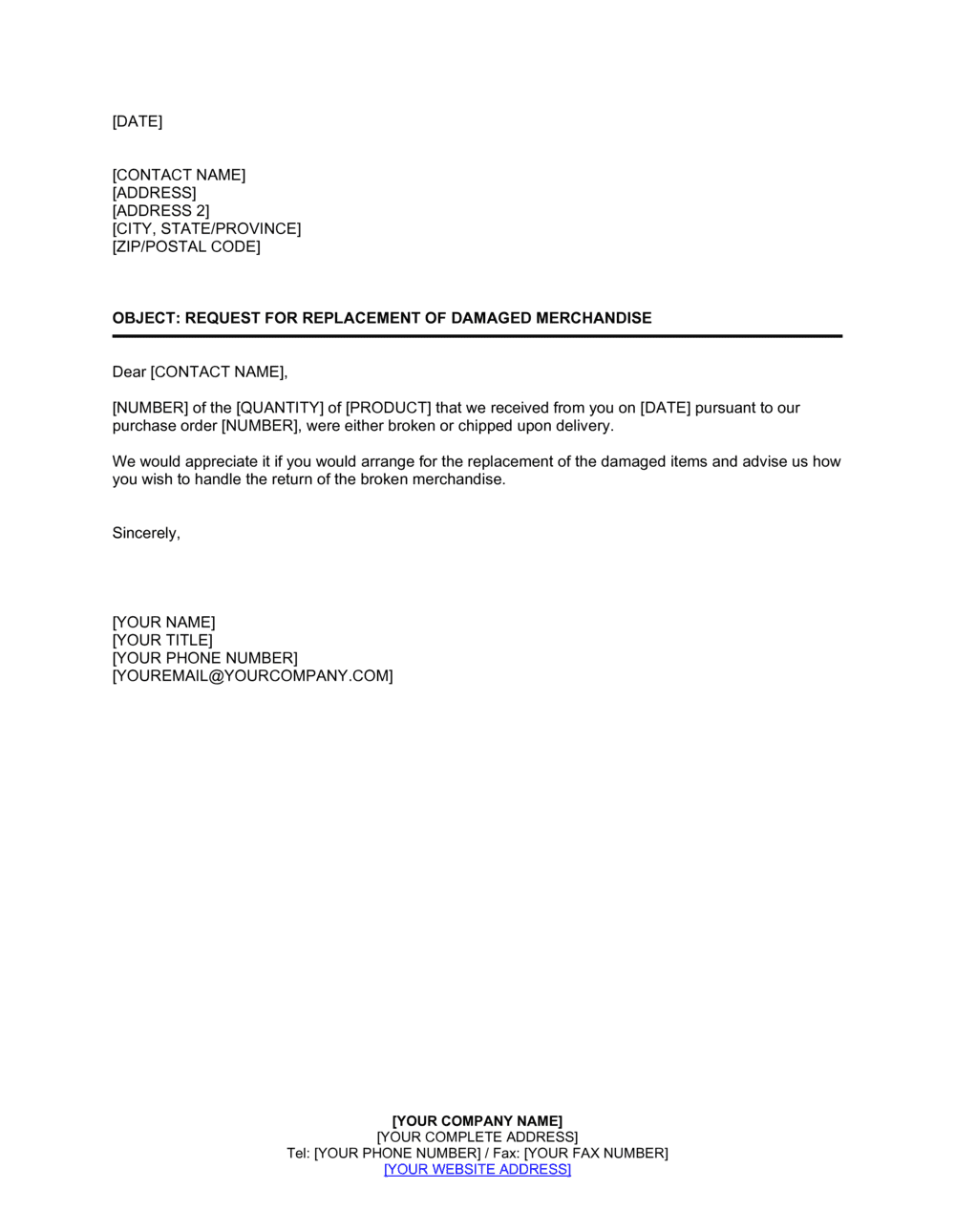
A Request For Replacement Of Damaged Merchandise is a formal business letter sent by a buyer to a supplier or vendor asking that damaged goods be replaced at no additional cost. This free Word download gives you a ready-to-edit template you can complete in minutes and send by email or post.
When you need it
Use it as soon as you inspect a delivery and discover that one or more items arrived damaged, defective, or not as described. Sending a written request promptly creates a documented paper trail that supports your claim under most supplier return and warranty policies.
What's inside
Sender and recipient details, order and invoice references, a clear description of the damaged item and the nature of the damage, supporting evidence references, the specific replacement requested, and a response deadline β€” everything a supplier needs to process your claim without back-and-forth delays.

What is a Request For Replacement Of Damaged Merchandise?

A Request For Replacement Of Damaged Merchandise is a formal business letter sent by a buyer to a supplier asking that goods received in damaged condition be replaced with identical undamaged items at no additional cost. The letter documents the claim in writing, references the original purchase order and invoice, describes the specific damage with supporting evidence, and sets a clear deadline for the supplier to respond. It functions as the official record of the claim β€” replacing informal phone calls or emails with a structured, traceable notice that both parties can rely on if the matter escalates.

Why You Need This Document

Without a written replacement request, damaged-goods claims are easy for suppliers to overlook, deprioritize, or later dispute. A verbal complaint leaves no audit trail; an informal email chain rarely contains all the information a supplier's claims team needs to act. A formal letter forces clarity on both sides: the buyer commits to the facts of the damage and the remedy expected, and the supplier receives everything needed to process the claim without asking follow-up questions. Most supplier return policies and purchase contracts require written notification within a defined window β€” typically 24 to 72 hours of delivery β€” meaning a prompt, properly structured letter is often the difference between a replacement being approved and a claim being denied on procedural grounds. This template gives you the right structure in under 15 minutes, so a damaged delivery becomes a resolved claim rather than a write-off.

Which variant fits your situation?

If your situation is…Use this template
Goods arrived damaged in transit and the carrier is responsibleFreight Damage Claim Letter
Received wrong items instead of β€” or in addition to β€” damaged onesRequest For Replacement Of Wrong Merchandise
Items are defective rather than physically damagedDefective Merchandise Complaint Letter
Requesting a refund instead of a replacementRequest For Refund Of Damaged Merchandise
Vendor has already denied an informal replacement requestFormal Complaint Letter To Supplier
Damaged goods under a warranty rather than a purchase orderWarranty Claim Letter

Common mistakes to avoid

❌ Delaying the claim after discovering damage

Why it matters: Most supplier return and replacement policies require notification within a defined window β€” often 48 to 72 hours of delivery. A late claim gives the supplier grounds to deny replacement entirely.

Fix: Inspect deliveries on the day of receipt and send the replacement request the same day or the next business day. Photograph damage immediately as timestamped evidence.
❌ No order or invoice reference in the letter

Why it matters: Without a PO number or invoice reference, the supplier cannot locate the transaction in their system and will request the information before acting, adding days to your resolution timeline.

Fix: Always include the purchase order number, invoice number, and delivery date in both the subject line and the body of the letter.

❌ Vague damage description

Why it matters: Descriptions like 'items are damaged' give the supplier no basis to assess the claim or approve replacement without a follow-up investigation, slowing the process.

Fix: Describe the damage specifically β€” what is broken, cracked, wet, or missing, on how many units, and whether the packaging was intact or also damaged.

❌ Sending the letter without supporting evidence

Why it matters: A replacement request without photographs or a signed delivery note is easy for a supplier to dispute or deprioritize. Your claim has no independent corroboration.

Fix: Attach date-stamped photographs of the damaged items and packaging, a copy of the delivery receipt noting the damage, and the original invoice before sending.

❌ No stated response deadline

Why it matters: Open-ended requests with no deadline are routinely deprioritized. Without a date, there is no trigger for follow-up and claims can sit unresolved for weeks.

Fix: State a specific response date in the letter β€” 'please confirm resolution by [DATE]' β€” and note that you will escalate if the deadline passes.

❌ Using informal or apologetic language

Why it matters: Phrases like 'I'm sorry to trouble you' or 'whenever you get a chance' undermine the formal nature of the request and signal that the buyer is unlikely to follow through.

Fix: Use direct, professional language throughout. State the problem, the evidence, and the expected remedy clearly and without hedging.

The 9 key clauses, explained

Sender and recipient details

In plain language: Opens the letter with the buyer's name, company, address, and contact details, along with the full name, title, and address of the supplier representative receiving the letter.

Sample language
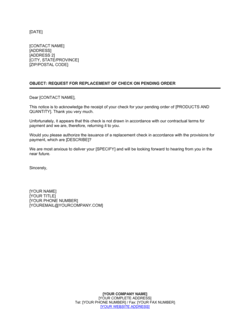
[SENDER NAME] | [SENDER COMPANY] | [ADDRESS] | [EMAIL] | [DATE] Attention: [RECIPIENT NAME], [TITLE] [SUPPLIER COMPANY] [SUPPLIER ADDRESS]

Common mistake: Addressing the letter generically to 'Customer Service' rather than a named contact. A named recipient gets routed and actioned faster than a generic salutation.

Subject line

In plain language: A one-line summary that identifies the letter as a replacement request and references the order number so the supplier can pull up the transaction immediately.

Sample language
Subject: Request for Replacement β€” Damaged Merchandise | PO #[PURCHASE ORDER NUMBER] | Invoice #[INVOICE NUMBER]

Common mistake: Omitting the PO or invoice number from the subject line, forcing the supplier to request it separately and delaying the claim by days.

Opening statement of the problem

In plain language: Clearly states that damaged merchandise was received, identifies the delivery date, and sets the tone as a formal written request rather than an informal complaint.

Sample language
I am writing to formally notify you that merchandise received on [DELIVERY DATE] under the above-referenced purchase order arrived in a damaged condition and to request replacement at no additional charge.

Common mistake: Opening with an apology or softening language such as 'I'm sorry to bother you.' Formal letters should state the issue directly β€” apologetic framing signals that the claim is negotiable.

Item description and quantity

In plain language: Specifies exactly which items were damaged β€” product name, SKU or model number, and quantity β€” so the supplier can identify and allocate the replacement stock.

Sample language
The following items were received in damaged condition: [QUANTITY] x [PRODUCT NAME], SKU [SKU NUMBER], as listed on Invoice #[INVOICE NUMBER], line item [LINE NUMBER].

Common mistake: Describing items only by product name without a SKU or model number. Ambiguous descriptions cause the supplier to substitute an incorrect item or request clarification before acting.

Description of damage

In plain language: Describes the specific nature and extent of the damage β€” broken, crushed, cracked, wet, missing parts β€” and notes whether packaging was also damaged, which helps establish whether damage occurred in transit or prior to shipment.

Sample language
Upon inspection, the items were found to be [DESCRIPTION OF DAMAGE β€” e.g., cracked along the base, with packaging intact / visibly crushed with the outer carton also damaged]. Photographs documenting the damage are attached as Exhibit A.

Common mistake: Describing damage vaguely as 'not in good condition.' Specific damage descriptions β€” with measurements or part references where applicable β€” make the claim harder to dispute and faster to approve.

Reference to supporting evidence

In plain language: Points to the photographs, inspection reports, or carrier notes attached to the letter, giving the supplier the evidence needed to approve the replacement without a site visit.

Sample language
Please find enclosed the following supporting documentation: (1) photographs of the damaged items and packaging taken on [DATE], (2) the signed delivery receipt noting visible damage, and (3) a copy of the original invoice.

Common mistake: Mentioning that photos exist without actually attaching them. Suppliers will wait for the evidence before processing the claim, resetting your timeline.

Replacement request and preferred resolution

In plain language: States the specific remedy being requested β€” replacement with identical undamaged items β€” and any preference regarding shipping method, timeline, or interim substitution.

Sample language
We respectfully request that you arrange for prompt replacement of the damaged items with identical undamaged units at no additional cost. Please confirm the expected dispatch date and provide a tracking number once the replacement order has been processed.

Common mistake: Leaving the resolution open-ended by writing 'please advise how you wish to proceed.' Stating the expected remedy clearly shifts the burden of action to the supplier.

Response deadline

In plain language: Gives the supplier a specific date by which to respond or act, and notes what action will follow if the deadline is not met.

Sample language
We ask that you confirm receipt of this request and provide a resolution by [DATE β€” typically 5–10 business days from the letter date]. If we do not receive a response by this date, we will be required to escalate this matter accordingly.

Common mistake: Setting no deadline at all. Without a stated deadline, replacement claims can remain open for weeks while the buyer waits for a response that never comes.

Closing and signature block

In plain language: Closes the letter professionally, thanks the recipient for their attention, and provides the sender's name, title, and contact information for follow-up.

Sample language
Thank you for your prompt attention to this matter. Please do not hesitate to contact me at [PHONE NUMBER] or [EMAIL ADDRESS] if you require any additional information. Sincerely, [SENDER NAME] [TITLE] [COMPANY NAME]

Common mistake: Closing without a direct contact method. If the supplier cannot reach the buyer quickly to clarify details, the claim gets deprioritized in favour of easier-to-resolve requests.

How to fill it out

  1. 1

    Enter sender and recipient details

    Add your full name, company name, address, email, and the letter date at the top. Then enter the name, title, and address of the specific supplier contact handling returns or claims.

    πŸ’‘ Call the supplier's customer service line before sending to get the correct name and email of the claims or returns contact β€” addressed letters get actioned faster.

  2. 2

    Complete the subject line with order references

    Fill in the PO number and invoice number in the subject line. If you have a supplier account number, include that too.

    πŸ’‘ Copy these numbers exactly as they appear on your purchase documents β€” a single digit mismatch can delay the supplier's ability to locate the transaction.

  3. 3

    State the delivery date and describe the damage

    Enter the date you received the delivery and write a specific, factual description of the damage. Note whether the outer packaging was also damaged, which indicates transit damage rather than a pre-shipment defect.

    πŸ’‘ Use objective language β€” 'three units arrived with cracked casings' rather than 'everything was a mess.' Factual descriptions move faster through supplier claims systems.

  4. 4

    Identify the damaged items by SKU and quantity

    List each damaged item with its product name, SKU or model number, and the quantity affected. Reference the line item number from the original invoice where possible.

    πŸ’‘ Cross-reference your packing slip against the invoice before filling this section β€” discrepancies between the two can complicate or strengthen your claim.

  5. 5

    Attach and reference your supporting evidence

    Gather photographs of the damage, a copy of the signed delivery receipt, and the original invoice. Reference each attachment by exhibit number in the body of the letter.

    πŸ’‘ Take photos the same day goods are received β€” timestamps on image files serve as objective proof that the damage was documented at receipt, not after.

  6. 6

    State the replacement request clearly

    Write that you are requesting replacement with identical undamaged items at no additional cost, and ask the supplier to confirm a dispatch date and provide tracking.

    πŸ’‘ If you need the replacement by a specific date β€” for a production run, store opening, or customer order β€” state that date explicitly so the supplier can prioritize accordingly.

  7. 7

    Set a response deadline

    Enter a specific calendar date β€” typically 5 to 10 business days from the letter date β€” by which you expect a response or resolution. Add a brief note that you will escalate if the deadline passes.

    πŸ’‘ 5 business days is appropriate for domestic suppliers; allow 10 business days for international vendors to account for time zone and internal routing.

Frequently asked questions

What is a request for replacement of damaged merchandise?

A request for replacement of damaged merchandise is a formal written letter a buyer sends to a supplier asking that damaged goods received in a delivery be replaced with undamaged identical items at no additional cost. It documents the claim in writing, references the original order, describes the damage, and sets a deadline for the supplier to respond β€” creating a paper trail that supports escalation if the supplier does not act.

When should I send this letter?

Send it as soon as you discover the damage β€” ideally the same day you receive and inspect the delivery. Most supplier return and replacement policies require written notification within 24 to 72 hours of delivery. Waiting longer gives the supplier grounds to question whether the damage occurred after receipt and may result in your claim being denied.

What evidence should I include with the letter?

Attach date-stamped photographs of the damaged items and any damaged packaging, a copy of the signed delivery receipt noting damage at the time of delivery, and a copy of the original invoice or packing slip. The more specific and contemporaneous your evidence, the harder the claim is to dispute.

What if the supplier ignores or denies my replacement request?

If the supplier does not respond by your stated deadline, follow up in writing referencing the original letter and requesting a response within a further defined period. If denied without valid grounds, you may escalate to the supplier's management, dispute the charge with your payment provider, or consult your purchase contract for remedies including mediation or arbitration.

Is this letter legally binding on the supplier?

The letter itself is not a contract β€” it is a formal notice of a claim. Whether the supplier is legally obligated to replace the goods depends on your purchase contract, the supplier's return policy, and applicable consumer or commercial law in your jurisdiction. The letter creates a documented record that strengthens any subsequent legal or dispute resolution action you may need to take.

Should I request a replacement or a refund?

Choose replacement when you still need the goods and the supplier can provide them promptly. Choose a refund when the supplier cannot replace the items in time, when the product is discontinued, or when you prefer to source elsewhere. Business in a Box also provides a Request For Refund Of Damaged Merchandise template if a refund is the better resolution for your situation.

How is this letter different from a complaint letter to a supplier?

A replacement request is narrow and action-focused β€” it asks for a specific remedy for a specific damaged delivery. A supplier complaint letter is broader and may address a pattern of issues such as repeated late deliveries, quality failures across multiple orders, or a breakdown in the business relationship. If an initial replacement request is ignored, a formal complaint letter is often the appropriate next step.

Can I use this letter for goods damaged by the shipping carrier rather than the supplier?

If the damage is clearly caused by the carrier β€” crushed outer packaging, visible impact damage β€” the carrier may bear primary responsibility and you may need to file a freight damage claim directly with them. In practice, many buyers send this letter to the supplier first and let the supplier coordinate with the carrier. Check your purchase contract and the supplier's return policy to determine which party is responsible for transit damage.

How this compares to alternatives

vs Request For Refund Of Damaged Merchandise

A refund request asks the supplier to return the purchase price rather than send replacement goods. Use a replacement request when you still need the items and the supplier can deliver promptly. Use a refund request when the goods cannot be replaced in time, the product is discontinued, or you prefer to source from a different vendor.

vs Request For Replacement Of Wrong Merchandise

A wrong-merchandise replacement request addresses a fulfillment error β€” the supplier shipped the incorrect product. A damaged-merchandise replacement request addresses a quality issue β€” the correct product arrived but was damaged. The evidence required and the supplier's internal handling process differ between the two claims.

vs Formal Complaint Letter To Supplier

A supplier complaint letter is a broader document addressing a pattern of failures or a serious breakdown in the vendor relationship. A replacement request is a single, action-specific notice for one damaged delivery. If the replacement request is ignored or denied, a formal complaint letter is often the appropriate escalation step.

vs Warranty Claim Letter

A warranty claim letter is used when goods fail due to a manufacturing defect discovered during use, within a warranty period. A replacement request for damaged merchandise is used when goods arrive physically damaged at the point of delivery. The trigger event, the responsible policy, and the documentation required are different for each.

Industry-specific considerations

Retail and wholesale

High shipment volumes mean damaged goods claims are routine; a standardized letter ensures consistent documentation across all supplier relationships.

Manufacturing

Damaged raw materials or components can halt production lines, making a rapid, well-documented replacement request critical to minimizing downtime.

E-commerce and fulfilment

Inbound stock damage directly affects inventory availability and customer order fulfilment; prompt claims protect service levels and margins.

Hospitality and food service

Damaged equipment, linens, or perishables affect operations immediately; replacement letters with tight response deadlines are standard practice.

Template vs pro β€” what fits your needs?

PathBest forCostTime
Use the templateAny buyer who received damaged goods and needs to send a formal replacement request to a supplier quicklyFree10–15 minutes
Template + professional reviewHigh-value shipments where the claim may be disputed or where the purchase contract includes specific claims procedures$50–$150 (brief review by a contracts advisor or procurement specialist)1 business day
Custom draftedComplex multi-shipment disputes, international vendor claims, or situations where legal proceedings may follow$200–$600 (commercial lawyer)2–5 business days

Glossary

Replacement Claim
A formal request asking a supplier to send an identical undamaged item in exchange for one received in damaged condition.
Purchase Order (PO) Number
A unique reference number the buyer assigns to a purchase transaction, used to match invoices and shipments to the original order.
Invoice Reference
The supplier's document number for the transaction, used alongside the PO number to identify the specific delivery being disputed.
Proof of Damage
Evidence β€” typically photographs, inspection reports, or carrier delivery notes β€” that documents the condition of goods at the time of receipt.
Return Merchandise Authorization (RMA)
A number issued by the supplier authorizing the buyer to return damaged goods, often required before a replacement is dispatched.
Response Deadline
The specific date by which the buyer requests the supplier to confirm or fulfill the replacement, giving the claim a clear timeline for escalation.
Carrier Damage Note
A notation made on a delivery receipt or bill of lading at the time of delivery, recording that goods arrived in damaged condition.
Vendor Return Policy
The supplier's documented terms governing how and when buyers may return or claim replacement for defective or damaged goods.
Escalation
The process of moving an unresolved claim to a higher authority β€” senior management, a disputes team, or legal action β€” when the initial request is ignored or denied.

Part of your Business Operating System

This document is one of 3,000+ business & legal templates included in Business in a Box.

  • Fill-in-the-blanks β€” ready in minutes
  • 100% customizable Word document
  • Compatible with all office suites
  • Export to PDF and share electronically

Create your document in 3 simple steps.

From template to signed document β€” all inside one Business Operating System.
1
Download or open template

Access over 3,000+ business and legal templates for any business task, project or initiative.

2
Edit and fill in the blanks with AI

Customize your ready-made business document template and save it in the cloud.

3
Save, Share, Send, Sign

Share your files and folders with your team. Create a space of seamless collaboration.

Save time, save money, and create top-quality documents.

β˜…β˜…β˜…β˜…β˜…

"Fantastic value! I'm not sure how I'd do without it. It's worth its weight in gold and paid back for itself many times."

Managing Director Β· Mall Farm
Robert Whalley
Managing Director, Mall Farm Proprietary Limited
β˜…β˜…β˜…β˜…β˜…

"I have been using Business in a Box for years. It has been the most useful source of templates I have encountered. I recommend it to anyone."

Business Owner Β· 4+ years
Dr Michael John Freestone
Business Owner
β˜…β˜…β˜…β˜…β˜…

"It has been a life saver so many times I have lost count. Business in a Box has saved me so much time and as you know, time is money."

Owner Β· Upstate Web
David G. Moore Jr.
Owner, Upstate Web

Run your business with a system β€” not scattered tools

Stop downloading documents. Start operating with clarity. Business in a Box gives you the Business Operating System used by over 250,000 companies worldwide to structure, run, and grow their business.

Start freeΒ Β·Β No credit card required