Consent and Hypothecs Replacement of Goods Template

Free Word download • Edit online • Save & share with Drive • Export to PDF

5 pages25–35 min to fillDifficulty: ComplexSignature requiredLegal review recommended
Learn more ↓
FreeConsent and Hypothecs Replacement of Goods Template

At a glance

What it is
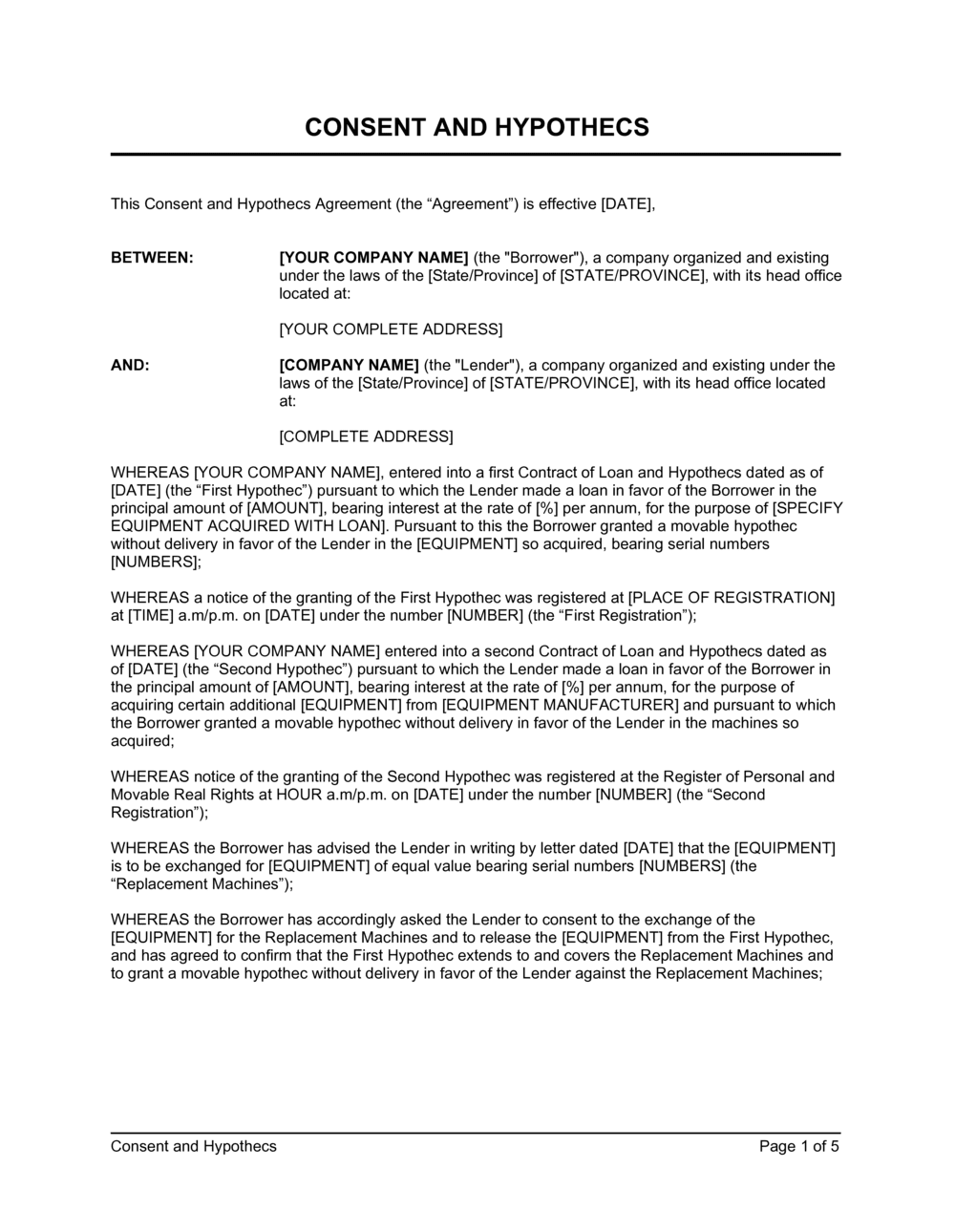
A Consent and Hypothecs Replacement of Goods is a legally binding document in which a secured creditor formally authorizes a debtor to substitute one or more items of collateral subject to a hypothec with replacement goods of equivalent or greater value, while confirming that the original security interest continues uninterrupted over the substituted property. This free Word download gives you a structured, professionally drafted starting point you can edit online and export as PDF for execution by both parties.
When you need it
Use it when a debtor needs to sell, upgrade, or otherwise dispose of goods that are encumbered by a hypothec — and must obtain the creditor's written consent before the substitution — to avoid being in default under the original security agreement. It is also required when a lender's internal policy or the governing security instrument mandates documented approval for any change to the collateral pool.
What's inside
Identification of the parties, description of the original hypothec and the encumbered goods being replaced, detailed description of the replacement goods and their value, the creditor's express consent to the substitution, confirmation that the hypothec continues in full force over the replacement goods, representations and warranties from the debtor, and execution blocks for both parties.

What is a Consent and Hypothecs Replacement of Goods?

A Consent and Hypothecs Replacement of Goods is a legally binding document in which a secured creditor formally authorizes a debtor to substitute one or more items of collateral encumbered by a hypothec with replacement goods of equivalent or greater value, while confirming that the original security interest continues uninterrupted over the substituted property. The document operates within an existing secured lending relationship — it does not create a new hypothec from scratch but rather amends the collateral pool of an existing charge, ensuring the creditor's registered priority is preserved throughout the substitution. In practice, this instrument is essential wherever a security agreement identifies specific goods by serial number or description rather than relying on a broad floating charge that automatically captures after-acquired assets.

Why You Need This Document

Without a properly executed consent and replacement document, a debtor who sells or replaces hypothecated goods is in default under their security agreement — exposing them to immediate debt acceleration, enforcement action, and potential seizure of other assets. From the creditor's perspective, allowing a verbal or informal substitution creates a gap in the registered security: the charge over the original goods is released, but if no formal amendment is filed in time, competing creditors can register against the replacement goods and claim superior priority. In an insolvency, that priority gap can mean the difference between a secured recovery and a cents-on-the-dollar unsecured claim. This template gives both parties a structured, enforceable record that closes the priority gap, satisfies registration requirements in Canadian PPSA and Quebec RPMRR systems, and provides the debtor with documented authorization to deal with the original collateral — all in a single document that takes under an hour to complete for a routine equipment substitution.

Which variant fits your situation?

If your situation is…Use this template
Replacing a single piece of financed equipment with a newer modelConsent and Hypothecs Replacement of Goods
Substituting an entire inventory pool under a revolving credit facilityGeneral Security Agreement
Amending the collateral schedule of an existing secured loanLoan Agreement Amendment
Releasing a specific asset from a hypothec without substitutionPartial Discharge of Hypothec
Granting a new hypothec over additional goods added to a portfolioMovable Hypothec Agreement
Confirming continued security after a debtor reorganization or mergerSecurity Interest Continuity Agreement
Documenting creditor consent to sale of collateral with proceeds applied to debtConsent to Sale of Collateral

Common mistakes to avoid

❌ Releasing original collateral before re-registration is complete

Why it matters: There is a window between releasing the old hypothec and registering the new one during which a competing creditor can register against the replacement goods and claim superior priority — leaving the original creditor holding an unsecured position.

Fix: Require registration of the amended hypothec as a condition precedent to the release of the original collateral, and use a simultaneous closing or escrow mechanism to coordinate timing.

❌ Using generic descriptions for both original and replacement goods

Why it matters: Vague descriptions like 'office equipment' or 'manufacturing machinery' cannot be matched to specific assets in an enforcement action or insolvency proceeding, effectively making the security unenforceable.

Fix: Always include serial numbers, model numbers, manufacturer, year, and acquisition cost for every item — attach detailed Schedules A and B rather than embedding descriptions in the body of the agreement.

❌ Omitting the insurance condition precedent

Why it matters: Replacement goods that are not insured with the creditor named as loss payee leave the security interest exposed to total loss from fire, theft, or damage with no recourse beyond an unsecured claim against the debtor.

Fix: Require the debtor to deliver a certificate of insurance naming the creditor as loss payee before the consent becomes effective, and confirm that coverage is sufficient to at least equal the outstanding secured obligation.

❌ Failing to confirm priority continuity explicitly

Why it matters: Without an express statement that the hypothec continues over the replacement goods with the same priority, a competing creditor who registers against the replacement goods in the gap period may successfully argue they hold a superior interest.

Fix: Include a dedicated priority-continuation clause and file the registration amendment as quickly as possible — ideally on the same day as execution.

❌ Choosing governing law that conflicts with the registration jurisdiction

Why it matters: A hypothec registered under the Civil Code of Quebec is subject to mandatory Quebec law regardless of what a governing-law clause says; an Ontario governing-law clause provides no protection against Quebec-specific procedural requirements.

Fix: Match the governing law to the province or state where the hypothec is registered, and confirm with local counsel that the consent document complies with the applicable registry's requirements.

❌ No deadline for the debtor to file the registration amendment

Why it matters: An open-ended filing obligation allows the debtor to delay indefinitely, leaving the creditor's charge unregistered against the replacement goods and exposing priority to challenge.

Fix: Set a specific number of business days — typically 3 to 5 — for the debtor to complete the filing, and require delivery of certified copies of the amended registration to the creditor within the same window.

The 10 key clauses, explained

Recitals and background

In plain language: Sets out the factual context — the original hypothec instrument, its registration details, the encumbered goods, and the reason the debtor is seeking to replace the collateral.

Sample language
WHEREAS [CREDITOR NAME] holds a hypothec dated [DATE], registered as No. [REGISTRATION NUMBER] against [ORIGINAL GOODS DESCRIPTION] owned by [DEBTOR NAME] (the 'Original Collateral') securing obligations totalling $[AMOUNT]; AND WHEREAS the Debtor wishes to replace the Original Collateral with the Replacement Goods described herein;

Common mistake: Omitting the precise registration number of the original hypothec. Without it, there is no clear link between this consent document and the registered charge, creating a gap that could be exploited in enforcement proceedings.

Description of original goods

In plain language: Provides a precise identification of the goods currently subject to the hypothec — including make, model, serial number, and current estimated value — so there is no ambiguity about what is being replaced.

Sample language
The Original Collateral consists of: [DESCRIPTION OF GOODS], serial number [SERIAL NUMBER], currently valued at approximately $[CURRENT VALUE], as more particularly described in Schedule A attached hereto.

Common mistake: Using a generic description such as 'manufacturing equipment' without serial numbers or specific identifiers, making it impossible to distinguish the collateral from other assets of the debtor in an insolvency.

Description of replacement goods

In plain language: Identifies the new goods that will substitute for the original collateral in equal or greater detail — make, model, serial number, acquisition cost, and appraised or market value — confirming they are sufficient security.

Sample language
The Replacement Goods consist of: [DESCRIPTION OF REPLACEMENT GOODS], serial number [SERIAL NUMBER], acquired by Debtor on [ACQUISITION DATE] at a cost of $[ACQUISITION COST], with a current market value of approximately $[CURRENT VALUE], as more particularly described in Schedule B attached hereto.

Common mistake: Failing to attach a Schedule B with a detailed description and valuation evidence. A bare reference to replacement goods without supporting documentation is routinely challenged by insolvency trustees and competing creditors.

Creditor's consent

In plain language: The operative clause in which the secured creditor expressly and irrevocably authorizes the substitution, releases the hypothecary charge from the original goods, and confirms all other terms of the underlying security agreement remain unchanged.

Sample language
The Creditor hereby consents to the substitution of the Original Collateral with the Replacement Goods and releases its hypothecary charge from the Original Collateral effective upon registration of the amended hypothec over the Replacement Goods, without prejudice to any other rights of the Creditor under the Security Agreement dated [DATE].

Common mistake: Drafting consent language as permissive rather than operative — phrases like 'the Creditor does not object' have been held to be insufficient to constitute formal release of a registered hypothec in several Canadian jurisdictions.

Continuation of hypothec

In plain language: Confirms that the original hypothec, with all its terms, conditions, covenants, and priority, attaches to and continues in full force over the replacement goods immediately upon the release from the original goods.

Sample language
The Debtor and Creditor confirm that the Hypothec shall continue in full force and effect over the Replacement Goods with the same priority, terms, and conditions as applied to the Original Collateral, and the Debtor hereby grants to the Creditor a hypothec over the Replacement Goods in accordance therewith.

Common mistake: Neglecting to state that the hypothec continues with the same priority. Without this, a competing creditor who registers a security interest in the replacement goods before the amended hypothec is registered could claim superior priority.

Representations and warranties of the debtor

In plain language: The debtor represents that it has good and marketable title to the replacement goods, that they are free and clear of all other encumbrances, that their stated value is accurate, and that no default exists under the underlying obligation.

Sample language
The Debtor represents and warrants that: (a) it is the sole legal and beneficial owner of the Replacement Goods, free and clear of all liens, charges, and encumbrances except those in favor of the Creditor; (b) the value of the Replacement Goods is not less than $[AMOUNT]; and (c) no event of default has occurred and is continuing under the Security Agreement.

Common mistake: Including only a title warranty without a 'no other encumbrances' representation. A debtor who has already pledged the replacement goods to a second creditor may be in breach without the creditor having any express contractual remedy if the representation is absent.

Registration obligations

In plain language: Allocates responsibility — typically to the debtor — for filing the necessary amendments to the hypothec registration to reflect the substituted collateral within a defined number of days, and requiring proof of filing to be delivered to the creditor.

Sample language
The Debtor shall, at its sole cost and expense, within [NUMBER] business days of execution of this Agreement, file all amendments required to amend the registration of the Hypothec to reflect the Replacement Goods and shall deliver to the Creditor certified copies of all such filings within [NUMBER] business days thereafter.

Common mistake: Setting no deadline for re-registration, or making it 'upon request.' The window between consent and re-registration leaves the creditor's priority unprotected — other creditors can register against the replacement goods in that gap.

Conditions precedent to consent becoming effective

In plain language: Lists any conditions the creditor requires to be satisfied before the consent becomes operative — for example, receipt of an appraisal, payment of outstanding amounts, or delivery of insurance certificates covering the replacement goods.

Sample language
This consent shall not become effective until: (a) the Creditor has received an independent appraisal confirming the Replacement Goods have a market value of not less than $[AMOUNT]; (b) the Replacement Goods are fully insured in favor of the Creditor as loss payee; and (c) all outstanding obligations under the Security Agreement are current with no arrears.

Common mistake: Omitting insurance as a condition precedent. Replacement goods that are uninsured or underinsured leave the creditor's security interest exposed to total loss with no recourse other than an unsecured claim.

Governing law and jurisdiction

In plain language: Specifies the province, state, or country whose laws govern the agreement and the courts or arbitration forum where disputes will be resolved — critical when debtor and creditor are in different jurisdictions.

Sample language
This Agreement shall be governed by and construed in accordance with the laws of the Province of [PROVINCE / STATE] and the federal laws of [COUNTRY] applicable therein. Each party irrevocably submits to the exclusive jurisdiction of the courts of [PROVINCE / STATE] for any dispute arising hereunder.

Common mistake: Choosing governing law without confirming it matches the jurisdiction where the hypothec is registered. A governing-law clause pointing to Ontario in a document governing a Quebec hypothec will not override the Civil Code of Quebec's mandatory provisions.

Entire agreement and amendment

In plain language: Confirms that this document, together with the original security agreement, constitutes the entire agreement between the parties regarding the collateral substitution, and that any further amendment requires written consent of both parties.

Sample language
This Agreement, together with the Security Agreement dated [DATE] and any schedules attached hereto, constitutes the entire agreement between the parties with respect to the subject matter hereof. No amendment, modification, or waiver of any provision shall be effective unless in writing and signed by both parties.

Common mistake: Failing to reference the underlying security agreement in the entire-agreement clause, which can allow a debtor to argue that the substitution somehow terminated or replaced obligations under the original instrument.

How to fill it out

  1. 1

    Identify both parties and the underlying hypothec

    Enter the full legal names of the creditor and debtor exactly as they appear in the original hypothec instrument. Include the date and registration number of the original hypothec so the consent is unambiguously linked to the existing charge.

    💡 Pull the party names directly from your hypothec registration — even minor discrepancies in corporate names can create enforceability issues.

  2. 2

    Describe the original collateral in Schedule A

    List every asset being released from the hypothec with full identifiers — serial number, model, manufacturer, and year of manufacture. Include the current estimated or appraised value of each item.

    💡 Obtain a written valuation or at least a market-comparable quote before filling in value figures — creditors can challenge a substitution if the original goods' value is understated.

  3. 3

    Describe the replacement goods in Schedule B

    Provide an equally detailed description of each replacement asset. Attach purchase invoices, manufacturer certificates, or appraisal reports as supporting exhibits to confirm value and clear title.

    💡 The replacement goods should have a documented market value equal to or greater than the goods they replace — a shortfall in value almost always requires additional security or a cash top-up.

  4. 4

    Set the conditions precedent

    List every condition the creditor requires before the consent becomes effective: appraisal receipt, insurance certificates naming the creditor as loss payee, confirmation of no arrears, and any other lender-specific requirements.

    💡 Add a specific deadline by which conditions must be satisfied — open-ended conditions create limbo where neither party knows whether the consent is live.

  5. 5

    Confirm the continuation of the hypothec and priority

    Complete the continuation clause to confirm the hypothec attaches to the replacement goods with the same terms and priority as the original. If the hypothec is registered under a PPSA or similar system, note that an amendment filing is required.

    💡 Check with your local registry whether a full new registration or a simple amendment is required — procedures vary by province and state.

  6. 6

    Assign registration obligations and set deadlines

    Specify which party — typically the debtor — is responsible for filing the registration amendment, the number of business days permitted, and the requirement to deliver proof of filing to the creditor.

    💡 A 5-business-day deadline for filing is standard in most commercial transactions; anything longer leaves the creditor's priority exposed.

  7. 7

    Complete representations and warranties

    Review and customize the debtor's representations to cover title, absence of other encumbrances, accuracy of valuation, and no existing default. Ensure the warranty language is drafted in present tense and as of the execution date.

    💡 Add a 'to the knowledge of the Debtor' qualifier for any representation that could be objectively unknowable — but avoid it for title and encumbrance warranties where strict accuracy is expected.

  8. 8

    Execute before releasing the original collateral

    Both parties must sign before the debtor disposes of or transfers the original encumbered goods. Premature release of the original collateral before the consent is signed leaves the creditor momentarily unsecured.

    💡 Use a simultaneous closing structure if possible: execute the consent, file the registration amendment, and complete the disposal of original goods on the same business day.

Frequently asked questions

What is the difference between a hypothec and a mortgage?

Both are security interests, but they typically apply to different types of property. A mortgage generally refers to a security charge over immovable or real property such as land and buildings. A hypothec, as used in civil law jurisdictions like Quebec and in many international commercial contexts, can attach to both movable and immovable property, including equipment, inventory, and receivables. In common-law provinces and US states, the equivalent security interest over personal property is governed by the PPSA or UCC Article 9.

Does the creditor have to agree to the substitution of collateral?

Yes — in most commercial security agreements, the debtor is prohibited from disposing of, replacing, or dealing with hypothecated goods without the creditor's prior written consent. Proceeding without consent typically constitutes an event of default entitling the creditor to accelerate the debt and enforce the security. The consent and hypothecs replacement of goods document is precisely the instrument used to obtain and record that written consent before the substitution takes place.

What value do the replacement goods need to have?

In most commercial arrangements, the replacement goods must have a market value equal to or greater than the goods they replace, ensuring the creditor's security position is not weakened. Creditors typically require an independent appraisal or purchase invoice as evidence of value before granting consent. If the replacement goods are worth less than the original collateral, the creditor may require additional security, a cash payment, or a partial repayment of the underlying obligation to make up the shortfall.

Does the hypothec need to be re-registered after the goods are replaced?

Yes — in virtually all registration systems, including the Quebec Register of Personal and Movable Real Rights (RPMRR), Canadian provincial PPSA registries, and US UCC filing offices, an amendment to the registration is required to reflect the new collateral. Failure to file the amendment risks loss of priority against third parties who register against the replacement goods in the interim period. The consent document should allocate this obligation to the debtor with a specific filing deadline.

Can a partial substitution be documented with this template?

Yes — the template can be adapted to cover partial substitutions where only some of the hypothecated goods are replaced while others remain subject to the original charge. In that case, Schedule A should clearly identify which specific items are being released, Schedule B should identify only the replacement goods for those items, and the continuation clause should confirm the hypothec remains in force over both the unreleased original goods and the new replacement goods.

Is this document relevant outside of Quebec civil law?

Yes — while the term 'hypothec' originates in civil law systems and is used specifically in Quebec and in many international contexts, the document covers the same transaction as a 'consent to substitution of collateral' under common-law security agreements governed by PPSA legislation in other Canadian provinces or by UCC Article 9 in the United States. Businesses operating in common-law jurisdictions should adapt the terminology accordingly and confirm local registration requirements with counsel.

Do I need a lawyer to prepare this document?

For routine equipment substitutions involving straightforward collateral and established lending relationships, a high-quality template reviewed by both parties is often sufficient. Legal counsel is strongly recommended when the transaction involves high-value assets, multiple creditors with competing security interests, cross-provincial or cross-border arrangements, or any question about priority, insolvency risk, or the adequacy of the replacement collateral's value. A lawyer's review typically costs $500–$1,500 and is well justified given the priority and enforcement consequences of getting the documentation wrong.

How this compares to alternatives

vs General Security Agreement

A General Security Agreement creates a broad floating charge over all present and after-acquired property of a debtor, automatically capturing replacement assets without requiring a specific consent for each substitution. A consent and hypothecs replacement of goods is used when the original hypothec was granted over identified specific goods rather than a floating pool, making explicit consent and re-registration necessary for each substitution.

vs Partial Discharge of Hypothec

A partial discharge permanently removes specific goods from a hypothec without any replacement, reducing the collateral pool. A consent and hypothecs replacement of goods keeps the security position intact by substituting equivalent collateral — the creditor releases the old goods only because new goods of equivalent value are simultaneously charged. Use a partial discharge only when the creditor agrees to reduce their security exposure.

vs Loan Agreement Amendment

A loan agreement amendment changes the financial terms of the underlying debt — interest rate, repayment schedule, principal amount, or covenants. A consent and hypothecs replacement of goods changes only the identity of the collateral without altering the debt terms. Both documents may be executed simultaneously when a collateral substitution accompanies a refinancing, but they serve distinct legal functions.

vs Movable Hypothec Agreement

A movable hypothec agreement creates a new security interest from scratch over specified movable property. A consent and hypothecs replacement of goods operates within an existing hypothec relationship, substituting collateral while preserving the original charge's registration date and priority. Creating a new hypothec instead of amending an existing one would lose the priority position established at the original registration date.

Industry-specific considerations

Manufacturing

Equipment upgrades are frequent in manufacturing; replacing hypothecated production machinery with newer models requires documented creditor consent and re-registration to maintain security priority over the new equipment.

Transportation and Logistics

Fleet operators regularly trade in financed vehicles for newer units; each vehicle substitution under a fleet hypothec requires a formal consent and replacement document to keep the lender's charge current against the replacement vehicles.

Agriculture

Seasonal equipment upgrades and livestock replacements under agricultural lending programs require consent documents that satisfy both the lender's security requirements and provincial agricultural credit legislation.

Retail and Wholesale

Inventory-backed credit facilities involve constant collateral turnover; consent and replacement agreements are used to document periodic substitutions when specific inventory items are identified in the original hypothec rather than covered by a floating charge.

Jurisdictional notes

United States

In the US, security interests in personal property are governed by Article 9 of the Uniform Commercial Code (UCC), adopted in all 50 states with minor variations. Collateral substitution requires a UCC-3 amendment filing to update the financing statement. Some states require the amendment to be filed in the state where the debtor is located (for most personal property) or where the goods are kept (for certain fixtures and titled vehicles). Perfection gaps during the substitution window can allow lien-avoidance actions in a subsequent bankruptcy.

Canada

Outside Quebec, security interests in personal property are governed by provincial Personal Property Security Acts (PPSA). Collateral substitution requires a PPSA amendment registration in the province where the debtor is located. In Quebec, hypothecs over movable property are governed by the Civil Code of Quebec and registered in the Register of Personal and Movable Real Rights (RPMRR); specific formalities apply and notarial form may be required for hypothecs over certain property types. French-language documentation is required for Quebec-governed instruments under the Charter of the French Language.

United Kingdom

In England and Wales, security over personal property typically takes the form of a fixed or floating charge registered at Companies House under the Companies Act 2006. A collateral substitution under a fixed charge requires a formal deed of release and re-grant; under a floating charge, substitution may occur in the ordinary course of business without specific consent unless the charge document restricts it. Scotland has its own system of real rights over corporeal moveables, and Northern Ireland follows broadly similar rules to England. Legal advice is recommended to confirm whether a change to Companies House registration is required.

European Union

Security interests over movable property are governed by the national law of each EU member state, with significant variation. France uses the gage (pledge) and nantissement framework; Germany uses the Sicherungsübereignung (security transfer of title); the Netherlands uses the pandrecht. The EU has no unified personal property security registry equivalent to the PPSA or UCC. Cross-border transactions may engage the EU Insolvency Regulation (2015/848) for priority questions on insolvency, and GDPR considerations apply if personal data is processed in connection with debtor identification. Always engage local counsel in the relevant member state.

Template vs lawyer — what fits your deal?

PathBest forCostTime
Use the templateRoutine equipment substitutions between established parties under straightforward domestic lending arrangementsFree30–60 minutes
Template + legal reviewMid-value asset substitutions, first-time use of this document type, or transactions in Quebec where Civil Code formalities apply$500–$1,5002–5 business days
Custom draftedHigh-value collateral, multiple competing creditors, cross-border transactions, or insolvency-adjacent situations where priority is disputed$2,000–$8,000+1–3 weeks

Glossary

Hypothec
A security interest granted over movable or immovable property that gives the creditor the right to proceed against the property if the debtor defaults, without requiring the creditor to take possession of the collateral.
Collateral
The specific asset or pool of assets pledged by a debtor to secure repayment of a debt or performance of an obligation.
Substitution of Collateral
The replacement of one or more assets encumbered by a security interest with different assets of equivalent or greater value, with the security charge transferring to the new assets.
Secured Creditor
A lender or other party holding a registered security interest or hypothec over the debtor's property, giving them priority over unsecured creditors on default.
Debtor
The party that has granted a hypothec or security interest over its property as collateral for a debt or other obligation.
Hypothecary Charge
The encumbrance placed on specific property under a hypothec, which attaches to the property and follows it even if ownership changes, until formally discharged.
Floating Charge
A security interest that attaches to a class of assets (such as all inventory) rather than specific items, allowing the debtor to deal with those assets in the ordinary course of business until the charge crystallizes.
Crystallization
The point at which a floating charge converts into a fixed charge over the assets then held by the debtor, typically triggered by default or insolvency.
Priority
The ranking of competing security interests or claims against the same collateral, which determines the order of payment on enforcement or insolvency.
Personal Property Security Act (PPSA)
Canadian provincial legislation governing the creation, registration, and enforcement of security interests in personal property, analogous to Article 9 of the UCC in the United States.
Release and Discharge
The formal cancellation of a hypothec or security interest over specific property, removing the encumbrance from the collateral and from any applicable registry.

Part of your Business Operating System

This document is one of 3,000+ business & legal templates included in Business in a Box.

  • Fill-in-the-blanks — ready in minutes
  • 100% customizable Word document
  • Compatible with all office suites
  • Export to PDF and share electronically

Create your document in 3 simple steps.

From template to signed document — all inside one Business Operating System.
1
Download or open template

Access over 3,000+ business and legal templates for any business task, project or initiative.

2
Edit and fill in the blanks with AI

Customize your ready-made business document template and save it in the cloud.

3
Save, Share, Send, Sign

Share your files and folders with your team. Create a space of seamless collaboration.

Save time, save money, and create top-quality documents.

★★★★★

"Fantastic value! I'm not sure how I'd do without it. It's worth its weight in gold and paid back for itself many times."

Managing Director · Mall Farm
Robert Whalley
Managing Director, Mall Farm Proprietary Limited
★★★★★

"I have been using Business in a Box for years. It has been the most useful source of templates I have encountered. I recommend it to anyone."

Business Owner · 4+ years
Dr Michael John Freestone
Business Owner
★★★★★

"It has been a life saver so many times I have lost count. Business in a Box has saved me so much time and as you know, time is money."

Owner · Upstate Web
David G. Moore Jr.
Owner, Upstate Web

Run your business with a system — not scattered tools

Stop downloading documents. Start operating with clarity. Business in a Box gives you the Business Operating System used by over 250,000 companies worldwide to structure, run, and grow their business.

Start free · No credit card required