Notice of Credit for Merchandise Damaged in Shipment Template

Free Word download β€’ Edit online β€’ Save & share with Drive β€’ Export to PDF

1 pageβ€’15–25 min to fillβ€’Difficulty: Standard
Learn more ↓
FreeNotice of Credit for Merchandise Damaged in Shipment Template

At a glance

What it is
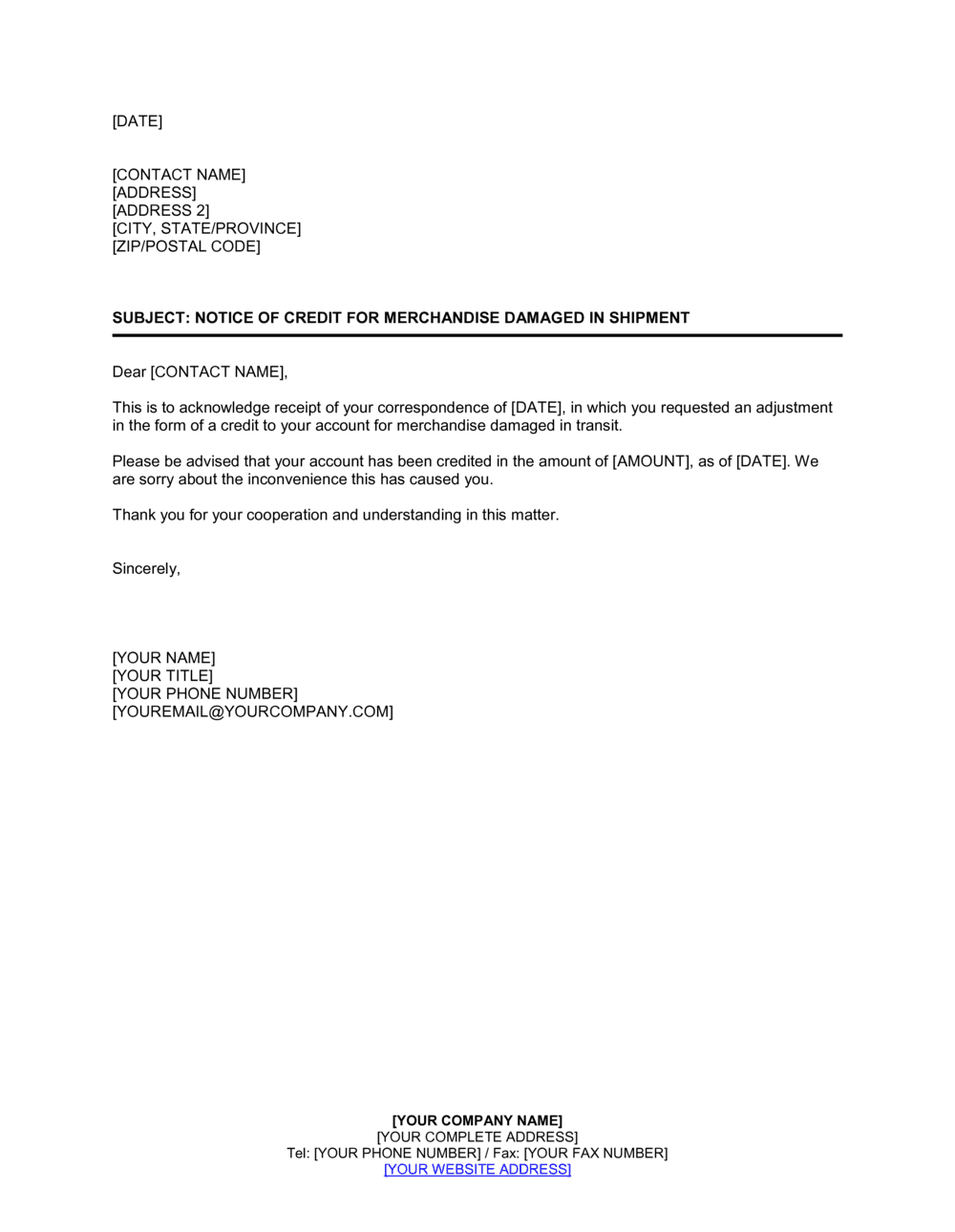
A Notice of Credit for Merchandise Damaged in Shipment is a formal business letter a seller sends to a customer to confirm that a credit has been applied to their account following a shipping damage claim. This free Word download gives you a ready-to-edit letter you can complete in minutes and export as PDF to send alongside a corrected invoice or account statement.
When you need it
Use it when a customer reports that goods arrived damaged in transit and you have agreed to issue a credit rather than a replacement or refund. It closes the claim formally and updates both parties' accounting records.
What's inside
Seller and buyer identification, reference to the original invoice or order, a description of the damaged merchandise, the credit amount and how it was calculated, the account adjustment confirmation, and next-step instructions for the customer.

What is a Notice of Credit for Merchandise Damaged in Shipment?

A Notice of Credit for Merchandise Damaged in Shipment is a formal business letter a seller sends to a customer to confirm that a credit has been applied to their account after goods arrived damaged in transit. It identifies the specific items affected, states the credit amount and the calculation behind it, adjusts the outstanding invoice balance, and instructs the customer on what to do with the damaged merchandise β€” whether to retain it for carrier inspection or arrange disposal. The letter creates a clear written record linking the damage event to the financial adjustment, which both parties need for accurate bookkeeping and audit trails.

Why You Need This Document

Without a formal credit notice, a shipping damage claim exists only as an email thread or a phone conversation β€” neither of which gives the customer's accounts payable team the documentation they need to apply the credit, nor gives your accounts receivable team the paper trail to justify the balance reduction. Unresolved damage claims become disputed invoices, disputed invoices become slow payments, and slow payments strain the business relationship. A properly completed notice closes the loop cleanly: the customer knows exactly what was credited and why, your accounting records match theirs, and the carrier claim β€” if one is needed β€” is supported by documented evidence that the seller acknowledged the damage promptly. This template gives you everything you need to issue a professional, complete credit notice in under ten minutes, protecting both the customer relationship and your own financial records.

Which variant fits your situation?

If your situation is…Use this template
Issuing a full credit for an entire shipment that arrived destroyedNotice of Credit for Merchandise Damaged in Shipment
Crediting only a portion of a partially damaged orderCredit Note (Partial)
Authorizing the customer to return the damaged goods for a refundReturn Merchandise Authorization (RMA)
Filing a claim with the freight carrier for reimbursementFreight Damage Claim Letter
Replacing damaged goods with a new shipment instead of a creditOrder Acknowledgment / Replacement Confirmation Letter
Formally disputing a carrier's denial of a damage claimFreight Claim Dispute Letter

Common mistakes to avoid

❌ Tying the customer's credit to carrier claim resolution

Why it matters: The customer's claim is against the seller; the seller's claim is against the carrier. Delaying the buyer's credit while you chase the carrier damages the relationship and may breach your sales terms.

Fix: Issue the credit to the customer promptly and pursue the carrier claim independently β€” the two processes run in parallel, not in sequence.
❌ Omitting the original invoice number

Why it matters: Without an invoice reference, neither the customer's AP team nor your own accounting team can apply the credit to the correct open balance, creating reconciliation errors that take weeks to untangle.

Fix: Always include the original invoice number, order number, and shipment date in both the subject line and the body of the letter.

❌ Failing to specify which items are covered by the credit

Why it matters: A vague credit notice leaves the door open for the customer to claim additional items were damaged, or for your team to over-credit by accident.

Fix: List every credited item by SKU, product name, and quantity β€” one line per item β€” and note that the credit covers only the items listed.

❌ Not instructing the customer to retain damaged goods

Why it matters: Freight carriers require physical inspection of damaged merchandise as a condition of processing a cargo claim. If the customer disposes of the goods, the carrier claim is void and the seller absorbs the full loss.

Fix: Include explicit retention instructions in every damage credit letter, with a specific hold period tied to your carrier's inspection window.

The 9 key clauses, explained

Header and date

In plain language: Identifies the sending company, the recipient, and the date the notice is issued β€” establishing the formal business correspondence record.

Sample language
[SENDER COMPANY NAME] | [STREET ADDRESS] | [CITY, STATE, ZIP] | [DATE]

Common mistake: Using an informal date format (e.g., '5/2/26') instead of a written-out date β€” courts and auditors treat date ambiguity as a documentation gap.

Subject line

In plain language: A one-line reference that identifies the letter as a credit notice and ties it to the specific invoice or order number.

Sample language
Subject: Credit Notice β€” Invoice #[INVOICE NUMBER] | Order #[ORDER NUMBER] | Shipment Dated [DATE]

Common mistake: Omitting the invoice or order reference from the subject line, making it impossible for the customer's AP team to match the credit to the right transaction.

Opening acknowledgment

In plain language: Confirms that the sender has received and reviewed the customer's damage report and accepts the basis for issuing the credit.

Sample language
We have received and reviewed your report dated [DATE] regarding damage to merchandise received under the above-referenced shipment. We sincerely regret the inconvenience this has caused.

Common mistake: Opening with a denial or caveat before acknowledging the customer's complaint β€” this puts the customer on the defensive and can escalate a routine claim into a dispute.

Description of damaged merchandise

In plain language: Identifies the specific items damaged by product name, SKU, and quantity so both parties are aligned on what the credit covers.

Sample language
The following items were reported as damaged: [QTY] units of [PRODUCT NAME / SKU], as documented in your inspection report of [DATE].

Common mistake: Using vague descriptions like 'the damaged items' without specifying SKUs or quantities β€” this creates ambiguity if the customer later claims additional items were damaged.

Credit amount and calculation

In plain language: States the exact dollar amount of the credit and explains how it was calculated β€” unit price, quantity, and any applicable deductions.

Sample language
Accordingly, a credit of $[AMOUNT] has been applied to your account, calculated as [QTY] units Γ— $[UNIT PRICE] = $[SUBTOTAL], less [ANY DEDUCTION, IF APPLICABLE].

Common mistake: Stating the credit amount without showing the calculation, which can lead the customer to dispute whether the amount is correct.

Account adjustment confirmation

In plain language: Formally confirms that the credit has been posted to the customer's account and states the revised outstanding balance.

Sample language
Your account has been adjusted accordingly. The revised balance due on Invoice #[INVOICE NUMBER] is $[NEW BALANCE DUE], payable by [DUE DATE].

Common mistake: Issuing the credit letter before actually posting the adjustment in the accounting system β€” the customer may apply the credit and short-pay the invoice, creating a reconciliation mismatch.

Carrier claim reference (if applicable)

In plain language: Notes whether a freight carrier claim has been filed and confirms it does not affect the customer's credit, which is being issued regardless of the carrier outcome.

Sample language
Please note that a damage claim has been filed with [CARRIER NAME] under Claim #[CLAIM NUMBER]. This credit is issued to you independently of the carrier claim resolution.

Common mistake: Telling the customer their credit is contingent on the carrier paying the claim β€” the seller's obligation to the buyer is separate from the seller's claim against the carrier.

Next steps and customer instructions

In plain language: Tells the customer what to do with the damaged goods (retain, return, or dispose of) and who to contact with questions.

Sample language
Please retain the damaged merchandise and packaging pending possible carrier inspection. If you have any questions regarding this credit, please contact [CONTACT NAME] at [EMAIL / PHONE].

Common mistake: Omitting disposal or retention instructions β€” carriers often require physical inspection of damaged goods to process a claim, and discarded items void the carrier claim.

Closing and signature block

In plain language: Closes the letter professionally and identifies the sender by name, title, and company.

Sample language
We value your business and appreciate your patience in this matter. Sincerely, [SENDER NAME] | [TITLE] | [COMPANY NAME] | [PHONE] | [EMAIL]

Common mistake: Closing without a named contact or direct phone number, leaving the customer no clear path to follow up if the credit does not appear on their next statement.

How to fill it out

  1. 1

    Enter your company and customer details

    Fill in your company's legal name and address in the sender block, then add the customer's full business name, billing address, and accounts payable contact.

    πŸ’‘ Use the customer's legal entity name, not their trade name, to ensure the credit posts to the correct account in both accounting systems.

  2. 2

    Set the date and write the subject line

    Use the date the credit is being issued β€” not the date of damage or delivery β€” and include the original invoice number and order number in the subject line.

    πŸ’‘ If the customer provided a damage report reference number, include it in the subject line as well so their team can match documents instantly.

  3. 3

    Acknowledge the damage report

    Reference the customer's damage notification by date and briefly confirm you have reviewed it. Keep this paragraph neutral and empathetic β€” one to two sentences.

    πŸ’‘ Avoid admitting fault for how the damage occurred; acknowledge the report without assigning carrier vs. seller liability.

  4. 4

    Describe the damaged merchandise specifically

    List each affected product by name, SKU, and quantity. If the damage was partial, be precise about how many units are being credited versus how many arrived intact.

    πŸ’‘ Cross-reference your packing list and the customer's inspection photos to ensure item counts match before finalizing the letter.

  5. 5

    State the credit amount with the full calculation

    Enter the unit price, quantity, and resulting credit subtotal. If you are deducting anything (e.g., restocking fee or carrier partial recovery), show the math explicitly.

    πŸ’‘ Round to two decimal places and state the currency β€” disputes over cents are rare, but currency ambiguity on international orders is not.

  6. 6

    Confirm the account adjustment and revised balance

    State the new outstanding balance on the affected invoice and confirm the payment due date has not changed unless you are granting an extension.

    πŸ’‘ Post the credit in your accounting system before sending the letter so the adjusted balance you quote is accurate in real time.

  7. 7

    Add carrier claim details and retention instructions

    If you have filed a freight claim, note the claim number. Instruct the customer to retain the damaged goods and original packaging until carrier inspection is complete.

    πŸ’‘ Include a target inspection timeline (e.g., 'within 10 business days') so the customer knows how long to hold the items.

  8. 8

    Review, sign, and send

    Proofread the letter for arithmetic accuracy and consistent reference numbers, then export as PDF and send to the customer's AP contact. File a copy against the original invoice in your records.

    πŸ’‘ Send via email with a read receipt or delivery confirmation so you have a timestamped record that the credit notice was received.

Frequently asked questions

What is a notice of credit for merchandise damaged in shipment?

It is a formal business letter a seller sends to a customer confirming that a credit has been applied to their account after goods were damaged during delivery. The notice identifies the specific items, states the credit amount and how it was calculated, adjusts the open invoice balance, and provides the customer with instructions for next steps β€” such as retaining the damaged goods for carrier inspection.

When should I send a damage credit notice?

Send it as soon as you have reviewed the customer's damage report and confirmed the credit amount β€” ideally within 2 to 5 business days of receiving the claim. Prompt issuance preserves the customer relationship, keeps your accounts receivable current, and ensures the customer retains the packaging and damaged items before a freight carrier inspection window closes.

Is a credit notice the same as a credit note or credit memo?

They refer to the same financial instrument β€” a document reducing the amount a customer owes. 'Credit memo' and 'credit note' are the accounting terms; 'credit notice' or 'notice of credit' is the customer-facing letter that accompanies or explains the memo. Both should reference the same invoice number and credit amount so the documents reconcile cleanly.

Do I need to wait for the freight carrier to approve my claim before issuing the customer's credit?

No. The customer's claim is against you as the seller, and your claim is against the carrier as the shipper. These are separate legal relationships. Issue the customer's credit promptly based on your agreed sales terms, then pursue the carrier independently. Holding the customer's credit hostage to the carrier process is a common mistake that damages relationships and may violate your sales contract.

What documentation should I attach to the credit notice?

Attach a revised invoice or account statement showing the adjusted balance, and optionally include a copy of the customer's damage inspection report for their records. If you have filed a carrier claim, you may note the claim number in the letter but do not need to attach carrier documentation to the customer copy.

How do I calculate the credit amount for partially damaged goods?

Multiply the unit price by the number of damaged units. If only a portion of items in a case or pallet were damaged, count each damaged unit individually. If goods are partially usable (e.g., dented packaging but intact product), you may issue a partial credit by agreement with the customer β€” document the agreed percentage reduction explicitly in the letter.

Should the customer return the damaged merchandise?

This depends on your policy and the carrier's requirements. Many sellers instruct customers to retain damaged goods and packaging for a carrier inspection period β€” typically 5 to 15 business days β€” before disposal. If you do not require a return, state that clearly. If you do require one, include a return merchandise authorization number and prepaid shipping instructions.

Does a damage credit notice need to be signed?

No signature is required for the notice to be effective as a business communication, but including the sender's name and title in a typed signature block is standard practice. It identifies the accountable contact and gives the customer a named person to follow up with if the credit does not appear on their next statement.

Can I use this template for international shipments?

Yes, with minor adjustments. For cross-border shipments, state the credit currency explicitly (e.g., USD, EUR, CAD), reference the commercial invoice number used for customs, and note any applicable Incoterms that define where damage risk transferred from seller to buyer. If the buyer's jurisdiction requires a formal credit note for VAT purposes, issue a separate tax credit note in addition to this letter.

How this compares to alternatives

vs Credit Note

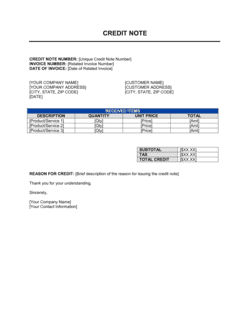
A credit note is a formal accounting document that reduces an open invoice balance β€” it lives inside the accounting system and may be issued for any reason (returns, billing errors, price adjustments). A notice of credit for damaged shipments is the customer-facing letter that explains the credit, ties it to a specific damage event, and provides handling instructions. Both documents should be issued together and reference the same invoice number.

vs Return Merchandise Authorization (RMA)

An RMA authorizes and instructs the customer to physically return damaged or defective goods to the seller. A damage credit notice issues a financial credit without requiring a return β€” the customer keeps or disposes of the damaged goods. Use an RMA when you need the product back; use this notice when you are crediting in place.

vs Freight Damage Claim Letter

A freight damage claim letter is directed at the carrier, demanding reimbursement for loss that occurred during transit. A notice of credit for damaged shipments is directed at the customer, confirming their account adjustment. These two letters address different parties and different legal relationships β€” both may be needed for the same damage event.

vs Refund Confirmation Letter

A refund confirmation letter confirms that cash has been returned to the customer's payment method. A damage credit notice confirms that a credit has been applied to the customer's trade account β€” reducing a future invoice rather than returning money. Use the refund letter for one-time or consumer transactions; use the credit notice for ongoing B2B account relationships.

Industry-specific considerations

Wholesale and Distribution

High shipment volumes mean damage credits must reference pallet or case counts precisely and integrate with EDI or ERP account adjustment workflows.

Manufacturing

Credits often involve partial shipments where some units in a batch are damaged; letter must distinguish intact units from credited units at the SKU level.

Retail and E-commerce

Consumer-facing sellers issue high volumes of individual parcel damage credits; the letter doubles as customer service correspondence and must be clear to non-finance recipients.

Food and Beverage

Perishable goods damaged in transit often cannot be retained for inspection; the notice should document the disposal authorization and credit basis clearly for audit purposes.

Template vs pro β€” what fits your needs?

PathBest forCostTime
Use the templateAny seller issuing standard B2B or B2C damage credits for routine shipment claimsFree5–10 minutes per letter
Template + professional reviewHigh-value claims, international shipments with VAT credit note requirements, or disputes involving carrier liability$50–$200 (accountant or logistics counsel check)1–2 hours
Custom draftedEnterprise sellers with high claim volumes requiring ERP-integrated credit memo workflows or regulated industries with mandatory documentation standards$200–$800 (process consultant or legal counsel)1–3 days

Glossary

Credit Memo
A document issued by a seller reducing the amount a buyer owes, typically due to a return, error, or damage claim.
Freight Damage Claim
A formal request submitted to a carrier or seller seeking compensation for goods that were damaged during shipment.
Account Adjustment
A change made to a customer's outstanding balance to reflect a credit, overpayment, or billing correction.
Invoice Reference Number
The unique identifier on the original invoice, used to link the credit notice to the specific transaction being adjusted.
Proof of Damage
Documentation β€” photographs, inspection reports, or carrier exception reports β€” that substantiates the damage claim.
Net Amount Due
The remaining balance a customer owes after the credit has been applied to the original invoice total.
Exception Report
A carrier-generated document noting discrepancies, shortages, or visible damage observed at the time of delivery.
Carrier Liability
The legal responsibility a freight or parcel carrier bears for loss or damage that occurs while goods are in their custody.
Accounts Receivable Adjustment
An internal accounting entry that reduces the open receivable balance to reflect a credit issued to a customer.

Part of your Business Operating System

This document is one of 3,000+ business & legal templates included in Business in a Box.

  • Fill-in-the-blanks β€” ready in minutes
  • 100% customizable Word document
  • Compatible with all office suites
  • Export to PDF and share electronically

Create your document in 3 simple steps.

From template to signed document β€” all inside one Business Operating System.
1
Download or open template

Access over 3,000+ business and legal templates for any business task, project or initiative.

2
Edit and fill in the blanks with AI

Customize your ready-made business document template and save it in the cloud.

3
Save, Share, Send, Sign

Share your files and folders with your team. Create a space of seamless collaboration.

Save time, save money, and create top-quality documents.

β˜…β˜…β˜…β˜…β˜…

"Fantastic value! I'm not sure how I'd do without it. It's worth its weight in gold and paid back for itself many times."

Managing Director Β· Mall Farm
Robert Whalley
Managing Director, Mall Farm Proprietary Limited
β˜…β˜…β˜…β˜…β˜…

"I have been using Business in a Box for years. It has been the most useful source of templates I have encountered. I recommend it to anyone."

Business Owner Β· 4+ years
Dr Michael John Freestone
Business Owner
β˜…β˜…β˜…β˜…β˜…

"It has been a life saver so many times I have lost count. Business in a Box has saved me so much time and as you know, time is money."

Owner Β· Upstate Web
David G. Moore Jr.
Owner, Upstate Web

Run your business with a system β€” not scattered tools

Stop downloading documents. Start operating with clarity. Business in a Box gives you the Business Operating System used by over 250,000 companies worldwide to structure, run, and grow their business.

Start freeΒ Β·Β No credit card required