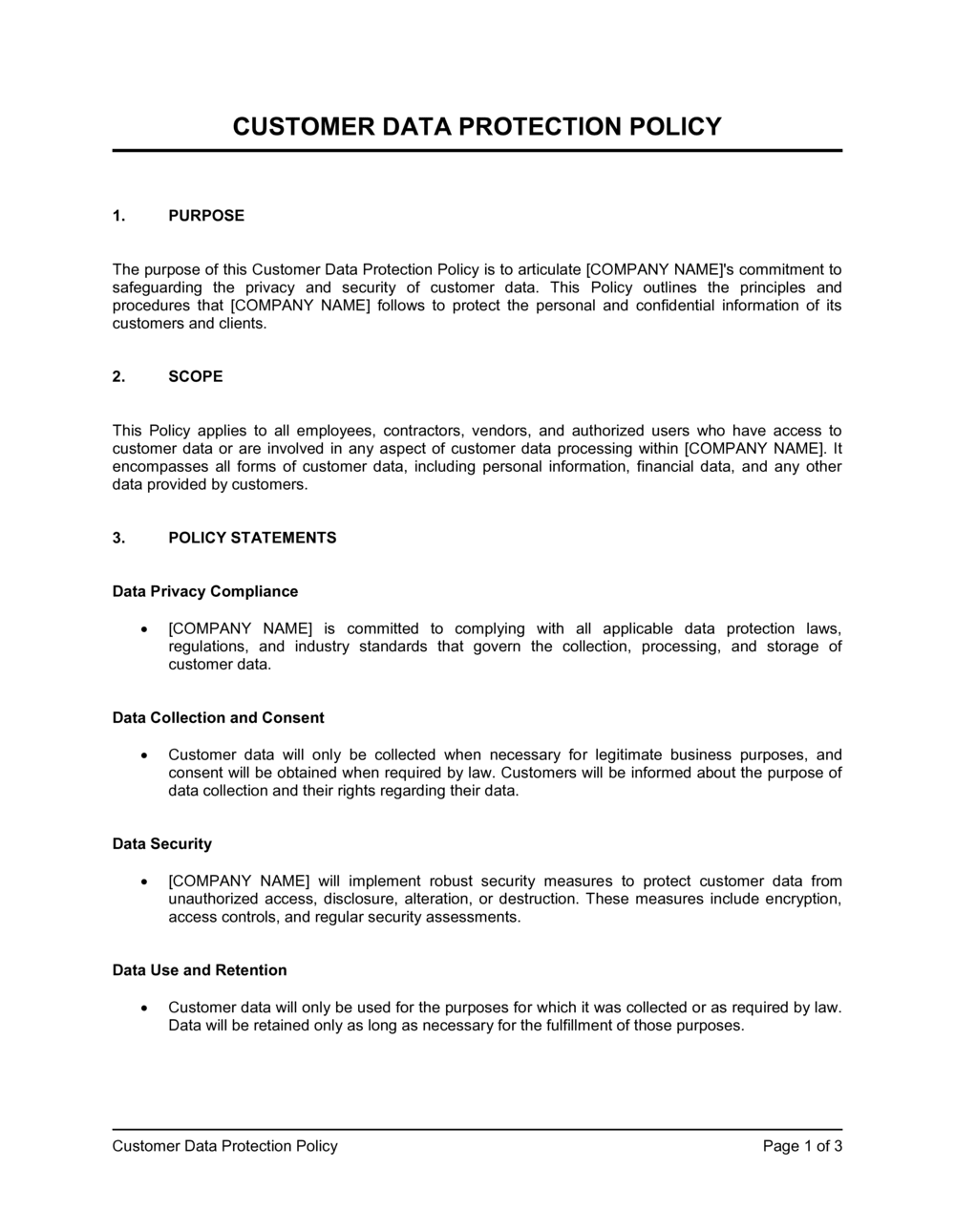
Customer Data Protection Policy Template

Free Word download β€’ Edit online β€’ Save & share with Drive β€’ Export to PDF

3 pagesβ€’20–25 min to fillβ€’Difficulty: Standard
Learn more ↓
FreeCustomer Data Protection Policy Template

At a glance

What it is
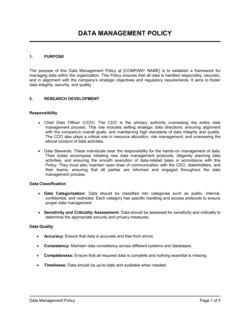
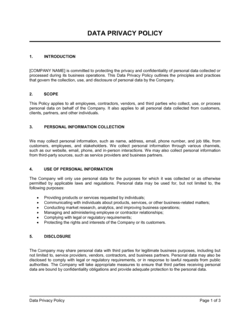
A Customer Data Protection Policy is an internal operational document that defines how your business collects, stores, accesses, shares, and disposes of customer personal data. This free Word download gives you a structured, editable starting point you can tailor to your industry and data environment, then distribute to staff, include in vendor contracts, or present to auditors.
When you need it
Use it when onboarding customers who share personal information, when scaling a team that handles customer records, when a customer or enterprise buyer requests evidence of a formal data policy, or when preparing for a compliance audit. Any business that stores names, emails, payment details, or behavioral data needs this document before a breach occurs, not after.
What's inside
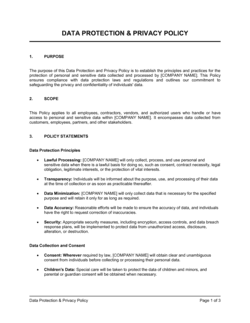
The policy covers the purpose and scope of data handling, the types of customer data collected and their legal basis, access control rules, storage and security standards, data retention and deletion schedules, third-party sharing rules, customer rights and request procedures, and a breach response protocol.

What is a Customer Data Protection Policy?

A Customer Data Protection Policy is an internal operational document that defines how a business collects, stores, accesses, shares, and deletes personal data belonging to its customers. It sets rules for staff conduct, specifies the technical and organizational measures that protect customer information, assigns accountability for data handling decisions, and documents how the business fulfills customer rights and responds to data breaches. Unlike a public-facing privacy notice, this policy is written for internal audiences β€” employees, contractors, and auditors β€” and contains the procedural detail that a customer notice intentionally omits.

Why You Need This Document

Without a written customer data protection policy, your business has no documented standard for staff to follow, no audit trail to present to enterprise buyers or regulators, and no defined process for handling a breach when one occurs. The absence of a policy is itself a compliance risk under frameworks like GDPR, CCPA, and PIPEDA, which require demonstrable accountability β€” not just good intentions. In practice, a single unanswered data deletion request, a misconfigured access permission, or an undisclosed third-party data transfer can each generate a regulatory inquiry or a lost enterprise contract. A completed, distributed, and annually reviewed data protection policy is the operational foundation that prevents those exposures from becoming costly incidents.

Which variant fits your situation?

If your situation is…Use this template
Customer-facing notice of how you use personal dataPrivacy Policy
Regulating how an external vendor handles your customer dataData Processing Agreement
Employee handling of all confidential company data, not only customer dataConfidentiality Policy
Responding to a confirmed personal data breachData Breach Response Plan
Governing employee use of company IT systems and data accessIT Acceptable Use Policy
Managing the full lifecycle of records across the organizationRecords Retention Policy
Restricting access to proprietary business information company-wideInformation Security Policy

Common mistakes to avoid

❌ Copying a public-facing privacy notice as the internal policy

Why it matters: A privacy notice tells customers what you do with their data. An internal policy tells staff how to handle it. They serve different audiences and contain different operational detail β€” using one as the other leaves staff without actionable guidance.

Fix: Keep both documents. The internal policy should include access controls, retention schedules, breach escalation steps, and role assignments that never appear in a customer-facing notice.

❌ No named owner for data subject requests

Why it matters: Without an assigned role, customer deletion or access requests go to a shared inbox and expire without response β€” each unanswered request is a potential regulatory violation.

Fix: Name a specific role (not a person, since people change) as the Data Request Owner, document a response workflow, and maintain a log of every request received and fulfilled.

❌ Setting a single retention period for all customer data

Why it matters: Different data categories have different legal minimum retention requirements. Deleting financial transaction records after 12 months may violate tax law; keeping marketing opt-in data for 10 years may violate privacy regulations.

Fix: Build a retention schedule that assigns a specific period to each data category, references the regulation or business reason behind it, and identifies the deletion method.

❌ Omitting third-party sub-processors from the sharing section

Why it matters: Your CRM vendor, email platform, and analytics tool each pass data to their own sub-processors. If your policy only names your direct vendors, customers and auditors will find undisclosed data flows during any serious review.

Fix: Request and review the sub-processor list from each of your key vendors annually, and include a disclosure in your policy that sub-processors may be used, with a process for customers to request the full list.

❌ Never updating the policy after systems change

Why it matters: A policy that names a deprecated platform or omits a new CRM tool is both inaccurate and a compliance liability β€” auditors treat an outdated policy as evidence of no policy.

Fix: Tie the policy review cycle to your annual vendor review and any material system change. Version-control the document with a revision date and changelog.

❌ No breach notification timeline specified

Why it matters: Many privacy regulations impose 72-hour notification windows to regulators. A policy that says 'we will notify affected parties promptly' gives staff no actionable deadline and will fail any post-breach audit.

Fix: State the specific notification timelines required by each applicable regulation β€” 72 hours for GDPR supervisory authority notification, for example β€” and assign the role responsible for meeting each deadline.

The 9 key sections, explained

Purpose and scope

Types of customer data collected

Lawful basis for collection and use

Data storage and security standards

Access control and role permissions

Third-party data sharing

Data retention and deletion schedule

Customer rights and request procedures

Data breach identification and response

How to fill it out

  1. 1

    Identify every category of customer data you actually collect

    Audit all systems β€” CRM, payment processor, analytics, email platform, support tickets β€” and list every data field that can identify a customer. Include data collected passively, such as IP addresses and session recordings.

    πŸ’‘ Run a data-mapping exercise with one representative from IT, marketing, and customer support. They collectively know where data lives; no single department does.

  2. 2

    Assign a lawful basis to each data category

    For each category identified, document whether you are processing it under consent, contract performance, legal obligation, or legitimate interest. Avoid defaulting all categories to consent.

    πŸ’‘ Transaction and account data almost always qualifies under contract performance β€” reserve consent for optional marketing communications only.

  3. 3

    Document your storage infrastructure and security controls

    Name each platform where customer data is stored, confirm the data residency region, and record the encryption standard and authentication method in use.

    πŸ’‘ If you use SaaS vendors, request their security documentation (SOC 2 report or equivalent) and attach the summary to your policy as an appendix.

  4. 4

    Define access roles using the least-privilege principle

    List every job role that touches customer data and specify exactly which data categories each role can view, edit, or export. Build the access matrix into the policy or attach it as a schedule.

    πŸ’‘ Review your actual system permissions before writing this section β€” documented access and actual access often differ, and the gap is your first audit finding.

  5. 5

    List all third parties that receive customer data

    Name each vendor, state what data they receive, and confirm a Data Processing Agreement is in place. Include payment processors, email platforms, analytics tools, and any offshore support teams.

    πŸ’‘ Check vendor sub-processor lists annually β€” many SaaS tools add sub-processors through their own terms without direct notice to customers.

  6. 6

    Set specific retention periods by data category

    Assign a retention period to each data category based on business need and any applicable regulatory minimum. Document the deletion method and assign a named owner responsible for executing scheduled deletions.

    πŸ’‘ For payment data, check the specific requirements of your payment processor and any applicable financial regulations β€” 7 years is standard for transaction records in many jurisdictions.

  7. 7

    Define the breach response escalation chain

    Name the person who receives internal breach reports, the steps for assessment and containment, and the regulatory notification timelines that apply to your business.

    πŸ’‘ Run a tabletop exercise once per year where a fictional breach scenario is walked through the response steps β€” gaps in the policy become obvious within the first ten minutes.

  8. 8

    Distribute, train, and schedule annual reviews

    Send the finalized policy to all staff with access to customer data, document that each person has read it, and schedule a recurring annual review to update the policy as systems and regulations change.

    πŸ’‘ Embed policy acknowledgment into your employee onboarding checklist so new hires review it before they are granted any system access.

Frequently asked questions

What is a customer data protection policy?

A customer data protection policy is an internal business document that defines how your organization collects, stores, accesses, shares, and deletes customer personal data. It establishes rules for staff behavior, sets technical security standards, assigns accountability for data handling, and documents how the business responds to data breaches or customer data requests. It is distinct from a public-facing privacy notice, which communicates data practices to customers rather than governing internal staff conduct.

Is a customer data protection policy legally required?

No single law universally mandates a policy by this name, but many privacy regulations β€” including GDPR, CCPA, and Canada's PIPEDA β€” require businesses to demonstrate accountability for personal data handling through documented policies and procedures. In practice, enterprise customers, procurement teams, and security auditors routinely request a written policy as evidence of compliance. Having a documented policy is standard due diligence for any business that collects customer personal data.

What is the difference between a data protection policy and a privacy policy?

A privacy policy (or privacy notice) is a public-facing document that tells your customers what personal data you collect and why. A data protection policy is an internal operational document that tells your staff how to handle that data day to day. Both are necessary β€” the privacy notice satisfies the customer's right to be informed; the internal policy provides the governance framework your staff follows to honor that notice.

Who should approve and own this policy?

Ownership typically sits with the person responsible for data protection, privacy, or information security β€” a Data Protection Officer, IT Manager, or Chief Operating Officer depending on company size. Approval should involve legal or compliance input if your business operates in a regulated industry. For small businesses without a dedicated role, the founder or operations lead should own the policy and schedule annual reviews.

How often should a data protection policy be updated?

At minimum, review and update the policy annually. Trigger an immediate review whenever you add a new system that processes customer data, engage a new third-party processor, experience a data breach, or become subject to a new regulation. A policy that does not reflect your current systems and practices is worse than a gap in your compliance file, because it creates a documented misrepresentation of your actual data handling.

Does this policy need to cover employee data as well as customer data?

This template focuses specifically on customer personal data. Employee personal data involves distinct categories, different legal bases for processing, and specific HR obligations β€” it should be covered by a separate HR data or employee privacy policy. Combining both in one document often creates confusion about which rules apply to which data, which can undermine enforcement of both.

What technical security standards should the policy reference?

At a minimum, reference encryption at rest (AES-256 is the current standard), encryption in transit (TLS 1.2 or higher), multi-factor authentication for systems containing personal data, and role-based access controls. For businesses handling payment data, reference PCI DSS compliance. For healthcare data in the US, reference HIPAA technical safeguards. The policy does not need to reproduce the full technical specification β€” it should state the standard applied and point to a separate technical security document for detail.

What should happen when a customer asks for their data to be deleted?

The policy should define a clear request intake channel (email or a web form), a response acknowledgment timeline (typically 5 business days), and a fulfillment deadline (30 days is standard under most privacy laws). All requests should be logged in a Data Subject Request Register. Before deleting, confirm there is no legal obligation to retain the data β€” financial transaction records, for example, often must be kept for 7 years regardless of a deletion request.

Can a small business use this template without a Data Protection Officer?

Yes. Most small businesses are not legally required to appoint a formal Data Protection Officer unless they process personal data at large scale or handle sensitive categories of data as a core activity. For small businesses, assigning the policy ownership to an existing senior role β€” such as the Operations Manager or CEO β€” and completing the template accurately is sufficient for most compliance and customer due-diligence purposes.

How this compares to alternatives

vs Privacy Policy

A privacy policy is a public-facing notice telling customers how their data is used β€” it satisfies disclosure obligations under GDPR, CCPA, and similar laws. A customer data protection policy is an internal operational document governing staff behavior and data handling procedures. Both are necessary, but they serve completely different audiences. Replacing one with the other leaves either customers uninformed or staff without clear rules.

vs Information Security Policy

An information security policy covers the protection of all company information assets β€” including proprietary business data, financial records, and intellectual property β€” not only customer personal data. A customer data protection policy focuses specifically on personal data belonging to customers, with emphasis on privacy rights, consent, and regulatory compliance. Businesses typically need both, with the data protection policy sitting within the broader security framework.

vs Data Processing Agreement

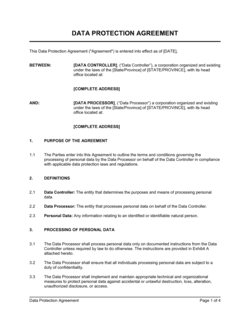
A data processing agreement is a contract between a data controller and a third-party processor that legally binds the processor to handle personal data according to the controller's instructions. A customer data protection policy is an internal governance document. The DPA is what you send to vendors; the policy is what governs your own staff. Under GDPR, both are required when using third-party processors.

vs Records Retention Policy

A records retention policy governs how long all types of business records β€” financial, legal, HR, and operational β€” are kept and how they are disposed of. A customer data protection policy focuses specifically on personal data and includes rights, access controls, and breach response in addition to retention. If you already have a records retention policy, the data protection policy complements it by addressing the privacy-specific obligations that a general retention policy does not cover.

Industry-specific considerations

SaaS / Technology

Covers API data flows, sub-processor chains, session and behavioral analytics, and SOC 2 or ISO 27001 alignment requirements from enterprise buyers.

E-commerce and retail

Addresses payment card data handling under PCI DSS, purchase history retention, abandoned cart tracking, and cross-border data transfers for international customers.

Healthcare and wellness

Must address the intersection of personal data and health information, minimum access controls for sensitive records, and HIPAA business associate obligations where applicable.

Professional services

Client confidentiality obligations overlap with data protection requirements; policy must address how client engagement data is stored, who can access matter files, and how data is handled at engagement close.

Template vs pro β€” what fits your needs?

PathBest forCostTime
Use the templateSmall to mid-size businesses collecting standard customer contact, transaction, or behavioral data without complex cross-border flowsFree2–4 hours to complete and distribute
Template + professional reviewBusinesses subject to GDPR, CCPA, HIPAA, or other specific regulations, or those handling sensitive data categories such as health, financial, or children's data$300–$1,000 for a privacy consultant or legal review3–7 days
Custom draftedEnterprise SaaS companies undergoing SOC 2 or ISO 27001 certification, regulated financial or healthcare businesses, or businesses with multi-jurisdiction data flows requiring a full privacy program$2,000–$8,000+ for a privacy attorney or compliance consultant2–6 weeks

Glossary

Personal Data
Any information that can identify a living individual, directly or indirectly β€” including names, email addresses, IP addresses, and payment details.
Data Controller
The business or individual that determines the purpose and means of processing personal data β€” typically your company.
Data Processor
A third party that processes personal data on behalf of the controller β€” such as a payment gateway, CRM vendor, or cloud hosting provider.
Lawful Basis for Processing
A legally recognized justification for collecting or using personal data, such as consent, contract performance, or legitimate business interest.
Data Minimization
The principle that only the minimum amount of personal data necessary for a specific purpose should be collected and retained.
Retention Schedule
A documented policy specifying how long each category of customer data is kept before it must be deleted, anonymized, or archived.
Data Subject
The living individual whose personal data is being collected or processed β€” typically the customer.
Access Control
Technical and organizational measures that restrict who can view, edit, or export customer data, usually based on job role and the principle of least privilege.
Right to Erasure
A customer's right, recognized in several privacy laws, to request that a business delete their personal data under certain conditions.
Data Breach
An unauthorized access, disclosure, loss, or destruction of personal data, whether caused by a cyberattack, human error, or system failure.
Pseudonymization
Processing personal data so that it can no longer be attributed to a specific individual without additional, separately stored information.
Legitimate Interest
A lawful basis for processing personal data where the business has a genuine need that is not overridden by the individual's privacy rights.

Part of your Business Operating System

This document is one of 3,000+ business & legal templates included in Business in a Box.

  • Fill-in-the-blanks β€” ready in minutes
  • 100% customizable Word document
  • Compatible with all office suites
  • Export to PDF and share electronically

Create your document in 3 simple steps.

From template to signed document β€” all inside one Business Operating System.
1
Download or open template

Access over 3,000+ business and legal templates for any business task, project or initiative.

2
Edit and fill in the blanks with AI

Customize your ready-made business document template and save it in the cloud.

3
Save, Share, Send, Sign

Share your files and folders with your team. Create a space of seamless collaboration.

Save time, save money, and create top-quality documents.

β˜…β˜…β˜…β˜…β˜…

"Fantastic value! I'm not sure how I'd do without it. It's worth its weight in gold and paid back for itself many times."

Managing Director Β· Mall Farm
Robert Whalley
Managing Director, Mall Farm Proprietary Limited
β˜…β˜…β˜…β˜…β˜…

"I have been using Business in a Box for years. It has been the most useful source of templates I have encountered. I recommend it to anyone."

Business Owner Β· 4+ years
Dr Michael John Freestone
Business Owner
β˜…β˜…β˜…β˜…β˜…

"It has been a life saver so many times I have lost count. Business in a Box has saved me so much time and as you know, time is money."

Owner Β· Upstate Web
David G. Moore Jr.
Owner, Upstate Web

Run your business with a system β€” not scattered tools

Stop downloading documents. Start operating with clarity. Business in a Box gives you the Business Operating System used by over 250,000 companies worldwide to structure, run, and grow their business.

Start freeΒ Β·Β No credit card required