Client Satisfaction Survey Template

Free Word download • Edit online • Save & share with Drive • Export to PDF

2 pages20–30 min to fillDifficulty: StandardSignature requiredLegal review recommended
Learn more ↓
FreeClient Satisfaction Survey Template

At a glance

What it is
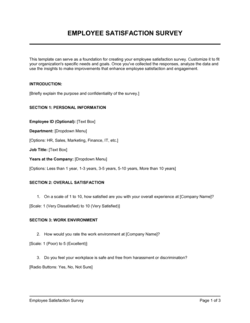
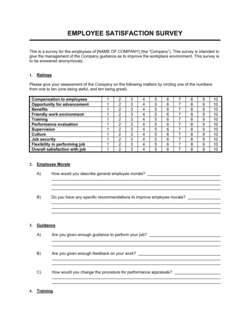
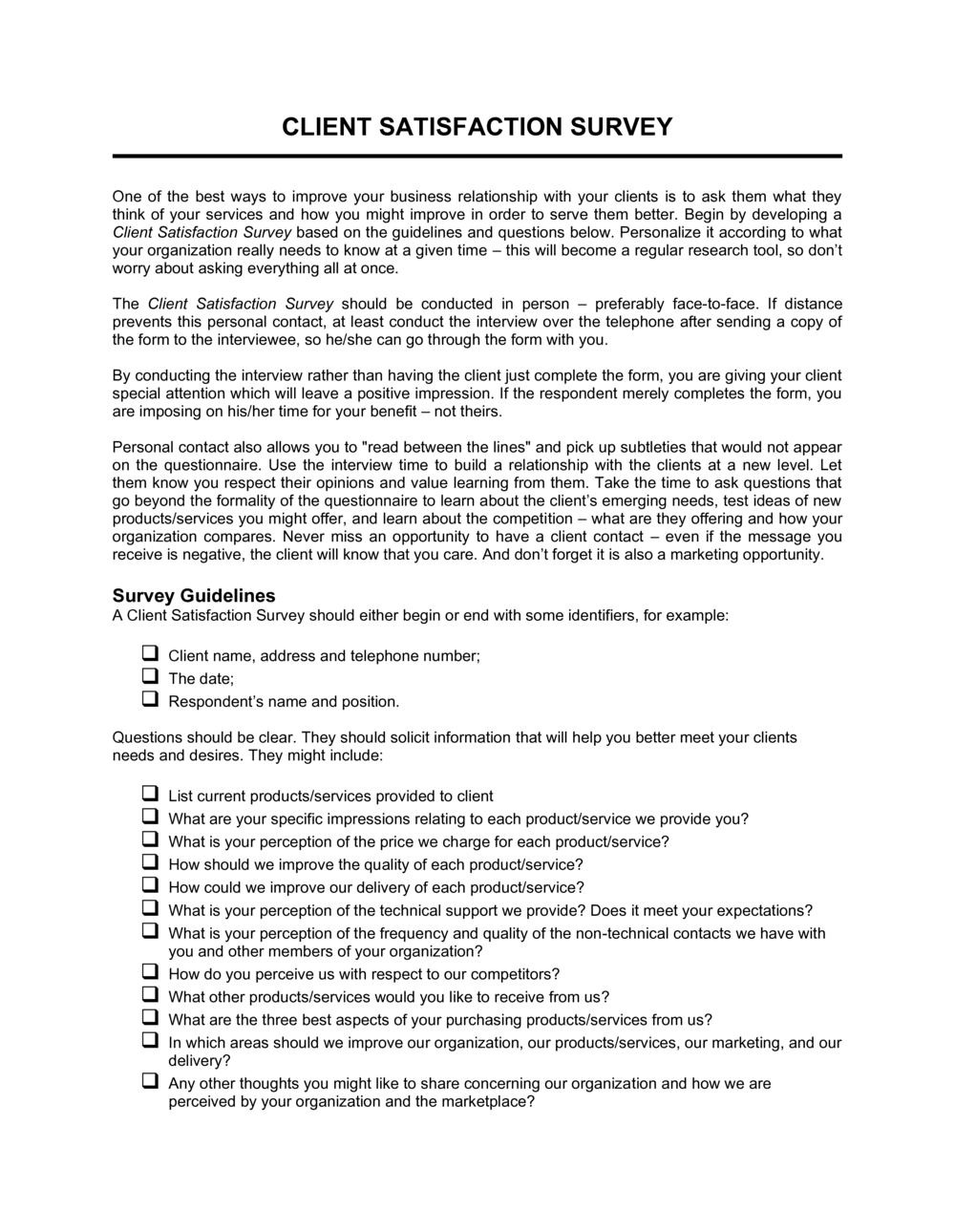
A Client Satisfaction Survey is a structured feedback document that businesses distribute to clients following the delivery of a product or service to measure satisfaction, identify service gaps, and collect actionable data for improvement. This free Word download includes rated scale questions, open-ended response fields, consent language, and a data-use disclosure — ready to edit online and export as PDF.
When you need it
Use it after project completion, at contract renewal milestones, or on a quarterly cadence to capture how clients perceive your service quality, responsiveness, and overall value. It is also used when a service complaint has been resolved and you need documented evidence of client satisfaction for your records.
What's inside
Introductory purpose statement and confidentiality notice, rated scale questions covering service quality and communication, open-ended feedback fields, Net Promoter Score question, consent to use responses for improvement purposes, and a respondent acknowledgment block with signature and date.

What is a Client Satisfaction Survey?

A Client Satisfaction Survey is a structured feedback document that a business distributes to clients following the delivery of a product or service to systematically measure satisfaction, identify service gaps, and create a documented record of client experience. It combines rated scale questions covering specific service dimensions, a Net Promoter Score question, open-ended response fields, data consent language, and a signed acknowledgment block — making it both a quality management tool and a legally significant record. Unlike an informal feedback email, a properly structured client satisfaction survey produces comparable, time-stamped data that supports performance benchmarking, contract renewals, and regulatory quality reviews.

Why You Need This Document

Without a formal client satisfaction survey, feedback remains anecdotal, inconsistently captured, and impossible to track over time — meaning service problems recur without documentation and client dissatisfaction escalates to churn before you have any early warning. In regulated industries including healthcare, financial services, and government contracting, documented evidence of client satisfaction is not optional: accreditation bodies and procurement auditors require it. The signed acknowledgment block also protects you operationally — if a satisfied client later raises a dispute, the completed survey provides contemporaneous evidence of their stated experience at the time of project close. This template gives you a compliant, professional instrument you can customize in minutes and deploy consistently across every client engagement.

Which variant fits your situation?

If your situation is…Use this template
Collecting feedback from individual consumers rather than business clientsCustomer Satisfaction Survey
Measuring satisfaction at a discrete project milestone rather than completionProject Feedback Form
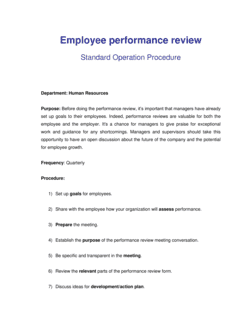
Evaluating a specific employee's service performanceEmployee Performance Review
Gathering feedback on a product rather than a serviceProduct Feedback Form
Conducting an annual relationship review with a major accountClient Review Meeting Agenda
Assessing satisfaction after a vendor delivered services to your organizationVendor Evaluation Form
Measuring satisfaction as part of a Net Promoter Score programNPS Survey Template

Common mistakes to avoid

❌ Sending the survey to the wrong contact

Why it matters: A survey completed by a junior team member who was not the decision-maker or economic buyer reflects a narrow, often operationally-focused view of satisfaction that misses the factors that actually drive renewal and referral.

Fix: Address the survey to the most senior client contact who experienced the full scope of the engagement. For larger accounts, send a version to both the project contact and the executive sponsor.

❌ Inconsistent rating scale direction

Why it matters: When 1 means 'best' on one question and 1 means 'worst' on another, respondents answer some questions incorrectly, making the data unusable for benchmarking or trend analysis.

Fix: Set one scale direction — typically low = dissatisfied, high = satisfied — and apply it uniformly to every rated question in the document. Test the survey internally before distributing.

❌ Omitting the data privacy notice

Why it matters: Collecting names, job titles, and qualitative responses without a processing disclosure violates GDPR, UK GDPR, and PIPEDA — exposing the business to regulatory complaints even when the data is used benignly.

Fix: Add a concise privacy notice stating the purpose of data collection, retention period, and how to request deletion. Link to your full privacy policy for clients who want more detail.

❌ Bundling improvement and marketing consent

Why it matters: Clients who consent to internal improvement use have not necessarily agreed to public attribution — using a single bundled checkbox conflates the two and invalidates the marketing consent under GDPR's specificity requirement.

Fix: Create two distinct, independently checkable consent options — one for internal use and one for public attribution — and honor each independently in how you use the responses.

❌ Waiting too long to send the survey

Why it matters: Surveys sent more than two weeks after project completion capture diminished recall of specific service experiences, producing generic ratings that offer little actionable insight.

Fix: Distribute the survey within five business days of project completion or the defined satisfaction checkpoint. Set a calendar reminder at the time the project closes.

❌ Never acting on the responses received

Why it matters: Clients who complete surveys and observe no visible change in subsequent engagements stop completing them and begin to question whether the business takes their feedback seriously — eroding trust.

Fix: Close the feedback loop by acknowledging responses within one week and communicating at least one specific change or action taken as a result of client input, even if minor.

The 8 key clauses, explained

Purpose Statement and Introduction

In plain language: Explains to the respondent why the survey exists, who is conducting it, and how the results will be used — establishing context and encouraging honest responses.

Sample language
[COMPANY NAME] values your feedback. This survey is designed to measure your satisfaction with the services provided under [PROJECT / ENGAGEMENT NAME] and to help us improve the quality of our work. Your responses are confidential and will be reviewed by [ROLE / DEPARTMENT] only.

Common mistake: Omitting the purpose statement entirely. Surveys without context generate lower response rates and produce responses shaped by guesswork about intent rather than the actual service dimensions you want to measure.

Service Quality Rating Questions

In plain language: A set of rated scale questions — typically 1 to 5 or 1 to 10 — covering the core dimensions of the service delivered, such as technical quality, timeliness, and communication.

Sample language
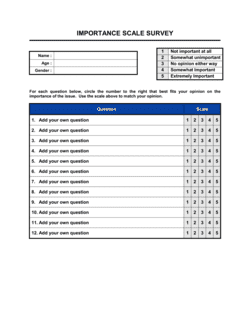
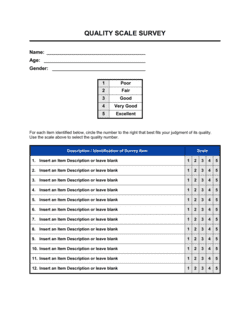
Please rate the following on a scale of 1 (Very Dissatisfied) to 5 (Very Satisfied): (a) Overall quality of work delivered: __ (b) Timeliness of deliverables: __ (c) Responsiveness of your primary contact: __ (d) Value for the fee paid: __

Common mistake: Using inconsistent scale directions across questions — e.g., 1=best on one question and 1=worst on another. Inconsistency invalidates comparisons between dimensions and confuses respondents.

Net Promoter Score Question

In plain language: A single standardized question asking the client how likely they are to recommend the company to a colleague or peer, scored 0–10, used to calculate an NPS.

Sample language
On a scale of 0 to 10, how likely are you to recommend [COMPANY NAME]'s services to a colleague or business associate? 0 (Not at all likely) — 10 (Extremely likely). Score: __

Common mistake: Placing the NPS question at the beginning of the survey. Respondents who answer it first anchor all subsequent ratings to that initial score. Place it near the end, after specific service dimensions have been rated.

Open-Ended Feedback Fields

In plain language: Free-text boxes inviting the client to describe what went well, what could be improved, and any other comments — capturing qualitative insight that scaled questions cannot.

Sample language
What did we do particularly well during this engagement? [OPEN TEXT FIELD] What is one thing we could improve? [OPEN TEXT FIELD] Any additional comments or suggestions: [OPEN TEXT FIELD]

Common mistake: Including more than three open-ended questions. Beyond three, completion rates drop sharply and response quality degrades. Limit open-ended fields to what you can realistically act on.

Outcome and Resolution Confirmation

In plain language: For surveys issued after a complaint or service issue, this clause asks the client to confirm whether the resolution met their expectations — creating a documented record of the outcome.

Sample language
If you raised a concern or complaint during this engagement: Was it addressed to your satisfaction? Yes / No / Partially. Please describe the outcome: [OPEN TEXT FIELD]

Common mistake: Skipping this clause when the survey follows a service recovery situation. Without written confirmation of resolution, businesses lose the documented evidence they need if the complaint is later escalated or disputed.

Consent to Use Responses

In plain language: Informs the client that their responses may be used for internal improvement purposes, team performance reviews, or — if they opt in — as a testimonial or case study.

Sample language
I consent to [COMPANY NAME] using my survey responses for internal quality improvement purposes. [Yes / No] I additionally consent to my responses being attributed and used as a testimonial or in client-facing materials. [Yes / No — Name or Anonymous]

Common mistake: Bundling improvement consent and marketing consent into a single checkbox. Regulatory frameworks in the EU, UK, and Canada require separate, granular consent for each distinct purpose of data use.

Data Collection and Privacy Notice

In plain language: A short disclosure stating what personal data is collected in the survey, the legal basis for processing it, how long it is retained, and how the client can request deletion.

Sample language
The information collected in this survey — including your name, role, and responses — is processed by [COMPANY NAME] for service quality management purposes. Data is retained for [X] years and may be requested for deletion by contacting [EMAIL / CONTACT]. For full details, see our Privacy Policy at [URL].

Common mistake: Omitting the retention period and deletion mechanism. Under GDPR, PIPEDA, and UK GDPR, this information is mandatory — omitting it exposes the company to regulatory complaints and invalidates the consent collected.

Respondent Acknowledgment and Signature Block

In plain language: A closing statement confirming that the respondent completed the survey voluntarily and accurately, with fields for name, title, company, date, and signature.

Sample language
I confirm that the responses above reflect my honest assessment of the services received. Respondent Name: [FULL NAME] | Title: [JOB TITLE] | Company: [COMPANY NAME] | Date: [DATE] | Signature: _______________

Common mistake: Making the signature block mandatory for all survey formats. For anonymous surveys distributed at scale, requiring a signature defeats the anonymity that drives honest responses. Reserve the signature block for named, relationship-based feedback contexts.

How to fill it out

  1. 1

    Complete the header and purpose statement

    Enter your company name, the client's name, project or engagement reference, and the date the survey is issued. Edit the purpose statement to reflect exactly how responses will be used and who will review them.

    💡 Personalizing the introduction with the client's name and engagement title increases completion rates by making the survey feel like a direct conversation rather than a mass form.

  2. 2

    Select and customize your rating scale questions

    Choose a consistent 1–5 or 1–10 scale and apply it uniformly across all rated questions. Customize the service dimensions to match the specific deliverables of the engagement — remove dimensions that did not apply and add any that are specific to your service model.

    💡 Limit rated questions to six to eight dimensions. Surveys beyond 10 minutes in estimated completion time see significant drop-off in response quality.

  3. 3

    Position the NPS question correctly

    Place the Net Promoter Score question after all service-dimension rating questions and before the open-ended fields. Confirm the scale runs 0–10 and that the anchor labels read 'Not at all likely' at 0 and 'Extremely likely' at 10.

    💡 Track NPS over time by project type or service line — a single data point is informative but a trend across 10+ surveys becomes a strategic asset.

  4. 4

    Tailor the open-ended questions to your service model

    Keep open-ended fields to three or fewer. At minimum, include one question on what went well and one on what could be improved. For post-complaint surveys, add the outcome confirmation field.

    💡 Read verbatim responses within 48 hours of receiving them while the engagement is still fresh in your memory — delayed review loses the context needed to act on the feedback.

  5. 5

    Configure the consent checkboxes

    Separate improvement consent from marketing consent into two distinct checkboxes. Ensure the marketing consent clearly states that responses may be attributed and used publicly — do not bury this in general language.

    💡 Clients who opt into testimonial use are your warmest advocates — follow up personally to request a case study or reference call within two weeks of survey completion.

  6. 6

    Insert the data privacy notice

    Complete the retention period, deletion contact details, and privacy policy URL in the data notice section. Confirm these match your current privacy policy before distributing the survey.

    💡 If your business operates in the EU or UK, have your privacy notice reviewed against current GDPR and UK GDPR requirements before distributing surveys to clients in those jurisdictions.

  7. 7

    Decide on named versus anonymous format

    For key account clients and post-project reviews, use the named format with signature block. For broad satisfaction tracking across a large client base, remove identifying fields and the signature block to encourage candid responses.

    💡 Named surveys generate lower response rates but higher-quality, actionable feedback; anonymous surveys generate higher volume but require aggregation to be meaningful. Run both on different cadences if your client base warrants it.

  8. 8

    Distribute and log responses

    Send the completed survey to the client's primary contact or decision-maker — not to the project team who worked with you day-to-day. Log receipt, completion date, and overall satisfaction score in your CRM for trend analysis.

    💡 A personal follow-up email or call to thank the client for completing the survey doubles as a relationship touch point and opens the door to referral conversations.

Frequently asked questions

What is a client satisfaction survey?

A client satisfaction survey is a structured feedback document a business sends to clients after delivering a product or service to measure how well their expectations were met. It typically combines rated scale questions, a Net Promoter Score question, and open-ended fields. When it includes a signed acknowledgment and consent language, it also functions as a documented record of client experience for quality management and regulatory purposes.

Why does a client satisfaction survey require a signature?

The signature block converts informal feedback into a documented record that can be referenced in contract renewals, dispute resolution, and regulatory quality reviews. In professional services, healthcare, and financial services, a signed satisfaction record provides evidence that the client reviewed and acknowledged the outcome of an engagement. It also validates consent to use responses for testimonial or case study purposes.

How often should I send a client satisfaction survey?

For project-based businesses, send a survey within five business days of each project close. For retainer or subscription relationships, a quarterly survey cadence is standard. Annual relationship reviews with major accounts typically warrant a more in-depth survey supplemented by a live conversation. Sending surveys more frequently than quarterly for ongoing accounts risks survey fatigue and declining response quality.

What is the difference between a client satisfaction survey and a customer satisfaction survey?

The terms are often used interchangeably, but in a B2B context a client satisfaction survey typically refers to named, relationship-based feedback from a specific account following a defined engagement. A customer satisfaction survey is more often anonymous and distributed at scale across a broad consumer base. The client survey format usually includes identifying fields, a signature block, and consent language that a mass consumer survey does not require.

Does a client satisfaction survey need to comply with GDPR?

Yes, if you distribute the survey to clients in the European Union or the United Kingdom. GDPR and UK GDPR require a lawful basis for processing personal data, a clear purpose statement, a defined retention period, and a mechanism for respondents to request deletion. Bundled or implied consent is not sufficient — each distinct purpose of data use requires a specific, informed consent option. Consider consulting a privacy advisor if your client base includes EU or UK contacts.

How many questions should a client satisfaction survey include?

Aim for six to twelve questions total — enough to cover the key service dimensions without exceeding ten minutes of completion time. Research consistently shows that surveys perceived to take more than ten minutes see a significant drop in completion rates and a measurable decline in response quality toward the end. Limit open-ended questions to three at most, and prioritize the dimensions you can actually change based on the responses.

Can I use client satisfaction survey responses as testimonials?

Only with explicit, separately obtained consent from the respondent. The survey must include a distinct opt-in checkbox for testimonial and marketing use that is separate from the general improvement-use consent. Under GDPR and PIPEDA, bundling these consents is not sufficient. Best practice is to follow up with clients who opt in to confirm the exact wording of any testimonial before publishing it.

What should I do if a client gives a very low satisfaction score?

Contact the client personally within 24 hours of receiving a low score — do not respond by email only. Acknowledge the feedback without being defensive, ask one open question to understand the root cause, and commit to a specific follow-up action within a defined timeframe. Document the conversation and the resolution in your CRM. A well-handled low score frequently converts a dissatisfied client into a loyal one; an ignored low score almost always results in churn.

Is a client satisfaction survey legally binding?

In most jurisdictions, a client satisfaction survey is not a contract and does not create new legal obligations between the parties. However, the signed acknowledgment block and consent language within it are legally significant — the signature validates the client's agreement to the data use terms and can be referenced as evidence of satisfaction in a dispute. Consult a lawyer if you intend to use survey responses in formal legal proceedings or regulatory submissions.

How this compares to alternatives

vs Client Feedback Form

A client feedback form is a lightweight, often unsigned document used for ad hoc input at any point in an engagement. A client satisfaction survey is a structured, cadenced document with rated scale questions, NPS, consent language, and a signature block — designed for systematic measurement and documentation rather than one-off feedback collection. Use the feedback form for quick mid-project check-ins and the satisfaction survey for formal post-engagement review.

vs Net Promoter Score Survey

A standalone NPS survey asks a single question and is optimized for high-volume, low-friction response collection. A client satisfaction survey incorporates the NPS question as one component alongside service-dimension ratings, open-ended fields, and consent language. Use a standalone NPS for broad, anonymous tracking across a large client base and the full satisfaction survey for named, relationship-based accounts where a documented record matters.

vs Service Level Agreement (SLA)

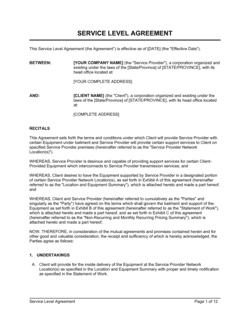
An SLA defines the performance standards a service provider commits to before or during delivery — response times, uptime targets, escalation procedures. A client satisfaction survey measures whether those standards were actually experienced as satisfactory after delivery. The two documents are complementary: the SLA sets the expectation; the survey documents whether it was met from the client's perspective.

vs Complaint Resolution Form

A complaint resolution form documents a specific service failure, the client's grievance, and the agreed remedy. A client satisfaction survey is broader and is used as a routine quality measurement tool, not only after failures. When a complaint has been resolved, a satisfaction survey issued afterward provides documented evidence that the client acknowledged the resolution — serving a distinct purpose from the complaint form itself.

Industry-specific considerations

Professional Services

Used at engagement close to document client satisfaction for quality accreditation, performance reviews, and renewal conversations with decision-makers.

Healthcare and Wellness

Required by many accreditation bodies to document patient and client experience; privacy notices must align with HIPAA in the US and equivalent frameworks in other jurisdictions.

Technology and SaaS

Distributed post-onboarding and at subscription renewal to identify churn risk early and capture product improvement signals from high-value accounts.

Marketing and Creative Agencies

Sent after campaign delivery or creative project completion; signed responses with testimonial consent support case study development and new business pitches.

Jurisdictional notes

United States

No single federal law governs commercial satisfaction surveys, but sector-specific rules apply — HIPAA in healthcare requires that survey instruments collecting protected health information be covered by a business associate agreement, and FTC guidelines govern testimonial use. California's CCPA grants consumers the right to know what personal data is collected and to request deletion, which affects surveys distributed to California-based contacts.

Canada

PIPEDA and provincial equivalents (including Quebec's Law 25) require meaningful consent before collecting personal information through surveys. Quebec's Law 25, in force since 2023, requires a privacy impact assessment for new data collection activities and explicit consent language that clearly separates each purpose. French-language versions of survey instruments are required for distribution to Quebec-based clients in provincially regulated businesses.

United Kingdom

UK GDPR and the Data Protection Act 2018 apply to any survey collecting personal data from UK-based respondents. The lawful basis for processing is typically legitimate interests for internal improvement use and explicit consent for marketing or testimonial use. The Information Commissioner's Office (ICO) recommends a concise privacy notice within the survey itself rather than relying solely on a linked privacy policy.

European Union

GDPR requires a specific lawful basis for each purpose of data processing — legitimate interests and explicit consent must be documented separately for improvement use and testimonial use respectively. Retention periods must be stated within the survey instrument. Cross-border data transfers outside the EEA require appropriate safeguards such as Standard Contractual Clauses. Member states including Germany and France have additional national data protection authorities with active enforcement records.

Template vs lawyer — what fits your deal?

PathBest forCostTime
Use the templateSmall and mid-size businesses collecting post-engagement feedback from domestic clients in non-regulated industriesFree15–30 minutes to customize and distribute
Template + legal reviewBusinesses distributing surveys to EU, UK, or Canadian clients where GDPR, UK GDPR, or PIPEDA compliance is required$200–$500 for a privacy counsel review of consent and data notice language2–5 business days
Custom draftedHealthcare providers, financial services firms, or government contractors where client feedback documentation is subject to sector-specific regulatory requirements$800–$2,500+ depending on regulatory complexity1–3 weeks

Glossary

Net Promoter Score (NPS)
A single-question loyalty metric asking respondents how likely they are to recommend a service on a 0–10 scale, producing a score from -100 to +100.
Likert Scale
A rating scale that asks respondents to indicate their level of agreement or satisfaction across a fixed range, typically 1–5 or 1–7.
Closed-Ended Question
A survey question with a predefined set of answer options — rating scales, yes/no, or multiple choice — that produces quantifiable data.
Open-Ended Question
A free-text question that invites respondents to describe their experience in their own words, producing qualitative data.
Respondent Consent
Language in the survey acknowledging that the client agrees their responses may be used for service improvement, marketing testimonials, or regulatory reporting.
Data Retention Policy
A statement specifying how long survey responses will be stored, who can access them, and when they will be deleted or anonymized.
Benchmarking
Comparing your satisfaction scores against an industry standard or your own historical results to assess relative performance over time.
Response Bias
The tendency for survey respondents to answer questions in a way they believe is expected or socially acceptable rather than reflecting their true opinion.
Verbatim Comment
A direct, unedited quote from a client's open-ended response, often used in reports or testimonials with the respondent's documented consent.
Satisfaction Driver
A specific attribute — such as communication speed, technical quality, or pricing transparency — that correlates most strongly with overall client satisfaction scores.

Part of your Business Operating System

This document is one of 3,000+ business & legal templates included in Business in a Box.

  • Fill-in-the-blanks — ready in minutes
  • 100% customizable Word document
  • Compatible with all office suites
  • Export to PDF and share electronically

Create your document in 3 simple steps.

From template to signed document — all inside one Business Operating System.
1
Download or open template

Access over 3,000+ business and legal templates for any business task, project or initiative.

2
Edit and fill in the blanks with AI

Customize your ready-made business document template and save it in the cloud.

3
Save, Share, Send, Sign

Share your files and folders with your team. Create a space of seamless collaboration.

Save time, save money, and create top-quality documents.

★★★★★

"Fantastic value! I'm not sure how I'd do without it. It's worth its weight in gold and paid back for itself many times."

Managing Director · Mall Farm
Robert Whalley
Managing Director, Mall Farm Proprietary Limited
★★★★★

"I have been using Business in a Box for years. It has been the most useful source of templates I have encountered. I recommend it to anyone."

Business Owner · 4+ years
Dr Michael John Freestone
Business Owner
★★★★★

"It has been a life saver so many times I have lost count. Business in a Box has saved me so much time and as you know, time is money."

Owner · Upstate Web
David G. Moore Jr.
Owner, Upstate Web

Run your business with a system — not scattered tools

Stop downloading documents. Start operating with clarity. Business in a Box gives you the Business Operating System used by over 250,000 companies worldwide to structure, run, and grow their business.

Start free · No credit card required