Customer Service Policy Template

Free Word download β€’ Edit online β€’ Save & share with Drive β€’ Export to PDF

3 pagesβ€’20–30 min to fillβ€’Difficulty: Standard
Learn more ↓
FreeCustomer Service Policy Template

At a glance

What it is
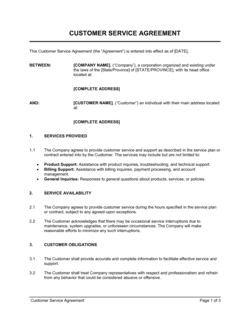
A Customer Service Policy is a formal internal document that defines how your company responds to customer inquiries, complaints, refund requests, and escalations. This free Word download gives you a structured, editable starting point covering SLA targets, communication standards, decision authority levels, and exception handling β€” ready to export as PDF and share with your team.
When you need it
Use it when onboarding a support team, standardizing inconsistent service practices, or preparing for a quality audit. It is also essential when scaling past the point where informal norms can be reliably passed on by word of mouth.
What's inside
Purpose and scope, response-time SLAs by channel and severity, complaint intake and triage procedures, refund and return decision authority, escalation paths, communication tone standards, and policy exception handling.

What is a Customer Service Policy?

A Customer Service Policy is a formal internal document that defines the standards, procedures, and authority levels governing every interaction between your staff and your customers. It specifies response-time SLAs by channel and priority, outlines how complaints are received and triaged, establishes who can approve refunds and at what amounts, and documents the escalation path when an issue exceeds a front-line agent's authority. Unlike a public-facing terms and conditions document, this policy is written for your team β€” it is the operational rulebook that turns service intentions into repeatable, measurable behavior.

Why You Need This Document

Without a written customer service policy, service quality is entirely dependent on individual judgment. Refund decisions vary from agent to agent, escalations stall because no one knows who decides what, and new hires adopt the habits of whoever trains them rather than a defined standard. The consequences are concrete: inconsistent responses produce chargebacks, negative reviews, and avoidable churn. When a customer escalates to their card issuer or posts publicly, a documented policy with clear SLAs and authority levels is your primary evidence of good-faith service. This template gives you a structured, customizable starting point β€” SLAs, triage steps, authority tiers, escalation paths, and tone guidelines in a single document β€” so you can publish a policy your team can actually follow rather than a set of aspirations no one enforces.

Which variant fits your situation?

If your situation is…Use this template
Defining how agents handle inbound complaints step by stepCustomer Complaint Procedure
Setting rules for product returns and exchangesReturn and Refund Policy
Governing how customer data is collected and storedPrivacy Policy
Documenting service levels promised to B2B clients contractuallyService Level Agreement (SLA)
Training new support agents on tone and communication standardsCustomer Service Training Manual
Publishing public-facing service commitments on your websiteTerms of Service
Capturing customer feedback systematically after interactionsCustomer Satisfaction Survey

Common mistakes to avoid

❌ No differentiated SLAs by channel

Why it matters: Applying a 24-hour response target to live chat or social media means customers wait far longer than channel norms, driving negative reviews and public complaints before a resolution is even attempted.

Fix: Set independent FRT and resolution targets for each channel based on published industry benchmarks and your current staffing capacity.

❌ Undefined refund authority levels

Why it matters: Without clear thresholds, agents either escalate every refund β€” creating management bottlenecks β€” or improvise approvals, resulting in inconsistent outcomes and budget overruns.

Fix: Assign a specific dollar ceiling to each role tier and document the approval chain for amounts above each ceiling.

❌ No formal escalation hand-off checklist

Why it matters: Customers who must re-explain their issue to a second or third agent report significantly lower satisfaction and are more likely to churn or file a chargeback.

Fix: Require agents to complete a structured hand-off note β€” account details, issue summary, actions already taken, and customer's expected outcome β€” before any transfer.

❌ Tone guidelines without concrete examples

Why it matters: Abstract instructions to 'be empathetic' or 'use professional language' are unactionable β€” agents default to personal habits under pressure, producing wildly inconsistent communication.

Fix: Supplement each guideline with a correct and incorrect example drawn from real customer interactions your team has already handled.

❌ Exceptions approved verbally with no documentation

Why it matters: Undocumented exceptions become informal precedents. Other agents cite them to justify off-policy resolutions, and the policy gradually becomes meaningless without anyone deciding to change it.

Fix: Require every exception to be logged in the helpdesk with the authorizing manager's name, rationale, and resolution amount before the exception is honored.

❌ Publishing the policy without a version number or review date

Why it matters: Outdated policies circulate alongside current ones, agents follow the wrong version, and there is no mechanism to retire superseded guidance after a team or channel change.

Fix: Add a version number, effective date, and named policy owner to the header of every draft, and archive superseded versions with a clear 'SUPERSEDED' label.

The 9 key sections, explained

Purpose, scope, and applicability

Response-time SLAs by channel and priority

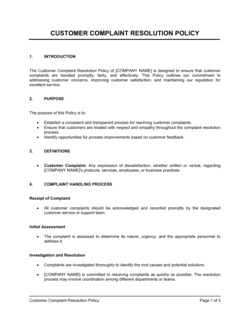
Complaint intake and triage procedure

Refund, credit, and compensation authority

Escalation path and hand-off procedure

Communication tone and language standards

Channel-specific handling rules

Exception handling and policy override process

Performance metrics and review cadence

How to fill it out

  1. 1

    Define the scope and applicable teams

    Name every channel and team type covered by the policy. If billing, technical support, and general service follow different sub-procedures, state that here and reference where those documents live.

    πŸ’‘ A tight scope statement prevents policy sprawl β€” if a channel is not listed, agents assume the policy does not apply to it.

  2. 2

    Set SLA targets for each channel and priority tier

    List first-response and resolution-time targets for every channel you operate (email, phone, chat, social) and for each severity level (critical, high, standard). Confirm targets are achievable at current staffing levels before publishing.

    πŸ’‘ Benchmark your targets against industry standards: B2B SaaS averages a 4-hour first response for email; e-commerce live chat benchmarks are under 2 minutes.

  3. 3

    Document refund and compensation authority levels

    Assign specific dollar thresholds to each role β€” front-line agent, team lead, supervisor, manager β€” for refunds, credits, and discounts. Include the approval workflow for amounts that exceed the threshold.

    πŸ’‘ Start conservative and adjust after 90 days of data. It is easier to expand agent authority after proving the policy works than to claw it back after over-spending.

  4. 4

    Map the escalation path end to end

    Draw out every escalation trigger and the corresponding next-level contact, including a backup for when the primary contact is unavailable. Add the hand-off checklist items agents must complete before transferring.

    πŸ’‘ Test the escalation path in a tabletop exercise before launch β€” identify the gaps now rather than when a P1 customer complaint exposes them.

  5. 5

    Write the communication tone section with examples

    Provide three to five example exchanges showing correct tone alongside a prohibited-phrase list. Use real customer complaint scenarios your team already encounters, not hypothetical ones.

    πŸ’‘ Include one example of a difficult or angry customer interaction β€” this is where tone standards are most often abandoned under pressure.

  6. 6

    Define the exception handling workflow

    Specify the approval authority, required documentation fields, and the review cadence for exceptions. Link the exception log to your helpdesk or ticketing system so every override is captured automatically.

    πŸ’‘ Run a quarterly exception review and compare override rates by agent β€” high rates from a single agent usually signal a training gap or a policy clause that needs updating.

  7. 7

    Set performance metrics with thresholds and review dates

    Populate each KPI with a specific target value and state the review frequency. Assign ownership for the quarterly policy review to a named role so it does not slip.

    πŸ’‘ Tie at least one metric β€” CSAT or FRT β€” directly to agent performance reviews so the policy has teeth beyond good intentions.

  8. 8

    Distribute, train, and version-control the policy

    Publish the signed policy in your team knowledge base with a version number and effective date. Brief all affected staff before the effective date and record attendance.

    πŸ’‘ Create a one-page quick-reference card summarizing SLAs, authority levels, and escalation contacts β€” agents consult this daily, not the full policy document.

Frequently asked questions

What is a customer service policy?

A customer service policy is a formal internal document that defines how a company handles customer inquiries, complaints, refunds, and escalations. It specifies response-time SLAs, decision authority levels, communication standards, and exception handling procedures. It gives customer-facing staff a clear framework to follow consistently and gives management a baseline against which to measure service quality.

What should a customer service policy include?

At minimum it should cover: scope and applicability, response-time SLAs by channel and priority, complaint triage and intake steps, refund and compensation authority levels, escalation paths with hand-off requirements, communication tone and language standards, and a review cadence with named ownership. Policies that omit authority levels or SLA targets are too vague to be enforced consistently.

What is a realistic first-response SLA for customer service?

Benchmarks vary by channel. For live chat, under 2 minutes is the industry standard. For email, 4 business hours is common in B2B and 24 hours in B2C. For phone, 80% of calls answered within 20 seconds is a widely used contact-center target. Social media public mentions should receive an acknowledgment within 1–2 hours. Set your SLAs based on these benchmarks and then verify your current staffing can meet them before publishing.

How do I handle customer complaints that escalate to social media?

Acknowledge the complaint publicly within 1–2 hours β€” even if only to confirm you are looking into it β€” then move the resolution to a private channel (direct message, email, or phone). Your policy should specify which team monitors social channels, what the public acknowledgment template looks like, and who has authority to offer a resolution once the conversation is private. Never attempt to negotiate a refund or admit fault in a public thread.

What authority should front-line agents have for refunds?

Most small businesses authorize front-line agents to approve refunds up to $50–$150 without escalation, depending on average order or transaction value. The right threshold is typically 1–2 times the average transaction value for your business. Setting it too low creates escalation bottlenecks; too high leads to inconsistent spending. Review actual refund data after 90 days and adjust accordingly.

How often should a customer service policy be reviewed?

At minimum annually, and immediately after any significant change to team structure, product offering, channel mix, or SLA performance data. Assign a named policy owner β€” typically the customer service or operations manager β€” and schedule the review in the calendar at the same time as the previous review is published. Policies with no review date are typically the ones most out of date.

Is a customer service policy different from a terms and conditions document?

Yes. A customer service policy is an internal operational document for staff β€” it governs how your team responds to customers. Terms and conditions is an external-facing legal document that governs the contractual relationship between the company and the customer. Both reference similar subject matter (refunds, warranties, response commitments), but the audience and purpose are different.

Do small businesses need a formal customer service policy?

Any business with more than two or three customer-facing staff benefits from a written policy. Without one, service quality depends entirely on individual judgment β€” refund decisions vary by agent, escalation paths are unclear, and onboarding new staff is inconsistent. A one-page summary of SLAs and authority levels is sufficient to start; the full policy document becomes essential once the team exceeds five people.

How does a customer service policy reduce chargebacks?

Chargebacks are most commonly filed when customers cannot reach support, receive inconsistent refund decisions, or feel their complaint has been ignored. A policy with defined response-time SLAs, clear refund authority, and documented escalation paths ensures complaints are handled before customers resort to their card issuer. Most payment processors also accept documented policy compliance as evidence in chargeback disputes.

How this compares to alternatives

vs Service Level Agreement (SLA)

An SLA is a contractual commitment to a specific client or customer group, often part of a signed agreement. A customer service policy is an internal operational document for staff. The policy governs how your team behaves; an SLA governs what you have promised a specific party in writing. High-performing teams build their internal policy targets to meet or exceed their contractual SLA commitments.

vs Terms and Conditions

Terms and conditions is a public-facing legal document that defines the contractual rights and obligations between a company and its customers. A customer service policy is an internal staff-facing document that specifies how those obligations are fulfilled operationally. The terms and conditions document tells customers what they are entitled to; the policy tells agents how to deliver it.

vs Customer Complaint Procedure

A customer complaint procedure is a narrow, step-by-step document focused exclusively on complaint intake, investigation, and resolution. A customer service policy is broader β€” it covers all customer interactions including inquiries, refunds, escalations, and proactive communication, with the complaint procedure as one component. Use the procedure for detailed agent training and the policy as the governing framework.

vs Employee Handbook

An employee handbook covers company-wide conduct, HR policies, and benefits. A customer service policy is a specialized operational document within that broader framework, focused entirely on customer interaction standards. The handbook may reference the customer service policy but should not attempt to contain it β€” the detail required for SLAs and escalation paths makes it a standalone document.

Industry-specific considerations

E-commerce and retail

High complaint volume around returns and shipping delays requires tiered SLAs and clearly documented refund windows tied to order date, not contact date.

SaaS and technology

Service outages require a P1 protocol with sub-1-hour response commitments, status page updates, and a separate post-incident communication procedure distinct from standard complaint handling.

Financial services

Regulated complaint-handling timelines β€” typically 8 weeks under FCA rules in the UK or specific state requirements in the US β€” must be built into escalation and resolution SLAs.

Healthcare and wellness

Patient or client complaints involving clinical outcomes must be routed to a separate clinical escalation path distinct from billing or scheduling complaints, with stricter documentation requirements.

Template vs pro β€” what fits your needs?

PathBest forCostTime
Use the templateSmall businesses and teams standardizing service practices for the first timeFree2–4 hours to customize and publish
Template + professional reviewGrowing teams adding channel-specific SLAs or integrating with a formal QA program$200–$800 for an operations consultant review1–3 days
Custom draftedRegulated industries (financial services, healthcare) or enterprise teams with multi-tier support structures$1,000–$4,000 for a customer experience consultant or legal review2–4 weeks

Glossary

Service Level Agreement (SLA)
A defined commitment to respond or resolve customer issues within a specified timeframe, such as first reply within 4 business hours.
First Response Time (FRT)
The elapsed time between a customer submitting a request and receiving the first substantive reply from a support agent.
Resolution Time
The total time from when a customer issue is opened to when it is fully resolved and closed to the customer's acknowledgment.
Escalation
The process of transferring an unresolved issue to a higher authority β€” senior agent, supervisor, or department head β€” because it exceeds the current agent's decision authority.
Decision Authority
The maximum value or category of resolution (refund amount, discount level, exception approval) a staff member is authorized to grant without manager approval.
Triage
The intake process of categorizing and prioritizing incoming customer contacts by channel, issue type, and urgency before assigning them to agents.
CSAT (Customer Satisfaction Score)
A post-interaction survey metric asking customers to rate their satisfaction, typically on a 1–5 scale, used to evaluate service quality.
Net Promoter Score (NPS)
A loyalty metric derived from asking customers how likely they are to recommend the company on a 0–10 scale; promoters score 9–10, detractors score 0–6.
Omnichannel Support
A service model in which customers receive consistent, connected support across multiple channels β€” email, phone, chat, and social β€” without repeating context.
Exception Handling
A documented process for approving service outcomes that fall outside standard policy β€” such as a refund beyond the normal window β€” including who can authorize them and what must be recorded.

Part of your Business Operating System

This document is one of 3,000+ business & legal templates included in Business in a Box.

  • Fill-in-the-blanks β€” ready in minutes
  • 100% customizable Word document
  • Compatible with all office suites
  • Export to PDF and share electronically

Create your document in 3 simple steps.

From template to signed document β€” all inside one Business Operating System.
1
Download or open template

Access over 3,000+ business and legal templates for any business task, project or initiative.

2
Edit and fill in the blanks with AI

Customize your ready-made business document template and save it in the cloud.

3
Save, Share, Send, Sign

Share your files and folders with your team. Create a space of seamless collaboration.

Save time, save money, and create top-quality documents.

β˜…β˜…β˜…β˜…β˜…

"Fantastic value! I'm not sure how I'd do without it. It's worth its weight in gold and paid back for itself many times."

Managing Director Β· Mall Farm
Robert Whalley
Managing Director, Mall Farm Proprietary Limited
β˜…β˜…β˜…β˜…β˜…

"I have been using Business in a Box for years. It has been the most useful source of templates I have encountered. I recommend it to anyone."

Business Owner Β· 4+ years
Dr Michael John Freestone
Business Owner
β˜…β˜…β˜…β˜…β˜…

"It has been a life saver so many times I have lost count. Business in a Box has saved me so much time and as you know, time is money."

Owner Β· Upstate Web
David G. Moore Jr.
Owner, Upstate Web

Run your business with a system β€” not scattered tools

Stop downloading documents. Start operating with clarity. Business in a Box gives you the Business Operating System used by over 250,000 companies worldwide to structure, run, and grow their business.

Free Forever PlanΒ Β·Β No credit card required