Request for Authorization to Substitute Product Template

Free Word download β€’ Edit online β€’ Save & share with Drive β€’ Export to PDF

1 pageβ€’15–25 min to fillβ€’Difficulty: Standard
Learn more ↓
FreeRequest for Authorization to Substitute Product Template

At a glance

What it is
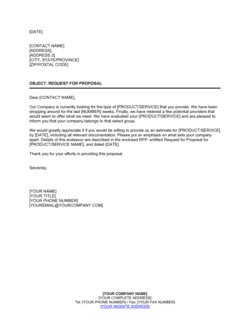
A Request for Authorization to Substitute Product is a formal business letter used to ask a client, project owner, or approving authority to approve the replacement of a specified product with a functionally equivalent alternative. This free Word download gives you a ready-to-edit template you can complete in minutes and export as PDF for immediate submission.
When you need it
Use it when a specified product is unavailable, discontinued, or cost-prohibitive and you need written approval before substituting an alternative. It is common in construction, procurement, manufacturing, and supply chain contexts where specifications are contractually fixed.
What's inside
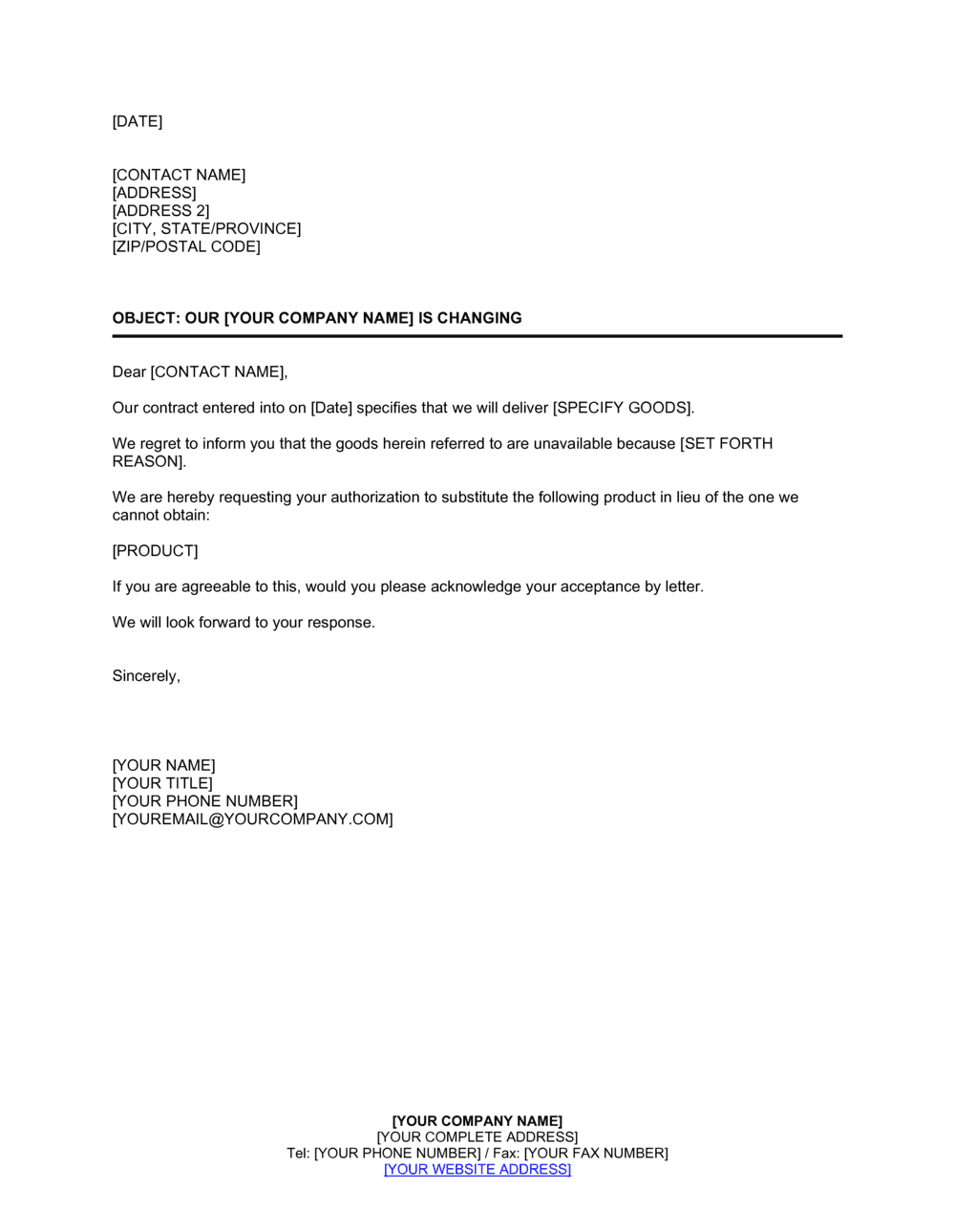
Sender and recipient details, identification of the originally specified product, full description of the proposed substitute, a side-by-side comparison of key attributes, justification for the substitution, and a formal request for written authorization to proceed.

What is a Request for Authorization to Substitute Product?

A Request for Authorization to Substitute Product is a formal business letter submitted by a contractor, vendor, or procurement team to ask an approving authority β€” typically a client, project owner, or engineer of record β€” for written permission to replace a contractually specified product with a functionally equivalent alternative. It documents the original specification, the proposed substitute, the reason substitution is necessary, a comparison of key attributes, and any resulting cost or schedule impact. Because most contracts fix product specifications in writing, a substitution made without prior authorization can constitute a breach β€” making this letter the essential first step before any change is made.

Why You Need This Document

Proceeding with a product substitution before receiving written approval exposes you to significant financial and contractual risk: the client can require you to remove and replace the unauthorized item at your cost, withhold payment pending compliance, or pursue a warranty claim if the substitute underperforms. A well-documented substitution request creates a clear paper trail that protects both parties β€” it shows due diligence, establishes the factual basis for the change, and triggers a formal approval record that holds up in any subsequent dispute. Using this template ensures every substitution request leaves your team with the right information in the right structure, keeps approvals moving quickly, and keeps your projects on schedule.

Which variant fits your situation?

If your situation is…Use this template
Substituting a building material on a construction projectRequest For Authorization To Substitute Product
Formally declining to supply and proposing an alternativeNotice of Product Unavailability
Requesting a change to the contracted project scopeChange Order Request
Seeking approval for a deviation from technical specificationsEngineering Change Request
Documenting a supplier's inability to deliver the agreed itemSupplier Non-Conformance Notice
Amending the contract to reflect the approved substitutionContract Amendment

Common mistakes to avoid

❌ Addressing the wrong recipient

Why it matters: A substitution request sent to a project coordinator rather than the approving authority sits unacted on while your schedule slips β€” the coordinator has no authority to approve.

Fix: Check the contract's notice clause and the project directory to confirm the specific person with authority, and copy the project coordinator as an informational recipient only.

❌ Omitting the equivalence comparison

Why it matters: Without a direct attribute comparison, the reviewer must research the substitute independently, which adds days to the approval cycle and increases the chance of rejection.

Fix: Include a structured side-by-side table covering the five to seven attributes most relevant to the application, and attach the technical data sheet for both products.

❌ Providing no justification documentation

Why it matters: Asserting that a product is unavailable without evidence is unconvincing β€” reviewers assume the requester simply prefers the substitute, which can trigger suspicion and rejection.

Fix: Attach a supplier backorder notice, a manufacturer discontinuation letter, or a dated quote showing the lead time that makes the specified product impractical.

❌ Leaving the cost and schedule impact blank

Why it matters: A reviewer who cannot see the financial and schedule impact will request clarification before approving, adding a full review cycle to the timeline.

Fix: Complete the cost impact statement explicitly β€” even if the answer is 'no change to contract price or schedule' β€” so the reviewer can approve without a follow-up.

The 9 key clauses, explained

Header and date

In plain language: Identifies the sender's and recipient's full names, titles, company names, and contact details, plus the date the letter is issued.

Sample language
[SENDER NAME] | [SENDER TITLE] | [COMPANY NAME] | [ADDRESS] | [DATE] β€” To: [RECIPIENT NAME], [RECIPIENT TITLE], [COMPANY / PROJECT NAME]

Common mistake: Addressing the letter to a project contact rather than the approving authority β€” delays approval when the contact lacks authority to sign off.

Subject line

In plain language: A single line that identifies the project or purchase order, the specified product, and the purpose of the letter so the recipient can route it immediately.

Sample language
Re: Substitution Request β€” [PROJECT NAME / PO NUMBER] β€” [SPECIFIED PRODUCT NAME] for [PROPOSED SUBSTITUTE NAME]

Common mistake: Omitting the project or PO reference number, making it impossible for the recipient's team to match the letter to the correct file.

Identification of the specified product

In plain language: Clearly names the original product, including manufacturer, model or part number, and the specification or contract section where it appears.

Sample language
The originally specified product is [MANUFACTURER] [MODEL / PART NUMBER], as referenced in Specification Section [SECTION NUMBER] / Purchase Order [PO NUMBER] dated [DATE].

Common mistake: Citing only the product name without the model or part number β€” introduces ambiguity when the manufacturer produces multiple similar items.

Description of the proposed substitute

In plain language: Fully identifies the alternative product, including manufacturer, model or part number, and a brief description of its function and characteristics.

Sample language
The proposed substitute is [MANUFACTURER] [MODEL / PART NUMBER], a [BRIEF DESCRIPTION] rated for [KEY SPECIFICATION], manufactured in [COUNTRY / FACILITY].

Common mistake: Describing the substitute in marketing language rather than technical terms β€” reviewers need specifications, not promotional copy.

Justification for substitution

In plain language: States the specific reason the original product cannot be used β€” unavailability, discontinuation, lead time, or cost β€” supported by facts or documentation.

Sample language
The specified product is currently unavailable due to [REASON β€” e.g., manufacturer discontinuation / supply chain disruption / lead time of [X] weeks that would delay project completion by [X] days].

Common mistake: Vague justifications like 'supply issues' with no supporting evidence β€” attach supplier correspondence or a backorder notice to substantiate the claim.

Equivalence comparison

In plain language: Provides a side-by-side comparison of the specified and proposed products on the attributes that matter most β€” performance, dimensions, certifications, and price.

Sample language
The proposed substitute meets or exceeds the specified product in the following respects: [ATTRIBUTE 1]: Specified β€” [VALUE], Proposed β€” [VALUE]; [ATTRIBUTE 2]: Specified β€” [VALUE], Proposed β€” [VALUE]. Supporting technical data sheet is attached.

Common mistake: Listing only the attributes where the substitute is equal or better, while omitting differences β€” reviewers who discover undisclosed gaps lose confidence in the entire request.

Cost and schedule impact statement

In plain language: States whether the substitution will affect the contract price or project timeline, and quantifies any difference.

Sample language
This substitution will result in [no change to / a reduction of $[AMOUNT] in / an increase of $[AMOUNT] in] the contract price. The project schedule is [unaffected / advanced by [X] days / delayed by [X] days].

Common mistake: Omitting the cost impact statement entirely β€” recipients assume the worst and request clarification before approving, adding unnecessary delay.

Formal authorization request

In plain language: The closing paragraph that explicitly requests written approval, states any response deadline, and provides contact details for questions.

Sample language
We respectfully request your written authorization to proceed with [PROPOSED SUBSTITUTE NAME] in lieu of [SPECIFIED PRODUCT NAME]. Please respond by [DATE] to avoid schedule impact. Questions may be directed to [NAME] at [EMAIL / PHONE].

Common mistake: Closing with a passive statement like 'please advise' rather than a specific ask and deadline β€” vague requests receive slow or no responses.

Attachments reference

In plain language: Lists the supporting documents enclosed with the letter β€” technical data sheets, certifications, supplier backorder notices, or samples.

Sample language
Attachments: (1) Technical Data Sheet β€” [PROPOSED SUBSTITUTE]; (2) [MANUFACTURER] Backorder Confirmation dated [DATE]; (3) [CERTIFICATION NAME] Certificate of Compliance.

Common mistake: Referencing attachments in the letter body without listing them in a numbered attachment block β€” when pages get separated, the reviewer cannot tell if anything is missing.

How to fill it out

  1. 1

    Enter sender and recipient details

    Fill in your full name, title, company, and address, then the recipient's full name, title, and company. Confirm the recipient is the person authorized to approve the substitution β€” not merely the project contact.

    πŸ’‘ Check the contract's notice provision to confirm the correct addressee and delivery method; some contracts require substitution requests to be sent to the engineer of record, not the client.

  2. 2

    Complete the subject line with project and product references

    Include the project name or PO number, the specified product name, and the proposed substitute in the subject line so the letter can be matched to the correct file without opening the body.

    πŸ’‘ Use the exact product name as it appears in the specification or purchase order β€” even minor variations cause matching errors in document management systems.

  3. 3

    Identify the specified product with precision

    Enter the manufacturer name, model or part number, and the specification section or PO line item where the product is referenced. Pull this directly from the project specification or contract schedule.

    πŸ’‘ Screenshot or attach the relevant specification page to eliminate disputes about which product was originally required.

  4. 4

    Describe the proposed substitute with technical specifics

    Enter the substitute's manufacturer, model or part number, and the key performance parameters β€” dimensions, ratings, material composition, certifications β€” that are relevant to the application.

    πŸ’‘ Use the substitute's technical data sheet as your source and attach it to the letter; reviewers will look for it regardless.

  5. 5

    Write a specific, evidenced justification

    State the concrete reason for the substitution β€” supplier backorder, product discontinuation, or lead time impact β€” and attach supporting documentation such as a supplier letter or backorder confirmation.

    πŸ’‘ Quantify the lead-time or cost consequence of waiting for the specified product; a specific number (e.g., '14-week lead time causes a 9-day schedule slip') is far more persuasive than a general statement.

  6. 6

    Complete the equivalence comparison and cost impact

    Fill in the side-by-side attribute table, including any differences as well as equivalences. Then state explicitly whether the substitution changes the contract price or schedule.

    πŸ’‘ If there is a cost saving, state the dollar amount β€” approving authorities are more receptive to substitutions that reduce cost or hold schedule.

  7. 7

    Add a response deadline and list attachments

    Set a specific response date based on your schedule requirements, provide a direct contact for questions, and list every attachment in a numbered block at the end of the letter.

    πŸ’‘ Allow at least 5 business days for the reviewer to respond β€” unrealistically short deadlines are ignored or create friction that slows approval.

Frequently asked questions

What is a request for authorization to substitute product?

A request for authorization to substitute product is a formal letter asking a client, project owner, engineer, or purchasing authority to approve replacing a contractually specified product with a functionally equivalent alternative. It documents the specified item, the proposed replacement, the reason for substitution, a performance comparison, and any cost or schedule impact β€” creating a written approval trail before any change is made.

When should I submit a product substitution request?

Submit the request as soon as you know the specified product cannot be delivered on time, has been discontinued, or poses a cost problem that affects the project. Waiting until the product is already needed on-site eliminates the reviewer's response time and forces hasty decisions. Early submission also gives you time to source the substitute if approval is granted.

Does a product substitution request need to be signed?

A formal signature is not typically required for the letter to be acted upon, but including a printed name, title, and company beneath the closing β€” and sending from an official company email address β€” adds credibility and creates a clear record of who made the request. Some contracts specify that substitution requests must be submitted on company letterhead or by authorized personnel.

What happens if I make a substitution without prior authorization?

Proceeding without written approval can constitute a contract breach. The client or project owner may require you to remove and replace the unauthorized substitution at your own cost, withhold payment, or assert a warranty claim if the unapproved product later underperforms. Always obtain written authorization before installing or using the substitute.

What supporting documents should I attach to the request?

Attach the proposed substitute's technical data sheet, any relevant certifications or compliance certificates, and documentation supporting your justification β€” such as a supplier backorder confirmation or a manufacturer discontinuation notice. If the original specification page is lengthy, attach a highlighted excerpt showing where the specified product is cited.

How long should I allow for a response?

Allow a minimum of 5 business days for routine substitution requests on commercial projects, and 7 to 10 business days for requests involving engineered systems, public contracts, or products requiring re-specification. State your required response date explicitly in the letter so the reviewer understands the schedule consequence of a delayed decision.

Can a product substitution request change the contract price?

Yes β€” a substitution can increase or decrease the contract price, and any agreed change should be documented in a formal change order referencing the approved substitution request. If the substitute costs less, the client may require the savings to be passed through. Always state the cost impact clearly in the request so both parties can agree before work proceeds.

Is a verbal approval sufficient for a product substitution?

A verbal approval is generally not sufficient. Most construction and procurement contracts require written authorization for any departure from specifications. Without written approval, a verbal agreement is difficult to prove and offers no protection if the substitute product is later challenged by the client, an inspector, or a third-party certifier.

How this compares to alternatives

vs Change Order

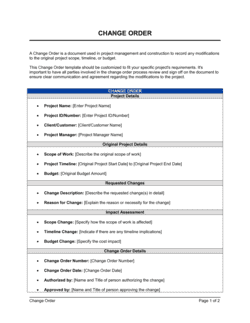
A change order formally amends the contract to reflect an approved change in scope, cost, or schedule. A product substitution request comes first β€” it seeks approval to make the change. Once the substitution is approved, a change order documents the resulting contract adjustment. The substitution request initiates the process; the change order closes it.

vs Purchase Order

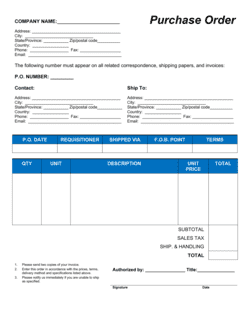
A purchase order directs a supplier to deliver a specific product at an agreed price. A substitution request addresses the situation where that product cannot be supplied as specified and authorization is needed to procure a different item. The substitution request precedes the issuance of a revised purchase order for the approved alternate.

vs Supplier Non-Conformance Notice

A non-conformance notice documents a supplier's failure to deliver goods that meet the contracted specification β€” it is a reactive quality record. A substitution request is proactive, initiated by the buyer or contractor to gain advance approval for an alternate product before any delivery occurs. One addresses a problem that has already happened; the other prevents one.

vs Contract Amendment

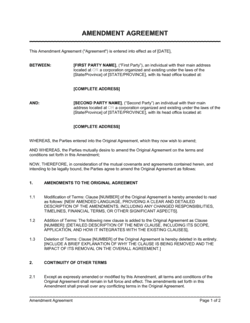
A contract amendment modifies the underlying agreement's terms β€” including specifications β€” with signatures from all parties. A substitution request is a simpler operational letter that seeks approval within the existing contract framework. For minor product changes, a substitution request plus a change order is sufficient; only material specification changes require a full contract amendment.

Industry-specific considerations

Construction

Architect or engineer of record approval is typically required before substituting any specified material, fitting, or system on a construction project.

Manufacturing

Component substitutions on production lines require engineering change approval to confirm fit, form, and function before the alternate part enters the bill of materials.

Procurement and Supply Chain

Procurement teams use substitution requests to document supplier shortages and obtain purchasing authority approval for alternate vendors or part numbers.

Professional Services

Service firms that procure goods on behalf of clients β€” IT integrators, facilities managers β€” use substitution requests to keep clients informed and avoid liability for unapproved changes.

Template vs pro β€” what fits your needs?

PathBest forCostTime
Use the templateContractors, procurement managers, and project teams submitting routine substitution requests under standard commercial contractsFree15–30 minutes
Template + professional reviewSubstitutions on public or government contracts, engineered systems, or projects where the specification is incorporated into a regulated standard$100–$300 (project manager or contract administrator review)1–2 hours
Custom draftedHigh-value or complex projects where the substitution has significant cost, safety, or warranty implications and legal review of the contract is warranted$300–$800 (legal or specialist consultant review)1–3 days

Glossary

Product Substitution
The replacement of a contractually or technically specified product with a functionally equivalent alternative, subject to prior written approval.
Specified Product
The item, material, or component originally named in a contract, purchase order, or project specification that the requester proposes to replace.
Proposed Substitute
The alternative product the requester wishes to use in place of the specified item, demonstrated to meet or exceed the original's performance requirements.
Functional Equivalence
The condition in which a substitute product performs the same intended function as the original under the same operating conditions and constraints.
Approving Authority
The client, project owner, engineer of record, or purchasing manager who holds the contractual right to approve or reject a substitution request.
Substitution Clause
A contract provision defining the conditions under which a party may request product substitutions and the procedure for obtaining approval.
Or-Equal Provision
Contract language allowing a contractor or vendor to propose a product other than the one specified, provided it is deemed equal in quality and performance.
Change Order
A formal document amending the original contract to reflect approved changes β€” including product substitutions β€” in scope, cost, or schedule.
Technical Data Sheet
A manufacturer-issued document listing a product's specifications, performance characteristics, and compliance certifications, used to support a substitution request.
Lead Time
The time between placing an order and receiving a product; a long or uncertain lead time for the specified product is a common driver of substitution requests.

Part of your Business Operating System

This document is one of 3,000+ business & legal templates included in Business in a Box.

  • Fill-in-the-blanks β€” ready in minutes
  • 100% customizable Word document
  • Compatible with all office suites
  • Export to PDF and share electronically

Create your document in 3 simple steps.

From template to signed document β€” all inside one Business Operating System.
1
Download or open template

Access over 3,000+ business and legal templates for any business task, project or initiative.

2
Edit and fill in the blanks with AI

Customize your ready-made business document template and save it in the cloud.

3
Save, Share, Send, Sign

Share your files and folders with your team. Create a space of seamless collaboration.

Save time, save money, and create top-quality documents.

β˜…β˜…β˜…β˜…β˜…

"Fantastic value! I'm not sure how I'd do without it. It's worth its weight in gold and paid back for itself many times."

Managing Director Β· Mall Farm
Robert Whalley
Managing Director, Mall Farm Proprietary Limited
β˜…β˜…β˜…β˜…β˜…

"I have been using Business in a Box for years. It has been the most useful source of templates I have encountered. I recommend it to anyone."

Business Owner Β· 4+ years
Dr Michael John Freestone
Business Owner
β˜…β˜…β˜…β˜…β˜…

"It has been a life saver so many times I have lost count. Business in a Box has saved me so much time and as you know, time is money."

Owner Β· Upstate Web
David G. Moore Jr.
Owner, Upstate Web

Run your business with a system β€” not scattered tools

Stop downloading documents. Start operating with clarity. Business in a Box gives you the Business Operating System used by over 250,000 companies worldwide to structure, run, and grow their business.

Start freeΒ Β·Β No credit card required