Letter of Authorization to Negotiate Template

Free Word download β€’ Edit online β€’ Save & share with Drive β€’ Export to PDF

1 pageβ€’15–25 min to fillβ€’Difficulty: Standard
Learn more ↓
FreeLetter of Authorization to Negotiate Template

At a glance

What it is
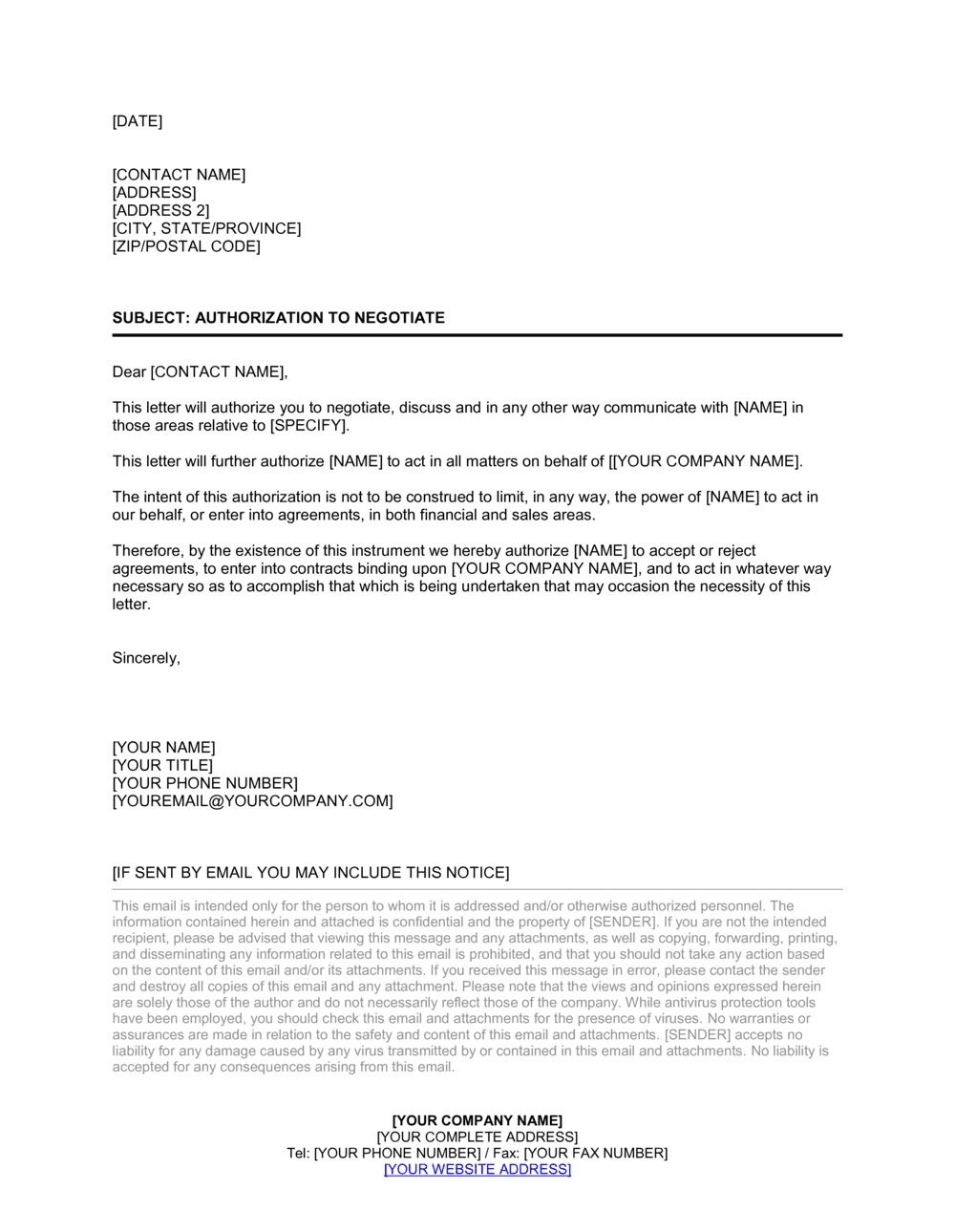
A Letter of Authorization to Negotiate is a formal business letter in which a principal β€” an individual or organization β€” grants a named representative the authority to negotiate on their behalf in a specific transaction or matter. This free Word download gives you a ready-to-edit template you can customize, export as PDF, and present to counterparties or institutions in minutes.
When you need it
Use it whenever you cannot attend negotiations personally and need a trusted representative β€” an agent, attorney, employee, or business partner β€” to engage, discuss terms, and advance a deal on your behalf. Common triggers include contract renewals, supplier negotiations, property transactions, and institutional approvals.
What's inside
Identification of the authorizing party and the designated representative, a clear statement of the scope and limits of negotiation authority, the specific matter or transaction covered, a validity period, and the authorizing party's signature block with contact details for verification.

What is a Letter of Authorization to Negotiate?

A Letter of Authorization to Negotiate is a formal business letter in which an individual or organization β€” the principal β€” grants a named representative the authority to negotiate terms on their behalf for a specific transaction or matter. It identifies both parties by name and role, defines the precise scope of what the representative may discuss and propose, sets a validity period, and is signed by the authorizing party. Unlike a power of attorney, it does not grant authority to sign or execute binding agreements β€” it governs the negotiation phase only, making it appropriate for the vast majority of business dealings where principals want to delegate discussions without surrendering final approval.

Why You Need This Document

Without a written authorization, counterparties β€” especially banks, government agencies, and large corporations β€” will routinely refuse to engage with a representative they cannot verify, stalling negotiations that depend on your personal availability. Verbal delegations create ambiguity about scope: a representative who exceeds an unwritten mandate can inadvertently commit you to terms you never intended to accept. A clear, dated letter with defined scope and an explicit validity period protects you on both fronts β€” it gives the counterparty confidence to proceed and gives you a documented record of exactly what authority you granted. This template lets you issue a professional, complete authorization in under 15 minutes, reducing the friction of delegation without creating unintended legal exposure.

Which variant fits your situation?

If your situation is…Use this template
Delegating full signing and binding authority, not just negotiationPower of Attorney
Authorizing an agent to negotiate a real estate transactionReal Estate Authorization Letter
Authorizing a representative to act on all company mattersGeneral Letter of Authorization
Delegating authority to collect payments on your behalfLetter of Authorization to Collect Payment
Authorizing a bank or financial institution transactionBank Authorization Letter
Formally introducing a representative to a third partyLetter of Introduction
Granting limited authority to execute a single contractLimited Power of Attorney

Common mistakes to avoid

❌ Using the letter as a binding signature authority

Why it matters: A Letter of Authorization to Negotiate grants authority to discuss and propose terms β€” not to sign contracts. Counterparties who proceed as if it authorizes binding commitments can create unintended obligations.

Fix: Include an explicit statement that the representative is not authorized to execute binding agreements, and ensure a separate signature process is used for final contracts.
❌ Omitting the validity period

Why it matters: A letter without an end date remains technically valid indefinitely and can be presented by the representative in future unrelated negotiations, exposing you to liability.

Fix: Always include a specific end date. For ongoing relationships, issue fresh authorization letters for each distinct negotiation.

❌ Vague scope description

Why it matters: Generic language like 'authorized to negotiate all matters' gives the representative unchecked latitude and makes it impossible to challenge actions that exceed your intent.

Fix: List the specific terms the representative may negotiate β€” price range, delivery windows, warranty conditions β€” and exclude everything else by default.

❌ Failing to provide verification contact details

Why it matters: Counterparties β€” especially banks, government agencies, and large corporates β€” routinely verify authorization letters before proceeding. An unverifiable letter delays or blocks the negotiation entirely.

Fix: Include a direct phone number and email address for the authorizing party, and be available to respond promptly during the negotiation window.

The 9 key clauses, explained

Date and addressee block

In plain language: States the date the letter is issued and identifies the recipient β€” typically the counterparty, institution, or third party who will be dealing with the authorized representative.

Sample language
[DATE] [RECIPIENT NAME / ORGANIZATION] [ADDRESS] Dear [RECIPIENT NAME / TITLE],

Common mistake: Leaving the recipient line blank or addressing it generically to 'Whom It May Concern.' A named recipient improves credibility and ensures the letter reaches the right person.

Introduction and purpose statement

In plain language: Opens the letter by identifying the authorizing party and clearly stating the purpose β€” to formally authorize a named individual to negotiate on their behalf.

Sample language
I, [YOUR FULL NAME], [TITLE] of [COMPANY NAME], hereby authorize [REPRESENTATIVE FULL NAME] to negotiate on my/our behalf in connection with [SPECIFIC MATTER OR TRANSACTION].

Common mistake: Omitting the authorizing party's title or organizational role, leaving the recipient unsure whether the person issuing the authorization has standing to do so.

Identification of the authorized representative

In plain language: Provides identifying details for the representative β€” full name, title or role, and optionally an ID or employee number β€” so the counterparty can verify the person they are dealing with.

Sample language
[REPRESENTATIVE FULL NAME], [TITLE / ROLE], [ID NUMBER IF APPLICABLE], is authorized to represent [COMPANY NAME] in all negotiations related to [MATTER].

Common mistake: Including only a first name or an informal title. Counterparties and institutions need enough detail to confirm the representative's identity.

Scope of negotiation authority

In plain language: Defines specifically what the representative is authorized to do β€” discuss terms, propose counteroffers, review drafts β€” and what they are not authorized to do, such as sign binding agreements.

Sample language
[REPRESENTATIVE NAME] is authorized to discuss, propose, and negotiate terms including [SPECIFIC TERMS, e.g., pricing, delivery schedules, warranty conditions] on behalf of [COMPANY NAME]. This authorization does not extend to the execution of binding agreements, which remain subject to [YOUR NAME/COMPANY]'s separate written approval.

Common mistake: Failing to state what the representative cannot do. Without explicit limits, counterparties may assume the representative has full binding authority.

Subject matter and transaction details

In plain language: Identifies the specific deal, contract, project, or matter the authorization covers, preventing the letter from being used beyond its intended scope.

Sample language
This authorization applies specifically to negotiations regarding [DESCRIPTION OF CONTRACT / PROJECT / TRANSACTION], referenced as [PROJECT NAME / CONTRACT NUMBER], expected to be concluded by [DATE].

Common mistake: Writing a vague subject description like 'business matters.' A specific description protects the authorizing party from the representative exceeding their mandate.

Validity period

In plain language: States the start and end dates during which the authorization is valid, ensuring the letter cannot be used indefinitely or after the negotiation has concluded.

Sample language
This authorization is valid from [START DATE] through [END DATE], unless revoked earlier in writing by [YOUR NAME / COMPANY NAME].

Common mistake: Omitting an end date entirely. An open-ended authorization creates ongoing liability and can be presented by the representative in unrelated future dealings.

Request for cooperation

In plain language: Politely asks the recipient to extend full cooperation and assistance to the representative as they would to the principal directly.

Sample language
We kindly request that you extend to [REPRESENTATIVE NAME] the same professional cooperation and access to information that you would extend to [YOUR NAME / COMPANY NAME] directly.

Common mistake: Skipping this clause in short letters. Without it, counterparties at larger organizations may route the representative to junior staff rather than the appropriate decision-maker.

Contact information for verification

In plain language: Provides the authorizing party's direct phone number and email so the recipient can verify the letter's authenticity before proceeding.

Sample language
Should you require verification of this authorization, please contact me directly at [PHONE NUMBER] or [EMAIL ADDRESS].

Common mistake: Providing only a general company phone number. Counterparties who cannot reach the authorizing party directly may delay or refuse to proceed with negotiations.

Closing and signature block

In plain language: Closes the letter professionally and provides the authorizing party's full name, title, company, and signature for authentication.

Sample language
Yours sincerely, [YOUR SIGNATURE] [YOUR FULL NAME] [TITLE] [COMPANY NAME] [DATE]

Common mistake: Using an illegible digital scrawl or no signature at all. Even for a non-binding letter, a clear signature β€” wet or digital β€” signals professionalism and authenticity.

How to fill it out

  1. 1

    Enter the date and recipient details

    Add the date of issue at the top and address the letter to the specific person or organization your representative will be negotiating with. If the counterparty contact is not yet known, address it to the appropriate department.

    πŸ’‘ Use the date you intend to send or hand-deliver the letter β€” backdating can undermine the document's credibility.

  2. 2

    Identify yourself and your organization

    State your full legal name and your title or role within the organization. If issuing on behalf of a company, include the company's registered name.

    πŸ’‘ Match the name exactly to the signatory on any related contracts β€” discrepancies create confusion about who holds authority.

  3. 3

    Name the authorized representative with identifying details

    Enter the representative's full name, their title or relationship to you, and any ID reference the counterparty may need to verify them on arrival.

    πŸ’‘ For institutional recipients such as banks or government bodies, include the representative's government-issued ID number or passport number.

  4. 4

    Define the scope and limits of authority clearly

    Describe exactly what the representative may negotiate and explicitly state what is excluded β€” typically the authority to sign binding agreements. Be as specific as possible about permitted actions.

    πŸ’‘ Bullet-pointing the permitted actions (e.g., pricing, timelines, warranty terms) makes the scope unambiguous and easier for the counterparty to process quickly.

  5. 5

    Describe the specific transaction or matter

    Reference the contract, project, or matter by name and number if one exists. Include an expected completion date to further limit the authorization's scope.

    πŸ’‘ Cross-reference the same project name used in any related proposal or contract draft so all documents are clearly connected.

  6. 6

    Set the validity period

    Enter a specific start date and end date for the authorization. For active negotiations, a window of 30–60 days is typical.

    πŸ’‘ If negotiations may extend beyond the initial window, issue a brief follow-up letter extending the validity rather than leaving the end date open-ended.

  7. 7

    Add your verification contact details and sign

    Include your direct phone number and email address so the recipient can confirm the authorization. Sign with a clear signature β€” wet ink or a recognized e-signature.

    πŸ’‘ For high-value negotiations, consider sending a scanned copy by email and a hard copy by courier to ensure both the counterparty and your representative have a copy on file.

Frequently asked questions

What is a letter of authorization to negotiate?

A letter of authorization to negotiate is a formal business letter in which an individual or organization grants a named representative the authority to negotiate terms on their behalf for a specific transaction or matter. It identifies both parties, defines the scope of what the representative may discuss or propose, states a validity period, and is signed by the authorizing party. It does not grant authority to sign binding agreements unless that is explicitly stated.

When should I use a letter of authorization to negotiate?

Use one whenever you cannot be present at negotiations and need a trusted person β€” an employee, agent, attorney, or partner β€” to engage on your behalf. Common situations include supplier contract renewals, real estate lease negotiations, bank or government dealings, cross-border transactions, and procurement processes where a manager is delegating to a buyer.

Is a letter of authorization to negotiate legally binding?

The letter itself is not a binding contract β€” it is a formal notice of delegated authority. It does not obligate either party to reach an agreement. However, it can create apparent authority for the representative, meaning third parties who rely on it in good faith may hold the principal to commitments the representative makes. Define the scope carefully to limit this risk.

What is the difference between a letter of authorization and a power of attorney?

A letter of authorization to negotiate grants a representative authority to discuss and propose terms for a specific matter β€” it typically stops short of binding the principal. A power of attorney is a stronger legal instrument that grants an agent broad authority to act on the principal's behalf and can include the authority to sign documents and create binding legal obligations. For most business negotiations, a letter of authorization is sufficient; a power of attorney is needed when the representative must execute final agreements.

Does a letter of authorization to negotiate need to be notarized?

In most business contexts, notarization is not required. However, some government agencies, financial institutions, and international counterparties may require notarization or apostille certification before accepting the letter. Check the specific requirements of the institution or jurisdiction involved before issuing the letter.

Can I revoke a letter of authorization to negotiate?

Yes. You can revoke the authorization at any time by sending a written revocation notice to both the representative and the counterparty. Revocation is effective from the date the counterparty receives it. Always notify the counterparty directly β€” revoking only with the representative leaves third parties who were unaware still able to rely on the original authorization.

How long should a letter of authorization to negotiate be valid?

Tailor the validity period to the expected duration of the negotiation. For a single meeting or short-term negotiation, 15–30 days is typical. For extended or multi-round negotiations, 60–90 days is more practical. Avoid open-ended authorizations β€” always include a specific end date and issue a new letter if the negotiation extends beyond the original window.

Can a company issue a letter of authorization to negotiate, or must it be an individual?

A company can issue this letter, signed by an officer or authorized signatory acting on the company's behalf. The letter should identify the company as the principal, state the signatory's name and title, and confirm they have authority to delegate on behalf of the organization. Counterparties dealing with corporate principals often expect a company letterhead and a named officer's signature.

How this compares to alternatives

vs Power of Attorney

A power of attorney grants broad legal authority to act and bind the principal, including signing contracts and making financial decisions. A letter of authorization to negotiate is narrower β€” it covers discussion and proposal of terms only. Use the letter for standard business negotiations; use a power of attorney only when the representative must execute final, binding documents.

vs General Letter of Authorization

A general letter of authorization delegates authority to act across a broader or unspecified range of tasks β€” collecting documents, representing interests generally, or transacting on behalf of the principal. A letter of authorization to negotiate is scoped specifically to the negotiation process for a defined matter. Use the general letter when the tasks are varied; use the negotiation letter when the mandate is specifically to negotiate terms.

vs Letter of Intent

A letter of intent expresses one party's intention to enter into an agreement on proposed terms β€” it is a document between the two negotiating parties. A letter of authorization to negotiate is an internal delegation document from the principal to their representative. The two serve entirely different functions and are often both used in the same transaction.

vs Engagement Letter

An engagement letter formalizes the scope, fees, and terms of a professional services relationship between a firm and its client. A letter of authorization to negotiate is issued by a principal to authorize a representative and is addressed to a counterparty or institution. The engagement letter governs the professional relationship; the authorization letter governs who may speak and negotiate on behalf of whom.

Industry-specific considerations

Real Estate

Owners and investors authorize agents to negotiate lease renewals, purchase prices, and tenant improvement allowances when they cannot attend in person.

Import / Export and Trade

Exporters and importers delegate local representatives to negotiate customs clearance terms, freight rates, and supplier pricing across borders.

Professional Services

Law firms, consulting firms, and accounting practices authorize senior associates or partners to negotiate engagement terms and fee structures with prospective clients.

Government and Public Sector

Public bodies require formal written authorization before engaging with a representative rather than the named contracting official, particularly for procurement and grant negotiations.

Template vs pro β€” what fits your needs?

PathBest forCostTime
Use the templateStandard business delegations β€” supplier negotiations, vendor renewals, internal procurement authorizationsFree10–15 minutes
Template + professional reviewHigh-value transactions, regulated industries, or cross-border negotiations with institutional counterparties$100–$300 (lawyer or notary review)1–2 hours
Custom draftedComplex multi-party authorizations, transactions requiring notarization or apostille, or matters where apparent authority liability is a significant concern$300–$800+1–3 days

Glossary

Principal
The individual or organization granting authority to a representative to act on their behalf.
Authorized Representative
The person designated by the principal to conduct negotiations within the scope defined in the letter.
Scope of Authority
The specific boundaries of what the representative is permitted to negotiate, discuss, or agree to on behalf of the principal.
Validity Period
The date range during which the authorization is active β€” after which the representative's authority automatically lapses.
Power of Attorney
A stronger legal instrument that grants an agent broad authority to act and bind the principal legally, beyond negotiation alone.
Delegation
The act of formally transferring a defined set of responsibilities or authority from one party to another.
Counterparty
The other party in a negotiation or transaction β€” the entity the authorized representative will engage with.
Non-binding negotiation
A discussion phase in which terms are explored and proposed but no final commitment is made until a formal agreement is signed.
Revocation
The formal cancellation of an authorization, terminating the representative's authority before the validity period expires.

Part of your Business Operating System

This document is one of 3,000+ business & legal templates included in Business in a Box.

  • Fill-in-the-blanks β€” ready in minutes
  • 100% customizable Word document
  • Compatible with all office suites
  • Export to PDF and share electronically

Create your document in 3 simple steps.

From template to signed document β€” all inside one Business Operating System.
1
Download or open template

Access over 3,000+ business and legal templates for any business task, project or initiative.

2
Edit and fill in the blanks with AI

Customize your ready-made business document template and save it in the cloud.

3
Save, Share, Send, Sign

Share your files and folders with your team. Create a space of seamless collaboration.

Save time, save money, and create top-quality documents.

β˜…β˜…β˜…β˜…β˜…

"Fantastic value! I'm not sure how I'd do without it. It's worth its weight in gold and paid back for itself many times."

Managing Director Β· Mall Farm
Robert Whalley
Managing Director, Mall Farm Proprietary Limited
β˜…β˜…β˜…β˜…β˜…

"I have been using Business in a Box for years. It has been the most useful source of templates I have encountered. I recommend it to anyone."

Business Owner Β· 4+ years
Dr Michael John Freestone
Business Owner
β˜…β˜…β˜…β˜…β˜…

"It has been a life saver so many times I have lost count. Business in a Box has saved me so much time and as you know, time is money."

Owner Β· Upstate Web
David G. Moore Jr.
Owner, Upstate Web

Run your business with a system β€” not scattered tools

Stop downloading documents. Start operating with clarity. Business in a Box gives you the Business Operating System used by over 250,000 companies worldwide to structure, run, and grow their business.

Start freeΒ Β·Β No credit card required