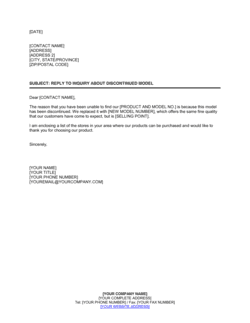
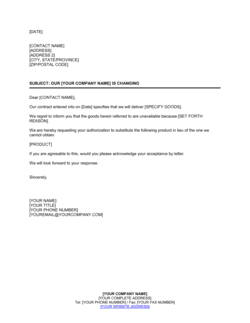
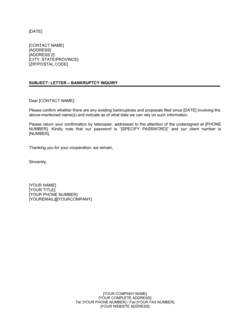
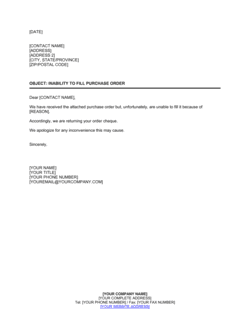
Reply to Inquiry and Inability to Offer Substitute Template

Free Word download • Edit online • Save & share with Drive • Export to PDF

1 page20–30 min to fillDifficulty: StandardSignature requiredLegal review recommended
Learn more ↓
FreeReply to Inquiry and Inability to Offer Substitute Template

At a glance

What it is
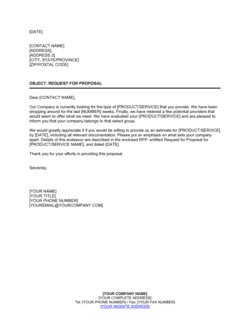
A Reply to Inquiry and Inability to Offer Substitute is a formal written response issued by a business or supplier to a customer or counterparty when the requested product, service, or resource is unavailable and no suitable alternative can be provided. This template is a free Word download you can edit online and export as PDF — covering acknowledgment of the inquiry, explanation of unavailability, confirmation that no substitute exists, and a professional closing that preserves the business relationship.
When you need it
Use it when a buyer, client, or partner has submitted a formal inquiry for goods or services that you cannot fulfill, and your inventory, capacity, or product range offers no comparable replacement to propose. It is also appropriate when a contractual or pre-contractual inquiry must be formally declined in writing to create a documented record.
What's inside
Parties and reference identifiers, acknowledgment of the original inquiry, a clear statement of unavailability, confirmation that no substitute can be offered, an explanation of the reason where appropriate, a goodwill closing, and an authorized signature block. The document creates a traceable written record that protects both sides from future disputes about the status of the request.

What is a Reply to Inquiry and Inability to Offer Substitute?

A Reply to Inquiry and Inability to Offer Substitute is a formal written business letter issued by a supplier, vendor, or service provider when a counterparty has submitted an inquiry for a specific product, service, or resource that is unavailable, and no comparable alternative can be proposed in its place. The letter acknowledges the original inquiry by reference number and date, states the unavailability in clear terms, explicitly confirms that no substitute exists within the sender's current offering, and closes professionally to preserve the commercial relationship. Unlike a casual email decline, this document is structured to function as a formal correspondence record — signed by an authorized representative and retained by both parties as evidence of how the inquiry was resolved.

Why You Need This Document

Failing to formally document an inability to fulfill an inquiry creates real operational and legal risk on both sides. For the sender, an informal or incomplete reply leaves the inquiry technically open — the recipient may continue waiting for a response, delay their own sourcing, or later claim they were led to believe a substitute was being identified. In an active supply or distribution relationship, an undocumented refusal can be construed as a breach of a duty to supply or a failure to act in good faith, particularly in jurisdictions such as Canada and several EU member states where good-faith obligations in commercial dealings are enforced by courts. For the recipient, the absence of a formal written reply prevents them from closing out the inquiry in their procurement records or demonstrating due diligence to auditors and internal stakeholders. This template gives you a professionally structured, legally aware starting point that closes the inquiry cleanly, creates a defensible documentation trail, and keeps the commercial relationship intact — all in under 15 minutes.

Which variant fits your situation?

If your situation is…Use this template
Declining an inquiry and offering a partial substituteReply to Inquiry with Counter-Offer
Responding to an inquiry where stock is temporarily unavailable but expected to returnBackorder Notice Letter
Formally declining a request for proposal from a potential vendorRejection of Bid Letter
Declining a client's service inquiry due to capacity constraintsLetter of Decline for Services
Acknowledging an inquiry and directing the requester to an alternative supplierReferral Letter to Alternative Supplier
Formally closing a sales inquiry with no further engagement plannedSales Inquiry Closure Letter
Notifying a buyer of product discontinuation with no replacementProduct Discontinuation Notice

Common mistakes to avoid

❌ Omitting the 'no substitute' clause

Why it matters: Without an explicit statement that no alternative is available, the recipient may reasonably believe the sender is still identifying options — keeping the inquiry technically open and potentially stalling their procurement process.

Fix: Add a standalone clause explicitly confirming that the sender's current catalog and capacity offer no comparable substitute for the requested item.

❌ Describing unavailability as temporary when it is permanent

Why it matters: Calling a discontinued product 'currently unavailable' implies a future restock that will never happen — creating a misrepresentation the recipient may act on by waiting rather than sourcing elsewhere.

Fix: Confirm internally whether the item is permanently discontinued or genuinely subject to a future restock before choosing your language; use 'permanently discontinued' or 'indefinitely unavailable' where accurate.

❌ Sending an unsigned or informally signed reply

Why it matters: A reply signed only with a first name, a job function, or an auto-generated email signature does not constitute formal correspondence and carries little weight as a business record in a dispute or audit.

Fix: Have the letter signed by a named individual with the title and authority to issue external correspondence, and include the date of signing.

❌ Disclosing commercially sensitive supplier or pricing details

Why it matters: Including upstream supplier names, cost breakdowns, or internal capacity figures in the explanation clause creates competitive exposure and may breach confidentiality obligations to third-party suppliers.

Fix: Limit the reason clause to general, non-sensitive language — 'supply chain constraints,' 'product range limitations,' or 'regulatory requirements' — without naming suppliers or revealing internal figures.

❌ Failing to reference the original inquiry by date and reference number

Why it matters: Without a clear link to the original inquiry, the reply cannot be matched to the underlying request in an audit, legal review, or dispute — reducing its value as a documentation record to near zero.

Fix: Always include the date of the original inquiry and its reference number in the opening clause; if the inquiry had no reference number, create one and note it in both documents.

❌ Missing the no-commitment and disclaimer-of-liability clause

Why it matters: Without this clause, the reply — especially when sent to a party with an existing supply relationship — may be construed as acknowledging an obligation to supply or as a partial acceptance, creating unintended legal exposure.

Fix: Include the no-commitment clause in every version of this letter and have a lawyer review before sending when an active supply or service agreement is in place.

The 9 key clauses, explained

Parties and reference identification

In plain language: Identifies the sender and recipient by legal name, address, and contact information, and links the reply to the original inquiry via a reference number or date.

Sample language
This letter is issued by [COMPANY LEGAL NAME] ('Respondent') to [RECIPIENT LEGAL NAME OR COMPANY] ('Inquirer') in response to your inquiry dated [INQUIRY DATE], Reference No. [REFERENCE NUMBER].

Common mistake: Omitting the original inquiry's date or reference number — without this link, the reply cannot be matched to the underlying request in an audit or dispute, undermining its value as a documentation record.

Acknowledgment of the inquiry

In plain language: Confirms that the original inquiry was received, identifies the specific product, service, or request it concerned, and thanks the inquirer for their interest.

Sample language
We acknowledge receipt of your inquiry dated [DATE] regarding [SPECIFIC PRODUCT / SERVICE / REQUEST DESCRIPTION] and thank you for your interest in [COMPANY NAME].

Common mistake: Using vague language such as 'your recent request' without specifying what was requested — if the correspondence is reviewed later, neither party can confirm which inquiry this letter addresses.

Statement of unavailability

In plain language: Clearly states that the requested product, service, or resource is unavailable, and specifies the reason to the extent the sender is willing to disclose.

Sample language
We regret to inform you that [PRODUCT / SERVICE NAME] is currently unavailable due to [REASON: e.g., permanent discontinuation / supply chain constraints / capacity limits] effective [DATE].

Common mistake: Framing unavailability as temporary when it is permanent — this creates a reasonable expectation of future availability and may expose the sender to claims of misrepresentation if the item is never restocked.

Confirmation of no substitute

In plain language: Explicitly states that no comparable alternative product, service, or arrangement is available within the sender's current offering, removing any implied obligation to provide one.

Sample language
After reviewing our current inventory and service catalog, we confirm that we are unable to offer a substitute or alternative that would meet the specifications of your inquiry.

Common mistake: Leaving this clause out and relying on the unavailability statement alone — without an explicit 'no substitute' confirmation, the recipient may reasonably assume the sender is still researching alternatives.

Reason for inability (optional disclosure)

In plain language: Provides context for why no substitute can be offered — whether due to manufacturing constraints, regulatory restrictions, exclusivity agreements, or a product range that simply does not extend to the requested category.

Sample language
Our inability to offer a substitute results from [REASON: e.g., our product range does not currently include items with [SPECIFICATION] / applicable regulatory requirements preclude us from supplying [ITEM]].

Common mistake: Disclosing commercially sensitive supply chain details or naming specific upstream suppliers — this information is not necessary to make the reply effective and can create competitive or contractual exposure.

Disclaimer of liability and no-commitment clause

In plain language: States that this reply does not constitute a contractual commitment, acknowledgment of any obligation, or admission of liability for failing to meet the inquiry.

Sample language
This response is issued as a matter of professional courtesy and does not constitute an offer, a contractual commitment, or an admission of any obligation on the part of [COMPANY NAME] with respect to the subject matter of your inquiry.

Common mistake: Omitting this clause entirely when the inquiry arose from a pre-existing commercial relationship — without it, the reply may be read as confirming an expectation of supply that the sender never intended to create.

Preservation of relationship and future engagement

In plain language: Expresses genuine regret for the inability to assist, affirms the sender's interest in the business relationship, and invites the recipient to contact the sender for other needs.

Sample language
We regret that we are unable to assist on this occasion and value our ongoing relationship with [RECIPIENT NAME]. We encourage you to contact us regarding any other inquiries where we may be of service.

Common mistake: Omitting this clause or writing a terse closing that reads as dismissive — while not legally required, an abrupt close can damage a commercial relationship unnecessarily and is inconsistent with professional correspondence standards.

Referral to alternative sources (optional)

In plain language: Where the sender is willing and able, provides a general direction to other suppliers or resources without creating a warranty or endorsement.

Sample language
While we are unable to fulfill this request directly, you may wish to explore alternative suppliers in your region. Please note that any such referral does not constitute an endorsement or warranty by [COMPANY NAME].

Common mistake: Naming a specific competitor or supplier as a referral without a clear disclaimer — this can expose the sender to endorsement liability or create the impression of a formal supplier relationship with the named party.

Authorized signature block

In plain language: Identifies the signatory by name, title, and date, confirming that the letter is issued with corporate authority and is not an informal communication.

Sample language
Yours sincerely, [AUTHORIZED SIGNATORY NAME] | [TITLE] | [COMPANY NAME] | Date: [DATE] | Contact: [EMAIL / PHONE]

Common mistake: Signing with a first name only, a job function title without a name, or failing to include a date — these omissions reduce the letter's evidentiary weight and make it harder to establish who issued it and when.

How to fill it out

  1. 1

    Retrieve and reference the original inquiry

    Locate the original written inquiry and note its date, reference number, and the specific product or service requested. Enter these details into the parties and reference identification clause at the top of the letter.

    💡 If the original inquiry did not include a reference number, assign one using your internal tracking system and note it on the correspondence file as well as in this reply.

  2. 2

    Identify the exact item or service that cannot be provided

    Be precise about what was requested — use the product name, SKU, service description, or specification as it appeared in the inquiry. Vague acknowledgment creates ambiguity about what was actually declined.

    💡 Copy the product description verbatim from the inquiry where possible — this prevents the recipient from later claiming the reply addressed a different item.

  3. 3

    Determine whether the unavailability is temporary or permanent

    Confirm internally whether the item is discontinued, out of stock with no restock date, or subject to a permanent capacity constraint. The language in your unavailability clause must accurately reflect the true status.

    💡 If there is any uncertainty about restocking, use language like 'we are currently unable to confirm availability' rather than 'permanently discontinued' — the latter is harder to walk back if circumstances change.

  4. 4

    Confirm that no substitute exists in your catalog

    Review your full product or service range to confirm there is genuinely no comparable alternative before completing the 'no substitute' clause. If a partial substitute exists, consider using a counter-offer template instead.

    💡 Document your internal review — a note in your CRM or email thread confirming who checked and when — so you can demonstrate due diligence if the reply is later challenged.

  5. 5

    Decide what reason to disclose

    Determine whether and how much context to provide in the optional reason clause. You are not obligated to explain the cause, but a brief, non-sensitive reason — such as 'supply chain constraints' — is more professional than no explanation.

    💡 Never disclose upstream supplier names, pricing breakdowns, or internal capacity figures — these details are unnecessary for the letter's purpose and may have competitive or contractual implications.

  6. 6

    Add the disclaimer of liability and no-commitment language

    Include the no-commitment clause in every version of this letter, especially when the inquiry arose from an ongoing supplier or customer relationship. This clause prevents the reply from being interpreted as a partial acceptance or a breach of an implied obligation.

    💡 If you are replying to a counterparty with whom you have an active supply agreement, have a lawyer review whether the agreement imposes a duty to supply or propose alternatives before sending.

  7. 7

    Write the goodwill closing and sign with full authority

    Close with a brief goodwill statement, then have the letter signed by a manager or officer with authority to issue external correspondence on behalf of the company. Include the signatory's full name, title, and the date of signing.

    💡 Use company letterhead for this letter — a plain-text email without letterhead carries less weight as a formal business record in a dispute or audit.

  8. 8

    Send, retain, and log the correspondence

    Send the letter by email with a read receipt or by tracked post for high-stakes inquiries. Retain a copy in your correspondence file and log the inquiry and reply in your CRM or contract management system.

    💡 For inquiries connected to an active contract or tendering process, send the reply within the response window specified in the relevant agreement or RFQ to avoid a default or deemed acceptance.

Frequently asked questions

What is a reply to inquiry and inability to offer substitute?

A reply to inquiry and inability to offer substitute is a formal written business letter issued when a supplier, vendor, or service provider receives a request for a product or service it cannot fulfill and has no comparable alternative to propose. It acknowledges the original inquiry, states the unavailability clearly, confirms that no substitute exists, and closes professionally. The document creates a traceable written record that protects both parties from later disputes about the status of the request.

When should I use this letter instead of a counter-offer?

Use this letter only when you have confirmed there is genuinely no alternative in your catalog or capacity that could meet the requester's need. If you have even a partial substitute — a different size, a comparable service tier, or a delayed availability date — a counter-offer letter is more appropriate because it keeps the commercial relationship active. Sending this letter when a substitute exists and failing to propose it could cost you a sale or damage a client relationship.

Does this letter need to be signed to be valid?

Yes. As a formal business correspondence document, it should be signed by a named individual with authority to issue external communications on behalf of the company. An unsigned letter or one signed only with a job function carries reduced weight as a business record and may not be accepted as evidence in a dispute or audit. The signature block should include the signatory's full name, title, company, and the date of signing.

Do I need to explain why I cannot offer a substitute?

You are generally not legally obligated to provide a reason, but a brief, non-sensitive explanation — such as 'supply chain constraints' or 'our product range does not extend to this specification' — is more professional and reduces follow-up questions. Avoid disclosing upstream supplier names, cost data, or internal capacity figures, as these details are unnecessary and can create competitive or contractual exposure.

Can this letter be used to respond to an inquiry under an active supply contract?

It can, but with additional caution. If an active supply contract imposes a duty to supply, a minimum order commitment, or an obligation to propose alternatives, sending this letter without first reviewing those obligations may constitute a breach. In those cases, have a lawyer review the contract before issuing the reply to confirm the letter's content aligns with your contractual position.

What is the difference between this letter and a rejection letter?

A rejection letter declines a proposal, application, or bid — often with an evaluative judgment about the submission. This letter does not evaluate or reject the requester's inquiry on its merits; it simply states that the requested item or service is unavailable and no substitute can be offered. The distinction matters commercially: this letter preserves the relationship and leaves the door open for future inquiries, while a rejection letter closes a specific application or proposal.

Does sending this letter expose me to liability?

When properly drafted with a no-commitment and disclaimer-of-liability clause, this letter generally does not create new legal exposure. In fact, it reduces risk by creating a clear written record that the inquiry was declined formally and that no alternative was proposed. Omitting the disclaimer clause, however, especially in an ongoing commercial relationship, can inadvertently imply an acknowledgment of obligation — which is why the clause is essential in every version of the letter.

How quickly should I send this reply after receiving the inquiry?

Best practice is to reply within 5 business days of receiving the inquiry. For inquiries connected to a formal tendering or RFQ process, reply within the response window stated in the tender documents — failure to respond within that window can sometimes be interpreted as a deemed acceptance or a failure to comply with the process. For routine commercial inquiries with no deadline, prompt response protects the requester's ability to source alternatives in time.

Should I keep a copy of this letter?

Yes, always. Retain a copy of both the original inquiry and this reply in your correspondence file, CRM, or contract management system. The two documents together form the documentation trail that proves the inquiry was formally received and declined with no substitute offered. This record is valuable in any future dispute about whether you had an obligation to supply, and it satisfies audit requirements in regulated industries.

How this compares to alternatives

vs Counter-offer letter

A counter-offer letter responds to an inquiry by proposing an alternative product, service, or terms in place of what was requested — keeping the commercial dialogue open. This letter is used specifically when no alternative exists and the inquiry must be closed without any further proposal. Use a counter-offer when a partial substitute or adjusted arrangement is possible; use this letter only when nothing comparable is available.

vs Rejection of bid letter

A rejection of bid letter declines a supplier's or vendor's submitted proposal, typically after an evaluation process. This letter does the opposite — it is issued by the supplier to a buyer declining the buyer's inquiry on the basis of unavailability. The two letters operate in opposite directions of the commercial relationship and should not be used interchangeably.

vs Product discontinuation notice

A product discontinuation notice proactively informs customers of an upcoming or recent discontinuation, often sent to all affected buyers at once. This letter is a reactive, one-to-one reply to a specific inquiry from a specific party. Both documents may be needed in the same situation — the discontinuation notice informs the market; this letter formally closes the individual inquiry.

vs Backorder notice letter

A backorder notice informs a buyer that a requested item is temporarily out of stock but expected to be available by a specified date. This letter is used when the item will not be restocked and no substitute can be proposed — it closes the inquiry entirely. If there is a realistic restock date, a backorder notice is the correct document; this letter is reserved for permanent or indefinite unavailability.

Industry-specific considerations

Manufacturing and wholesale

Suppliers use this letter to formally decline buyer inquiries for discontinued SKUs or components outside their current production run, documenting unavailability for procurement audit trails.

Professional services

Consultancies and agencies issue this letter when a client requests a specific service capability — such as a niche compliance specialty or geographic coverage — that the firm does not offer and cannot replicate with existing staff.

Retail and e-commerce

Retailers use this letter to formally respond to wholesale or bulk purchase inquiries for out-of-stock or permanently discontinued product lines with no comparable item in the current catalog.

Healthcare and life sciences

Medical device and pharmaceutical distributors issue this letter when a requested product is subject to regulatory restrictions, recalls, or market withdrawal — confirming no substitute can be supplied under applicable compliance requirements.

Jurisdictional notes

United States

In the US, there is generally no common-law duty to supply or propose alternatives unless an active contract creates one. However, if the inquiry relates to a standing purchase order or a supply agreement with minimum volume commitments, the reply must be reviewed against those terms before sending. State contract law governs most commercial correspondence disputes; the UCC Article 2 governs sales of goods and may impose good-faith obligations in certain ongoing dealer or distributor relationships.

Canada

Canadian courts impose a duty of good faith in commercial contract performance under Bhasin v Hrynew (2014 SCC 71), which may extend to pre-contractual and ongoing supply relationships. If the inquiry arises from an active distributor or supply agreement, the reply should be reviewed to ensure it does not conflict with good-faith obligations under that agreement. Quebec civil law may impose additional disclosure or cooperation duties not present in common-law provinces.

United Kingdom

Under English contract law, there is no general duty to contract or to propose alternatives unless an existing agreement requires it. However, supply agreements governed by English law often include best-efforts or reasonable-endeavors clauses that may require the supplier to identify substitutes before declining. The letter should include a clear disclaimer confirming it does not constitute a breach of any existing agreement, and legal review is recommended where a supply contract is in place.

European Union

Several EU member states — including Germany and France — impose a general duty of good faith in pre-contractual and commercial dealings that may require a party to disclose known alternatives even when declining an inquiry. GDPR applies to any personal data included in the correspondence; ensure the recipient's contact details are handled in accordance with your privacy policy. In regulated product categories (medical devices, chemicals, food), unavailability letters may require additional regulatory references to be valid in a compliance context.

Template vs lawyer — what fits your deal?

PathBest forCostTime
Use the templateRoutine commercial inquiries from non-contracted customers where no supply obligation existsFree10–15 minutes per letter
Template + legal reviewReplies to inquiries from active customers, distributors, or parties with an existing supply or service agreement$150–$400 for a one-hour lawyer review1–2 business days
Custom draftedHigh-value procurement relationships, regulated industries, or situations where an active contract may impose supply obligations or penalties$500–$1,5002–5 business days

Glossary

Inquiry
A formal written request from a buyer or counterparty seeking information about the availability, pricing, or terms for a specific product or service.
Substitute
An alternative product, service, or arrangement offered in place of an unavailable item that meets the same or substantially similar need.
Unavailability
The condition in which a requested item or service cannot be provided due to stock depletion, discontinuation, capacity limits, or regulatory restrictions.
Reference Number
A unique identifier assigned to an inquiry or correspondence thread, used by both parties to track and match documents in their records.
Goodwill Closing
A sentence or short paragraph at the end of a business letter that maintains a cordial tone, expresses regret for the inability to assist, and invites future contact.
Authorized Signatory
An individual with the legal authority to sign documents on behalf of a company, binding the organization to the statements or commitments in the letter.
Force Majeure
An event outside a party's reasonable control — such as a natural disaster, supply chain disruption, or regulatory change — that may explain an inability to fulfill a request.
Documentation Trail
A chronological set of written records that evidences the communications and decisions made between parties, used in audits, disputes, and contract negotiations.
Counterparty
The other party in a business transaction or correspondence — the buyer, client, or requester who sent the original inquiry.
Formal Correspondence
Written business communication issued under a company letterhead, signed by an authorized representative, and intended to create a documented record.
Disclaimer of Liability
A clause or statement clarifying that the inability to fulfill the request does not constitute a breach of contract or admission of fault.

Part of your Business Operating System

This document is one of 3,000+ business & legal templates included in Business in a Box.

  • Fill-in-the-blanks — ready in minutes
  • 100% customizable Word document
  • Compatible with all office suites
  • Export to PDF and share electronically

Create your document in 3 simple steps.

From template to signed document — all inside one Business Operating System.
1
Download or open template

Access over 3,000+ business and legal templates for any business task, project or initiative.

2
Edit and fill in the blanks with AI

Customize your ready-made business document template and save it in the cloud.

3
Save, Share, Send, Sign

Share your files and folders with your team. Create a space of seamless collaboration.

Save time, save money, and create top-quality documents.

★★★★★

"Fantastic value! I'm not sure how I'd do without it. It's worth its weight in gold and paid back for itself many times."

Managing Director · Mall Farm
Robert Whalley
Managing Director, Mall Farm Proprietary Limited
★★★★★

"I have been using Business in a Box for years. It has been the most useful source of templates I have encountered. I recommend it to anyone."

Business Owner · 4+ years
Dr Michael John Freestone
Business Owner
★★★★★

"It has been a life saver so many times I have lost count. Business in a Box has saved me so much time and as you know, time is money."

Owner · Upstate Web
David G. Moore Jr.
Owner, Upstate Web

Run your business with a system — not scattered tools

Stop downloading documents. Start operating with clarity. Business in a Box gives you the Business Operating System used by over 250,000 companies worldwide to structure, run, and grow their business.

Start free · No credit card required