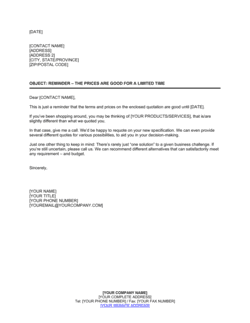
Inquiry About Last Quotation Template

Free Word download • Edit online • Save & share with Drive • Export to PDF

1 page20–30 min to fillDifficulty: StandardSignature requiredLegal review recommended
Learn more ↓
FreeInquiry About Last Quotation Template

At a glance

What it is
An Inquiry About Last Quotation is a formal written communication from a buyer to a supplier requesting confirmation, clarification, or an update on a previously issued price quotation. This free Word download gives you a professionally structured letter you can edit online and export as PDF, covering price verification, validity period, revised terms, and next steps in a single document that creates a written record of pre-contractual negotiations.
When you need it
Use it when a supplier's quotation has expired or is approaching its validity deadline, when market conditions have shifted since the original quote, or when you need written confirmation of pricing before issuing a purchase order or committing budget. It is also appropriate when a prior quotation contained ambiguous terms that must be clarified before proceeding.
What's inside
Reference to the original quotation by number and date, a specific inquiry into current pricing and any revised terms, a request for confirmation of the validity period, questions about delivery timelines and conditions, and a clear call to action with a response deadline — all formatted as a signed business letter that creates an auditable paper trail.

What is an Inquiry About Last Quotation?

An Inquiry About Last Quotation is a formal written letter a buyer sends to a supplier to ask whether a previously issued price quotation is still valid and to request confirmation or clarification of its terms before placing an order. It identifies both parties, cites the original quotation by reference number and date, asks specific questions about current pricing, validity period, delivery conditions, and quantity availability, and sets a response deadline that aligns with the buyer's procurement timeline. Because the letter creates a documented record of pre-contractual communications, it can be significant evidence if a pricing dispute arises after a purchase order is placed.

Why You Need This Document

Proceeding with a purchase order based on an expired or unconfirmed quotation is one of the most common — and avoidable — sources of supplier disputes. If the validity period has lapsed or market conditions have shifted, the supplier may deliver at a materially different price than the buyer assumed, leaving no written record of what was agreed. A formal inquiry letter closes that gap: it produces a timestamped, signed confirmation from the supplier that the quoted price applies to the buyer's intended quantity before any commitment is made. It also protects the buyer's internal approval process — finance and legal teams can approve a purchase order with confidence when the supporting quotation has been explicitly confirmed in writing. This template gives you the correct structure, legally relevant language, and authorized signature block to handle that confirmation in minutes.

Which variant fits your situation?

If your situation is…Use this template
Asking a supplier for an entirely new price quote from scratchRequest for Quotation (RFQ)
Formally accepting a supplier's quotation and placing an orderPurchase Order
Requesting clarification on specific line items in a current quoteInquiry About Last Quotation
Declining a supplier quotation after reviewRejection of Quotation Letter
Negotiating revised pricing terms from a supplierCounter Proposal Letter
Formalizing the agreed terms from a quotation into a binding supply contractSupply Agreement
Requesting quotes from multiple vendors simultaneously for comparisonRequest for Proposal (RFP)

Common mistakes to avoid

❌ Omitting the original quotation reference number

Why it matters: Suppliers who issue multiple quotes to the same buyer cannot identify which quotation is being referenced, causing delays while they search for the correct document.

Fix: Always cite the exact quotation reference number and date in the first paragraph. If you do not have the reference number, call the supplier to retrieve it before sending the letter.

❌ Sending the inquiry after the validity period has already expired

Why it matters: Once a quotation expires, the supplier is under no obligation to honor the original pricing. An inquiry sent after expiry is effectively a new RFQ, and the supplier may respond with materially different terms.

Fix: Calendar the expiry date of every quotation received and set a reminder 5–7 business days before it lapses so you have time to act or inquire before the price is no longer binding.

❌ Failing to specify the intended order quantity

Why it matters: Many supplier quotations include volume pricing tiers. Without knowing the buyer's intended quantity, the supplier cannot confirm whether the quoted price is applicable or flag a more favorable tier.

Fix: Include at minimum an approximate quantity or range in every quotation inquiry so the supplier's response is calibrated to the correct pricing level.

❌ Not including a response deadline

Why it matters: Without a deadline, inquiries are deprioritized behind time-sensitive requests from other buyers. The buyer's internal procurement timeline slips while the supplier's response sits in a queue.

Fix: Always state a specific calendar date by which you need a reply and briefly explain the business reason. This converts the inquiry from a low-priority information request into a time-bound action item for the supplier.

The 10 key clauses, explained

Sender and Recipient Identification

In plain language: States the full legal names, addresses, and contact details of the buyer sending the inquiry and the supplier being addressed.

Sample language
[BUYER COMPANY NAME] | [BUYER ADDRESS] | [DATE] | Attn: [SUPPLIER CONTACT NAME], [TITLE] | [SUPPLIER COMPANY NAME] | [SUPPLIER ADDRESS]

Common mistake: Addressing the letter to a general sales inbox rather than a named contact in the supplier's accounts or sales team. Letters without a named recipient are routinely deprioritized or lost, delaying a time-sensitive response.

Reference to Original Quotation

In plain language: Explicitly cites the supplier's prior quotation by its reference number, the date it was issued, and the goods or services it covered.

Sample language
We refer to your quotation reference [QUOTATION NUMBER] dated [DATE], covering [DESCRIPTION OF GOODS/SERVICES] at a unit price of [PRICE] per [UNIT].

Common mistake: Referencing 'your recent quotation' without citing the quotation number. If the supplier has issued multiple quotes to the buyer, this ambiguity delays the response and can result in confirmation of the wrong price.

Statement of Purpose

In plain language: Explains clearly why the inquiry is being sent — whether to confirm the quote is still valid, to request a revised price, or to seek clarification on specific terms.

Sample language
We are writing to inquire whether the terms of the above-referenced quotation remain valid and whether [SUPPLIER COMPANY NAME] is in a position to supply the goods on the terms previously quoted.

Common mistake: Burying the actual question within pleasantries or background context. The supplier's team needs to understand within the first two sentences what action is being requested.

Price Confirmation or Revision Request

In plain language: Asks the supplier to confirm the quoted unit price is still current, or requests a revised price if market conditions have changed since the original quote.

Sample language
Please confirm whether the unit price of [PRICE] per [UNIT] as quoted on [DATE] remains applicable. If pricing has changed, kindly provide a revised schedule at your earliest convenience.

Common mistake: Asking for a price update without providing the original price for reference. The supplier must then retrieve the original quote before responding, adding unnecessary delay.

Validity Period Inquiry

In plain language: Asks the supplier to confirm how long the current (or revised) pricing will remain valid, enabling the buyer to plan purchase order timing accurately.

Sample language
Kindly advise the validity period for which the current pricing will remain firm, and whether any advance notice is required prior to placing a purchase order.

Common mistake: Assuming the original validity period automatically restarts from the date of the supplier's reply. Many suppliers treat their reply as a new quotation with a fresh validity window — the buyer must confirm this explicitly.

Delivery Timeline and Conditions

In plain language: Requests updated lead times, Incoterms, shipping method, and any conditions that may have changed since the original quotation.

Sample language
Please also confirm the estimated lead time from order placement to delivery, applicable Incoterms, and whether any supply chain conditions affecting delivery have changed since your original quotation of [DATE].

Common mistake: Omitting delivery timeline questions from the inquiry. If lead times have changed since the original quote, the buyer may plan production or project milestones against stale assumptions.

Quantity and Scope Confirmation

In plain language: States the quantity the buyer intends to order and asks whether the quoted pricing and availability apply to that volume.

Sample language
We anticipate placing an order for approximately [QUANTITY] [UNITS] of [PRODUCT/SERVICE DESCRIPTION]. Please confirm that the quoted pricing and availability apply to this quantity.

Common mistake: Not specifying the intended order quantity when requesting a price confirmation. Volume tiers can materially affect unit pricing — failing to state a quantity may result in a confirmation that does not reflect the applicable tier.

Request for Revised Terms (if applicable)

In plain language: Optionally invites the supplier to propose any revised or improved terms — payment schedule, warranty, or volume discount — that may be available since the original quotation.

Sample language
If you are able to offer revised terms, including any volume discounts, extended payment terms, or improved warranty conditions, we would welcome your updated proposal at the same time.

Common mistake: Framing this clause as a demand rather than an invitation. Aggressive renegotiation language in a follow-up letter can damage supplier relationships and result in the supplier withdrawing the original offer entirely.

Response Deadline

In plain language: Specifies a clear date by which the buyer requires the supplier's response in order to meet internal procurement timelines or project deadlines.

Sample language
We would appreciate your response by [DATE] in order to meet our internal procurement deadline of [DATE]. Please direct your reply to [CONTACT NAME] at [EMAIL / PHONE].

Common mistake: Not including a response deadline at all, or setting one that is unrealistically tight. A missing deadline signals no urgency; an impossible deadline signals poor planning and may not be taken seriously.

Authorized Signature Block

In plain language: Closes the letter with the authorized representative's name, title, and signature, confirming the inquiry carries the buyer's official authority.

Sample language
Yours sincerely, [AUTHORIZED SIGNATORY NAME] | [TITLE] | [BUYER COMPANY NAME] | [DATE]

Common mistake: Having a junior team member sign the letter when the buyer's procurement policy requires director-level authorization. Some suppliers will not act on or prioritize purchasing inquiries that are not signed by an authorized officer.

How to fill it out

  1. 1

    Gather the original quotation details

    Locate the supplier's original quotation and note the reference number, date of issue, items covered, unit prices, and the stated validity period. You will reference all of these directly in the letter.

    💡 If the original quotation was issued verbally or informally, document what was communicated and attach any supporting emails to your file before sending the inquiry.

  2. 2

    Identify the correct supplier contact

    Address the letter to a named individual in the supplier's sales or accounts team — not a generic inbox. Confirm the contact's current role and email address before sending.

    💡 If your original quotation came from a sales representative who has since left, call the supplier to identify the current account owner before issuing the inquiry.

  3. 3

    Cite the original quotation by number and date

    In the opening paragraph, reference the quotation by its exact reference number and issue date. Briefly describe the goods or services covered so the supplier can retrieve the correct document immediately.

    💡 If the supplier uses a quotation numbering system different from your internal PO system, include both reference numbers in the header to prevent confusion.

  4. 4

    State your specific questions clearly

    List each question — price confirmation, validity period, delivery timeline, quantity availability — as a distinct item. Avoid bundling multiple questions into a single run-on sentence.

    💡 Numbered questions get faster, more complete responses than questions buried in paragraphs. Suppliers' sales teams process dozens of inquiries daily — clarity directly reduces response time.

  5. 5

    Specify your intended order quantity

    State the quantity you plan to order so the supplier can confirm whether the quoted pricing applies and flag any volume-tier changes that may affect the price.

    💡 If you are not yet certain of the exact quantity, give a range — 'approximately 500 to 750 units' — so the supplier can address the relevant pricing tier.

  6. 6

    Set a realistic response deadline

    Enter a specific response date that aligns with your internal procurement approval timeline. Allow at least 3–5 business days for a domestic supplier and 7–10 for international.

    💡 State the business consequence of a late response — 'we must confirm our order by [DATE] to meet our project start date' — without being aggressive. This context motivates timely replies.

  7. 7

    Have the authorized signatory sign before sending

    Confirm who in your organization is authorized to sign procurement correspondence, obtain their signature, and send the letter on company letterhead via the agreed communication channel.

    💡 Send the signed PDF by email and follow up with a brief phone call to confirm receipt, especially for time-sensitive inquiries where the validity period is imminent.

Frequently asked questions

What is an inquiry about last quotation?

An inquiry about last quotation is a formal written letter a buyer sends to a supplier to ask whether a previously issued price quotation is still valid, and to request confirmation, clarification, or an update on its terms. It creates a written record of the pre-contractual communication between buyer and supplier, which is useful if a pricing dispute arises later. It is distinct from a new RFQ because it references a specific prior quote rather than requesting fresh pricing from scratch.

Is an inquiry about last quotation legally binding?

The inquiry letter itself is not a binding contract — it is a request for information or confirmation. Legal obligations arise when the supplier responds by confirming the quoted terms and the buyer accepts by issuing a purchase order or signed agreement. However, the letter creates a paper trail that courts and arbitrators may consider when interpreting what was agreed during pre-contractual negotiations. In most jurisdictions, a supplier's written confirmation of pricing in response to an inquiry constitutes a firm offer that the buyer can accept within the stated validity period.

When should I send an inquiry about last quotation instead of a new RFQ?

Send this letter when you already have a specific quotation on file and need to confirm whether its price and terms are still current before issuing a purchase order. Use a new RFQ when no prior quotation exists, when the scope of supply has changed materially, or when you want competitive quotes from multiple vendors simultaneously. The inquiry about last quotation is faster and more targeted because both parties already share a frame of reference from the prior quote.

Does the inquiry need to be signed to be valid?

Yes. A signed inquiry letter carries the buyer's official authority and is treated by suppliers as a formal procurement communication rather than an informal email inquiry. In practice, unsigned or informally worded requests are often deprioritized or handled at a junior level, which can result in slower, less reliable responses. For any procurement action that may lead to a significant purchase order, authorized signature is recommended as a matter of best practice.

What happens if the supplier's quotation has already expired?

If the validity period has passed, the supplier is generally not obligated to honor the original price. Sending an inquiry about the last quotation after expiry is effectively asking the supplier to re-quote on the same terms. Some suppliers will honor the expired price as a goodwill gesture, particularly for established customers. If the validity period is close to expiring, send the inquiry immediately and ask the supplier to extend the validity period in their response.

How many days should I allow for the supplier to respond?

For domestic suppliers, 3–5 business days is a reasonable standard. International suppliers may need 7–10 business days, particularly if the inquiry involves currency conversion, updated logistics costs, or regional management approval. Set your internal response deadline accordingly — if your procurement committee meets on the 15th of the month, your supplier's deadline should be the 10th to give you time to review the response and prepare your recommendation.

Can I use this letter to negotiate a lower price?

Yes, but carefully. The inquiry can include a clause inviting the supplier to offer revised or improved terms, such as a volume discount or extended payment terms, without explicitly demanding a price reduction. Aggressive or confrontational renegotiation language in a formal letter risks damaging the supplier relationship and may prompt the supplier to withdraw the original offer. Frame any renegotiation as an invitation rather than a condition of proceeding.

What records should I keep after sending this letter?

Retain a copy of the signed inquiry letter, proof of delivery (email read receipt or postal tracking), the supplier's written response, and any subsequent purchase order or contract that follows. These documents together form the pre-contractual record for the transaction. If a pricing dispute arises after the purchase order is placed, this correspondence sequence is the primary evidence of what was agreed and when.

Does this document need to be sent on company letterhead?

Sending on official company letterhead is strongly recommended and is standard practice in most jurisdictions for formal procurement correspondence. Letterhead establishes the buyer's identity, registered address, and contact details at a glance, and signals to the supplier that the communication is official rather than a casual inquiry. Some corporate supplier approval processes require procurement letters to be on letterhead before they will action a response.

How this compares to alternatives

vs Request for Quotation (RFQ)

An RFQ asks a supplier to provide a brand-new price and terms for a defined scope of supply. An inquiry about last quotation references a specific prior quote and asks whether it is still valid. Use the RFQ when no prior quotation exists or when the scope has changed materially; use the inquiry letter when you already have a quotation and simply need confirmation or clarification before proceeding.

vs Purchase Order

A purchase order is the buyer's binding instruction to the supplier to deliver goods or services at the agreed price — it creates a contract upon supplier acceptance. An inquiry about last quotation is pre-contractual and creates no obligation to buy. The inquiry should be sent and confirmed before the purchase order is raised to ensure the order reflects current, agreed pricing.

vs Supply Agreement

A supply agreement is a long-term binding contract governing an ongoing commercial relationship — pricing mechanisms, exclusivity, warranty, and dispute resolution. An inquiry about last quotation addresses a single, specific prior quote in a one-off or transactional context. Once negotiations from the inquiry are concluded, a supply agreement may be appropriate to govern the broader relationship on agreed terms.

vs Request for Proposal (RFP)

An RFP invites competitive proposals covering pricing, methodology, and qualifications from multiple vendors. An inquiry about last quotation is addressed to a single known supplier about a specific existing quote. Use an RFP for complex, high-value, or competitively sourced requirements; use the quotation inquiry for follow-up with an established supplier on a specific prior offer.

Industry-specific considerations

Manufacturing

Used to confirm raw material prices and lead times before releasing production schedules, where even minor pricing changes affect unit cost calculations and margin targets.

Construction

Subcontractor and materials quotes expire quickly in volatile markets; inquiry letters are routinely sent before milestone billing or project phase commitments to lock in current pricing.

Retail and E-commerce

Buyers use quotation inquiries to verify wholesale pricing before seasonal purchase orders, particularly when currency fluctuations or freight cost changes may have altered supplier pricing since the last quote.

Professional Services

Firms sending inquiries to technology vendors, software licensors, or specialist subcontractors to confirm quoted rates before including them in client proposals or fixed-fee bids.

Jurisdictional notes

United States

Under the UCC (Article 2), a firm offer from a merchant supplier in writing is irrevocable for the period stated, up to three months, even without consideration. An inquiry letter referencing the prior quotation can help establish the context of the offer. State-specific procurement rules may apply for government contracts.

Canada

Canadian contract law under common law provinces treats a quotation as an offer capable of acceptance. Quebec follows civil law principles under the Civil Code, where pre-contractual obligations of good faith apply more broadly. For federal or provincial government procurement, specific regulations govern how quotations and follow-up inquiries must be documented.

United Kingdom

Under English contract law, a quotation is generally treated as an invitation to treat rather than a firm offer, meaning the supplier can withdraw it at any time before acceptance unless the quote expressly states it is firm for a specified period. The inquiry letter helps establish the buyer's intent and the timeline of negotiations, which courts may consider in interpreting the contract. Post-Brexit, EU procurement rules no longer apply to UK public contracts.

European Union

EU member state contract law varies but generally treats a detailed price quotation as a binding offer for the validity period stated. The CISG (UN Convention on Contracts for the International Sale of Goods) applies to cross-border commercial sales between most EU member states and many other countries, treating a quotation as an offer revocable only before acceptance unless stated as irrevocable. GDPR considerations apply if the inquiry letter contains personal data of supplier contacts.

Template vs lawyer — what fits your deal?

PathBest forCostTime
Use the templateStandard domestic procurement follow-ups where the original quotation is clear and the buyer relationship with the supplier is establishedFree10–20 minutes
Template + legal reviewInternational procurement inquiries, high-value orders where pricing disputes are likely, or situations involving complex delivery terms like Incoterms$150–$4001–2 business days
Custom draftedStrategic supplier negotiations involving significant contract value, sole-source arrangements, or sectors with specific regulatory procurement requirements$500–$1,500+3–7 business days

Glossary

Quotation
A formal offer from a supplier stating the price, quantity, and conditions under which goods or services will be provided, valid for a specified period.
Validity Period
The window of time during which the supplier's quoted price and terms remain firm and can be accepted by the buyer without renegotiation.
RFQ (Request for Quotation)
A formal buyer document inviting one or more suppliers to submit a price and terms for a defined set of goods or services.
Pre-contractual Negotiation
The exchange of letters, quotes, and inquiries that occurs before a binding contract is formed — important because representations made here can affect contract interpretation.
Purchase Order
A buyer-issued commercial document that formally authorizes a supplier to deliver specified goods or services at an agreed price, creating a binding contract upon supplier acceptance.
Force Majeure
A contractual provision excusing a party from performance when extraordinary events beyond their control — war, natural disaster, pandemic — make performance impossible.
Lead Time
The period between placing an order and receiving delivery, which suppliers typically specify as part of their quotation.
Incoterms
International commercial terms published by the ICC that define the responsibilities of buyers and sellers for the delivery of goods, risk transfer, and cost allocation — commonly referenced in supplier quotations.
Unit Price
The cost per single item or unit of measure quoted by the supplier, which may vary depending on volume tiers or applicable discounts.
Scope of Supply
A clear description of exactly what the supplier's quotation covers — specific goods, quantities, services, packaging, and any exclusions.

Part of your Business Operating System

This document is one of 3,000+ business & legal templates included in Business in a Box.

  • Fill-in-the-blanks — ready in minutes
  • 100% customizable Word document
  • Compatible with all office suites
  • Export to PDF and share electronically

Create your document in 3 simple steps.

From template to signed document — all inside one Business Operating System.
1
Download or open template

Access over 3,000+ business and legal templates for any business task, project or initiative.

2
Edit and fill in the blanks with AI

Customize your ready-made business document template and save it in the cloud.

3
Save, Share, Send, Sign

Share your files and folders with your team. Create a space of seamless collaboration.

Save time, save money, and create top-quality documents.

★★★★★

"Fantastic value! I'm not sure how I'd do without it. It's worth its weight in gold and paid back for itself many times."

Managing Director · Mall Farm
Robert Whalley
Managing Director, Mall Farm Proprietary Limited
★★★★★

"I have been using Business in a Box for years. It has been the most useful source of templates I have encountered. I recommend it to anyone."

Business Owner · 4+ years
Dr Michael John Freestone
Business Owner
★★★★★

"It has been a life saver so many times I have lost count. Business in a Box has saved me so much time and as you know, time is money."

Owner · Upstate Web
David G. Moore Jr.
Owner, Upstate Web

Run your business with a system — not scattered tools

Stop downloading documents. Start operating with clarity. Business in a Box gives you the Business Operating System used by over 250,000 companies worldwide to structure, run, and grow their business.

Start free · No credit card required