Inability to Fill Purchase Order Template

Free Word download • Edit online • Save & share with Drive • Export to PDF

1 page20–30 min to fillDifficulty: StandardSignature requiredLegal review recommended
Learn more ↓
FreeInability to Fill Purchase Order Template

At a glance

What it is
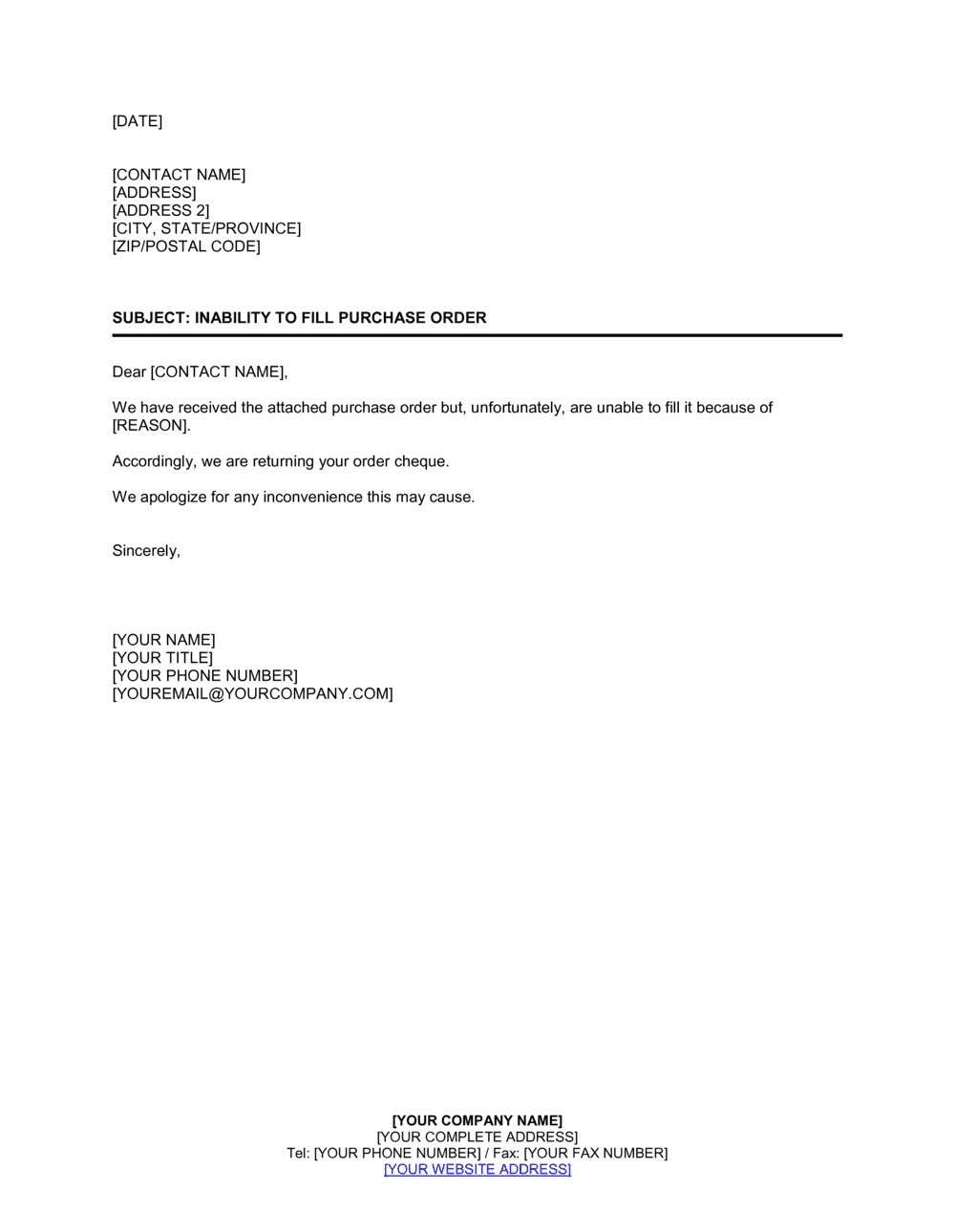
An Inability To Fill Purchase Order is a formal written notice a seller or supplier sends to a buyer to communicate that it cannot fulfill all or part of an accepted purchase order — whether due to stock shortages, supply chain disruptions, force majeure events, or production constraints. This template is a free Word download you can edit online and export as PDF, covering the affected order details, the reason for non-fulfillment, any partial delivery terms, and a proposed resolution or cancellation in a single professional document.
When you need it
Use it as soon as you identify that a confirmed purchase order cannot be fulfilled on time, in full, or at all — before the delivery deadline, so the buyer has time to source alternatives. It is equally applicable for complete inability to fulfill and partial shortfalls that leave the buyer with fewer units than ordered.
What's inside
Identification of the original purchase order by number and date, a clear statement of inability to fulfill with the specific reason, details of any partial shipment or substitute goods available, proposed resolution options including revised delivery dates or cancellation, and signature blocks for both parties to acknowledge receipt and agreed next steps.

What is an Inability To Fill Purchase Order?

An Inability To Fill Purchase Order is a formal written notice issued by a seller or supplier to a buyer when a confirmed purchase order cannot be fulfilled — in whole or in part — due to stock shortages, supply chain disruptions, production failures, force majeure events, or regulatory restrictions. It identifies the specific order affected, documents the reason for non-fulfillment, specifies any partial delivery the seller can make, and presents the buyer with concrete resolution options including a revised delivery date, substitute goods, or cancellation with refund. Unlike an informal email or a verbal apology, this document creates a legally recognized record of notice that can determine liability, trigger force majeure protections, and establish the timeline for the buyer's right to seek alternative supply.

Why You Need This Document

Failing to issue a formal inability notice — or issuing one too late — transforms a routine supply shortage into a breach of contract claim. Under the UCC in the United States and equivalent commercial law in Canada, the UK, and the EU, a seller has a duty to notify the buyer promptly when performance becomes impossible or impractical, and that notification must be specific enough for the buyer to act on it. Without a properly drafted, signed notice delivered before the PO's delivery deadline, the buyer can claim the full cost of sourcing replacement goods from another supplier, plus incidental and consequential damages. For high-value orders or contracts with liquidated damages clauses, that exposure can be substantial. This template gives suppliers a structured, legally sound way to communicate a shortfall, document mitigation efforts, invoke force majeure where applicable, and close out the transaction — protecting both the seller's legal position and the commercial relationship with the buyer.

Which variant fits your situation?

If your situation is…Use this template
Supplier cannot deliver any portion of the orderInability To Fill Purchase Order (Full Cancellation)
Supplier can fulfill part of the order but not the full quantityPartial Purchase Order Fulfillment Notice
Delivery is possible but will be significantly delayedPurchase Order Delivery Delay Notice
Buyer wants to cancel an order the supplier has not yet shippedPurchase Order Cancellation Letter
Force majeure event prevents fulfillment under a supply agreementForce Majeure Notice
Supplier proposes substitute goods in place of ordered itemsSubstitute Goods Offer Letter
Ongoing supply relationship governed by a master agreementSupply Agreement

Common mistakes to avoid

❌ Delivering notice after the delivery deadline has passed

Why it matters: A late notice converts a manageable supply shortage into a formal breach of contract. The buyer loses the ability to source alternatives in time and can claim the full cost of cover — what they paid to obtain replacement goods elsewhere.

Fix: Send the notice as soon as you have reasonable certainty of the shortfall — even if you are still confirming quantities. A preliminary notice followed by a confirmed notice is always better than a single late notice.

❌ Using vague or hedging language instead of a clear declaration

Why it matters: Phrases like 'we may be unable to fulfill' or 'we anticipate some difficulty' do not constitute legal notice of inability to perform. The buyer cannot act on ambiguity, and courts have found that unclear notices do not trigger force majeure protections.

Fix: State the inability in direct, unambiguous terms: 'Seller is unable to fulfill [all / [X] units of] Purchase Order No. [NUMBER].' Specify the exact affected quantity and item.

❌ Failing to document mitigation efforts

Why it matters: In most common-law and civil-law jurisdictions, a seller who made no demonstrable effort to reduce the buyer's loss cannot rely on supply chain disruption or force majeure as a full defense. Courts reduce or deny damage claims where mitigation was inadequate.

Fix: Include a specific paragraph describing at least two concrete steps taken to mitigate — contacting alternative suppliers, expediting available inventory, or securing substitute goods — with dates and outcomes.

❌ Offering resolution options without a response deadline

Why it matters: Without a deadline, the buyer's silence can be interpreted as either acceptance of the delay or an open dispute, leaving both parties in contractual uncertainty indefinitely and preventing the seller from closing out the order.

Fix: Always include a firm deadline — typically 3–10 business days depending on the buyer's urgency — and state the default action if no response is received within that period.

❌ Not referencing the governing law or underlying contract

Why it matters: A notice that does not specify the governing legal framework creates ambiguity about which jurisdiction's rules on force majeure, notice, and remedies apply — especially in cross-border transactions where parties are in different countries.

Fix: Include a governing law clause that matches the jurisdiction stated in the original purchase order or master supply agreement, and reference the relevant contract by name and date.

❌ Sending the notice to the wrong contact

Why it matters: A notice sent to a project manager or sales contact instead of the buyer's legal or procurement department may not constitute valid legal delivery, restarting the clock on the buyer's remedies and exposing the seller to a breach claim.

Fix: Direct the notice to the named contact specified in the purchase order's terms, or to the buyer's accounts-payable or procurement department if no contact is specified. Use a delivery method that generates a timestamped receipt.

The 10 key clauses, explained

Parties and Purchase Order Identification

In plain language: Identifies the seller and buyer by full legal name and references the specific purchase order being addressed by its number, date, and total value.

Sample language
This notice is issued by [SELLER LEGAL NAME] ('Seller') to [BUYER LEGAL NAME] ('Buyer') regarding Purchase Order No. [PO NUMBER], dated [PO DATE], in the amount of [TOTAL VALUE] ('Order').

Common mistake: Referencing only the PO number without the date or value — creating ambiguity when the buyer holds multiple open orders from the same supplier, which delays their ability to act.

Statement of Inability to Fulfill

In plain language: A clear, unambiguous declaration that the seller is unable to fulfill all or a specified portion of the order, including the quantity affected and the expected shortfall.

Sample language
Seller regrets to inform Buyer that it is unable to fulfill [ALL / [QUANTITY] units of] the Order. The shortfall affects the following items: [ITEM DESCRIPTION], SKU [NUMBER], Qty [X] of [Y] ordered.

Common mistake: Using vague language like 'we may have difficulties fulfilling your order.' Ambiguous phrasing does not constitute proper legal notice and may not trigger the buyer's right to source alternatives or claim damages.

Reason for Non-Fulfillment

In plain language: States the specific cause of the inability to fulfill — supply shortage, production failure, force majeure, transportation disruption, or regulatory restriction — to establish context and, where applicable, legal excuse.

Sample language
The inability to fulfill the Order is due to [SPECIFIC REASON — e.g., an unexpected shortage of [RAW MATERIAL] from Seller's primary supplier / a force majeure event constituting [DESCRIPTION] affecting Seller's [FACILITY/REGION] since [DATE]].

Common mistake: Omitting the reason entirely to avoid embarrassment. Courts and buyers treat an unexplained failure to deliver more harshly than a documented force majeure or supply chain event, and the omission waives potential defenses.

Partial Fulfillment or Available Quantity

In plain language: Specifies what, if anything, the seller can deliver — the quantity available, the items available, and the proposed revised shipment date for any partial delivery.

Sample language
Seller is able to fulfill a partial delivery of [AVAILABLE QUANTITY] units of [ITEM] on or before [REVISED DATE]. The remaining [SHORTFALL QUANTITY] units cannot be delivered due to the reason stated above.

Common mistake: Leaving the partial quantity vague or expressing it as a range. A range — 'approximately 500–600 units' — shifts the loss planning burden onto the buyer and may constitute a new offer rather than performance of the existing order.

Proposed Resolution and Options

In plain language: Presents the buyer with specific resolution paths — accept partial delivery, wait for a restocked full delivery on a revised date, accept substitute goods, or cancel the order — and requests a written election within a defined deadline.

Sample language
Seller proposes the following options for Buyer's election within [X] business days: (a) accept partial delivery of [QUANTITY] units on [DATE]; (b) defer full delivery to [REVISED DATE]; (c) accept substitute goods described in Schedule A; or (d) cancel the Order and receive a full refund of any amounts paid.

Common mistake: Offering resolution options without a response deadline. Without a deadline, the buyer's silence can be interpreted as acceptance of the delay, leaving the seller in contractual limbo with no clear path to close the matter.

Effect on Price and Payment

In plain language: Addresses how the pricing of the original PO applies to a partial delivery or substitute goods, and clarifies refund obligations if the order is cancelled.

Sample language
In the event of partial delivery, Buyer shall be invoiced only for the quantity actually shipped at the per-unit price in the Order. In the event of cancellation, Seller shall refund all amounts paid by Buyer within [X] business days of written cancellation notice.

Common mistake: Failing to address what happens to pre-payments or deposits in a cancellation scenario. Leaving this undefined triggers disputes over refund timing and the seller's right to offset restocking or production costs.

Mitigation Efforts

In plain language: Documents the steps the seller has taken or is taking to mitigate the impact — sourcing alternative suppliers, expediting production, or securing substitute materials — demonstrating good faith and reducing damages exposure.

Sample language
Seller has taken the following steps to mitigate the shortfall: [DESCRIPTION OF MITIGATION STEPS, e.g., engaged alternative supplier [NAME] to source [QUANTITY] units, with an estimated arrival date of [DATE]].

Common mistake: Omitting the mitigation clause entirely. In most jurisdictions, a seller who made no documented effort to reduce the buyer's losses cannot rely on force majeure or supply chain disruption as a full defense against a breach of contract claim.

Force Majeure Declaration (Conditional)

In plain language: If the non-fulfillment results from a qualifying force majeure event, formally invokes the force majeure clause in the underlying contract or governing law, identifying the event, the date it arose, and its expected duration.

Sample language
Seller hereby invokes the force majeure provision of [CONTRACT NAME / governing law] on the grounds that [EVENT DESCRIPTION], which began on [DATE] and is expected to continue until approximately [DATE], constitutes an event beyond Seller's reasonable control that has made performance impossible.

Common mistake: Invoking force majeure without referencing the specific event's start date and expected duration. Courts require that force majeure be tied to a concrete, time-bound event — a general reference to 'supply chain issues' rarely qualifies.

Reservation of Rights

In plain language: Preserves both parties' legal rights under the original purchase order and applicable law, confirming that the notice itself does not constitute a waiver of any rights or remedies.

Sample language
This notice is issued without prejudice to either party's rights under the Order and applicable law. Nothing herein shall be construed as a waiver of Seller's or Buyer's rights or remedies with respect to the Order or any related agreement.

Common mistake: Omitting the reservation of rights clause, which can allow the opposing party to argue that the notice constitutes an admission of liability or a waiver of contractual protections.

Governing Law and Contact for Response

In plain language: Specifies the jurisdiction whose law governs the notice and the underlying order, and designates a named contact and response method for the buyer to communicate their election.

Sample language
This notice is governed by the laws of [STATE / PROVINCE / COUNTRY]. Buyer shall direct its response to [CONTACT NAME], [TITLE], at [EMAIL / ADDRESS] within [X] business days of receipt of this notice.

Common mistake: Providing only a general company email address for buyer responses. A named individual and a deadline ensure accountability — a generic inbox response can be lost or delayed, destroying the audit trail.

How to fill it out

  1. 1

    Identify the parties and the specific purchase order

    Enter both parties' full legal entity names and the exact purchase order number, date, and total value. Cross-reference your order management system to ensure the PO number matches the buyer's records exactly.

    💡 If the buyer uses a different internal PO reference than the one you received, include both numbers in this section to prevent any matching confusion on their end.

  2. 2

    State clearly whether fulfillment is fully or partially impossible

    Choose unambiguous language: either you cannot deliver any portion of the order, or you can deliver a specific quantity but not the full amount. List affected line items by SKU, description, and quantity.

    💡 Never use hedging language like 'we anticipate difficulty' — this does not constitute formal notice and may not start the clock on the buyer's right to source alternatives.

  3. 3

    Document the specific reason for non-fulfillment

    Describe the cause in factual, specific terms — a named supplier's failure, a flood at a specific warehouse, a regulatory export restriction. If invoking force majeure, state the event name, date it arose, and its expected duration.

    💡 Attach supporting documentation — a supplier's written notice, a government order, or a logistics carrier's disruption report — as a schedule to the notice. It strengthens any force majeure defense significantly.

  4. 4

    Specify any partial fulfillment quantity and revised timeline

    If you can deliver some of the order, state the exact quantity available and the specific date you can ship it. Do not use ranges or approximations.

    💡 Confirm available inventory with your warehouse team before inserting partial delivery figures — revising this number downward in a follow-up notice damages your credibility.

  5. 5

    Present resolution options with a response deadline

    List each option available to the buyer — partial delivery, revised full delivery date, substitute goods, or cancellation with refund — and set a firm response deadline of 3–10 business days depending on the buyer's urgency.

    💡 If the underlying contract specifies a notice-and-cure period, set your response deadline to fall within that window so the buyer's election occurs before any cure period expires.

  6. 6

    Address price, payment, and refund terms

    Confirm that partial deliveries will be invoiced only for quantities shipped at the original unit price, and specify the refund timeline for any prepaid amounts if the order is cancelled.

    💡 State the refund timeline as a specific number of business days — 'promptly' is not enforceable and invites disputes.

  7. 7

    Sign and deliver before the original delivery deadline

    Have an authorized signatory execute the notice and send it to the buyer's designated procurement or accounts-payable contact via tracked email or courier before the PO's delivery date passes.

    💡 Send via a method that generates a delivery receipt — email with read-receipt request or a courier with proof of delivery. The timestamp of delivery is critical if a breach-of-contract dispute arises.

  8. 8

    Retain a countersigned copy of the buyer's election

    Request that the buyer sign and return the notice indicating their elected resolution option. File the countersigned copy alongside the original PO in your contract management system.

    💡 If the buyer does not respond by the deadline, send a written follow-up confirming that their silence does not constitute acceptance of any option — and state what action you will take if no response is received.

Frequently asked questions

What is an inability to fill purchase order notice?

An inability to fill purchase order notice is a formal written document a seller sends to a buyer to communicate that it cannot fulfill all or part of a confirmed purchase order. It identifies the specific order affected, states the reason for non-fulfillment, describes any partial delivery available, and offers the buyer resolution options such as a revised delivery date, substitute goods, or order cancellation with refund. Issuing this notice promptly is both a commercial courtesy and a legal obligation in most supply relationships.

Is a seller legally required to notify a buyer when it cannot fill a purchase order?

In most jurisdictions, yes — once a purchase order is accepted, it creates a binding contract to deliver. The seller has a duty to notify the buyer as soon as it becomes aware of an inability to perform, both under general contract law and, in common-law countries, under the duty to mitigate. In the US, the UCC Section 2-610 governs anticipatory repudiation; in Canada and the UK, common law imposes similar notice obligations. Failing to notify promptly can convert a supply shortage into a breach of contract claim with damages covering the buyer's cost of sourcing replacement goods.

Does an inability to fill purchase order notice constitute a breach of contract?

Not automatically. Issuing a properly drafted notice — especially one that invokes a valid force majeure clause or documents a qualifying supply-chain disruption — may excuse the seller from liability for non-performance under the applicable contract or governing law. However, if no force majeure or other legal excuse applies, the notice is effectively an anticipatory breach notice, which entitles the buyer to seek remedies including cover damages. The notice itself does not create liability; the underlying inability to perform does.

What should I do if a supplier sends me an inability to fill purchase order notice?

Review the notice immediately against your original PO terms and the supplier's stated reason for non-fulfillment. Determine whether the reason qualifies as force majeure under your contract. Respond in writing within the deadline specified in the notice, electing one of the offered resolution options — partial delivery, revised date, substitute goods, or cancellation. If the shortfall will cause significant operational or financial harm, consult a lawyer before accepting any proposed resolution, as acceptance may limit your right to claim damages.

Can a seller cancel a purchase order by issuing this notice?

A seller cannot unilaterally cancel a binding purchase order simply by issuing this notice. The notice communicates the inability to perform and offers the buyer resolution options — including cancellation — but the buyer must elect cancellation for it to take effect. If the buyer rejects all options and insists on full performance, the seller faces a breach of contract claim unless a valid legal excuse such as force majeure applies. In that scenario, legal advice is strongly recommended.

What is force majeure and does it apply to purchase order shortfalls?

Force majeure is a contractual or statutory provision that excuses a party from performance when an unforeseeable event beyond their control makes fulfillment impossible or impractical — natural disasters, pandemics, wars, and government-imposed restrictions are common examples. Whether it applies to a specific purchase order shortfall depends on the exact language of the force majeure clause in the underlying contract and the nature of the event. A general supply shortage, price increase, or labor dispute typically does not qualify unless the contract expressly includes it. Courts apply a strict standard: the event must have been unforeseeable and must have actually prevented — not merely made more expensive — performance.

Does the notice need to be signed by both parties?

The seller must sign the notice as the issuing party. Obtaining the buyer's countersignature confirming receipt and their elected resolution option is not legally required in all jurisdictions, but it is strongly recommended. A countersigned notice creates an unambiguous record of the buyer's election — whether they accepted partial delivery, agreed to a revised date, or elected cancellation — which prevents subsequent disputes about what was agreed. Without it, the seller has only one-sided documentation of the resolution.

How is this notice different from a purchase order cancellation letter?

A purchase order cancellation letter is typically issued by the buyer to cancel an order before the seller ships. An inability to fill purchase order notice is issued by the seller to inform the buyer that it cannot perform and to offer resolution options, one of which may be cancellation. The direction of the communication and the initiating party are opposite. A seller-initiated notice that offers only cancellation with no alternatives is closer to a unilateral cancellation and carries greater breach-of-contract risk than a notice that presents multiple resolution options.

What damages can a buyer claim if a seller fails to fill a purchase order?

Under the UCC in the US, a buyer whose seller fails to deliver can claim cover damages — the difference between the original contract price and the cost of purchasing equivalent goods from another supplier. The buyer can also claim incidental and consequential damages such as storage costs, lost profits from downstream sales, and expedited shipping costs, provided they are foreseeable. In Canada and the UK, common-law damages follow similar principles. A prompt, properly drafted notice that documents force majeure or other legal excuse significantly reduces the seller's exposure to these claims.

How this compares to alternatives

vs Purchase Order Cancellation Letter

A purchase order cancellation letter is issued by the buyer to cancel an order before delivery occurs. An inability to fill notice is issued by the seller to inform the buyer that it cannot perform. The parties and the triggering circumstances are different. A seller who issues a unilateral cancellation without using a proper inability notice exposes itself to greater breach-of-contract liability than one that documents the reason for non-fulfillment and offers resolution options.

vs Purchase Order

A purchase order is the buyer's original authorization to a supplier to deliver goods at agreed terms. The inability to fill notice is the seller's formal response when those terms cannot be met. The PO creates the obligation; the inability notice addresses what happens when that obligation cannot be performed. Both documents should be cross-referenced by PO number in any dispute or audit.

vs Force Majeure Notice

A force majeure notice specifically invokes a contractual or statutory force majeure clause to excuse non-performance due to an extraordinary event outside the party's control. An inability to fill purchase order notice is broader — it applies whether or not force majeure is the cause, and it encompasses supply shortages, production failures, and partial fulfillment scenarios that do not qualify as force majeure. Use a force majeure notice when the event clearly meets the legal threshold; use the inability notice for all other supply shortfall situations.

vs Backorder Notification

A backorder notification is a less formal communication — often automated — informing a buyer that ordered goods are temporarily out of stock with an expected restock date. It is typically used in consumer retail and does not carry the legal weight of a formal inability notice. For B2B purchase orders governed by a contract or the UCC, a properly signed inability notice is required to establish legal notice, document the reason for non-fulfillment, and preserve the seller's defenses.

Industry-specific considerations

Manufacturing

Raw material shortages, production line shutdowns, and capacity constraints make this notice a standard operational document in manufacturing supply chains, where upstream delays cascade quickly into downstream delivery failures.

Wholesale and Distribution

Distributors holding inventory for multiple retail clients frequently face allocation shortfalls during peak demand seasons, making a clear, documented inability notice essential for managing multiple buyer relationships simultaneously.

Retail and E-commerce

E-commerce sellers and retailers sourcing from overseas suppliers regularly encounter shipment delays, customs holds, and stock-out situations where a formal notice to B2B buyers protects against chargebacks, contract penalties, and reputational damage.

Construction and Building Materials

Materials suppliers to construction projects face strict delivery windows tied to project milestones; an inability notice issued promptly can trigger a project timeline adjustment rather than a liquidated damages claim under the construction contract.

Food and Beverage

Perishable goods and seasonal crop shortfalls mean inability notices in food supply are time-critical, often requiring same-day or next-day delivery to allow buyers to source alternatives before shelf-life or production deadlines are missed.

Technology and Electronics

Semiconductor shortages and single-source component dependencies make inability notices routine in electronics supply chains, where a single unfulfilled PO can halt an entire product assembly line and trigger downstream customer delivery penalties.

Jurisdictional notes

United States

Under UCC Article 2, a seller who cannot perform must notify the buyer seasonably — meaning with enough lead time for the buyer to source substitute goods. UCC Section 2-615 provides a commercial impracticability defense when unforeseen conditions make performance impractical, but courts apply this narrowly. State-level variations exist; California and New York courts have been particularly strict about what qualifies as impracticability.

Canada

Canadian contract law follows common-law principles of anticipatory breach and frustration of contract. The doctrine of frustration may excuse performance when an unforeseen event makes the contract impossible to perform, but a mere increase in cost or supply difficulty does not typically qualify. Quebec's Civil Code applies different rules for impossibility of performance, and French-language notices may be required for contracts governed by Quebec law.

United Kingdom

Under the Sale of Goods Act 1979 and common law, a UK seller who cannot deliver must notify the buyer promptly. The doctrine of frustration may excuse performance in extreme cases, but courts apply it strictly. Post-Brexit, supply chain disruptions related to EU-UK trade may not automatically qualify as force majeure unless the underlying contract explicitly includes Brexit-related events. Electronic signatures are valid on commercial notices under the Electronic Communications Act 2000.

European Union

EU member states generally follow CISG (UN Convention on Contracts for the International Sale of Goods) for cross-border commercial sales, which requires prompt notice of inability to perform under Article 79. Member state domestic law varies: German law under the BGB imposes strict notification obligations, while French law under the Code Civil provides for force majeure when the event is unforeseeable, irresistible, and external. GDPR considerations apply if the notice includes personal contact data about procurement personnel.

Template vs lawyer — what fits your deal?

PathBest forCostTime
Use the templateSuppliers issuing standard inability notices for routine stock shortages or backorders under straightforward B2B purchase ordersFree15–30 minutes per notice
Template + legal reviewCross-border transactions, high-value orders, or situations where force majeure is being invoked for the first time$300–$800 for a commercial lawyer review1–2 business days
Custom draftedComplex multi-party supply chains, orders with liquidated damages clauses, or situations where litigation is a realistic outcome$1,000–$3,500+3–7 business days

Glossary

Purchase Order (PO)
A buyer-issued commercial document authorizing a supplier to deliver specified goods or services at an agreed price, quantity, and date.
Force Majeure
A contractual clause excusing a party from performance obligations when an unforeseeable event beyond their control — such as a natural disaster, pandemic, or war — makes fulfillment impossible.
Partial Fulfillment
Delivery of fewer units or a lesser quantity than specified in the original purchase order, with the shortfall acknowledged in writing.
Backorder
A confirmed order for goods that are temporarily out of stock, with fulfillment deferred to a future date when supply is restored.
Mitigation Obligation
A party's legal duty to take reasonable steps to reduce the losses caused by its own inability to perform — for example, sourcing substitute goods or offering a partial shipment.
Anticipatory Breach
When one party notifies the other — before the performance due date — that it will not fulfill its contractual obligations, allowing the non-breaching party to seek remedies immediately.
Substitute Goods
Equivalent or comparable products offered by the seller in place of the originally ordered items when the specified goods are unavailable.
Acceptance
The buyer's written or implied agreement to receive a partial shipment, revised delivery date, or substitute goods in satisfaction of the original purchase order.
Liquidated Damages
A pre-agreed sum specified in a contract that one party must pay the other if a defined breach — such as failure to deliver by a specified date — occurs.
Governing Law
The jurisdiction whose legal rules apply to interpret and enforce the notice and the underlying purchase order in the event of a dispute.

Part of your Business Operating System

This document is one of 3,000+ business & legal templates included in Business in a Box.

  • Fill-in-the-blanks — ready in minutes
  • 100% customizable Word document
  • Compatible with all office suites
  • Export to PDF and share electronically

Create your document in 3 simple steps.

From template to signed document — all inside one Business Operating System.
1
Download or open template

Access over 3,000+ business and legal templates for any business task, project or initiative.

2
Edit and fill in the blanks with AI

Customize your ready-made business document template and save it in the cloud.

3
Save, Share, Send, Sign

Share your files and folders with your team. Create a space of seamless collaboration.

Save time, save money, and create top-quality documents.

★★★★★

"Fantastic value! I'm not sure how I'd do without it. It's worth its weight in gold and paid back for itself many times."

Managing Director · Mall Farm
Robert Whalley
Managing Director, Mall Farm Proprietary Limited
★★★★★

"I have been using Business in a Box for years. It has been the most useful source of templates I have encountered. I recommend it to anyone."

Business Owner · 4+ years
Dr Michael John Freestone
Business Owner
★★★★★

"It has been a life saver so many times I have lost count. Business in a Box has saved me so much time and as you know, time is money."

Owner · Upstate Web
David G. Moore Jr.
Owner, Upstate Web

Run your business with a system — not scattered tools

Stop downloading documents. Start operating with clarity. Business in a Box gives you the Business Operating System used by over 250,000 companies worldwide to structure, run, and grow their business.

Start free · No credit card required