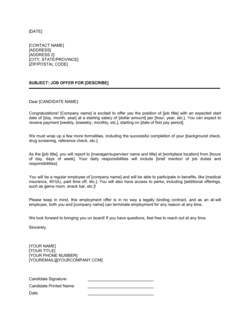
Registered Nurse Job Description Template

Free Word download • Edit online • Save & share with Drive • Export to PDF

2 pages20–30 min to fillDifficulty: StandardSignature requiredLegal review recommended
Learn more ↓
FreeRegistered Nurse Job Description Template

At a glance

What it is
A Registered Nurse Job Description is a formal binding document used by healthcare employers to define the duties, qualifications, licensure requirements, reporting structure, and employment conditions for a Registered Nurse (RN) role. This free Word download gives you a professionally structured template you can edit online and export as PDF for use in recruitment postings, onboarding packages, and regulatory compliance files.
When you need it
Use it when hiring a new RN, updating an existing role to reflect regulatory changes or expanded scope of practice, or documenting role expectations ahead of a performance review or disciplinary process.
What's inside
Position summary, clinical duties and responsibilities, required qualifications and licensure, physical demands, reporting structure, working hours and schedule, compensation and benefits overview, and compliance and credentialing requirements.

What is a Registered Nurse Job Description?

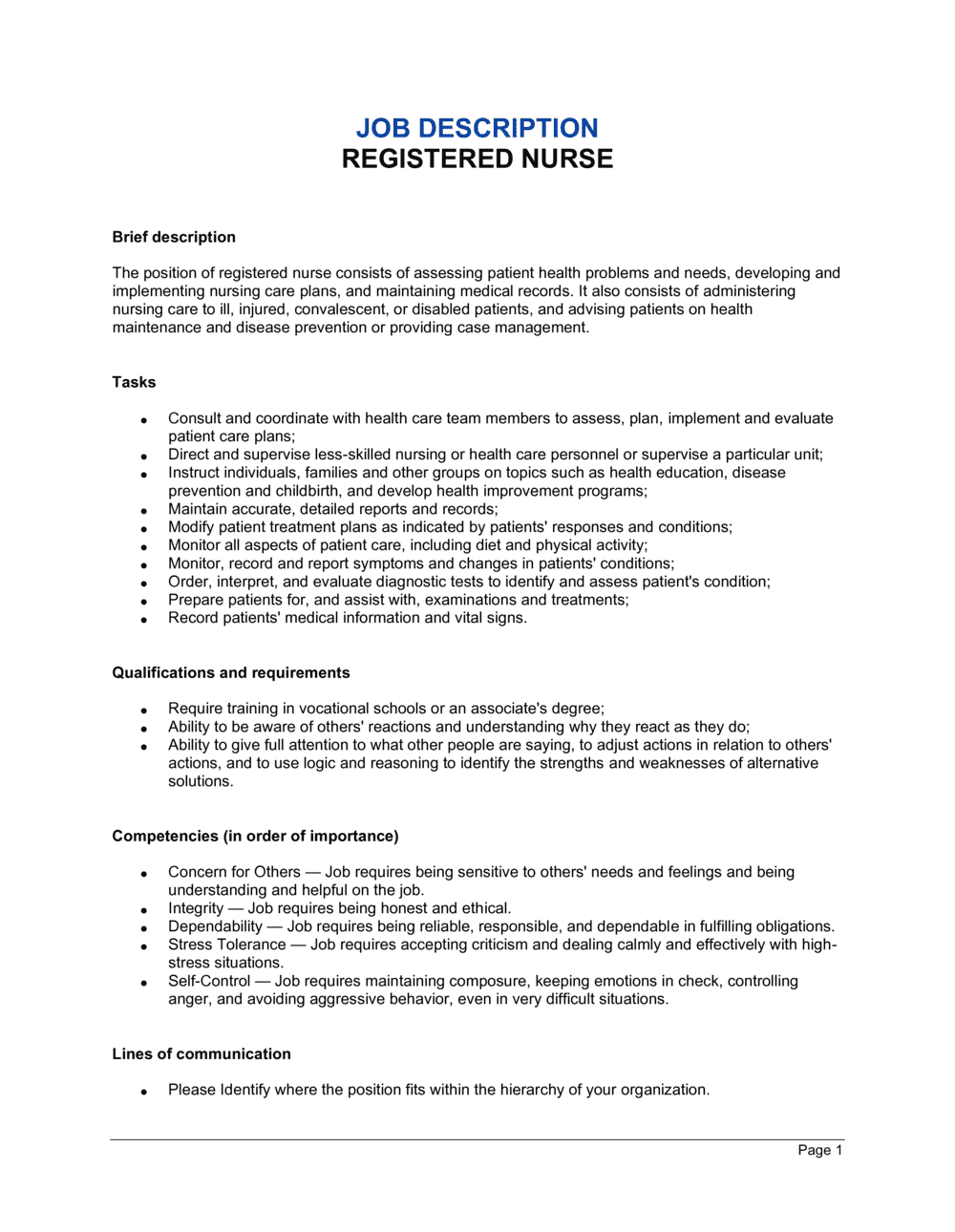
A Registered Nurse Job Description is a formal binding document that defines the clinical duties, licensure requirements, education and experience qualifications, reporting structure, physical demands, and regulatory compliance obligations for a Registered Nurse position at a specific healthcare facility or practice setting. Unlike a general-purpose offer letter, a signed RN job description creates enforceable, role-specific obligations on both the employer and the nurse — documenting scope of practice, credentialing requirements, and compliance duties in terms that satisfy CMS Conditions of Participation, Joint Commission standards, and state nursing board requirements. This free Word download is structured for hospital, clinic, long-term care, and telehealth settings and can be edited online and exported as PDF for inclusion in offer packages, personnel files, and accreditation documentation.

Why You Need This Document

Healthcare employers that rely on a generic offer letter or verbal role description face four compounding risks simultaneously. First, without a unit-specific written job description, scope-of-practice disputes — a nurse performing tasks outside their competency or licensure level — are nearly impossible to substantiate in a disciplinary or termination proceeding. Second, CMS-certified facilities are required to maintain written job descriptions for all clinical staff as a Condition of Participation; missing or outdated descriptions are cited as deficiencies during surveys and can jeopardize Medicare and Medicaid reimbursement. Third, if a nurse's license is restricted and no self-reporting clause exists in the job description, the employer may not learn of the restriction until a patient harm event occurs — at which point liability for negligent retention attaches. Fourth, facilities operating across state lines or in telehealth settings that do not specify compact license requirements risk unknowingly employing nurses who are not licensed to practice in the states where care is being delivered. A properly executed RN job description, signed before the first clinical shift, closes all four gaps and provides the documented foundation that HR, legal, and accreditation functions all depend on.

Which variant fits your situation?

If your situation is…Use this template
Hiring an RN for a general acute care inpatient unitRegistered Nurse Job Description (Hospital)
Hiring a nurse practitioner with prescriptive authorityNurse Practitioner Job Description
Placing a temporary or travel nurse through an agencyTravel Nurse Assignment Agreement
Hiring a licensed practical nurse for a lower-acuity roleLicensed Practical Nurse Job Description
Defining duties for a charge nurse with supervisory responsibilitiesCharge Nurse Job Description
Documenting a director of nursing or CNO roleDirector of Nursing Job Description
Onboarding a per-diem or PRN nurse with variable schedulingPer-Diem Employment Agreement

Common mistakes to avoid

❌ Using a generic job description across all nursing units

Why it matters: An ICU RN and a post-partum RN have materially different scopes of practice, certification requirements, and patient ratios. A one-size-fits-all description cannot support unit-specific performance management or credentialing reviews and may misrepresent scope of practice to a licensing board.

Fix: Create a unit-specific version for each care setting — at minimum, customize the clinical duties, required certifications, and patient ratio language for each unit type.

❌ Failing to specify which states' licenses are accepted

Why it matters: As telehealth and travel nursing expand, candidates increasingly hold licenses in states other than where they will practice. An employer that accepts a non-compact license for a role in a non-compact state may unknowingly hire an unlicensed practitioner.

Fix: State explicitly whether a compact license is accepted and, if so, which states satisfy the requirement. For telehealth roles, list every state in which the nurse will provide care.

❌ Omitting mandatory overtime restrictions

Why it matters: States including California, New York, Minnesota, Oregon, and Illinois restrict or prohibit mandatory overtime for nurses. A job description that reserves mandatory overtime rights without jurisdiction-specific carve-outs exposes the employer to labor board complaints and fines.

Fix: Add a jurisdiction-specific note: 'Mandatory overtime obligations are subject to applicable state law. In states where mandatory nurse overtime is restricted, this provision applies only to the extent permitted by law.'

❌ Not requiring self-reporting of license encumbrances

Why it matters: If a nurse's license is suspended or restricted and the employer is unaware, any patient harm event during that period generates compounded liability — CMS deficiency citations, accreditation jeopardy, and potential negligent-retention claims.

Fix: Include an explicit self-reporting clause requiring the employee to notify HR within 48 hours of any license investigation, restriction, suspension, or criminal charge.

❌ Collecting the acknowledgment signature after the first shift

Why it matters: Under common law, a post-start signature requires fresh consideration to be enforceable. Compliance and scope-of-practice clauses signed on day two or later may be unenforceable, removing the employer's clearest defense in a scope-creep or policy-violation dispute.

Fix: Route the job description to the new hire with the offer letter and require a countersigned copy as a condition of starting the first clinical shift.

❌ Requiring a BSN without documenting the job-related justification

Why it matters: A BSN requirement that is not operationally necessary for the specific role may constitute a disparate-impact violation under Title VII if it disproportionately screens out protected classes without being demonstrably job-related.

Fix: Document in your HR files why a BSN is required for the specific role — if an ADN is operationally sufficient, list BSN as preferred rather than required and reserve the mandatory designation for roles where research consistently demonstrates a patient-outcome link.

The 9 key clauses, explained

Position identification and summary

In plain language: States the job title, department, facility, employment type (full-time, part-time, PRN), shift, and a two-to-three sentence summary of the role's primary purpose.

Sample language
Position: Registered Nurse | Department: [UNIT NAME] | Facility: [FACILITY NAME] | Employment Type: [FULL-TIME / PART-TIME / PRN] | Shift: [DAY / EVENING / NIGHT / ROTATING]. The Registered Nurse is responsible for delivering direct patient care, coordinating interdisciplinary care plans, and maintaining compliance with all applicable clinical and regulatory standards.

Common mistake: Omitting the specific unit or department. A generic 'hospital nurse' description fails to define scope of practice for the role, creating ambiguity during performance management and credentialing reviews.

Clinical duties and responsibilities

In plain language: An enumerated list of the nurse's core clinical tasks — patient assessment, medication administration, care plan development, documentation, and interdisciplinary coordination.

Sample language
Duties include: (a) conducting comprehensive patient assessments on admission and as clinically indicated; (b) administering medications per physician orders in compliance with [FACILITY] medication administration policy; (c) developing, implementing, and updating individualized care plans; (d) documenting all patient interactions in [EHR SYSTEM NAME] in accordance with CMS and [STATE] documentation standards.

Common mistake: Listing tasks at such a high level ('provide patient care') that the description cannot support a performance improvement plan or justify a disciplinary action when a specific duty is not performed.

Licensure and certification requirements

In plain language: States the specific active licenses and certifications the nurse must hold as a condition of employment, including the governing jurisdiction and any renewal obligations.

Sample language
Required: Active, unrestricted RN license in the State of [STATE], or a valid Compact Nursing License with [STATE] as primary or secondary state. BLS certification (AHA) required upon hire. ACLS certification required within [90] days of hire. [SPECIALTY CERTIFICATION, e.g., CCRN] preferred.

Common mistake: Not specifying whether a compact license is accepted. Telehealth employers and staffing agencies that omit this create compliance exposure when a nurse holds only their home-state license.

Education and experience qualifications

In plain language: Defines the minimum academic credential (ADN, BSN, MSN) and years of clinical experience required for the role, and distinguishes required from preferred qualifications.

Sample language
Required: Associate Degree in Nursing (ADN) or Bachelor of Science in Nursing (BSN) from an accredited program. Minimum [X] year(s) of clinical nursing experience in [SPECIALTY / SETTING]. Preferred: BSN or higher; [RELEVANT SPECIALTY EXPERIENCE].

Common mistake: Requiring a BSN as mandatory when only an ADN is operationally necessary. This artificially narrows the candidate pool and may constitute disparate-impact discrimination if the requirement is not job-related in the specific setting.

Reporting structure and supervision

In plain language: Identifies who the RN reports to directly, what supervisory responsibilities (if any) the RN holds over LPNs or CNAs, and the chain of command for clinical escalation.

Sample language
The Registered Nurse reports directly to the [CHARGE NURSE / NURSE MANAGER / DIRECTOR OF NURSING]. The RN may supervise Licensed Practical Nurses and Certified Nursing Assistants assigned to the same patient care team. Clinical escalation follows the chain of command as defined in [FACILITY] Policy [POLICY NUMBER].

Common mistake: Leaving the supervisory scope undefined for roles that include delegation authority over LPNs or CNAs. This creates liability exposure if an RN improperly delegates a task outside an LPN's scope.

Working hours, scheduling, and on-call obligations

In plain language: States the standard shift length, the scheduling pattern (fixed vs. rotating), any on-call requirements, and whether mandatory overtime may be required.

Sample language
Standard shift: [8 / 10 / 12] hours. Schedule: [FIXED / ROTATING / FLEXIBLE]. The employee may be required to participate in the on-call rotation on a [FREQUENCY] basis. Mandatory overtime may be required in accordance with [STATE] law and [FACILITY] staffing policy. Pre-approved overtime rates apply per the compensation schedule.

Common mistake: Omitting mandatory overtime language in states where it is regulated. Several states — California, New York, and Minnesota among them — restrict or prohibit mandatory overtime for nurses; a blanket mandatory-overtime clause may be unenforceable and expose the employer to regulatory penalties.

Physical and environmental demands

In plain language: Documents the physical requirements of the role — lifting, standing, and exposure to pathogens or hazardous materials — to support ADA compliance and workers' compensation administration.

Sample language
The role requires the ability to: stand and walk for up to [X] hours per shift; lift and reposition patients weighing up to [50] lbs with or without assistance; and work in environments that may involve exposure to bloodborne pathogens, infectious disease, and hazardous materials in accordance with OSHA standards.

Common mistake: Omitting the physical demands section entirely. Without documented physical requirements, accommodations under the ADA become harder to evaluate consistently, and workers' compensation claims are more difficult to adjudicate.

Compliance and regulatory obligations

In plain language: Requires the employee to maintain current licensure, complete mandatory training, adhere to HIPAA, comply with CMS conditions of participation, and meet any accreditation body standards applicable to the facility.

Sample language
The Registered Nurse shall at all times: (a) maintain an active, unrestricted RN license in [STATE]; (b) complete all mandatory annual training including HIPAA, infection control, and facility safety programs; (c) comply with all applicable CMS Conditions of Participation and [ACCREDITATION BODY, e.g., TJC] standards; and (d) report any license encumbrance, criminal charge, or adverse action to [HR CONTACT] within [48] hours of occurrence.

Common mistake: Not requiring the employee to self-report license encumbrances promptly. Employers that are unaware of a nurse's disciplinary action or license restriction face CMS deficiency citations and liability if a patient harm event occurs.

Acknowledgment and signature block

In plain language: A mutual acknowledgment that both parties have read, understood, and agreed to the terms of the job description, signed and dated before the employee's first clinical shift.

Sample language
I, [EMPLOYEE FULL NAME], acknowledge that I have received, read, and understood this job description and agree to perform the duties and meet the requirements described herein. Signature: _______________ Date: [DATE]. Supervisor Signature: _______________ Title: [TITLE] Date: [DATE].

Common mistake: Collecting the employee's signature after their first shift rather than before it begins. Post-start signatures create a 'fresh consideration' problem under common law and may undermine enforceability of scope-of-practice and compliance clauses.

How to fill it out

  1. 1

    Enter the facility and unit details

    Fill in the facility's full legal name, the specific unit or department (e.g., Medical-Surgical, ICU, ED), and the facility address. This anchors scope-of-practice and regulatory citations to the correct jurisdiction and care setting.

    💡 Use the exact entity name that appears on your CMS certification and state operating license — not a trade name or brand.

  2. 2

    Define the employment type and shift pattern

    Select full-time, part-time, or PRN and specify the standard shift length (8, 10, or 12 hours) and rotation pattern. If the role is eligible for a specific shift differential, note it here so it is part of the written offer.

    💡 Specifying the shift pattern in the job description — not just the offer letter — gives you a documented basis for scheduling disputes.

  3. 3

    List clinical duties with measurable specificity

    Write each duty as a verb-led statement specific enough to support performance evaluation: 'Administer medications per physician orders' rather than 'provide patient care.' Aim for 10–15 enumerated duties covering assessment, administration, documentation, coordination, and patient education.

    💡 Review your most recent CMS survey findings or Joint Commission action plans — duties tied to past deficiencies should appear explicitly in the list.

  4. 4

    State licensure and certification requirements precisely

    Specify the required license type, the issuing jurisdiction, and whether a compact license is accepted. List each required certification (BLS, ACLS, PALS, NIH Stroke Scale) with the issuing body and any grace period for post-hire attainment.

    💡 Cross-reference your facility's credentialing policy before finalizing — the job description and credentialing checklist must match exactly.

  5. 5

    Set education and experience thresholds

    Distinguish required from preferred credentials. State the minimum degree (ADN or BSN) and the number of years of experience required in the specific care setting. If the role qualifies as a 'new graduate' position, note that zero experience is acceptable.

    💡 If you require a BSN, confirm with HR that this requirement is documented as job-related for the specific role to withstand a disparate-impact challenge.

  6. 6

    Document physical demands and environmental conditions

    List the specific physical requirements — standing hours, lift weight limits, exposure categories — using OSHA and ADA-consistent language. This section protects the facility in workers' compensation and accommodation reviews.

    💡 Align the lift weight thresholds with your facility's safe patient handling policy so the two documents are internally consistent.

  7. 7

    Add compliance obligations and self-reporting requirements

    Include the nurse's obligations to maintain licensure, complete annual mandatory training, comply with HIPAA and CMS standards, and self-report any license encumbrance within a defined window (48 hours is standard).

    💡 State the specific HR contact or reporting mechanism for license events — a named role or email address is more actionable than 'notify your supervisor.'

  8. 8

    Obtain signatures before the first clinical shift

    Route the completed document to the hiring manager and the new employee for signature before day one. File the executed copy in the employee's personnel file and the credentialing file.

    💡 Use a timestamped e-signature tool so the execution date is indisputable if the document is needed in a regulatory audit or legal proceeding.

Frequently asked questions

What is a registered nurse job description?

A registered nurse job description is a formal document that defines the duties, qualifications, licensure, physical requirements, and employment conditions for an RN position at a specific facility or practice setting. It serves as the authoritative reference for recruitment, credentialing, performance management, regulatory compliance, and scope-of-practice disputes. A signed copy becomes part of the employee's personnel and credentialing file.

Is a job description a legally binding document?

A job description is generally enforceable as a binding part of the employment relationship when it is signed by both the employee and a management representative before work begins. It can be used to support disciplinary actions, performance improvement plans, and scope-of-practice determinations. Courts and arbitrators have upheld job description terms as contractual obligations when they are incorporated by reference into an employment contract or acknowledged in a signed offer letter. Always consult an employment attorney to confirm enforceability in your jurisdiction.

What qualifications should a registered nurse job description require?

At minimum: an active, unrestricted RN license in the applicable jurisdiction, an ADN or BSN from an accredited program, current BLS certification, and relevant clinical experience for the specific care setting. ICU and emergency department roles typically require ACLS within 90 days of hire. Specialty units may require CCRN, CEN, or other specialty certifications. Always align the requirements with your credentialing policy so the two documents are consistent.

Do I need a separate job description for each nursing unit?

Yes, in most cases. An ICU RN, a med-surg RN, a labor and delivery RN, and a school nurse have materially different scopes of practice, certification requirements, nurse-to-patient ratios, and physical demands. A single generic description cannot adequately define performance expectations for any of these roles and will not withstand scrutiny in a regulatory audit or disciplinary proceeding. Create a unit-specific version for each distinct care setting.

What is the Nurse Licensure Compact and should I reference it in the job description?

The Nurse Licensure Compact (NLC) allows RNs licensed in one of the 40+ participating states to practice in any other compact state without obtaining an additional license. If your facility hires travel nurses, remote or telehealth nurses, or staff from other states, specify in the job description whether a compact license satisfies the licensure requirement. Omitting this creates ambiguity that can result in unknowingly hiring a practitioner who is not licensed to practice in your state.

Can a nurse be disciplined for performing duties not listed in the job description?

Generally, yes — if the job description includes a clause stating that the employee may be assigned additional duties as reasonably directed by the supervisor. Without such a clause, an employer relying solely on the enumerated duty list may have difficulty supporting discipline for tasks not explicitly mentioned. Including a standard residual-duties clause ('and other duties as assigned consistent with the RN scope of practice') preserves management flexibility while keeping the core duties list specific enough to support performance management.

What mandatory overtime restrictions apply to nurses?

Several states restrict or prohibit mandatory overtime for nurses, including California, New York, Minnesota, Oregon, Illinois, New Jersey, and Washington. Specific rules vary — some apply only to hospital settings, others to all healthcare facilities, and some include exceptions for declared emergencies. A job description that reserves mandatory overtime rights without jurisdiction-specific carve-outs may be partially unenforceable and expose the facility to labor board complaints. Review current state law before finalizing the scheduling clause.

What should the physical demands section include?

The physical demands section should specify: maximum lift weight with and without assistance, expected standing and walking hours per shift, fine motor requirements, sensory requirements (hearing, vision), and occupational exposure categories (bloodborne pathogens, infectious disease, hazardous materials) under OSHA standards. This section supports ADA reasonable accommodation analysis and workers' compensation adjudication. Align the lift weight thresholds with your facility's safe patient handling policy for internal consistency.

How does a registered nurse job description differ from an employment contract?

A job description defines the duties, qualifications, and working conditions of the role. An employment contract is a comprehensive binding agreement covering compensation, term, IP, confidentiality, non-compete, termination, and severance. In practice, most healthcare employers use both: a signed job description incorporated by reference into the employment agreement or offer letter. The job description provides the operational detail; the contract provides the legal framework. Relying on a job description alone leaves compensation, termination, and restrictive covenant terms undefined.

How this compares to alternatives

vs Employment Contract

An employment contract governs the legal relationship — compensation, term, termination, non-compete, and severance. A job description defines the operational scope of the role — duties, qualifications, and compliance obligations. Both documents should be executed together: the job description provides the clinical detail the employment contract does not cover. Using only an employment contract leaves scope-of-practice and credentialing expectations unwritten.

vs Offer Letter

An offer letter confirms the compensation, start date, and employment type to secure candidate acceptance. It does not define clinical duties, licensure requirements, physical demands, or compliance obligations in sufficient detail for regulatory or performance management purposes. For nursing roles, an offer letter alone is inadequate — a signed job description must accompany it to satisfy CMS, TJC, and state licensing board documentation standards.

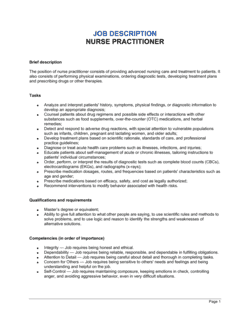
vs Nurse Practitioner Job Description

A nurse practitioner job description covers an advanced practice role with prescriptive authority, independent diagnosis, and a collaborative practice agreement with a supervising physician. A registered nurse job description covers a different scope of practice with a different licensure pathway. Using an RN description for an NP role misrepresents the scope of practice and may violate state advanced practice nursing regulations.

vs Independent Contractor Agreement

Some facilities engage per-diem or specialty nurses as independent contractors rather than employees. A contractor agreement governs that relationship — there are no employment entitlements, no tax withholding, and the nurse is responsible for their own licensure maintenance. Misclassifying an employee nurse as a contractor triggers back taxes, benefit liability, and potential CMS compliance violations. If the facility controls how, when, and where the nurse works, the relationship is almost certainly employment, not contracting.

Industry-specific considerations

Hospitals and health systems

Unit-specific descriptions tied to CMS Conditions of Participation, Joint Commission standards, nurse-to-patient ratio policies, and EHR documentation requirements by department.

Long-term care and skilled nursing facilities

CMS staffing mandate compliance, state survey readiness, MDS coordinator duties, and infection control obligations specific to congregate care environments.

Telehealth and remote care

Multi-state compact license requirements, asynchronous and synchronous care protocols, HIPAA-compliant remote documentation standards, and technology platform proficiency requirements.

Staffing and travel nursing agencies

Assignment-specific scope-of-practice definitions, credential verification obligations, facility-specific orientation requirements, and contractual compliance with Joint Commission staffing agency standards.

Jurisdictional notes

United States

RN licensure is state-regulated through each State Board of Nursing; 40+ states participate in the Nurse Licensure Compact. Mandatory overtime for nurses is restricted or prohibited in California, New York, Minnesota, Oregon, Illinois, New Jersey, and Washington — job descriptions must include jurisdiction-specific carve-outs. California mandates minimum nurse-to-patient ratios by unit type under Health & Safety Code §1276.4. CMS Conditions of Participation require written job descriptions for all clinical staff at certified facilities.

Canada

RN licensure is regulated by provincial colleges of nursing (e.g., CNO in Ontario, BCCNM in British Columbia) with no inter-provincial compact equivalent to the US NLC — nurses must be licensed in each province where they practice. Employment Standards Acts in each province set minimum notice and termination obligations. Quebec requires that employment documents be provided in French for provincially regulated employers. Scope-of-practice definitions vary by province and must be reflected in the duties clause.

United Kingdom

RNs in the UK must be registered with the Nursing and Midwifery Council (NMC); job descriptions for NMC-registered roles must reference the NMC Code as a conduct standard. NHS employers must comply with NHS Agenda for Change terms and conditions, which define pay bands, working hours, and annual leave entitlements. The Working Time Regulations 1998 limit average weekly working hours to 48 unless the employee opts out in writing — a separate opt-out form is required and should not be embedded in the job description.

European Union

Directive 2005/36/EC on the recognition of professional qualifications establishes minimum training requirements for nurses across EU member states and enables mutual recognition of nursing qualifications. The EU Transparent and Predictable Working Conditions Directive requires that written job terms be provided within seven days of the first day of work. GDPR applies to personal health data handled by nurses — the job description's compliance clause should reference the facility's data protection policy. Working time limits and mandatory rest periods are governed by the EU Working Time Directive (2003/88/EC).

Template vs lawyer — what fits your deal?

PathBest forCostTime
Use the templateHealthcare employers hiring RNs for standard inpatient, clinic, or long-term care roles in a single stateFree20–30 minutes per role
Template + legal reviewMulti-state or telehealth employers, facilities with recent CMS or Joint Commission deficiencies, or roles with complex supervisory or on-call structures$300–$800 for employment counsel review2–5 business days
Custom draftedHealth systems with union contracts, academic medical centers, heavily regulated specialty units (NICU, transplant, psychiatric), or facilities requiring NLRB compliance review$1,000–$3,500+1–3 weeks

Glossary

Scope of Practice
The procedures, actions, and clinical decisions a licensed nurse is legally permitted to perform based on their licensure level and applicable state or provincial law.
RN Licensure
A state- or province-issued credential authorizing an individual to practice as a Registered Nurse, obtained by passing the NCLEX-RN examination in the US and Canada.
NCLEX-RN
The National Council Licensure Examination for Registered Nurses — the standardized competency test required to obtain initial RN licensure in the US and Canada.
Nurse-to-Patient Ratio
The number of patients assigned to a single nurse per shift — regulated by statute in some states (California mandates specific ratios by unit type) and by policy in others.
BLS / ACLS Certification
Basic Life Support and Advanced Cardiovascular Life Support certifications from the American Heart Association — typically required for hospital-based RN roles.
Compact Nursing License
An RN license issued under the Nurse Licensure Compact (NLC), allowing the nurse to practice in any of the 40+ participating US states without obtaining additional state licenses.
Credentialing
The formal process by which a healthcare employer verifies a nurse's education, licensure, certifications, and employment history before granting clinical privileges.
CMS
The Centers for Medicare and Medicaid Services — the federal agency that sets staffing, documentation, and care standards for facilities receiving Medicare or Medicaid reimbursement.
Per Diem (PRN)
A scheduling arrangement where a nurse works on an as-needed basis without a guaranteed number of hours, typically at a higher hourly rate in exchange for flexibility.
Mandatory Overtime
A requirement that a nurse work beyond their scheduled shift hours when patient census or staffing shortages demand it — regulated or prohibited in several states.
At-Will Employment
An employment arrangement in which either the employer or employee may end the relationship at any time for any lawful reason — the default in most US states.

Part of your Business Operating System

This document is one of 3,000+ business & legal templates included in Business in a Box.

  • Fill-in-the-blanks — ready in minutes
  • 100% customizable Word document
  • Compatible with all office suites
  • Export to PDF and share electronically

Create your document in 3 simple steps.

From template to signed document — all inside one Business Operating System.
1
Download or open template

Access over 3,000+ business and legal templates for any business task, project or initiative.

2
Edit and fill in the blanks with AI

Customize your ready-made business document template and save it in the cloud.

3
Save, Share, Send, Sign

Share your files and folders with your team. Create a space of seamless collaboration.

Save time, save money, and create top-quality documents.

★★★★★

"Fantastic value! I'm not sure how I'd do without it. It's worth its weight in gold and paid back for itself many times."

Managing Director · Mall Farm
Robert Whalley
Managing Director, Mall Farm Proprietary Limited
★★★★★

"I have been using Business in a Box for years. It has been the most useful source of templates I have encountered. I recommend it to anyone."

Business Owner · 4+ years
Dr Michael John Freestone
Business Owner
★★★★★

"It has been a life saver so many times I have lost count. Business in a Box has saved me so much time and as you know, time is money."

Owner · Upstate Web
David G. Moore Jr.
Owner, Upstate Web

Run your business with a system — not scattered tools

Stop downloading documents. Start operating with clarity. Business in a Box gives you the Business Operating System used by over 250,000 companies worldwide to structure, run, and grow their business.

Free Forever Plan · No credit card required