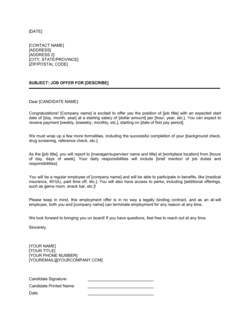
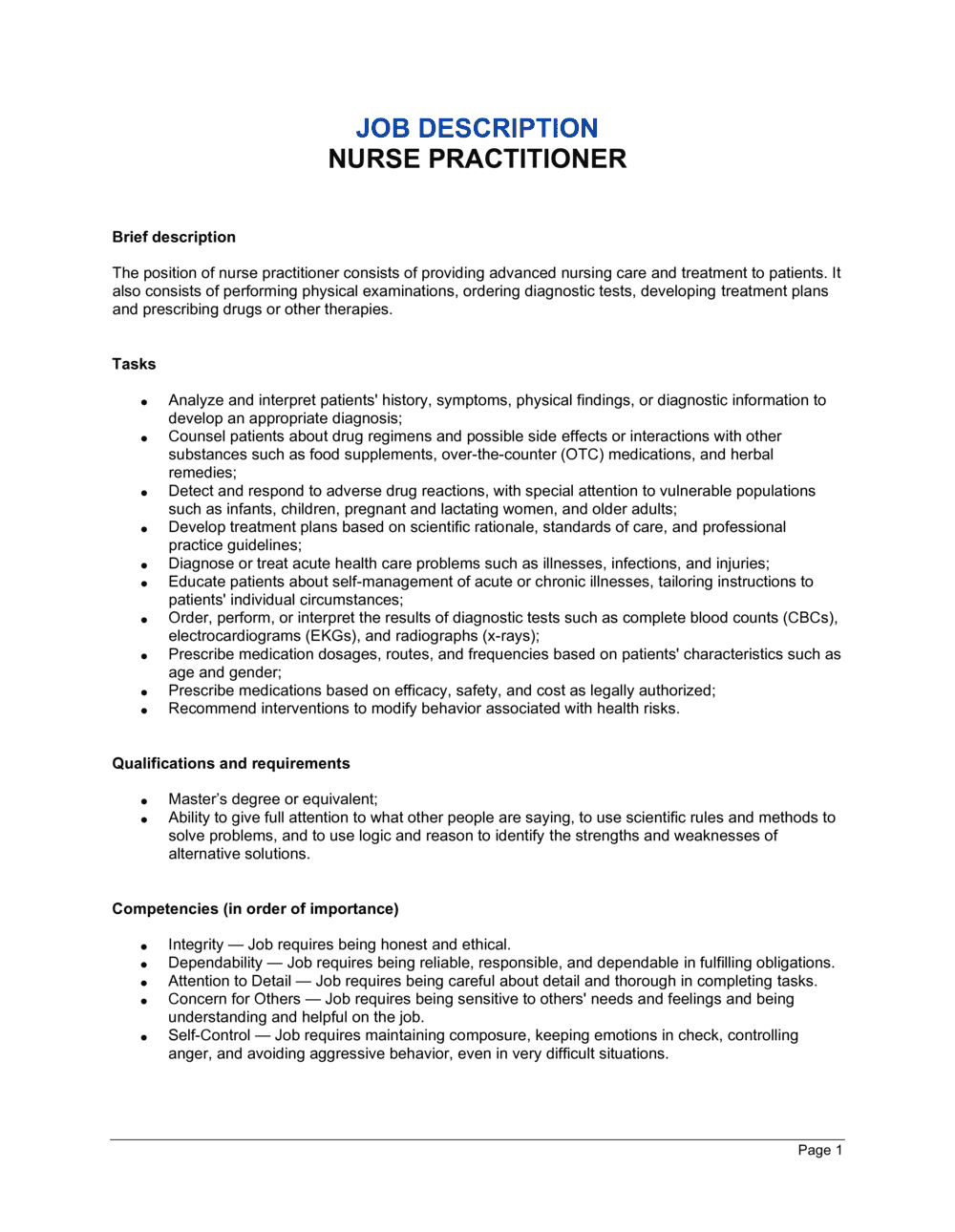
Nurse Practitioner Job Description Template

Free Word download • Edit online • Save & share with Drive • Export to PDF

2 pages20–30 min to fillDifficulty: StandardSignature requiredLegal review recommended
Learn more ↓
FreeNurse Practitioner Job Description Template

At a glance

What it is
A Nurse Practitioner Job Description is a formal binding document that defines the scope of practice, clinical duties, supervisory structure, qualifications, and compliance obligations for an NP role within a healthcare organization. This free Word download can be edited online and exported as PDF — ready to attach to an employment contract or post directly to a job board.
When you need it
Use it when hiring an NP for a new or backfilled position, when restructuring an existing role to reflect updated regulatory requirements, or when an employment contract references a separate scope-of-practice document.
What's inside
Position title and department, reporting structure, clinical scope of practice, patient care duties, prescriptive authority details, required licensure and certifications, collaboration and supervision requirements, performance expectations, and compliance and documentation obligations.

What is a Nurse Practitioner Job Description?

A Nurse Practitioner Job Description is a formal document that defines the clinical scope of practice, day-to-day duties, required licensure, supervisory structure, performance expectations, and compliance obligations for an NP position within a healthcare organization. Unlike a generic clinical role description, an NP-specific document must address state-regulated practice authority — including whether a collaborative practice agreement is required — prescriptive authority for controlled substances, national certification requirements tied to the NP's population focus, and CMS billing compliance obligations. When attached as an exhibit to an employment contract, it becomes a legally binding component of the NP's terms of employment.

Why You Need This Document

Operating without a signed, scope-specific nurse practitioner job description creates layered legal and regulatory exposure. A missing or vague scope-of-practice statement leaves the facility unable to enforce practice boundaries if an NP exceeds their authorized clinical role — and may void the facility's malpractice coverage for those encounters. Without a documented license-notification requirement, a suspended or encumbered license can go undetected for months. Incomplete prescriptive authority language generates pharmacy refusals and DEA compliance questions. And without explicitly stated incident-to billing obligations, facilities risk Medicare overpayment findings that carry repayment demands, civil monetary penalties, and program exclusion. This template gives healthcare employers and nurse practitioners a compliant, editable starting point that closes these gaps in under an hour.

Which variant fits your situation?

If your situation is…Use this template
Hiring a family NP for a primary care or outpatient clinicFamily Nurse Practitioner Job Description
Engaging an NP in an acute care or hospital inpatient settingAcute Care Nurse Practitioner Job Description
Staffing a psychiatric or behavioral health NP rolePsychiatric Mental Health NP Job Description
Hiring an NP for a telehealth or remote-care platformTelehealth Nurse Practitioner Job Description
Defining a pediatric NP role in a children's hospital or clinicPediatric Nurse Practitioner Job Description
Onboarding an NP as an independent contractor rather than an employeeIndependent Contractor Agreement (Healthcare)
Documenting collaboration requirements between an NP and supervising physicianCollaborative Practice Agreement

Common mistakes to avoid

❌ Using a generic clinical job description not tailored to NP scope

Why it matters: A description drafted for an RN or PA role will omit NP-specific requirements — prescriptive authority, collaboration agreements, and APRN licensure — creating credentialing gaps and billing compliance exposure.

Fix: Use an NP-specific template and verify every clause against the licensing board regulations for the state where the NP will practice.

❌ Failing to update the document when state law changes

Why it matters: More than 20 states have expanded NP practice authority in the past five years. An outdated job description that still requires a CPA in a full-practice-authority state can deter qualified candidates and create unnecessary administrative burden.

Fix: Set a calendar reminder to review the job description against current state NP practice laws annually, and immediately after any legislative change affecting APRN scope.

❌ Omitting the notification obligation for license actions

Why it matters: Without a written requirement to notify the employer of licensing board complaints or sanctions, facilities may not learn of a suspended or encumbered license until a patient safety event or payer audit surfaces it.

Fix: Include a clause requiring the NP to notify HR in writing within 24–48 hours of any licensing board action, DEA inquiry, or malpractice claim — and make failure to do so a terminable offense.

❌ Not addressing incident-to billing supervision requirements

Why it matters: CMS incident-to billing requires the supervising physician to be present in the same office suite during the encounter. If the job description does not document this requirement and it isn't followed, the facility faces Medicare overpayment recovery and exclusion risk.

Fix: Add an explicit clause requiring the NP to comply with CMS incident-to supervision rules when billing under a physician's NPI, and provide annual training on when direct billing under the NP's own NPI is required instead.

❌ Setting productivity targets that conflict with documentation time

Why it matters: Mandating 22 patient encounters per day while requiring same-day chart completion is mathematically incompatible in most EHR systems — resulting in chronic documentation backlogs, billing denials, and NP burnout.

Fix: Pilot the productivity target with one NP for 30 days before embedding it in the job description, and adjust to reflect actual average encounter length plus documentation time for your EHR and patient population.

❌ Omitting the population focus from the qualifications clause

Why it matters: Hiring a family NP to fill an acute care NP role — or vice versa — without specifying the required population focus in the job description creates a credential mismatch that can void the NP's malpractice coverage and violate credentialing standards.

Fix: State the required national certification population focus explicitly (e.g., 'AANP Family Nurse Practitioner or ANCC Family Nurse Practitioner certification required') and verify it matches the clinical role before extending an offer.

The 9 key clauses, explained

Position identification and department

In plain language: States the official job title, department or practice unit, employment classification (full-time, part-time, or per diem), and the FLSA exemption status.

Sample language
Position Title: Nurse Practitioner — [SPECIALTY]. Department: [DEPARTMENT NAME]. Classification: Full-Time, Exempt. Reports to: [SUPERVISING PHYSICIAN / MEDICAL DIRECTOR TITLE].

Common mistake: Listing the NP as non-exempt (hourly) when the role qualifies for the learned professional exemption under the FLSA — triggering unnecessary overtime calculations and payroll compliance exposure.

Scope of practice statement

In plain language: Defines the clinical boundaries of the role — what conditions the NP may assess and treat, what procedures they may perform, and any limitations tied to state law or facility policy.

Sample language
The Nurse Practitioner shall practice within the scope authorized by [STATE] Board of Nursing regulations and this organization's credentialing policies, providing care to patients with [CONDITION TYPES] in the [SETTING] setting.

Common mistake: Writing a scope statement that is broader than what the applicable state licensing board authorizes — exposing the facility to regulatory sanction if the NP acts on the documented scope.

Clinical duties and patient care responsibilities

In plain language: Itemizes the NP's day-to-day clinical functions: history and physical examination, diagnosis, treatment planning, ordering and interpreting diagnostics, and patient education.

Sample language
Duties include: conducting comprehensive patient assessments; formulating differential diagnoses; ordering and interpreting laboratory, imaging, and diagnostic studies; developing and implementing individualized treatment plans; and educating patients and families on [CONDITION/TREATMENT].

Common mistake: Omitting diagnostic ordering authority from the duties list, then prohibiting it in the credentialing file — creating a conflict that confuses both the NP and billing staff.

Prescriptive authority and DEA registration

In plain language: Documents the NP's authority to prescribe medications, the schedule of controlled substances included, and whether a DEA registration is required as a condition of employment.

Sample language
The NP shall hold active prescriptive authority under [STATE] law, including Schedule [II–V / III–V] controlled substances, and shall maintain a current DEA registration as a condition of continued employment. All prescribing shall comply with the organization's formulary and prescribing policies.

Common mistake: Failing to specify which controlled substance schedules are included — leaving prescribers and pharmacies uncertain about the NP's authority and creating dispensing errors or refusals.

Collaboration and supervision requirements

In plain language: States whether the role requires a collaborative practice agreement, who the collaborating or supervising physician is, the required availability ratio, and chart review frequency.

Sample language
This position [requires / does not require] a Collaborative Practice Agreement pursuant to [STATE] law. The collaborating physician shall be [PHYSICIAN NAME / TITLE], available within [RESPONSE TIME] during clinical hours. Chart review shall occur [no less than X% of charts per month].

Common mistake: Omitting the response-time requirement for physician availability — a detail many state boards specify in regulation and that facilities regularly leave undefined until a patient safety event occurs.

Required licensure, certifications, and education

In plain language: Lists every mandatory credential the NP must hold on hire and maintain throughout employment — state RN and APRN licenses, national NP certification, BLS/ACLS, and any specialty credentials.

Sample language
Required: Active, unencumbered RN and APRN licensure in [STATE]; national NP certification by AANP or ANCC in [POPULATION FOCUS]; current BLS certification; DEA registration where applicable. Preferred: [X] years of [SPECIALTY] clinical experience.

Common mistake: Listing licensure requirements in the job posting but not in the signed job description — creating a gap where a hire can argue the credential is aspirational rather than a condition of employment.

Performance standards and productivity expectations

In plain language: Defines measurable expectations for patient volume, documentation turnaround, quality metrics, and participation in peer review or quality improvement activities.

Sample language
The NP is expected to manage [X] patient encounters per [day/week], complete clinical documentation within [24/48] hours of encounter, maintain a patient satisfaction score at or above the [Xth] percentile, and participate in [quarterly] peer-review activities.

Common mistake: Setting patient-volume targets without accounting for documentation time — causing NPs to consistently fall behind on charting, which generates HIPAA audit risk and billing denials.

Compliance, documentation, and billing obligations

In plain language: Requires the NP to comply with HIPAA, OSHA, CMS billing rules (including incident-to billing requirements), facility policies, and mandatory reporting obligations.

Sample language
The NP shall document all patient encounters in [EHR SYSTEM] in compliance with CMS documentation guidelines, maintain HIPAA confidentiality of all protected health information, complete mandatory annual compliance training, and report any suspected abuse, neglect, or adverse event per [STATE] and facility reporting requirements.

Common mistake: Not addressing incident-to billing in the compliance clause — when NPs bill under a physician's NPI without meeting CMS supervision requirements, it results in significant Medicare overpayment liability.

Termination and license integrity conditions

In plain language: States that employment is contingent on maintaining clean licensure and that any license encumbrance, sanction, or DEA action triggers immediate review and possible termination.

Sample language
Employment is contingent upon the NP maintaining an active, unencumbered license in all applicable jurisdictions. The NP shall notify [EMPLOYER / HR DEPARTMENT] within [24/48] hours of any investigation, complaint, sanction, or action by a licensing board, DEA, or insurer.

Common mistake: Relying only on annual credentialing renewals to catch license issues — without a real-time notification requirement, a suspended license may go undetected for months, exposing the facility to vicarious liability.

How to fill it out

  1. 1

    Confirm the applicable state or provincial scope of practice rules

    Before completing any section, look up whether your state grants full practice authority, reduced practice, or restricted practice to NPs. The scope-of-practice clause and collaboration section must align with what the licensing board permits — not what is convenient for the practice.

    💡 The AANP maintains a current state-by-state practice environment map at aanp.org — use it as a starting reference before drafting the scope clause.

  2. 2

    Enter the position title, department, and reporting structure

    Use the exact job title that will appear on the employment contract and payroll system. Specify the department or clinical unit and the direct supervisor's title — not just a name, since personnel change.

    💡 Align the FLSA exemption status with your payroll classification before signing — misclassification is one of the most common and costly HR errors in healthcare.

  3. 3

    Draft the scope of practice statement for the specific setting

    Tailor the scope to the patient population, clinical setting, and specialty. A family NP in a primary care clinic has a different scope than an acute care NP in an ICU. Overly broad or generic scope statements create credentialing conflicts.

    💡 Cross-reference the scope statement against the facility's credentialing file for this role — both documents should describe identical practice boundaries.

  4. 4

    Complete the prescriptive authority and DEA registration clause

    State the specific controlled substance schedules the NP is authorized to prescribe under your state's law and facility formulary. If the role requires a DEA registration as a condition of employment, state this explicitly and include the renewal obligation.

    💡 Some states require a separate state controlled substances registration in addition to a federal DEA number — check your state pharmacy board rules before completing this clause.

  5. 5

    Define collaboration or supervision requirements

    If your state requires a collaborative practice agreement, name the collaborating physician (or at minimum the title), specify availability ratios, and define the chart review frequency. If your state has full practice authority, note that no CPA is required and delete the supervision fields.

    💡 Document the CPA as a separate exhibit or attachment — embedding the full physician agreement inside the job description creates version-control problems when the collaborating physician changes.

  6. 6

    List all required licensure and certifications

    Enumerate every license and certification that is a condition of hire and continued employment. Include the specific certifying body (AANP or ANCC), the population focus, BLS or ACLS level, and any specialty certifications required for the clinical setting.

    💡 Add a verification date field so HR has a documented obligation to re-verify credentials at each renewal cycle — typically every two years for NP national certification.

  7. 7

    Set measurable performance and productivity standards

    Enter specific numeric targets for daily patient volume, documentation turnaround time, and quality metrics. Avoid ranges like '15–20 patients per day' — pick one number so performance reviews are unambiguous.

    💡 Benchmark volume expectations against your specialty's median encounter numbers from MGMA or AAPA data before finalizing — unrealistic targets are a leading cause of NP turnover.

  8. 8

    Obtain signatures before the start date

    Both the NP and the authorized employer representative must sign the job description before or on the first day of employment. Post-start-date signatures may undermine the enforceability of the scope-of-practice and termination conditions.

    💡 Attach the signed job description as an exhibit to the employment contract and reference it explicitly in the contract body so the two documents form a single integrated agreement.

Frequently asked questions

What is a nurse practitioner job description?

A nurse practitioner job description is a formal document that defines the clinical scope of practice, duties, required credentials, supervisory structure, performance expectations, and compliance obligations for an NP position within a healthcare organization. It functions as both a recruiting tool and a binding component of the employment relationship, and is often attached as an exhibit to the NP's employment contract.

What should a nurse practitioner job description include?

At minimum: position title and department, reporting structure, scope of practice statement aligned with applicable state law, clinical duties, prescriptive authority details, required licensure and certifications (including national NP certification population focus), collaboration or supervision requirements, performance standards, billing compliance obligations, and termination conditions tied to license integrity. Missing any of these creates credentialing, compliance, or liability gaps.

Does a nurse practitioner job description need to be signed?

Yes. A signed job description creates a documented record that the NP acknowledged and accepted the defined scope of practice, performance expectations, and compliance obligations before beginning work. When attached to an employment contract, the signed description strengthens the enforceability of scope limitations and notification requirements. Post-start-date signatures may weaken enforceability in common-law jurisdictions.

How does state law affect a nurse practitioner job description?

State law determines whether an NP requires a collaborative practice agreement, who may supervise them, what they may prescribe, and which patient populations they may serve. A job description that describes a scope broader than what the licensing board permits exposes the facility to regulatory action. Facilities operating across multiple states must tailor the document to each state's practice environment separately.

What is the difference between full practice authority and restricted practice for NPs?

Full practice authority means an NP may assess, diagnose, treat, and prescribe without a physician collaboration agreement or supervision requirement — as of 2025, over 25 states and DC grant this status. Reduced practice requires a CPA but not direct supervision. Restricted practice requires ongoing physician supervision for all or part of the NP's scope. The job description must accurately reflect which regime applies in the NP's practice state.

Can a nurse practitioner job description be used for an independent contractor?

A job description drafted for an employee will not translate directly to an independent contractor arrangement. The control and direction language typical in employee job descriptions — including supervision requirements, scheduling mandates, and facility policy compliance — can support a worker misclassification finding. For contractor NPs, use an Independent Contractor Agreement that incorporates scope of practice by reference rather than an employee job description.

How often should a nurse practitioner job description be updated?

Review the document annually and immediately after any change in state NP practice law, federal billing rules (CMS), or your facility's credentialing standards. More than 20 states have modified NP practice authority since 2020 — an outdated description can require collaboration that is no longer legally mandated, or omit requirements that have since been added. Attach a version date and revision log to the document.

What is incident-to billing and why does it belong in the job description?

Incident-to billing allows services furnished by an NP to be billed under a supervising physician's NPI at the 100% Medicare fee schedule rate, rather than the 85% rate applicable to direct NP billing, provided strict CMS supervision and care-plan requirements are met. Including incident-to compliance obligations in the job description establishes a documented standard that reduces overpayment risk and guides the NP's day-to-day practice decisions.

Do I need a lawyer to create a nurse practitioner job description?

For straightforward single-state roles at established facilities, a high-quality template reviewed against current state NP practice law is typically sufficient. Legal review is warranted when the NP will practice in multiple states with different scope requirements, when the role involves complex prescriptive authority including Schedule II controlled substances, or when the position is senior enough that the job description will be incorporated into a negotiated executive employment agreement.

How this compares to alternatives

vs Physician Assistant Job Description

A PA job description covers a similar clinical role but reflects a different licensing framework — PAs are licensed under a physician-led medical model in most states, while NPs are licensed under the nursing model with population-focused certifications. The supervision and collaboration requirements, national certifying bodies, and scope language differ materially between the two. Use the NP-specific template for any APRN hire.

vs Registered Nurse Job Description

An RN job description defines a scope limited to nursing assessment, care planning, and treatment implementation without independent diagnosis or prescribing authority. An NP job description must additionally address independent or collaborative diagnosis, prescriptive authority, and APRN licensure requirements. Using an RN description for an NP role omits legally required scope and credentialing language.

vs Independent Contractor Agreement (Healthcare)

A contractor agreement governs the terms under which a self-employed NP provides services without employee status. It defines deliverables, compensation, and liability allocation rather than daily duties and productivity targets. When an NP is engaged as a contractor rather than an employee, the contractor agreement is the primary governance document and the job description format is not appropriate.

vs Collaborative Practice Agreement

A collaborative practice agreement is a separate legal document between an NP and a supervising or collaborating physician that defines the physician's oversight responsibilities, availability requirements, and chart review obligations as required by state law. It supplements — and should be attached to — the NP job description but does not replace it. The job description defines the role; the CPA defines the supervision structure mandated by regulation.

Industry-specific considerations

Primary care and family medicine

Family NP scope covering all ages, chronic disease management panels, annual wellness visits billed under Medicare, and collaborative or independent practice depending on state.

Urgent care and retail health

High-volume acute episodic care, standing order protocols, rapid documentation turnaround in high-throughput EHR systems, and multistate licensure for chain operators.

Behavioral health and psychiatry

Psychiatric-mental health NP scope, psychotropic prescriptive authority including Schedule II stimulants and benzodiazepines, and mandatory reporting and crisis intervention documentation.

Hospital and acute care

Acute care NP credentialing for inpatient privileges, intensivist or hospitalist coverage ratios, on-call availability requirements, and hospital medical staff bylaws alignment.

Jurisdictional notes

United States

NP scope of practice is governed entirely at the state level — over 25 states and DC have granted full practice authority, while others require a collaborative or supervisory physician agreement. Prescriptive authority for Schedule II controlled substances varies by state. The job description must reference the specific state's Nurse Practice Act and any applicable Board of Nursing regulations. Multistate licensure through the APRN Compact, where operational, allows practice across member states but each state's scope rules still apply.

Canada

NP regulation in Canada is provincial and territorial. Ontario's Regulated Health Professions Act and the College of Nurses of Ontario govern NP practice in that province; other provinces have equivalent bodies. NPs in most provinces hold prescriptive authority, though the specific drug schedules authorized vary. Quebec uses the title 'infirmière praticienne spécialisée' and the regulatory framework differs from common-law provinces. Job descriptions must reference the applicable provincial college and standards of practice.

United Kingdom

Advanced Nurse Practitioners in the UK are regulated by the Nursing and Midwifery Council, which does not yet have a protected 'nurse practitioner' title — meaning role definition in the job description carries particular weight. Independent and supplementary prescribing authority must be specifically credentialed and referenced. NHS and independent sector employers must align the job description with the relevant Agenda for Change pay band (typically Band 7 or 8) and the NMC Code standards.

European Union

The advanced practice nursing role varies significantly across EU member states — some have well-defined APRN frameworks (Ireland, the Netherlands, Finland) while others do not formally recognize the NP title. The EU Professional Qualifications Directive facilitates recognition of nursing qualifications across member states but does not harmonize advanced practice scope. Employers in EU member states should reference the national nursing regulatory body's standards and confirm whether prescriptive authority exists under local pharmaceutical law.

Template vs lawyer — what fits your deal?

PathBest forCostTime
Use the templateSingle-state clinics and health systems hiring NPs in standard primary care, urgent care, or specialty rolesFree30–60 minutes
Template + legal reviewMultistate operators, roles involving Schedule II prescribing, or positions attached to a negotiated employment contract$300–$800 (healthcare employment attorney review)2–5 days
Custom draftedHealth systems establishing new NP practice models, roles in heavily regulated states, or executive NP positions with equity or complex severance$1,500–$4,000+1–3 weeks

Glossary

Scope of Practice
The procedures, actions, and processes a healthcare provider is permitted to perform based on their license, training, and applicable state or provincial law.
Prescriptive Authority
Legal permission granted by a licensing board that allows an NP to prescribe medications, including controlled substances, within defined limits.
Collaborative Practice Agreement (CPA)
A written agreement between a nurse practitioner and a supervising or collaborating physician that defines the NP's practice parameters where state law requires physician oversight.
Full Practice Authority (FPA)
A regulatory status in which a nurse practitioner may assess, diagnose, treat, and prescribe without physician supervision or a formal collaboration agreement.
APRN
Advanced Practice Registered Nurse — the umbrella title covering nurse practitioners, certified nurse-midwives, clinical nurse specialists, and certified registered nurse anesthetists.
DEA Registration
A license from the US Drug Enforcement Administration required to prescribe Schedule II–V controlled substances, issued per practitioner per practice site.
Credentialing
The process by which a healthcare facility verifies an NP's licenses, certifications, education, and work history before granting clinical privileges.
Clinical Privileges
Specific authorized activities an NP may perform within a particular healthcare facility, granted after credentialing and subject to periodic renewal.
Population Focus
The patient population an NP is licensed and trained to serve — such as family/individual across the lifespan, adult-gerontology, pediatrics, or psychiatric-mental health.
National Certification
Board certification from a recognized body such as AANP or ANCC that validates an NP's clinical competency in their population focus and is required for licensure in most jurisdictions.

Part of your Business Operating System

This document is one of 3,000+ business & legal templates included in Business in a Box.

  • Fill-in-the-blanks — ready in minutes
  • 100% customizable Word document
  • Compatible with all office suites
  • Export to PDF and share electronically

Create your document in 3 simple steps.

From template to signed document — all inside one Business Operating System.
1
Download or open template

Access over 3,000+ business and legal templates for any business task, project or initiative.

2
Edit and fill in the blanks with AI

Customize your ready-made business document template and save it in the cloud.

3
Save, Share, Send, Sign

Share your files and folders with your team. Create a space of seamless collaboration.

Save time, save money, and create top-quality documents.

★★★★★

"Fantastic value! I'm not sure how I'd do without it. It's worth its weight in gold and paid back for itself many times."

Managing Director · Mall Farm
Robert Whalley
Managing Director, Mall Farm Proprietary Limited
★★★★★

"I have been using Business in a Box for years. It has been the most useful source of templates I have encountered. I recommend it to anyone."

Business Owner · 4+ years
Dr Michael John Freestone
Business Owner
★★★★★

"It has been a life saver so many times I have lost count. Business in a Box has saved me so much time and as you know, time is money."

Owner · Upstate Web
David G. Moore Jr.
Owner, Upstate Web

Run your business with a system — not scattered tools

Stop downloading documents. Start operating with clarity. Business in a Box gives you the Business Operating System used by over 250,000 companies worldwide to structure, run, and grow their business.

Free Forever Plan · No credit card required