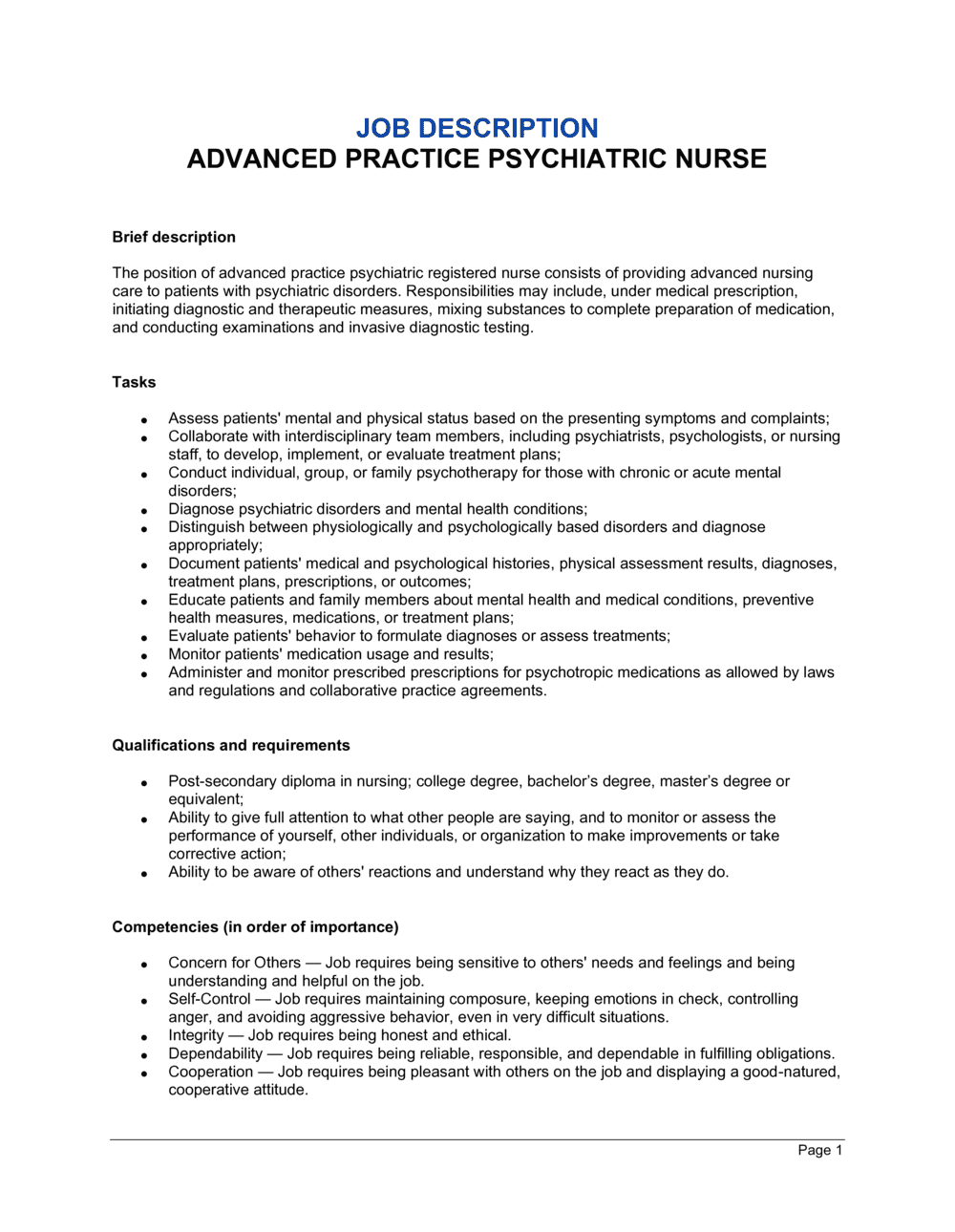
Advanced Practice Psychiatric Registered Nurse Job Description Template

Free Word download β€’ Edit online β€’ Save & share with Drive β€’ Export to PDF

2 pagesβ€’20–25 min to fillβ€’Difficulty: Standard
Learn more ↓
FreeAdvanced Practice Psychiatric Registered Nurse Job Description Template

At a glance

What it is
An Advanced Practice Psychiatric Registered Nurse (APRN) Job Description is a structured operational document that defines the role, clinical responsibilities, licensure requirements, prescriptive authority, and supervision arrangements for a psychiatric APRN position within a healthcare organization. This free Word download gives you an editable, ready-to-post template you can customize for your facility and publish to job boards or include in an offer package.
When you need it
Use it when hiring a Psychiatric Mental Health Nurse Practitioner (PMHNP) or Clinical Nurse Specialist in psychiatry for a hospital, outpatient clinic, community mental health center, or telehealth platform. It is also needed when updating an existing role to reflect new prescriptive authority, supervision requirements, or scope-of-practice regulations.
What's inside
Role summary and reporting structure, clinical duties and patient population scope, licensure and certification requirements, prescriptive authority and DEA registration expectations, supervision and collaboration requirements, performance standards, and physical and schedule demands.

What is an Advanced Practice Psychiatric Registered Nurse Job Description?

An Advanced Practice Psychiatric Registered Nurse Job Description is a structured operational document that defines the clinical scope, credentialing requirements, prescriptive authority, supervision model, and performance expectations for a Psychiatric Mental Health Nurse Practitioner (PMHNP) or psychiatric Clinical Nurse Specialist (CNS) position. Unlike a general nursing job description, it addresses the specific regulatory framework governing psychiatric APRN practice β€” including state-level collaborative practice agreement requirements, ANCC board certification standards, DEA registration obligations, and mental health confidentiality statutes. This free Word download gives healthcare organizations an editable, ready-to-post template that reflects real-world psychiatric APRN practice requirements.

Why You Need This Document

Posting a vague or generic job description for a psychiatric APRN role creates problems before the candidate even starts. Regulatory bodies, malpractice carriers, and accreditation surveyors all expect the written job description to accurately reflect the APRN's authorized scope of practice β€” a mismatch is a compliance finding, not a paperwork formality. Candidates in a specialty with a documented national shortage will withdraw or resign early when the daily caseload, on-call expectations, or collaboration structure turn out to differ from what was posted. Credentialing committees need to see the specific certifications, licensure requirements, and supervision arrangements documented before granting clinical privileges. This template gives HR teams, clinic owners, and staffing coordinators a complete, specialty-specific starting point that covers every element regulators, candidates, and accreditors expect to find β€” reducing credentialing delays, early turnover, and compliance risk from the first day the role is posted.

Which variant fits your situation?

If your situation is…Use this template
Hiring a PMHNP for an outpatient behavioral health clinicAdvanced Practice Psychiatric Registered Nurse Job Description
Hiring a general nurse practitioner for primary careNurse Practitioner Job Description
Hiring a registered nurse for an inpatient psychiatric unitRegistered Nurse Job Description
Hiring a licensed clinical social worker for behavioral healthLicensed Clinical Social Worker Job Description
Hiring a psychiatrist (MD/DO) rather than an APRNPsychiatrist Job Description
Documenting ongoing role expectations after hireEmployee Performance Review Template
Creating a supervision agreement between APRN and collaborating physicianCollaborative Practice Agreement

Common mistakes to avoid

❌ Using a general NP job description and adding 'psychiatric' to the title

Why it matters: Psychiatric APRNs operate under specific scope-of-practice rules, ANCC certification requirements, and mental health confidentiality statutes that differ materially from primary care NP roles. A generic template creates credentialing gaps and compliance risk.

Fix: Start from a psychiatric-specific template and verify every clinical duty, certification requirement, and supervision clause against the state nurse practice act before posting.

❌ Omitting the collaborating physician relationship in restricted-practice states

Why it matters: In states requiring physician oversight, an APRN practicing without a documented collaborative agreement faces license suspension, billing fraud exposure, and malpractice coverage gaps β€” regardless of clinical competency.

Fix: Name the collaborating physician and reference the CPA by title in the job description, and execute the written CPA before the APRN's first patient encounter.

❌ Listing board certification as 'preferred' instead of 'required'

Why it matters: Most state boards, accreditation bodies, and malpractice carriers require active PMHNP-BC certification as a non-negotiable condition of practice β€” hiring without it creates immediate regulatory and insurance exposure.

Fix: Move ANCC PMHNP-BC (or equivalent state-recognized certification) to the required qualifications section and include it as a condition of continued employment.

❌ Leaving caseload expectations and on-call frequency unspecified

Why it matters: Candidates who accept an offer without knowing daily encounter targets or on-call frequency frequently resign within 90 days when reality diverges from expectation, creating costly turnover in a specialty with a national shortage.

Fix: State the daily encounter target, weekly schedule, and on-call rotation in the scheduling section before posting β€” even if the numbers are estimated ranges during a ramp-up period.

❌ Failing to address multi-state licensure for telehealth roles

Why it matters: An APRN prescribing to a patient in a state where they hold no license is practicing without authorization β€” a federal and state violation regardless of the platform used or the employer's location.

Fix: Explicitly list every state where the APRN will see patients and confirm β€” or require as a hiring condition β€” that the candidate holds an active license or Nurse Licensure Compact (NLC) authorization in each one.

❌ Omitting documentation timeliness standards

Why it matters: Late or missing encounter notes create billing denials, care continuity failures, and audit findings. In a psychiatric setting, undocumented sessions also create liability exposure if a patient experiences an adverse event.

Fix: State the note-completion deadline in hours (e.g., within 24 hours of encounter) and the EHR system by name in the documentation section of the job description.

The 8 key sections, explained

Position summary and reporting structure

Clinical duties and patient population

Prescriptive authority and medication management

Supervision, collaboration, and consultation

Licensure, certification, and education requirements

Documentation and compliance responsibilities

Quality improvement and team participation

Physical requirements and scheduling demands

How to fill it out

  1. 1

    Confirm the governing state's APRN scope-of-practice model

    Before filling in the supervision and prescriptive authority sections, verify whether your state grants full practice authority, reduced practice (CPA required), or restricted practice (physician supervision required). The answer determines every oversight clause in the document.

    πŸ’‘ The American Association of Nurse Practitioners (AANP) maintains a current state-by-state practice environment map at aanp.org β€” check it before drafting, not after.

  2. 2

    Enter the facility and reporting structure details

    Replace all [FACILITY NAME], [DIRECTOR TITLE], and [COLLABORATING PHYSICIAN NAME] placeholders with the actual legal entity name and named individuals. If a CPA is required, the collaborating physician must be identified by name and license number.

    πŸ’‘ Use the physician's full name as it appears on their state medical license β€” matching names across the CPA, job description, and credentialing file prevents audit discrepancies.

  3. 3

    Define the patient population and caseload target

    Specify the age group (pediatric, adult, geriatric, or lifespan), acuity level (outpatient wellness to acute crisis), and daily encounter target. These details determine which ANCC certification track is required and set realistic compensation benchmarks.

    πŸ’‘ A caseload of more than 20 psychiatric encounters per day in an outpatient setting is widely considered above the safe threshold β€” document your target and get clinical leadership sign-off before publishing.

  4. 4

    Complete the licensure and certification requirements

    List each credential as 'required' or 'preferred' with specificity: ANCC PMHNP-BC (or ANCC CNS-BC for clinical specialist roles), active state RN and APRN licenses, and active DEA registration for any controlled-substance prescribing role.

    πŸ’‘ Check your malpractice carrier's credentialing requirements β€” many carriers require ANCC certification as a condition of coverage, making it a financial risk item, not just a hiring preference.

  5. 5

    Specify EHR system, CPT codes, and documentation timelines

    Name the EHR platform, the required diagnostic coding system (DSM-5 and ICD-10-CM), the specific CPT codes used for psychiatric evaluations and medication management visits, and the note-completion deadline in hours.

    πŸ’‘ Including CPT codes in the job description signals to experienced candidates exactly what billing complexity to expect and reduces surprises during onboarding.

  6. 6

    State on-call, telehealth, and schedule expectations explicitly

    Enter the exact shift schedule, on-call frequency (nights per month or week), and whether telehealth coverage is required after hours. Specify whether the platform and equipment are provided or the clinician's responsibility.

    πŸ’‘ Telehealth roles that cross state lines require the APRN to hold an active license in every state where patients are located β€” flag this in the description if multi-state licensure is required.

  7. 7

    Review against state nurse practice act and facility credentialing standards

    Have your compliance officer or credentialing coordinator compare the final draft against the current state nurse practice act and your facility's medical staff bylaws to confirm all scope, supervision, and prescribing language is accurate.

    πŸ’‘ A 30-minute review by a healthcare compliance consultant ($75–$150) is significantly cheaper than a scope-of-practice complaint filed with the state board.

Frequently asked questions

What is an Advanced Practice Psychiatric Registered Nurse?

An Advanced Practice Psychiatric Registered Nurse (APRN) is a registered nurse with a graduate degree β€” MSN or DNP β€” and specialty certification in psychiatric mental health, typically as a PMHNP-BC through the American Nurses Credentialing Center. They are licensed to assess, diagnose, and treat psychiatric and mental health conditions, and in most states to prescribe psychotropic medications including controlled substances. They work in settings ranging from outpatient clinics and hospitals to community mental health centers and telehealth platforms.

What is the difference between a PMHNP and a psychiatrist?

A psychiatrist holds an MD or DO degree and completed a psychiatric residency; a PMHNP holds a graduate nursing degree and completed a psychiatric nurse practitioner program. Both can diagnose psychiatric conditions and prescribe medications. Psychiatrists typically manage higher-acuity or more complex cases, conduct longer evaluations, and in most states can admit patients involuntarily without a physician co-signature. PMHNPs are increasingly the primary psychiatric prescriber in outpatient and community mental health settings, particularly in areas with psychiatrist shortages.

Do all states allow PMHNPs to prescribe independently?

No. As of 2025, roughly half of US states grant full practice authority, allowing PMHNPs to prescribe independently without a physician collaborative agreement. The remaining states require either a reduced practice model (CPA required) or a restricted practice model (physician supervision required for prescribing). The job description must reflect the specific model in the state where the APRN will practice β€” and in telehealth roles, in every state where patients are located.

What certifications should a psychiatric APRN job description require?

At minimum, require ANCC PMHNP-BC (Psychiatric Mental Health Nurse Practitioner β€” Board Certified) for nurse practitioner roles, or ANCC APRN-CNS certification for clinical nurse specialist positions. Active state RN and APRN licensure and a current DEA registration for any role involving controlled-substance prescribing are also non-negotiable. Some facilities additionally require BLS/ACLS certification and experience with specific EHR platforms.

What should a psychiatric APRN job description include that a general NP job description does not?

A psychiatric-specific job description must address: mental health confidentiality statutes (which differ from standard HIPAA requirements for substance use and psychiatric records), involuntary commitment procedures and who holds that authority, psychiatric-specific CPT codes (90792 for psychiatric evaluation, 90833 for psychotherapy add-ons), controlled-substance prescribing protocols, and crisis intervention competencies. General NP templates omit all of these and create compliance and credentialing gaps when used for psychiatric hires.

How do I handle multi-state licensure in a telehealth APRN job description?

List every state in which the APRN will provide patient care and require active licensure β€” or Nurse Licensure Compact (NLC) participation where applicable β€” in each one as a condition of hire. Note that the NLC covers RN and LPN licenses; separate APRN compact states are expanding but not universal as of 2025. Require candidates to self-report any license restrictions and build a licensure maintenance obligation into the ongoing employment terms.

What is a collaborative practice agreement and when is it required?

A Collaborative Practice Agreement (CPA) is a written document between an APRN and a supervising or collaborating physician that defines the scope of the APRN's practice, the oversight frequency, referral protocols, and the physician's availability for consultation. It is required in restricted-practice and reduced-practice states as a legal prerequisite for the APRN to prescribe. The job description should reference the CPA requirement and the collaborating physician's name, with the formal agreement executed separately before the first patient encounter.

What is a typical caseload for an outpatient psychiatric APRN?

Outpatient psychiatric APRNs in medication management roles typically carry 15–20 patient encounters per day for follow-up visits (15–30 minutes each) and 2–4 new patient evaluations (45–90 minutes each). Integrated care models or community mental health settings may have higher volume expectations. The job description should state the expected daily encounter target explicitly β€” understating or omitting this figure is one of the leading causes of early turnover in psychiatric APRN placements.

Can a staffing agency use this template for multiple healthcare clients?

Yes, with important modifications for each placement. The collaborating physician, EHR platform, state licensure requirements, CPA terms, and patient population details must be updated for every client facility and every state where patients will be seen. A single generic template used across clients without these customizations creates scope-of-practice compliance risk and can expose both the agency and the client facility to regulatory liability if the posted requirements do not match the actual practice environment.

How this compares to alternatives

vs Psychiatrist Job Description

A psychiatrist job description targets an MD or DO with a completed residency, typically commanding a higher salary range and carrying authority for involuntary commitment in most states. The APRN job description covers an overlapping clinical scope but must address graduate nursing credentials, ANCC certification, and state-specific prescriptive authority rules that do not apply to physician roles. Use the psychiatrist template when filling an MD/DO position; use this APRN template for PMHNP or CNS hires.

vs Registered Nurse β€” Psychiatric Unit Job Description

A registered nurse in psychiatry provides direct patient care under physician or APRN orders but does not independently diagnose, prescribe, or manage a psychiatric caseload. The APRN job description adds graduate-level educational requirements, prescriptive authority, independent clinical decision-making, and supervision structure that an RN role does not include. Use the RN template for bedside and care-coordination roles; use this template for autonomous clinical practice positions.

vs Licensed Clinical Social Worker Job Description

An LCSW provides psychotherapy, case management, and crisis intervention but cannot prescribe medications or make medical diagnoses. The APRN job description covers a distinct clinical scope β€” pharmacological management, medical assessment, and prescriptive authority β€” that an LCSW role does not. Many behavioral health teams employ both; each requires its own job description with role-specific credentialing requirements.

vs Nurse Practitioner Job Description (General)

A general nurse practitioner job description covers primary care or specialty NP roles without psychiatric-specific content β€” no PMHNP-BC certification requirement, no mental health confidentiality provisions, no psychiatric CPT codes, and no crisis intervention protocols. Using a general NP template for a psychiatric hire creates credentialing gaps and scope-of-practice compliance risk. This psychiatric APRN template includes all of those specialty-specific elements.

Industry-specific considerations

Behavioral health and outpatient psychiatry

Outpatient medication management caseloads, telehealth delivery models, and state CPA requirements are the defining operational variables for this setting.

Hospital systems and inpatient units

Inpatient psychiatric APRNs work within medical staff bylaws, require credentialing committee approval, and must align their job description with the hospital's scope-of-practice policies and Joint Commission standards.

Community mental health centers

FQHC and community health center placements often require HRSA compliance documentation, sliding-scale billing competency, and experience with underserved or seriously mentally ill populations.

Telehealth platforms

Multi-state licensure, HIPAA-compliant platform requirements, asynchronous documentation standards, and state-by-state prescriptive authority variations make telehealth APRN job descriptions significantly more complex than single-site roles.

Template vs pro β€” what fits your needs?

PathBest forCostTime
Use the templateBehavioral health clinics, hospitals, and staffing agencies with an HR or compliance staff member who can verify state-specific scope-of-practice requirementsFree30–60 minutes to customize
Template + professional reviewTelehealth platforms operating across multiple states, or facilities adding a first APRN psychiatric role without prior credentialing experience$150–$400 for a healthcare compliance consultant or credentialing specialist review1–2 business days
Custom draftedAcademic medical centers, Federally Qualified Health Centers, or organizations establishing a new APRN-led psychiatric service line with complex supervision and billing structures$500–$2,000 for a healthcare attorney or workforce consultant1–2 weeks

Glossary

APRN (Advanced Practice Registered Nurse)
A registered nurse with graduate-level education and national certification to provide advanced clinical care, including diagnosis, treatment, and prescribing.
PMHNP (Psychiatric Mental Health Nurse Practitioner)
An APRN with specialty certification from ANCC to assess, diagnose, and treat psychiatric and mental health conditions across the lifespan.
Prescriptive Authority
The legal authorization granted by state law for an APRN to prescribe medications, including controlled substances, within their scope of practice.
Collaborative Practice Agreement (CPA)
A formal written agreement between an APRN and a supervising or collaborating physician that defines the scope, oversight, and referral requirements of the APRN's practice in states that require it.
Full Practice Authority
A state regulatory model that allows APRNs to evaluate, diagnose, and prescribe independently without a required physician collaboration agreement.
DEA Registration
A federal Drug Enforcement Administration number that authorizes a licensed prescriber to prescribe, dispense, or administer controlled substances.
Scope of Practice
The procedures, actions, and processes that a healthcare professional is legally permitted to perform based on their license, education, and demonstrated competency.
CNS (Clinical Nurse Specialist)
An APRN with specialty expertise in a specific patient population or clinical area β€” such as psychiatry β€” who provides direct care, consultation, and system-level quality improvement.
ANCC Certification
A national credential issued by the American Nurses Credentialing Center that validates an APRN's specialty competency, required for psychiatric NP practice in all US states.
Supervision Ratio
The maximum number of APRNs a collaborating or supervising physician may oversee simultaneously, a figure defined by state regulation and used to structure staffing models.

Part of your Business Operating System

This document is one of 3,000+ business & legal templates included in Business in a Box.

  • Fill-in-the-blanks β€” ready in minutes
  • 100% customizable Word document
  • Compatible with all office suites
  • Export to PDF and share electronically

Create your document in 3 simple steps.

From template to signed document β€” all inside one Business Operating System.
1
Download or open template

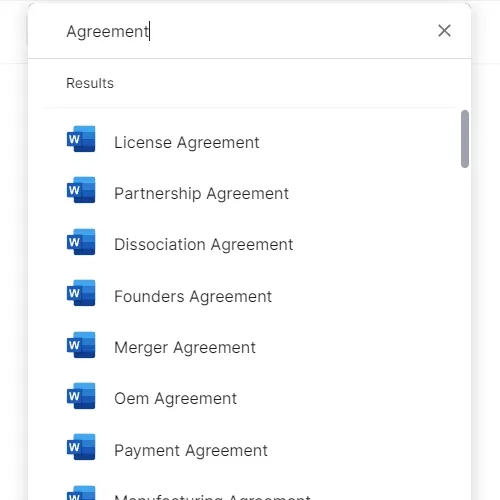
Access over 3,000+ business and legal templates for any business task, project or initiative.

2
Edit and fill in the blanks with AI

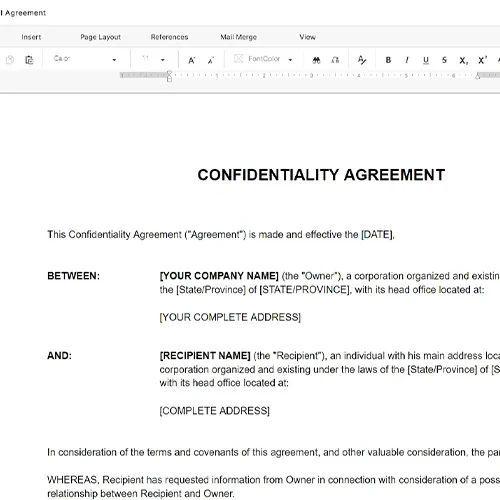
Customize your ready-made business document template and save it in the cloud.

3
Save, Share, Send, Sign

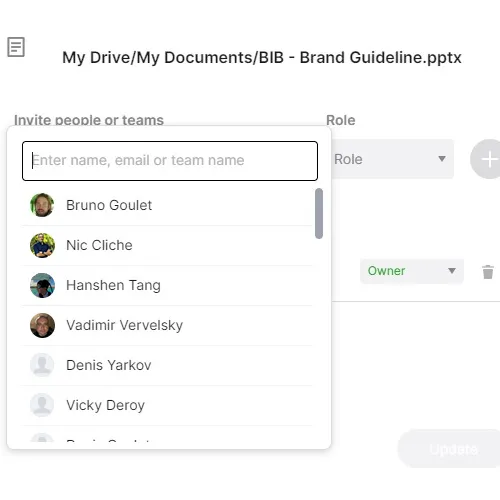
Share your files and folders with your team. Create a space of seamless collaboration.

Save time, save money, and create top-quality documents.

β˜…β˜…β˜…β˜…β˜…

"Fantastic value! I'm not sure how I'd do without it. It's worth its weight in gold and paid back for itself many times."

Managing Director Β· Mall Farm
Robert Whalley
Managing Director, Mall Farm Proprietary Limited
β˜…β˜…β˜…β˜…β˜…

"I have been using Business in a Box for years. It has been the most useful source of templates I have encountered. I recommend it to anyone."

Business Owner Β· 4+ years
Dr Michael John Freestone
Business Owner
β˜…β˜…β˜…β˜…β˜…

"It has been a life saver so many times I have lost count. Business in a Box has saved me so much time and as you know, time is money."

Owner Β· Upstate Web
David G. Moore Jr.
Owner, Upstate Web

Run your business with a system β€” not scattered tools

Stop downloading documents. Start operating with clarity. Business in a Box gives you the Business Operating System used by over 250,000 companies worldwide to structure, run, and grow their business.

Start freeΒ Β·Β No credit card required