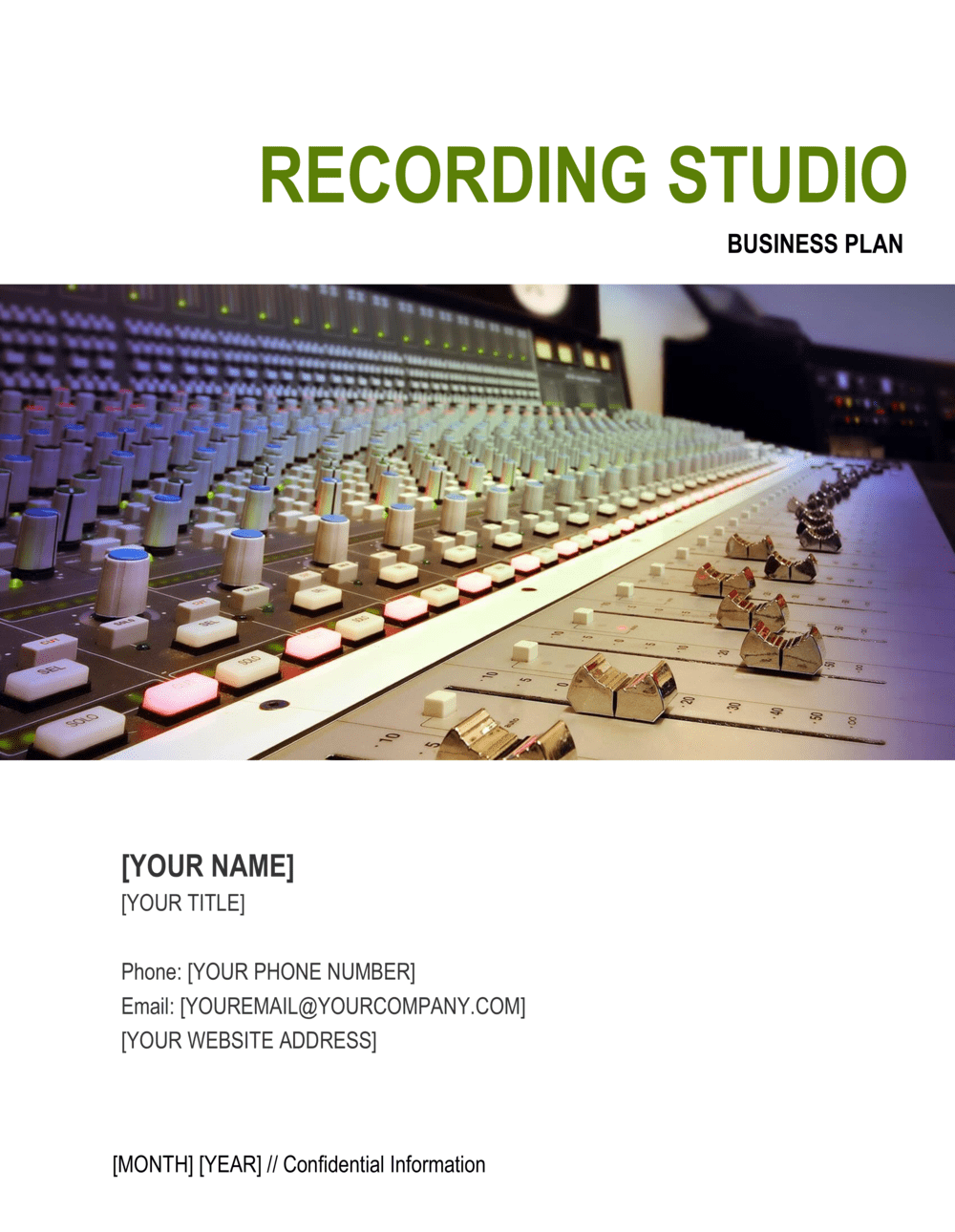
Recording Studio Business Plan Template

Free Word download β€’ Edit online β€’ Save & share with Drive β€’ Export to PDF

30 pagesβ€’2h 35m – 3h 25m to fillβ€’Difficulty: Expert
Learn more ↓
FreeRecording Studio Business Plan Template

At a glance

What it is
A Recording Studio Business Plan is a structured document that maps the vision, service offering, target market, competitive positioning, operational setup, and financial projections for a professional or home-based recording studio. This free Word download gives you a complete, investor-ready framework you can edit online and export as PDF to share with lenders, investors, or business partners.
When you need it
Use it when launching a new recording studio, applying for a small business loan or equipment financing, or presenting a studio expansion to investors or partners. It is also useful when formalizing an existing home studio into a commercial operation.
What's inside
Executive summary, company overview, services and pricing, market and competitive analysis, marketing and client acquisition strategy, studio operations and equipment plan, management team, and three-year financial projections including revenue, costs, and cash flow.

What is a Recording Studio Business Plan?

A Recording Studio Business Plan is a structured document that defines a studio's concept, target clientele, service offering, competitive positioning, physical and technical operations, and three-year financial projections in a single reference document. It covers everything from session pricing and occupancy assumptions to acoustic buildout costs and client acquisition strategy, giving founders, lenders, and investors a complete picture of how the studio will operate and generate revenue. Whether you are converting a spare room into a home studio or building a multi-room commercial facility, the plan translates a creative vision into a financially defensible business case.

Why You Need This Document

Without a written business plan, lenders will not approve studio equipment loans, investors have no basis for evaluating your revenue model, and you have no framework for catching a flawed occupancy assumption before you sign a lease. The most common reason recording studios fail in the first two years is not poor sound quality β€” it is running out of cash before bookings reach breakeven. A properly built business plan forces you to calculate your breakeven in billable hours, stress-test your projections at 70% of expected occupancy, and size your working capital reserve before you spend a dollar on gear. This template gives you the structure to do that analysis systematically, and the finished document to present it credibly to any lender, partner, or investor who asks.

Which variant fits your situation?

If your situation is…Use this template
Opening a commercial multi-room studio targeting signed artists and labelsRecording Studio Business Plan (Commercial)
Launching a home studio focused on independent and emerging artistsHome Recording Studio Business Plan
Adding podcast, voiceover, and audiobook production servicesPodcast Studio Business Plan
Seeking a quick internal planning document or early-stage conceptOne-Page Business Plan
Applying for a bank loan or SBA financing for studio equipmentBusiness Plan for Bank Loan
Planning a broader music production company beyond studio rentalMusic Production Company Business Plan
Pitching investors for a multi-service entertainment venue with a studioEntertainment Business Plan

Common mistakes to avoid

❌ Using national music industry data instead of local market research

Why it matters: A studio's real addressable market is within 20–30 miles. National statistics about the $[X]B music industry have no bearing on how many clients will drive to your studio in Month 1.

Fix: Research local studio count, local average rates, and local artist population from city-specific sources. Ground every market claim in data a lender can verify.

❌ Projecting revenue without underlying booking assumptions

Why it matters: A revenue line that says '$120,000 Year 1' with no session count, rate, or occupancy model behind it will be rejected immediately by any lender evaluating the plan.

Fix: Build revenue from the bottom up: available hours per week Γ— occupancy rate Γ— blended hourly rate Γ— 52 weeks. Show each input as a named assumption.

❌ No use-of-funds breakdown in the funding request

Why it matters: Asking for $80,000 without itemizing buildout, equipment, working capital, and marketing tells the lender you have not thought through execution costs.

Fix: Break the funding request into at least four line items with a dollar amount and percentage of total for each. Attach equipment quotes where available.

❌ Writing the marketing strategy as 'social media and word of mouth'

Why it matters: Every studio owner says this. Without a specific channel, budget, posting cadence, and booking target, it is not a strategy β€” it is a hope.

Fix: Name two or three specific channels with a monthly budget and a measurable goal (e.g., 'Instagram Reels 3Γ—/week to drive 10 inquiry calls per month by Month 4').

❌ Describing the studio by its gear list rather than its market position

Why it matters: Lenders and investors cannot evaluate a gear list. A Neve console does not explain who your clients are, what you charge, or how you fill the room.

Fix: Lead with client type, pricing position, and differentiation. Move equipment details to the operations section where they belong.

❌ Omitting working capital from the funding request

Why it matters: Most studios take 6–12 months to reach consistent occupancy. Without 3–6 months of operating expenses in reserve, a slow booking ramp triggers a cash crisis before the business stabilizes.

Fix: Add a working capital line equal to at least 3 months of fixed operating costs to the funding request, and explain the ramp assumption that justifies the amount.

The 10 key sections, explained

Executive Summary

Company Overview

Services and Pricing

Market Analysis

Competitive Analysis

Marketing and Client Acquisition

Studio Operations and Equipment

Management Team

Financial Projections

Funding Requirements and Use of Funds

How to fill it out

  1. 1

    Define your studio concept and target client

    Start by writing one paragraph describing the type of studio you are building β€” commercial, home-based, niche genre β€” and the specific client segment you will serve. This anchors every section that follows.

    πŸ’‘ Choose a primary niche (hip-hop tracking, podcast production, classical ensemble recording) before writing anything else. Trying to serve everyone in a business plan produces a plan that convinces no one.

  2. 2

    Research your local market and competitors

    Search for recording studios within a 20-mile radius. Document their rates, room count, genre focus, and online reviews. Call two or three as a prospective client to understand their booking process firsthand.

    πŸ’‘ Google Maps, Yelp, and SoundBetter are reliable sources for local studio discovery. Screenshot rate cards where available β€” prices change and you want a timestamped record.

  3. 3

    List every service with a specific price

    Write out tracking, mixing, mastering, podcast, voiceover, and any other service you plan to offer. Assign a rate β€” hourly, per-song, or monthly package β€” to each one before moving on.

    πŸ’‘ Set rates by researching what the two nearest competitors charge, then position 10–15% below, at parity, or above based on your differentiation. Justify the position in the competitive analysis section.

  4. 4

    Build the equipment and operations plan

    List the core equipment required to deliver your services β€” interface or console, DAW, microphones, monitors, acoustic treatment β€” with purchase or lease costs. Describe the booking workflow and any software you will use to manage sessions.

    πŸ’‘ Separate must-have equipment from nice-to-have gear. Fund the must-have list first; add upgrades once revenue supports it. This makes the financial model more credible.

  5. 5

    Model revenue from booking assumptions

    Start with the number of available studio hours per week, estimate a realistic occupancy rate for Year 1 (30–40% is conservative and credible), multiply by your blended hourly rate, and project monthly revenue. Build Year 2 and Year 3 on improving occupancy.

    πŸ’‘ A Year 1 occupancy rate above 60% will draw skepticism from most lenders unless you have pre-booked clients or an existing client base to document.

  6. 6

    List all fixed and variable costs

    Fixed costs include rent or mortgage, utilities, insurance, software subscriptions, and loan repayments. Variable costs include session consumables, mixing engineer fees, and any revenue share. Sum both to find your monthly breakeven in billable hours.

    πŸ’‘ Include 3–6 months of operating expenses as a working capital line in your funding request. Studios ramp slowly β€” running out of cash before reaching breakeven is the most common failure point.

  7. 7

    Write the executive summary last

    Pull one key data point from each completed section β€” concept, market size, competitive advantage, funding ask, and projected revenue β€” and compress them into one to two pages.

    πŸ’‘ The executive summary should be readable in under three minutes. If a lender or investor has to search for the funding ask or the revenue figure, rewrite it.

  8. 8

    Stress-test the financial model before sharing

    Rerun your projections at 70% of your assumed occupancy rate and confirm the business still reaches breakeven within a reasonable timeline. If it does not, revisit your cost structure before presenting the plan.

    πŸ’‘ Show the downside scenario in the plan itself rather than waiting to be asked. It signals financial maturity and builds credibility with lenders.

Frequently asked questions

What is a recording studio business plan?

A recording studio business plan is a structured document that defines the studio's concept, target clientele, service offering, pricing, competitive positioning, operational setup, and financial projections. It functions as both an internal roadmap for launching and running the studio and an external document for securing loans, investor funding, or equipment financing.

What sections should a recording studio business plan include?

A complete plan covers an executive summary, company overview, services and pricing, market and competitive analysis, marketing and client acquisition strategy, operations and equipment plan, management team, financial projections (revenue, costs, and cash flow), and a funding requirements section with use-of-funds breakdown. Plans used for bank loans typically run 20–30 pages plus a financial model appendix.

Do I need a business plan to open a recording studio?

You do not legally need one, but any lender or investor will require it before approving funding. Beyond financing, the planning process itself forces you to validate your local market, set realistic occupancy targets, and calculate your breakeven point β€” all of which reduce the risk of running out of cash in the first year.

How much does it cost to start a recording studio?

Startup costs range from approximately $5,000–$15,000 for a home studio to $50,000–$250,000 for a commercial facility with acoustic buildout, professional consoles, and outboard gear. The largest single expense for most commercial studios is the acoustic treatment and construction work, which typically runs $20,000–$80,000 depending on room size and finish level.

What is a realistic occupancy rate for a new recording studio?

A conservative and credible Year 1 occupancy rate is 30–45% of available hours. Studios with an existing client base or pre-booked anchor clients can project 50–60%. Projecting above 60% in Year 1 without documented pre-bookings will draw skepticism from lenders. Year 2 and Year 3 projections of 60–75% are reasonable for a studio with a working referral network.

What financial projections should a recording studio business plan include?

Include a monthly revenue model for Year 1 built from session count, average session length, and hourly rate assumptions. Add fixed and variable cost schedules, a cash flow statement showing monthly net position, a breakeven analysis in billable hours per month, and annual projections for Years 2 and 3. Lenders will also want to see a sensitivity analysis at 70% of projected occupancy.

How do I price recording studio sessions?

Research the two to five nearest comparable studios and document their published or quoted rates. Set your opening rate 10–20% below the local market average if you are unestablished, at parity if you have comparable credits and equipment, or at a premium if you serve a distinct niche with limited local competition. Rates in US markets typically range from $25–$50/hour for home studios to $75–$200/hour for commercial facilities.

Can I get an SBA loan to open a recording studio?

Yes, recording studios qualify as small businesses and are eligible for SBA 7(a) and SBA 504 loans for equipment and real estate. Lenders will require a complete business plan, personal financial statements, three years of tax returns (if applicable), an equipment list with quotes, and evidence of industry experience. Studios with an existing client base or signed letters of intent from anchor clients have materially higher approval rates.

How long does it take to write a recording studio business plan?

Most founders spend 20–40 hours over two to three weeks on a complete plan. The financial model and market research sections account for roughly half that time. Using a structured template reduces the formatting and organizational work by approximately 60%, leaving your time for the local research and financial modeling that requires original analysis.

How this compares to alternatives

vs Music Production Company Business Plan

A music production company plan covers artist development, label operations, publishing, and distribution alongside studio services. A recording studio business plan focuses specifically on the physical facility β€” room bookings, equipment, and session revenue. Use the studio plan if your primary revenue model is selling studio time; use the production company plan if you are also signing artists, licensing masters, or building a label.

vs General Business Plan

A general business plan template provides a universal structure applicable to any industry. A recording studio-specific plan includes sections tailored to session pricing, occupancy modeling, acoustic buildout costs, and music industry client acquisition β€” reducing the customization work significantly for studio founders.

vs One-Page Business Plan

A one-page plan is a rapid alignment tool for internal planning or early-stage concept testing. It lacks the financial depth, equipment cost detail, and competitive analysis that banks and investors require. Use it to validate the studio concept before committing to the full plan.

vs Financial Projections Template

A standalone financial projections template covers revenue, expenses, and cash flow in detail but provides no market context, competitive analysis, or operational narrative. A lender or investor evaluating a studio loan needs both documents β€” the projections are the evidence; the business plan is the argument for why the numbers are credible.

Industry-specific considerations

Music and Entertainment

Session tracking and mixing for independent artists, label projects, and sync licensing β€” with revenue modeled on hourly rates, project fees, and lockout arrangements.

Podcast and Audio Media

Monthly subscription packages for podcast teams, voiceover production for advertising agencies, and audiobook recording for publishers drive predictable recurring revenue alongside variable session income.

Film and Television Production

ADR, Foley, score recording, and sound design for film and TV projects require specialized acoustic setups and command premium project rates, making crew relationships and industry network central to the plan.

Education and Community Arts

Community studios and nonprofit music programs use the business plan to secure grant funding and demonstrate sustainability through a blend of subsidized session rates, lesson fees, and donor support.

Template vs pro β€” what fits your needs?

PathBest forCostTime
Use the templateIndependent studio founders, home studio operators, and SBA loan applications under $150,000Free2–3 weeks (20–40 hours)
Template + professional reviewCommercial studio buildouts, loans above $150,000, or plans presented to outside investors$500–$2,000 for a financial model review by a CPA or small business advisor3–4 weeks
Custom draftedMulti-room commercial facilities, entertainment venue combinations, or institutional lending above $500,000$3,000–$8,000 for a professional business plan writer with entertainment industry experience4–8 weeks

Glossary

Session Rate
The hourly or half-day fee charged to clients for studio time, including the use of the room, equipment, and a house engineer if included.
Studio Buildout
The construction and acoustic treatment work required to convert a raw space into a professionally functioning recording environment.
Acoustic Treatment
Materials and installation β€” absorption panels, diffusers, bass traps β€” applied to a room to control reflections and achieve a flat, accurate monitoring environment.
DAW (Digital Audio Workstation)
Software used to record, edit, mix, and produce audio; common platforms include Pro Tools, Logic Pro, Ableton Live, and Reaper.
Signal Chain
The sequence of hardware components β€” microphone, preamp, compressor, converter, and DAW β€” through which audio passes during a recording session.
Tracking Room
The live room in a studio where instruments and vocals are recorded, acoustically separated from the control room where the engineer works.
Control Room
The room where the engineer operates the mixing console, monitors, and DAW, with an acoustic window view into the tracking room.
Lockout Rate
A flat weekly or monthly fee a client pays to reserve exclusive access to the studio, typically at a discount to the hourly rate.
Spec Work
Projects a studio takes on at reduced or no cost in exchange for credit, relationship-building, or a revenue share on the final release.
Breakeven Point
The number of billable studio hours per month needed to cover all fixed and variable costs before generating a net profit.
Revenue per Available Hour
Total monthly revenue divided by total available booking hours β€” the recording studio equivalent of hotel occupancy rate.

Part of your Business Operating System

This document is one of 3,000+ business & legal templates included in Business in a Box.

  • Fill-in-the-blanks β€” ready in minutes
  • 100% customizable Word document
  • Compatible with all office suites
  • Export to PDF and share electronically

Create your document in 3 simple steps.

From template to signed document β€” all inside one Business Operating System.
1
Download or open template

Access over 3,000+ business and legal templates for any business task, project or initiative.

2
Edit and fill in the blanks with AI

Customize your ready-made business document template and save it in the cloud.

3
Save, Share, Send, Sign

Share your files and folders with your team. Create a space of seamless collaboration.

Save time, save money, and create top-quality documents.

β˜…β˜…β˜…β˜…β˜…

"Fantastic value! I'm not sure how I'd do without it. It's worth its weight in gold and paid back for itself many times."

Managing Director Β· Mall Farm
Robert Whalley
Managing Director, Mall Farm Proprietary Limited
β˜…β˜…β˜…β˜…β˜…

"I have been using Business in a Box for years. It has been the most useful source of templates I have encountered. I recommend it to anyone."

Business Owner Β· 4+ years
Dr Michael John Freestone
Business Owner
β˜…β˜…β˜…β˜…β˜…

"It has been a life saver so many times I have lost count. Business in a Box has saved me so much time and as you know, time is money."

Owner Β· Upstate Web
David G. Moore Jr.
Owner, Upstate Web

Run your business with a system β€” not scattered tools

Stop downloading documents. Start operating with clarity. Business in a Box gives you the Business Operating System used by over 250,000 companies worldwide to structure, run, and grow their business.

Free Forever PlanΒ Β·Β No credit card required