Receptionist Job Description Template

Free Word download β€’ Edit online β€’ Save & share with Drive β€’ Export to PDF

2 pagesβ€’20–30 min to fillβ€’Difficulty: Standardβ€’Signature requiredβ€’Legal review recommended
Learn more ↓
FreeReceptionist Job Description Template

At a glance

What it is
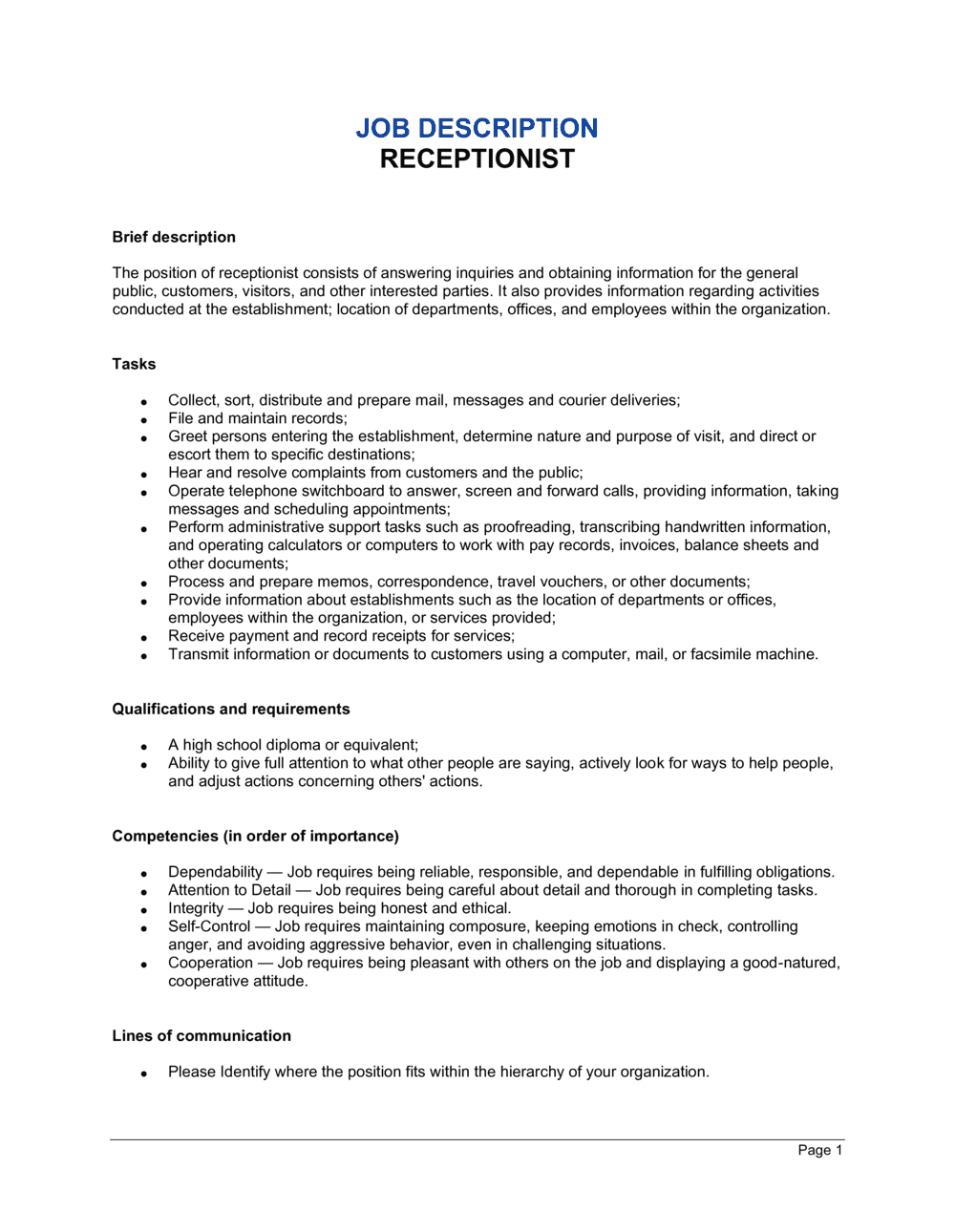
A Receptionist Job Description is a formal document that defines the duties, qualifications, reporting structure, working conditions, and compensation expectations for a receptionist or front desk role. This free Word download gives employers a structured, legally defensible starting point they can edit online and export as PDF to attach to offer letters, employment contracts, or internal HR records.
When you need it
Use it whenever you are recruiting for a receptionist position, updating an existing role to reflect expanded responsibilities, or documenting current duties to support performance management or termination decisions.
What's inside
Job title and department, reporting line, role summary, detailed duties and responsibilities, required and preferred qualifications, physical and scheduling demands, compensation range, and an acknowledgment section for the employee to sign confirming they have received and reviewed the document.

What is a Receptionist Job Description?

A Receptionist Job Description is a formal HR and legal document that defines the duties, qualifications, reporting structure, working conditions, and compensation expectations for a front desk or reception role. It identifies what the employee is expected to do on a daily basis, what skills and experience they must bring, and what physical and scheduling demands the role places on them β€” written with enough specificity to support recruiting, performance management, and, when signed, to serve as a legally defensible record of the agreed scope of work. Unlike a casual job posting, a properly prepared job description is retained in the employee's personnel file and referenced throughout the employment relationship.

Why You Need This Document

Without a signed job description, the employer has no documented standard against which to measure performance or justify corrective action. When a termination or discrimination claim arises, the absence of a clear, contemporaneous record of what the role required leaves the employer relying on verbal accounts that are difficult to substantiate. A complete receptionist job description β€” with physical demands labeled as essential functions, qualifications separated into required and preferred, and an FLSA classification stated explicitly β€” closes the gaps that plaintiffs' attorneys and labor regulators look for first. For roles with access to client data, patient records, or confidential business information, the confidentiality section also sets the foundation for a separate NDA. This template gives you a compliant, field-tested starting point you can tailor in minutes and put in front of a new hire before their first day.

Which variant fits your situation?

If your situation is…Use this template
Hiring a full-time, permanent front desk receptionistReceptionist Job Description
Filling a temporary or seasonal front desk roleTemporary Employee Job Description
Defining a combined receptionist and administrative assistant roleAdministrative Assistant Job Description
Hiring a medical or dental front desk receptionistMedical Receptionist Job Description
Recruiting a receptionist with office management responsibilitiesOffice Manager Job Description
Posting the role publicly on a job boardJob Posting Template
Formalizing employment terms after the description is acceptedEmployment Contract

Common mistakes to avoid

❌ Omitting the non-contract disclaimer in the acknowledgment

Why it matters: Without explicit language stating the job description is not a contract of employment, a terminated employee in certain jurisdictions may argue the description created an implied promise of continued employment or fixed duties.

Fix: Add a standard disclaimer β€” 'This job description does not constitute a contract of employment and may be modified at the Company's discretion' β€” directly above the signature line.

❌ Listing a bachelor's degree as a required qualification

Why it matters: An unjustified degree requirement for an administrative role can expose the employer to disparate-impact discrimination claims under Title VII in the US or equivalent laws in Canada, the UK, and the EU, because degree attainment correlates with race and socioeconomic background.

Fix: Replace degree requirements with the specific skills or knowledge the degree would confer β€” e.g., 'Demonstrated proficiency in business correspondence and scheduling software' β€” unless a degree is genuinely essential.

❌ Failing to document the FLSA classification

Why it matters: Receptionists are almost always non-exempt under the FLSA and entitled to overtime. An undocumented classification leaves the employer without a clear record if the employee later claims unpaid overtime wages.

Fix: Include 'FLSA Classification: Non-Exempt' explicitly in the compensation section of every receptionist job description.

❌ Using vague physical demands language

Why it matters: Descriptions like 'some physical activity required' do not constitute documented essential functions under the ADA. Without specific, measurable language, the employer cannot defend a refusal to hire based on an inability to meet physical requirements.

Fix: Replace vague terms with specific measurements: 'ability to remain seated for up to 7 hours per day,' 'occasionally lift packages up to 25 lbs,' and label each as an essential function.

❌ Mixing required and preferred qualifications in a single list

Why it matters: Recruiters and hiring managers apply unlisted criteria inconsistently when required and preferred qualifications are blended β€” creating documentation gaps that are difficult to defend in a discrimination claim.

Fix: Use clearly labeled separate sections β€” 'Required Qualifications' and 'Preferred Qualifications' β€” and train recruiters to screen only on the required list at the initial stage.

❌ Skipping the signature before the start date

Why it matters: A job description signed after the employee begins work may not be enforceable in common-law jurisdictions because the employee provided no new consideration for any obligations imposed after starting.

Fix: Collect the signed acknowledgment block on or before day one of employment and file it immediately in the employee's HR record alongside the signed offer letter and employment contract.

The 10 key clauses, explained

Job Title, Department, and Location

In plain language: States the official job title, the department the role belongs to, and the primary work location β€” including whether remote or hybrid work is permitted.

Sample language
Job Title: Receptionist | Department: Administration | Reports To: Office Manager | Location: [OFFICE ADDRESS] | Work Arrangement: On-site, Monday–Friday

Common mistake: Using an informal title like 'Front Desk Person' instead of the official HR title. Inconsistency between the job description and payroll records creates classification problems and complicates unemployment or workers' compensation claims.

Role Summary

In plain language: A 3–5 sentence overview of why the position exists, what it achieves for the organization, and how it fits into the team β€” without listing every duty.

Sample language
The Receptionist serves as the first point of contact for all visitors, clients, and callers at [COMPANY NAME]. This role is responsible for creating a professional first impression, routing inquiries efficiently, and supporting administrative operations for the [DEPARTMENT] team.

Common mistake: Writing a role summary that is identical to the duties list β€” restating tasks instead of explaining the purpose and value of the role. This signals poor role design and makes the posting less attractive to qualified candidates.

Essential Duties and Responsibilities

In plain language: A prioritized list of the core tasks the employee must perform, ordered from most to least time-consuming, with enough specificity to support performance measurement.

Sample language
Answer and direct all incoming calls using the company's multi-line phone system ([SYSTEM NAME]); greet and register visitors in the visitor management system ([SYSTEM NAME]); receive, sort, and distribute daily mail and courier deliveries; schedule and confirm appointments using [CALENDAR SYSTEM]; maintain the reception area in a clean and orderly condition at all times.

Common mistake: Ending the duties list with 'and other duties as assigned' without specifying that such duties must be consistent with the role's essential functions. Courts have found this language insufficient to justify significantly expanded or changed responsibilities.

Required Qualifications

In plain language: The minimum education, experience, certifications, and technical skills a candidate must have on day one to perform the role β€” anything listed here can be used to disqualify applicants.

Sample language
High school diploma or GED required. Minimum [X] years of experience in a customer-facing administrative or reception role. Proficiency in Microsoft Office Suite (Word, Outlook, Excel). Demonstrated ability to manage a multi-line phone system. Fluency in written and spoken English required.

Common mistake: Listing a bachelor's degree as a minimum requirement for a receptionist role without documented business justification. In jurisdictions with disparate-impact protections, an unjustified degree requirement can expose the employer to discrimination claims.

Preferred Qualifications

In plain language: Skills, experience, or certifications that are desirable but not disqualifying β€” clearly separated from required qualifications to avoid misuse in screening.

Sample language
Associate's degree in Business Administration or a related field preferred. Experience with [CRM / VISITOR MANAGEMENT SOFTWARE] preferred. Bilingual proficiency in [SECOND LANGUAGE] is an asset. Prior experience in a [INDUSTRY] environment preferred.

Common mistake: Blending required and preferred qualifications into a single list. Candidates and recruiters cannot tell which criteria are non-negotiable, leading to inconsistent screening and potential discrimination claims.

Physical and Environmental Demands

In plain language: Describes the physical requirements of the role β€” sitting, standing, lifting, screen time β€” and any environmental conditions, framed as essential functions to comply with ADA and equivalent laws.

Sample language
This role requires the ability to remain seated at a workstation for up to [X] hours per day, answer telephone calls continuously, and occasionally lift packages weighing up to [X] lbs. The work environment is an indoor, climate-controlled office with moderate noise levels.

Common mistake: Omitting physical demands entirely or stating them vaguely. Without specific language, employers cannot defend decisions to decline a candidate who cannot perform a documented essential physical function.

Work Schedule and Attendance Requirements

In plain language: States the standard hours, days of the week, and any flexibility or coverage requirements β€” including whether the role requires overtime, holiday coverage, or on-call availability.

Sample language
Standard schedule: Monday–Friday, [START TIME]–[END TIME], [X] hours per week. Occasional overtime may be required during peak periods. The employee is expected to maintain reliable, punctual attendance as the role provides essential front desk coverage during business hours.

Common mistake: Failing to state that consistent attendance is an essential function. Without this language, disciplinary action for repeated tardiness or absences is harder to defend, especially if the employee claims a disability-related accommodation.

Compensation and Benefits

In plain language: States the salary or hourly range for the role, FLSA classification (exempt or non-exempt), and references to benefits eligibility β€” without locking in specific benefit terms.

Sample language
Compensation: $[MIN]/hr – $[MAX]/hr, commensurate with experience. FLSA Classification: Non-Exempt (eligible for overtime). Benefits: Eligible to participate in the Company's standard benefits program as in effect from time to time, including health, dental, and PTO.

Common mistake: Omitting the FLSA classification on a receptionist job description. Receptionists are almost always non-exempt β€” failing to document this exposes the employer to unpaid overtime claims.

Confidentiality and Professional Conduct

In plain language: Sets expectations for discretion regarding company information, visitor details, and client data β€” and references any separate confidentiality agreement the employee will sign.

Sample language
The Receptionist will be exposed to confidential information regarding clients, visitors, and internal company operations. Employee is expected to handle all such information with strict discretion and in accordance with the Company's confidentiality policies and any applicable data protection laws. A separate Confidentiality Agreement may be required as a condition of employment.

Common mistake: Relying solely on the job description's confidentiality language instead of executing a separate NDA or confidentiality agreement. Job descriptions are rarely considered binding contracts on their own; a standalone agreement is far more enforceable.

Acknowledgment and Signature

In plain language: A signed block confirming the employee has received, read, and understood the job description β€” and that it does not constitute a contract of employment.

Sample language
I, [EMPLOYEE NAME], acknowledge that I have received and reviewed this Job Description dated [DATE]. I understand that this document does not constitute a contract of employment and that my duties may be modified at the Company's discretion with reasonable notice. Employee Signature: _________________ Date: __________ Supervisor Signature: _________________ Date: __________

Common mistake: Omitting the disclaimer that the job description is not a contract of employment. Without it, a terminated employee may argue the description created an implied promise of continued employment, particularly in states with narrower at-will protections.

How to fill it out

  1. 1

    Enter the official job title and reporting structure

    Use the exact job title as it will appear in payroll and HR systems. Confirm the direct reporting line β€” typically an Office Manager or HR Director β€” and record the primary work location.

    πŸ’‘ Align the title with your internal job-leveling framework before publishing. Mismatched titles between the description and offer letter create confusion during onboarding and background checks.

  2. 2

    Write a role summary focused on purpose, not tasks

    Draft 3–5 sentences explaining why the role exists and what it contributes to the organization. Save the task list for the duties section.

    πŸ’‘ Frame the summary around the candidate β€” what they will own and impact β€” rather than what the company needs. This consistently improves application quality.

  3. 3

    List essential duties in order of time allocation

    Identify the 6–10 tasks that define at least 80% of the role's daily work. Order them from most to least time-intensive and use specific, action-verb-first language.

    πŸ’‘ For each duty, ask: 'If we removed this task, would the role still exist?' If yes, it may not be essential β€” move it to a separate 'additional duties' note.

  4. 4

    Separate required from preferred qualifications

    List only genuinely necessary qualifications as 'required' β€” anything you would waive for an exceptional candidate belongs in 'preferred.' Use clear headings for both.

    πŸ’‘ Review required qualifications against the disparate-impact risk before publishing. A bachelor's degree requirement for a front desk role is difficult to defend without a documented business necessity.

  5. 5

    Document physical demands with specific measurements

    Describe sitting, standing, lifting, and screen time requirements using specific numbers (e.g., 'lift up to 25 lbs occasionally') rather than vague terms like 'light physical activity.'

    πŸ’‘ Frame physical demands as essential functions explicitly β€” 'The ability to [X] is an essential function of this role' β€” to support accommodation decisions and potential adverse action.

  6. 6

    State the FLSA classification and compensation range

    Confirm the role is non-exempt (as it almost always is for receptionists), state the hourly or salary range, and reference benefits eligibility without locking in specific plan terms.

    πŸ’‘ Check your state or province's pay transparency laws before finalizing β€” California, Colorado, New York, and others require a posted salary range on job postings and descriptions.

  7. 7

    Add the confidentiality expectations and NDA reference

    Include a paragraph on discretion expectations and note that a separate confidentiality agreement will be required. Do not rely on this clause as a standalone NDA.

    πŸ’‘ If your receptionist will handle HIPAA-covered patient information or financial data, reference the specific regulatory framework by name in this section.

  8. 8

    Obtain signatures before or on the first day

    Have both the employee and their supervisor sign and date the acknowledgment block before or on day one of employment. File the signed copy in the employee's HR record.

    πŸ’‘ Use Business in a Box eSign to timestamp the signing and generate a tamper-evident PDF for your records β€” critical if the description is later used in a performance or termination proceeding.

Frequently asked questions

What is a receptionist job description?

A receptionist job description is a formal document that defines the duties, qualifications, reporting line, working conditions, and compensation expectations for a front desk or reception role. It serves as the authoritative record of what the position requires β€” used in recruiting, onboarding, performance reviews, and, when signed, as a documented basis for corrective action or termination.

What duties should be included in a receptionist job description?

Core duties for most receptionist roles include answering and routing multi-line phone calls, greeting and registering visitors, managing incoming mail and deliveries, scheduling appointments, maintaining the reception area, and supporting basic administrative tasks for the broader team. Industry-specific duties β€” such as patient check-in for medical offices or client intake for law firms β€” should be added to reflect the actual role. Duties should be ordered from most to least time-intensive and use action-verb-first language.

Is a receptionist job description a legally binding contract?

In most jurisdictions, a job description is not a contract of employment on its own. It documents the role's requirements but does not create an obligation to continue employing the individual or limit the employer's right to modify duties with reasonable notice. To make this clear and protect the employer, the acknowledgment section should include an explicit disclaimer confirming the description is not a contract of employment.

Do I need to include a salary range in a receptionist job description?

In a growing number of jurisdictions β€” including California, Colorado, New York, Illinois, and Washington β€” employers are legally required to disclose a salary or hourly range on job postings and internal role documents. Even where not legally required, including a compensation range reduces unqualified applications, sets expectations early, and supports pay equity compliance. Always check your specific state, province, or country's pay transparency requirements before publishing.

What qualifications should I require for a receptionist?

Minimum qualifications for a standard receptionist role typically include a high school diploma or equivalent, 1–2 years of customer-facing experience, proficiency in Microsoft Office or Google Workspace, and demonstrated ability to manage a multi-line phone system. Industry-specific roles may require additional credentials β€” for example, medical receptionists often need experience with EMR systems and HIPAA awareness. Avoid requiring a bachelor's degree unless you can document a specific business necessity, as it may expose you to disparate-impact claims.

Does a receptionist job description need to be signed?

While not universally required by law, having the employee sign and date an acknowledgment block on the job description creates a documented record that they received, understood, and agreed to the role's requirements. This record is valuable in performance management, disciplinary, and termination proceedings. Obtain the signature on or before the employee's first day to ensure it is supported by valid consideration.

How does a job description protect an employer in a termination?

A signed job description establishes the documented standard against which the employee's performance is measured. When an employer terminates for poor performance or failure to meet duties, a clear job description provides the factual basis for that decision β€” reducing exposure to wrongful termination or discrimination claims. Without one, the employer's case rests on verbal understandings that are harder to prove in proceedings.

How often should a receptionist job description be updated?

Review and update the job description whenever the role's duties change materially β€” new software adoption, expanded responsibilities, or changes in reporting structure. An annual review aligned to performance appraisal cycles is good practice. A description that is more than two years old and has not been updated to reflect actual duties creates a gap between documented and real responsibilities that can complicate performance management.

What is the difference between a job description and a job posting?

A job description is an internal HR document defining the role's duties, qualifications, and conditions β€” it is signed by the employee and retained in their personnel file. A job posting is a public-facing advertisement adapted from the job description to attract applicants, often with marketing language about the company and culture. The job description governs the employment relationship; the job posting generates applications. Both should reflect consistent and accurate information about the role.

How this compares to alternatives

vs Employment Contract

An employment contract is the binding legal agreement governing the entire employment relationship β€” compensation, IP, non-compete, termination, and severance. A job description defines role duties and qualifications and is attached as a schedule or exhibit to the contract. The contract creates the legal obligations; the job description defines the performance standard. Both are needed; neither replaces the other.

vs Offer Letter

An offer letter confirms the role, start date, and compensation to secure the candidate's acceptance. A job description provides the full operational detail of what the role requires. The offer letter triggers acceptance; the job description governs daily performance expectations and is signed separately, typically on or before the first day of work.

vs Administrative Assistant Job Description

An administrative assistant job description covers a broader scope of organizational support β€” project coordination, document preparation, executive calendar management, and research β€” beyond the front-desk, visitor-facing focus of a receptionist role. Use the receptionist template for primarily customer-facing roles and the administrative assistant template when the position involves substantial behind-the-scenes organizational work.

vs Non-Disclosure Agreement

A job description's confidentiality section sets general conduct expectations around discretion but is not a standalone enforceable confidentiality agreement. An NDA creates explicit, binding legal obligations around specific categories of confidential information with defined consequences for breach. For receptionist roles with access to sensitive client or patient data, a separate NDA executed alongside the job description is strongly recommended.

Industry-specific considerations

Healthcare

Medical receptionists require HIPAA confidentiality language, patient intake procedures, EMR system proficiency, and insurance verification duties documented explicitly.

Legal Services

Law firm receptionists handle client intake, matter number assignment, and highly confidential communications β€” requiring specific conflict-of-interest awareness and attorney-client privilege discretion language.

Retail / Hospitality

Hotel and retail reception roles emphasize point-of-sale system proficiency, extended or variable shift coverage, upselling duties, and multilingual communication expectations.

Corporate / Financial Services

Corporate receptionists in financial services must adhere to visitor credentialing protocols, building security procedures, and may be subject to background check and securities-related compliance requirements.

Jurisdictional notes

United States

Receptionists are almost always classified as non-exempt under the FLSA and must be paid 1.5Γ— their regular rate for hours over 40 per week β€” document this classification explicitly. ADA compliance requires physical demands to be listed as essential functions with specific measurements. California, Colorado, New York, Illinois, and Washington require a posted salary range. California's AB 5 and similar state laws may affect classification of temporary reception staff placed through agencies.

Canada

Each province's Employment Standards Act sets minimum wage, overtime thresholds, and scheduling requirements that must be reflected in the compensation and hours sections. Ontario's Human Rights Code and Alberta's Human Rights Act require reasonable accommodation language tied to specific protected grounds. Quebec employers must provide the job description in French for provincially regulated workplaces. Pay transparency requirements are expanding β€” British Columbia and Prince Edward Island have introduced salary disclosure rules.

United Kingdom

While a job description is not itself a statutory document, it typically forms part of the written statement of employment particulars required under the Employment Rights Act 1996, which must be provided on or before the first day of work. The Equality Act 2010 requires that physical demands and qualification requirements are objectively justified to avoid indirect discrimination. National Living Wage rates apply to most receptionists and must align with the stated compensation range.

European Union

The EU Transparent and Predictable Working Conditions Directive requires that core role information β€” duties, hours, and compensation β€” be provided in writing within seven days of the start date. GDPR implications apply where the receptionist role involves handling visitor or client personal data; a reference to data processing responsibilities and applicable training should be included. Member states such as Germany and France impose works council consultation requirements before issuing or materially changing job descriptions for existing employees.

Template vs lawyer β€” what fits your deal?

PathBest forCostTime
Use the templateStandard receptionist hires at small to mid-size businesses in a single domestic jurisdictionFree15–30 minutes
Template + legal reviewHealthcare, legal, or financial services employers; multi-location businesses; jurisdictions with active pay transparency or accommodation laws$150–$400 (HR consultant or employment lawyer review)1–3 days
Custom draftedRegulated industries with specific compliance requirements, unionized workplaces, or employers with recent employment litigation exposure$500–$1,500+1–2 weeks

Glossary

Job Description
A formal document listing the duties, qualifications, reporting structure, and conditions of a specific position β€” used in hiring, performance management, and termination.
Essential Functions
The core duties a person must be able to perform, with or without reasonable accommodation, that define the fundamental purpose of the role.
Reporting Structure
The designation of which manager or title the employee reports to directly, establishing the accountability chain for the role.
Reasonable Accommodation
A modification to a job's duties, schedule, or environment that allows a qualified individual with a disability to perform the essential functions.
At-Will Employment
An employment relationship in most US states where either party may end the arrangement at any time for any lawful reason β€” a job description does not create a contract of indefinite employment.
ADA (Americans with Disabilities Act)
US federal law requiring employers with 15 or more employees to provide reasonable accommodations for qualified individuals with disabilities β€” directly relevant to physical demands language in job descriptions.
BFOQ (Bona Fide Occupational Qualification)
A characteristic that is genuinely necessary to perform a job's essential functions β€” the legal basis for including specific physical or scheduling requirements.
Exempt vs. Non-Exempt
US FLSA classification: non-exempt employees (including most receptionists) must receive overtime pay at 1.5Γ— their regular rate for hours worked beyond 40 per week.
Acknowledgment Clause
A signed section confirming the employee has received, read, and understood the job description β€” providing a documented record for performance management or legal proceedings.
Compensation Range
The minimum and maximum salary or hourly rate associated with the role, increasingly required by pay transparency laws in several US states and jurisdictions.
Soft Skills
Interpersonal and behavioral competencies β€” such as verbal communication, discretion, and composure under pressure β€” that are measurable enough to include in a job description if defined specifically.

Part of your Business Operating System

This document is one of 3,000+ business & legal templates included in Business in a Box.

  • Fill-in-the-blanks β€” ready in minutes
  • 100% customizable Word document
  • Compatible with all office suites
  • Export to PDF and share electronically

Create your document in 3 simple steps.

From template to signed document β€” all inside one Business Operating System.
1
Download or open template

Access over 3,000+ business and legal templates for any business task, project or initiative.

2
Edit and fill in the blanks with AI

Customize your ready-made business document template and save it in the cloud.

3
Save, Share, Send, Sign

Share your files and folders with your team. Create a space of seamless collaboration.

Save time, save money, and create top-quality documents.

β˜…β˜…β˜…β˜…β˜…

"Fantastic value! I'm not sure how I'd do without it. It's worth its weight in gold and paid back for itself many times."

Managing Director Β· Mall Farm
Robert Whalley
Managing Director, Mall Farm Proprietary Limited
β˜…β˜…β˜…β˜…β˜…

"I have been using Business in a Box for years. It has been the most useful source of templates I have encountered. I recommend it to anyone."

Business Owner Β· 4+ years
Dr Michael John Freestone
Business Owner
β˜…β˜…β˜…β˜…β˜…

"It has been a life saver so many times I have lost count. Business in a Box has saved me so much time and as you know, time is money."

Owner Β· Upstate Web
David G. Moore Jr.
Owner, Upstate Web

Run your business with a system β€” not scattered tools

Stop downloading documents. Start operating with clarity. Business in a Box gives you the Business Operating System used by over 250,000 companies worldwide to structure, run, and grow their business.

Free Forever PlanΒ Β·Β No credit card required