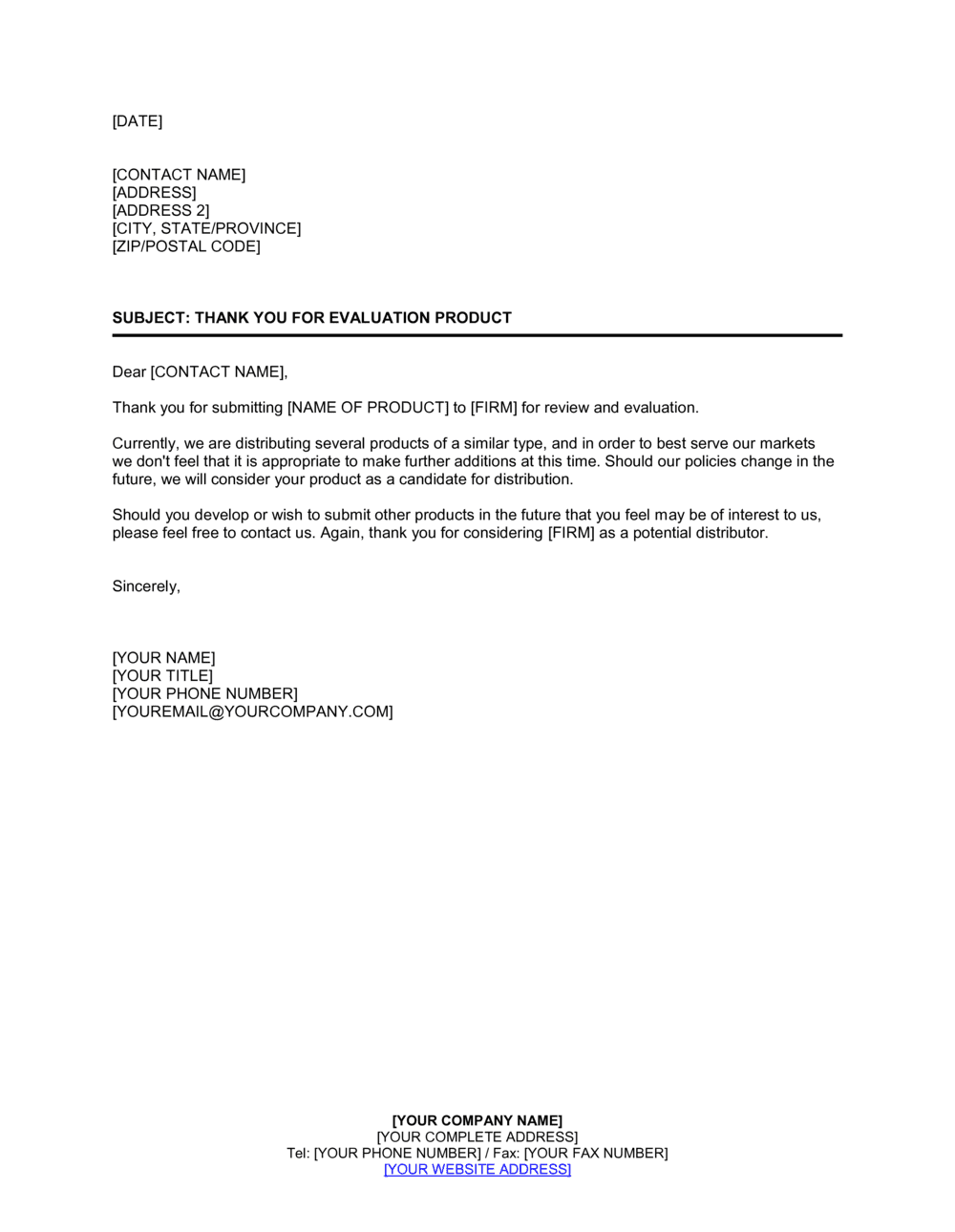
Thank You for Evaluation Product, Product Similar, Declined Template

Free Word download • Edit online • Save & share with Drive • Export to PDF

1 page20–30 min to fillDifficulty: StandardSignature requiredLegal review recommended
Learn more ↓
FreeThank You for Evaluation Product, Product Similar, Declined Template

At a glance

What it is
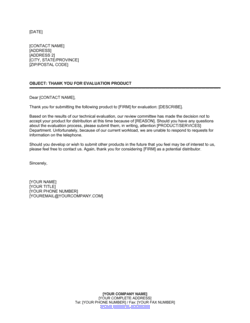
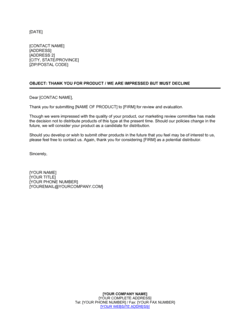
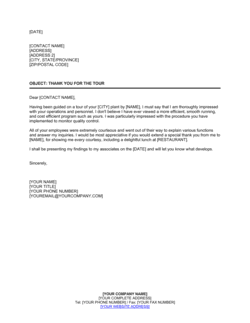
A Thank You for Evaluation — Product Similar Declined letter is a formal written communication a company sends to a vendor or supplier after evaluating a submitted product that closely resembles an existing solution already in use or under consideration. This free Word download gives you a structured, professionally worded letter you can edit online and export as PDF to close the evaluation process on clear, documented terms.
When you need it
Use it when your procurement, product, or purchasing team has completed a formal product evaluation and must decline the submission because an equivalent or substantially similar product is already sourced, contracted, or approved. It is especially important when the vendor has invested significant time or resources in the evaluation and expects a substantive response.
What's inside
The letter includes an acknowledgment of the submission and evaluation effort, a clear statement of the decline decision with the specific reason of product similarity, a professional closing that preserves the vendor relationship, and a signature block establishing authorship and authority.

What is a Thank You for Evaluation — Product Similar Declined Letter?

A Thank You for Evaluation — Product Similar Declined Letter is a formal business communication used to close a vendor product evaluation by notifying the submitting company that their product has been reviewed and declined on the specific basis that a substantially similar product is already sourced, contracted, or approved within the evaluating organization. It serves as the official written record that the evaluation was completed, that a decision was reached, and that the decline is grounded in an identifiable, documented commercial reason rather than an arbitrary or unexplained rejection. The letter typically includes an acknowledgment of the vendor's submission effort, a clear statement of the decision and its basis, a confirmation of how submitted confidential materials will be handled, and a professional closing that does not create implied obligations for future reconsideration.

Why You Need This Document

Without a formal written decline, an evaluated vendor has no definitive record that the process has concluded — and the evaluating company has no documented basis for its decision if the vendor later claims their proprietary specifications were retained and used, that they were treated unfairly, or that the evaluation process was conducted in bad faith. Verbal declines or unanswered follow-ups leave the procurement file incomplete, create ambiguity about whether submitted NDAs have been formally discharged, and expose the company to repeated vendor contact that consumes procurement team resources. A signed, dated letter with a clear reason closes the file cleanly, confirms confidentiality obligations, and protects the company against implied-commitment claims arising from informal communications made during the evaluation. This template gives you the professionally worded structure to complete that step in under 30 minutes, with the right legal language already in place.

Which variant fits your situation?

If your situation is…Use this template
Declining a product because the budget was cut before evaluation concludedDecline Due to Budget Constraints Letter
Declining after evaluation with no specific reason givenGeneral Vendor Rejection Letter
Declining a proposal rather than a physical product submissionRejection of Business Proposal Letter
Declining a bid after a formal RFP processBid Rejection Letter
Declining a vendor but inviting resubmission in a future cycleVendor Evaluation Deferral Letter
Declining and terminating an existing supplier relationshipSupplier Termination Letter
Declining a product sample submitted without a formal evaluation requestUnsolicited Sample Decline Letter

Common mistakes to avoid

❌ Using vague future-commitment language

Why it matters: Phrases like 'we will revisit this in Q3' or 'please resubmit when we begin our next cycle' create an implied contractual obligation to reconsider, which the company may not fulfill — exposing it to a bad-faith claim.

Fix: Use conditional language: 'We encourage you to contact our procurement team if our requirements in this category change' — this signals openness without creating a firm commitment.

❌ Omitting the confidentiality clause when proprietary materials were submitted

Why it matters: If the vendor submitted formulations, pricing models, or technical specifications and receives no acknowledgment that these will be protected, they may claim misappropriation if a similar internal decision is made later.

Fix: Always include the confidentiality clause when any non-public vendor information was received, and specify whether materials will be returned or destroyed.

❌ Giving multiple decline reasons when only one is documented

Why it matters: Each stated reason is a separate ground the vendor can challenge. A reason not fully supported by the evaluation record can be used to argue that the true reason was discriminatory or pretextual.

Fix: State the single most accurate and documented reason — product similarity — and do not add secondary grounds unless they are also clearly evidenced in the evaluation file.

❌ Sending the letter without an authorised signatory

Why it matters: A decline letter signed by a junior employee who lacks procurement authority may be challenged as insufficient notice, allowing the vendor to argue the evaluation is still open.

Fix: Confirm signatory authority before drafting. Route for signature through the procurement manager or the individual named in the vendor engagement agreement.

❌ Failing to reference the specific submission date

Why it matters: Without a specific date, the letter cannot be conclusively linked to the vendor's submission in the procurement record, creating ambiguity about which product or which evaluation cycle is being closed.

Fix: Always reference both the product name and the original submission date in the subject line and in the evaluation-completion clause.

❌ Including evaluative commentary on product quality

Why it matters: Any language suggesting the product is inferior, uncompetitive, or below standard can form the basis of a trade-libel or defamation claim, particularly if the vendor can show the statement was shared beyond the immediate recipient.

Fix: Limit the decline reason to the similarity basis and include the no-adverse-reflection clause. Never characterize the product's quality, even in positive hedging terms like 'while the product is adequate.'

The 9 key clauses, explained

Date, Reference, and Addressee Block

In plain language: Establishes the formal date of the letter, a unique reference number for file tracking, and the full legal name and address of the vendor being notified.

Sample language
[DATE] | Ref: [EVALUATION REFERENCE NUMBER] | [VENDOR COMPANY NAME] | Attn: [CONTACT NAME, TITLE] | [VENDOR ADDRESS]

Common mistake: Using only a first name or informal contact in the addressee block. Without the vendor's full legal entity name, the letter cannot be linked definitively to the commercial relationship in the event of a dispute.

Subject Line and Evaluation Identification

In plain language: Identifies the specific product or product category that was evaluated so the vendor has no ambiguity about which submission is being declined.

Sample language
Re: Evaluation of [PRODUCT NAME / PRODUCT CATEGORY] — Submission Dated [DATE OF SUBMISSION]

Common mistake: Using a generic subject line like 'Your recent submission.' If the vendor has submitted multiple products, this creates confusion and may trigger follow-up inquiries that consume additional procurement time.

Acknowledgment of Submission and Effort

In plain language: Opens the letter by thanking the vendor for participating in the evaluation and acknowledging the time and resources they invested in the submission.

Sample language
Thank you for submitting [PRODUCT NAME] for our evaluation and for the time and effort your team invested in preparing the submission dated [DATE]. We appreciate the opportunity to review your product.

Common mistake: Skipping the acknowledgment entirely and opening with the decline. An abrupt opening is perceived as unprofessional and damages vendor relationships that may be valuable in future procurement cycles.

Statement of Evaluation Completion

In plain language: Confirms that the evaluation was completed fully and fairly, establishing that the decision follows a genuine assessment process rather than a summary dismissal.

Sample language
After completing our evaluation process, which included a review of [PRODUCT SPECIFICATIONS / SAMPLES / PRICING / TECHNICAL DATA], our procurement team has reached a final decision regarding this submission.

Common mistake: Omitting this clause and jumping directly to the reason. Without confirming the evaluation was completed, the vendor may argue that the process was not genuine and seek to re-open the submission.

Decline Decision and Reason — Product Similarity

In plain language: States clearly and unambiguously that the product is declined, and gives the specific reason that a substantially similar product is already in use or under contract.

Sample language
We regret to inform you that we are unable to proceed with [PRODUCT NAME] at this time. Following our evaluation, we determined that [PRODUCT NAME] is substantially similar to a product we currently source from an existing supplier, and we do not have a current requirement for an additional or alternative solution in this category.

Common mistake: Adding qualifiers like 'at this stage' or 'for now' without intending to reopen the evaluation. These phrases create a reasonable expectation of future reconsideration and may generate repeated follow-up from the vendor.

Confidentiality and Return of Information

In plain language: Confirms that any confidential information, samples, or proprietary materials submitted by the vendor will be treated as confidential and, where applicable, returned or destroyed.

Sample language
Any confidential information, product samples, technical documentation, or proprietary materials submitted during the evaluation process will be [returned to you / securely destroyed] in accordance with our obligations under [the NDA dated DATE / our standard information-handling policy].

Common mistake: Omitting this clause when the vendor submitted detailed formulations, pricing schedules, or trade-secret-level specifications. Without an explicit confidentiality acknowledgment, the vendor may claim the company retained and misused their information.

No Adverse Reflection Statement

In plain language: Clarifies that the decline is based solely on the similarity of the product to an existing solution and does not reflect negatively on the quality of the vendor's product or company.

Sample language
This decision is based solely on our existing product coverage in this category and is not a reflection of the quality of [PRODUCT NAME] or the capabilities of [VENDOR COMPANY NAME]. We have no adverse findings regarding your product.

Common mistake: Including this clause but then adding conditional language that implies quality concerns. Even a subtle qualifier — 'while the product meets basic standards' — can be read as a negative assessment and used in a defamation or trade-libel claim.

Future Engagement Clause

In plain language: Leaves the door open for future consideration in a controlled way — either by inviting the vendor to submit in a different category or by specifying conditions under which re-evaluation might occur.

Sample language
We encourage you to consider submitting products in other categories where we may have an unmet need, or to contact our procurement team in [TIMEFRAME, e.g., 12 months] should our requirements in this category change.

Common mistake: Promising a specific future review date or guaranteed reconsideration. A firm future commitment creates a contractual expectation that, if not honored, exposes the company to a bad-faith claim.

Signatory and Authority Block

In plain language: Closes the letter with the full name, title, department, and signature of the authorised person sending the letter, confirming they have authority to communicate this decision.

Sample language
Sincerely, [SIGNATORY FULL NAME] | [TITLE] | [DEPARTMENT] | [COMPANY LEGAL NAME] | [DATE SIGNED]

Common mistake: Having a junior team member sign without confirming they are an authorised signatory. If the vendor disputes the decision, they may argue the declination was not communicated by someone with authority to bind the company's procurement process.

How to fill it out

  1. 1

    Complete the header with legal names and reference numbers

    Enter the letter date, a unique evaluation reference number from your procurement tracking system, and the vendor's full legal entity name and address. Use the same reference number on all documents in the evaluation file.

    💡 Assign reference numbers at the time the vendor submits — not at the time of decline. Consistent numbering makes the full evaluation file retrievable for audit without searching by vendor name.

  2. 2

    Identify the specific product in the subject line

    Enter the exact product name or SKU and the date of the original submission. If the vendor submitted multiple items, list each one that is being declined in this letter.

    💡 If only one of several submitted products is declined, note this explicitly to prevent the vendor from assuming all submissions were rejected.

  3. 3

    Draft the acknowledgment using the vendor's submission date

    Reference the specific date of submission in the acknowledgment clause. This ties the letter to a documented event in the procurement record and prevents the vendor from later claiming the submission was never formally received.

    💡 If the vendor attended a presentation or demonstration, acknowledge that specifically — it signals you invested time in a genuine review.

  4. 4

    Confirm the evaluation scope in the completion statement

    List the types of materials reviewed — product specifications, pricing proposals, samples, or technical datasheets. This establishes that the evaluation was substantive and not a formality.

    💡 Keep this clause factual. Do not include evaluative language like 'impressive' or 'limited' — it can undermine the neutrality of the decline.

  5. 5

    State the decline and reason precisely

    Use the product similarity language in the template verbatim or with minimal tailoring. Avoid adding additional reasons — each additional ground creates an additional avenue for the vendor to argue or contest.

    💡 One clear, accurate reason is more defensible than two reasons that may not both be fully supported by the evaluation record.

  6. 6

    Address confidentiality obligations

    Check whether an NDA is in place. If yes, reference it by date. If no formal NDA exists, state that you will handle submitted materials in accordance with your standard information-handling policy.

    💡 Confirm with your legal team whether any samples or physical prototypes need to be returned before sending the letter, so you can state the disposition accurately.

  7. 7

    Choose your future engagement language carefully

    Decide whether to invite future submissions in other categories, in this category after a defined period, or not at all. Use the template language that matches your actual intent — do not invite future contact if your team does not intend to follow up.

    💡 If the vendor is a strategic relationship you want to preserve, name a specific product category or timeline. Vague open-door language generates more follow-up with less result than a specific invitation.

  8. 8

    Obtain the correct authorised signatory before sending

    Confirm with your legal or procurement policy who is authorised to send formal vendor communications. Have that person sign the letter before it is transmitted — do not send before the signature is in place.

    💡 Store the signed PDF alongside the evaluation file. If the vendor later disputes the decline, the signed original is your primary evidence that the communication was formal and authorised.

Frequently asked questions

What is a 'thank you for evaluation — product similar declined' letter?

It is a formal written communication sent by a company to a vendor after completing a product evaluation, informing them that their submission has been declined because the product is substantially similar to one already sourced or contracted. It acknowledges the vendor's submission effort, states the decline clearly, and closes the evaluation on documented terms without implying future commitment. The letter protects the buyer from implied obligations while preserving the vendor relationship professionally.

Is this letter legally binding?

The letter itself is not a contract — it does not create new obligations between the parties. However, it is a legally significant document because it formally closes the evaluation, triggers any return-of-information obligations under an existing NDA, and establishes the company's documented basis for the decline. In jurisdictions where pre-contractual good-faith obligations apply, a well-worded letter reduces the risk of claims that the evaluation was conducted in bad faith.

Do I need to give a reason for declining a vendor's product?

In most jurisdictions, private companies are not legally required to give reasons for declining a commercial submission unless a specific regulatory framework (such as a public-sector procurement regulation) applies. However, giving a clear and accurate reason — such as product similarity — is strongly recommended because it closes the vendor's avenue for arguing the rejection was arbitrary, discriminatory, or in bad faith. It also reduces the volume of follow-up inquiries.

What should I do with confidential information submitted during the evaluation?

If you signed an NDA before the evaluation, you are bound by its return and destruction obligations — follow them and reference them in the letter. If no NDA exists, your company's standard information-handling policy applies. In either case, the decline letter should acknowledge that confidential materials will be handled appropriately. Retaining and using vendor-submitted trade secrets after declining the product is a significant legal risk in all major jurisdictions.

Can the vendor challenge a product evaluation decline?

In private commercial transactions, vendors have limited grounds to formally challenge a decline decision. Potential grounds include breach of an NDA, misappropriation of submitted trade secrets, discrimination under applicable procurement regulations, or bad faith in jurisdictions with pre-contractual obligations. A well-documented evaluation process, a clearly worded decline letter, and proper handling of submitted materials are the most effective protections against any challenge.

Should the decline letter be sent by email or post?

For formal vendor evaluations, sending a signed PDF by email with read receipt, and retaining a copy in the procurement file, is the standard practice in most industries. For high-value evaluations, regulated procurement environments, or situations where the vendor may dispute the decision, consider following up with a physical copy by tracked delivery to establish unambiguous receipt. The method used should match the formality of the original engagement.

What is the difference between this letter and a general vendor rejection letter?

A general vendor rejection letter declines a submission without specifying a particular reason. This letter is specifically tailored to the situation where an evaluation was completed and the basis for decline is product similarity to an existing solution. The similarity-specific reason is more defensible, reduces vendor follow-up, and carries less risk of implying a quality finding than a generic declination. It is appropriate when you can accurately and specifically document that the reason is duplicate coverage.

Do I need a lawyer to send this letter?

For routine vendor evaluations in standard commercial categories, a well-prepared template is typically sufficient. Legal review is recommended when the evaluation involved a non-disclosure agreement with complex return-of-information obligations, when the vendor is a strategic partner or significant supplier, when the submitted product involved patentable technology or trade secrets, or when the vendor has already indicated a potential dispute. A 30-minute legal review typically costs $150–$300 and is worthwhile in any higher-stakes evaluation.

Should this letter be marked 'without prejudice'?

In most cases, a standard product decline letter does not need to be marked without prejudice — that designation is typically reserved for settlement negotiations. However, if the evaluation process has already generated a dispute or the vendor has made legal threats, marking the letter without prejudice may be appropriate to prevent it from being used as an admission in subsequent proceedings. Consult your legal counsel if there is any existing tension with the vendor before sending.

How this compares to alternatives

vs Rejection of Business Proposal Letter

A business proposal rejection declines a broad commercial proposal — a partnership, service arrangement, or strategic initiative — rather than a specific product submission. The product similarity decline letter is narrower in scope, focused on a product evaluation outcome, and includes specific language around confidentiality of submitted specifications and sample materials. Use the proposal rejection for service or partnership declines; use this letter for product submissions.

vs Supplier Termination Letter

A supplier termination letter ends an existing commercial relationship and carries contractual notice obligations, liability provisions, and transition requirements. This letter declines a new submission before any commercial relationship is formed — no existing contract is terminated, and no notice period applies. Using a termination letter to decline an evaluation overstates the relationship and can imply contractual obligations that do not exist.

vs Non-Disclosure Agreement (NDA)

An NDA governs the confidentiality obligations that apply during the evaluation process. This decline letter is a downstream document that closes the evaluation and references those obligations. The two documents work together: the NDA creates the confidentiality framework; the decline letter triggers the return-of-information and end-of-use obligations the NDA established.

vs Bid Rejection Letter

A bid rejection letter is used in formal tendering or RFP processes and typically must comply with public procurement regulations, mandatory feedback requirements, and standstill periods. This product evaluation decline letter is designed for private commercial product evaluations with no regulatory framework, where the company has more discretion over the format and content of its communication.

Industry-specific considerations

Retail and Consumer Goods

Category buyers routinely decline new product submissions that duplicate existing SKUs or violate planogram constraints, making a documented similarity-based decline essential for clean vendor records.

Technology and SaaS

Procurement and IT teams evaluating software tools or integrations frequently encounter submissions that overlap with existing licensed platforms, requiring a formal decline to close the evaluation and address any shared technical data.

Manufacturing and Industrial

Component and materials buyers decline substitute supplier submissions when approved vendor lists are already closed for a given specification, and must document the similarity basis to satisfy quality management system requirements.

Healthcare and Life Sciences

Hospital and clinic procurement teams evaluating medical devices or consumables must document decline decisions carefully to satisfy regulatory audit requirements and protect against vendor claims involving patented formulations or device specifications.

Jurisdictional notes

United States

US private companies are generally free to decline vendor submissions for any non-discriminatory commercial reason. Federal trade secret law (Defend Trade Secrets Act) and state-level equivalents require companies to handle submitted proprietary information carefully. In regulated industries such as healthcare (GPO compliance) or federal contracting, additional documentation requirements may apply to vendor evaluation processes.

Canada

Canadian commercial law recognizes an implied duty of good faith in contractual dealings under organizing principles established in Bhasin v. Hrynew. While this applies primarily to existing contracts, a pattern of misleading conduct during an evaluation process could attract liability. Quebec civil law imposes pre-contractual good faith obligations more explicitly than common-law provinces. Confidential information submitted during evaluations may be protected by common law or by a signed NDA regardless of province.

United Kingdom

In the UK, private commercial evaluations are generally governed by freedom of contract, and companies may decline submissions for legitimate commercial reasons. The Misrepresentation Act 1967 and common law on negligent misstatement mean that if the evaluating company made representations during the process that induced the vendor to invest heavily, care should be taken in drafting the decline. Public sector procurements are governed by the Procurement Act 2023 and require specific feedback and standstill obligations.

European Union

Several EU member states impose pre-contractual good faith (culpa in contrahendo) obligations that can make a company liable for a vendor's wasted evaluation costs if the process was not conducted in good faith. GDPR applies to any personal data submitted by the vendor as part of the evaluation, including contact information and personnel profiles — ensure submitted data is handled and deleted in accordance with your GDPR data retention policy. Public procurement in the EU is governed by Directive 2014/24/EU with mandatory notification and debriefing obligations.

Template vs lawyer — what fits your deal?

PathBest forCostTime
Use the templateRoutine vendor product evaluations in standard commercial categories with no existing NDA disputesFree15–30 minutes
Template + legal reviewEvaluations involving NDAs, patented technology, or strategic vendor relationships where a dispute is possible$150–$300 for a 30-minute legal review1–2 business days
Custom draftedHigh-value evaluations involving trade secrets, regulated procurement environments, or vendors who have signaled a legal challenge$500–$1,5003–5 business days

Glossary

Product Evaluation
A formal internal process by which a company assesses a vendor's submitted product against predefined technical, commercial, and operational criteria.
Similar Product Basis
The stated reason for declining a submission, indicating that the product duplicates or closely resembles a solution already contracted or approved.
Vendor Relationship Management
The structured process of initiating, maintaining, and concluding commercial relationships with external suppliers in a way that protects the buyer's interests and reputation.
Implied Commitment
An unwritten obligation that could be inferred from informal communications — a key risk in vendor decline letters if language is not carefully controlled.
Procurement Cycle
The end-to-end process from identifying a need through specification, sourcing, evaluation, selection, and contract award or rejection.
Without Prejudice
A designation indicating that the communication cannot be used as evidence of an admission or obligation in any future dispute or negotiation.
Confidential Information
Proprietary data — product specifications, pricing, formulations, or trade secrets — disclosed by the vendor during the evaluation process.
Non-Disclosure Obligation
A duty, arising from an NDA or implied by law, to keep confidential information received during evaluation from being shared or used outside the evaluation context.
Authorised Signatory
An individual with documented authority to bind the company in formal written communications, including vendor decisions.
Evaluation Record
The documented file of a vendor submission and the company's assessment, retained for audit, compliance, and dispute-resolution purposes.

Part of your Business Operating System

This document is one of 3,000+ business & legal templates included in Business in a Box.

  • Fill-in-the-blanks — ready in minutes
  • 100% customizable Word document
  • Compatible with all office suites
  • Export to PDF and share electronically

Create your document in 3 simple steps.

From template to signed document — all inside one Business Operating System.
1
Download or open template

Access over 3,000+ business and legal templates for any business task, project or initiative.

2
Edit and fill in the blanks with AI

Customize your ready-made business document template and save it in the cloud.

3
Save, Share, Send, Sign

Share your files and folders with your team. Create a space of seamless collaboration.

Save time, save money, and create top-quality documents.

★★★★★

"Fantastic value! I'm not sure how I'd do without it. It's worth its weight in gold and paid back for itself many times."

Managing Director · Mall Farm
Robert Whalley
Managing Director, Mall Farm Proprietary Limited
★★★★★

"I have been using Business in a Box for years. It has been the most useful source of templates I have encountered. I recommend it to anyone."

Business Owner · 4+ years
Dr Michael John Freestone
Business Owner
★★★★★

"It has been a life saver so many times I have lost count. Business in a Box has saved me so much time and as you know, time is money."

Owner · Upstate Web
David G. Moore Jr.
Owner, Upstate Web

Run your business with a system — not scattered tools

Stop downloading documents. Start operating with clarity. Business in a Box gives you the Business Operating System used by over 250,000 companies worldwide to structure, run, and grow their business.

Start free · No credit card required