Checklist Internal Audit

Free download β€’ Use as a template β€’ Print or share

2 pagesβ€’20–30 min to useβ€’Difficulty: Standard
Learn more ↓
FreeChecklist Internal Audit Template

At a glance

What it is
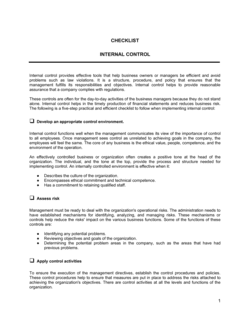
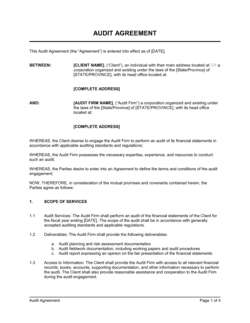
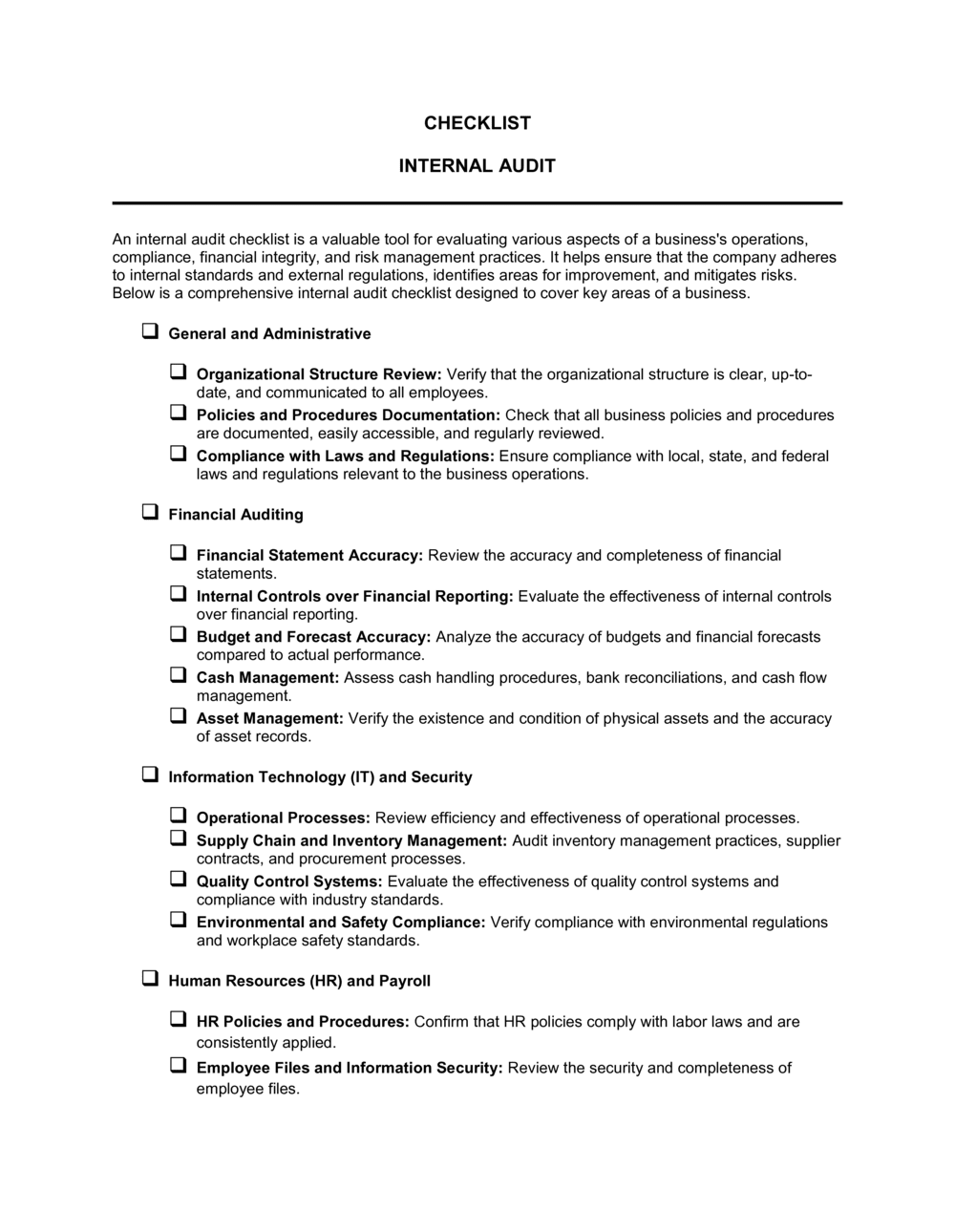
An Internal Audit Checklist is a structured form used to systematically verify that business processes, controls, and policies meet defined standards. This free Word download gives you a ready-made checklist you can customize for any department or function, then export as PDF for use during on-site or remote audit sessions.
When you need it
Use it when conducting scheduled or surprise internal audits of any operational area β€” finance, HR, IT, procurement, safety, or quality control. It is also the right tool when preparing for an external audit or regulatory inspection and needing documented evidence of internal control activity.
What's inside
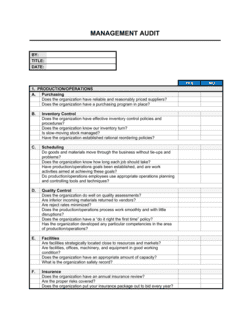
Audit scope and objective fields, department and auditor identification, audit date and reference number, itemized control questions with pass/fail/N-A response options, finding severity ratings, corrective action fields, and a sign-off block for the auditor and department head.

What is an Internal Audit Checklist?

An Internal Audit Checklist is a structured form that guides an auditor through a defined set of control checkpoint questions to verify whether business processes, policies, and procedures meet an organization's standards. Each line item asks a testable question β€” typically answered Yes, No, or N/A β€” and provides space to record the evidence reviewed, any gaps found, their severity, and the corrective actions required. The checklist creates a repeatable, documented audit process that produces consistent results regardless of who conducts the review or how often it is performed.

Why You Need This Document

Without a structured checklist, internal audits are inconsistent β€” different auditors test different things, evidence goes unrecorded, and findings are impossible to compare across departments or audit cycles. The cost of an undocumented audit is concrete: when a regulator or external auditor asks for evidence of internal control activity, a verbal description carries no weight. Gaps that were identified but not formally recorded cannot be tracked to resolution, and recurring deficiencies go undetected until they produce a material loss or compliance breach. This template gives any business β€” with or without a dedicated audit function β€” a professional, evidence-ready framework for conducting internal reviews that stand up to external scrutiny.

Which variant fits your situation?

If your situation is…Use this template
Auditing financial controls, reconciliations, and expense approvalsFinancial Internal Audit Checklist
Reviewing HR processes β€” onboarding, terminations, and record-keepingHR Audit Checklist
Assessing IT security controls and data access policiesIT Audit Checklist
Evaluating workplace health and safety complianceSafety Audit Checklist
Preparing for an ISO 9001 quality management system reviewISO 9001 Internal Audit Checklist
Auditing supplier or vendor compliance with procurement standardsVendor Audit Checklist
Logging and tracking findings from a completed auditAudit Findings Log

Common mistakes to avoid

❌ Leaving evidence fields blank on passing checkpoints

Why it matters: Undocumented passes cannot be verified by a reviewer or relied upon in an external audit β€” the checklist becomes a record of opinions, not tested controls.

Fix: Record at least one observation note for every checkpoint, including the sample reviewed and what it showed, regardless of the outcome.

❌ Assigning corrective actions to a team rather than a named individual

Why it matters: Shared ownership means no one tracks completion, and remediation deadlines consistently pass without follow-up or escalation.

Fix: Name one specific person as the corrective action owner for every finding, and schedule a follow-up date on the checklist itself.

❌ Writing compound checkpoint questions that test two controls at once

Why it matters: A 'no' answer to a compound question cannot identify which of the two controls failed, making root-cause analysis and corrective action selection unreliable.

Fix: Split compound questions into separate line items β€” one control tested per question, always.

❌ Skipping the sign-off block when findings are minor

Why it matters: An unsigned checklist has no evidentiary value if a finding is later disputed, escalates to a regulator, or becomes the subject of a legal claim.

Fix: Collect auditor and department head signatures on every completed checklist, regardless of finding count or severity.

The 9 key fields, explained

Audit Identification Block

Audit Scope and Objective

Control Checkpoint Questions

Evidence and Observation Notes

Finding Severity Rating

Root Cause Field

Corrective Action and Owner

Overall Audit Summary and Rating

Sign-Off and Acknowledgment Block

How to fill it out

  1. 1

    Define the audit scope and objective before opening the checklist

    Write one to two sentences stating exactly which process, system, or time period you are reviewing and what you are testing for. Share this with the department head before the audit begins.

    πŸ’‘ A tightly defined scope β€” one process, one quarter β€” produces findings specific enough to act on. Broad scopes produce generic observations.

  2. 2

    Complete the audit identification block

    Enter the audit reference number, today's date, your name as auditor, the department name, and the contact person. Assign a sequential reference number using a format like AUD-YYYY-NNN.

    πŸ’‘ Log every audit reference number in a master register so you can track completion rates and year-over-year trends across the audit program.

  3. 3

    Work through each checkpoint question systematically

    Answer each question YES, NO, or N/A based on direct observation, document review, or staff interview. Do not infer answers β€” test each control with evidence before responding.

    πŸ’‘ Test a sample of at least five to ten transactions or records per checkpoint rather than relying on a single example, which may not be representative.

  4. 4

    Record evidence for every checkpoint β€” including passes

    Enter a brief observation note beside each response describing what you reviewed. For passes, note the sample size and what you found. For failures, note specific instances with reference numbers.

    πŸ’‘ Photographs, system screenshots, or document reference numbers make the strongest evidence β€” verbal descriptions alone can be challenged.

  5. 5

    Rate the severity of each finding

    Classify every NO or partial response as High, Medium, or Low based on the financial, operational, or compliance risk it creates. Document your rationale in one sentence.

    πŸ’‘ Use a consistent rating matrix across all audits β€” define High as findings that could cause material financial loss or regulatory breach β€” so ratings are comparable across audit cycles.

  6. 6

    Identify root causes and assign corrective actions

    For each finding, write the root cause in one sentence and a specific corrective action with a named owner and a due date. Avoid assigning actions to unnamed teams.

    πŸ’‘ Ask 'why did this control fail?' at least twice before recording the root cause β€” the first answer is usually a symptom, not the underlying issue.

  7. 7

    Complete the summary and obtain sign-off

    Tally findings by severity, assign an overall control rating, and write one paragraph of key recommendations. Review the completed checklist with the department head and collect both signatures.

    πŸ’‘ Send the signed checklist to both parties within 48 hours of the audit session while findings are still fresh and agreed.

Frequently asked questions

What is an internal audit checklist?

An internal audit checklist is a structured form used to test whether specific business controls, policies, or procedures are in place and operating effectively. It guides the auditor through a defined set of checkpoint questions, captures evidence and observations, rates the severity of any gaps found, and documents corrective actions. It is used across finance, HR, IT, operations, and quality functions to provide consistent, repeatable audit evidence.

Who should conduct an internal audit?

Internal audits are typically conducted by a dedicated internal audit function, a compliance officer, or a cross-functional team member who is independent of the process being reviewed. For small businesses without a formal audit team, an operations manager or controller can conduct the audit provided they did not design or operate the process being tested. Independence β€” even informal independence β€” is the key quality requirement.

How often should internal audits be conducted?

Frequency depends on the risk level of the process being reviewed. High-risk processes β€” financial controls, data security, regulatory compliance β€” are typically audited quarterly or semi-annually. Lower-risk operational processes may be audited annually. Most audit programs define a risk-based schedule at the start of the fiscal year and revisit it after significant changes to the business.

What is the difference between an internal audit and an external audit?

An internal audit is conducted by personnel within the organization to test controls and identify gaps for improvement β€” its primary audience is management. An external audit is conducted by an independent third party, typically a licensed accounting or certification firm, to provide an opinion for regulators, investors, or customers. Internal audits prepare the organization for external audits and reduce the risk of surprises during those reviews.

Do internal audit checklists need to be signed?

Signatures are not legally required for internal audit checklists in most contexts, but they are strongly recommended. A signed checklist confirms that findings were communicated to and acknowledged by the department head, creates a clear record of when the audit was completed, and provides evidentiary weight if a finding is later disputed or escalates to a regulator. Treat sign-off as mandatory regardless of finding severity.

How do I handle a finding that the department disputes?

Document the dispute in the finding's observation field β€” note the department's position alongside the auditor's conclusion. Do not modify the finding to resolve the disagreement informally. Escalate unresolved disputes to the audit committee, CFO, or senior management depending on your organization's governance structure. The checklist should reflect what the auditor found, not a negotiated outcome.

Can a small business use an internal audit checklist without a formal audit function?

Yes. Many small businesses conduct informal but structured internal reviews using a checklist without a dedicated audit team. The key is to ensure the person conducting the review is not auditing their own work β€” a controller auditing the AP process they manage, for example, creates an obvious conflict. Rotating review responsibilities or having the owner conduct spot audits of specific functions is an effective low-cost alternative.

What should happen after an internal audit is completed?

After the checklist is signed, distribute copies to the department head and the audit file. Track each corrective action against its deadline in a central findings log. Schedule a follow-up review at the remediation deadline to verify the action was completed and the control gap was closed. Unresolved High-severity findings should be escalated to senior management within five business days of the audit close date.

How this compares to alternatives

vs External Audit Report

An external audit report is produced by an independent third-party firm and provides a formal opinion for regulators, lenders, or investors. An internal audit checklist is a working document used by your own team to test controls and drive improvement before external scrutiny. Internal checklists feed and prepare the evidence base that external auditors rely on.

vs Corrective Action Plan

A corrective action plan is a standalone document that details the steps, owners, and timelines for remediating identified gaps. An internal audit checklist identifies and records those gaps during the audit itself. The checklist generates the findings; the corrective action plan governs how they are resolved.

vs Risk Assessment Template

A risk assessment identifies and scores potential risks before they materialize β€” it is a forward-looking planning tool. An internal audit checklist tests whether controls addressing those risks are actually in place and working β€” it is a backward-looking verification tool. Both are needed: the risk assessment sets priorities, and the audit checklist confirms execution.

vs Process Audit Checklist

A process audit checklist evaluates whether a specific workflow is followed correctly and efficiently. An internal audit checklist evaluates whether the controls governing that process meet compliance and governance standards. Use a process checklist for operational consistency; use an internal audit checklist when accountability, risk, and evidence are the primary concerns.

Industry-specific considerations

Financial Services

Controls testing covers transaction approval limits, segregation of duties, reconciliation frequency, and regulatory reporting accuracy.

Healthcare

Audit checkpoints address HIPAA data access controls, patient record accuracy, billing compliance, and medication handling procedures.

Manufacturing

Checklists cover quality control at production stages, equipment calibration records, safety compliance, and supplier material certification.

Retail / E-commerce

Internal audits test inventory count accuracy, cash-handling procedures, refund authorization controls, and POS reconciliation completeness.

Template vs pro β€” what fits your needs?

PathBest forCostTime
Use the templateSmall businesses, operations managers, and compliance officers running routine departmental auditsFree30–60 minutes to customize; 1–3 hours to complete per audit session
Template + professional reviewOrganizations preparing for an external audit or regulatory inspection who need a qualified reviewer to validate checkpoint coverage$200–$800 for a compliance consultant review2–5 business days
Custom draftedRegulated industries (banking, healthcare, publicly listed companies) that require audit programs aligned to specific frameworks such as SOX, ISO 27001, or HIPAA$1,500–$5,000+ for a specialized internal audit firm2–6 weeks

Glossary

Internal Audit
An independent, objective review of a company's operations, controls, and compliance conducted by personnel within the organization.
Control
A policy, procedure, or mechanism designed to reduce risk, prevent errors, or ensure compliance with a defined standard.
Audit Scope
The defined boundaries of an audit β€” which processes, time periods, locations, or systems will be examined.
Finding
A specific gap, deficiency, or non-conformance identified during an audit that requires a documented response.
Corrective Action
A documented step taken to address an audit finding, eliminate its root cause, and prevent recurrence.
Non-Conformance
A failure to meet a defined requirement, whether internal policy, a regulatory standard, or a contractual obligation.
Audit Trail
A chronological record of activities, approvals, and changes that provides evidence a control was applied.
Risk Rating
A classification β€” typically High, Medium, or Low β€” assigned to a finding based on its likelihood and potential impact on the business.
Sign-Off
The formal acknowledgment by the auditor and the department head that the audit was completed and findings were communicated.
Remediation Deadline
The agreed date by which a corrective action must be completed and verified, used to track accountability after an audit.

Part of your Business Operating System

This document is one of 3,000+ business & legal templates included in Business in a Box.

  • Fill-in-the-blanks β€” ready in minutes
  • 100% customizable Word document
  • Compatible with all office suites
  • Export to PDF and share electronically

Create your document in 3 simple steps.

From template to signed document β€” all inside one Business Operating System.
1
Download or open template

Access over 3,000+ business and legal templates for any business task, project or initiative.

2
Edit and fill in the blanks with AI

Customize your ready-made business document template and save it in the cloud.

3
Save, Share, Send, Sign

Share your files and folders with your team. Create a space of seamless collaboration.

Save time, save money, and create top-quality documents.

β˜…β˜…β˜…β˜…β˜…

"Fantastic value! I'm not sure how I'd do without it. It's worth its weight in gold and paid back for itself many times."

Managing Director Β· Mall Farm
Robert Whalley
Managing Director, Mall Farm Proprietary Limited
β˜…β˜…β˜…β˜…β˜…

"I have been using Business in a Box for years. It has been the most useful source of templates I have encountered. I recommend it to anyone."

Business Owner Β· 4+ years
Dr Michael John Freestone
Business Owner
β˜…β˜…β˜…β˜…β˜…

"It has been a life saver so many times I have lost count. Business in a Box has saved me so much time and as you know, time is money."

Owner Β· Upstate Web
David G. Moore Jr.
Owner, Upstate Web

Run your business with a system β€” not scattered tools

Stop downloading documents. Start operating with clarity. Business in a Box gives you the Business Operating System used by over 250,000 companies worldwide to structure, run, and grow their business.

Start freeΒ Β·Β No credit card required