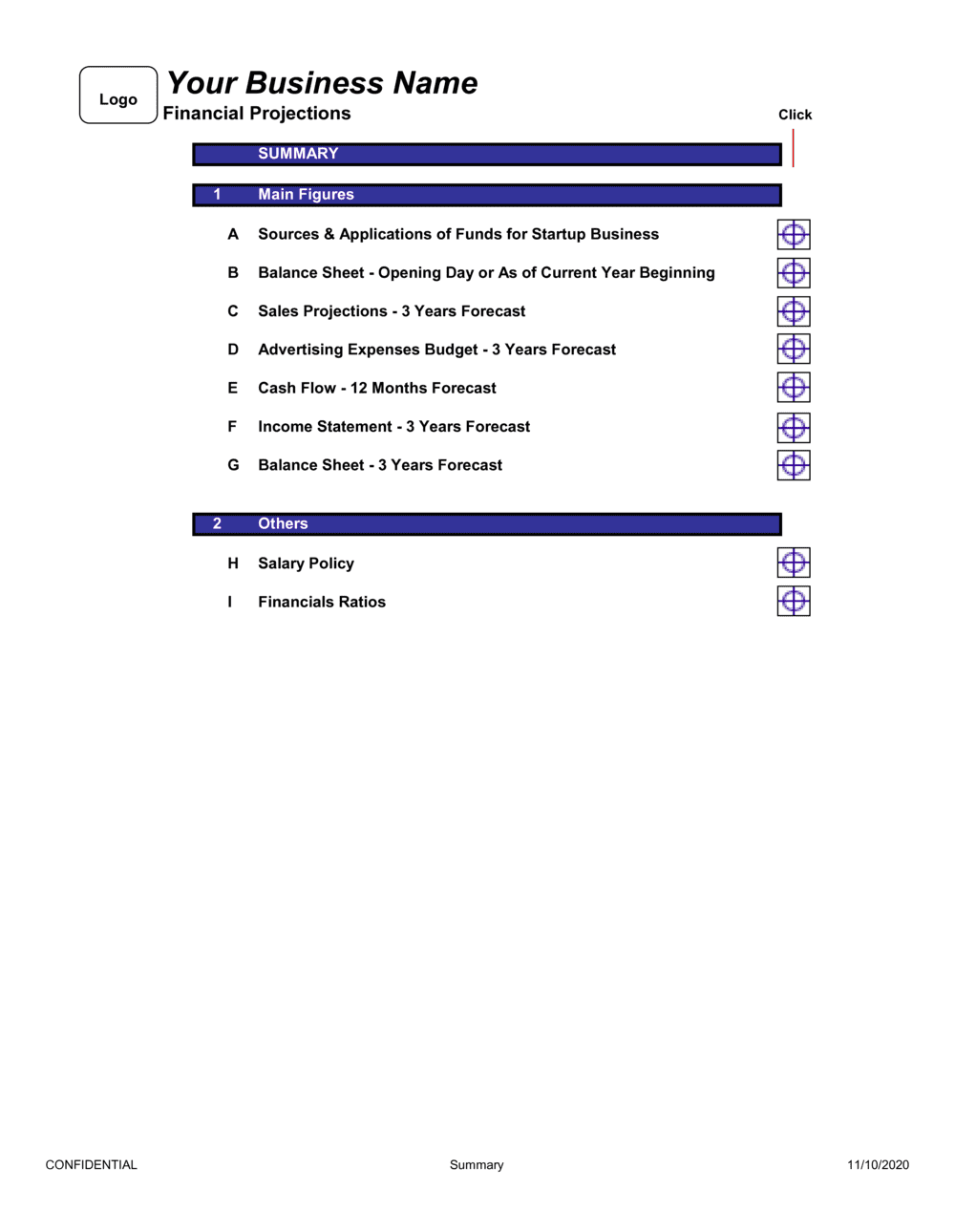
Financial Projections_3 Years Template

Free Excel download β€’ Use online β€’ Print or share

1 pageβ€’20–30 min to useβ€’Difficulty: Standardβ€’Signature requiredβ€’Legal review recommended
Learn more ↓
FreeXLSFinancial Projections_3 Years Template

At a glance

What it is
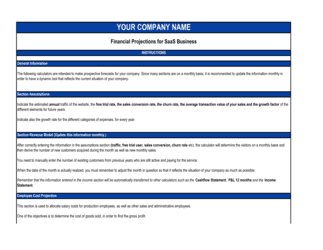
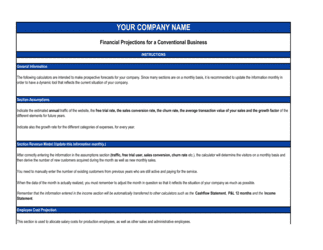
A Financial Projections 3 Years template is a structured forward-looking financial document that models a company's expected revenue, expenses, cash flow, and balance sheet position across a 36-month horizon. This free Word download gives you a pre-formatted, investor-ready starting point you can edit online and export as PDF to present to banks, equity investors, grant bodies, or your board of directors.
When you need it
Use it when raising debt or equity financing, applying for an SBA or commercial bank loan, presenting to a board or investors, or building an internal operating plan that requires multi-year financial accountability.
What's inside
Revenue forecast by product or service line, cost of goods sold and gross margin schedule, operating expense detail, projected profit and loss statement, cash flow statement, projected balance sheet, and a key assumptions summary that documents the drivers behind every line item.

What is a Financial Projections 3 Years Template?

A Financial Projections 3 Years template is a structured forward-looking financial model that maps a company's expected revenue, costs, cash flow, and balance sheet position across a 36-month horizon. It consists of three interconnected financial statements β€” a projected profit and loss, a cash flow statement, and a projected balance sheet β€” supported by a detailed assumptions schedule that documents every input driving the numbers. Unlike a historical financial report, a 3-year projection is built on stated assumptions about growth rates, pricing, headcount, and costs, making the assumptions schedule as important as the statements themselves. Lenders, investors, and boards use it to evaluate financial viability, determine capital requirements, and stress-test the business model before committing funds.

Why You Need This Document

Without a credible 3-year financial projection, capital conversations stall before they start. SBA lenders require them as a condition of application; commercial banks use them to determine debt service coverage ratios; equity investors treat them as the primary test of whether a founder understands their own business model. Beyond fundraising, a 3-year projection forces you to confront the operational implications of your growth plan β€” headcount requirements, working capital needs, CapEx timing, and cash flow gaps β€” before they become emergencies. A model that balances, flows internally, and holds up under a downside scenario signals financial discipline and earns credibility with every counterparty who reviews it. This template gives you the structure to build that model correctly the first time, with the statements, assumptions, and scenario analysis already framed and ready to populate.

Which variant fits your situation?

If your situation is…Use this template
Need monthly detail for the first 12 months onlyFinancial Projections 12 Months
Raising growth capital and need a 5-year model for institutional investorsFinancial Projections 5 Years
Building a comprehensive business plan with financials integratedBusiness Plan
Tracking actuals vs. budget on a monthly basisAnnual Budget Template
Projecting cash position and burn rate for a startupCash Flow Forecast
Presenting a quick financial summary to a board or advisory panelFinancial Summary Report
Modeling revenue for a SaaS or subscription business specificallySaaS Financial Model

Common mistakes to avoid

❌ Confusing net income with cash flow

Why it matters: A profitable P&L can mask a cash crisis when AR days are long, inventory is building, or debt payments are due. Lenders who see this error immediately question whether the preparer understands basic financial mechanics.

Fix: Always build a separate cash flow statement that reconciles net income to actual cash movement through working capital adjustments and CapEx.

❌ Submitting only a base-case scenario

Why it matters: Every sophisticated reviewer will immediately stress-test the model at 70–80% of projected revenue. Presenting only the optimistic case signals either overconfidence or an inability to model downside risk.

Fix: Include at least a downside scenario alongside the base case, with explicit actions β€” headcount freeze, cost reduction, credit line draw β€” triggered if revenue misses plan.

❌ Hiding assumptions inside formula cells

Why it matters: When a lender or investor wants to test a different growth rate or price point, hidden inputs force them to reverse-engineer the model β€” which they typically will not do, and which destroys confidence in the document.

Fix: Surface all inputs in a dedicated assumptions schedule at the front of the document, linked to every dependent formula, so any variable can be changed in one place.

❌ Projecting unexplained gross margin improvement

Why it matters: A gross margin that rises from 40% in Year 1 to 65% in Year 3 with no stated operational driver will be flagged as unsupported and will trigger detailed scrutiny of every other line in the model.

Fix: Document the specific operational change driving each margin improvement β€” a supplier contract, automation investment, or product mix shift β€” and tie it to the assumptions schedule.

❌ Presenting an unbalanced balance sheet

Why it matters: An unbalanced balance sheet is a mathematical error that signals the model was not built correctly. It is one of the fastest ways to lose credibility with an accountant, CFO, or lender.

Fix: Add a dedicated balance check row that flags any period where Assets do not equal Liabilities plus Equity, and resolve every discrepancy before sharing the document.

❌ Using a single top-line revenue growth rate for all years

Why it matters: A flat growth rate ignores the operational realities of scaling β€” sales cycle length, hiring constraints, and market saturation β€” and produces revenue curves that experienced reviewers immediately dismiss as placeholder math.

Fix: Build revenue from the bottom up by customer segment, channel, or product line, with each driver's growth rate grounded in a specific operational assumption.

The 10 key clauses, explained

Assumptions schedule

In plain language: Documents every input driving the model β€” pricing, volume growth rates, headcount additions, cost escalation percentages, and payment terms β€” so any reader can audit and stress-test the numbers.

Sample language
Revenue growth rate: [X]% per annum (Years 1–3). Average selling price: $[X] per unit. Headcount additions: [X] FTEs in Year 1, [X] in Year 2. COGS as % of revenue: [X]%.

Common mistake: Burying assumptions inside formula cells rather than surfacing them in a visible schedule. When an investor or lender changes an assumption, hidden inputs break the model silently.

Revenue forecast by stream

In plain language: Projects revenue for each distinct product line, service category, or customer segment, showing unit volume, price, and total per period.

Sample language
Product Line A: [X] units Γ— $[X] ASP = $[X] Year 1 revenue. Service Line B: [X] clients Γ— $[X]/month retainer = $[X] ARR. Total projected Year 3 revenue: $[X].

Common mistake: Consolidating all revenue into a single line. Lenders and investors want to see the mix β€” concentration risk and margin differences across streams affect creditworthiness and valuation.

Cost of goods sold schedule

In plain language: Details direct production or service-delivery costs by category β€” materials, direct labor, fulfillment β€” and shows gross margin at the product or line level.

Sample language
Materials cost: $[X] per unit (Year 1), declining to $[X] in Year 3 due to [VOLUME DISCOUNT / SUPPLIER RENEGOTIATION]. Direct labor: [X] hours Γ— $[X]/hr. Gross margin: [X]% Year 1, [X]% Year 3.

Common mistake: Projecting a dramatic gross margin improvement without explaining the operational driver. Reviewers will flag unexplained margin expansion as unsupported and discount the model.

Operating expense detail

In plain language: Lists each recurring expense category β€” salaries and benefits, rent, marketing, software, insurance, and G&A β€” by year, showing the dollar amount and year-over-year growth rationale.

Sample language
Salaries and benefits: $[X] Year 1 ([X] FTEs @ avg $[X]); $[X] Year 2 ([X] FTEs). Marketing: $[X] (Year 1) growing at [X]% annually. Rent: $[X]/month on [LEASE TERM] lease expiring [DATE].

Common mistake: Using a flat percentage escalator for all expense lines regardless of their actual cost drivers. Salaries scale with headcount, not revenue; applying a revenue-growth rate to payroll inflates or understates the number.

Projected profit and loss statement

In plain language: Summarizes revenue, COGS, gross profit, operating expenses, EBITDA, interest, taxes, and net income for each of the three years in a standard income statement format.

Sample language
Year 1: Revenue $[X] | Gross Profit $[X] ([X]%) | EBITDA $[X] | Net Income ($[X]). Year 2: Revenue $[X] | EBITDA $[X] | Net Income $[X]. Year 3: Revenue $[X] | EBITDA $[X] | Net Income $[X].

Common mistake: Omitting taxes from the P&L projection. Presenting pre-tax net income as the bottom line overstates profitability and raises immediate credibility concerns with accountants and lenders.

Cash flow statement

In plain language: Tracks cash inflows and outflows from operations, investing, and financing activities month by month in Year 1 and quarterly in Years 2–3, showing opening and closing cash balances.

Sample language
Operating cash flow Year 1: $[X]. Investing activities (CapEx): ($[X]). Financing activities (loan proceeds): $[X]. Net change in cash: $[X]. Closing cash balance Month 12: $[X].

Common mistake: Treating net income as cash flow. Non-cash items β€” depreciation, AR changes, deferred revenue β€” mean a profitable P&L can coincide with a cash crisis. The cash flow statement is where lenders look first.

Projected balance sheet

In plain language: Shows assets, liabilities, and equity at the end of each projected year, confirming that the model balances (Assets = Liabilities + Equity) and reflecting capital structure changes over the period.

Sample language
Year 3 Total Assets: $[X] (Cash $[X], AR $[X], PP&E net $[X]). Total Liabilities: $[X] (Current $[X], Long-term debt $[X]). Shareholders' Equity: $[X].

Common mistake: Submitting a balance sheet that does not balance. An unbalanced sheet signals a fundamental modeling error and immediately disqualifies the document in a lender's review.

Key performance indicators and metrics summary

In plain language: Presents the business-specific metrics that drive the financial model β€” CAC, LTV, churn rate, utilization, inventory turns, or revenue per employee β€” alongside each year's projected values.

Sample language
Year 1 CAC: $[X] | LTV: $[X] | LTV:CAC ratio: [X]x. Year 3 CAC: $[X] (target improvement driven by [CHANNEL OPTIMIZATION]). Monthly churn: [X]% declining to [X]% by Year 3.

Common mistake: Omitting KPIs entirely and presenting only GAAP financials. For early-stage companies, lenders and investors weight operational metrics as heavily as the P&L β€” a model without them signals limited business understanding.

Sensitivity and scenario analysis

In plain language: Models at least two alternative scenarios β€” typically a base case, a downside at 70–80% of plan, and an upside β€” showing the impact on revenue, EBITDA, and ending cash for each.

Sample language
Base case Year 3 revenue: $[X]. Downside (80% of plan): $[X] β€” EBITDA: ($[X]), additional funding required: $[X]. Upside (120% of plan): $[X] β€” EBITDA: $[X], cash balance: $[X].

Common mistake: Presenting only the base case. Every sophisticated reviewer will immediately ask 'what if revenue comes in at 75%?' β€” if the answer is not in the document, it creates doubt about the founder's or CFO's preparedness.

Funding requirements and use-of-funds schedule

In plain language: States the total capital required over the three-year period, how it is allocated across spending categories, the instrument (equity, debt, or convertible note), and the milestones each tranche funds.

Sample language
Total funding required: $[X] over [X] months. Allocation: [X]% product development ($[X]), [X]% sales and marketing ($[X]), [X]% operations ($[X]), [X]% G&A ($[X]). Milestone funded: [SPECIFIC OUTCOME] by [DATE].

Common mistake: Stating a total funding need without breaking it into categories and milestones. Investors fund milestones, not burn rates β€” an undifferentiated ask signals the model was not built from the bottom up.

How to fill it out

  1. 1

    Complete the assumptions schedule first

    Before touching any financial statement, populate every input in the assumptions schedule: revenue growth rates, pricing, headcount plan, COGS drivers, cost escalators, AR and AP days, and CapEx items.

    πŸ’‘ Every number in the model should trace back to a named cell in the assumptions schedule β€” if you cannot point to the assumption, delete the formula.

  2. 2

    Build the revenue forecast by stream

    Project each revenue line separately using a bottom-up approach: number of customers or units Γ— price per period. Avoid applying a single top-line growth rate; break it into the components that actually drive revenue.

    πŸ’‘ Validate your Year 1 revenue total against your pipeline or signed contracts β€” if the two numbers diverge by more than 20%, revisit your assumptions.

  3. 3

    Calculate COGS and gross margin by line

    Map direct costs to each revenue stream and compute gross margin at the product or service level before rolling up to the total. Identify any cost improvement drivers (volume discounts, automation, supplier renegotiation) and document them in the assumptions.

    πŸ’‘ Compare your projected gross margin to public company benchmarks in your industry β€” outliers in either direction require explicit explanation.

  4. 4

    Detail operating expenses by category

    List every recurring OpEx line β€” payroll by department, rent, marketing, software, insurance, professional fees β€” and tie each to its real cost driver rather than applying a blanket escalator.

    πŸ’‘ Build a separate headcount plan that shows hire date, role, and fully-loaded cost (salary plus 20–25% for benefits and payroll tax) β€” this is the most scrutinized expense section in any review.

  5. 5

    Assemble the projected P&L

    Roll revenue, COGS, and OpEx into a standard three-statement P&L format. Include depreciation and amortization, interest expense on any projected debt, and a tax provision using the applicable statutory rate.

    πŸ’‘ Show EBITDA as a subtotal before D&A and interest β€” it is the primary valuation anchor for most investors and lenders.

  6. 6

    Build the cash flow statement from the P&L

    Start with net income, add back non-cash charges (D&A), and adjust for working capital movements (AR, AP, inventory). Add investing cash flows for CapEx and financing flows for any debt draws or equity raises.

    πŸ’‘ Check that the closing cash balance on the cash flow statement matches the cash line on the projected balance sheet for each period β€” if they diverge, there is a modeling error.

  7. 7

    Complete the projected balance sheet

    Calculate ending balances for all asset and liability accounts using the cash flow statement and P&L. Confirm the balance sheet balances (Assets = Liabilities + Equity) for each of the three year-ends.

    πŸ’‘ An unbalanced sheet is an automatic disqualifier in any lender review β€” run a balance check formula before finalizing.

  8. 8

    Run sensitivity analysis and document scenarios

    Build at least a base case and a downside scenario (70–80% of plan revenue). Show the impact on EBITDA, cash flow, and funding requirements. Present both cases together β€” never submit only the optimistic scenario.

    πŸ’‘ If the downside scenario shows a cash shortfall, state explicitly how you would respond β€” cost cuts, additional funding, or a credit line. This turns a risk into a plan.

Frequently asked questions

What is a 3-year financial projection?

A 3-year financial projection is a forward-looking financial model that estimates a company's revenue, expenses, cash flow, and balance sheet position over a 36-month period. It typically includes a projected profit and loss statement, a cash flow statement, a balance sheet, and a supporting assumptions schedule. Investors, lenders, and boards use it to evaluate financial viability, capital requirements, and growth trajectory before committing funds or resources.

Why do banks and investors require a 3-year projection?

Three years is the standard minimum horizon for assessing whether a business can service debt, generate a return on equity, or reach self-sustaining profitability. A 12-month forecast is too short to show the trajectory beyond the initial ramp; a 5-year forecast is often considered speculative for early-stage businesses. The 3-year window balances credibility with strategic visibility and is the most widely required format for SBA loans, commercial bank applications, and seed-to-Series A fundraising.

What should a 3-year financial projection include?

A complete 3-year projection includes a revenue forecast broken down by product or service line, a cost of goods sold schedule with gross margin by stream, a detailed operating expense plan, a projected P&L, a cash flow statement, a projected balance sheet, a key assumptions schedule, and at least a base case and downside scenario. KPI summaries β€” CAC, LTV, churn, utilization β€” are expected for technology, SaaS, and service businesses.

What is the difference between a financial projection and a financial forecast?

The terms are often used interchangeably, but technically a financial projection models a hypothetical scenario based on stated assumptions that may or may not occur β€” typically used for planning or fundraising. A financial forecast is a best-estimate of expected future performance based on known conditions and recent actuals. For practical purposes, investors and lenders treat them the same way and apply the same level of scrutiny to both.

How detailed should the monthly vs. annual breakdown be?

Standard practice is monthly detail for Year 1 β€” which shows seasonality, cash burn timing, and the ramp from launch β€” and annual totals for Years 2 and 3. Some lenders and investors request quarterly detail for Years 2 and 3 on larger transactions. Monthly detail beyond Year 1 is generally considered speculative unless the business has strong historical data.

Can I build a 3-year financial projection myself without an accountant?

Yes β€” for most small businesses, SBA applications, and early-stage fundraises below $500K, a well-completed template is sufficient. The quality of the output depends on the accuracy and honesty of your assumptions, not on professional credentials. Engage an accountant or CFO when the raise exceeds $500K, when the model involves complex multi-entity structures, when the transaction involves audited financials, or when a regulated lender requires CPA-prepared projections.

How do I validate that my revenue projections are realistic?

Run two checks: a bottom-up build from unit economics (customers Γ— average contract value, or units Γ— price) and a top-down sanity check against comparable companies or industry benchmarks. If your projected Year 3 revenue implies a market share that exceeds what any comparable company has achieved in the same timeframe, revisit the assumptions. Also cross-reference Year 1 projections against your current pipeline, signed contracts, or confirmed orders.

What growth rate assumptions are reasonable for a 3-year projection?

Reasonable growth rates vary significantly by industry and stage. Early- stage SaaS businesses commonly project 80–150% Year 1 growth declining to 50–80% by Year 3. Professional services firms typically model 20–40% annually. Retail and manufacturing businesses often project 10–25%. The most defensible approach is to build growth from a specific number of new customers or contracts rather than applying a percentage to prior- year revenue, and to benchmark against published data for your sector.

Do financial projections need to be signed or certified?

For most business plan and investor contexts, no formal certification is required β€” the preparer attests to the assumptions by presenting the document. However, SBA lenders and some commercial banks require projections to be signed by the business owner or CEO as a representation of good faith. Regulated transactions β€” securities offerings, merger filings, or prospectus documents β€” may require CPA review or compilation. Always confirm the specific requirements with the recipient institution before submitting.

How this compares to alternatives

vs Financial Projections 12 Months

A 12-month projection provides monthly detail for the immediate operating year and is primarily used for budget management and short-term cash monitoring. A 3-year projection adds the strategic horizon that lenders, investors, and boards require to assess long-term viability. Use the 12-month version for internal operating discipline and the 3-year version for any external capital transaction.

vs Business Plan

A business plan is a comprehensive narrative document covering market analysis, competitive positioning, management team, and strategy β€” with financials as one component. Financial projections are the numerical model that stands independently as a diligence or loan document. The business plan tells the story; the financial projections provide the quantitative evidence that either supports or undermines it.

vs Cash Flow Statement

A cash flow statement records historical cash movements from operations, investing, and financing activities. A 3-year financial projection is forward-looking and hypothetical. The historical cash flow statement informs the assumptions used to build the projection; both documents are typically required together by lenders who want to see both actual performance and the credibility of the outlook.

vs Financial Projections 5 Years

A 5-year projection adds a longer strategic horizon useful for Series B or later fundraising, large commercial real estate loans, or franchise development plans. The additional two years carry more uncertainty and are treated as directional by most reviewers. A 3-year model is the standard minimum for the widest range of capital transactions; extend to 5 years only when the recipient specifically requests it or when the investment payback period exceeds three years.

Industry-specific considerations

SaaS / Technology

MRR and ARR build schedules, monthly churn rate assumptions, CAC payback period, net revenue retention, and cloud infrastructure cost as a percentage of revenue are the primary model drivers.

Retail / E-commerce

Average order value, repeat purchase rate, inventory carrying costs, fulfillment cost per order, and seasonal revenue distribution require monthly cash flow modeling to capture working capital peaks accurately.

Professional Services

Billable utilization rate (target 65–75%), average bill rate per role, revenue per employee, and client concentration risk are the key levers; headcount-driven OpEx makes the hiring plan the central driver of the entire model.

Manufacturing

COGS breakdown by materials, direct labor, and overhead absorption is critical; CapEx timing for equipment, inventory build-up ahead of demand, and supplier payment terms create meaningful cash flow timing differences from the P&L.

Jurisdictional notes

United States

SBA lenders require projections signed by the business owner and covering at least 3 years with monthly detail for Year 1. The FTC and SEC regulate forward-looking financial statements in securities contexts β€” projections included in a private placement memorandum must include risk factor disclosures. State-specific income tax rates should be reflected in the tax provision line.

Canada

BDC and EDC loan applications typically require 3-year projections prepared or reviewed by a CPA. Quebec-based businesses should note that provincial tax rates differ from federal rates and must be modeled separately. IFRS-based terminology (e.g., 'statement of profit or loss' rather than 'P&L') is preferred in CPA-reviewed documents, though US GAAP formats are widely accepted by commercial lenders.

United Kingdom

UK banks and the British Business Bank require 3-year projections for most growth lending applications. Projections should reflect UK corporation tax rates (currently 25% for profits over Β£250,000 as of 2023), VAT cash flow timing if the business is VAT-registered, and Companies House filing obligations if the business is incorporated. R&D tax credits, where applicable, should be reflected in the cash flow statement.

European Union

EU member state development banks and the European Investment Fund require projections in IFRS-compatible format for most financing programs. VAT reclaim timing materially affects cash flow projections in many member states and must be modeled explicitly. Corporate tax rates vary significantly by member state β€” Ireland at 12.5% versus France at 25% β€” and the applicable rate should be confirmed and stated in the assumptions schedule.

Template vs lawyer β€” what fits your deal?

PathBest forCostTime
Use the templateSmall business owners, startup founders, and operators preparing SBA applications or early-stage fundraising below $500KFree8–20 hours depending on business complexity
Template + legal reviewRaises between $500K and $2M, commercial bank loans, or models requiring an accountant's sign-off on assumptions$500–$2,000 for a CPA or CFO-for-hire review3–5 business days
Custom draftedSeries A and later raises, regulated transactions, multi-entity structures, or filings requiring CPA-compiled or reviewed financials$2,000–$10,000+ depending on complexity and CPA firm2–4 weeks

Glossary

Revenue Forecast
A projection of total income expected from each product or service line over the forecast period, built from unit volume and price assumptions.
Cost of Goods Sold (COGS)
The direct costs attributable to producing goods sold or delivering services β€” materials, direct labor, and allocated manufacturing overhead.
Gross Margin
Revenue minus COGS, expressed as a percentage β€” the portion of each revenue dollar retained after direct production costs.
Operating Expenses (OpEx)
Recurring business costs not tied directly to production, including salaries, rent, marketing, and administrative expenses.
EBITDA
Earnings Before Interest, Taxes, Depreciation, and Amortization β€” a widely used proxy for operating cash generation and business valuation.
Pro Forma
Forward-looking financial statements based on stated assumptions rather than historical data, used to model future performance.
Burn Rate
Monthly net cash outflow β€” how quickly a business consumes its cash reserves before reaching cash-flow breakeven.
Working Capital
Current assets minus current liabilities β€” the short-term liquidity available to fund day-to-day operations.
Sensitivity Analysis
A model that shows how projected outcomes change when one or more key assumptions β€” price, volume, or cost β€” are adjusted up or down.
Assumptions Schedule
A dedicated section or tab that lists every input driving the financial model, including growth rates, pricing, headcount, and cost escalation.
Capital Expenditure (CapEx)
Spending on long-term physical or intangible assets β€” equipment, software licenses, or leasehold improvements β€” recorded on the balance sheet rather than expensed immediately.
Accounts Receivable (AR) Days
The average number of days it takes to collect payment after a sale β€” a key driver of cash flow timing in the balance sheet.

Part of your Business Operating System

This document is one of 3,000+ business & legal templates included in Business in a Box.

  • Fill-in-the-blanks β€” ready in minutes
  • 100% customizable Word document
  • Compatible with all office suites
  • Export to PDF and share electronically

Create your document in 3 simple steps.

From template to signed document β€” all inside one Business Operating System.
1
Download or open template

Access over 3,000+ business and legal templates for any business task, project or initiative.

2
Edit and fill in the blanks with AI

Customize your ready-made business document template and save it in the cloud.

3
Save, Share, Send, Sign

Share your files and folders with your team. Create a space of seamless collaboration.

Save time, save money, and create top-quality documents.

β˜…β˜…β˜…β˜…β˜…

"Fantastic value! I'm not sure how I'd do without it. It's worth its weight in gold and paid back for itself many times."

Managing Director Β· Mall Farm
Robert Whalley
Managing Director, Mall Farm Proprietary Limited
β˜…β˜…β˜…β˜…β˜…

"I have been using Business in a Box for years. It has been the most useful source of templates I have encountered. I recommend it to anyone."

Business Owner Β· 4+ years
Dr Michael John Freestone
Business Owner
β˜…β˜…β˜…β˜…β˜…

"It has been a life saver so many times I have lost count. Business in a Box has saved me so much time and as you know, time is money."

Owner Β· Upstate Web
David G. Moore Jr.
Owner, Upstate Web

Run your business with a system β€” not scattered tools

Stop downloading documents. Start operating with clarity. Business in a Box gives you the Business Operating System used by over 250,000 companies worldwide to structure, run, and grow their business.

Start freeΒ Β·Β No credit card required