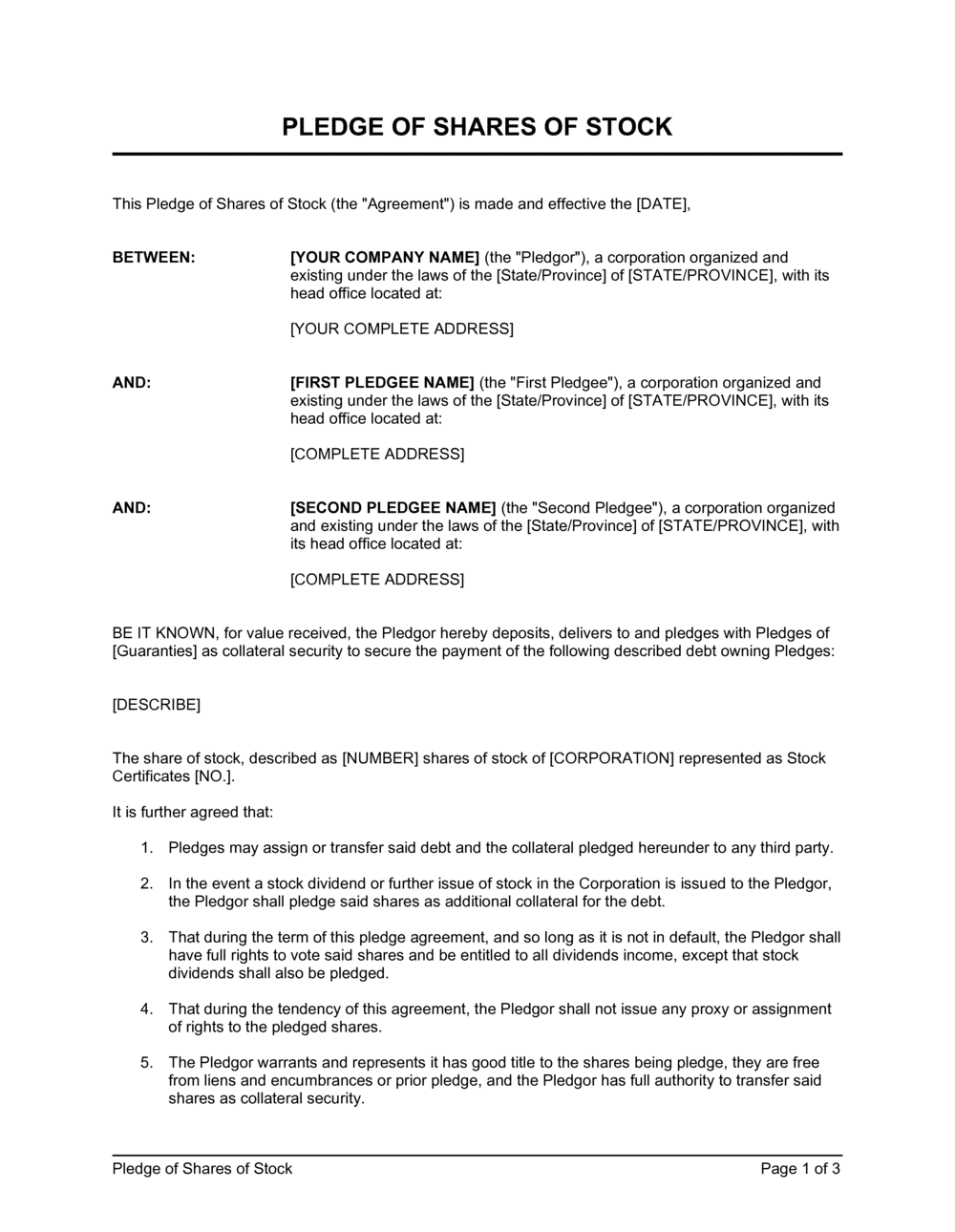
Pledge of Shares of Stock Template

Free Word download β€’ Edit online β€’ Save & share with Drive β€’ Export to PDF

3 pagesβ€’25–30 min to fillβ€’Difficulty: Complexβ€’Signature requiredβ€’Legal review recommended
Learn more ↓
FreePledge of Shares of Stock Template

At a glance

What it is
A Pledge of Shares of Stock is a legally binding agreement in which a shareholder (the pledgor) grants a lender or creditor (the pledgee) a security interest in specified shares as collateral to secure a loan or other obligation. This free Word download gives you a structured, attorney-reviewed starting point you can edit online and export as PDF, covering the key mechanics of share delivery, voting rights during the pledge period, enforcement on default, and release upon repayment.
When you need it
Use it when a shareholder is borrowing money and the lender requires the borrower's shares as collateral, when a business owner needs financing but lacks other assets to pledge, or when a parent company pledges subsidiary shares to secure a credit facility. It is also commonly used in shareholder loans, management buyouts, and venture debt arrangements.
What's inside
Identification of the pledgor, pledgee, and pledged shares, the secured obligation amount and terms, delivery and registration of the pledge, voting and dividend rights during the pledge, representations and warranties, events of default, pledgee's enforcement remedies, and conditions for release and reassignment of the shares upon satisfaction of the obligation.

What is a Pledge of Shares of Stock?

A Pledge of Shares of Stock is a legally binding security agreement in which a shareholder (the pledgor) grants a lender or creditor (the pledgee) a security interest in specifically identified shares as collateral to secure a loan or other financial obligation. Unlike a full transfer of ownership, a pledge leaves the shares registered in the pledgor's name during the pledge period β€” the pledgee holds a conditional right to take, sell, or transfer those shares only if the pledgor fails to meet the secured obligation. The agreement governs every material aspect of the arrangement: precise identification of the pledged shares, delivery and registration of the security interest, allocation of voting rights and dividends while the pledge is in effect, defined events of default, the pledgee's enforcement remedies, and the conditions under which the pledge is discharged and the shares returned.

Why You Need This Document

Without a written, perfected pledge agreement, a lender accepting shares as collateral has little more than an informal promise β€” one that ranks behind every other creditor if the borrower becomes insolvent. An oral or loosely worded arrangement cannot be registered in the applicable public registry, cannot bind third parties, and provides no enforceable framework for enforcement or release. For the pledgor, an undocumented pledge creates equal risk: unresolved questions about voting rights, dividend entitlement, and the conditions for return of the shares routinely generate expensive disputes. A precisely drafted Pledge of Shares of Stock eliminates this uncertainty, gives the pledgee a perfected first-priority claim on the collateral, and gives the pledgor a clear, contractually guaranteed path to recovering unencumbered title once the obligation is satisfied. This template provides the structural starting point for that protection β€” ready to adapt, execute, and register in your jurisdiction.

Which variant fits your situation?

If your situation is…Use this template
Pledging shares in a private company to a bank or institutional lenderPledge of Shares of Stock
Pledging publicly traded shares held in a brokerage accountSecurities Pledge Agreement
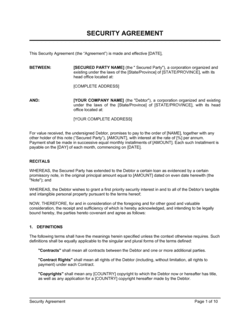
Granting a security interest over all business assets, including sharesGeneral Security Agreement
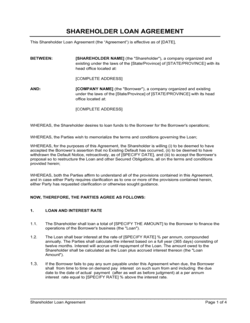
Pledging shares as part of a shareholder loan between individualsShareholder Loan Agreement
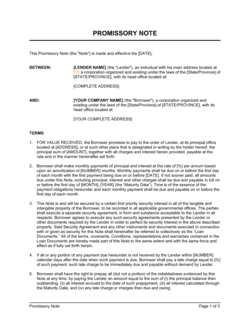
Securing a promissory note with a pledge of sharesPromissory Note with Security Interest
Documenting a mortgage or charge over shares in a UK or Commonwealth companyLegal Mortgage of Shares
Pledging shares in an LLC or partnership interest rather than corporate stockPledge of Membership Interest

Common mistakes to avoid

❌ Failing to perfect the security interest by registration or possession

Why it matters: An unperfected pledge is subordinate to any subsequently perfected security interest and is effectively void against the pledgor's trustee in bankruptcy β€” the pledgee becomes an unsecured creditor.

Fix: File the applicable financing statement (UCC-1, PPSA, or equivalent) immediately upon execution, and deliver original share certificates to the pledgee at closing.

❌ Not checking for existing transfer restrictions or pre-emption rights

Why it matters: Most private company shareholder agreements and articles of incorporation restrict share transfers without board or shareholder approval. A pledge made in violation of these restrictions is voidable or void.

Fix: Review all constitutional documents and shareholder agreements before execution and obtain written consent from all required parties. Attach consents as a schedule.

❌ Omitting the power of attorney clause

Why it matters: Without an irrevocable power of attorney, the pledgee must obtain the pledgor's cooperation to transfer shares on enforcement β€” which is impossible if the pledgor is insolvent, hostile, or has disappeared.

Fix: Include an irrevocable power of attorney explicitly stated to be 'coupled with an interest,' and have it witnessed or notarized as required by the applicable jurisdiction.

❌ Executing the pledge after loan proceeds have been disbursed

Why it matters: A pledge granted after the loan is funded may be characterized as a preference or fraudulent conveyance in insolvency proceedings, particularly if the pledgor was insolvent at the time of execution.

Fix: Always execute the pledge agreement simultaneously with or before the disbursement of funds, using a funds-flow memo to document the contemporaneous nature of the transactions.

❌ Using a vague description of the secured obligations

Why it matters: If the pledge says 'certain indebtedness' without cross-referencing a specific loan agreement, a court may find the secured obligation too uncertain to enforce.

Fix: Reference the underlying loan agreement by date, parties, and principal amount, and list every category of obligation (principal, interest, fees, costs) covered by the pledge.

❌ No timeline for release of the pledge after repayment

Why it matters: Without a defined release deadline, a pledge can remain registered on the share register for months after repayment, blocking a sale, refinancing, or new pledge of the same shares.

Fix: Specify a number of business days β€” typically 5 to 10 β€” within which the pledgee must return certificates, execute release documents, and file discharge notices after full repayment.

The 10 key clauses, explained

Parties and recitals

In plain language: Identifies the pledgor and pledgee with full legal names and addresses, and states the background context β€” the loan agreement or obligation being secured.

Sample language
This Pledge of Shares of Stock (the 'Agreement') is entered into as of [DATE] between [PLEDGOR FULL LEGAL NAME] ('Pledgor') and [PLEDGEE FULL LEGAL NAME] ('Pledgee'). WHEREAS, Pledgor is the registered owner of [NUMBER] shares of [COMPANY NAME] (the 'Company'); and WHEREAS, Pledgee has agreed to extend credit to Pledgor in the amount of $[AMOUNT] pursuant to a Loan Agreement dated [DATE] (the 'Loan Agreement').

Common mistake: Using trade names rather than registered legal names. If the pledgor entity name does not match the share register, the pledge cannot be properly registered and may be unenforceable against third parties.

Description and grant of pledge

In plain language: Precisely identifies the pledged shares by class, certificate number, and quantity, and formally grants the security interest to the pledgee.

Sample language
Pledgor hereby pledges, assigns, and grants to Pledgee a first-priority security interest in [NUMBER] [CLASS] shares of [COMPANY NAME], represented by Share Certificate No(s). [CERTIFICATE NUMBERS] (the 'Pledged Shares'), together with all dividends, distributions, and proceeds thereof.

Common mistake: Failing to specify certificate numbers and share classes. A vague description β€” 'certain shares in the company' β€” is insufficient to perfect a security interest and will not hold up in enforcement proceedings.

Secured obligations

In plain language: Defines the exact debt or obligation the pledge secures, including principal, interest, fees, and any future advances, so the scope of the collateral is clear.

Sample language
The Pledged Shares are pledged to secure the full and punctual payment of the principal amount of $[AMOUNT], together with interest at [RATE]% per annum, fees, and all other amounts owing under the Loan Agreement, as may be amended from time to time (collectively, the 'Secured Obligations').

Common mistake: Limiting the secured obligations only to the principal amount and forgetting accrued interest, penalties, and enforcement costs. This forces the pledgee to initiate separate proceedings to recover amounts not expressly secured.

Delivery and perfection of pledge

In plain language: Sets out how the pledge is made effective β€” typically by delivering original share certificates and signed blank transfer forms to the pledgee, and registering the pledge in applicable public registries.

Sample language
Concurrently with execution, Pledgor shall deliver to Pledgee: (a) the original share certificates representing the Pledged Shares; (b) stock transfer forms duly executed in blank; and (c) any other documents required to register the pledge with [APPLICABLE REGISTRY]. Pledgee is authorized to register this security interest at the [UCC / PPSA / Companies House / applicable registry].

Common mistake: Not delivering original certificates or failing to register in the applicable personal property or corporate registry. An unperfected pledge is subordinate to subsequently perfected interests and may be voided in the pledgor's insolvency.

Representations and warranties

In plain language: The pledgor confirms that they own the shares free and clear, have authority to pledge them, and that no prior security interest, lien, or restriction exists on the shares.

Sample language
Pledgor represents and warrants that: (a) Pledgor is the sole registered and beneficial owner of the Pledged Shares; (b) the Pledged Shares are fully paid and non-assessable; (c) there are no prior pledges, liens, or encumbrances on the Pledged Shares; (d) Pledgor has full authority to enter into this Agreement; and (e) no consent of any third party is required other than as obtained.

Common mistake: Omitting a representation that no third-party consent is required to pledge the shares. Many shareholder agreements and company constitutions contain transfer restrictions or right-of-first-refusal provisions that, if triggered without consent, void the pledge.

Voting rights and dividends during pledge

In plain language: Allocates control over the pledged shares during the pledge period β€” typically the pledgor retains voting rights and receives dividends unless a default has occurred.

Sample language
Prior to the occurrence of an Event of Default: (a) Pledgor shall retain the right to vote the Pledged Shares on all matters; and (b) all cash dividends and distributions paid on the Pledged Shares shall be paid to Pledgor. Upon the occurrence of an Event of Default, all voting rights and distributions shall vest in and be exercised by Pledgee.

Common mistake: Giving the pledgee unconditional voting rights from day one. This creates governance complications, may violate the company's articles of incorporation, and in some jurisdictions triggers a change-of-control analysis.

Events of default and acceleration

In plain language: Lists the specific events that entitle the pledgee to call the debt and enforce the pledge β€” including non-payment, insolvency, breach of warranty, and cross-defaults under related agreements.

Sample language
Each of the following shall constitute an Event of Default: (a) failure to pay any Secured Obligation within [X] days of the due date; (b) the Pledgor becoming insolvent or a receiver being appointed; (c) any representation or warranty proving materially false; (d) a material breach of this Agreement not cured within [X] days of written notice; or (e) a default under any related agreement between the parties.

Common mistake: Omitting a cure period for non-payment defaults. Courts in several jurisdictions scrutinize immediate acceleration as a penalty clause and may refuse to enforce it if no cure opportunity was provided for payment defaults.

Pledgee's enforcement remedies

In plain language: Sets out what the pledgee can do when a default occurs β€” including selling the shares by public or private sale, transferring them, or voting them to protect the collateral β€” and the notice required before doing so.

Sample language
Upon the occurrence and continuance of an Event of Default, Pledgee may, without further notice except as required by law: (a) sell the Pledged Shares by public or private sale at commercially reasonable prices; (b) register or transfer the Pledged Shares in its own name; or (c) exercise all voting and other rights with respect to the Pledged Shares. Net proceeds of any sale shall be applied first to costs of enforcement, then to the Secured Obligations.

Common mistake: Not including a 'commercially reasonable manner' standard for share sales. Many jurisdictions impose this requirement by statute regardless β€” failing to include it signals a poorly drafted agreement and can expose the pledgee to damages if the shares are sold below market value.

Power of attorney

In plain language: Grants the pledgee an irrevocable authority to execute transfers and take all actions needed to enforce the pledge upon default, without needing to return to the pledgor for signatures.

Sample language
Pledgor hereby irrevocably appoints Pledgee as its attorney-in-fact, with full power of substitution, to execute and deliver all instruments and take all actions necessary to transfer the Pledged Shares and otherwise enforce this Agreement upon the occurrence of an Event of Default. This power of attorney is coupled with an interest and shall survive the insolvency of the Pledgor.

Common mistake: Using a revocable power of attorney or omitting the 'coupled with an interest' language. A revocable power can be withdrawn before enforcement, and courts have declined to enforce powers of attorney that do not state they are coupled with an interest.

Release and reassignment

In plain language: Specifies that upon full repayment of the secured obligation, the pledge is discharged, the certificates are returned, and the pledgee must take all steps to deregister any security interest.

Sample language
Upon full and final payment and discharge of all Secured Obligations, Pledgee shall: (a) return the Pledged Share certificates and signed transfer forms to Pledgor; (b) execute and deliver all documents required to release and discharge the security interest; and (c) file all necessary notices to discharge any registration of the pledge in applicable registries within [X] business days.

Common mistake: No timeline for release after repayment. Without a defined deadline, pledgees sometimes delay deregistration, leaving a security interest on the share register that blocks subsequent financing or a sale of the company.

How to fill it out

  1. 1

    Identify all parties with full legal names

    Enter the pledgor's and pledgee's full registered legal names, addresses, and entity types. Cross-reference the pledgor's name against the company's share register to ensure they match exactly.

    πŸ’‘ Even a minor name discrepancy between the pledge agreement and the share register can prevent registration and invalidate the security interest.

  2. 2

    Describe the pledged shares precisely

    Enter the exact number of shares, share class, and certificate numbers. If the shares are uncertificated, state the book-entry account details. Include all accrued rights attached to the shares.

    πŸ’‘ Attach a copy of the share certificate as a schedule β€” this removes any ambiguity in enforcement proceedings.

  3. 3

    Define the secured obligations in full

    Reference the underlying loan agreement or obligation by date and amount. Ensure the clause captures not only principal but also interest, fees, costs, and any future advances expressly contemplated.

    πŸ’‘ If the pledge is meant to secure all present and future indebtedness rather than a single loan, use 'all obligations' language and confirm with a lawyer that this is permissible in your jurisdiction.

  4. 4

    Arrange delivery of certificates and blank transfer forms

    Organize delivery of the original share certificates and stock transfer forms signed in blank by the pledgor to the pledgee simultaneously with execution. Do not allow a gap between signing and delivery.

    πŸ’‘ Use a closing checklist and confirm receipt in writing β€” an email acknowledgment from the pledgee stating receipt of the certificates on a specific date serves as evidence of perfection by possession.

  5. 5

    File the security interest in the applicable registry

    In the US, file a UCC-1 Financing Statement in the pledgor's state of formation. In Canada, register under the applicable PPSA. In the UK, register at Companies House within 21 days of creation. In the EU, follow the member state's commercial pledge registration rules.

    πŸ’‘ Set a calendar reminder for the registration deadline β€” missing the 21-day window in the UK, for example, makes the pledge void against a liquidator.

  6. 6

    Confirm third-party consents are in place

    Review the company's shareholder agreement, articles of incorporation, and any existing credit agreements for transfer restrictions, pre-emption rights, or lender consent requirements before signing.

    πŸ’‘ Obtain any required consents in writing and attach them as a schedule to the agreement β€” undocumented consents are impossible to prove in a dispute.

  7. 7

    Execute and date the agreement before the loan funds

    Both parties must sign and date the agreement before β€” or simultaneously with β€” the disbursement of loan proceeds. Post-funding pledges create fraudulent conveyance risk and may be voided in insolvency.

    πŸ’‘ Use Business in a Box eSign to timestamp execution and store the fully-executed agreement with the loan file.

  8. 8

    Set up a release process at the outset

    Agree and document the exact steps and timeline for releasing the pledge upon repayment, including who is responsible for filing discharge notices with each registry.

    πŸ’‘ Include a specific deadline β€” '10 business days after receipt of full payment' β€” so the pledgor can plan subsequent financing around it.

Frequently asked questions

What is a pledge of shares of stock?

A pledge of shares of stock is a legally binding security agreement in which a shareholder grants a lender or creditor a security interest in specified shares as collateral to secure a loan or other obligation. If the borrower defaults, the lender can enforce the pledge by selling the shares or transferring them to satisfy the debt. Unlike a sale of shares, a pledge does not transfer ownership unless and until a default occurs and the pledgee enforces its rights.

How does a share pledge differ from a share transfer?

A share transfer permanently moves ownership of shares from one party to another with no obligation to return them. A share pledge retains ownership with the pledgor during the pledge period β€” the pledgee holds only a security interest, not title. Ownership reverts fully and unencumbered to the pledgor once the secured obligation is repaid. A transfer is final; a pledge is conditional.

What does it mean to 'perfect' a share pledge?

Perfection is the process of making a security interest enforceable against third parties β€” including other creditors and a bankruptcy trustee. For share pledges, perfection is typically achieved by taking physical possession of the share certificates (in certificated systems) and filing a financing statement in the applicable public registry such as the UCC in the US, the PPSA in Canada, or Companies House in the UK. An unperfected pledge ranks behind any subsequently perfected claim.

Can a pledgor still vote shares and receive dividends during the pledge?

In most pledge agreements, the pledgor retains voting rights and the right to receive cash dividends prior to any event of default. After default, those rights typically shift to the pledgee. The agreement should state this allocation clearly. Granting the pledgee unconditional voting rights from the outset can create governance complications and may trigger change-of-control provisions in the company's constitutive documents.

What happens if the pledgor defaults?

Upon a defined event of default β€” typically non-payment, insolvency, or material breach β€” the pledgee is entitled to enforce the pledge. This usually means selling the shares by public or private sale in a commercially reasonable manner, applying the net proceeds to the outstanding debt, and returning any surplus to the pledgor. The pledgee may also register the shares in its own name or vote them to protect value while enforcement proceeds.

Are transfer restrictions in a shareholder agreement a problem for a share pledge?

Yes β€” most private company shareholder agreements and articles of incorporation include pre-emption rights, board approval requirements, or outright transfer restrictions that apply equally to pledges. A pledge granted in breach of these restrictions is voidable or void and cannot be enforced. Always review constitutional documents and obtain any required consents in writing before executing a share pledge.

Do I need a lawyer to prepare a pledge of shares of stock?

For simple domestic transactions between sophisticated parties β€” a single loan secured by shares in one jurisdiction β€” a high-quality template with a brief legal review is generally sufficient. You should engage a lawyer for cross-border pledges, regulated industries, pledges involving shares in multiple companies, complex capital structures with existing secured creditors, or any transaction where enforcement risk is material. A one-to-two-hour review typically costs $400–$900.

What registrations are required to perfect a share pledge?

In the United States, file a UCC-1 Financing Statement in the state where the pledgor is organized. In Canada, register under the applicable provincial PPSA. In the UK, file at Companies House within 21 days of the pledge's creation β€” failure voids the pledge against a liquidator. In EU member states, registration requirements vary: France requires registration with the commercial court registry; Germany uses a notarial deed for GmbH share pledges. Confirm local requirements before signing.

What is a power of attorney in a share pledge agreement and why is it needed?

A power of attorney in a share pledge grants the pledgee irrevocable authority to execute transfers, sign documents, and take all steps needed to enforce the pledge without the pledgor's cooperation. This is critical because on enforcement the pledgor may be insolvent, hostile, or unavailable. The power must be stated as 'coupled with an interest' and survive the pledgor's insolvency to be effective β€” a revocable or ordinary power of attorney can be withdrawn before enforcement.

How this compares to alternatives

vs General Security Agreement

A General Security Agreement creates a security interest over all present and after-acquired personal property of a business β€” inventory, receivables, equipment, and intellectual property. A pledge of shares is narrower, covering only identified shares in a specific company. Use a GSA when the lender wants a blanket lien over the whole business; use a share pledge when collateral is limited to equity ownership.

vs Shareholder Loan Agreement

A Shareholder Loan Agreement documents the terms of a loan made between shareholders or from a shareholder to the company, without necessarily creating any security interest. A pledge of shares adds a layer of collateral security on top of an existing loan β€” the two documents are often used together, with the pledge referenced as security for the shareholder loan.

vs Promissory Note

A promissory note is a written promise to repay a specific debt β€” it establishes the obligation but does not create collateral. A pledge of shares is a separate security document that backs the promissory note with specific shares. For secured lending, you typically need both: the note as the payment obligation and the pledge as the collateral instrument.

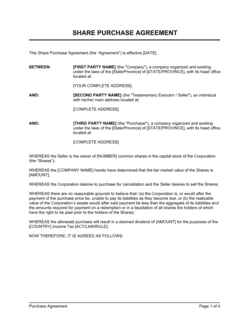
vs Share Purchase Agreement

A share purchase agreement permanently transfers ownership of shares from seller to buyer for a price. A pledge of shares does not transfer ownership unless and until the pledgor defaults and the pledgee enforces. If the goal is to sell shares now, use a share purchase agreement; if the goal is to borrow money with shares as security while retaining ownership, use a pledge.

Industry-specific considerations

Banking and Lending

Banks routinely require share pledges as security for term loans, revolving credit facilities, and acquisition financing, with perfection and registration conditions precedent to drawdown.

Private Equity and Venture Capital

Sponsors pledge portfolio company shares to back acquisition debt in leveraged buyouts, and founders pledge shares to secure venture debt from specialty lenders.

Real Estate

SPV shareholders frequently pledge shares in the holding company rather than mortgaging the underlying property directly, avoiding stamp duty triggers and simplifying enforcement.

Technology / SaaS

Founders use share pledges to secure non-dilutive venture debt, balancing the need for growth capital against equity preservation during early revenue stages.

Jurisdictional notes

United States

Share pledges in the US are governed by Article 8 and Article 9 of the Uniform Commercial Code. Perfection of a certificated share pledge is achieved by the pledgee taking possession of the original certificates. A UCC-1 Financing Statement should also be filed in the pledgor's state of formation. California and Delaware have well-developed case law on enforcement, but state variations in priority rules and self-help enforcement procedures mean local counsel review is advisable for any high-value transaction.

Canada

Pledges of shares in Canadian companies are primarily governed by provincial Personal Property Security Acts (PPSA). Registration is required in the pledgor's home province to achieve perfection. Quebec uses the Civil Code's hypothec framework rather than the common-law PPSA model, and a notarial deed may be required. Shares in federally incorporated companies under the CBCA require additional consideration for transfer restrictions and the register of security interests.

United Kingdom

A pledge or charge over shares in a UK company must be registered at Companies House within 21 days of creation under the Companies Act 2006; failure renders it void against a liquidator and other creditors. The Financial Collateral Arrangements Regulations 2003 provide an expedited enforcement regime for certain share pledges, including the right to appropriate shares without a court order. Stamp Duty Reserve Tax at 0.5% is payable on certain transfers of UK shares, including enforcement transfers.

European Union

The EU Financial Collateral Directive provides a harmonized framework for share pledges used as financial collateral, allowing simplified enforcement without court proceedings in most member states. However, implementation varies significantly: Germany requires a notarial deed for pledges of GmbH shares; France requires registration with the commercial court registry within 15 days; the Netherlands uses a private deed with notarial authentication for BV shares. GDPR implications arise when pledge enforcement involves disclosure of shareholder data to third-party buyers.

Template vs lawyer β€” what fits your deal?

PathBest forCostTime
Use the templateStraightforward single-jurisdiction share pledges between two sophisticated parties with a simple loan structureFree30–60 minutes
Template + legal reviewPledges involving private company shares with existing shareholder agreements, transfer restrictions, or first-time secured lenders$400–$900 for a 1–2 hour lawyer review2–5 business days
Custom draftedCross-border pledges, multi-company structures, regulated industry borrowers, or pledges as part of leveraged buyout or institutional credit facility documentation$2,500–$8,000+1–3 weeks

Glossary

Pledgor
The shareholder who owns the shares being pledged and grants the security interest to the pledgee.
Pledgee
The lender or creditor who receives the security interest in the pledged shares as collateral.
Security Interest
A legal right granted by a debtor to a creditor over an asset, giving the creditor the right to take and sell the asset if the debtor defaults.
Secured Obligation
The specific loan, debt, or other liability that the pledge is designed to secure β€” typically a defined principal amount plus interest.
Perfection
The process of making a security interest enforceable against third parties, typically by registering it in the appropriate public registry or taking physical possession of the share certificates.
Default
A defined event β€” such as non-payment, insolvency, or breach of a representation β€” that triggers the pledgee's right to enforce the pledge and sell the shares.
Enforcement
The pledgee's exercise of rights upon default, which may include selling the pledged shares, voting them, or transferring them to satisfy the debt.
Release
The termination of the pledge and return of full, unencumbered title to the pledgor upon full satisfaction of the secured obligation.
Representations and Warranties
Statements of fact made by the pledgor at signing β€” such as ownership of the shares, absence of prior encumbrances, and authority to pledge β€” that, if false, give the pledgee grounds to accelerate the debt.
Acceleration
A clause making the entire secured obligation immediately due and payable upon the occurrence of a specified event of default.
Power of Attorney
An authority granted by the pledgor to the pledgee, typically in a schedule to the pledge agreement, authorizing the pledgee to transfer or vote the shares upon default.

Part of your Business Operating System

This document is one of 3,000+ business & legal templates included in Business in a Box.

  • Fill-in-the-blanks β€” ready in minutes
  • 100% customizable Word document
  • Compatible with all office suites
  • Export to PDF and share electronically

Create your document in 3 simple steps.

From template to signed document β€” all inside one Business Operating System.
1
Download or open template

Access over 3,000+ business and legal templates for any business task, project or initiative.

2
Edit and fill in the blanks with AI

Customize your ready-made business document template and save it in the cloud.

3
Save, Share, Send, Sign

Share your files and folders with your team. Create a space of seamless collaboration.

Save time, save money, and create top-quality documents.

β˜…β˜…β˜…β˜…β˜…

"Fantastic value! I'm not sure how I'd do without it. It's worth its weight in gold and paid back for itself many times."

Managing Director Β· Mall Farm
Robert Whalley
Managing Director, Mall Farm Proprietary Limited
β˜…β˜…β˜…β˜…β˜…

"I have been using Business in a Box for years. It has been the most useful source of templates I have encountered. I recommend it to anyone."

Business Owner Β· 4+ years
Dr Michael John Freestone
Business Owner
β˜…β˜…β˜…β˜…β˜…

"It has been a life saver so many times I have lost count. Business in a Box has saved me so much time and as you know, time is money."

Owner Β· Upstate Web
David G. Moore Jr.
Owner, Upstate Web

Run your business with a system β€” not scattered tools

Stop downloading documents. Start operating with clarity. Business in a Box gives you the Business Operating System used by over 250,000 companies worldwide to structure, run, and grow their business.

Free Forever PlanΒ Β·Β No credit card required