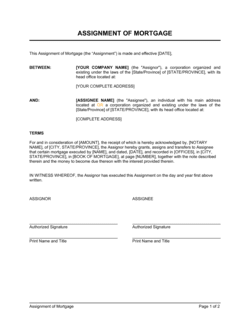
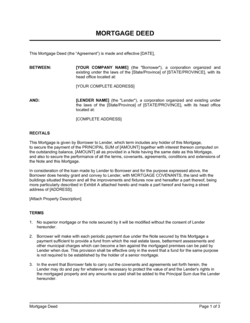
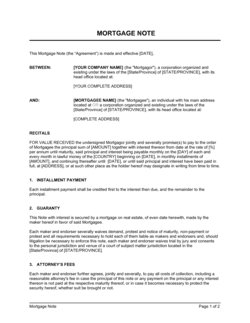
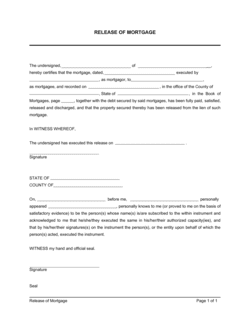
Mortgage Template

Free Word download • Edit online • Save & share with Drive • Export to PDF

4 pages25–35 min to fillDifficulty: ComplexSignature requiredLegal review recommended
Learn more ↓
FreeMortgage Template

At a glance

What it is
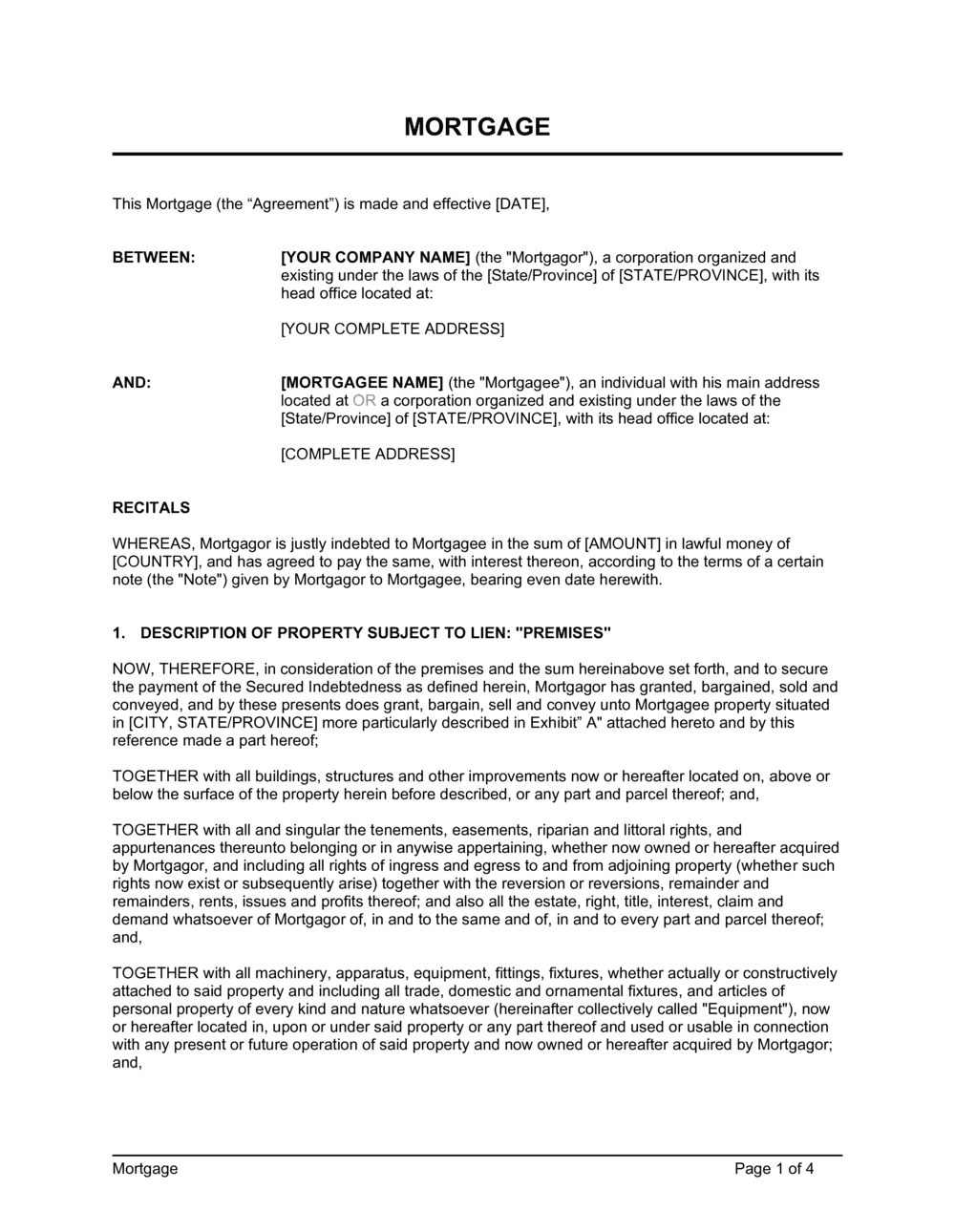
A Mortgage is a legally binding security agreement in which a borrower pledges real property as collateral to a lender in exchange for a loan. This free Word download gives you a professionally structured template covering the loan amount, interest rate, repayment schedule, property description, default conditions, and lender remedies — ready to edit online and export as PDF.
When you need it
Use it when a lender is financing the purchase, refinancing, or improvement of real property and requires a registered security interest in that property as collateral for the loan. It is required at closing for any real-estate-secured financing transaction.
What's inside
Borrower and lender identification, property legal description, loan amount and interest terms, amortization and payment schedule, escrow obligations, insurance and tax covenants, default triggers, acceleration clause, foreclosure and power-of-sale remedies, and governing law.

What is a Mortgage?

A Mortgage is a legally binding security instrument in which a Mortgagor (borrower) pledges real property as collateral to a Mortgagee (lender) in exchange for a loan. The borrower typically retains possession and title to the property, but grants the lender a registered interest that remains attached to the title until the debt is fully repaid. If the borrower defaults on the repayment obligations, the lender is entitled to enforce the security by exercising power of sale or commencing foreclosure proceedings to recover the outstanding balance from the property's sale proceeds. A mortgage is always paired with a promissory note — the note records the personal repayment promise, while the mortgage ties that obligation to the specific property.

Why You Need This Document

Advancing money secured by real estate without a properly drafted and registered mortgage instrument exposes the lender to catastrophic risk. An oral arrangement or unregistered agreement creates only personal liability against the borrower — if the borrower sells the property, refinances it with another lender, or becomes insolvent, the unpaid creditor has no claim against the land itself and joins the general unsecured creditor queue. A registered mortgage, by contrast, gives the lender priority over subsequently registered interests and the right to sell the property to recover the debt regardless of who holds title. For borrowers, a clear mortgage instrument prevents disputes over interest calculation, prepayment rights, and discharge obligations that routinely escalate into expensive litigation. This template provides the structural foundation for a compliant, registrable security instrument — reviewed by a lawyer for your jurisdiction, it protects both parties and gives the transaction the legal certainty that every real-estate-secured loan requires.

Which variant fits your situation?

If your situation is…Use this template
Financing a primary residence purchase through a bank or credit unionResidential Mortgage Agreement
Lending against an income-producing commercial propertyCommercial Mortgage Agreement
Short-term high-LTV lending secured by real propertyHard Money Mortgage Agreement
Seller carrying part of the purchase price as a second lienSecond Mortgage Agreement
Financing construction before a permanent takeout loanConstruction Loan Agreement
Recording a charge without a promissory note in the same instrumentDeed of Trust
Owner retaining title and making instalment payments before full transferLand Contract (Contract for Deed)

Common mistakes to avoid

❌ Using a street address instead of the legal property description

Why it matters: Title registries reject instruments that do not reference the exact legal description. An incorrectly described mortgage cannot be registered, leaving the lender with no security interest enforceable against third parties.

Fix: Pull the legal description directly from the current title search or certificate of title and copy it verbatim into the mortgage instrument.

❌ Failing to register the mortgage against title

Why it matters: An unregistered mortgage is typically ineffective against subsequent purchasers or creditors who register first. If the borrower sells or refinances before the mortgage is registered, the lender may lose priority or have no enforceable claim against the property.

Fix: Register the executed mortgage with the applicable land registry as soon as possible after signing — in most jurisdictions, same-day or next-day registration is achievable.

❌ Omitting a cure period before triggering acceleration

Why it matters: Courts in consumer-mortgage jurisdictions routinely refuse to enforce accelerations that gave the borrower no notice and no opportunity to remedy a technical breach, exposing the lender to litigation costs and delays.

Fix: Include a grace period of 10–15 days for missed payments and a 30-day written-notice cure period for covenant breaches before any acceleration right arises.

❌ Conflating the mortgage term with the amortization period

Why it matters: A 5-year term on a 25-year amortization creates a balloon payment at year five. Borrowers who misread this face unexpected payoff obligations they cannot meet, and lenders face credit risk they did not price.

Fix: State both the term and the amortization period explicitly and separately, and confirm the maturity date and expected balloon balance in the payment schedule.

❌ No due-on-sale clause in private or seller-financed mortgages

Why it matters: Without it, the borrower can transfer the property to a new owner without the lender's knowledge or consent, saddling the lender with a debtor they never underwrote and no contractual right to call the loan.

Fix: Include a due-on-sale clause requiring full repayment on any transfer of title or beneficial interest, subject only to exceptions the lender explicitly consents to in writing.

❌ Power-of-sale clause that does not match the local statutory notice period

Why it matters: Non-judicial sale procedures are strictly statutory. A notice period shorter than the statutory minimum — even by one day — renders the sale voidable, exposing the lender to damages and title defects on any onward sale.

Fix: Research the exact statutory notice period for the jurisdiction where the property is located and insert that specific number of days into the power-of-sale clause.

The 10 key clauses, explained

Parties and property identification

In plain language: Identifies the borrower (mortgagor) and lender (mortgagee) by full legal name and address, and describes the mortgaged property by its full legal description as recorded in the land registry.

Sample language
This Mortgage is granted by [BORROWER FULL LEGAL NAME] ('Mortgagor') of [ADDRESS] to [LENDER FULL LEGAL NAME] ('Mortgagee') of [ADDRESS], in respect of the property legally described as [LEGAL DESCRIPTION], [MUNICIPALITY], [STATE/PROVINCE] ('Property').

Common mistake: Using a street address instead of the full registered legal description. A street address is insufficient for registration — title offices require the lot, plan, and folio number exactly as they appear on the certificate of title.

Loan amount, interest rate, and term

In plain language: States the principal amount advanced, the annual interest rate, whether the rate is fixed or variable, the calculation basis, and the total term of the mortgage.

Sample language
Mortgagee has advanced to Mortgagor the principal sum of $[AMOUNT] ('Principal'), bearing interest at [X]% per annum, calculated [semi-annually / monthly] not in advance, for a term of [X] years commencing [DATE] and maturing [DATE].

Common mistake: Omitting the interest calculation basis. In Canada, residential mortgages must state semi-annual compounding not in advance; using monthly compounding without disclosing it overstates the effective rate and may render the interest provision unenforceable.

Payment schedule and amortization

In plain language: Specifies the payment amount, frequency, due date, and the amortization period over which the loan is fully repaid, along with any balloon payment due at maturity.

Sample language
Mortgagor shall pay to Mortgagee [AMOUNT] on the [DAY] of each [month / bi-week], beginning [DATE], comprising blended principal and interest, fully amortized over [X] years. Any outstanding balance shall be due and payable in full on the maturity date.

Common mistake: Confusing the mortgage term with the amortization period. A 5-year term on a 25-year amortization means the full balance is due in 5 years — not that the loan disappears. Borrowers who miss this often face an unexpected balloon payment.

Escrow for taxes and insurance

In plain language: Requires the borrower to deposit a pro-rated monthly amount into an escrow account managed by the lender to ensure property taxes and insurance premiums are paid on time.

Sample language
Mortgagor shall pay to Mortgagee, together with each scheduled payment, [1/12] of the estimated annual property taxes and hazard insurance premiums, to be held in escrow by Mortgagee and disbursed when due.

Common mistake: Omitting the escrow clause and relying on the borrower's self-certification of insurance and tax payments. A lapsed insurance policy or tax lien can subordinate or extinguish the lender's security interest without warning.

Borrower's covenants

In plain language: Sets out the borrower's ongoing obligations — maintaining the property, keeping it insured, paying taxes, not committing waste, and notifying the lender of any material change in the property's condition.

Sample language
Mortgagor covenants to: (a) keep the Property in good repair; (b) maintain hazard insurance of not less than $[AMOUNT] naming Mortgagee as loss payee; (c) pay all property taxes and assessments when due; and (d) not alter, demolish, or encumber the Property without Mortgagee's prior written consent.

Common mistake: Listing covenants without specifying the cure period. A borrower who receives no notice and no time to remedy a minor covenant breach — such as a lapsed insurance renewal — should not face immediate acceleration; vague drafting invites disputes.

Default and acceleration

In plain language: Defines what constitutes a default — including missed payments, breach of covenants, insolvency, and unauthorized transfer — and triggers the lender's right to accelerate the entire outstanding balance.

Sample language
An Event of Default includes: (a) failure to make any payment within [X] days of its due date; (b) breach of any covenant not remedied within [30] days of written notice; (c) insolvency or bankruptcy of Mortgagor; or (d) any unauthorized transfer of the Property. Upon an Event of Default, Mortgagee may, at its option, declare the entire Principal and accrued interest immediately due and payable.

Common mistake: Not specifying a grace or cure period before acceleration. Courts in several jurisdictions will decline to enforce an acceleration triggered without any notice or opportunity to cure, particularly for consumer mortgages.

Power of sale and foreclosure remedies

In plain language: Grants the lender the right, upon default, to sell the property by power of sale or to commence judicial foreclosure proceedings to recover the outstanding debt.

Sample language
Upon an uncured Event of Default, Mortgagee shall have the right, in addition to all other remedies at law or equity, to sell the Property by public or private sale pursuant to the [APPLICABLE STATUTE] with [X] days' prior written notice to Mortgagor, and to apply net proceeds first to costs and expenses of sale, then to accrued interest, then to Principal.

Common mistake: Relying on a generic power-of-sale clause without referencing the applicable statutory authority and notice period. Power-of-sale procedures are strictly governed by statute in every jurisdiction — a non-compliant notice period voids the sale.

Due-on-sale clause

In plain language: Requires the borrower to repay the full outstanding loan balance immediately if the property is sold, transferred, or title changes without the lender's prior written consent.

Sample language
If all or any part of the Property or any interest in it is sold or transferred without Mortgagee's prior written consent, Mortgagee may require immediate payment in full of all sums secured by this Mortgage.

Common mistake: Omitting the due-on-sale clause in private or seller-financed mortgages. Without it, a borrower can transfer the property to a new owner — including someone with poor credit — while leaving the original debt outstanding and the lender with no contractual basis to call the loan.

Discharge and release

In plain language: Obligates the lender to provide a formal discharge or release of the mortgage upon full repayment, and sets a timeline within which the discharge must be registered.

Sample language
Upon full payment of all Principal, interest, and other amounts secured by this Mortgage, Mortgagee shall, within [30] days of receipt of payment, execute and deliver to Mortgagor a discharge of this Mortgage in registrable form at Mortgagor's expense.

Common mistake: Omitting the discharge timeline entirely. Without a contractual deadline, borrowers have been left unable to refinance or sell because an ex-lender failed to register a discharge promptly — title remains encumbered until the instrument is formally removed.

Governing law and registration

In plain language: Specifies the jurisdiction whose laws govern the mortgage and confirms the borrower's obligation to register the instrument against title in the applicable land registry at the borrower's cost.

Sample language
This Mortgage shall be governed by and construed in accordance with the laws of [STATE / PROVINCE / COUNTRY]. Mortgagor shall promptly register this Mortgage against the title to the Property in the [LAND REGISTRY / RECORDER OF DEEDS] at Mortgagor's sole cost and expense.

Common mistake: Failing to register the mortgage against title. An unregistered mortgage is generally unenforceable against third parties — a subsequent buyer or creditor who registers first will take priority over an unregistered prior lender.

How to fill it out

  1. 1

    Identify the parties using full legal names

    Enter the borrower's and lender's complete legal names exactly as they appear on government-issued identification or corporate registration documents. For corporate parties, include the entity type and jurisdiction of incorporation.

    💡 For trusts or estates acting as mortgagor or mortgagee, name the trustee individually and in their trustee capacity — 'Jane Smith, as Trustee of the Smith Family Trust' — not the trust entity alone.

  2. 2

    Insert the full legal property description

    Copy the legal description from the current certificate of title or land registry record — lot number, plan reference, municipality, and folio. Do not substitute a street address or PIN number.

    💡 Order a title search before finalizing the description to confirm no existing undisclosed encumbrances or title defects.

  3. 3

    Set the loan amount, interest rate, and compounding basis

    Enter the exact principal advanced, the annual interest rate expressed to two decimal places, and whether interest is calculated monthly or semi-annually. For variable-rate mortgages, state the index, margin, and adjustment frequency.

    💡 In Canada, residential mortgage interest must be stated as semi-annual compounding not in advance to comply with the Interest Act — any other basis requires explicit written disclosure.

  4. 4

    Define the payment schedule and amortization period

    Specify the payment amount, frequency (monthly, bi-weekly, or weekly), the first payment date, and the amortization period. Clearly state any balloon or lump-sum payment due at the end of the term.

    💡 Include an optional prepayment privilege clause — for example, 10% of original principal per year without penalty — to give the borrower flexibility without compromising the lender's yield.

  5. 5

    Complete the covenant and escrow provisions

    Confirm the insurance minimums, specify the coverage types required (hazard, liability, flood if applicable), name the lender as additional insured or loss payee, and set the monthly escrow contribution formula.

    💡 Require the borrower to deliver evidence of insurance renewal at least 15 days before each policy expiry — this gives the lender time to force-place coverage if the borrower lapses.

  6. 6

    Tailor the default, cure period, and acceleration clause

    Set the payment grace period (typically 10–15 days) and the covenant cure period (typically 30 days with written notice). Confirm that the acceleration clause applies to all sums secured, including advances, costs, and default interest.

    💡 Add a default interest rate — typically 2–5% above the contract rate — to compensate the lender for the cost of enforcement and to incentivize prompt cure.

  7. 7

    Confirm the power-of-sale or foreclosure remedy and statutory references

    Reference the specific statute governing non-judicial sale in the applicable jurisdiction and insert the correct statutory notice period. For jurisdictions using deed-of-trust structures, confirm that the correct instrument type is used.

    💡 In states and provinces where judicial foreclosure is the only remedy, the power-of-sale clause has no effect — confirm the correct enforcement mechanism for the property's location before finalizing.

  8. 8

    Execute, notarize, and register

    Have the mortgagor sign before a notary public or commissioner of oaths as required by the jurisdiction. File the executed instrument with the applicable land registry, recorder of deeds, or land titles office and retain the registered copy with the original loan file.

    💡 Most jurisdictions require registration within a specific window after execution to preserve priority against subsequent encumbrances — confirm the local deadline before signing.

Frequently asked questions

What is a mortgage?

A mortgage is a security agreement in which a borrower pledges real property as collateral to a lender in exchange for a loan. The borrower retains possession and title but grants the lender a registered interest in the property that remains in place until the loan is repaid in full. If the borrower defaults, the lender can enforce the security by selling the property to recover the outstanding debt.

What is the difference between a mortgage and a promissory note?

A promissory note is the personal debt instrument — the borrower's written promise to repay a specific amount on specific terms. A mortgage is the security instrument that attaches that debt to a specific piece of real property. Both documents are typically signed at closing and must be read together. The note creates personal liability; the mortgage creates the lender's right to seize and sell the property.

What is the difference between a mortgage and a deed of trust?

In a deed-of-trust structure, the borrower transfers legal title to a neutral third-party trustee who holds it for the lender's benefit until the loan is repaid. In a mortgage, the borrower retains title and grants only a security interest. Deeds of trust are common in roughly 30 US states and allow non-judicial trustee sales on default; mortgages are used in the remaining states and typically require judicial foreclosure. The practical difference for most borrowers is the speed of the lender's enforcement remedy.

Does a mortgage need to be notarized?

In most jurisdictions, yes. A mortgage or deed of trust must be signed before a notary public or commissioner of oaths to be eligible for registration against the property title. Some states and provinces also require witnesses. Check the execution requirements of the jurisdiction where the property is located before signing — execution defects discovered after the fact can be expensive to cure.

What happens if a mortgage is not registered?

An unregistered mortgage is generally enforceable only between the original parties. It provides no protection against a subsequent buyer, lender, or creditor who acquires an interest in the property without actual knowledge of the prior unregistered mortgage. In most land registration systems, priority is determined by order of registration, not order of execution. Failing to register promptly is one of the most common and costly errors in private mortgage lending.

What is an acceleration clause in a mortgage?

An acceleration clause allows the lender to declare the entire outstanding principal and accrued interest immediately due and payable upon a specified event — most commonly a missed payment or material covenant breach. Without an acceleration clause, the lender can only sue for each missed installment as it falls due, which makes enforcement slow and expensive. Acceleration is typically a precondition to commencing power-of-sale or foreclosure proceedings.

What is the difference between a first mortgage and a second mortgage?

Priority between mortgages on the same property is generally determined by the order of registration. A first mortgage has priority over all subsequently registered interests and is paid out first from sale proceeds. A second mortgage sits behind the first and is paid only from what remains after the first mortgage is discharged. Second mortgages carry higher risk for the lender and typically command a higher interest rate to compensate.

Can a private individual act as a mortgagee?

Yes. Private individuals, family members, corporations, and institutional lenders can all serve as mortgagees. Seller-financed and intra-family mortgages are common — particularly where a buyer cannot qualify for conventional financing. The same formal requirements apply regardless of who the lender is: written instrument, proper execution, and registration against title. In some jurisdictions, private lenders who make mortgages regularly may require a lending licence.

Do I need a lawyer to prepare a mortgage?

For any mortgage that will be registered against title, legal involvement is strongly recommended and often required. Most land registries will only accept instruments prepared or certified by a licensed attorney or notary. Even in jurisdictions where self-preparation is technically permitted, errors in the legal description, execution, or covenant language can render the instrument unenforceable. A template is a starting point; a lawyer's review ensures the document meets local registration requirements and adequately protects the lender's interest.

How this compares to alternatives

vs Deed of Trust

A deed of trust transfers legal title to a neutral trustee who holds it for the lender's benefit, enabling non-judicial trustee sales on default in states that permit them. A mortgage retains title with the borrower and typically requires judicial foreclosure in states without a power-of-sale statute. Deeds of trust are used in roughly 30 US states; mortgages are used where judicial process is mandated.

vs Promissory Note

A promissory note records the borrower's personal promise to repay a debt and creates personal liability. A mortgage secures that promise against a specific piece of real property. Both documents are executed at closing and must be read together — the note is the debt; the mortgage is the security. A note without a mortgage creates unsecured debt; a mortgage without a note creates a security interest with no defined repayment obligation.

vs Construction Loan Agreement

A construction loan agreement governs a short-term facility that advances funds in draws as construction milestones are met. A standard mortgage is a term loan secured by an existing, completed property. Construction loans typically convert to a permanent term mortgage upon project completion; the two instruments are often executed simultaneously at closing.

vs Land Contract (Contract for Deed)

In a land contract, the seller retains legal title and transfers it only when the buyer completes all instalment payments. In a mortgage, the buyer takes title at closing and grants a security interest back to the lender. A land contract exposes the buyer to forfeiture of all payments upon default in states with strict forfeiture rules; a mortgage borrower retains equity and is entitled to surplus sale proceeds after the debt is satisfied.

Industry-specific considerations

Real estate investment

Bridge loans, fix-and-flip financing, and portfolio mortgages where speed of execution and flexible covenant structures are prioritized over institutional underwriting standards.

Construction and development

Construction mortgages advance funds in draw tranches tied to completion milestones, with interest calculated only on amounts drawn, and convert to a term mortgage upon project completion.

Commercial real estate

Commercial mortgages include DSCR covenants, assignment of rents clauses, environmental indemnities, and cash management provisions not typically found in residential instruments.

Professional services and law firms

Attorneys and notaries prepare, review, and register mortgage instruments at closing, advise on title insurance requirements, and manage lender compliance with jurisdiction-specific consumer-protection statutes.

Jurisdictional notes

United States

Mortgage law is state-specific. Approximately 30 states are deed-of-trust states allowing non-judicial trustee sales; the remaining states use mortgage instruments requiring judicial foreclosure. Foreclosure timelines range from 90 days in some states to over 3 years in New York and New Jersey. The federal Truth in Lending Act (TILA) and RESPA impose disclosure requirements on lenders; consumer mortgages must include an APR disclosure and loan estimate.

Canada

Mortgage law is provincially regulated. Ontario and most common-law provinces use charge instruments under the Land Titles Act rather than traditional mortgage deeds. Alberta uses Land Titles Act charges with a power-of-sale remedy available after 3 months in default. Quebec uses the hypothec under the Civil Code. The federal Interest Act requires that interest on residential mortgages be calculated semi-annually not in advance and that any prepayment penalty be stated in equivalent annual rate terms.

United Kingdom

In England and Wales, mortgages over registered land are created by a legal charge registered at HM Land Registry using Form CH1; unregistered land mortgages use a deed of mortgage. Lenders must be authorised by the FCA to provide regulated mortgage contracts. The Financial Services and Markets Act 2000 and Mortgage Credit Directive impose conduct-of-business rules on residential lending. Scotland uses a standard security instrument governed by the Conveyancing and Feudal Reform (Scotland) Act 1970.

European Union

The EU Mortgage Credit Directive (2014/17/EU) harmonises consumer-mortgage standards across member states, requiring a standardised European Standardised Information Sheet (ESIS), a 7-day reflection period before binding commitment, and annual percentage rate disclosure. Individual member states retain significant variation in enforcement mechanisms — France uses the hypothèque, Germany the Grundschuld, and Spain the hipoteca — with notarial authentication required in most civil-law jurisdictions.

Template vs lawyer — what fits your deal?

PathBest forCostTime
Use the templateIntra-family or private party loans where both parties understand the terms and will engage independent counsel for registrationFree1–2 hours to complete the instrument
Template + legal reviewPrivate lenders, small commercial transactions, and seller-financed deals where the template needs to be adapted to local registration requirements$500–$1,5002–5 business days
Custom draftedInstitutional lenders, commercial properties, multi-jurisdiction transactions, complex covenant structures, or any mortgage exceeding $500,000$1,500–$5,000+1–3 weeks

Glossary

Mortgagor
The borrower who pledges real property as collateral and grants the security interest to the lender.
Mortgagee
The lender who holds the security interest in the property until the loan is repaid in full.
Promissory Note
The companion debt instrument that records the borrower's promise to repay the loan — the mortgage secures it against the property.
Amortization
The scheduled repayment of a loan through equal periodic payments that cover both principal and interest over a fixed term.
Loan-to-Value Ratio (LTV)
The loan amount expressed as a percentage of the property's appraised value — lenders use it to assess collateral risk.
Acceleration Clause
A provision allowing the lender to demand the entire outstanding loan balance immediately upon the borrower's default.
Escrow
An account managed by a third party — often the lender — into which the borrower makes monthly deposits to cover property taxes and insurance premiums.
Power of Sale
A clause granting the lender the right to sell the mortgaged property through a non-judicial process upon default, without a court order.
Foreclosure
The legal process by which a lender enforces its security interest, terminates the borrower's ownership rights, and recovers the outstanding debt from the property's sale proceeds.
Subordination
An agreement ranking one mortgage lien below another in priority — the first mortgage is paid out before any second or junior mortgage upon sale or foreclosure.
Due-on-Sale Clause
A provision requiring the borrower to repay the outstanding loan balance in full if the property is sold or transferred to a new owner.
Title Insurance
A policy protecting the lender or owner against losses arising from defects in the property title that were not discovered before closing.

Part of your Business Operating System

This document is one of 3,000+ business & legal templates included in Business in a Box.

  • Fill-in-the-blanks — ready in minutes
  • 100% customizable Word document
  • Compatible with all office suites
  • Export to PDF and share electronically

Create your document in 3 simple steps.

From template to signed document — all inside one Business Operating System.
1
Download or open template

Access over 3,000+ business and legal templates for any business task, project or initiative.

2
Edit and fill in the blanks with AI

Customize your ready-made business document template and save it in the cloud.

3
Save, Share, Send, Sign

Share your files and folders with your team. Create a space of seamless collaboration.

Save time, save money, and create top-quality documents.

★★★★★

"Fantastic value! I'm not sure how I'd do without it. It's worth its weight in gold and paid back for itself many times."

Managing Director · Mall Farm
Robert Whalley
Managing Director, Mall Farm Proprietary Limited
★★★★★

"I have been using Business in a Box for years. It has been the most useful source of templates I have encountered. I recommend it to anyone."

Business Owner · 4+ years
Dr Michael John Freestone
Business Owner
★★★★★

"It has been a life saver so many times I have lost count. Business in a Box has saved me so much time and as you know, time is money."

Owner · Upstate Web
David G. Moore Jr.
Owner, Upstate Web

Run your business with a system — not scattered tools

Stop downloading documents. Start operating with clarity. Business in a Box gives you the Business Operating System used by over 250,000 companies worldwide to structure, run, and grow their business.

Free Forever Plan · No credit card required